Science Background: 
· A physical change is one in which the size, shape, or state of 
matter changes, but the kind of matter remains the same. 
For example, you make a physical change when you cut a 
sheet of paper into smaller pieces. Freezing and melting are 
also physical changes. 
· A mixture is two or more kinds of matter placed together, 
such as different fruits placed in a bowl to make a fruit salad. 
In a mixture, each kind of matter can be easily separated 
from the others.
Quick Quiz #1: 
1. Name some kinds of physical changes you can make to 
matter. 
2. What is a mixture? 
Higher Order Thinking - Suppose you were given a cup 
containing sugar that had been dissolved in hot water. Is the 
sugar water a mixture? How would you try to separate the 
sugar from the water?
Science Background: 
· Matter exists in three forms, solid, liquid, and gas, which are 
called the states of matter. 
· Solids have a definite shape and volume. Liquids have a 
definite volume, but not a definite shape. Gases have 
neither a definite shape nor a definite volume. Gases take 
the shape of a closed container. 
· A change of state is a physical change, and it occurs when a 
substance is heated or cooled beyond a certain point. 
· When a liquid evaporates, it changes to a gas. Water in its 
gas state is called water vapor. When water vapor in the air 
cools, it condenses, changing from a gas to a liquid. 
· Water vapor is not the same as steam. Steam is always hot, 
and sometimes contains water droplets. Steams forms from 
boiling water. The whitish clouds that are sometimes visible 
from the spout of a kettle are not water vapor, but water 
droplets condensing in air.
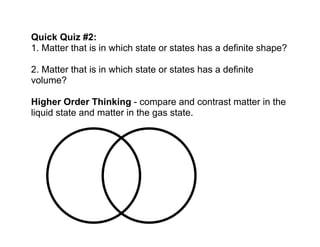
Quick Quiz #2: 
1. Matter that is in which state or states has a definite shape? 
2. Matter that is in which state or states has a definite 
volume? 
Higher Order Thinking - compare and contrast matter in the 
liquid state and matter in the gas state.
Chapter 1   lesson 2

Chapter 1 lesson 2

  • 1.
    Science Background: ·A physical change is one in which the size, shape, or state of matter changes, but the kind of matter remains the same. For example, you make a physical change when you cut a sheet of paper into smaller pieces. Freezing and melting are also physical changes. · A mixture is two or more kinds of matter placed together, such as different fruits placed in a bowl to make a fruit salad. In a mixture, each kind of matter can be easily separated from the others.
  • 2.
    Quick Quiz #1: 1. Name some kinds of physical changes you can make to matter. 2. What is a mixture? Higher Order Thinking - Suppose you were given a cup containing sugar that had been dissolved in hot water. Is the sugar water a mixture? How would you try to separate the sugar from the water?
  • 3.
    Science Background: ·Matter exists in three forms, solid, liquid, and gas, which are called the states of matter. · Solids have a definite shape and volume. Liquids have a definite volume, but not a definite shape. Gases have neither a definite shape nor a definite volume. Gases take the shape of a closed container. · A change of state is a physical change, and it occurs when a substance is heated or cooled beyond a certain point. · When a liquid evaporates, it changes to a gas. Water in its gas state is called water vapor. When water vapor in the air cools, it condenses, changing from a gas to a liquid. · Water vapor is not the same as steam. Steam is always hot, and sometimes contains water droplets. Steams forms from boiling water. The whitish clouds that are sometimes visible from the spout of a kettle are not water vapor, but water droplets condensing in air.
  • 4.
    Quick Quiz #2: 1. Matter that is in which state or states has a definite shape? 2. Matter that is in which state or states has a definite volume? Higher Order Thinking - compare and contrast matter in the liquid state and matter in the gas state.