Course Title: Introduction to AI.
Credit Hour: 3 hrs.
ECTS: 5 [2 Lecture hours and 3 Lab hours]
Lecture Schedule: Every _____________
1
Introduction to AI - CoSc3112
Bedasa Wayessa
Classroom Rules
• Late comer will be tolerated for the first 5 minutes.
• If you arrive late to class, let yourself in quietly and find a seat.
• Talk to me and Not to each other
• Listen with your ears and your eyes
• Do not sleep
• Cell Phone Please turn off or place it on silent.
• Please wear acceptable clothing to class.
Introduction to AI - CoSc3112 2
It is my desire to see students grow in
their writing, responsibility, and maturity.
Assignment Submission
• Guidelines for submission will be provided with every assignment.
• Submit assignments by the assignment due date.
• Students should be prepared to hand in assignments when they
come to class.
• Important:
– Late submissions are allowed for 1 day with 10% marks deduction.
– Incomplete and without/duplicate names are allowed with 10% point
deduction
– Late + Copy = ZERO Marking
3
Introduction to AI - CoSc3112
QUIZZES
• Quizzes will NOT be announced
• Re-grade requests will only be entertained within one week
after the marked quizzes have been handed back to students
[with tangible and acceptable reason only]
4
Introduction to AI - CoSc3112
Programming Language
• Lab contents:With python or prolog
• In our case Laboratory session will be by prolog language
• Prolog: https://www.swi-prolog.org/
– Any prolog references will be useful
• Python: https://www.python.org/
– Any logic programming in python package(pylogic)
5
Introduction to AI - CoSc3112
Introduction to Artificial
Intelligence
6
Introduction to AI - CoSc3112
Outline
 Introduction to AI
 Objectives/Goals of AI
 Types of AI(General and Specific AI)
 Approaches to AI – making computer:
– Think like a human (The cognitive modeling approach)
– Act like a human (TheTuring test approach)
– Think rationally (The “laws of thought” approach)
– Act rationally (The rational agent approach)
 The Foundations of AI
 Bits of History and the State of the Art
 Proposing and evaluating Application of AI
7
Introduction to AI - CoSc3112
INTRODUCTION:WHAT IS AI?
 As human, we try to understand how we think, our intelligence.
 In field of Artificial intelligence, we are now trying to build
intelligence.
 What is AI?
 The term Artificial Intelligence comprises of two words ‘Artificial’ and
‘Intelligence’, where,Artificial means ‘copy of something natural’
and ‘Intelligence’ means ‘able to think.'
 There are many ways to define the field of Artificial Intelligence.
 Here is one:
8
Introduction to AI - CoSc3112
DEFINING Artificial Intelligence
 Artificial intelligence is the enterprise of constructing an intelligent
artifact. – Matt Ginsberg - Essential of artificial intelligence.
 Artificial intelligence is ... The study of the computations that make it
possible to perceive, reason, and act. - Winston - Artificial Intelligence.
 Artificial intelligence is concerned with not just understanding but also
building intelligent—machines that can think and act humanly
and also rational. Peter Norvig & Stuart J. Russell
 So what is intelligence?
9
Introduction to AI - CoSc3112
Intelligence
 Some have defined intelligence in terms of
– fidelity to human performance, while
– others prefer an abstract, formal definition of intelligence called
rationality—loosely speaking, doing the “right thing.”
 Intelligence has been defined in many ways:
 the capacity for abstraction, logic, understanding, self-awareness,
learning, emotional knowledge, reasoning, planning, creativity,
critical thinking, and problem-solving. Wikipedia
10
Introduction to AI - CoSc3112
Intelligence
 Intelligence is the capability of observing, learning, remembering and
reasoning.
 AI attempts to develop intelligent agents.
 Characteristics of Intelligent system
– Use vast amount of knowledge
– Learn from experience and adopt to changing environment
– Interact with human using language and speech
– Respond in real time
– Tolerate error and ambiguity in communication
11
Introduction to AI - CoSc3112
Introduction to AI
 So, AI is all about creating Intelligent agent as human intelligence.
 If you ask about artificial intelligence to an AI researcher:
– He/she would say that it’s a set of algorithms that can produce results
without having to be explicitly instructed to do so. And they would all be
right.
 What artificial intelligence can do?
– Intelligent Systems Can Help Experts to Solve Difficult Analysis
Problems.
– Intelligent Systems Can Help Experts to Design New Devices.
– Intelligent Systems Can Learn from Examples.
– Intelligent Systems Can Provide Answers to ….
12
Introduction to AI - CoSc3112
Introduction to AI
 Different people approach AI with different goals in mind.
 Two important questions to ask are:
– Are you concerned with thinking, or behavior?
– Do you want to model humans, or try to achieve the optimal results?
– Definition AI is the branch of Computer Science that deals:
– An intelligent entity created by humans.
– Capable of performing tasks intelligently without being explicitly
instructed.
– Capable of thinking and acting rationally and humanely.
13
Introduction to AI - CoSc3112
Objectives/Goals of AI
 Following are the main goals of Artificial Intelligence:
1. Replicate human intelligence
2. Solve Knowledge-intensive tasks
3. An intelligent connection of perception and action
4. Building a machine which can perform tasks that requires human
intelligence such as:
– Proving a theorem
– Playing chess
– Plan some surgical operation
– Driving a car in traffic
5. Creating some system which can exhibit intelligent behavior, learn new
things by itself, demonstrate, explain, and can advise to its user.
14
Introduction to AI - CoSc3112
Types of AI(General and Specific AI)
 Different Artificial Intelligence entities are built for different purposes, and
that’s how they vary.
 AI can be classified to Type 1 and Type 2.
 Artificial Intelligence type-1: Based on Capabilities
– Artificial Narrow Intelligence (ANI)
– Artificial General Intelligence (AGI)
– Artificial Super Intelligence (ASI)
 Artificial Intelligence type-2: Based on functionality
– Reactive Machines
– Limited Memory
– Theory of Mind
– Self-Awareness
15
Introduction to AI - CoSc3112
Types of AI(General and Specific AI)
 AI type-1: Based on Capabilities
1. Artificial Weak or Narrow Intelligence (ANI).
– Narrow AI is a type of AI which is able to perform a dedicated task with
intelligence.
– The most common and currently available AI is Narrow AI in the world
of Artificial Intelligence.
– Narrow AI cannot perform beyond its field or limitations, as it is only
trained for one specific task. Hence it is also termed as weak AI.
– Narrow AI can fail in unpredictable ways if it goes beyond its limits.
– Apple Siri is a good example of Narrow AI, but it operates with a
limited predefined range of functions.
16
Introduction to AI - CoSc3112
Types of AI(General and Specific AI)
 AI type-1: Based on Capabilities
1. Artificial Weak or Narrow Intelligence (ANI).
– Narrow AI is a type of AI which is able to perform a dedicated task with
intelligence.
– The most common and currently available AI is Narrow AI in the world
of Artificial Intelligence.
– Narrow AI cannot perform beyond its field or limitations, as it is only
trained for one specific task.
– Hence it is also termed as weak AI.
– Narrow AI can fail in unpredictable ways if it goes beyond its limits.
– Apple Siri is a good example of Narrow AI, but it operates with a
limited predefined range of functions.
17
Introduction to AI - CoSc3112
Types of AI(General and Specific AI)
 AI type-1: Based on Capabilities
2. Artificial General Intelligence (AGI)
– AGI is still a theoretical concept.
– It’s defined as AI which has a human-level of cognitive function, across
a wide variety of domains such as language processing, image
processing, computational functioning and reasoning and so on.
– We’re still a long way away from building an AGI system.
– The idea behind the general AI to make such a system that could be
smarter and think like a human on its own.
– It may arrive within the next 20 or so years but it has challenges
relating to hardware, the energy consumption required in today’s
powerful machines, and the need to solve for catastrophic memory
loss that affects even the most advanced deep learning algorithms of
today
– As systems with general AI are still under research, and it will take
lots of effort and time to develop such systems.
18
Introduction to AI - CoSc3112
Types of AI(General and Specific AI)
 AI type-1: Based on Capabilities
3. Artificial Super Intelligence (ASI)
– We’re almost entering into science-fiction territory here, but ASI
is seen as the logical progression from AGI.
– An Artificial Super Intelligence (ASI) system would be able to
surpass all human capabilities.
– This would include decision making, taking rational decisions, and
even includes things like making better art and building emotional
relationships.
– This refers to aspects like general wisdom, problem solving and
creativity.
– It is an outcome of general AI.
– Super AI is still a hypothetical concept of Artificial Intelligence.The
development of such systems in real is still a world-changing task.
19
Introduction to AI - CoSc3112
Types of AI(General and Specific AI)
 AI type-1: Based on Capabilities
20
Introduction to AI - CoSc3112
Types of AI(General and Specific AI)
 AI type-II: Based on functionality
1. Reactive Machines
– Purely reactive machines are the most basic types of Artificial
Intelligence.
– Such AI systems do not store memories or past experiences for
future actions.
– These machines only focus on current scenarios and react on it as
per possible best action.
– IBM's Deep Blue system is an example of reactive machines.
– Google's AlphaGo is also an example of reactive machines.
21
Introduction to AI - CoSc3112
Types of AI(General and Specific AI)
 AI type-II: Based on functionality
2. Limited Memory
– Limited memory machines can store past experiences or some
data for a short period of time.
– These machines can use stored data for a limited time period
only.
– Self-driving cars are one of the best examples of Limited
Memory systems.
– These cars can store the recent speed of nearby cars, the
distance of other cars, speed limits, and other information to
navigate the road.
22
Introduction to AI - CoSc3112
Types of AI(General and Specific AI)
 AI type-II: Based on functionality
3. Theory of Mind
– Theory of Mind AI should understand the human emotions,
people, beliefs, and be able to interact socially like humans.
– This type of AI machines are still not developed, but researchers
are making lots of efforts and improvement for developing such AI
machines.
23
Introduction to AI - CoSc3112
Types of AI(General and Specific AI)
 AI type-II: Based on functionality
4. Self-Awareness
– Self-awareness AI is the future of Artificial Intelligence.
– These machines will be super intelligent, and will have their
own consciousness, sentiments, and self-awareness.
– These machines will be smarter than human mind.
– Self-Awareness AI does not exist in reality still and it is a
hypothetical concept.
24
Introduction to AI - CoSc3112
Approaches to AI – making computer:
 AI is found on the premise that:
– workings of human mind can be explained in terms of
computation, and
– computers can do the right thing given correct premises and
reasoning rules.
 Views of AI fall into four categories:
25
Introduction to AI - CoSc3112
Thinking humanly Thinking rationally
Acting humanly Acting rationally
Thinking humanly - The cognitive modeling approach
 Reasons like humans do
– Programs that behave like humans
 Requires understanding of the internal activities of the brain see how
humans behave in certain situations and see if you could make
computers behave in that same way.
 Example.
 Write a program that plays chess.
 Instead of making the best possible chess-playing program, you
would make one that play chess like people do.
26
Introduction to AI - CoSc3112
Thinking humanly - The cognitive modeling approach
 To say that a program thinks like a human, we must know how
humans think.
 As the name suggests, this approach tries to build an Artificial
Intelligence model based on Human Cognition.
 We can learn about human thought in three ways:
– introspection—trying to catch our own thoughts as they go by;
– psychological experiments—observing a person in action;
– brain imaging—observing the brain in action.
– If the program’s input–output behavior matches
corresponding human behavior, that is evidence that some of
the program’s mechanisms could also be operating in humans.
27
Introduction to AI - CoSc3112
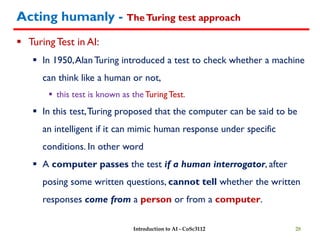
Acting humanly - TheTuring test approach
 TuringTest in AI:
 In 1950,Alan Turing introduced a test to check whether a machine
can think like a human or not,
 this test is known as the TuringTest.
 In this test,Turing proposed that the computer can be said to be
an intelligent if it can mimic human response under specific
conditions. In other word
 A computer passes the test if a human interrogator, after
posing some written questions, cannot tell whether the written
responses come from a person or from a computer.
28
Introduction to AI - CoSc3112
Acting humanly - TheTuring test approach
 TuringTest in AI:
29
Introduction to AI - CoSc3112
Acting humanly - TheTuring test approach
 Turing Test in AI:
 Consider,
 Player A is a computer,
 Player B is human, and
 Player C is an interrogator.
 Interrogator is aware that one of them is machine, but he needs
to identify this on the basis of questions and their responses.
 The conversation between all players is via keyboard and screen.
 The test result does not depend on each correct answer, but only
how closely its responses like a human answer.
30
Introduction to AI - CoSc3112
Acting humanly - TheTuring test approach
 Turing Test in AI:
 The questions and answers can be like:
 Interrogator: Are you a computer?
 Player A (Computer): No
 Interrogator: Multiply two such as (256896489*456725896)
 Player A: Long pause and give the wrong answer.
31
Introduction to AI - CoSc3112
 In this game, if an interrogator would not be able to identify
– which is a machine and
– which is human, then the computer passes the test
successfully, and the machine is said to be intelligent and can
think like a human.
Acting humanly - TheTuring test approach
 Features required for a machine to pass theTuring test:
– NLP- to communicate successfully in a human language;
– Knowledge representation - to store what it knows or hears;
– Automated reasoning - to answer questions and to draw new
conclusions;
– Machine learning - to adapt to new circumstances and to detect and
extrapolate patterns.
32
Introduction to AI - CoSc3112
 Turing viewed the physical simulation of a person as unnecessary to
demonstrate intelligence.
 However, other researchers have proposed a totalTuring test, which
requires interaction with objects and people in the real world.
 To pass the totalTuring test, a robot will need computer vision and
speech recognition to perceive the world;
Think rationally - The “laws of thought” approach
 The Laws of Thought are a large list of logical statements that
govern the operation of our mind.
 The same laws can be codified and applied to artificial intelligence
algorithms.
 The issues with this approach, because solving a problem in principle
and solving them in practice can be quite different, requiring
contextual nuances to apply.
 A system is rational if it thinks/does the right thing through correct
reasoning.
33
Introduction to AI - CoSc3112
Think rationally - The “laws of thought” approach
 The Greek philosopher - Aristotle was one of the first to attempt to
codify “right thinking”— that is, irrefutable reasoning processes.
 His syllogisms - Provided the correct arguments/thought structures
that always gave correct conclusions given correct premises.
 Abebe is a man; All men are mortal:- Therefore Abebe is mortal
 These Laws of thought governed the operation of the mind and
initiated the field called Logic.
 Logic as conventionally understood requires knowledge of the world
that is certain— a condition that that, in reality, is seldom achieved.
34
Introduction to AI - CoSc3112
Act rationally - The rational agent approach
 An agent is just something that acts (agent comes from the Latin
agree, to do).
 Of course, all computer programs do something, but computer agents
are expected to do more:
 operate autonomously, perceive their environment, persist over a
prolonged time period, adapt to change, and create and pursue
goals.
 A rational agent is one that acts so as to achieve the best outcome
or, when there is uncertainty, the best expected outcome.
35
Introduction to AI - CoSc3112
Act rationally - The rational agent approach
 In the “laws of thought” approach to AI, the emphasis was on
correct inferences.
 Making correct inferences is sometimes part of being a rational agent.
 A rational agent acts to achieve the best possible outcome in its
present circumstances.
 It means that it’s a much more dynamic and adaptable agent.
 Doing the right thing so as to achieve one’s goal, given one’s beliefs.
 Rational action requires the ability to represent knowledge and
reason with it so as to reach good decision.
36
Introduction to AI - CoSc3112
Act rationally - The rational agent approach
 In the early decades, rational agents were built on logical
foundations and formed definite plans to achieve specific goals.
 Later, methods based on probability theory and machine learning
allowed the creation of agents that could make decisions under
uncertainty to attain the best expected outcome.
 In a nutshell, AI has focused on the study and construction of agents that
do the right thing.
 The right thing is defined by the objective that we provide to the agent.
 This general paradigm is called the standard model.
 Is there the perfect rationality?
37
Introduction to AI - CoSc3112
Summary
 A rational agent acts to achieve the best possible outcome in its
present circumstances.
 It means that it’s a much more dynamic and adaptable agent.
 Doing the right thing so as to achieve one’s goal, given one’s beliefs.
 Rational action requires the ability to represent knowledge and
reason with it so as to reach good decision.
 Now that we understand how Artificial Intelligence can be designed
to act like a human, let’s take a look at how these systems are built.
38
Introduction to AI - CoSc3112
Thinking Humanly Thinking Rationally
“The exciting new effort to make computers
think . . . machines with minds, in the
full and literal sense.” (Haugeland, 1985)
“[The automation of] activities that we
associate with human thinking, activities
such as decision-making, problem solving,
learning . . .” (Bellman, 1978)
“The study of mental faculties through the
use of computational models.”
(Charniak and McDermott, 1985)
“The study of the computations that make
it possible to perceive, reason, and act.”
(Winston, 1992)
Acting Humanly Acting Rationally
“The art of creating machines that perform
functions that require intelligence
when performed by people.” (Kurzweil,
1990)
“The study of how to make computers do
things at which, at the moment, people are
better.” (Rich and Knight, 1991)
“Computational Intelligence is the study
of the design of intelligent agents.” (Poole
et al., 1998)
“AI . . . is concerned with intelligent behavior
in artifacts.” (Nilsson, 1998)
The Foundations of AI
 It is a brief history of the disciplines that contributed ideas, viewpoints, and
techniques to AI.
 Intelligence is an intangible part of our brain which is a combination of :
1. Philosophy
2. Mathematics
3. Economics
4. Neuroscience
5. Psychology
6. Computer engineering
7. Control theory and cybernetics
8. Linguistics
39
Introduction to AI - CoSc3112
The Foundations of AI
1. Philosophy : Aristotle (384–322 BCE) was the first to formulate a precise
set of laws governing the rational part of the mind.
 Can formal rules be used to draw valid conclusions?
 How does the mind arise from a physical brain?
 Where does knowledge come from?
 How does knowledge lead to action?
2. Mathematics
 What are the formal rules to draw valid conclusions?
 What can be computed?
 How do we reason with uncertain information?
40
Introduction to AI - CoSc3112
Reading Assignment 1
 Foundation of AI regarding to different disciplines …
 Bits of History and the State of the Art
 Proposing and evaluating Application of AI
 References - athan Russell_ Peter Norvig_ Ernest Davis - Artificial
Intelligence_ A Modern Approach-Prentice Hall (4ed)
 Page 17-32
41
Introduction to AI - CoSc3112

Chapter 1 Introduction to AI.pdf

  • 1.
    Course Title: Introductionto AI. Credit Hour: 3 hrs. ECTS: 5 [2 Lecture hours and 3 Lab hours] Lecture Schedule: Every _____________ 1 Introduction to AI - CoSc3112 Bedasa Wayessa
  • 2.
    Classroom Rules • Latecomer will be tolerated for the first 5 minutes. • If you arrive late to class, let yourself in quietly and find a seat. • Talk to me and Not to each other • Listen with your ears and your eyes • Do not sleep • Cell Phone Please turn off or place it on silent. • Please wear acceptable clothing to class. Introduction to AI - CoSc3112 2 It is my desire to see students grow in their writing, responsibility, and maturity.
  • 3.
    Assignment Submission • Guidelinesfor submission will be provided with every assignment. • Submit assignments by the assignment due date. • Students should be prepared to hand in assignments when they come to class. • Important: – Late submissions are allowed for 1 day with 10% marks deduction. – Incomplete and without/duplicate names are allowed with 10% point deduction – Late + Copy = ZERO Marking 3 Introduction to AI - CoSc3112
  • 4.
    QUIZZES • Quizzes willNOT be announced • Re-grade requests will only be entertained within one week after the marked quizzes have been handed back to students [with tangible and acceptable reason only] 4 Introduction to AI - CoSc3112
  • 5.
    Programming Language • Labcontents:With python or prolog • In our case Laboratory session will be by prolog language • Prolog: https://www.swi-prolog.org/ – Any prolog references will be useful • Python: https://www.python.org/ – Any logic programming in python package(pylogic) 5 Introduction to AI - CoSc3112
  • 6.
  • 7.
    Outline  Introduction toAI  Objectives/Goals of AI  Types of AI(General and Specific AI)  Approaches to AI – making computer: – Think like a human (The cognitive modeling approach) – Act like a human (TheTuring test approach) – Think rationally (The “laws of thought” approach) – Act rationally (The rational agent approach)  The Foundations of AI  Bits of History and the State of the Art  Proposing and evaluating Application of AI 7 Introduction to AI - CoSc3112
  • 8.
    INTRODUCTION:WHAT IS AI? As human, we try to understand how we think, our intelligence.  In field of Artificial intelligence, we are now trying to build intelligence.  What is AI?  The term Artificial Intelligence comprises of two words ‘Artificial’ and ‘Intelligence’, where,Artificial means ‘copy of something natural’ and ‘Intelligence’ means ‘able to think.'  There are many ways to define the field of Artificial Intelligence.  Here is one: 8 Introduction to AI - CoSc3112
  • 9.
    DEFINING Artificial Intelligence Artificial intelligence is the enterprise of constructing an intelligent artifact. – Matt Ginsberg - Essential of artificial intelligence.  Artificial intelligence is ... The study of the computations that make it possible to perceive, reason, and act. - Winston - Artificial Intelligence.  Artificial intelligence is concerned with not just understanding but also building intelligent—machines that can think and act humanly and also rational. Peter Norvig & Stuart J. Russell  So what is intelligence? 9 Introduction to AI - CoSc3112
  • 10.
    Intelligence  Some havedefined intelligence in terms of – fidelity to human performance, while – others prefer an abstract, formal definition of intelligence called rationality—loosely speaking, doing the “right thing.”  Intelligence has been defined in many ways:  the capacity for abstraction, logic, understanding, self-awareness, learning, emotional knowledge, reasoning, planning, creativity, critical thinking, and problem-solving. Wikipedia 10 Introduction to AI - CoSc3112
  • 11.
    Intelligence  Intelligence isthe capability of observing, learning, remembering and reasoning.  AI attempts to develop intelligent agents.  Characteristics of Intelligent system – Use vast amount of knowledge – Learn from experience and adopt to changing environment – Interact with human using language and speech – Respond in real time – Tolerate error and ambiguity in communication 11 Introduction to AI - CoSc3112
  • 12.
    Introduction to AI So, AI is all about creating Intelligent agent as human intelligence.  If you ask about artificial intelligence to an AI researcher: – He/she would say that it’s a set of algorithms that can produce results without having to be explicitly instructed to do so. And they would all be right.  What artificial intelligence can do? – Intelligent Systems Can Help Experts to Solve Difficult Analysis Problems. – Intelligent Systems Can Help Experts to Design New Devices. – Intelligent Systems Can Learn from Examples. – Intelligent Systems Can Provide Answers to …. 12 Introduction to AI - CoSc3112
  • 13.
    Introduction to AI Different people approach AI with different goals in mind.  Two important questions to ask are: – Are you concerned with thinking, or behavior? – Do you want to model humans, or try to achieve the optimal results? – Definition AI is the branch of Computer Science that deals: – An intelligent entity created by humans. – Capable of performing tasks intelligently without being explicitly instructed. – Capable of thinking and acting rationally and humanely. 13 Introduction to AI - CoSc3112
  • 14.
    Objectives/Goals of AI Following are the main goals of Artificial Intelligence: 1. Replicate human intelligence 2. Solve Knowledge-intensive tasks 3. An intelligent connection of perception and action 4. Building a machine which can perform tasks that requires human intelligence such as: – Proving a theorem – Playing chess – Plan some surgical operation – Driving a car in traffic 5. Creating some system which can exhibit intelligent behavior, learn new things by itself, demonstrate, explain, and can advise to its user. 14 Introduction to AI - CoSc3112
  • 15.
    Types of AI(Generaland Specific AI)  Different Artificial Intelligence entities are built for different purposes, and that’s how they vary.  AI can be classified to Type 1 and Type 2.  Artificial Intelligence type-1: Based on Capabilities – Artificial Narrow Intelligence (ANI) – Artificial General Intelligence (AGI) – Artificial Super Intelligence (ASI)  Artificial Intelligence type-2: Based on functionality – Reactive Machines – Limited Memory – Theory of Mind – Self-Awareness 15 Introduction to AI - CoSc3112
  • 16.
    Types of AI(Generaland Specific AI)  AI type-1: Based on Capabilities 1. Artificial Weak or Narrow Intelligence (ANI). – Narrow AI is a type of AI which is able to perform a dedicated task with intelligence. – The most common and currently available AI is Narrow AI in the world of Artificial Intelligence. – Narrow AI cannot perform beyond its field or limitations, as it is only trained for one specific task. Hence it is also termed as weak AI. – Narrow AI can fail in unpredictable ways if it goes beyond its limits. – Apple Siri is a good example of Narrow AI, but it operates with a limited predefined range of functions. 16 Introduction to AI - CoSc3112
  • 17.
    Types of AI(Generaland Specific AI)  AI type-1: Based on Capabilities 1. Artificial Weak or Narrow Intelligence (ANI). – Narrow AI is a type of AI which is able to perform a dedicated task with intelligence. – The most common and currently available AI is Narrow AI in the world of Artificial Intelligence. – Narrow AI cannot perform beyond its field or limitations, as it is only trained for one specific task. – Hence it is also termed as weak AI. – Narrow AI can fail in unpredictable ways if it goes beyond its limits. – Apple Siri is a good example of Narrow AI, but it operates with a limited predefined range of functions. 17 Introduction to AI - CoSc3112
  • 18.
    Types of AI(Generaland Specific AI)  AI type-1: Based on Capabilities 2. Artificial General Intelligence (AGI) – AGI is still a theoretical concept. – It’s defined as AI which has a human-level of cognitive function, across a wide variety of domains such as language processing, image processing, computational functioning and reasoning and so on. – We’re still a long way away from building an AGI system. – The idea behind the general AI to make such a system that could be smarter and think like a human on its own. – It may arrive within the next 20 or so years but it has challenges relating to hardware, the energy consumption required in today’s powerful machines, and the need to solve for catastrophic memory loss that affects even the most advanced deep learning algorithms of today – As systems with general AI are still under research, and it will take lots of effort and time to develop such systems. 18 Introduction to AI - CoSc3112
  • 19.
    Types of AI(Generaland Specific AI)  AI type-1: Based on Capabilities 3. Artificial Super Intelligence (ASI) – We’re almost entering into science-fiction territory here, but ASI is seen as the logical progression from AGI. – An Artificial Super Intelligence (ASI) system would be able to surpass all human capabilities. – This would include decision making, taking rational decisions, and even includes things like making better art and building emotional relationships. – This refers to aspects like general wisdom, problem solving and creativity. – It is an outcome of general AI. – Super AI is still a hypothetical concept of Artificial Intelligence.The development of such systems in real is still a world-changing task. 19 Introduction to AI - CoSc3112
  • 20.
    Types of AI(Generaland Specific AI)  AI type-1: Based on Capabilities 20 Introduction to AI - CoSc3112
  • 21.
    Types of AI(Generaland Specific AI)  AI type-II: Based on functionality 1. Reactive Machines – Purely reactive machines are the most basic types of Artificial Intelligence. – Such AI systems do not store memories or past experiences for future actions. – These machines only focus on current scenarios and react on it as per possible best action. – IBM's Deep Blue system is an example of reactive machines. – Google's AlphaGo is also an example of reactive machines. 21 Introduction to AI - CoSc3112
  • 22.
    Types of AI(Generaland Specific AI)  AI type-II: Based on functionality 2. Limited Memory – Limited memory machines can store past experiences or some data for a short period of time. – These machines can use stored data for a limited time period only. – Self-driving cars are one of the best examples of Limited Memory systems. – These cars can store the recent speed of nearby cars, the distance of other cars, speed limits, and other information to navigate the road. 22 Introduction to AI - CoSc3112
  • 23.
    Types of AI(Generaland Specific AI)  AI type-II: Based on functionality 3. Theory of Mind – Theory of Mind AI should understand the human emotions, people, beliefs, and be able to interact socially like humans. – This type of AI machines are still not developed, but researchers are making lots of efforts and improvement for developing such AI machines. 23 Introduction to AI - CoSc3112
  • 24.
    Types of AI(Generaland Specific AI)  AI type-II: Based on functionality 4. Self-Awareness – Self-awareness AI is the future of Artificial Intelligence. – These machines will be super intelligent, and will have their own consciousness, sentiments, and self-awareness. – These machines will be smarter than human mind. – Self-Awareness AI does not exist in reality still and it is a hypothetical concept. 24 Introduction to AI - CoSc3112
  • 25.
    Approaches to AI– making computer:  AI is found on the premise that: – workings of human mind can be explained in terms of computation, and – computers can do the right thing given correct premises and reasoning rules.  Views of AI fall into four categories: 25 Introduction to AI - CoSc3112 Thinking humanly Thinking rationally Acting humanly Acting rationally
  • 26.
    Thinking humanly -The cognitive modeling approach  Reasons like humans do – Programs that behave like humans  Requires understanding of the internal activities of the brain see how humans behave in certain situations and see if you could make computers behave in that same way.  Example.  Write a program that plays chess.  Instead of making the best possible chess-playing program, you would make one that play chess like people do. 26 Introduction to AI - CoSc3112
  • 27.
    Thinking humanly -The cognitive modeling approach  To say that a program thinks like a human, we must know how humans think.  As the name suggests, this approach tries to build an Artificial Intelligence model based on Human Cognition.  We can learn about human thought in three ways: – introspection—trying to catch our own thoughts as they go by; – psychological experiments—observing a person in action; – brain imaging—observing the brain in action. – If the program’s input–output behavior matches corresponding human behavior, that is evidence that some of the program’s mechanisms could also be operating in humans. 27 Introduction to AI - CoSc3112
  • 28.
    Acting humanly -TheTuring test approach  TuringTest in AI:  In 1950,Alan Turing introduced a test to check whether a machine can think like a human or not,  this test is known as the TuringTest.  In this test,Turing proposed that the computer can be said to be an intelligent if it can mimic human response under specific conditions. In other word  A computer passes the test if a human interrogator, after posing some written questions, cannot tell whether the written responses come from a person or from a computer. 28 Introduction to AI - CoSc3112
  • 29.
    Acting humanly -TheTuring test approach  TuringTest in AI: 29 Introduction to AI - CoSc3112
  • 30.
    Acting humanly -TheTuring test approach  Turing Test in AI:  Consider,  Player A is a computer,  Player B is human, and  Player C is an interrogator.  Interrogator is aware that one of them is machine, but he needs to identify this on the basis of questions and their responses.  The conversation between all players is via keyboard and screen.  The test result does not depend on each correct answer, but only how closely its responses like a human answer. 30 Introduction to AI - CoSc3112
  • 31.
    Acting humanly -TheTuring test approach  Turing Test in AI:  The questions and answers can be like:  Interrogator: Are you a computer?  Player A (Computer): No  Interrogator: Multiply two such as (256896489*456725896)  Player A: Long pause and give the wrong answer. 31 Introduction to AI - CoSc3112  In this game, if an interrogator would not be able to identify – which is a machine and – which is human, then the computer passes the test successfully, and the machine is said to be intelligent and can think like a human.
  • 32.
    Acting humanly -TheTuring test approach  Features required for a machine to pass theTuring test: – NLP- to communicate successfully in a human language; – Knowledge representation - to store what it knows or hears; – Automated reasoning - to answer questions and to draw new conclusions; – Machine learning - to adapt to new circumstances and to detect and extrapolate patterns. 32 Introduction to AI - CoSc3112  Turing viewed the physical simulation of a person as unnecessary to demonstrate intelligence.  However, other researchers have proposed a totalTuring test, which requires interaction with objects and people in the real world.  To pass the totalTuring test, a robot will need computer vision and speech recognition to perceive the world;
  • 33.
    Think rationally -The “laws of thought” approach  The Laws of Thought are a large list of logical statements that govern the operation of our mind.  The same laws can be codified and applied to artificial intelligence algorithms.  The issues with this approach, because solving a problem in principle and solving them in practice can be quite different, requiring contextual nuances to apply.  A system is rational if it thinks/does the right thing through correct reasoning. 33 Introduction to AI - CoSc3112
  • 34.
    Think rationally -The “laws of thought” approach  The Greek philosopher - Aristotle was one of the first to attempt to codify “right thinking”— that is, irrefutable reasoning processes.  His syllogisms - Provided the correct arguments/thought structures that always gave correct conclusions given correct premises.  Abebe is a man; All men are mortal:- Therefore Abebe is mortal  These Laws of thought governed the operation of the mind and initiated the field called Logic.  Logic as conventionally understood requires knowledge of the world that is certain— a condition that that, in reality, is seldom achieved. 34 Introduction to AI - CoSc3112
  • 35.
    Act rationally -The rational agent approach  An agent is just something that acts (agent comes from the Latin agree, to do).  Of course, all computer programs do something, but computer agents are expected to do more:  operate autonomously, perceive their environment, persist over a prolonged time period, adapt to change, and create and pursue goals.  A rational agent is one that acts so as to achieve the best outcome or, when there is uncertainty, the best expected outcome. 35 Introduction to AI - CoSc3112
  • 36.
    Act rationally -The rational agent approach  In the “laws of thought” approach to AI, the emphasis was on correct inferences.  Making correct inferences is sometimes part of being a rational agent.  A rational agent acts to achieve the best possible outcome in its present circumstances.  It means that it’s a much more dynamic and adaptable agent.  Doing the right thing so as to achieve one’s goal, given one’s beliefs.  Rational action requires the ability to represent knowledge and reason with it so as to reach good decision. 36 Introduction to AI - CoSc3112
  • 37.
    Act rationally -The rational agent approach  In the early decades, rational agents were built on logical foundations and formed definite plans to achieve specific goals.  Later, methods based on probability theory and machine learning allowed the creation of agents that could make decisions under uncertainty to attain the best expected outcome.  In a nutshell, AI has focused on the study and construction of agents that do the right thing.  The right thing is defined by the objective that we provide to the agent.  This general paradigm is called the standard model.  Is there the perfect rationality? 37 Introduction to AI - CoSc3112
  • 38.
    Summary  A rationalagent acts to achieve the best possible outcome in its present circumstances.  It means that it’s a much more dynamic and adaptable agent.  Doing the right thing so as to achieve one’s goal, given one’s beliefs.  Rational action requires the ability to represent knowledge and reason with it so as to reach good decision.  Now that we understand how Artificial Intelligence can be designed to act like a human, let’s take a look at how these systems are built. 38 Introduction to AI - CoSc3112 Thinking Humanly Thinking Rationally “The exciting new effort to make computers think . . . machines with minds, in the full and literal sense.” (Haugeland, 1985) “[The automation of] activities that we associate with human thinking, activities such as decision-making, problem solving, learning . . .” (Bellman, 1978) “The study of mental faculties through the use of computational models.” (Charniak and McDermott, 1985) “The study of the computations that make it possible to perceive, reason, and act.” (Winston, 1992) Acting Humanly Acting Rationally “The art of creating machines that perform functions that require intelligence when performed by people.” (Kurzweil, 1990) “The study of how to make computers do things at which, at the moment, people are better.” (Rich and Knight, 1991) “Computational Intelligence is the study of the design of intelligent agents.” (Poole et al., 1998) “AI . . . is concerned with intelligent behavior in artifacts.” (Nilsson, 1998)
  • 39.
    The Foundations ofAI  It is a brief history of the disciplines that contributed ideas, viewpoints, and techniques to AI.  Intelligence is an intangible part of our brain which is a combination of : 1. Philosophy 2. Mathematics 3. Economics 4. Neuroscience 5. Psychology 6. Computer engineering 7. Control theory and cybernetics 8. Linguistics 39 Introduction to AI - CoSc3112
  • 40.
    The Foundations ofAI 1. Philosophy : Aristotle (384–322 BCE) was the first to formulate a precise set of laws governing the rational part of the mind.  Can formal rules be used to draw valid conclusions?  How does the mind arise from a physical brain?  Where does knowledge come from?  How does knowledge lead to action? 2. Mathematics  What are the formal rules to draw valid conclusions?  What can be computed?  How do we reason with uncertain information? 40 Introduction to AI - CoSc3112
  • 41.
    Reading Assignment 1 Foundation of AI regarding to different disciplines …  Bits of History and the State of the Art  Proposing and evaluating Application of AI  References - athan Russell_ Peter Norvig_ Ernest Davis - Artificial Intelligence_ A Modern Approach-Prentice Hall (4ed)  Page 17-32 41 Introduction to AI - CoSc3112