1.1 Overview and Purpose of this Guide
Generally recognized means the knowledge and practices described are applicable to most
projects most of the time, and there is consensus about their value and usefulness.Good
practice means there is general agreement that the application of the knowledge, skills, tools,
and techniques to project management processes can enhance the chance of success over
many projects in delivering the expected business values and results.
This PMBOK®Guide is different from a methodology.A methodology is a system of practices,
techniques, procedures, and rules used by those who work in a discipline.This PMBOK®Guide
is a foundation upon which organizations can build methodologies, policies, procedures, rules,
tools and techniques, and life cycle phases needed to practice project management.
The project management body of knowledge (PMBOK)
describes the knowledge within the profession of project
management.The project management body of knowledge
includes proven traditional practices that are widely applied
as well as innovative practices that are emerging in the
profession.
The body of knowledge (BOK) includes both published and
unpublished materials.This body of knowledge is
constantly evolving.This PMBOK®Guide identifies a subset
of the project management body of knowledge that is
generally recognized as good practice
1.1 Overview and Purpose of this Guide
1.1.1 The Standard for Project Management | PMBOK® Guide Pages 1-2
This guide is based on The Standard for Project Management. A standard is a document established by
an authority, custom, or general consent as a model or example. As an American National Standards
Institute (ANSI) standard, The Standard for Project Management was developed using a process based
on the concepts of consensus, openness, due process, and balance. The Standard for Project
Management is a foundational reference for PMI's project management professional development
development programs and the practice of project management. Because project management needs
to be tailored to fit the needs of the project, the standard and the guide are both based on descriptive
practices, rather than prescriptive practices. Therefore, the standard identifies the processes that are
considered good practices on most projects, most of the time. The standard also identifies the inputs
and outputs that are usually associated with those processes. The standard does not require that any
particular process or practice be performed.
The PMBOK® Guide provides more detail about key concepts, emerging trends, considerations for
tailoring the project management processes, and information on how tools and techniques are applied
to projects. Project managers may use one or more methodologies to implement the project
management processes outlined in the standard.
1.1 Overview and Purpose of this Guide
1.1.3 Code of Ethics and Professional Conduct | PMBOK® Guide Pages 2-3
PMI publishes the Code of Ethics and Professional Conduct to instill confidence in the project
management profession and to help an individual in making wise decisions, particularly when faced
with difficult situations where the individual may be asked to compromise his or her integrity or
values. The values that the global project management community defined as most important were
responsibility, respect, fairness, and honesty. The Code of Ethics and Professional Conduct affirms
these four values as its foundation.
The Code of Ethics and Professional Conduct includes both aspirational standards and mandatory
standards. The aspirational standards describe the conduct that practitioners, who are also PMI
members, certification holders, or volunteers, strive to uphold. Although adherence to the aspirational
standards is not easily measured, conduct in accordance with these is an expectation for those who
consider themselves to be professionals—it is not optional. The mandatory standards establish firm
requirements and, in some cases, limit or prohibit practitioner behavior. Practitioners who are also
PMI members, certification holders, or volunteers and who do not conduct themselves in accordance
with these standards will be subject to disciplinary procedures before PMI's Ethics Review Committee.
1.2 Foundational Elements
1.2.1 Project | PMBOK® Guide Pages 4-9
A Project is a temporary endeavor undertaken to create a unique product, service or result.
1.2 Foundational Elements
1.2.1 Project | PMBOK® Guide Pages 4-9
A Project is a temporary endeavor undertaken to create a unique product, service or result.
Unique Product, Service, or Result
 Projects are undertaken to fulfill objectives by producing deliverables.
 An objective is defined as an outcome toward which work is to be directed, a strategic position to
be attained, a purpose to be achieved, a result to be obtained, a product to be produced, or a
service to be performed.
 A deliverable is defined as any unique and verifiable product, result, or capability to perform a
service that is required to be produced to complete a process, phase, or project. Deliverables
may be tangible or intangible.
 Repetitive elements may be present in some project deliverables and activities. This repetition
does not change the fundamental and unique characteristics of the project work.
1.2 Foundational Elements
1.2.1 Project | PMBOK® Guide Pages 4-9
A Project is a temporary endeavor undertaken to create a unique product, service or result.
Temporary Endeavor
The temporary nature of projects indicates that a project has a definite beginning and end. Temporary
does not necessarily mean a project has a short duration. The end of the project is reached when one
or more of the following is true:
 The project's objectives have been achieved;
 The objectives will not or cannot be met;
 Funding is exhausted or no longer available for allocation to the project;
 The need for the project no longer exists (e.g., the customer no longer wants the
 project completed, a change in strategy or priority ends the project, the
 organizational management provides direction to end the project);
 The human or physical resources are no longer available; or
 The project is terminated for legal cause or convenience.
1.2 Foundational Elements
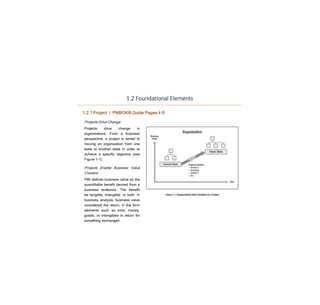
Projects Drive Change
Projects drive change in
organizations. From a business
perspective, a project is aimed at
moving an organization from one
state to another state in order to
achieve a specific objective (see
Figure 1-1).
Projects Enable Business Value
Creation
PMI defines business value as the
quantifiable benefit derived from a
business endeavor. The benefit
be tangible, intangible, or both. In
business analysis, business value
considered the return, in the form
elements such as time, money,
goods, or intangibles in return for
something exchanged.
1.2.1 Project | PMBOK® Guide Pages 4-9
1.2 Foundational Elements
1.2.1 Project | PMBOK® Guide Pages 4-9
Project Initiation Context
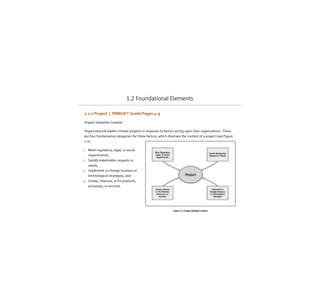
Organizational leaders initiate projects in response to factors acting upon their organizations. There
are four fundamental categories for these factors, which illustrate the context of a project (see Figure
1-2):
1. Meet regulatory, legal, or social
requirements;
2. Satisfy stakeholder requests or
needs;
3. Implement or change business or
technological strategies; and
4. Create, improve, or fix products,
processes, or services.

Chapter 1

  • 1.
    1.1 Overview andPurpose of this Guide Generally recognized means the knowledge and practices described are applicable to most projects most of the time, and there is consensus about their value and usefulness.Good practice means there is general agreement that the application of the knowledge, skills, tools, and techniques to project management processes can enhance the chance of success over many projects in delivering the expected business values and results. This PMBOK®Guide is different from a methodology.A methodology is a system of practices, techniques, procedures, and rules used by those who work in a discipline.This PMBOK®Guide is a foundation upon which organizations can build methodologies, policies, procedures, rules, tools and techniques, and life cycle phases needed to practice project management. The project management body of knowledge (PMBOK) describes the knowledge within the profession of project management.The project management body of knowledge includes proven traditional practices that are widely applied as well as innovative practices that are emerging in the profession. The body of knowledge (BOK) includes both published and unpublished materials.This body of knowledge is constantly evolving.This PMBOK®Guide identifies a subset of the project management body of knowledge that is generally recognized as good practice
  • 2.
    1.1 Overview andPurpose of this Guide 1.1.1 The Standard for Project Management | PMBOK® Guide Pages 1-2 This guide is based on The Standard for Project Management. A standard is a document established by an authority, custom, or general consent as a model or example. As an American National Standards Institute (ANSI) standard, The Standard for Project Management was developed using a process based on the concepts of consensus, openness, due process, and balance. The Standard for Project Management is a foundational reference for PMI's project management professional development development programs and the practice of project management. Because project management needs to be tailored to fit the needs of the project, the standard and the guide are both based on descriptive practices, rather than prescriptive practices. Therefore, the standard identifies the processes that are considered good practices on most projects, most of the time. The standard also identifies the inputs and outputs that are usually associated with those processes. The standard does not require that any particular process or practice be performed. The PMBOK® Guide provides more detail about key concepts, emerging trends, considerations for tailoring the project management processes, and information on how tools and techniques are applied to projects. Project managers may use one or more methodologies to implement the project management processes outlined in the standard.
  • 3.
    1.1 Overview andPurpose of this Guide 1.1.3 Code of Ethics and Professional Conduct | PMBOK® Guide Pages 2-3 PMI publishes the Code of Ethics and Professional Conduct to instill confidence in the project management profession and to help an individual in making wise decisions, particularly when faced with difficult situations where the individual may be asked to compromise his or her integrity or values. The values that the global project management community defined as most important were responsibility, respect, fairness, and honesty. The Code of Ethics and Professional Conduct affirms these four values as its foundation. The Code of Ethics and Professional Conduct includes both aspirational standards and mandatory standards. The aspirational standards describe the conduct that practitioners, who are also PMI members, certification holders, or volunteers, strive to uphold. Although adherence to the aspirational standards is not easily measured, conduct in accordance with these is an expectation for those who consider themselves to be professionals—it is not optional. The mandatory standards establish firm requirements and, in some cases, limit or prohibit practitioner behavior. Practitioners who are also PMI members, certification holders, or volunteers and who do not conduct themselves in accordance with these standards will be subject to disciplinary procedures before PMI's Ethics Review Committee.
  • 4.
    1.2 Foundational Elements 1.2.1Project | PMBOK® Guide Pages 4-9 A Project is a temporary endeavor undertaken to create a unique product, service or result.
  • 5.
    1.2 Foundational Elements 1.2.1Project | PMBOK® Guide Pages 4-9 A Project is a temporary endeavor undertaken to create a unique product, service or result. Unique Product, Service, or Result  Projects are undertaken to fulfill objectives by producing deliverables.  An objective is defined as an outcome toward which work is to be directed, a strategic position to be attained, a purpose to be achieved, a result to be obtained, a product to be produced, or a service to be performed.  A deliverable is defined as any unique and verifiable product, result, or capability to perform a service that is required to be produced to complete a process, phase, or project. Deliverables may be tangible or intangible.  Repetitive elements may be present in some project deliverables and activities. This repetition does not change the fundamental and unique characteristics of the project work.
  • 6.
    1.2 Foundational Elements 1.2.1Project | PMBOK® Guide Pages 4-9 A Project is a temporary endeavor undertaken to create a unique product, service or result. Temporary Endeavor The temporary nature of projects indicates that a project has a definite beginning and end. Temporary does not necessarily mean a project has a short duration. The end of the project is reached when one or more of the following is true:  The project's objectives have been achieved;  The objectives will not or cannot be met;  Funding is exhausted or no longer available for allocation to the project;  The need for the project no longer exists (e.g., the customer no longer wants the  project completed, a change in strategy or priority ends the project, the  organizational management provides direction to end the project);  The human or physical resources are no longer available; or  The project is terminated for legal cause or convenience.
  • 7.
    1.2 Foundational Elements ProjectsDrive Change Projects drive change in organizations. From a business perspective, a project is aimed at moving an organization from one state to another state in order to achieve a specific objective (see Figure 1-1). Projects Enable Business Value Creation PMI defines business value as the quantifiable benefit derived from a business endeavor. The benefit be tangible, intangible, or both. In business analysis, business value considered the return, in the form elements such as time, money, goods, or intangibles in return for something exchanged. 1.2.1 Project | PMBOK® Guide Pages 4-9
  • 8.
    1.2 Foundational Elements 1.2.1Project | PMBOK® Guide Pages 4-9 Project Initiation Context Organizational leaders initiate projects in response to factors acting upon their organizations. There are four fundamental categories for these factors, which illustrate the context of a project (see Figure 1-2): 1. Meet regulatory, legal, or social requirements; 2. Satisfy stakeholder requests or needs; 3. Implement or change business or technological strategies; and 4. Create, improve, or fix products, processes, or services.