Module 6 – Systems Planning
R. CALDO TECHNICAL CONSULTANCY SERVICES
Address: Brgy. San Jose, Sto. Tomas,
Batangas
Email: rionel14_caldo@yahoo.com
Contact No.: (0966) 4426196
Facebook Page:
www.facebook.com/RCaldoConsultancy
This printed document is for reference use only of R.CALDO Technical Consultancy Services
Rionel Belen Caldo, BsCpE, MPA, MSc ECE
Model-Based Design Engineer/ Group Leader
ROHM LSI Design Philippines, Inc. (RLDP)
DLSU PhD-ECE Scholar
MEP-CpE CHED Scholar
MSc ECE DOST-ERDT Scholar
International Researcher, Reviewer, Presenter and Publisher
Academician and Professor of different Colleges and Universities
RTCS CEO/President and RSquare General Manager
Agenda
• Interesting News and Articles
• Strategic Planning
• Information Systems Projects
• Class Exercise
Systems Analysis and Design
Methodology
• System Development Life Cycle (SDLC)
– Systems Planning
– Systems Analysis
– Systems Design
– Systems Implementation
– Systems Operation and Support
Strategic Planning
• The process of identifying long-term
organizational goals, strategies, and
resources.
SWOT Analysis
• Strengths (S)
• Weaknesses (W)
• Opportunities (O)
• Threats (T)
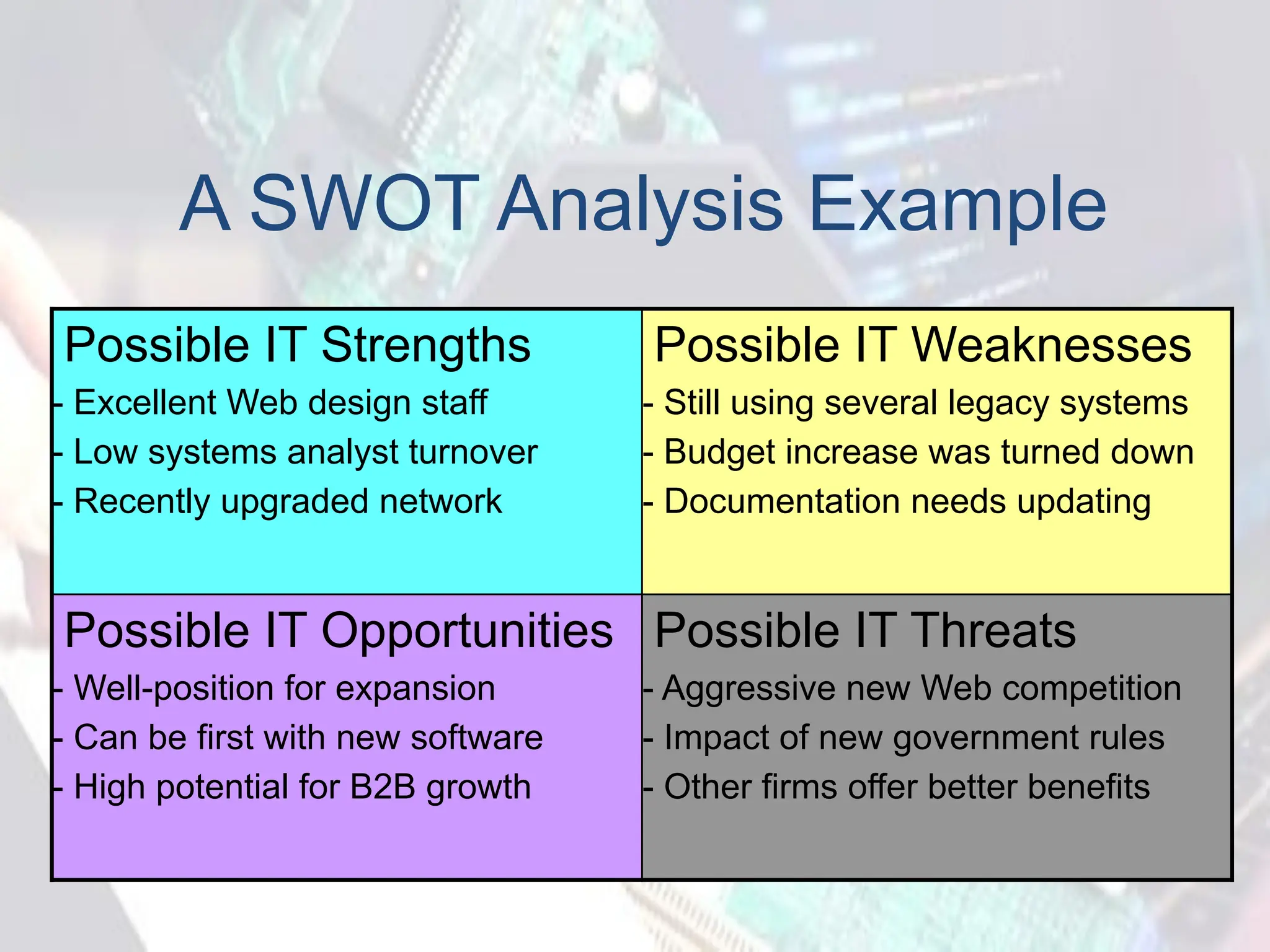
A SWOT Analysis Example
Possible IT Strengths
- Excellent Web design staff
- Low systems analyst turnover
- Recently upgraded network
Possible IT Weaknesses
- Still using several legacy systems
- Budget increase was turned down
- Documentation needs updating
Possible IT Opportunities
- Well-position for expansion
- Can be first with new software
- High potential for B2B growth
Possible IT Threats
- Aggressive new Web competition
- Impact of new government rules
- Other firms offer better benefits
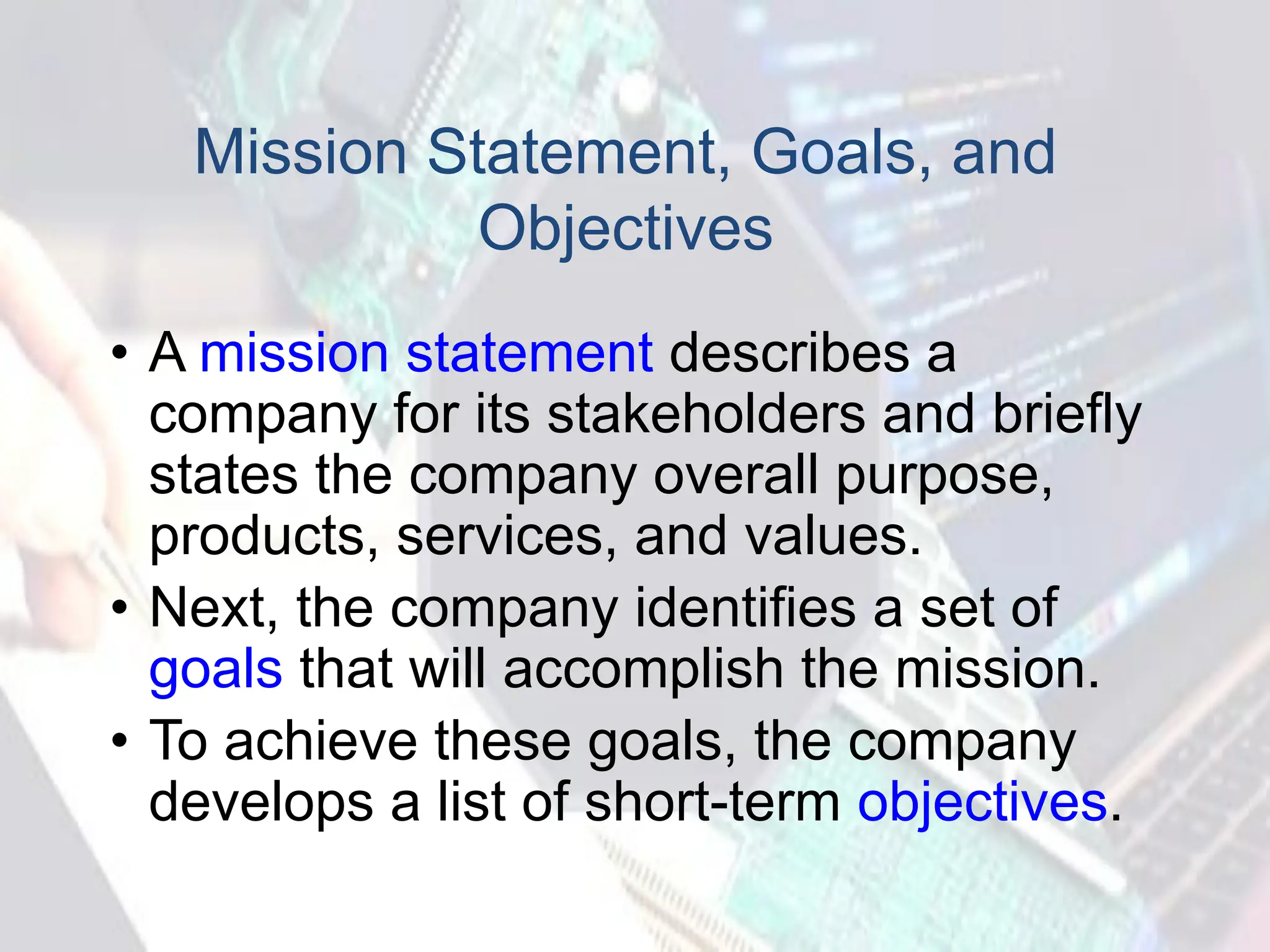
Mission Statement, Goals, and
Objectives
• A mission statement describes a
company for its stakeholders and briefly
states the company overall purpose,
products, services, and values.
• Next, the company identifies a set of
goals that will accomplish the mission.
• To achieve these goals, the company
develops a list of short-term objectives.
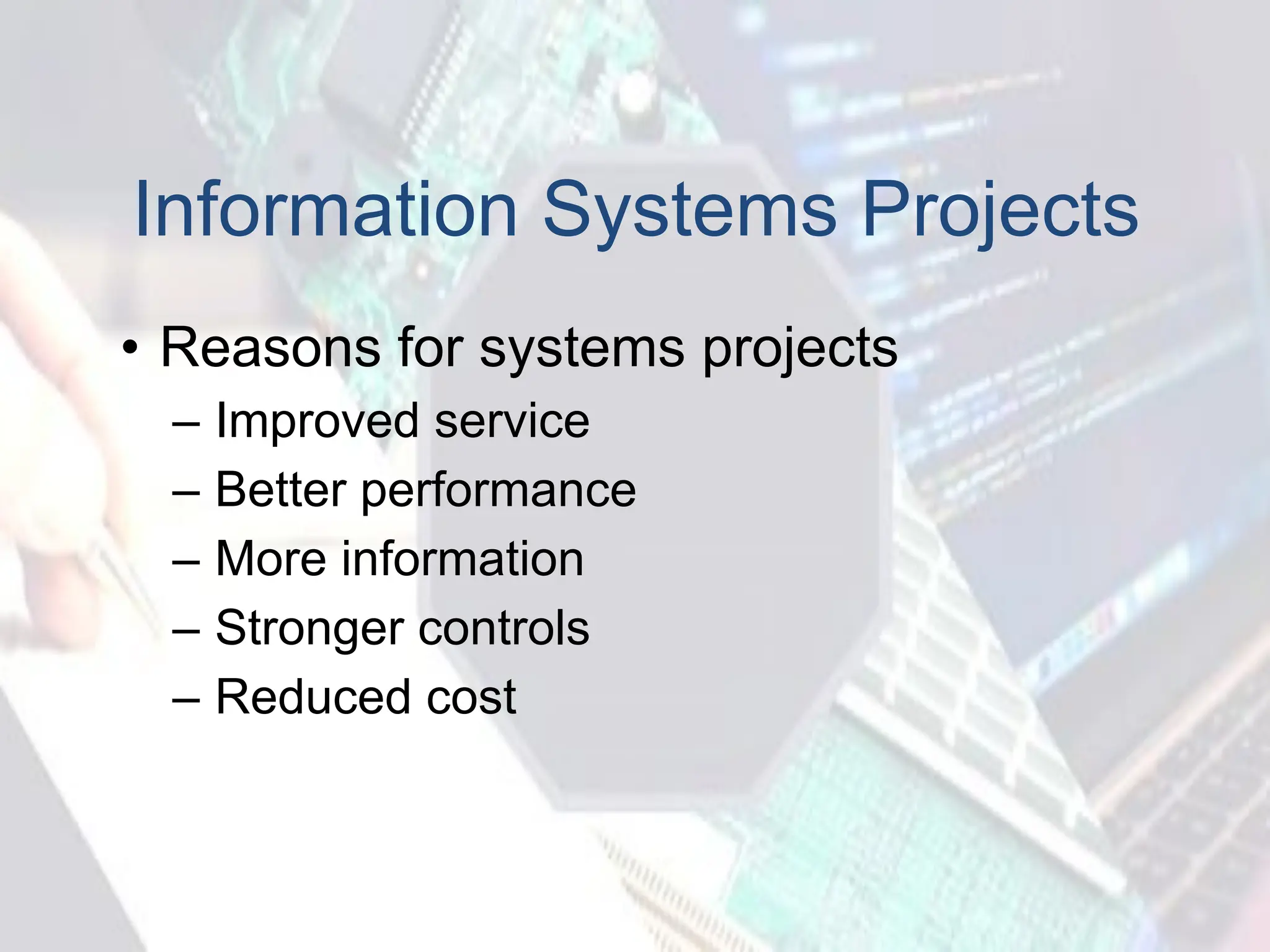
Information Systems Projects
• Reasons for systems projects
– Improved service
– Better performance
– More information
– Stronger controls
– Reduced cost
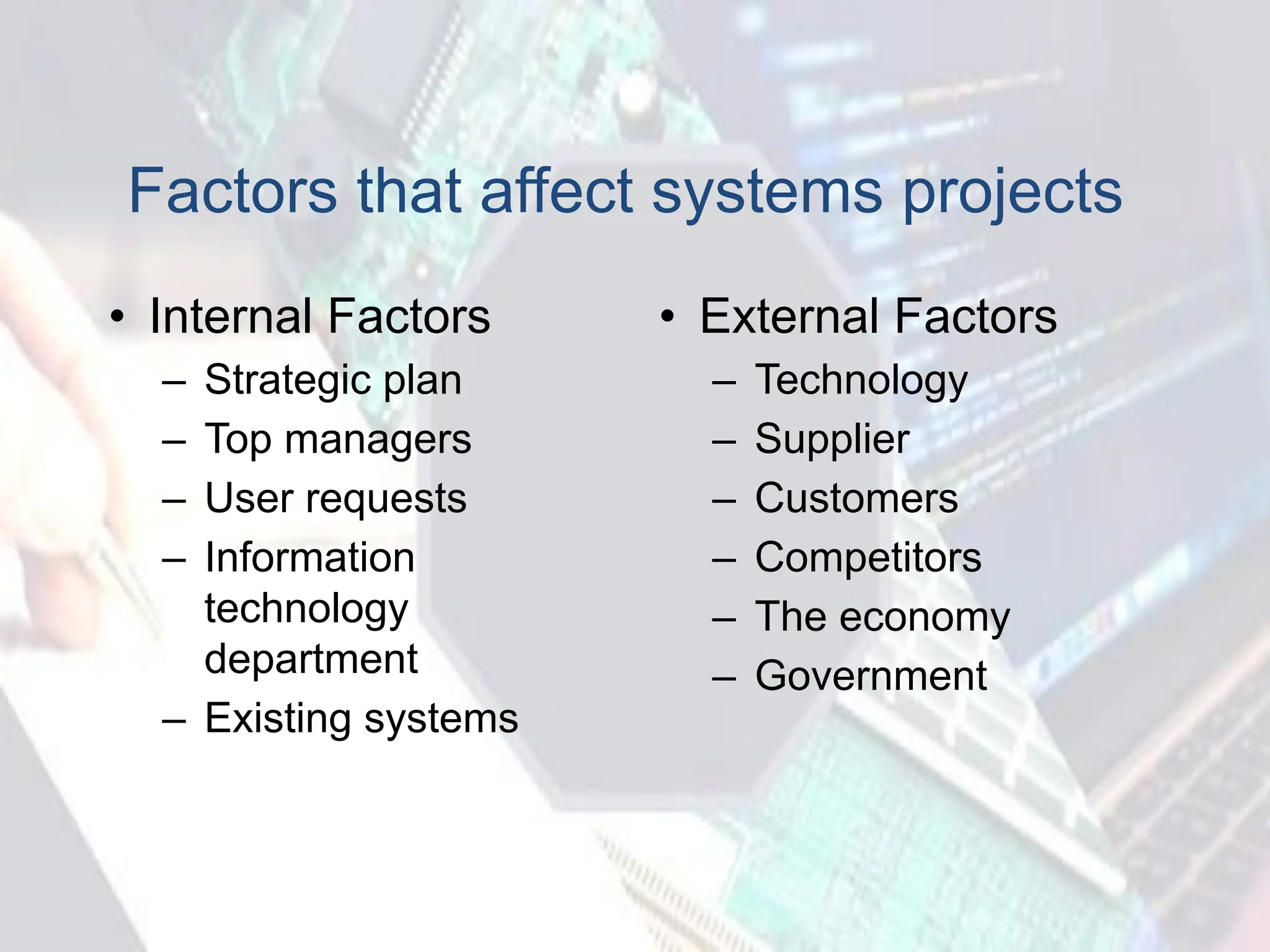
Factors that affect systems projects
• Internal Factors
– Strategic plan
– Top managers
– User requests
– Information
technology
department
– Existing systems
• External Factors
– Technology
– Supplier
– Customers
– Competitors
– The economy
– Government
Feasibility study
• Operational Feasibility
• Technical Feasibility
• Economic Feasibility
• Schedule Feasibility
Operational Feasibility
• Operational Feasibility means that a
proposed system will be used effectively after
it has been developed.
– Does management or do users support the
projects? Do users see the need for change?
– Will the system result in a work force reduction?
– Will the system require training for users?
– Will customers experience adverse effect in
anyway, either temporarily or permanently.
Technical Feasibility
• The technical resources needed to develop,
purchase, install, or operate the system.
– Does the company have the necessary hardware,
software, and network resources?
– Does the company have the needed technical
expertise?
– Will the hardware and software environment be
reliable?
– Will the system be able to handle future
transaction volume and company growth?
Economic Feasibility
• Economic Feasibility means that the projected
benefits of the proposed system outweigh the
estimated costs usually considered the total cost of
ownership (TCO).
– People, including IT staff and users
– Hardware and equipment
– Software
– Formal and informal training
– Licenses and fees
– Consulting expenses
– Facility costs
– The estimated cost of not developing the system or
postponing the project
Schedule Feasibility
• Schedule Feasibility means that a
project can be implemented in an
acceptable time.
– Can the company or the IT team control
the factor that effect schedule feasibility?
– What condition must be satisfied during the
development of the system?
– Will an accelerated schedule pose any
risk?
– Will the project manager be appointed?
Evaluating Feasibility
• Identify and weed out the systems
request that are not feasible.
• Even if the request is feasible, it might
not be necessary.
• Feasibility analysis is an ongoing task
that must be performed throughout the
systems development process.
Types of Project
• Discretionary projects
• Nondiscretionary project
Planning the Preliminary
Investigation
• Step 1: Understand the problem or
opportunity
• Step 2: Define the project scope and
constraint
• Step 3: Perform fact-finding
• Step 4: Evaluate feasibility
• Step 5: Estimate project development time
and cost
• Step 6: Present results and recommendation
to management
Step 1: Understand the
problem or opportunity
• Analyze the problem encountered
• Define the need for the new system
• Identify information systems involved
• Initiate the project
Step 2: Define the project
scope and constraint
• Project scope: boundaries or extent of
the project.
• A constraint: a requirement or condition
that the system must satisfy or the
outcome that the system must achieve.
Step 3: Perform fact-finding
• Conduct interview
• Review documentation
• Observe operation
• Conduct a user survey
Step 4: Evaluate feasibility
• Evaluate the project’s operational,
technical, economic, and schedule
feasibility.
Step 5: Estimate project
development time and cost
• Estimate the project time and develop
the time schedule
• Estimate the project cost based on TCO
Step 6: Present results and
recommendation to management
• Introduction
• Systems request summary
• Findings
• Recommendation
• Time and cost estimates
• Expected benefits
• Appendix
1 Corinthians 15:57 “But thanks be to God!
He gives us the victory through our Lord
Jesus Christ.
Colossians 3:17 “Whatever you do or say, do
it as a representative of the Lord Jesus,
giving thanks through him to God the
Father.”
🡪 Your goal is to work in such a way that
you are a good representative of Jesus
Reflection
END of Presentation…

Module 6 - Systems Planning bak.pptx.pdf

  • 1.
    Module 6 –Systems Planning R. CALDO TECHNICAL CONSULTANCY SERVICES Address: Brgy. San Jose, Sto. Tomas, Batangas Email: rionel14_caldo@yahoo.com Contact No.: (0966) 4426196 Facebook Page: www.facebook.com/RCaldoConsultancy This printed document is for reference use only of R.CALDO Technical Consultancy Services Rionel Belen Caldo, BsCpE, MPA, MSc ECE Model-Based Design Engineer/ Group Leader ROHM LSI Design Philippines, Inc. (RLDP) DLSU PhD-ECE Scholar MEP-CpE CHED Scholar MSc ECE DOST-ERDT Scholar International Researcher, Reviewer, Presenter and Publisher Academician and Professor of different Colleges and Universities RTCS CEO/President and RSquare General Manager
  • 2.
    Agenda • Interesting Newsand Articles • Strategic Planning • Information Systems Projects • Class Exercise
  • 3.
    Systems Analysis andDesign Methodology • System Development Life Cycle (SDLC) – Systems Planning – Systems Analysis – Systems Design – Systems Implementation – Systems Operation and Support
  • 4.
    Strategic Planning • Theprocess of identifying long-term organizational goals, strategies, and resources.
  • 5.
    SWOT Analysis • Strengths(S) • Weaknesses (W) • Opportunities (O) • Threats (T)
  • 6.
    A SWOT AnalysisExample Possible IT Strengths - Excellent Web design staff - Low systems analyst turnover - Recently upgraded network Possible IT Weaknesses - Still using several legacy systems - Budget increase was turned down - Documentation needs updating Possible IT Opportunities - Well-position for expansion - Can be first with new software - High potential for B2B growth Possible IT Threats - Aggressive new Web competition - Impact of new government rules - Other firms offer better benefits
  • 7.
    Mission Statement, Goals,and Objectives • A mission statement describes a company for its stakeholders and briefly states the company overall purpose, products, services, and values. • Next, the company identifies a set of goals that will accomplish the mission. • To achieve these goals, the company develops a list of short-term objectives.
  • 8.
    Information Systems Projects •Reasons for systems projects – Improved service – Better performance – More information – Stronger controls – Reduced cost
  • 9.
    Factors that affectsystems projects • Internal Factors – Strategic plan – Top managers – User requests – Information technology department – Existing systems • External Factors – Technology – Supplier – Customers – Competitors – The economy – Government
  • 10.
    Feasibility study • OperationalFeasibility • Technical Feasibility • Economic Feasibility • Schedule Feasibility
  • 11.
    Operational Feasibility • OperationalFeasibility means that a proposed system will be used effectively after it has been developed. – Does management or do users support the projects? Do users see the need for change? – Will the system result in a work force reduction? – Will the system require training for users? – Will customers experience adverse effect in anyway, either temporarily or permanently.
  • 12.
    Technical Feasibility • Thetechnical resources needed to develop, purchase, install, or operate the system. – Does the company have the necessary hardware, software, and network resources? – Does the company have the needed technical expertise? – Will the hardware and software environment be reliable? – Will the system be able to handle future transaction volume and company growth?
  • 13.
    Economic Feasibility • EconomicFeasibility means that the projected benefits of the proposed system outweigh the estimated costs usually considered the total cost of ownership (TCO). – People, including IT staff and users – Hardware and equipment – Software – Formal and informal training – Licenses and fees – Consulting expenses – Facility costs – The estimated cost of not developing the system or postponing the project
  • 14.
    Schedule Feasibility • ScheduleFeasibility means that a project can be implemented in an acceptable time. – Can the company or the IT team control the factor that effect schedule feasibility? – What condition must be satisfied during the development of the system? – Will an accelerated schedule pose any risk? – Will the project manager be appointed?
  • 15.
    Evaluating Feasibility • Identifyand weed out the systems request that are not feasible. • Even if the request is feasible, it might not be necessary. • Feasibility analysis is an ongoing task that must be performed throughout the systems development process.
  • 16.
    Types of Project •Discretionary projects • Nondiscretionary project
  • 17.
    Planning the Preliminary Investigation •Step 1: Understand the problem or opportunity • Step 2: Define the project scope and constraint • Step 3: Perform fact-finding • Step 4: Evaluate feasibility • Step 5: Estimate project development time and cost • Step 6: Present results and recommendation to management
  • 18.
    Step 1: Understandthe problem or opportunity • Analyze the problem encountered • Define the need for the new system • Identify information systems involved • Initiate the project
  • 19.
    Step 2: Definethe project scope and constraint • Project scope: boundaries or extent of the project. • A constraint: a requirement or condition that the system must satisfy or the outcome that the system must achieve.
  • 20.
    Step 3: Performfact-finding • Conduct interview • Review documentation • Observe operation • Conduct a user survey
  • 21.
    Step 4: Evaluatefeasibility • Evaluate the project’s operational, technical, economic, and schedule feasibility.
  • 22.
    Step 5: Estimateproject development time and cost • Estimate the project time and develop the time schedule • Estimate the project cost based on TCO
  • 23.
    Step 6: Presentresults and recommendation to management • Introduction • Systems request summary • Findings • Recommendation • Time and cost estimates • Expected benefits • Appendix
  • 24.
    1 Corinthians 15:57“But thanks be to God! He gives us the victory through our Lord Jesus Christ. Colossians 3:17 “Whatever you do or say, do it as a representative of the Lord Jesus, giving thanks through him to God the Father.” 🡪 Your goal is to work in such a way that you are a good representative of Jesus Reflection
  • 25.