Cars and Loans
04/09
Lesson Nine
$
Presentation Slides
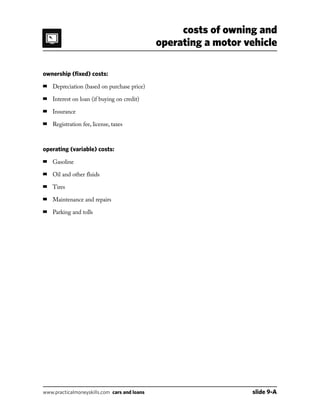
costs of owning and
operating a motor vehicle
www.practicalmoneyskills.com cars and loans	 slide 9-A
ownership (fixed) costs:
■	 Depreciation (based on purchase price)
■	 Interest on loan (if buying on credit)
■	 Insurance
■	 Registration fee, license, taxes
operating (variable) costs:
■	 Gasoline
■	 Oil and other fluids
■	 Tires
■	 Maintenance and repairs
■	 Parking and tolls
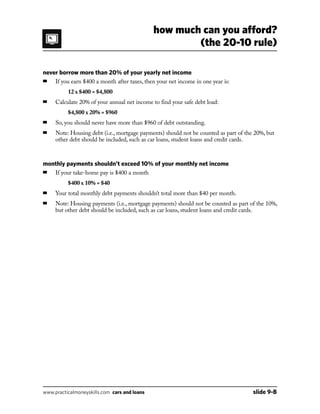
never borrow more than 20% of your yearly net income
■	 If you earn $400 a month after taxes, then your net income in one year is:
		 12 x $400 = $4,800
■	 Calculate 20% of your annual net income to find your safe debt load:
		 $4,800 x 20% = $960
■	 So, you should never have more than $960 of debt outstanding.
■	Note: Housing debt (i.e., mortgage payments) should not be counted as part of the 20%, but
other debt should be included, such as car loans, student loans and credit cards.
monthly payments shouldn’t exceed 10% of your monthly net income
■	 If your take-home pay is $400 a month
		 $400 x 10% = $40
■	 Your total monthly debt payments shouldn’t total more than $40 per month.
■	Note: Housing payments (i.e., mortgage payments) should not be counted as part of the 10%,
but other debt should be included, such as car loans, student loans and credit cards.
how much can you afford?
(the 20-10 rule)
www.practicalmoneyskills.com cars and loans	 slide 9-B
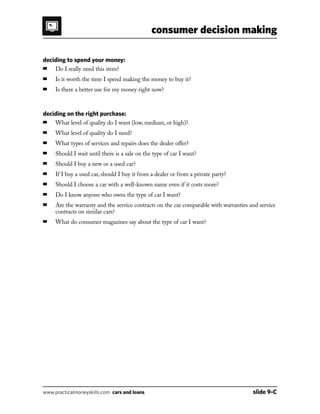
consumer decision making
www.practicalmoneyskills.com cars and loans	 slide 9-C
deciding to spend your money:
■	 Do I really need this item?
■	 Is it worth the time I spend making the money to buy it?
■	 Is there a better use for my money right now?
deciding on the right purchase:
■	 What level of quality do I want (low, medium, or high)?
■	 What level of quality do I need?
■	 What types of services and repairs does the dealer offer?
■	 Should I wait until there is a sale on the type of car I want?
■	 Should I buy a new or a used car?
■	 If I buy a used car, should I buy it from a dealer or from a private party?
■	 Should I choose a car with a well-known name even if it costs more?
■	 Do I know anyone who owns the type of car I want?
■	Are the warranty and the service contracts on the car comparable with warranties and service
contracts on similar cars?
■	 What do consumer magazines say about the type of car I want?
shopping for a used car
www.practicalmoneyskills.com cars and loans	 slide 9-D
before you begin shopping:
■	 Decide how much you can afford to spend.
■	 Decide which car models and options interest you.
■	 Research the reliability of the model of car you want.
■	 Find out where the nearest repair facility is that works on the type of car you want.
■	Find out whether parts are readily available for the type of car you want. Find recent prices
in used-car “blue books” in the library, on the internet, in newspaper ads, consumer
magazines, etc.
■	 Shop for financing.
■	 Factor in the costs of the loan and the cost of maintenance.
■	 Know how to read a “Buyer’s Guide” sticker.
as you shop:
■	 Find out the reputation of the dealer.
■	 Find out what type of warranty comes with the car.
■	 Find out what type of service contract comes with the car.
sources of used cars
www.practicalmoneyskills.com cars and loans	 slide 9-E
new-car dealers provide quality used vehicles; service department available; higher prices than
other sources
used-car dealers specialize in previously owned vehicles; limited warranty (if any); vehicles may
be in poor condition
private parties may be a good buy if vehicle was well maintained; few consumer protection
regulations apply to private party sales
other sources such as auctions or sales by government agencies, auto rental companies, and on
the internet; most of these vehicles have been driven many miles
shopping for a new car
www.practicalmoneyskills.com cars and loans	 slide 9-F
before you begin shopping:
■	 Decide which car model and specific options you want.
■	 Find out the invoice price and the true cost to the dealer of the model and options you want.
■	 Decide how much you are willing to pay the dealer above the invoice price.
■	 Make your offer to as many dealers as possible.
■	 Compare final sales prices with other dealers and buying services.
■	 Compare financing costs from various sources.
■	 If you already have a car, find out its value independent of the dealer’s trade-in offer.
■	 Try to sell your old car yourself (dealers usually give better deals without a trade-in).
■	 Decide whether you need an optional service contract or credit insurance.
warranties
www.practicalmoneyskills.com cars and loans	 slide 9-G
as-is (no warranty):
■	 No expressed or implied warranty.
■	 If you buy a car and have problems with it, you must pay for any repairs yourself.
■	 Some states do not permit “as-is” sales on used cars.
implied warranties:
■	 Warranty of merchantability—a product will do what it is designed to do.
■	Warranty of fitness for a particular purpose—a product will do what the seller promises it
will do.
■	Always in effect unless the product is sold as-is or the seller says in writing that there is
no warranty.
dealer warranties:
■	 Offered and specifically written by the dealer.
■	 Terms and conditions can vary greatly.
■	 Useful to compare warranty terms on similar cars or negotiate warranty coverage.
unexpired manufacturer’s warranties:
■	Manufacturer’s warranty can sometimes be transferred to the new owner.There may be a fee
for the transfer process.
service contracts
(also called “extended warranties”)
www.practicalmoneyskills.com cars and loans	 slide 9-H
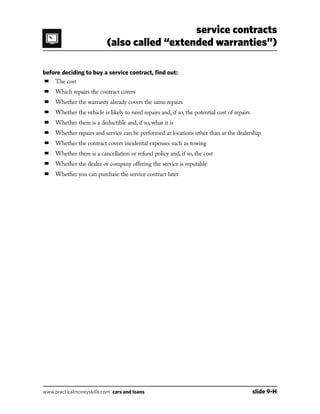
before deciding to buy a service contract, find out:
■	 The cost
■	 Which repairs the contract covers
■	 Whether the warranty already covers the same repairs
■	 Whether the vehicle is likely to need repairs and, if so, the potential cost of repairs
■	 Whether there is a deductible and, if so, what it is
■	 Whether repairs and service can be performed at locations other than at the dealership
■	 Whether the contract covers incidental expenses such as towing
■	 Whether there is a cancellation or refund policy and, if so, the cost
■	 Whether the dealer or company offering the service is reputable
■	 Whether you can purchase the service contract later
shopping for a car loan
www.practicalmoneyskills.com cars and loans	 slide 9-I
variables include:
■	 Annual Percentage Rate (APR)
■	 Length of the loan
■	 Monthly payments
■	 Total finance charge
■	 Total to be repaid
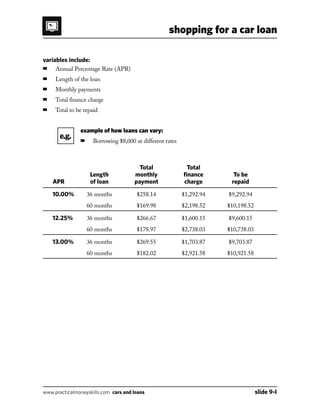
			 example of how loans can vary:
	 	 	 ■	 Borrowing $8,000 at different rates
			 Total	 Total
		 Length	 monthly	 finance	 To be
	 APR	 of loan	 payment	 charge	 repaid
	 10.00%	 36 months	 $258.14	 $1,292.94	 $9,292.94
		 60 months	 $169.98	 $2,198.52	 $10,198.52
	 12.25%	 36 months	 $266.67	 $1,600.15	 $9,600.15
		 60 months	 $178.97	 $2,738.03	 $10,738.03
	 13.00%	 36 months	 $269.55	 $1,703.87	 $9,703.87
		 60 months	 $182.02	 $2,921.58	 $10,921.58
e.g.
how to calculate the total cost of a loan
www.practicalmoneyskills.com cars and loans	 slide 9-J
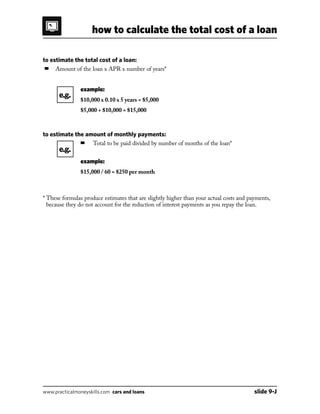
to estimate the total cost of a loan:
■	 Amount of the loan x APR x number of years*
			 example:
			 $10,000 x 0.10 x 5 years = $5,000
			 $5,000 + $10,000 = $15,000
to estimate the amount of monthly payments:
			 ■	 Total to be paid divided by number of months of the loan*
			 example:
			 $15,000 / 60 = $250 per month
* These formulas produce estimates that are slightly higher than your actual costs and payments,
because they do not account for the reduction of interest payments as you repay the loan.
e.g.
e.g.
the truth-in-lending act
www.practicalmoneyskills.com cars and loans	 slide 9-K
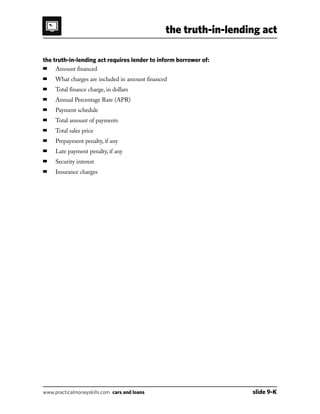
the truth-in-lending act requires lender to inform borrower of:
■	 Amount financed
■	 What charges are included in amount financed
■	 Total finance charge, in dollars
■	 Annual Percentage Rate (APR)
■	 Payment schedule
■	 Total amount of payments
■	 Total sales price
■	 Prepayment penalty, if any
■	 Late payment penalty, if any
■	 Security interest
■	 Insurance charges
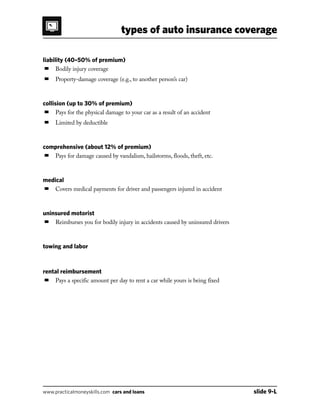
types of auto insurance coverage
www.practicalmoneyskills.com cars and loans	 slide 9-L
liability (40–50% of premium)
■	 Bodily injury coverage
■	 Property-damage coverage (e.g., to another person’s car)
collision (up to 30% of premium)
■	 Pays for the physical damage to your car as a result of an accident
■	 Limited by deductible
comprehensive (about 12% of premium)
■	 Pays for damage caused by vandalism, hailstorms, floods, theft, etc.
medical
■	 Covers medical payments for driver and passengers injured in accident
uninsured motorist
■	 Reimburses you for bodily injury in accidents caused by uninsured drivers
towing and labor
rental reimbursement
■	 Pays a specific amount per day to rent a car while yours is being fixed
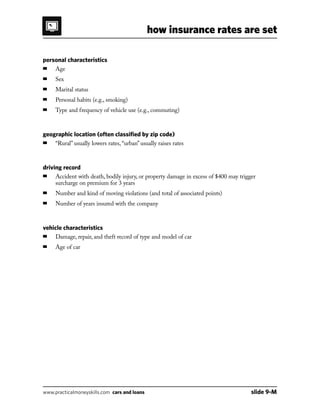
how insurance rates are set
www.practicalmoneyskills.com cars and loans	 slide 9-M
personal characteristics
■	 Age
■	 Sex
■	 Marital status
■	 Personal habits (e.g., smoking)
■	 Type and frequency of vehicle use (e.g., commuting)
geographic location (often classified by zip code)
■	 “Rural” usually lowers rates, “urban” usually raises rates
driving record
■	Accident with death, bodily injury, or property damage in excess of $400 may trigger
surcharge on premium for 3 years
■	 Number and kind of moving violations (and total of associated points)
■	 Number of years insured with the company
vehicle characteristics
■	 Damage, repair, and theft record of type and model of car
■	 Age of car
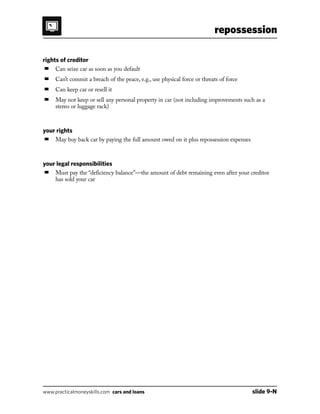
repossession
www.practicalmoneyskills.com cars and loans	 slide 9-N
rights of creditor
■	 Can seize car as soon as you default
■	 Can’t commit a breach of the peace, e.g., use physical force or threats of force
■	 Can keep car or resell it
■	May not keep or sell any personal property in car (not including improvements such as a
stereo or luggage rack)
your rights
■	 May buy back car by paying the full amount owed on it plus repossession expenses
your legal responsibilities
■	Must pay the “deficiency balance”—the amount of debt remaining even after your creditor
has sold your car
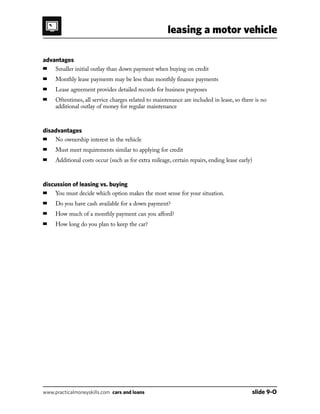
leasing a motor vehicle
www.practicalmoneyskills.com cars and loans	 slide 9-O
advantages
■	 Smaller initial outlay than down payment when buying on credit
■	 Monthly lease payments may be less than monthly finance payments
■	 Lease agreement provides detailed records for business purposes
■	Oftentimes, all service charges related to maintenance are included in lease, so there is no
additional outlay of money for regular maintenance
disadvantages
■	 No ownership interest in the vehicle
■	 Must meet requirements similar to applying for credit
■	 Additional costs occur (such as for extra mileage, certain repairs, ending lease early)
discussion of leasing vs. buying
■	You must decide which option makes the most sense for your situation.
■	 Do you have cash available for a down payment?
■	 How much of a monthly payment can you afford?
■	 How long do you plan to keep the car?

L3 presentation9

  • 1.
    Cars and Loans 04/09 LessonNine $ Presentation Slides
  • 2.
    costs of owningand operating a motor vehicle www.practicalmoneyskills.com cars and loans slide 9-A ownership (fixed) costs: ■ Depreciation (based on purchase price) ■ Interest on loan (if buying on credit) ■ Insurance ■ Registration fee, license, taxes operating (variable) costs: ■ Gasoline ■ Oil and other fluids ■ Tires ■ Maintenance and repairs ■ Parking and tolls
  • 3.
    never borrow morethan 20% of your yearly net income ■ If you earn $400 a month after taxes, then your net income in one year is: 12 x $400 = $4,800 ■ Calculate 20% of your annual net income to find your safe debt load: $4,800 x 20% = $960 ■ So, you should never have more than $960 of debt outstanding. ■ Note: Housing debt (i.e., mortgage payments) should not be counted as part of the 20%, but other debt should be included, such as car loans, student loans and credit cards. monthly payments shouldn’t exceed 10% of your monthly net income ■ If your take-home pay is $400 a month $400 x 10% = $40 ■ Your total monthly debt payments shouldn’t total more than $40 per month. ■ Note: Housing payments (i.e., mortgage payments) should not be counted as part of the 10%, but other debt should be included, such as car loans, student loans and credit cards. how much can you afford? (the 20-10 rule) www.practicalmoneyskills.com cars and loans slide 9-B
  • 4.
    consumer decision making www.practicalmoneyskills.comcars and loans slide 9-C deciding to spend your money: ■ Do I really need this item? ■ Is it worth the time I spend making the money to buy it? ■ Is there a better use for my money right now? deciding on the right purchase: ■ What level of quality do I want (low, medium, or high)? ■ What level of quality do I need? ■ What types of services and repairs does the dealer offer? ■ Should I wait until there is a sale on the type of car I want? ■ Should I buy a new or a used car? ■ If I buy a used car, should I buy it from a dealer or from a private party? ■ Should I choose a car with a well-known name even if it costs more? ■ Do I know anyone who owns the type of car I want? ■ Are the warranty and the service contracts on the car comparable with warranties and service contracts on similar cars? ■ What do consumer magazines say about the type of car I want?
  • 5.
    shopping for aused car www.practicalmoneyskills.com cars and loans slide 9-D before you begin shopping: ■ Decide how much you can afford to spend. ■ Decide which car models and options interest you. ■ Research the reliability of the model of car you want. ■ Find out where the nearest repair facility is that works on the type of car you want. ■ Find out whether parts are readily available for the type of car you want. Find recent prices in used-car “blue books” in the library, on the internet, in newspaper ads, consumer magazines, etc. ■ Shop for financing. ■ Factor in the costs of the loan and the cost of maintenance. ■ Know how to read a “Buyer’s Guide” sticker. as you shop: ■ Find out the reputation of the dealer. ■ Find out what type of warranty comes with the car. ■ Find out what type of service contract comes with the car.
  • 6.
    sources of usedcars www.practicalmoneyskills.com cars and loans slide 9-E new-car dealers provide quality used vehicles; service department available; higher prices than other sources used-car dealers specialize in previously owned vehicles; limited warranty (if any); vehicles may be in poor condition private parties may be a good buy if vehicle was well maintained; few consumer protection regulations apply to private party sales other sources such as auctions or sales by government agencies, auto rental companies, and on the internet; most of these vehicles have been driven many miles
  • 7.
    shopping for anew car www.practicalmoneyskills.com cars and loans slide 9-F before you begin shopping: ■ Decide which car model and specific options you want. ■ Find out the invoice price and the true cost to the dealer of the model and options you want. ■ Decide how much you are willing to pay the dealer above the invoice price. ■ Make your offer to as many dealers as possible. ■ Compare final sales prices with other dealers and buying services. ■ Compare financing costs from various sources. ■ If you already have a car, find out its value independent of the dealer’s trade-in offer. ■ Try to sell your old car yourself (dealers usually give better deals without a trade-in). ■ Decide whether you need an optional service contract or credit insurance.
  • 8.
    warranties www.practicalmoneyskills.com cars andloans slide 9-G as-is (no warranty): ■ No expressed or implied warranty. ■ If you buy a car and have problems with it, you must pay for any repairs yourself. ■ Some states do not permit “as-is” sales on used cars. implied warranties: ■ Warranty of merchantability—a product will do what it is designed to do. ■ Warranty of fitness for a particular purpose—a product will do what the seller promises it will do. ■ Always in effect unless the product is sold as-is or the seller says in writing that there is no warranty. dealer warranties: ■ Offered and specifically written by the dealer. ■ Terms and conditions can vary greatly. ■ Useful to compare warranty terms on similar cars or negotiate warranty coverage. unexpired manufacturer’s warranties: ■ Manufacturer’s warranty can sometimes be transferred to the new owner.There may be a fee for the transfer process.
  • 9.
    service contracts (also called“extended warranties”) www.practicalmoneyskills.com cars and loans slide 9-H before deciding to buy a service contract, find out: ■ The cost ■ Which repairs the contract covers ■ Whether the warranty already covers the same repairs ■ Whether the vehicle is likely to need repairs and, if so, the potential cost of repairs ■ Whether there is a deductible and, if so, what it is ■ Whether repairs and service can be performed at locations other than at the dealership ■ Whether the contract covers incidental expenses such as towing ■ Whether there is a cancellation or refund policy and, if so, the cost ■ Whether the dealer or company offering the service is reputable ■ Whether you can purchase the service contract later
  • 10.
    shopping for acar loan www.practicalmoneyskills.com cars and loans slide 9-I variables include: ■ Annual Percentage Rate (APR) ■ Length of the loan ■ Monthly payments ■ Total finance charge ■ Total to be repaid example of how loans can vary: ■ Borrowing $8,000 at different rates Total Total Length monthly finance To be APR of loan payment charge repaid 10.00% 36 months $258.14 $1,292.94 $9,292.94 60 months $169.98 $2,198.52 $10,198.52 12.25% 36 months $266.67 $1,600.15 $9,600.15 60 months $178.97 $2,738.03 $10,738.03 13.00% 36 months $269.55 $1,703.87 $9,703.87 60 months $182.02 $2,921.58 $10,921.58 e.g.
  • 11.
    how to calculatethe total cost of a loan www.practicalmoneyskills.com cars and loans slide 9-J to estimate the total cost of a loan: ■ Amount of the loan x APR x number of years* example: $10,000 x 0.10 x 5 years = $5,000 $5,000 + $10,000 = $15,000 to estimate the amount of monthly payments: ■ Total to be paid divided by number of months of the loan* example: $15,000 / 60 = $250 per month * These formulas produce estimates that are slightly higher than your actual costs and payments, because they do not account for the reduction of interest payments as you repay the loan. e.g. e.g.
  • 12.
    the truth-in-lending act www.practicalmoneyskills.comcars and loans slide 9-K the truth-in-lending act requires lender to inform borrower of: ■ Amount financed ■ What charges are included in amount financed ■ Total finance charge, in dollars ■ Annual Percentage Rate (APR) ■ Payment schedule ■ Total amount of payments ■ Total sales price ■ Prepayment penalty, if any ■ Late payment penalty, if any ■ Security interest ■ Insurance charges
  • 13.
    types of autoinsurance coverage www.practicalmoneyskills.com cars and loans slide 9-L liability (40–50% of premium) ■ Bodily injury coverage ■ Property-damage coverage (e.g., to another person’s car) collision (up to 30% of premium) ■ Pays for the physical damage to your car as a result of an accident ■ Limited by deductible comprehensive (about 12% of premium) ■ Pays for damage caused by vandalism, hailstorms, floods, theft, etc. medical ■ Covers medical payments for driver and passengers injured in accident uninsured motorist ■ Reimburses you for bodily injury in accidents caused by uninsured drivers towing and labor rental reimbursement ■ Pays a specific amount per day to rent a car while yours is being fixed
  • 14.
    how insurance ratesare set www.practicalmoneyskills.com cars and loans slide 9-M personal characteristics ■ Age ■ Sex ■ Marital status ■ Personal habits (e.g., smoking) ■ Type and frequency of vehicle use (e.g., commuting) geographic location (often classified by zip code) ■ “Rural” usually lowers rates, “urban” usually raises rates driving record ■ Accident with death, bodily injury, or property damage in excess of $400 may trigger surcharge on premium for 3 years ■ Number and kind of moving violations (and total of associated points) ■ Number of years insured with the company vehicle characteristics ■ Damage, repair, and theft record of type and model of car ■ Age of car
  • 15.
    repossession www.practicalmoneyskills.com cars andloans slide 9-N rights of creditor ■ Can seize car as soon as you default ■ Can’t commit a breach of the peace, e.g., use physical force or threats of force ■ Can keep car or resell it ■ May not keep or sell any personal property in car (not including improvements such as a stereo or luggage rack) your rights ■ May buy back car by paying the full amount owed on it plus repossession expenses your legal responsibilities ■ Must pay the “deficiency balance”—the amount of debt remaining even after your creditor has sold your car
  • 16.
    leasing a motorvehicle www.practicalmoneyskills.com cars and loans slide 9-O advantages ■ Smaller initial outlay than down payment when buying on credit ■ Monthly lease payments may be less than monthly finance payments ■ Lease agreement provides detailed records for business purposes ■ Oftentimes, all service charges related to maintenance are included in lease, so there is no additional outlay of money for regular maintenance disadvantages ■ No ownership interest in the vehicle ■ Must meet requirements similar to applying for credit ■ Additional costs occur (such as for extra mileage, certain repairs, ending lease early) discussion of leasing vs. buying ■ You must decide which option makes the most sense for your situation. ■ Do you have cash available for a down payment? ■ How much of a monthly payment can you afford? ■ How long do you plan to keep the car?