Changing	
  the	
  Mindset:	
  Crea/ng	
  a	
  
Risk	
  Conscious	
  and	
  Security	
  Aware	
  
Culture	
  
Presented	
  By:	
  
John	
  P.	
  Piron*,	
  	
  
CGEIT,	
  CISA,	
  CISM,	
  CISSP,	
  CRISC,	
  ISSAP,	
  ISSMP	
  
President,	
  IP	
  Architects,	
  LLC.	


Hacker	
  Hotshots	
  
July	
  30,	
  2013	
  
Copyright	
  2013	
  -­‐	
  	
  IP	
  Architects,	
  LLC.,	
  -­‐	
  All	
  Rights	
  Reserved	
  
Agenda	
  
•  Using	
  risk	
  management	
  to	
  remove	
  the	
  fear	
  
of	
  security	
  
•  What	
  is	
  a	
  Risk	
  Aware	
  and	
  Security	
  Conscious	
  
Culture?	
  
•  Approaches	
  to	
  changing	
  crea/ng	
  and	
  
changing	
  culture	
  
•  Final	
  Thoughts	
  
What	
  is	
  a	
  Risk	
  Conscious	
  and	
  Security	
  
Aware	
  Culture?	
  
•  Risk	
  and	
  Security	
  ac/vi/es	
  are	
  business	
  
as	
  usual	
  considera/ons	
  
–  Embraced	
  as	
  benefit	
  to	
  business	
  and	
  not	
  
an	
  obstacle	
  to	
  success	
  
•  Threats	
  and	
  Risks	
  are	
  accurately	
  
iden/fied,	
  an/cipated,	
  and	
  managed	
  
–  Fear	
  Uncertainty	
  and	
  Doubt	
  (FUD)	
  no	
  
longer	
  influences	
  decisions	
  or	
  ac/vi/es	
  
•  Business	
  leaders	
  and	
  stakeholders	
  are	
  
empowered	
  	
  
–  Able	
  to	
  make	
  informed	
  and	
  business	
  
appropriate	
  risk	
  management	
  and	
  
security	
  decisions	
  
3	
  
Benefits	
  of	
  a	
  Risk	
  Conscious	
  and	
  
Security	
  Aware	
  Culture	
  
•  Provides	
  enhanced	
  protec/on	
  to	
  
informa/on	
  infrastructure	
  and	
  
data	
  assets	
  
–  Security	
  is	
  embraced	
  instead	
  of	
  
avoided	
  
•  Creates	
  a	
  force	
  mul/plier	
  
–  Personnel	
  ac/vely	
  assist	
  in	
  risk	
  
management	
  and	
  security	
  
ac/vi/es	
  
•  Security	
  awareness	
  empowers	
  
the	
  organiza/on	
  
–  Enables	
  informed	
  decision	
  
making	
  
–  Understand	
  business	
  benefits,	
  
expecta/ons,	
  and	
  requirements	
  
4	
  
Using	
  Risk	
  Management	
  to	
  Remove	
  
The	
  Fear	
  of	
  Security	
  
•  Business	
  leaders	
  and	
  stakeholders	
  are	
  
typically	
  afraid	
  of	
  or	
  annoyed	
  by	
  
security	
  
–  O^en	
  believe	
  it	
  will	
  create	
  obstacles	
  that	
  
will	
  prevent	
  them	
  from	
  being	
  successful	
  
–  Always	
  being	
  told	
  what	
  they	
  cannot	
  do	
  by	
  
security	
  
•  Risk	
  management	
  empowers	
  business	
  
leaders	
  and	
  stakeholders	
  to	
  make	
  
appropriate	
  decisions	
  about	
  security	
  
–  Stop	
  telling	
  them	
  what	
  you	
  think	
  they	
  
have	
  to	
  do	
  
–  Help	
  them	
  appreciate	
  the	
  risks	
  associated	
  
with	
  their	
  op/ons	
  
5	
  
Risk	
  Management	
  and	
  Security	
  vs.	
  
Security	
  and	
  Risk	
  Management	
  
•  Mind	
  of	
  business	
  person	
  -­‐	
  
“Security”	
  
–  Preven/on,	
  disablement,	
  
disempowerment	
  
•  Mind	
  of	
  business	
  person	
  -­‐	
  “Risk”	
  
–  Understanding,	
  management,	
  
control,	
  empowerment	
  
•  Alignment	
  with	
  risk	
  leads	
  to	
  
greater	
  acceptance	
  then	
  
alignment	
  with	
  security	
  
–  Both	
  terminology	
  and	
  approach	
  
–  Changing	
  the	
  mindset	
  requires	
  risk	
  
first	
  and	
  security	
  second	
  approach	
   6	
  
Change	
  the	
  Percep/on	
  and	
  Ac/ons	
  
•  Security	
  professionals	
  o^en	
  use	
  
the	
  word	
  “Risk”	
  when	
  they	
  mean	
  
“Threat	
  and/or	
  Vulnerability”	
  
–  Iden/fy	
  and	
  quan/fy	
  probabili/es	
  
and	
  impacts	
  
•  Without	
  current	
  business	
  
intelligence	
  risk	
  can	
  not	
  be	
  
accurately	
  or	
  properly	
  calculated	
  
–  Strategy,	
  financial,	
  business	
  
priori/es,	
  etc.	
  
•  Leading	
  prac/ces	
  instead	
  of	
  best	
  
prac/ces	
  
–  Only	
  you	
  know	
  what	
  is	
  “best”	
  for	
  
your	
  environment	
  
7	
  
Business	
  and	
  Informa/on	
  Risk	
  Profiles	
  
•  Iden/fy	
  risk	
  tolerances	
  of	
  business	
  leaders	
  and	
  
stakeholders	
  
–  Establish	
  bounds	
  of	
  acceptable	
  loss,	
  compromise,	
  
distribu/on,	
  or	
  disablement	
  for	
  key	
  business	
  processes	
  
and	
  assets	
  
•  Informa/on	
  risk	
  management	
  and	
  security	
  
should	
  assist	
  in	
  their	
  development	
  
–  Assists	
  in	
  cul/va/ng	
  awareness	
  of	
  consulta/ve	
  
approach	
  
–  Iden/fy	
  informa/on	
  threats	
  and	
  and	
  vulnerabili/es	
  and	
  
associated	
  likelihoods	
  and	
  business	
  impacts	
  if	
  realized	
  
–  Iden/fy,	
  develop,	
  implement	
  and	
  maintain	
  risk	
  aligned	
  
control	
  objec/ves	
  in	
  line	
  with	
  iden/fied	
  tolerances	
  
•  Business	
  leaders	
  will	
  view	
  of	
  Informa/on	
  Risk	
  
Management	
  and	
  Security	
  (IRMS)	
  will	
  change	
  
–  Valuable	
  informa/on	
  resource	
  
–  Protec/ve	
  and	
  suppor/ng	
  func/on	
  
8	
  
Security	
  by	
  Compliance	
  –	
  Fear	
  the	
  
Auditor	
  More	
  Then	
  The	
  Aiacker	
  
•  Compliance	
  always	
  intended	
  as	
  the	
  star/ng	
  
point	
  not	
  the	
  endgame	
  
–  Compliance	
  requirements	
  will	
  always	
  have	
  to	
  
catch	
  up	
  to	
  aiackers	
  and	
  their	
  capabili/es	
  
•  Audit	
  and	
  examina/on	
  findings	
  have	
  a	
  
known	
  business	
  outcome	
  and	
  impact	
  
–  Security	
  threats	
  and	
  vulnerabili/es	
  have	
  
probabili/es	
  and	
  poten/ali/es	
  
•  Compliance	
  provides	
  business	
  leaders	
  and	
  
stakeholders	
  a	
  way	
  to	
  push	
  back	
  on	
  FUD	
  
–  Believe	
  that	
  they	
  are	
  doing	
  what	
  can	
  be	
  
reasonably	
  expected	
  of	
  them	
  
9	
  
Policies	
  and	
  Standards	
  First,	
  Controls	
  
and	
  Technology	
  Second	
  
•  Policies	
  and	
  standards	
  define	
  requirements	
  
and	
  expecta/ons	
  
–  Iden/fy	
  control	
  objec/ves	
  
–  Approved	
  by	
  business	
  leaders	
  and	
  stakeholders	
  
•  Controls	
  and	
  technologies	
  assist	
  in	
  mee/ng	
  
policy	
  and	
  standard	
  requirements	
  
–  Technologies	
  should	
  not	
  define	
  control	
  
objec/ves	
  or	
  requirements	
  
–  Controls	
  and	
  technologies	
  presented	
  as	
  
requirements	
  without	
  suppor/ng	
  policies	
  and	
  
standards	
  o^en	
  considered	
  op/onal	
  or	
  ignored	
  
•  Proposed	
  requirements	
  and	
  control	
  
objec/ves	
  should	
  be	
  socialized	
  to	
  affected	
  
audience	
  in	
  advance	
  of	
  policy	
  development	
  
–  Iden/fy	
  areas	
  of	
  discomfort	
  or	
  discontent	
  
before	
  developing	
  policies	
  and	
  standards	
   10	
  
Users	
  –	
  Your	
  Greatest	
  Asset	
  and	
  	
  
Most	
  Challenging	
  Adversaries	
  
•  Many	
  security	
  professionals	
  incorrectly	
  
assume	
  users	
  are	
  weakest	
  link	
  
–  User	
  may	
  unknowingly	
  cause	
  damage	
  or	
  
harm	
  
–  Must	
  be	
  protected	
  from	
  themselves	
  
•  User	
  intui/on	
  can	
  be	
  a	
  powerful	
  control	
  
–  Both	
  detec/ve	
  and	
  preventa/ve	
  
–  Technical	
  controls	
  based	
  on	
  “yes”	
  or	
  “no”,	
  
user	
  knows	
  “Maybe”	
  
•  User	
  trust	
  is	
  key	
  to	
  cultural	
  change	
  
–  Work	
  with	
  users	
  not	
  against	
  them	
  
•  Privileged	
  users	
  can	
  cause	
  the	
  most	
  
damage	
  
–  Business	
  leaders	
  o^en	
  unable	
  or	
  unwilling	
  to	
  
accept	
  users	
  may	
  be	
  working	
  against	
  them	
   11	
  
Trust	
  But	
  Verify	
  
•  Ideal	
  way	
  to	
  protect	
  both	
  users	
  
and	
  corporate	
  assets	
  
–  Ensures	
  users	
  are	
  not	
  falsely	
  
accused	
  
–  Provides	
  effec/ve	
  oversight	
  
control	
  for	
  corpora/on	
  
•  Make	
  sure	
  users	
  are	
  made	
  aware	
  
of	
  the	
  existence	
  of	
  monitoring	
  
–  Existence	
  alone	
  may	
  prevent	
  
malicious	
  user	
  from	
  taking	
  ac/on	
  
•  Privileged	
  user	
  ac/vi/es	
  most	
  
important	
  to	
  monitor	
  
–  Highest	
  poten/al	
  for	
  material	
  
business	
  impact	
   12	
  
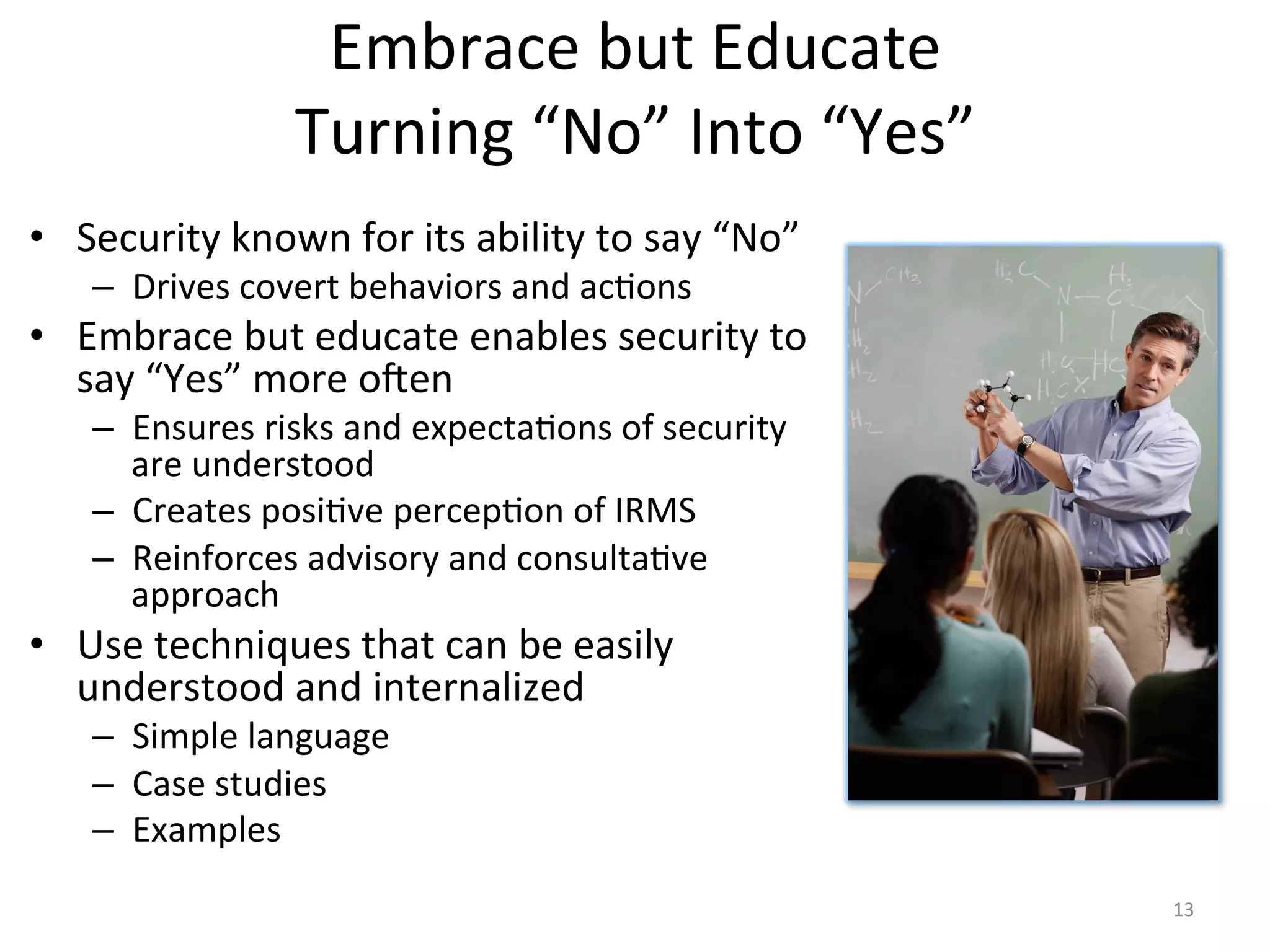
Embrace	
  but	
  Educate	
  
Turning	
  “No”	
  Into	
  “Yes”	
  
•  Security	
  known	
  for	
  its	
  ability	
  to	
  say	
  “No”	
  
–  Drives	
  covert	
  behaviors	
  and	
  ac/ons	
  
•  Embrace	
  but	
  educate	
  enables	
  security	
  to	
  
say	
  “Yes”	
  more	
  o^en	
  
–  Ensures	
  risks	
  and	
  expecta/ons	
  of	
  security	
  
are	
  understood	
  
–  Creates	
  posi/ve	
  percep/on	
  of	
  IRMS	
  
–  Reinforces	
  advisory	
  and	
  consulta/ve	
  
approach	
  
•  Use	
  techniques	
  that	
  can	
  be	
  easily	
  
understood	
  and	
  internalized	
  
–  Simple	
  language	
  
–  Case	
  studies	
  
–  Examples	
  
13	
  
Personal	
  Benefits	
  Approach	
  
•  Help	
  individuals	
  to	
  help	
  themselves	
  
–  Make	
  them	
  want	
  to	
  change	
  their	
  behaviors	
  
–  Change	
  both	
  personal	
  and	
  professional	
  behaviors	
  
•  Controls	
  that	
  restrict	
  without	
  context	
  will	
  
drive	
  covert	
  behaviors	
  
–  Proac/ve	
  educa/on	
  and	
  personal	
  benefit	
  beier	
  
and	
  o^en	
  cheaper	
  control	
  
–  Educa/on	
  of	
  safe	
  social	
  networking	
  easy	
  example	
  
to	
  use	
  to	
  champion	
  approach	
  
•  Users	
  will	
  embrace	
  security	
  if	
  they	
  understand	
  
the	
  universal	
  benefits	
  
–  Remove	
  the	
  percep/on	
  of	
  security	
  as	
  only	
  a	
  
requirement	
  of	
  the	
  business	
  
–  Assist	
  users	
  in	
  deriving	
  personnel	
  benefit	
  and	
  
value	
  from	
  security	
  knowledge	
  and	
  guidance	
  
14	
  
Final	
  Thoughts	
  
•  Culture	
  of	
  an	
  organiza/on	
  ul/mately	
  determines	
  
its	
  ability	
  to	
  protect	
  itself	
  
•  Crea/ng	
  a	
  risk	
  conscious	
  and	
  security	
  aware	
  
culture	
  is	
  a	
  journey	
  not	
  a	
  race	
  
–  Requires	
  careful	
  aien/on	
  and	
  constant	
  
reinforcement	
  
–  Ul/mately	
  provides	
  highest	
  return	
  on	
  investment	
  for	
  
protec/on	
  of	
  data	
  assets	
  and	
  informa/on	
  
infrastructure	
  
•  Change	
  in	
  culture	
  o^en	
  results	
  in	
  
conversion	
  of	
  malicious	
  aiacks	
  from	
  
incidents	
  to	
  anomalies	
  
–  Liile	
  to	
  no	
  material	
  business	
  impact	
  
–  Business	
  will	
  embrace	
  the	
  value	
  of	
  
Informa/on	
  Risk	
  Management	
  and	
  Security	
  
15	
  
Thank	
  You	
  for	
  Your	
  
Time!	
  
John	
  P.	
  Piron*	
  	
  
CGEIT,	
  CISA,	
  CISM,	
  CISSP,	
  CRISC,	
  ISSAP,	
  ISSMP	
  
President,	
  IP	
  Architects,	
  LLC.	
  
jpiron/@iparchitects.com	


Copyright	
  2013	
  -­‐	
  	
  IP	
  Architects,	
  LLC.,	
  -­‐	
  All	
  Rights	
  Reserved	
  

Changing the Mindset: Creating a Risk-Conscious Culture - Hacker Hotshots

  • 1.
    Changing  the  Mindset:  Crea/ng  a   Risk  Conscious  and  Security  Aware   Culture   Presented  By:   John  P.  Piron*,     CGEIT,  CISA,  CISM,  CISSP,  CRISC,  ISSAP,  ISSMP   President,  IP  Architects,  LLC.     Hacker  Hotshots   July  30,  2013   Copyright  2013  -­‐    IP  Architects,  LLC.,  -­‐  All  Rights  Reserved  
  • 2.
    Agenda   •  Using  risk  management  to  remove  the  fear   of  security   •  What  is  a  Risk  Aware  and  Security  Conscious   Culture?   •  Approaches  to  changing  crea/ng  and   changing  culture   •  Final  Thoughts  
  • 3.
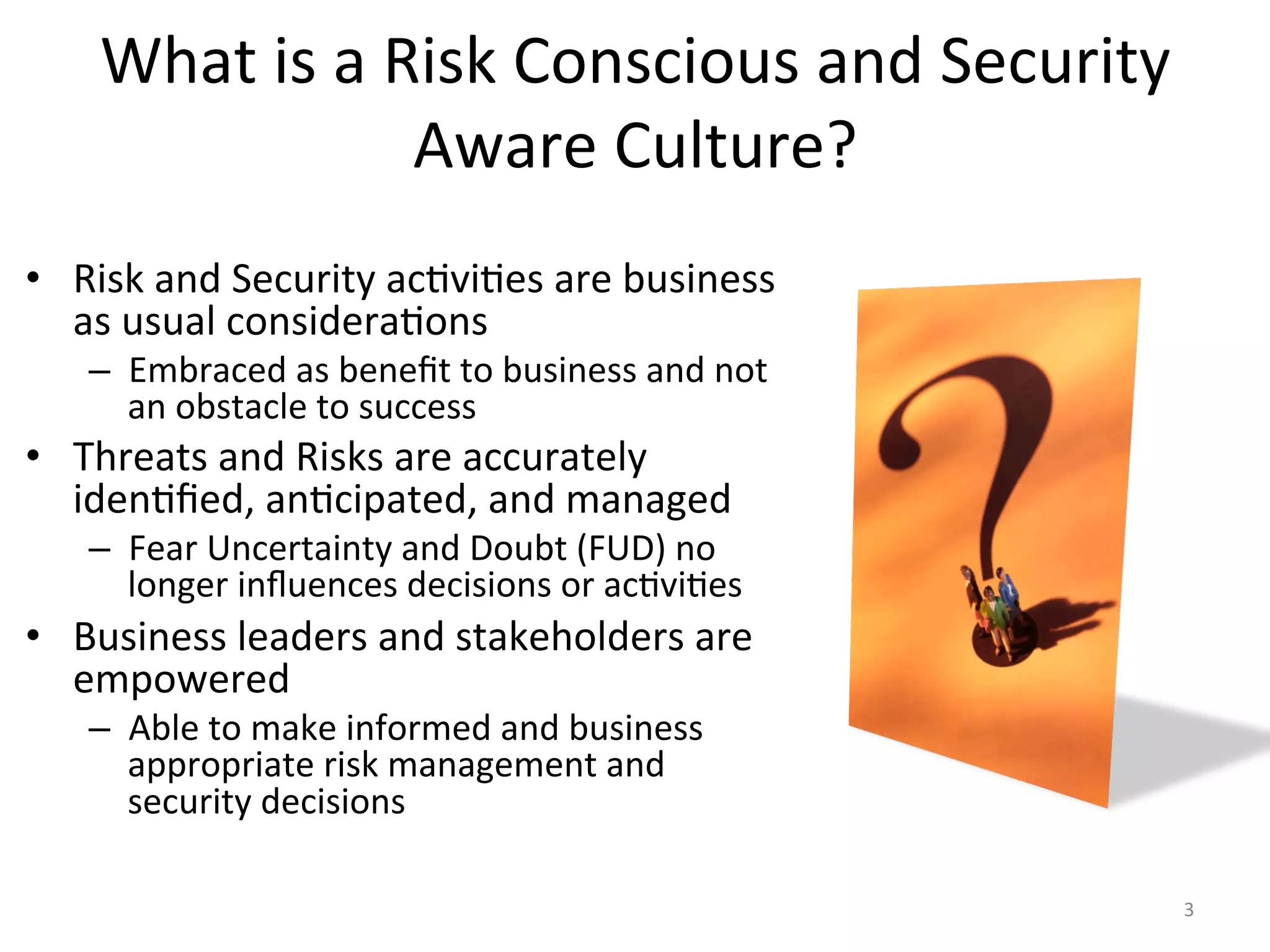
    What  is  a  Risk  Conscious  and  Security   Aware  Culture?   •  Risk  and  Security  ac/vi/es  are  business   as  usual  considera/ons   –  Embraced  as  benefit  to  business  and  not   an  obstacle  to  success   •  Threats  and  Risks  are  accurately   iden/fied,  an/cipated,  and  managed   –  Fear  Uncertainty  and  Doubt  (FUD)  no   longer  influences  decisions  or  ac/vi/es   •  Business  leaders  and  stakeholders  are   empowered     –  Able  to  make  informed  and  business   appropriate  risk  management  and   security  decisions   3  
  • 4.
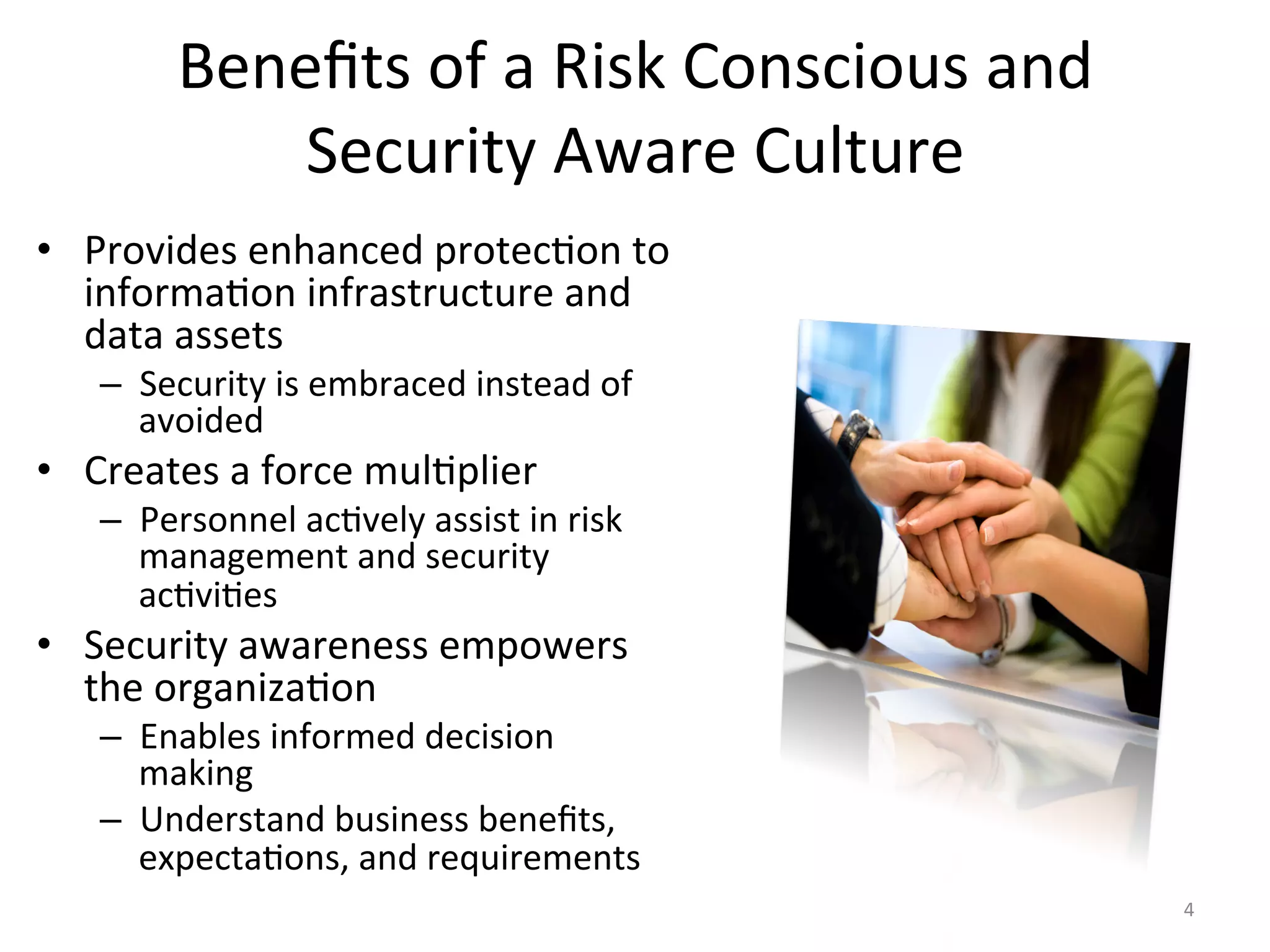
    Benefits  of  a  Risk  Conscious  and   Security  Aware  Culture   •  Provides  enhanced  protec/on  to   informa/on  infrastructure  and   data  assets   –  Security  is  embraced  instead  of   avoided   •  Creates  a  force  mul/plier   –  Personnel  ac/vely  assist  in  risk   management  and  security   ac/vi/es   •  Security  awareness  empowers   the  organiza/on   –  Enables  informed  decision   making   –  Understand  business  benefits,   expecta/ons,  and  requirements   4  
  • 5.
    Using  Risk  Management  to  Remove   The  Fear  of  Security   •  Business  leaders  and  stakeholders  are   typically  afraid  of  or  annoyed  by   security   –  O^en  believe  it  will  create  obstacles  that   will  prevent  them  from  being  successful   –  Always  being  told  what  they  cannot  do  by   security   •  Risk  management  empowers  business   leaders  and  stakeholders  to  make   appropriate  decisions  about  security   –  Stop  telling  them  what  you  think  they   have  to  do   –  Help  them  appreciate  the  risks  associated   with  their  op/ons   5  
  • 6.
    Risk  Management  and  Security  vs.   Security  and  Risk  Management   •  Mind  of  business  person  -­‐   “Security”   –  Preven/on,  disablement,   disempowerment   •  Mind  of  business  person  -­‐  “Risk”   –  Understanding,  management,   control,  empowerment   •  Alignment  with  risk  leads  to   greater  acceptance  then   alignment  with  security   –  Both  terminology  and  approach   –  Changing  the  mindset  requires  risk   first  and  security  second  approach   6  
  • 7.
    Change  the  Percep/on  and  Ac/ons   •  Security  professionals  o^en  use   the  word  “Risk”  when  they  mean   “Threat  and/or  Vulnerability”   –  Iden/fy  and  quan/fy  probabili/es   and  impacts   •  Without  current  business   intelligence  risk  can  not  be   accurately  or  properly  calculated   –  Strategy,  financial,  business   priori/es,  etc.   •  Leading  prac/ces  instead  of  best   prac/ces   –  Only  you  know  what  is  “best”  for   your  environment   7  
  • 8.
    Business  and  Informa/on  Risk  Profiles   •  Iden/fy  risk  tolerances  of  business  leaders  and   stakeholders   –  Establish  bounds  of  acceptable  loss,  compromise,   distribu/on,  or  disablement  for  key  business  processes   and  assets   •  Informa/on  risk  management  and  security   should  assist  in  their  development   –  Assists  in  cul/va/ng  awareness  of  consulta/ve   approach   –  Iden/fy  informa/on  threats  and  and  vulnerabili/es  and   associated  likelihoods  and  business  impacts  if  realized   –  Iden/fy,  develop,  implement  and  maintain  risk  aligned   control  objec/ves  in  line  with  iden/fied  tolerances   •  Business  leaders  will  view  of  Informa/on  Risk   Management  and  Security  (IRMS)  will  change   –  Valuable  informa/on  resource   –  Protec/ve  and  suppor/ng  func/on   8  
  • 9.
    Security  by  Compliance  –  Fear  the   Auditor  More  Then  The  Aiacker   •  Compliance  always  intended  as  the  star/ng   point  not  the  endgame   –  Compliance  requirements  will  always  have  to   catch  up  to  aiackers  and  their  capabili/es   •  Audit  and  examina/on  findings  have  a   known  business  outcome  and  impact   –  Security  threats  and  vulnerabili/es  have   probabili/es  and  poten/ali/es   •  Compliance  provides  business  leaders  and   stakeholders  a  way  to  push  back  on  FUD   –  Believe  that  they  are  doing  what  can  be   reasonably  expected  of  them   9  
  • 10.
    Policies  and  Standards  First,  Controls   and  Technology  Second   •  Policies  and  standards  define  requirements   and  expecta/ons   –  Iden/fy  control  objec/ves   –  Approved  by  business  leaders  and  stakeholders   •  Controls  and  technologies  assist  in  mee/ng   policy  and  standard  requirements   –  Technologies  should  not  define  control   objec/ves  or  requirements   –  Controls  and  technologies  presented  as   requirements  without  suppor/ng  policies  and   standards  o^en  considered  op/onal  or  ignored   •  Proposed  requirements  and  control   objec/ves  should  be  socialized  to  affected   audience  in  advance  of  policy  development   –  Iden/fy  areas  of  discomfort  or  discontent   before  developing  policies  and  standards   10  
  • 11.
    Users  –  Your  Greatest  Asset  and     Most  Challenging  Adversaries   •  Many  security  professionals  incorrectly   assume  users  are  weakest  link   –  User  may  unknowingly  cause  damage  or   harm   –  Must  be  protected  from  themselves   •  User  intui/on  can  be  a  powerful  control   –  Both  detec/ve  and  preventa/ve   –  Technical  controls  based  on  “yes”  or  “no”,   user  knows  “Maybe”   •  User  trust  is  key  to  cultural  change   –  Work  with  users  not  against  them   •  Privileged  users  can  cause  the  most   damage   –  Business  leaders  o^en  unable  or  unwilling  to   accept  users  may  be  working  against  them   11  
  • 12.
    Trust  But  Verify   •  Ideal  way  to  protect  both  users   and  corporate  assets   –  Ensures  users  are  not  falsely   accused   –  Provides  effec/ve  oversight   control  for  corpora/on   •  Make  sure  users  are  made  aware   of  the  existence  of  monitoring   –  Existence  alone  may  prevent   malicious  user  from  taking  ac/on   •  Privileged  user  ac/vi/es  most   important  to  monitor   –  Highest  poten/al  for  material   business  impact   12  
  • 13.
    Embrace  but  Educate   Turning  “No”  Into  “Yes”   •  Security  known  for  its  ability  to  say  “No”   –  Drives  covert  behaviors  and  ac/ons   •  Embrace  but  educate  enables  security  to   say  “Yes”  more  o^en   –  Ensures  risks  and  expecta/ons  of  security   are  understood   –  Creates  posi/ve  percep/on  of  IRMS   –  Reinforces  advisory  and  consulta/ve   approach   •  Use  techniques  that  can  be  easily   understood  and  internalized   –  Simple  language   –  Case  studies   –  Examples   13  
  • 14.
    Personal  Benefits  Approach   •  Help  individuals  to  help  themselves   –  Make  them  want  to  change  their  behaviors   –  Change  both  personal  and  professional  behaviors   •  Controls  that  restrict  without  context  will   drive  covert  behaviors   –  Proac/ve  educa/on  and  personal  benefit  beier   and  o^en  cheaper  control   –  Educa/on  of  safe  social  networking  easy  example   to  use  to  champion  approach   •  Users  will  embrace  security  if  they  understand   the  universal  benefits   –  Remove  the  percep/on  of  security  as  only  a   requirement  of  the  business   –  Assist  users  in  deriving  personnel  benefit  and   value  from  security  knowledge  and  guidance   14  
  • 15.
    Final  Thoughts   • Culture  of  an  organiza/on  ul/mately  determines   its  ability  to  protect  itself   •  Crea/ng  a  risk  conscious  and  security  aware   culture  is  a  journey  not  a  race   –  Requires  careful  aien/on  and  constant   reinforcement   –  Ul/mately  provides  highest  return  on  investment  for   protec/on  of  data  assets  and  informa/on   infrastructure   •  Change  in  culture  o^en  results  in   conversion  of  malicious  aiacks  from   incidents  to  anomalies   –  Liile  to  no  material  business  impact   –  Business  will  embrace  the  value  of   Informa/on  Risk  Management  and  Security   15  
  • 16.
    Thank  You  for  Your   Time!   John  P.  Piron*     CGEIT,  CISA,  CISM,  CISSP,  CRISC,  ISSAP,  ISSMP   President,  IP  Architects,  LLC.   jpiron/@iparchitects.com     Copyright  2013  -­‐    IP  Architects,  LLC.,  -­‐  All  Rights  Reserved