The Changing Dimensions of Distributed Learning Paulette Robinson, PhD Assistant Dean for Teaching, Learning and Technology National Defense University
Question… How many of you have had  1-5 different positions or jobs (in the same organization or different organizations) over your career 6-10 11-15 More…
Questions How many of you have been in your current workplace no more than 2 years?  How many of you have been in your current workplace no more than 5 years?  If you compare yourself with your parents and you adult children how are they different from you?
According to  the Department of Labor… 1 in 4 workers have been with their current employer less than 1 year 1 in 2 workers have been with their current employer less than 5 years Today’s learners will have 10-14 jobs by their 38 th  birthday
Preparing for work…  (Shift Happens 2.0) Top 10 in demand jobs in 2010 will not have existed in 2004 Many of today’s college majors did not exist 10 years ago (e.g., new media, e-business, nanotechnology, etc.) Technical information is doubling every 2 years and by 2010 it is predicted to double every 72 hrs We are currently preparing students for technical jobs that don’t exist in order to solve problems we don’t know are problems yet
Growing State of Information 3000 books are published daily It is estimated that 161 extabytes (4.0 x 10 19 —billion gigabytes) of unique information was generated world wide in 2006 (more than the last 5,000 years). In 2003, it was 5 extabytes and it is predicted to be 988 in 2010 (IDC) 2.7 billion searches occur on Google every month.
Technology Interaction  (Shift Happens 2.0) The number of text messages sent and received every day exceeds the total population of the planet Revenue for eBay reached 6 billion in 2006 MySpace visitors reached over 60 million in 2006 YouTube reaches over 100,000,000 users Wikipedia has more than 6 million articles posted  Today’s average 21 year olds have… Watched 20,000 hrs of TV Played 10,000 hrs of video games Talked 10,000 hrs on the phone  Sent/received 250,000 emails or Instant Messages More than 50% have created content for the web
How do we prepare the future workforce?   Lifelong learning is key Knowledge transfer  Experiential learning techniques (e.g., games, simulations, case studies, digital collaboration, etc.) Delivery using new collaborative Web 2.0 Convergence of 2-D, 3-D, and mobile technologies with a convergence of hardware.
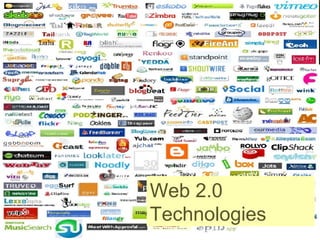
Web 2.0 Technologies
What is Web 2.0? “ Web 2.0 is ultimately about a social phenomenon…not just about networked social experiences, but about the distribution and creation of Web content itself, characterized by open communication, decentralization of authority, freedom to share and reuse, and the market as conversation (Abram, 2005)”
Web 2.0 Functional Types  Communicative Collaborative Documentation Generative Interactive (McGee, P. & Diaz, V. , 2007).
iPods/MP3 Players Mobile training on a handheld (Cell phones, PDAs, ultra-light computers, etc.) Advantages Disadvantages Examples IRM College In training Resources Duke University Digital Initiative  (http:// www.duke.edu/ddi /)
Instant Messaging/Text Messaging Synchronous text interactions between one or more individuals Advantages Disadvantages  Examples Resources Instant Messaging Online RU?  (http://www.educause.edu/ir/library/pdf/ERM0562.pdf) IM in Education  (http:// www.bigblueball.com/forums/im -education/) ; http://connect.educause.edu/library/abstract/InstantMessaginginOn/40014?time=1190994768 Corporate training and IM  http://www.cramersweeney.com/cs_id/trainingblog/2006/02/new-learning-tool-instant-messaging.htm
Blogs Shared digital diary or journal (text, image, sound, video)--asynchronous Advantages Disadvantages Examples Resources Blogs in Education  (http:// awd.cl.uh.edu/blog /) Using weblogs and RSS in education.  http://www.weblogg-ed.com /
Twitter Online application that is part blog, part social networking site, part cell phone/IM tool, designed to answer the question “what are you doing?”  Advantages Disadvantages Examples Resources http://web20teach.blogspot.com/2007/08/twitter-tweets-for-higher-education.html
Wikis Collaborative web-based tool where users can co-edit content (e.g., Wikipedia) Advantages Disadvantages IRM College examples Resources Using a Wiki in Education  ( http:// www.wikiineducation.com/display/ikiw/Home ) WikiMatrix  ( http:// www.wikimatrix.org /)
Communities of Practice Digital spaces where communities can share best practices (asynchronous and synchronous) Advantages Disadvantages Examples Resources Communities of Practice Online  (http://coponline.blogspot.com/2004/12/resources-and-links.html?CFID=8073458&CFTOKEN=69014080) Online Community Toolkit  (http:// www.fullcirc.com/community/communitymanual.htm )
Webinars Web-based synchronous seminar or interactive presentation tools that can be archived (e.g., WebEx, mShow, Adobe Connect).  Often combines web and telephone.  IRMC purchased services Advantages Disadvantages Examples IRM College Resources
3-D Virtual Worlds 3-D Internet spaces (e.g., Second Life, There, Forterra, Qwak, etc.) modeled after 3-D functionality found online games with avatars and personas Advantages Disadvantages Examples Resources New Media Consortium ( http:// www.nmc.org ;  http:// sl.nmc.org / ) Second Life ( http:// www.secondlife.com ;  http://secondlifegrid.net/programs/education ) Second Life & Education:  http://www.sl-education.org/
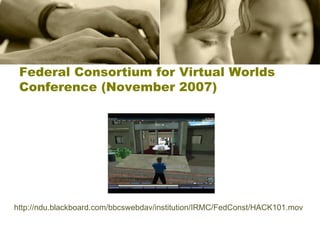
Federal Consortium for Virtual Worlds Conference (November 2007) http://ndu.blackboard.com/bbcswebdav/institution/IRMC/FedConst/HACK101.mov
Business Uses of Virtual Worlds Ability to simulate real-life objects in 3-D Ability of users to build 3-D models  Structured activities in 3-D spaces  Shared real time space that can host distributed groups of people Interpersonal communication Safe space that protects the privacy of users while letting them project their real or ideal identities  (Lamont, 2007)
Questions?  Contact Information: Paulette Robinson, PhD 202-685-3891 [email_address]

Changing Dimensions Of Distributed Learning

  • 1.
    The Changing Dimensionsof Distributed Learning Paulette Robinson, PhD Assistant Dean for Teaching, Learning and Technology National Defense University
  • 2.
    Question… How manyof you have had 1-5 different positions or jobs (in the same organization or different organizations) over your career 6-10 11-15 More…
  • 3.
    Questions How manyof you have been in your current workplace no more than 2 years? How many of you have been in your current workplace no more than 5 years? If you compare yourself with your parents and you adult children how are they different from you?
  • 4.
    According to the Department of Labor… 1 in 4 workers have been with their current employer less than 1 year 1 in 2 workers have been with their current employer less than 5 years Today’s learners will have 10-14 jobs by their 38 th birthday
  • 5.
    Preparing for work… (Shift Happens 2.0) Top 10 in demand jobs in 2010 will not have existed in 2004 Many of today’s college majors did not exist 10 years ago (e.g., new media, e-business, nanotechnology, etc.) Technical information is doubling every 2 years and by 2010 it is predicted to double every 72 hrs We are currently preparing students for technical jobs that don’t exist in order to solve problems we don’t know are problems yet
  • 6.
    Growing State ofInformation 3000 books are published daily It is estimated that 161 extabytes (4.0 x 10 19 —billion gigabytes) of unique information was generated world wide in 2006 (more than the last 5,000 years). In 2003, it was 5 extabytes and it is predicted to be 988 in 2010 (IDC) 2.7 billion searches occur on Google every month.
  • 7.
    Technology Interaction (Shift Happens 2.0) The number of text messages sent and received every day exceeds the total population of the planet Revenue for eBay reached 6 billion in 2006 MySpace visitors reached over 60 million in 2006 YouTube reaches over 100,000,000 users Wikipedia has more than 6 million articles posted Today’s average 21 year olds have… Watched 20,000 hrs of TV Played 10,000 hrs of video games Talked 10,000 hrs on the phone Sent/received 250,000 emails or Instant Messages More than 50% have created content for the web
  • 8.
    How do weprepare the future workforce? Lifelong learning is key Knowledge transfer Experiential learning techniques (e.g., games, simulations, case studies, digital collaboration, etc.) Delivery using new collaborative Web 2.0 Convergence of 2-D, 3-D, and mobile technologies with a convergence of hardware.
  • 9.
  • 10.
    What is Web2.0? “ Web 2.0 is ultimately about a social phenomenon…not just about networked social experiences, but about the distribution and creation of Web content itself, characterized by open communication, decentralization of authority, freedom to share and reuse, and the market as conversation (Abram, 2005)”
  • 11.
    Web 2.0 FunctionalTypes Communicative Collaborative Documentation Generative Interactive (McGee, P. & Diaz, V. , 2007).
  • 12.
    iPods/MP3 Players Mobiletraining on a handheld (Cell phones, PDAs, ultra-light computers, etc.) Advantages Disadvantages Examples IRM College In training Resources Duke University Digital Initiative (http:// www.duke.edu/ddi /)
  • 13.
    Instant Messaging/Text MessagingSynchronous text interactions between one or more individuals Advantages Disadvantages Examples Resources Instant Messaging Online RU? (http://www.educause.edu/ir/library/pdf/ERM0562.pdf) IM in Education (http:// www.bigblueball.com/forums/im -education/) ; http://connect.educause.edu/library/abstract/InstantMessaginginOn/40014?time=1190994768 Corporate training and IM http://www.cramersweeney.com/cs_id/trainingblog/2006/02/new-learning-tool-instant-messaging.htm
  • 14.
    Blogs Shared digitaldiary or journal (text, image, sound, video)--asynchronous Advantages Disadvantages Examples Resources Blogs in Education (http:// awd.cl.uh.edu/blog /) Using weblogs and RSS in education. http://www.weblogg-ed.com /
  • 15.
    Twitter Online applicationthat is part blog, part social networking site, part cell phone/IM tool, designed to answer the question “what are you doing?” Advantages Disadvantages Examples Resources http://web20teach.blogspot.com/2007/08/twitter-tweets-for-higher-education.html
  • 16.
    Wikis Collaborative web-basedtool where users can co-edit content (e.g., Wikipedia) Advantages Disadvantages IRM College examples Resources Using a Wiki in Education ( http:// www.wikiineducation.com/display/ikiw/Home ) WikiMatrix ( http:// www.wikimatrix.org /)
  • 17.
    Communities of PracticeDigital spaces where communities can share best practices (asynchronous and synchronous) Advantages Disadvantages Examples Resources Communities of Practice Online (http://coponline.blogspot.com/2004/12/resources-and-links.html?CFID=8073458&CFTOKEN=69014080) Online Community Toolkit (http:// www.fullcirc.com/community/communitymanual.htm )
  • 18.
    Webinars Web-based synchronousseminar or interactive presentation tools that can be archived (e.g., WebEx, mShow, Adobe Connect). Often combines web and telephone. IRMC purchased services Advantages Disadvantages Examples IRM College Resources
  • 19.
    3-D Virtual Worlds3-D Internet spaces (e.g., Second Life, There, Forterra, Qwak, etc.) modeled after 3-D functionality found online games with avatars and personas Advantages Disadvantages Examples Resources New Media Consortium ( http:// www.nmc.org ; http:// sl.nmc.org / ) Second Life ( http:// www.secondlife.com ; http://secondlifegrid.net/programs/education ) Second Life & Education: http://www.sl-education.org/
  • 20.
    Federal Consortium forVirtual Worlds Conference (November 2007) http://ndu.blackboard.com/bbcswebdav/institution/IRMC/FedConst/HACK101.mov
  • 21.
    Business Uses ofVirtual Worlds Ability to simulate real-life objects in 3-D Ability of users to build 3-D models Structured activities in 3-D spaces Shared real time space that can host distributed groups of people Interpersonal communication Safe space that protects the privacy of users while letting them project their real or ideal identities (Lamont, 2007)
  • 22.
    Questions? ContactInformation: Paulette Robinson, PhD 202-685-3891 [email_address]

Editor's Notes

  • #2 User focused and tailored