From the Classroom


                  to the World:
              Inspiring Social Justice Activism
                          in the Middle School

Mark Silbebrerg, Middle School Principal
msilberberg@lrei.org - @silberbergmark - #sj-nysais
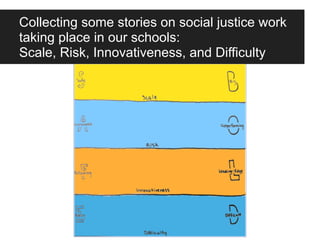
Collecting some stories on social justice work
taking place in our schools:
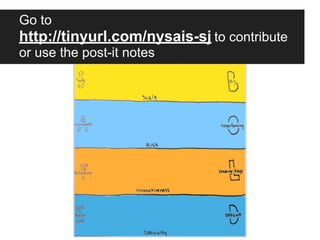
Scale, Risk, Innovativeness, and Difficulty
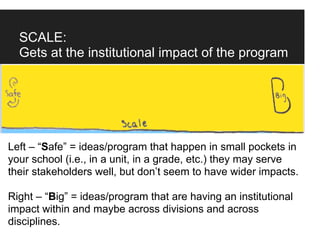
SCALE:
  Gets at the institutional impact of the program


Left – “Safe” = ideas/program that happen in small pockets in
your school (i.e., in a unit, in a grade, etc.) they may serve
their stakeholders well, but don’t seem to have wider impacts.

Right – “Big” = ideas/program that are having an institutional
impact within and maybe across divisions and across
disciplines.
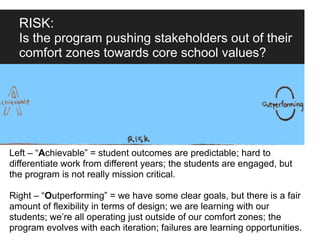
RISK:
  Is the program pushing stakeholders out of their
  comfort zones towards core school values?


Left – “Achievable” = student outcomes are predictable; hard to
differentiate work from different years; the students are engaged, but
the program is not really mission critical.

Right – “Outperforming” = we have some clear goals, but there is a fair
amount of flexibility in terms of design; we are learning with our
students; we’re all operating just outside of our comfort zones; the
program evolves with each iteration; failures are learning opportunities.
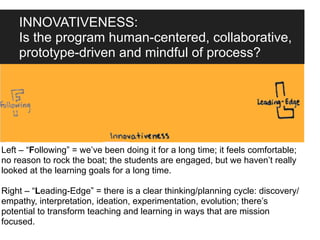
INNOVATIVENESS:
    Is the program human-centered, collaborative,
    prototype-driven and mindful of process?


Left – “Following” = we’ve been doing it for a long time; it feels comfortable;
no reason to rock the boat; the students are engaged, but we haven’t really
looked at the learning goals for a long time.

Right – “Leading-Edge” = there is a clear thinking/planning cycle: discovery/
empathy, interpretation, ideation, experimentation, evolution; there’s
potential to transform teaching and learning in ways that are mission
focused.
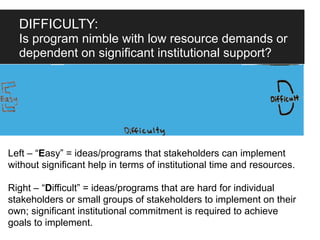
DIFFICULTY:
  Is program nimble with low resource demands or
  dependent on significant institutional support?


Left – “Easy” = ideas/programs that stakeholders can implement
without significant help in terms of institutional time and resources.

Right – “Difficult” = ideas/programs that are hard for individual
stakeholders or small groups of stakeholders to implement on their
own; significant institutional commitment is required to achieve
goals to implement.
Go to
http://tinyurl.com/nysais-sj to contribute
or use the post-it notes
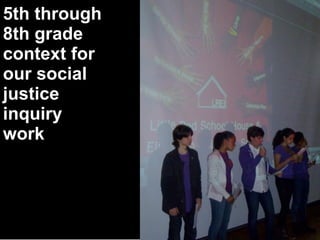
5th through
8th grade
context for
our social
justice
inquiry
work
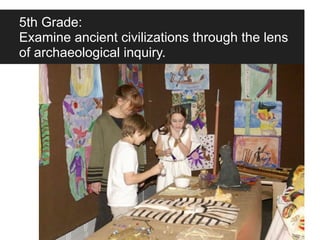
5th Grade:
Examine ancient civilizations through the lens
of archaeological inquiry.
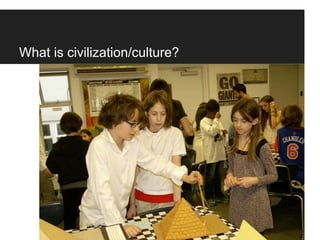
What is civilization/culture?
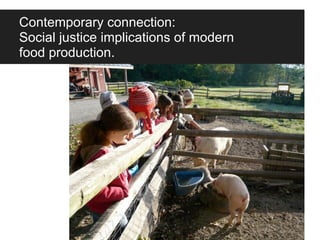
Contemporary connection:
Social justice implications of modern
food production.
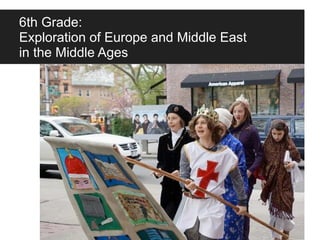
6th Grade:
Exploration of Europe and Middle East
in the Middle Ages
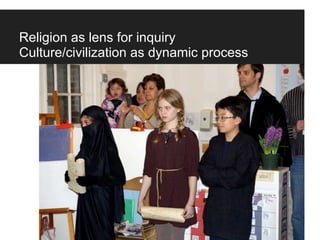
Religion as lens for inquiry
Culture/civilization as dynamic process
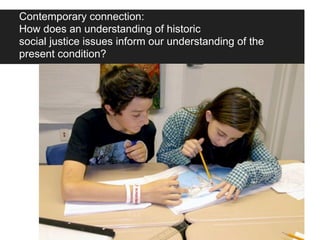
Contemporary connection:
How does an understanding of historic
social justice issues inform our understanding of the
present condition?
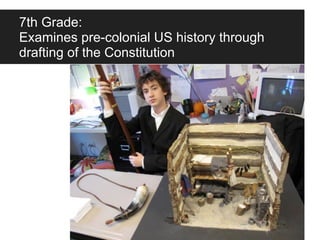
7th Grade:
Examines pre-colonial US history through
drafting of the Constitution
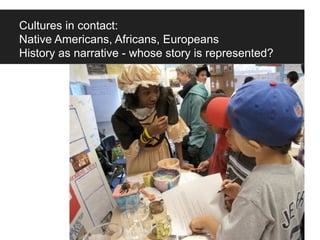
Cultures in contact:
Native Americans, Africans, Europeans
History as narrative - whose story is represented?
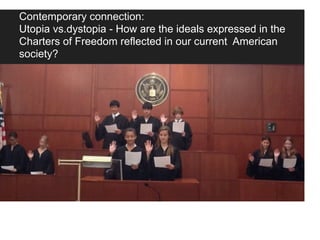
Contemporary connection:
Utopia vs.dystopia - How are the ideals expressed in the
Charters of Freedom reflected in our current American
society?
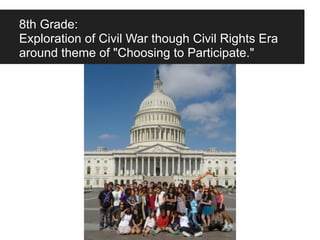
8th Grade:
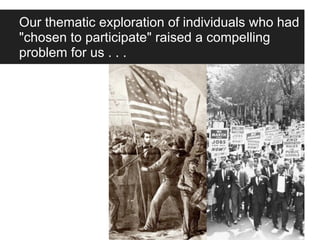
Exploration of Civil War though Civil Rights Era
around theme of "Choosing to Participate."
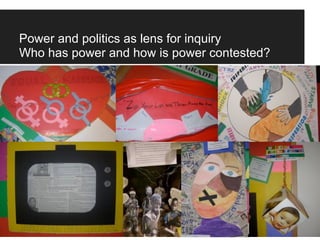
Power and politics as lens for inquiry
Who has power and how is power contested?
Our thematic exploration of individuals who had
"chosen to participate" raised a compelling
problem for us . . .
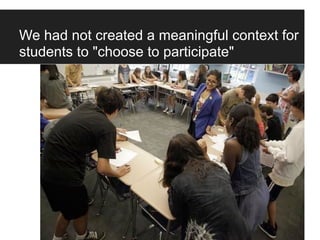
We had not created a meaningful context for
students to "choose to participate"
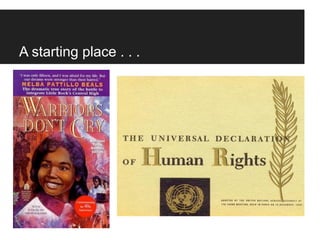
A starting place . . .
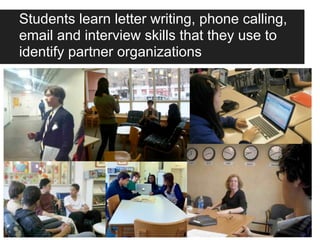
Students learn letter writing, phone calling,
email and interview skills that they use to
identify partner organizations
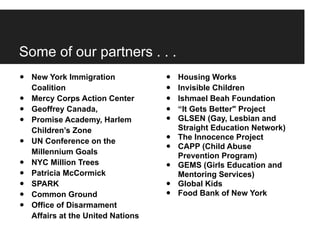
Some of our partners . . .
•   New York Immigration            •   Housing Works
    Coalition                       •   Invisible Children
•   Mercy Corps Action Center       •   Ishmael Beah Foundation
•   Geoffrey Canada,                •   “It Gets Better" Project
•   Promise Academy, Harlem         •   GLSEN (Gay, Lesbian and
    Children’s Zone                     Straight Education Network)
•   UN Conference on the            •   The Innocence Project
    Millennium Goals                •   CAPP (Child Abuse
                                        Prevention Program)
•   NYC Million Trees
                                    •   GEMS (Girls Education and
•   Patricia McCormick                  Mentoring Services)
•   SPARK                           •   Global Kids
•   Common Ground                   •   Food Bank of New York
•   Office of Disarmament
    Affairs at the United Nations
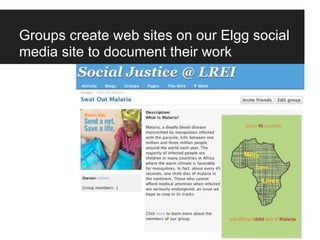
Groups create web sites on our Elgg social
media site to document their work
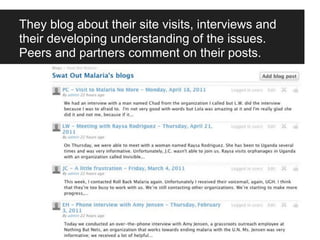
They blog about their site visits, interviews and
their developing understanding of the issues.
Peers and partners comment on their posts.
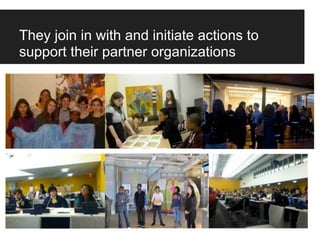
They join in with and initiate actions to
support their partner organizations
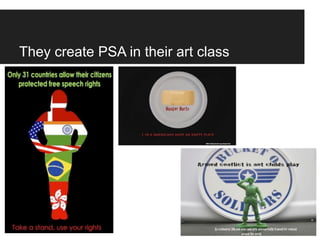
They create PSA in their art class
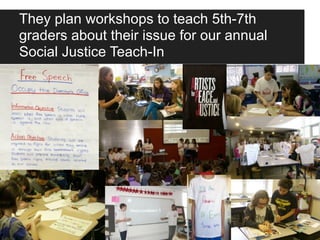
They plan workshops to teach 5th-7th
graders about their issue for our annual
Social Justice Teach-In
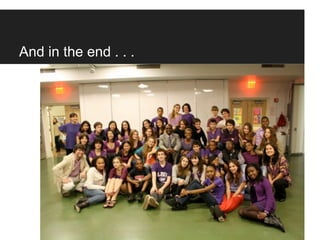
And in the end . . .
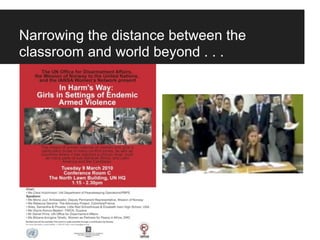
Narrowing the distance between the
classroom and world beyond . . .
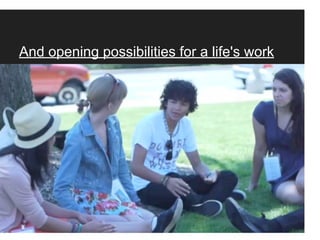
And opening possibilities for a life's work
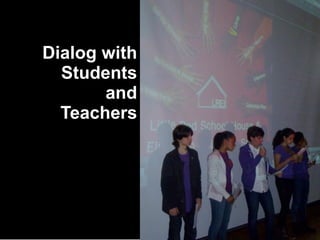
Dialog with
  Students
       and
  Teachers
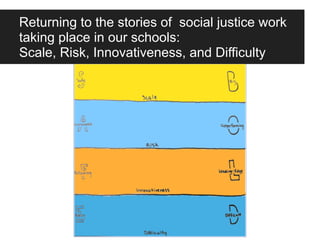
Returning to the stories of social justice work
taking place in our schools:
Scale, Risk, Innovativeness, and Difficulty
From the Classroom


                  to the World:
              Inspiring Social Justice Activism
                          in the Middle School

Mark Silbebrerg, Middle School Principal
msilberberg@lrei.org - @silberbergmark - #sj-nysais

Social justice presentation

  • 1.
    From the Classroom to the World: Inspiring Social Justice Activism in the Middle School Mark Silbebrerg, Middle School Principal msilberberg@lrei.org - @silberbergmark - #sj-nysais
  • 2.
    Collecting some storieson social justice work taking place in our schools: Scale, Risk, Innovativeness, and Difficulty
  • 3.
    SCALE: Getsat the institutional impact of the program Left – “Safe” = ideas/program that happen in small pockets in your school (i.e., in a unit, in a grade, etc.) they may serve their stakeholders well, but don’t seem to have wider impacts. Right – “Big” = ideas/program that are having an institutional impact within and maybe across divisions and across disciplines.
  • 4.
    RISK: Isthe program pushing stakeholders out of their comfort zones towards core school values? Left – “Achievable” = student outcomes are predictable; hard to differentiate work from different years; the students are engaged, but the program is not really mission critical. Right – “Outperforming” = we have some clear goals, but there is a fair amount of flexibility in terms of design; we are learning with our students; we’re all operating just outside of our comfort zones; the program evolves with each iteration; failures are learning opportunities.
  • 5.
    INNOVATIVENESS: Is the program human-centered, collaborative, prototype-driven and mindful of process? Left – “Following” = we’ve been doing it for a long time; it feels comfortable; no reason to rock the boat; the students are engaged, but we haven’t really looked at the learning goals for a long time. Right – “Leading-Edge” = there is a clear thinking/planning cycle: discovery/ empathy, interpretation, ideation, experimentation, evolution; there’s potential to transform teaching and learning in ways that are mission focused.
  • 6.
    DIFFICULTY: Isprogram nimble with low resource demands or dependent on significant institutional support? Left – “Easy” = ideas/programs that stakeholders can implement without significant help in terms of institutional time and resources. Right – “Difficult” = ideas/programs that are hard for individual stakeholders or small groups of stakeholders to implement on their own; significant institutional commitment is required to achieve goals to implement.
  • 7.
    Go to http://tinyurl.com/nysais-sj tocontribute or use the post-it notes
  • 8.
    5th through 8th grade contextfor our social justice inquiry work
  • 9.
    5th Grade: Examine ancientcivilizations through the lens of archaeological inquiry.
  • 10.
  • 11.
    Contemporary connection: Social justiceimplications of modern food production.
  • 12.
    6th Grade: Exploration ofEurope and Middle East in the Middle Ages
  • 13.
    Religion as lensfor inquiry Culture/civilization as dynamic process
  • 14.
    Contemporary connection: How doesan understanding of historic social justice issues inform our understanding of the present condition?
  • 15.
    7th Grade: Examines pre-colonialUS history through drafting of the Constitution
  • 16.
    Cultures in contact: NativeAmericans, Africans, Europeans History as narrative - whose story is represented?
  • 17.
    Contemporary connection: Utopia vs.dystopia- How are the ideals expressed in the Charters of Freedom reflected in our current American society?
  • 18.
    8th Grade: Exploration ofCivil War though Civil Rights Era around theme of "Choosing to Participate."
  • 19.
    Power and politicsas lens for inquiry Who has power and how is power contested?
  • 20.
    Our thematic explorationof individuals who had "chosen to participate" raised a compelling problem for us . . .
  • 21.
    We had notcreated a meaningful context for students to "choose to participate"
  • 22.
  • 23.
    Students learn letterwriting, phone calling, email and interview skills that they use to identify partner organizations
  • 24.
    Some of ourpartners . . . • New York Immigration • Housing Works Coalition • Invisible Children • Mercy Corps Action Center • Ishmael Beah Foundation • Geoffrey Canada, • “It Gets Better" Project • Promise Academy, Harlem • GLSEN (Gay, Lesbian and Children’s Zone Straight Education Network) • UN Conference on the • The Innocence Project Millennium Goals • CAPP (Child Abuse Prevention Program) • NYC Million Trees • GEMS (Girls Education and • Patricia McCormick Mentoring Services) • SPARK • Global Kids • Common Ground • Food Bank of New York • Office of Disarmament Affairs at the United Nations
  • 25.
    Groups create websites on our Elgg social media site to document their work
  • 26.
    They blog abouttheir site visits, interviews and their developing understanding of the issues. Peers and partners comment on their posts.
  • 27.
    They join inwith and initiate actions to support their partner organizations
  • 28.
    They create PSAin their art class
  • 29.
    They plan workshopsto teach 5th-7th graders about their issue for our annual Social Justice Teach-In
  • 30.
    And in theend . . .
  • 31.
    Narrowing the distancebetween the classroom and world beyond . . .
  • 32.
    And opening possibilitiesfor a life's work
  • 33.
    Dialog with Students and Teachers
  • 34.
    Returning to thestories of social justice work taking place in our schools: Scale, Risk, Innovativeness, and Difficulty
  • 35.
    From the Classroom to the World: Inspiring Social Justice Activism in the Middle School Mark Silbebrerg, Middle School Principal msilberberg@lrei.org - @silberbergmark - #sj-nysais