Curriculum
Part I.
Three Versions of Curriculum
Subject Centered
Teacher Centered
Student Centered
In my K-? Education, I have had….
20
%
20
%
20
%
20
%
20
%
All teacher-cente... Some Subject-cent...
Some student-cent... An optimal blend ...
A blend that had ...
1. All teacher-centered
experiences of curriculum
2. Some Subject-centered
experiences
3. Some student-centered
experiences
4. An optimal blend of these
varieties
5. A blend that had little
rhyme or reason to
recommend it
What is the nature of curriculum?
 Curriculum is something determined by
experts and authorities.
 There is no right curriculum.
 Curriculum should reflect the real world, be
practical, of use.
 There are many curricula we can learn and
negotiate
Please make your selection...
A
u
t
h
o
r
i
t
i
e
s
/
E
x
p
e
r
t
s
.
.
.
T
h
e
r
e
i
s
n
o
“
r
i
g
h
t
”
c
u
.
.
.
C
u
r
r
i
c
u
l
u
m
s
h
o
u
l
d
b
e
.
.
.
T
h
e
r
e
a
r
e
m
a
n
y
c
u
r
r
i
.
.
.
10%
48%
12%
30%
1. Authorities /Experts
Determine
2. There is no “right”
curriculum
3. Curriculum should be
the “real world”
4. There are many
curricula we can learn
Definitions of Curriculum
1. Curriculum is all of the
experiences children have
under the guidance of
teachers.
2. Curriculum encompasses all
learning opportunities provided
by school.
3. Curriculum is a plan for all
experiences which the learner
encounters in school.
4. Curriculum is subject to
perspectives, debate, change
Discipline, Discourse, & Theory
 Discipline – an area of study, with its own particular rules
and expectations.
 E.G., the discipline of Economics, or History
 Discourse – a system of statements that provide rules of
information and sets of practices within a social milieu (Grant
& Gillette, 2006).
 E.G. “discourse of free-market capitalism.”
 Theory– an argument about how to think about a discipline
or a discourse. Thinking about the
Nature of our thinking – “metacognition.”
 E.G. Theory of the novel, or Theory of Evolution, or Marxist
Theory of History
Who owns the curriculum?
 A teacher in a public school is an employee
of the district, which is an educational entity
of the state.
 It is the state, the governor, the legislature
(the state dept. of education or state board of
education) which has ultimate responsibility
over the curriculum.
Curriculum…Thomas Popkewitz
 “I view curriculum as a particular, historically formed
knowledge that inscribes rules and standards by
which we ‘reason’ about the world and our ‘self’ as a
productive member of that world.”
 “Curriculum is a disciplining technology that directs
how the individual is to act, feel, talk, and ‘see’ the
world and the ‘self.’ As such, curriculum is a form of
social regulation.”
Curriculum and Power Relationships
 Expert knowledge shapes our thinking about
much in our daily life.
 We think of it as “natural” but it is not…it is
built from expert systems of thinking.
 We assume expert knowledge to be true.
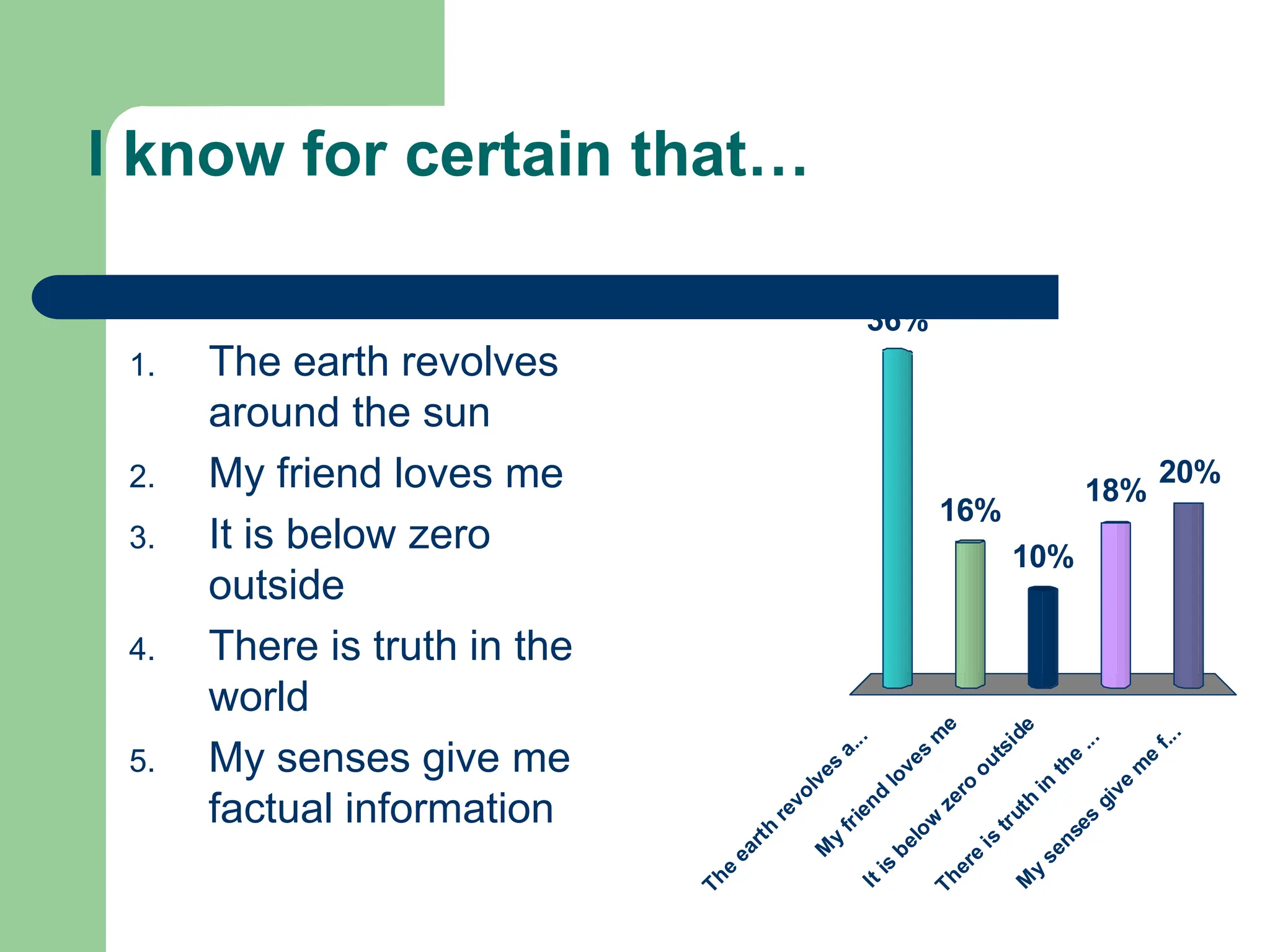
I know for certain that…
T
h
e
e
a
r
t
h
r
e
v
o
l
v
e
s
a
.
.
.
M
y
f
r
i
e
n
d
l
o
v
e
s
m
e
I
t
i
s
b
e
l
o
w
z
e
r
o
o
u
t
s
i
d
e
T
h
e
r
e
i
s
t
r
u
t
h
i
n
t
h
e
.
.
.
M
y
s
e
n
s
e
s
g
i
v
e
m
e
f
.
.
.
36%
16%
20%
18%
10%
1. The earth revolves
around the sun
2. My friend loves me
3. It is below zero
outside
4. There is truth in the
world
5. My senses give me
factual information
Curriculum Standards
 Nothing new…in 1909 E.L. Thorndike developed handwriting
standards measuring students’ penmanship performance
 Standards consider content and performance and remove the
need for teachers to guess or make inferences about what
students need to know
 Content standards specify what students should know and be
able to do
 Performance standards specify the evidence needed to
demonstrate achievement
 Tendency toward conservative visions of back to basics since
1983 A Nation at Risk Report
 Tendency toward internationalism in curricular thinking
Standards and Curriculum
 “Although most educators…argue that these
standards are not the curriculum, standards do
suggest the learning experience and opportunities
that students should have under the guidance of the
teachers.”
 “…for many teachers, the standards have become
the fusion of teachers’ public, professional, and
personal knowledge that disciplines their choices
and possibilities, and must therefore be thought of as
the effects of power.”
The Overt Curriculum
 The overt curriculum is the open, or public,
dimension and includes current and
historical interpretations, learning
experiences, and learning outcomes.
 Openly discussed, consciously planned,
usually written down, presented through the
instructional process
 Textbooks, learning kits, lesson plans, school
plays etc.
Overt Curriculum
 Provides students with science, history,
math, literature
 Provides students with the knowledge society
wants them to have…beyond the academics
 Social Responsibility…the overt curriculum
should be “society’s messenger” (Benjamin
Franklin)
Society’s Messsenger
 In the 1600s…for religious purposes…Old Deluder
Satan laws (1642)
 In order to organize what students should learn and
teachers should teach, The New England Primer
was published (1690)
 In the late 1700s and 1800s, Americanization
 1900’s Progressivism for Democracy in reforms
founded on thinking of John Dewey
 E.D. Hirsch, Cultural Literacy
The Invisible (Hidden)Curriculum
 The processes…the “noise” by which the overt
curriculum is transmitted
 “they are also learning and modifying attitudes,
motives, and values in relationship to the
experiences…in the classroom.”
 The nonacademic outcomes of formal education are
sometimes of greater consequence…than is learning
the subject matter….
Results of the Hidden Curriculum
 Notions of truth, ways of thinking, unstated
implications
 Appraisals of self-worth
 Social Roles
 Middle-Class Perspectives
 Attitudes and Behavior Required for Work
I see myself
1. As an “A” kind of person
2. As a future leader in my field
3. As a hard worker
4. As a solid middle class member
The “What Knowledge” Debate
 Colonial – moral education
 19th Century – “Americanization”
 Early 20th …The Scopes trial…before
Scopes, religious faith was the common, if
not universal, premise of American thought;
after Scopes, scientific skepticism prevailed.
 A Nation at Risk (1983) return to the “basics”
The Null Curriculum
 When a topic is never taught:
 “too unimportant…”
 “too controversial…”
 “too inappropriate…”
 “not worth the time…”
 “not essential…”
Extra or Co-curricula
 Beneficial to self-esteem
 Improved race relations
 Higher SAT scores, grades
 Better health for females, gender stereotypes
undermined
 Higher career aspirations
The “Whose Knowledge” Debate
 …our arguments over curriculum are also
our arguments over who we are as
Americans, including how we wish to
represent ourselves to our children
 The Canon…defining what is central and
what is marginal
Curriculum Organization
 Societal level…politicians, special committees,
experts
 Institutional level…set at the school, district,
college…usually set along subject matter disciplines
 Instructional level…teacher planning and teaching
students
 Ideological level…learning theorists and subject
matter specialists
The Reign of the Textbook
 Textbook adoption states
 Effects
 Economies of scale
 Censorship
 “Mentioning Effect…”
 Inauthentic text
 Timeliness
Standards Movement
 Content Standards
– Whose content?
– Traditional versus Progressive
– Today…debate over Scientifically Based
Practices in education.
NCLB
 Annual Testing
 Academic Improvement
 Report Cards
 Faculty Qualifications
Adequate Yearly Progress
 AYP
 “Underperforming” by measurements
 Students and parents offered options
 Consequent Loss of Funding
 Browse State Website?
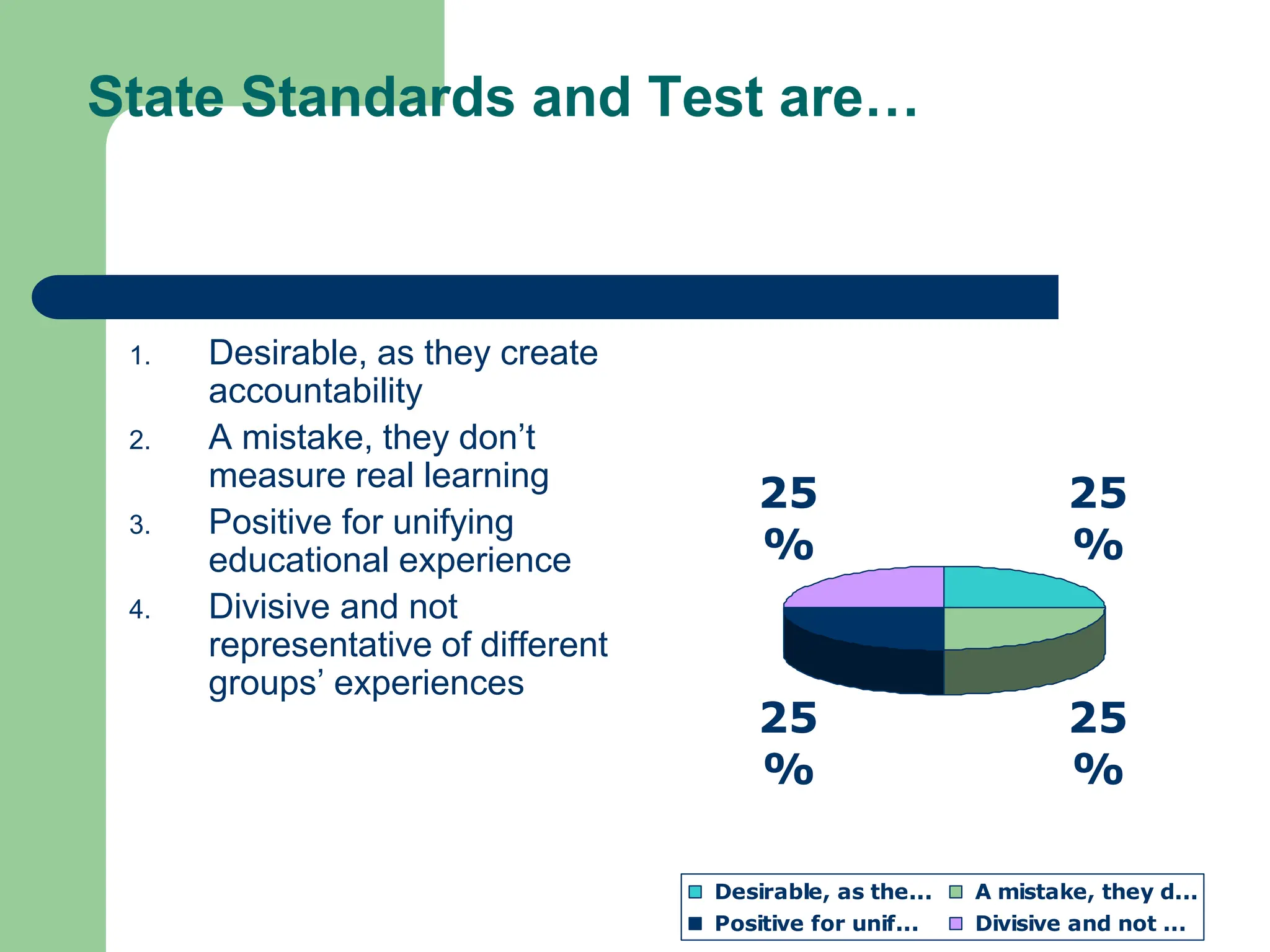
State Standards and Test are…
25
%
25
%
25
%
25
%
Desirable, as the... A mistake, they d...
Positive for unif... Divisive and not ...
1. Desirable, as they create
accountability
2. A mistake, they don’t
measure real learning
3. Positive for unifying
educational experience
4. Divisive and not
representative of different
groups’ experiences
Alfie Kohn
 Individuals lost in sea of tests
 Learning as exploration, creativity stifled
 Use of threats and bribery counter to ethical
education.
 Shifting emphasis from real issues to surface
issues
 Detract from teacher autonomy
Topics in Curriculum / Know these in
terms of philosophy topics?
 Creationism versus Evolution
 Core Knowledge, the Canon, versus
Multiculturalism
 Multiple Intelligences
 Critical Thinking Skills
 Metacognition
 Critical Pedagogy (and literacy)

Curriculum.ppt

  • 1.
  • 2.
    Three Versions ofCurriculum Subject Centered Teacher Centered Student Centered
  • 4.
    In my K-?Education, I have had…. 20 % 20 % 20 % 20 % 20 % All teacher-cente... Some Subject-cent... Some student-cent... An optimal blend ... A blend that had ... 1. All teacher-centered experiences of curriculum 2. Some Subject-centered experiences 3. Some student-centered experiences 4. An optimal blend of these varieties 5. A blend that had little rhyme or reason to recommend it
  • 5.
    What is thenature of curriculum?  Curriculum is something determined by experts and authorities.  There is no right curriculum.  Curriculum should reflect the real world, be practical, of use.  There are many curricula we can learn and negotiate
  • 6.
    Please make yourselection... A u t h o r i t i e s / E x p e r t s . . . T h e r e i s n o “ r i g h t ” c u . . . C u r r i c u l u m s h o u l d b e . . . T h e r e a r e m a n y c u r r i . . . 10% 48% 12% 30% 1. Authorities /Experts Determine 2. There is no “right” curriculum 3. Curriculum should be the “real world” 4. There are many curricula we can learn
  • 7.
    Definitions of Curriculum 1.Curriculum is all of the experiences children have under the guidance of teachers. 2. Curriculum encompasses all learning opportunities provided by school. 3. Curriculum is a plan for all experiences which the learner encounters in school. 4. Curriculum is subject to perspectives, debate, change
  • 8.
    Discipline, Discourse, &Theory  Discipline – an area of study, with its own particular rules and expectations.  E.G., the discipline of Economics, or History  Discourse – a system of statements that provide rules of information and sets of practices within a social milieu (Grant & Gillette, 2006).  E.G. “discourse of free-market capitalism.”  Theory– an argument about how to think about a discipline or a discourse. Thinking about the Nature of our thinking – “metacognition.”  E.G. Theory of the novel, or Theory of Evolution, or Marxist Theory of History
  • 9.
    Who owns thecurriculum?  A teacher in a public school is an employee of the district, which is an educational entity of the state.  It is the state, the governor, the legislature (the state dept. of education or state board of education) which has ultimate responsibility over the curriculum.
  • 10.
    Curriculum…Thomas Popkewitz  “Iview curriculum as a particular, historically formed knowledge that inscribes rules and standards by which we ‘reason’ about the world and our ‘self’ as a productive member of that world.”  “Curriculum is a disciplining technology that directs how the individual is to act, feel, talk, and ‘see’ the world and the ‘self.’ As such, curriculum is a form of social regulation.”
  • 11.
    Curriculum and PowerRelationships  Expert knowledge shapes our thinking about much in our daily life.  We think of it as “natural” but it is not…it is built from expert systems of thinking.  We assume expert knowledge to be true.
  • 12.
    I know forcertain that… T h e e a r t h r e v o l v e s a . . . M y f r i e n d l o v e s m e I t i s b e l o w z e r o o u t s i d e T h e r e i s t r u t h i n t h e . . . M y s e n s e s g i v e m e f . . . 36% 16% 20% 18% 10% 1. The earth revolves around the sun 2. My friend loves me 3. It is below zero outside 4. There is truth in the world 5. My senses give me factual information
  • 13.
    Curriculum Standards  Nothingnew…in 1909 E.L. Thorndike developed handwriting standards measuring students’ penmanship performance  Standards consider content and performance and remove the need for teachers to guess or make inferences about what students need to know  Content standards specify what students should know and be able to do  Performance standards specify the evidence needed to demonstrate achievement  Tendency toward conservative visions of back to basics since 1983 A Nation at Risk Report  Tendency toward internationalism in curricular thinking
  • 14.
    Standards and Curriculum “Although most educators…argue that these standards are not the curriculum, standards do suggest the learning experience and opportunities that students should have under the guidance of the teachers.”  “…for many teachers, the standards have become the fusion of teachers’ public, professional, and personal knowledge that disciplines their choices and possibilities, and must therefore be thought of as the effects of power.”
  • 15.
    The Overt Curriculum The overt curriculum is the open, or public, dimension and includes current and historical interpretations, learning experiences, and learning outcomes.  Openly discussed, consciously planned, usually written down, presented through the instructional process  Textbooks, learning kits, lesson plans, school plays etc.
  • 16.
    Overt Curriculum  Providesstudents with science, history, math, literature  Provides students with the knowledge society wants them to have…beyond the academics  Social Responsibility…the overt curriculum should be “society’s messenger” (Benjamin Franklin)
  • 17.
    Society’s Messsenger  Inthe 1600s…for religious purposes…Old Deluder Satan laws (1642)  In order to organize what students should learn and teachers should teach, The New England Primer was published (1690)  In the late 1700s and 1800s, Americanization  1900’s Progressivism for Democracy in reforms founded on thinking of John Dewey  E.D. Hirsch, Cultural Literacy
  • 18.
    The Invisible (Hidden)Curriculum The processes…the “noise” by which the overt curriculum is transmitted  “they are also learning and modifying attitudes, motives, and values in relationship to the experiences…in the classroom.”  The nonacademic outcomes of formal education are sometimes of greater consequence…than is learning the subject matter….
  • 19.
    Results of theHidden Curriculum  Notions of truth, ways of thinking, unstated implications  Appraisals of self-worth  Social Roles  Middle-Class Perspectives  Attitudes and Behavior Required for Work
  • 20.
    I see myself 1.As an “A” kind of person 2. As a future leader in my field 3. As a hard worker 4. As a solid middle class member
  • 21.
    The “What Knowledge”Debate  Colonial – moral education  19th Century – “Americanization”  Early 20th …The Scopes trial…before Scopes, religious faith was the common, if not universal, premise of American thought; after Scopes, scientific skepticism prevailed.  A Nation at Risk (1983) return to the “basics”
  • 22.
    The Null Curriculum When a topic is never taught:  “too unimportant…”  “too controversial…”  “too inappropriate…”  “not worth the time…”  “not essential…”
  • 23.
    Extra or Co-curricula Beneficial to self-esteem  Improved race relations  Higher SAT scores, grades  Better health for females, gender stereotypes undermined  Higher career aspirations
  • 24.
    The “Whose Knowledge”Debate  …our arguments over curriculum are also our arguments over who we are as Americans, including how we wish to represent ourselves to our children  The Canon…defining what is central and what is marginal
  • 25.
    Curriculum Organization  Societallevel…politicians, special committees, experts  Institutional level…set at the school, district, college…usually set along subject matter disciplines  Instructional level…teacher planning and teaching students  Ideological level…learning theorists and subject matter specialists
  • 26.
    The Reign ofthe Textbook  Textbook adoption states  Effects  Economies of scale  Censorship  “Mentioning Effect…”  Inauthentic text  Timeliness
  • 27.
    Standards Movement  ContentStandards – Whose content? – Traditional versus Progressive – Today…debate over Scientifically Based Practices in education.
  • 28.
    NCLB  Annual Testing Academic Improvement  Report Cards  Faculty Qualifications
  • 29.
    Adequate Yearly Progress AYP  “Underperforming” by measurements  Students and parents offered options  Consequent Loss of Funding  Browse State Website?
  • 30.
    State Standards andTest are… 25 % 25 % 25 % 25 % Desirable, as the... A mistake, they d... Positive for unif... Divisive and not ... 1. Desirable, as they create accountability 2. A mistake, they don’t measure real learning 3. Positive for unifying educational experience 4. Divisive and not representative of different groups’ experiences
  • 31.
    Alfie Kohn  Individualslost in sea of tests  Learning as exploration, creativity stifled  Use of threats and bribery counter to ethical education.  Shifting emphasis from real issues to surface issues  Detract from teacher autonomy
  • 32.
    Topics in Curriculum/ Know these in terms of philosophy topics?  Creationism versus Evolution  Core Knowledge, the Canon, versus Multiculturalism  Multiple Intelligences  Critical Thinking Skills  Metacognition  Critical Pedagogy (and literacy)