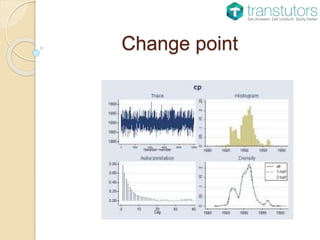
Change point
Introduction
 The change point detection is known as a stochastic
process in the statistical study, that is used to identify the
timely changes when the probability distribution of the system
changes or when the time series of the system changes.
 It deals with the problem that concern in detecting whether
the time change has occurred or not and if occurred, it
determines the time limit during which the change has
occurred
 The change detection is sometimes known as the anomaly
detection as it deals with the different detection techniques
like step and edge value detection that are concerned with
the change occurred in the values like mean, median,
variance and covariance
Types of detection
 Minimax change detection
The objective of this Minimax detection is to reduce
the delay that is expected to take place in a system in some
worst-case that can occur during the time distribution. This
detection technique is carried out by CUSUM procedure
which is one of the popular techniques.
 Offline change detection
This detection method was found out by basseville
that observes the change in mean detection of the system.
This estimation is related to the EM algorithm method and the
related methods like two-phase regression, clustering and in
the maximum likelihood estimation of the system variables.
 Linguistic change detection
This type of detection method deals with the ability
to detect the word-level changes that occur in the multiple
presentations of the same sentence.
Change point detection packages
 CPM:
The CPM method is used for the change detection in
the parametric and non-parametric sequences of the given
system. It is more helpful in the detection of multiple point
change that occurs in the time series from the unknown
distribution
 BCP:
This package is used for performing the Bayesian
analysis of change points in problems. This is an R package.
That was designed using the markov chain Carlo to find the
multiple changes in point that occurs within the sequence
 ECP:
This package is specially designed for the non-
parametric multiple point change analysis of the multivariate
data. The ECP package is similar to the hierarchical
clustering process used in the EM algorithm
The process in Change Point
detection
 First, when we perform the analysis, the analyst can
incorporate the background knowledge about the data
and the possible effects from the external events. This
kind of observation is not easily gathered for the
algorithm
 Second, this is the process that takes place before the
final step. This process mainly concentrates on the less
complex decision making technique
 The third and the final process involves the submission
of the visual feedback that demonstrates how these
algorithms perform and provide the judgment by
providing a second opinion
Change-point analysis
 This analysis is more powerful in detecting the small as well as
sustained changes
 It reduces the possibility of false detections by implementing the
control of change-wise error rate. While, control charts use point-
wise error rate for large data that produces more false detections
 This type of analysis is more flexible. The analysis is based on the
single assumption only
 The method is simpler and easy to use and to be interpreted. It has
the ability to automate the difficult process
Applications
 The change detection tests is helpful in the
manufacture of equipments that helps in the quality
control and in the detection of intrusion, filtering of
spam, tracking of websites and in the diagnosis of
medical aids.
 The change-point detection is more helpful in the field
of simulation process and in designing the filters for
the digital signal processing.
Hey Friends,
This was just a summary on Change Point. For
more detailed information on this topic, please type
the link given below or copy it from the description of
this PPT and open it in a new browser window.
http://www.transtutors.com/homework-
help/statistics/change-point.aspx

Change Point | Statistics

  • 1.
  • 2.
    Introduction  The changepoint detection is known as a stochastic process in the statistical study, that is used to identify the timely changes when the probability distribution of the system changes or when the time series of the system changes.  It deals with the problem that concern in detecting whether the time change has occurred or not and if occurred, it determines the time limit during which the change has occurred  The change detection is sometimes known as the anomaly detection as it deals with the different detection techniques like step and edge value detection that are concerned with the change occurred in the values like mean, median, variance and covariance
  • 3.
    Types of detection Minimax change detection The objective of this Minimax detection is to reduce the delay that is expected to take place in a system in some worst-case that can occur during the time distribution. This detection technique is carried out by CUSUM procedure which is one of the popular techniques.  Offline change detection This detection method was found out by basseville that observes the change in mean detection of the system. This estimation is related to the EM algorithm method and the related methods like two-phase regression, clustering and in the maximum likelihood estimation of the system variables.  Linguistic change detection This type of detection method deals with the ability to detect the word-level changes that occur in the multiple presentations of the same sentence.
  • 4.
    Change point detectionpackages  CPM: The CPM method is used for the change detection in the parametric and non-parametric sequences of the given system. It is more helpful in the detection of multiple point change that occurs in the time series from the unknown distribution  BCP: This package is used for performing the Bayesian analysis of change points in problems. This is an R package. That was designed using the markov chain Carlo to find the multiple changes in point that occurs within the sequence  ECP: This package is specially designed for the non- parametric multiple point change analysis of the multivariate data. The ECP package is similar to the hierarchical clustering process used in the EM algorithm
  • 5.
    The process inChange Point detection  First, when we perform the analysis, the analyst can incorporate the background knowledge about the data and the possible effects from the external events. This kind of observation is not easily gathered for the algorithm  Second, this is the process that takes place before the final step. This process mainly concentrates on the less complex decision making technique  The third and the final process involves the submission of the visual feedback that demonstrates how these algorithms perform and provide the judgment by providing a second opinion
  • 6.
    Change-point analysis  Thisanalysis is more powerful in detecting the small as well as sustained changes  It reduces the possibility of false detections by implementing the control of change-wise error rate. While, control charts use point- wise error rate for large data that produces more false detections  This type of analysis is more flexible. The analysis is based on the single assumption only  The method is simpler and easy to use and to be interpreted. It has the ability to automate the difficult process
  • 7.
    Applications  The changedetection tests is helpful in the manufacture of equipments that helps in the quality control and in the detection of intrusion, filtering of spam, tracking of websites and in the diagnosis of medical aids.  The change-point detection is more helpful in the field of simulation process and in designing the filters for the digital signal processing.
  • 8.
    Hey Friends, This wasjust a summary on Change Point. For more detailed information on this topic, please type the link given below or copy it from the description of this PPT and open it in a new browser window. http://www.transtutors.com/homework- help/statistics/change-point.aspx