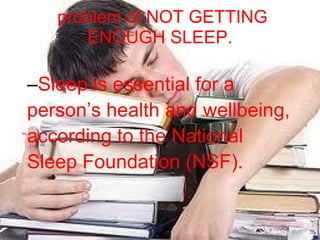
problem of NOT GETTING
      ENOUGH SLEEP.

–Sleep is essential for a
person’s health and wellbeing,
according to the National
Sleep Foundation (NSF).
EFFECT OF SLEEPLESSNESS

• If a sleep-deprived person doesn’t sleep
after the initial signs, the person may then
start to experience apathy, slowed speech
and flattened emotional responses,
impaired memory and an inability to be
novel or multitask.
As a person gets to the point of falling
asleep, he or she will fall into micro sleeps
that cause lapses in attention, nod off while
doing an activity like driving or reading .
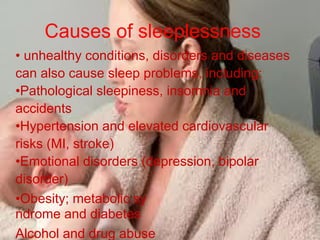
Causes of sleeplessness
• unhealthy conditions, disorders and diseases
can also cause sleep problems, including:
•Pathological sleepiness, insomnia and
accidents
•Hypertension and elevated cardiovascular
risks (MI, stroke)
•Emotional disorders (depression, bipolar
disorder)
•Obesity; metabolic sy
ndrome and diabetes
Alcohol and drug abuse
»Stress is the number one cause of short-term sleeping
difficulties, according to sleep experts. Common triggers
include school- or job-related pressures, a family or
marriage problem and a serious illness or death in the
family.
Drinking alcohol or beverages
containing caffeine in the
afternoon or evening, exercising
close to bedtime, following an
irregular morning and nighttime
schedule, and working or doing
other mentally intense activities
right before or after getting into
bed can disrupt sleep.
•Usually the sleep problem disappears when
the stressful situation passes. However, if
short-term sleep problems such as insomnia
aren't managed properly from the beginning,
they can persist long after the original stress
has passed.
•Risk factors for drowsy driving crashes:
•Late night/early morning driving
•Patients with untreated excessive sleepiness
•People who obtain six or fewer hours of sleep per
day
•Young adult males
•Commercial truck drivers
•Night shift workers
According to sleep researchers, a
night's sleep is divided into five
continually shifting stages, defined by
types of brain waves that reflect either
lighter or deeper sleep. Toward
morning, there is an increase in rapid
eye movement, or REM sleep, when
the muscles are relaxed and dreaming
occurs, and recent memories may be
consolidated in the brain.
CHALLENGE ASSUMPTIONS

CHALLENGE ASSUMPTIONS

  • 1.
    problem of NOTGETTING ENOUGH SLEEP. –Sleep is essential for a person’s health and wellbeing, according to the National Sleep Foundation (NSF).
  • 3.
    EFFECT OF SLEEPLESSNESS •If a sleep-deprived person doesn’t sleep after the initial signs, the person may then start to experience apathy, slowed speech and flattened emotional responses, impaired memory and an inability to be novel or multitask.
  • 4.
    As a persongets to the point of falling asleep, he or she will fall into micro sleeps that cause lapses in attention, nod off while doing an activity like driving or reading .
  • 5.
    Causes of sleeplessness •unhealthy conditions, disorders and diseases can also cause sleep problems, including: •Pathological sleepiness, insomnia and accidents •Hypertension and elevated cardiovascular risks (MI, stroke) •Emotional disorders (depression, bipolar disorder) •Obesity; metabolic sy ndrome and diabetes Alcohol and drug abuse
  • 8.
    »Stress is thenumber one cause of short-term sleeping difficulties, according to sleep experts. Common triggers include school- or job-related pressures, a family or marriage problem and a serious illness or death in the family.
  • 9.
    Drinking alcohol orbeverages containing caffeine in the afternoon or evening, exercising close to bedtime, following an irregular morning and nighttime schedule, and working or doing other mentally intense activities right before or after getting into bed can disrupt sleep.
  • 10.
    •Usually the sleepproblem disappears when the stressful situation passes. However, if short-term sleep problems such as insomnia aren't managed properly from the beginning, they can persist long after the original stress has passed.
  • 11.
    •Risk factors fordrowsy driving crashes: •Late night/early morning driving •Patients with untreated excessive sleepiness •People who obtain six or fewer hours of sleep per day •Young adult males •Commercial truck drivers •Night shift workers
  • 12.
    According to sleepresearchers, a night's sleep is divided into five continually shifting stages, defined by types of brain waves that reflect either lighter or deeper sleep. Toward morning, there is an increase in rapid eye movement, or REM sleep, when the muscles are relaxed and dreaming occurs, and recent memories may be consolidated in the brain.