1

Operations Strategy
and
Competitiveness
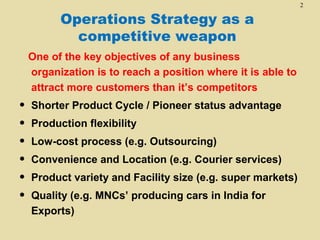
Operations Strategy as a
competitive weapon
One of the key objectives of any business
organization is to reach a position where it is able to
attract more customers than it’s competitors

•
•
•
•
•
•

Shorter Product Cycle / Pioneer status advantage
Production flexibility
Low-cost process (e.g. Outsourcing)
Convenience and Location (e.g. Courier services)
Product variety and Facility size (e.g. super markets)
Quality (e.g. MNCs’ producing cars in India for
Exports)

2
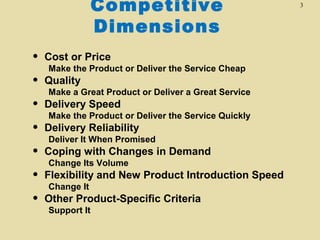
Competitive
Dimensions
•
•
•
•
•
•
•

Cost or Price
Make the Product or Deliver the Service Cheap

Quality
Make a Great Product or Deliver a Great Service

Delivery Speed
Make the Product or Deliver the Service Quickly

Delivery Reliability
Deliver It When Promised

Coping with Changes in Demand
Change Its Volume

Flexibility and New Product Introduction Speed
Change It

Other Product-Specific Criteria
Support It

3
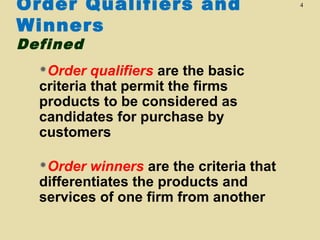
Order Qualifiers and
Winners
Defined

Order

qualifiers are the basic
criteria that permit the firms
products to be considered as
candidates for purchase by
customers

Order

winners are the criteria that
differentiates the products and
services of one firm from another

4
5

Service Breakthroughs


A brand name car can be an
“order qualifier”

Repair services can be “order
winners”
•

Examples: Warranty, Roadside Assistance,
Leases, etc
6

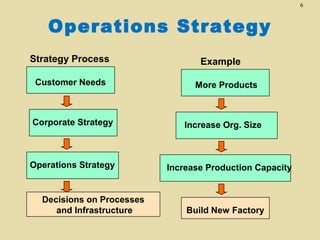
Operations Strategy
Strategy Process
Customer Needs

Corporate Strategy

Operations Strategy

Decisions on Processes
and Infrastructure

Example
More Products

Increase Org. Size

Increase Production Capacity

Build New Factory
7

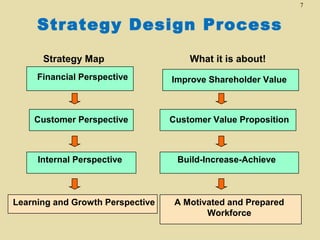
Strategy Design Process
Strategy Map

What it is about!

Financial Perspective

Improve Shareholder Value

Customer Perspective

Customer Value Proposition

Internal Perspective

Build-Increase-Achieve

Learning and Growth Perspective

A Motivated and Prepared
Workforce
8

The Balanced Scorecard
Judicious mix of financial and operational
measures for measuring the performance

• Customer perspective
• Business process perspective
• Innovation and learning perspective
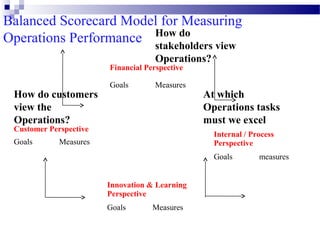
Balanced Scorecard Model for Measuring
Operations Performance How do
stakeholders view
Operations?

Financial Perspective

How do customers
view the
Operations?

Goals

Measures

Customer Perspective
Goals

At which
Operations tasks
must we excel
Internal / Process
Perspective

Measures

Goals
Innovation & Learning
Perspective
Goals

Measures

measures
10

Kaplan and Norton’s Generic
Strategy Map
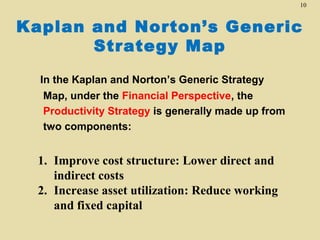
In the Kaplan and Norton’s Generic Strategy
Map, under the Financial Perspective, the
Productivity Strategy is generally made up from
two components:

1. Improve cost structure: Lower direct and
indirect costs
2. Increase asset utilization: Reduce working
and fixed capital
Kaplan and Norton’s
Generic Strategy Map
(Continued)
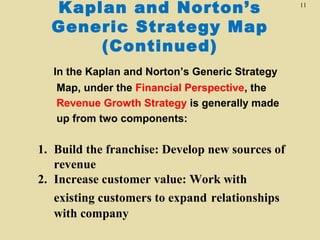
In the Kaplan and Norton’s Generic Strategy
Map, under the Financial Perspective, the
Revenue Growth Strategy is generally made
up from two components:

1. Build the franchise: Develop new sources of
revenue
2. Increase customer value: Work with
existing customers to expand relationships
with company

11
Kaplan and Norton’s
Generic Strategy Map
(Continued)
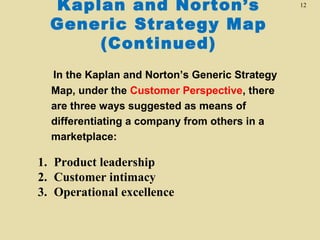
In the Kaplan and Norton’s Generic Strategy
Map, under the Customer Perspective, there
are three ways suggested as means of
differentiating a company from others in a
marketplace:

1. Product leadership
2. Customer intimacy
3. Operational excellence

12
13

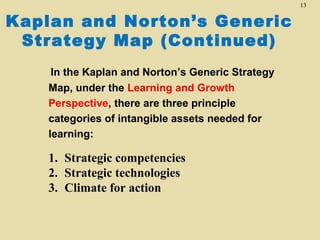
Kaplan and Norton’s Generic
Strategy Map (Continued)
In the Kaplan and Norton’s Generic Strategy
Map, under the Learning and Growth
Perspective, there are three principle
categories of intangible assets needed for
learning:

1. Strategic competencies
2. Strategic technologies
3. Climate for action
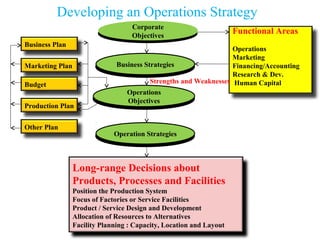
Developing an Operations Strategy
Corporate
Corporate
Objectives
Objectives

Business Plan
Marketing Plan
Budget
Production Plan
Other Plan

Functional Areas

Operations
Marketing
Business Strategies
Financing/Accounting
Business Strategies
Research & Dev.
Strengths and Weaknesses Human Capital
Operations
Operations
Objectives
Objectives

Operation Strategies

Long-range Decisions about
Products, Processes and Facilities
Position the Production System
Focus of Factories or Service Facilities
Product / Service Design and Development
Allocation of Resources to Alternatives
Facility Planning : Capacity, Location and Layout
15

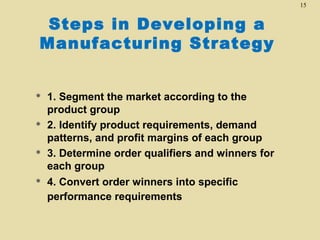
Steps in Developing a
Manufacturing Strategy








1. Segment the market according to the
product group
2. Identify product requirements, demand
patterns, and profit margins of each group
3. Determine order qualifiers and winners for
each group
4. Convert order winners into specific
performance requirements
16

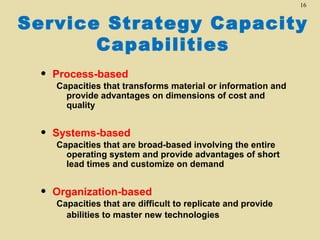
Service Strategy Capacity
Capabilities
•

Process-based

•

Systems-based

•

Organization-based

Capacities that transforms material or information and
provide advantages on dimensions of cost and
quality

Capacities that are broad-based involving the entire
operating system and provide advantages of short
lead times and customize on demand

Capacities that are difficult to replicate and provide
abilities to master new technologies
17

What is Productivity?
Defined

Productivity is a common measure
on how well resources are being
used. In the broadest sense, it can
be defined as the following ratio:
Outputs
Inputs
Productivity – Introduction &
Definition
•

Productivity primarily is an attitude of mind – an attitude of
looking at the scope for improvement

•

It stands for the elimination of MUDA( Japanese ) or Waste
in all forms

•

It is the function of providing more and more of everything,
for more and more people with less and less consumption of
Resources

•

The essence of productivity lies in producing the same
Factors affecting Productivity
External Factors

•
•
•
•
•
•

Beyond the control of individual Enterprise
External Infrastructure
Non- availability of Funds, Water, Power,
Transportation
Raw Material Supply constraints
Government Policies ( Emission Laws etc.)
Social / Political / Economic Environment
Factors affecting Productivity ( contd.)
Internal Factors

• Hard Factors – Products / Technology / Plant & Eqpt.
/ Raw Materials

• Soft Factors – People / Work Methods / Systems &
Procedures / Organisation Structure / Management
Practices
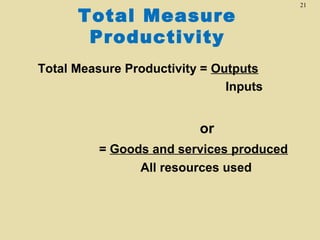
Total Measure
Productivity
Total Measure Productivity = Outputs
Inputs

or
= Goods and services produced
All resources used

21
22

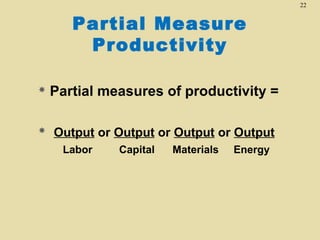
Partial Measure
Productivity


Partial measures of productivity =



Output or Output or Output or Output
Labor

Capital

Materials

Energy
23

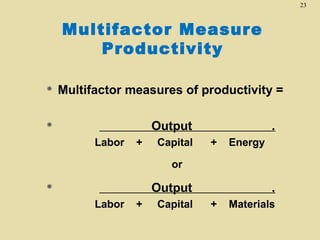
Multifactor Measure
Productivity


Multifactor measures of productivity =



Output
Labor

+

Capital

.
+

Energy

or

Output



Labor

+

Capital

.
+

Materials
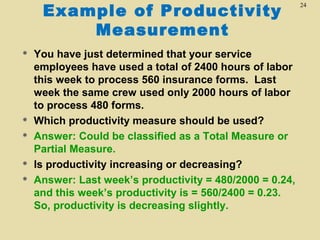
Example of Productivity
Measurement








You have just determined that your service
employees have used a total of 2400 hours of labor
this week to process 560 insurance forms. Last
week the same crew used only 2000 hours of labor
to process 480 forms.
Which productivity measure should be used?
Answer: Could be classified as a Total Measure or
Partial Measure.
Is productivity increasing or decreasing?
Answer: Last week’s productivity = 480/2000 = 0.24,
and this week’s productivity is = 560/2400 = 0.23.
So, productivity is decreasing slightly.

24
25

Question Bowl
An operations strategy is concerned
with which of the following?
a. Setting specific policies and plans
b. Short-term competitive strategies
c. Coordination of operational goals
d. All of the above
e. None of the above
Answer: c. Coordination of operational
goals
26

Question Bowl
Typically a strategy breaks down
into what major components?
a. Operations effectiveness
b. Customer management
c. Production innovation
d. All of the above
e. None of the above
Answer: d. All of the above
27

Question Bowl
A criterion that differentiates the
products and services of one firm
from another can be which of the
following?
a. An order qualifier
b. An order winner
c. PWP
d. KPI
e. None of the above

Answer: b. An order winner
28

Question Bowl

a.
b.
c.
d.
e.

A travel agency processed 240 customers on Day 1
with a staff of 12, and 360 customers the on Day 2
with a staff of 15. What can be said about the
productivity shift from Day 1 to Day 2?
An increase in productivity from Day 1 to Day 2
A decrease in productivity from Day 1 to Day 2
The same productivity from Day 1 to Day 2
Can not be computed from data above
None of the above
Answer: a. An increase in productivity from Day 1 to
Day 2(Day 1 productivity = 240/12=20
Day 2 productivity = 360/15=24)
29

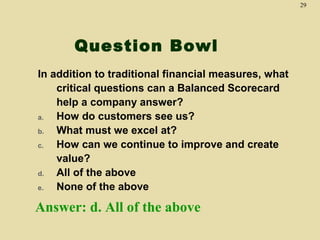
Question Bowl
In addition to traditional financial measures, what
critical questions can a Balanced Scorecard
help a company answer?
a.
How do customers see us?
b.
What must we excel at?
c.
How can we continue to improve and create
value?
d.
All of the above
e.
None of the above

Answer: d. All of the above
30

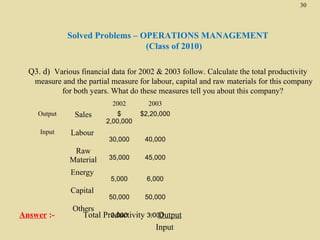
Solved Problems – OPERATIONS MANAGEMENT
(Class of 2010)
Q3. d) Various financial data for 2002 & 2003 follow. Calculate the total productivity
measure and the partial measure for labour, capital and raw materials for this company
for both years. What do these measures tell you about this company?
2002
Output

Sales

Input

Labour
Raw
Material
Energy
Capital

Answer :-

Others

2003

$
2,00,000

$2,20,000

30,000

40,000

35,000

45,000

5,000

6,000

50,000

50,000

2,000
Total Productivity 3,000
= Output
Input
31

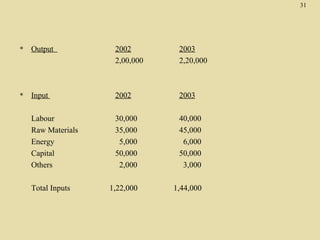


Output

2002
2,00,000

2003
2,20,000



Input

2002

2003

Labour
Raw Materials
Energy
Capital
Others

30,000
35,000
5,000
50,000
2,000

40,000
45,000
6,000
50,000
3,000

1,22,000

1,44,000

Total Inputs
32
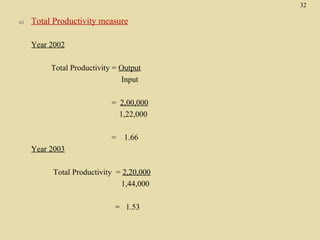
a)

Total Productivity measure
Year 2002
Total Productivity = Output
Input
= 2,00,000
1,22,000
=

1.66

Year 2003
Total Productivity = 2,20,000
1,44,000
= 1.53
33
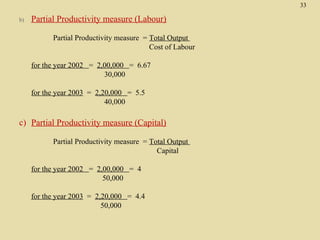
b)

Partial Productivity measure (Labour)
Partial Productivity measure = Total Output
Cost of Labour
for the year 2002 = 2,00,000 = 6.67
30,000
for the year 2003 = 2,20,000 = 5.5
40,000

c) Partial Productivity measure (Capital)
Partial Productivity measure = Total Output
Capital
for the year 2002 = 2,00,000 = 4
50,000
for the year 2003 = 2,20,000 = 4.4
50,000
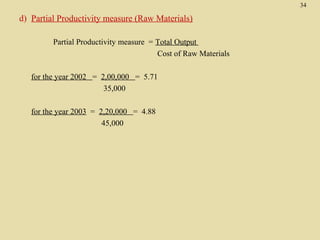
34

d) Partial Productivity measure (Raw Materials)
Partial Productivity measure = Total Output
Cost of Raw Materials
for the year 2002 = 2,00,000 = 5.71
35,000
for the year 2003 = 2,20,000 = 4.88
45,000

Ch2 op.str+&+comp.

  • 1.
  • 2.
    Operations Strategy asa competitive weapon One of the key objectives of any business organization is to reach a position where it is able to attract more customers than it’s competitors • • • • • • Shorter Product Cycle / Pioneer status advantage Production flexibility Low-cost process (e.g. Outsourcing) Convenience and Location (e.g. Courier services) Product variety and Facility size (e.g. super markets) Quality (e.g. MNCs’ producing cars in India for Exports) 2
  • 3.
    Competitive Dimensions • • • • • • • Cost or Price Makethe Product or Deliver the Service Cheap Quality Make a Great Product or Deliver a Great Service Delivery Speed Make the Product or Deliver the Service Quickly Delivery Reliability Deliver It When Promised Coping with Changes in Demand Change Its Volume Flexibility and New Product Introduction Speed Change It Other Product-Specific Criteria Support It 3
  • 4.
    Order Qualifiers and Winners Defined Order qualifiersare the basic criteria that permit the firms products to be considered as candidates for purchase by customers Order winners are the criteria that differentiates the products and services of one firm from another 4
  • 5.
    5 Service Breakthroughs  A brandname car can be an “order qualifier” Repair services can be “order winners” • Examples: Warranty, Roadside Assistance, Leases, etc
  • 6.
    6 Operations Strategy Strategy Process CustomerNeeds Corporate Strategy Operations Strategy Decisions on Processes and Infrastructure Example More Products Increase Org. Size Increase Production Capacity Build New Factory
  • 7.
    7 Strategy Design Process StrategyMap What it is about! Financial Perspective Improve Shareholder Value Customer Perspective Customer Value Proposition Internal Perspective Build-Increase-Achieve Learning and Growth Perspective A Motivated and Prepared Workforce
  • 8.
    8 The Balanced Scorecard Judiciousmix of financial and operational measures for measuring the performance • Customer perspective • Business process perspective • Innovation and learning perspective
  • 9.
    Balanced Scorecard Modelfor Measuring Operations Performance How do stakeholders view Operations? Financial Perspective How do customers view the Operations? Goals Measures Customer Perspective Goals At which Operations tasks must we excel Internal / Process Perspective Measures Goals Innovation & Learning Perspective Goals Measures measures
  • 10.
    10 Kaplan and Norton’sGeneric Strategy Map In the Kaplan and Norton’s Generic Strategy Map, under the Financial Perspective, the Productivity Strategy is generally made up from two components: 1. Improve cost structure: Lower direct and indirect costs 2. Increase asset utilization: Reduce working and fixed capital
  • 11.
    Kaplan and Norton’s GenericStrategy Map (Continued) In the Kaplan and Norton’s Generic Strategy Map, under the Financial Perspective, the Revenue Growth Strategy is generally made up from two components: 1. Build the franchise: Develop new sources of revenue 2. Increase customer value: Work with existing customers to expand relationships with company 11
  • 12.
    Kaplan and Norton’s GenericStrategy Map (Continued) In the Kaplan and Norton’s Generic Strategy Map, under the Customer Perspective, there are three ways suggested as means of differentiating a company from others in a marketplace: 1. Product leadership 2. Customer intimacy 3. Operational excellence 12
  • 13.
    13 Kaplan and Norton’sGeneric Strategy Map (Continued) In the Kaplan and Norton’s Generic Strategy Map, under the Learning and Growth Perspective, there are three principle categories of intangible assets needed for learning: 1. Strategic competencies 2. Strategic technologies 3. Climate for action
  • 14.
    Developing an OperationsStrategy Corporate Corporate Objectives Objectives Business Plan Marketing Plan Budget Production Plan Other Plan Functional Areas Operations Marketing Business Strategies Financing/Accounting Business Strategies Research & Dev. Strengths and Weaknesses Human Capital Operations Operations Objectives Objectives Operation Strategies Operation Strategies Long-range Decisions about Products, Processes and Facilities Position the Production System Focus of Factories or Service Facilities Product / Service Design and Development Allocation of Resources to Alternatives Facility Planning : Capacity, Location and Layout
  • 15.
    15 Steps in Developinga Manufacturing Strategy     1. Segment the market according to the product group 2. Identify product requirements, demand patterns, and profit margins of each group 3. Determine order qualifiers and winners for each group 4. Convert order winners into specific performance requirements
  • 16.
    16 Service Strategy Capacity Capabilities • Process-based • Systems-based • Organization-based Capacitiesthat transforms material or information and provide advantages on dimensions of cost and quality Capacities that are broad-based involving the entire operating system and provide advantages of short lead times and customize on demand Capacities that are difficult to replicate and provide abilities to master new technologies
  • 17.
    17 What is Productivity? Defined Productivityis a common measure on how well resources are being used. In the broadest sense, it can be defined as the following ratio: Outputs Inputs
  • 18.
    Productivity – Introduction& Definition • Productivity primarily is an attitude of mind – an attitude of looking at the scope for improvement • It stands for the elimination of MUDA( Japanese ) or Waste in all forms • It is the function of providing more and more of everything, for more and more people with less and less consumption of Resources • The essence of productivity lies in producing the same
  • 19.
    Factors affecting Productivity ExternalFactors • • • • • • Beyond the control of individual Enterprise External Infrastructure Non- availability of Funds, Water, Power, Transportation Raw Material Supply constraints Government Policies ( Emission Laws etc.) Social / Political / Economic Environment
  • 20.
    Factors affecting Productivity( contd.) Internal Factors • Hard Factors – Products / Technology / Plant & Eqpt. / Raw Materials • Soft Factors – People / Work Methods / Systems & Procedures / Organisation Structure / Management Practices
  • 21.
    Total Measure Productivity Total MeasureProductivity = Outputs Inputs or = Goods and services produced All resources used 21
  • 22.
    22 Partial Measure Productivity  Partial measuresof productivity =  Output or Output or Output or Output Labor Capital Materials Energy
  • 23.
    23 Multifactor Measure Productivity  Multifactor measuresof productivity =  Output Labor + Capital . + Energy or Output  Labor + Capital . + Materials
  • 24.
    Example of Productivity Measurement      Youhave just determined that your service employees have used a total of 2400 hours of labor this week to process 560 insurance forms. Last week the same crew used only 2000 hours of labor to process 480 forms. Which productivity measure should be used? Answer: Could be classified as a Total Measure or Partial Measure. Is productivity increasing or decreasing? Answer: Last week’s productivity = 480/2000 = 0.24, and this week’s productivity is = 560/2400 = 0.23. So, productivity is decreasing slightly. 24
  • 25.
    25 Question Bowl An operationsstrategy is concerned with which of the following? a. Setting specific policies and plans b. Short-term competitive strategies c. Coordination of operational goals d. All of the above e. None of the above Answer: c. Coordination of operational goals
  • 26.
    26 Question Bowl Typically astrategy breaks down into what major components? a. Operations effectiveness b. Customer management c. Production innovation d. All of the above e. None of the above Answer: d. All of the above
  • 27.
    27 Question Bowl A criterionthat differentiates the products and services of one firm from another can be which of the following? a. An order qualifier b. An order winner c. PWP d. KPI e. None of the above Answer: b. An order winner
  • 28.
    28 Question Bowl a. b. c. d. e. A travelagency processed 240 customers on Day 1 with a staff of 12, and 360 customers the on Day 2 with a staff of 15. What can be said about the productivity shift from Day 1 to Day 2? An increase in productivity from Day 1 to Day 2 A decrease in productivity from Day 1 to Day 2 The same productivity from Day 1 to Day 2 Can not be computed from data above None of the above Answer: a. An increase in productivity from Day 1 to Day 2(Day 1 productivity = 240/12=20 Day 2 productivity = 360/15=24)
  • 29.
    29 Question Bowl In additionto traditional financial measures, what critical questions can a Balanced Scorecard help a company answer? a. How do customers see us? b. What must we excel at? c. How can we continue to improve and create value? d. All of the above e. None of the above Answer: d. All of the above
  • 30.
    30 Solved Problems –OPERATIONS MANAGEMENT (Class of 2010) Q3. d) Various financial data for 2002 & 2003 follow. Calculate the total productivity measure and the partial measure for labour, capital and raw materials for this company for both years. What do these measures tell you about this company? 2002 Output Sales Input Labour Raw Material Energy Capital Answer :- Others 2003 $ 2,00,000 $2,20,000 30,000 40,000 35,000 45,000 5,000 6,000 50,000 50,000 2,000 Total Productivity 3,000 = Output Input
  • 31.
  • 32.
    32 a) Total Productivity measure Year2002 Total Productivity = Output Input = 2,00,000 1,22,000 = 1.66 Year 2003 Total Productivity = 2,20,000 1,44,000 = 1.53
  • 33.
    33 b) Partial Productivity measure(Labour) Partial Productivity measure = Total Output Cost of Labour for the year 2002 = 2,00,000 = 6.67 30,000 for the year 2003 = 2,20,000 = 5.5 40,000 c) Partial Productivity measure (Capital) Partial Productivity measure = Total Output Capital for the year 2002 = 2,00,000 = 4 50,000 for the year 2003 = 2,20,000 = 4.4 50,000
  • 34.
    34 d) Partial Productivitymeasure (Raw Materials) Partial Productivity measure = Total Output Cost of Raw Materials for the year 2002 = 2,00,000 = 5.71 35,000 for the year 2003 = 2,20,000 = 4.88 45,000