Chapter 12
Privacy and Digital Security

Friday, December 6, 13
Information Privacy & Security
Learning Objectives
• Privacy: safeguards for Personally Identifying
Information (PII) & Personal Identifiers (PIDs)
• OECD Fair Information Practices (FIPs)
• U.S. privacy: Opt-in/Opt-out, compliance/enforcement
• Computer Security
• public key cryptosystems (PKCs)

Copyright © 2013 Pearson Education, Inc. Publishing as Pearson Addison-Wesley

Friday, December 6, 13
Privacy: Whose Information Is It?
• Buying a product at a store generates a
transaction, which produces information.
• If you do this online, you supply even more
PII
• Even if you don’t “sign in”, your browser
reveals information about you

Copyright © 2013 Pearson Education, Inc. Publishing as Pearson Addison-Wesley

Friday, December 6, 13
How Can the Information Be Used?
• Transaction information
– normal part of business
– information belongs to the store

• based on your purchases
– store sends you ads for other items,
– standard business practice

Copyright © 2013 Pearson Education, Inc. Publishing as Pearson Addison-Wesley

Friday, December 6, 13
Controlling the Use of Information
• Who controls transaction information?
1. No Uses. The information ought to be deleted when
the store is finished with it.
2. Approval or Opt-in. The store can use it for other
purposes, but only if you approve.
3. Objection or Opt-out. The store can use it for other
purposes, but not if you object.
4. No Limits. The information can be used any
way the store chooses.

Copyright © 2013 Pearson Education, Inc. Publishing as Pearson Addison-Wesley

Friday, December 6, 13
Controlling the Use of Information
5. Internal Use.
– store can use the information to conduct
business with you, but for no other use
– It would not include giving or selling your
information to another person or business
– may not require your approval

Copyright © 2013 Pearson Education, Inc. Publishing as Pearson Addison-Wesley
Friday, December 6, 13
Controlling the Use of Information
• Outside the US
the law and standards would place it
between (1) and (2), but very close to (1).
• In the US,
the law and standards would place it
between (3) and (4), but very close
to (4)
Copyright © 2013 Pearson Education, Inc. Publishing as Pearson Addison-Wesley

Friday, December 6, 13
A Privacy Definition
• Privacy: The right of people to choose
freely under what circumstances and to
what extent they will reveal personally
identifying information to others.

Copyright © 2013 Pearson Education, Inc. Publishing as Pearson Addison-Wesley

Friday, December 6, 13
Fair Information Practices
• There must be clear guidelines adopted for
handling private information:
-> Fair Information Practices (FIPs).

Copyright © 2013 Pearson Education, Inc. Publishing as Pearson Addison-Wesley

Friday, December 6, 13
OECD Fair Information Practices
• 1980: the Organization for Economic
Cooperation & Development (OECD)
developed an 8-point list of privacy
principles
=> became known as the Fair
Information Practices
=> now, widely accepted standard
Copyright © 2013 Pearson Education, Inc. Publishing as Pearson Addison-Wesley

Friday, December 6, 13
OECD Fair Information Practices
• The public has an interest in these
principles becoming law
• The principles also give a standard that
businesses and governments can meet
as a “due diligence test” for protecting
citizens’ rights of privacy

Copyright © 2013 Pearson Education, Inc. Publishing as Pearson Addison-Wesley

Friday, December 6, 13
OECD Fair Information Practices
An important aspect of the OECD
principles is the concept that
– a data controller: (the person or office
setting the policies)
– must interact with individuals about their
information
– must be accountable for those policies

Copyright © 2013 Pearson Education, Inc. Publishing as Pearson Addison-Wesley

Friday, December 6, 13
OECD’s Fair Information Practices
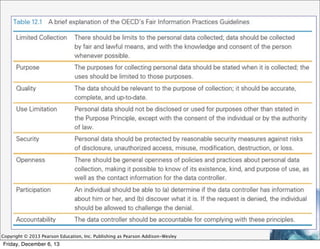
• The standard eight-point list of privacy
principles.
–
–
–
–
–
–
–
–

Limited Collection Principle
Quality Principle
Purpose Principle
Use Limitation Principle
Security Principle
Openness Principle
Participation Principle
Accountability Principle

Copyright © 2013 Pearson Education, Inc. Publishing as Pearson Addison-Wesley

Friday, December 6, 13

13
Copyright © 2013 Pearson Education, Inc. Publishing as Pearson Addison-Wesley

Friday, December 6, 13
Privacy Worldwide
• Privacy is not enjoyed in much of the world
at the OECD standard
• Privacy often comes in conflict with private
or governmental interests:
– Example, the United States has not adopted
the OECD principles, because many U.S.
companies profit by buying and using
information in ways that are inconsistent with
the OECD principles
Copyright © 2013 Pearson Education, Inc. Publishing as Pearson Addison-Wesley

Friday, December 6, 13
Privacy Worldwide
• Many non-EU countries have also
adopted laws based on OECD
principles
– One provision in the EU Directive requires
that data about EU citizens be protected
by the standards of the law even when it
leaves their country

Copyright © 2013 Pearson Education, Inc. Publishing as Pearson Addison-Wesley

Friday, December 6, 13
U.S. Privacy Laws
• The US failure to meet the
requirements of the EU Directive
concerns information stored by
businesses

Copyright © 2013 Pearson Education, Inc. Publishing as Pearson Addison-Wesley

Friday, December 6, 13
U.S. Privacy Laws
• US Sectoral Laws and Privacy:
– Electronic Communication Privacy Act (‘86)
– Telephone Consumer Protection Act of
(‘91)
– Driver’s Privacy Protection Act (’94)
– Health Insurance Privacy & Accountability
Act (’96)

• The sectoral approach provides very
strong privacy protections in specific
cases
Copyright © 2013 Pearson Education, Inc. Publishing as Pearson Addison-Wesley

Friday, December 6, 13
Privacy Principles: Abroad
• Three weaknesses in US privacy laws:
1. Opt-in/Opt-out (the US default is opt-out)
2. Enforcement
There is no office of data controller in the US
The FTC proposes that U.S. companies
“comply voluntarily”
3. Coverage
Countries adopting the Fair Information
Practices have everything covered
Copyright © 2013 Pearson Education, Inc. Publishing as Pearson Addison-Wesley

Friday, December 6, 13
Copyright © 2013 Pearson Education, Inc. Publishing as Pearson Addison-Wesley

Friday, December 6, 13
Cookies
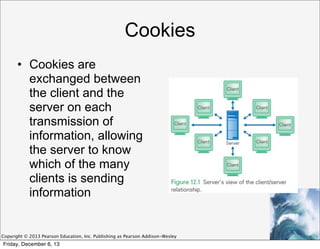
• Cookies are
exchanged between
the client and the
server on each
transmission of
information, allowing
the server to know
which of the many
clients is sending
information

Copyright © 2013 Pearson Education, Inc. Publishing as Pearson Addison-Wesley

Friday, December 6, 13
Cookies
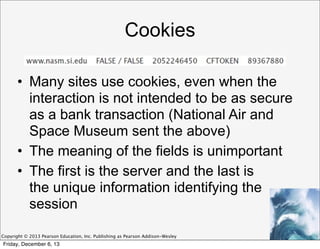
• Many sites use cookies, even when the
interaction is not intended to be as secure
as a bank transaction (National Air and
Space Museum sent the above)
• The meaning of the fields is unimportant
• The first is the server and the last is
the unique information identifying the
session
Copyright © 2013 Pearson Education, Inc. Publishing as Pearson Addison-Wesley

Friday, December 6, 13
Cookie Abuse
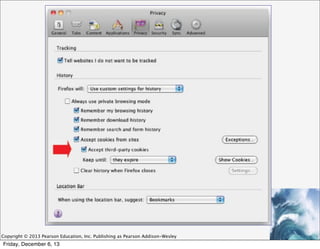
• There is a loophole called a third-party
cookie
• A cookie is exchanged between the client
and server making the interaction private
• But, if the Web site includes ads on its
page, the server may direct it to link to the
ad company to deliver the ad
• This new client/server relationship
place a cookie on your computer
Copyright © 2013 Pearson Education, Inc. Publishing as Pearson Addison-Wesley

Friday, December 6, 13
Copyright © 2013 Pearson Education, Inc. Publishing as Pearson Addison-Wesley

Friday, December 6, 13
Flash Cookies
Flash Cookies (LSO)
Congressmen Seek Answers to
‘Supercookies’ (WSJ)

Copyright © 2013 Pearson Education, Inc. Publishing as Pearson Addison-Wesley

Friday, December 6, 13
FIPS in the News
Hazards of the FaceBook Generation
FTC Fair Information Practices (FIPs)

Copyright © 2013 Pearson Education, Inc. Publishing as Pearson Addison-Wesley

Friday, December 6, 13
Tracking
• Tracking is the practice of a Web site
automatically sending details about a visit
to other content providers
• This is an emerging problem of concern to
privacy experts
• The consequences of being tracked are
not yet fully understood
• HTTP has a tracking flag telling servers
what your tracking preferences are
Copyright © 2013 Pearson Education, Inc. Publishing as Pearson Addison-Wesley

Friday, December 6, 13
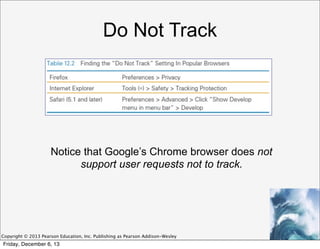
Do Not Track

Notice that Google’s Chrome browser does not
support user requests not to track.

Copyright © 2013 Pearson Education, Inc. Publishing as Pearson Addison-Wesley

Friday, December 6, 13
Copyright © 2013 Pearson Education, Inc. Publishing as Pearson Addison-Wesley

Friday, December 6, 13
Digital Security
• Computer security is a topic that is in the
news almost daily.
• Remember the “dos and don’ts” for online
behavior:
– Do check with the sender before opening an
attachment you’re unsure about
– Don’t fall for phishing emails

Copyright © 2013 Pearson Education, Inc. Publishing as Pearson Addison-Wesley

Friday, December 6, 13
Cryptology
The scientific study of cryptography and
cryptanalysis
Cryptography:
creating secret codes
encryption
Cryptanalysis:
breaking secret codes
decryption
Copyright © 2013 Pearson Education, Inc. Publishing as Pearson Addison-Wesley

Friday, December 6, 13
Encryption
• Information that is recoded to hide its true
meaning uses encryption
• A major component of encryption is the key
• They come in two forms:
– Private
– Public

Copyright © 2013 Pearson Education, Inc. Publishing as Pearson Addison-Wesley

Friday, December 6, 13
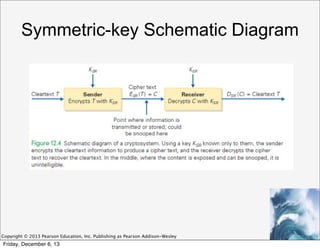
Symmetric-key Encryption
• The key is a “magic number” used to
transform plain text into cipher text
• Both the sender and receiver must
possess the key
• The process of sending an encrypted
message is a five-step algorithm

Copyright © 2013 Pearson Education, Inc. Publishing as Pearson Addison-Wesley

Friday, December 6, 13
Symmetric-key Encryption
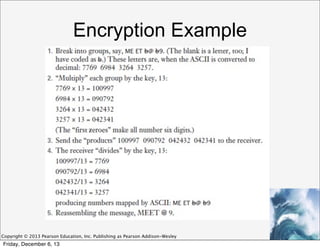
• 5-Step Encryption algorithm:
1. The sender breaks the message into groups
of letters
2. “Multiply” each group of letters times the key
3. Send the “products”/results from the
“multiplications” to the receiver
4. The receiver “divides” the “products” by the
key to recreate the groups
5. Assemble the groups into the message

Copyright © 2013 Pearson Education, Inc. Publishing as Pearson Addison-Wesley

Friday, December 6, 13
Symmetric-key Encryption
• This works because the math works
• The “reversibility” of encryption makes
them 2-way ciphers
– Only the sender and receiver know the key,
making the products useless numbers

• This is a secure communication
• This is called private key encryption, or
symmetric-key cryptography

Copyright © 2013 Pearson Education, Inc. Publishing as Pearson Addison-Wesley

Friday, December 6, 13
Encryption Example

Copyright © 2013 Pearson Education, Inc. Publishing as Pearson Addison-Wesley

Friday, December 6, 13
Symmetric-key Schematic Diagram

Copyright © 2013 Pearson Education, Inc. Publishing as Pearson Addison-Wesley

Friday, December 6, 13
Private Key Encryption
• Real encryption systems use much longer
blocks (hundreds of letters) and larger keys
• Multiplication, division are not the only
operations that can be used for encryption
• All that is needed is for an operation to
have an inverse (divide is the inverse of
multiply)

Copyright © 2013 Pearson Education, Inc. Publishing as Pearson Addison-Wesley

Friday, December 6, 13
Symmetric-key Encryption
• Effective only if the symmetric key is kept
secret by the two parties involved
• Problem: The sender and receiver have to
agree on the key, which means they need
to communicate somehow
• Usually, they meet face-to-face (they can’t
email, they don’t have a key yet!)

Copyright © 2013 Pearson Education, Inc. Publishing as Pearson Addison-Wesley

Friday, December 6, 13
Public Key Encryption
• To avoid that face-to-face meeting, publish
the key!
• Use public key encryption
– Two special prime numbers multiplied together

Copyright © 2013 Pearson Education, Inc. Publishing as Pearson Addison-Wesley

Friday, December 6, 13
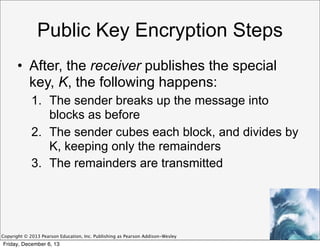
Public Key Encryption Steps
• After, the receiver publishes the special
key, K, the following happens:
1. The sender breaks up the message into
blocks as before
2. The sender cubes each block, and divides by
K, keeping only the remainders
3. The remainders are transmitted

Copyright © 2013 Pearson Education, Inc. Publishing as Pearson Addison-Wesley

Friday, December 6, 13
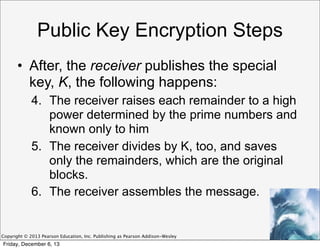
Public Key Encryption Steps
• After, the receiver publishes the special
key, K, the following happens:
4. The receiver raises each remainder to a high
power determined by the prime numbers and
known only to him
5. The receiver divides by K, too, and saves
only the remainders, which are the original
blocks.
6. The receiver assembles the message.

Copyright © 2013 Pearson Education, Inc. Publishing as Pearson Addison-Wesley

Friday, December 6, 13
How Do We Know It Works?
• K, the magic public key, is just two prime
numbers, p and q, multiplied together
• It is possible to figure out those two
numbers from the published key in theory.
• This process, called factoring, is tough if
the numbers p and q are large (60 digits
apiece)
• It is impractical to factor them no matter
how powerful the computer!
Copyright © 2013 Pearson Education, Inc. Publishing as Pearson Addison-Wesley

Friday, December 6, 13
Web Field Trip
Public-Key Cryptography
(Mozilla Developers Network)
•
•
•
•
•
•

Read the following sections:
Introduction
Internet Security Issues
Encryption & Decryption
Symmetric-Key Encryption
Public-Key Encryption
Key Length & Encryption Strength

Copyright © 2013 Pearson Education, Inc. Publishing as Pearson Addison-Wesley

Friday, December 6, 13
Web Field Trip
Public-Key Cryptography
(Mozilla Developers Network)
Symmetric-key encryption plays an
important role in the SSL protocol, which is
used for encryption over TCP/IP networks.
SSL also uses techniques of public-key
encryption
Copyright © 2013 Pearson Education, Inc. Publishing as Pearson Addison-Wesley

Friday, December 6, 13
Web Field Trip
Mozilla Developers Network
•

Public-key encryption requires more
computation than private-key encryption

•

Therefore, use public-key encryption to
send a symmetric key, which can then be
used to encrypt additional data

•

This is the approach used by the SSL
protocol

Copyright © 2013 Pearson Education, Inc. Publishing as Pearson Addison-Wesley

Friday, December 6, 13
Copyright © 2013 Pearson Education, Inc. Publishing as Pearson Addison-Wesley

Friday, December 6, 13
Back Up your Personal Computer
• First, you need a place to keep the copy,
and you need software to make the copy.
• The two easiest “places” to keep the copy
are on an external hard disk or “in the
cloud”
• The “cloud” company’s computers store the
information for you and they take
responsibility of keeping it available
to you
Copyright © 2013 Pearson Education, Inc. Publishing as Pearson Addison-Wesley

Friday, December 6, 13
System Backup Utilities
• OS X: Time Machine
• Windows: Backup and Restore

Copyright © 2013 Pearson Education, Inc. Publishing as Pearson Addison-Wesley

Friday, December 6, 13
Copyright © 2013 Pearson Education, Inc. Publishing as Pearson Addison-Wesley

Friday, December 6, 13
Summary
• Revealing personal information can be
beneficial (e.g., Facebook, Google, etc.)
• Organizations that receive the information
must keep it private & secure
• Guidelines for keeping data private have
been created by several organizations,
including the Organization for Economic
Cooperation and Development (OECD)

Copyright © 2013 Pearson Education, Inc. Publishing as Pearson Addison-Wesley

Friday, December 6, 13
Summary
• Guidelines often conflict with the interests
of business and government, so some
countries like the United States have not
adopted them. Because the United States
takes a sectoral approach to privacy,
adopting laws only for specific business
sectors or practices, much of the
information collected on its citizens is not
protected by OECD standards.
Copyright © 2013 Pearson Education, Inc. Publishing as Pearson Addison-Wesley

Friday, December 6, 13
Summary
• The shortcomings for privacy conditions in
the United States are Opt-in/Opt-out,
compliance/enforcement, and coverage.
• The “third-party cookie” loophole allows
companies to gather information; identity
theft is an unresolved problem. The best
way to manage privacy in the Information
Age is to have OECD-grade privacy laws.

Copyright © 2013 Pearson Education, Inc. Publishing as Pearson Addison-Wesley

Friday, December 6, 13
Summary
• Public key cryptography (PKC) is a
straightforward idea built on familiar
concepts.
• Computer scientists have not yet proved
the invincibility of the RSA scheme, but it
can be “made more secure” simply by
increasing the size of the key.

Copyright © 2013 Pearson Education, Inc. Publishing as Pearson Addison-Wesley

Friday, December 6, 13
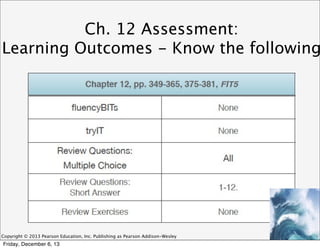
Ch. 12 Assessment:
Learning Outcomes - Know the following

Copyright © 2013 Pearson Education, Inc. Publishing as Pearson Addison-Wesley

Friday, December 6, 13

Ch. 12 FIT5, CIS 110 13F

  • 1.
    Chapter 12 Privacy andDigital Security Friday, December 6, 13
  • 2.
    Information Privacy &Security Learning Objectives • Privacy: safeguards for Personally Identifying Information (PII) & Personal Identifiers (PIDs) • OECD Fair Information Practices (FIPs) • U.S. privacy: Opt-in/Opt-out, compliance/enforcement • Computer Security • public key cryptosystems (PKCs) Copyright © 2013 Pearson Education, Inc. Publishing as Pearson Addison-Wesley Friday, December 6, 13
  • 3.
    Privacy: Whose InformationIs It? • Buying a product at a store generates a transaction, which produces information. • If you do this online, you supply even more PII • Even if you don’t “sign in”, your browser reveals information about you Copyright © 2013 Pearson Education, Inc. Publishing as Pearson Addison-Wesley Friday, December 6, 13
  • 4.
    How Can theInformation Be Used? • Transaction information – normal part of business – information belongs to the store • based on your purchases – store sends you ads for other items, – standard business practice Copyright © 2013 Pearson Education, Inc. Publishing as Pearson Addison-Wesley Friday, December 6, 13
  • 5.
    Controlling the Useof Information • Who controls transaction information? 1. No Uses. The information ought to be deleted when the store is finished with it. 2. Approval or Opt-in. The store can use it for other purposes, but only if you approve. 3. Objection or Opt-out. The store can use it for other purposes, but not if you object. 4. No Limits. The information can be used any way the store chooses. Copyright © 2013 Pearson Education, Inc. Publishing as Pearson Addison-Wesley Friday, December 6, 13
  • 6.
    Controlling the Useof Information 5. Internal Use. – store can use the information to conduct business with you, but for no other use – It would not include giving or selling your information to another person or business – may not require your approval Copyright © 2013 Pearson Education, Inc. Publishing as Pearson Addison-Wesley Friday, December 6, 13
  • 7.
    Controlling the Useof Information • Outside the US the law and standards would place it between (1) and (2), but very close to (1). • In the US, the law and standards would place it between (3) and (4), but very close to (4) Copyright © 2013 Pearson Education, Inc. Publishing as Pearson Addison-Wesley Friday, December 6, 13
  • 8.
    A Privacy Definition •Privacy: The right of people to choose freely under what circumstances and to what extent they will reveal personally identifying information to others. Copyright © 2013 Pearson Education, Inc. Publishing as Pearson Addison-Wesley Friday, December 6, 13
  • 9.
    Fair Information Practices •There must be clear guidelines adopted for handling private information: -> Fair Information Practices (FIPs). Copyright © 2013 Pearson Education, Inc. Publishing as Pearson Addison-Wesley Friday, December 6, 13
  • 10.
    OECD Fair InformationPractices • 1980: the Organization for Economic Cooperation & Development (OECD) developed an 8-point list of privacy principles => became known as the Fair Information Practices => now, widely accepted standard Copyright © 2013 Pearson Education, Inc. Publishing as Pearson Addison-Wesley Friday, December 6, 13
  • 11.
    OECD Fair InformationPractices • The public has an interest in these principles becoming law • The principles also give a standard that businesses and governments can meet as a “due diligence test” for protecting citizens’ rights of privacy Copyright © 2013 Pearson Education, Inc. Publishing as Pearson Addison-Wesley Friday, December 6, 13
  • 12.
    OECD Fair InformationPractices An important aspect of the OECD principles is the concept that – a data controller: (the person or office setting the policies) – must interact with individuals about their information – must be accountable for those policies Copyright © 2013 Pearson Education, Inc. Publishing as Pearson Addison-Wesley Friday, December 6, 13
  • 13.
    OECD’s Fair InformationPractices • The standard eight-point list of privacy principles. – – – – – – – – Limited Collection Principle Quality Principle Purpose Principle Use Limitation Principle Security Principle Openness Principle Participation Principle Accountability Principle Copyright © 2013 Pearson Education, Inc. Publishing as Pearson Addison-Wesley Friday, December 6, 13 13
  • 14.
    Copyright © 2013Pearson Education, Inc. Publishing as Pearson Addison-Wesley Friday, December 6, 13
  • 15.
    Privacy Worldwide • Privacyis not enjoyed in much of the world at the OECD standard • Privacy often comes in conflict with private or governmental interests: – Example, the United States has not adopted the OECD principles, because many U.S. companies profit by buying and using information in ways that are inconsistent with the OECD principles Copyright © 2013 Pearson Education, Inc. Publishing as Pearson Addison-Wesley Friday, December 6, 13
  • 16.
    Privacy Worldwide • Manynon-EU countries have also adopted laws based on OECD principles – One provision in the EU Directive requires that data about EU citizens be protected by the standards of the law even when it leaves their country Copyright © 2013 Pearson Education, Inc. Publishing as Pearson Addison-Wesley Friday, December 6, 13
  • 17.
    U.S. Privacy Laws •The US failure to meet the requirements of the EU Directive concerns information stored by businesses Copyright © 2013 Pearson Education, Inc. Publishing as Pearson Addison-Wesley Friday, December 6, 13
  • 18.
    U.S. Privacy Laws •US Sectoral Laws and Privacy: – Electronic Communication Privacy Act (‘86) – Telephone Consumer Protection Act of (‘91) – Driver’s Privacy Protection Act (’94) – Health Insurance Privacy & Accountability Act (’96) • The sectoral approach provides very strong privacy protections in specific cases Copyright © 2013 Pearson Education, Inc. Publishing as Pearson Addison-Wesley Friday, December 6, 13
  • 19.
    Privacy Principles: Abroad •Three weaknesses in US privacy laws: 1. Opt-in/Opt-out (the US default is opt-out) 2. Enforcement There is no office of data controller in the US The FTC proposes that U.S. companies “comply voluntarily” 3. Coverage Countries adopting the Fair Information Practices have everything covered Copyright © 2013 Pearson Education, Inc. Publishing as Pearson Addison-Wesley Friday, December 6, 13
  • 20.
    Copyright © 2013Pearson Education, Inc. Publishing as Pearson Addison-Wesley Friday, December 6, 13
  • 21.
    Cookies • Cookies are exchangedbetween the client and the server on each transmission of information, allowing the server to know which of the many clients is sending information Copyright © 2013 Pearson Education, Inc. Publishing as Pearson Addison-Wesley Friday, December 6, 13
  • 22.
    Cookies • Many sitesuse cookies, even when the interaction is not intended to be as secure as a bank transaction (National Air and Space Museum sent the above) • The meaning of the fields is unimportant • The first is the server and the last is the unique information identifying the session Copyright © 2013 Pearson Education, Inc. Publishing as Pearson Addison-Wesley Friday, December 6, 13
  • 23.
    Cookie Abuse • Thereis a loophole called a third-party cookie • A cookie is exchanged between the client and server making the interaction private • But, if the Web site includes ads on its page, the server may direct it to link to the ad company to deliver the ad • This new client/server relationship place a cookie on your computer Copyright © 2013 Pearson Education, Inc. Publishing as Pearson Addison-Wesley Friday, December 6, 13
  • 24.
    Copyright © 2013Pearson Education, Inc. Publishing as Pearson Addison-Wesley Friday, December 6, 13
  • 25.
    Flash Cookies Flash Cookies(LSO) Congressmen Seek Answers to ‘Supercookies’ (WSJ) Copyright © 2013 Pearson Education, Inc. Publishing as Pearson Addison-Wesley Friday, December 6, 13
  • 26.
    FIPS in theNews Hazards of the FaceBook Generation FTC Fair Information Practices (FIPs) Copyright © 2013 Pearson Education, Inc. Publishing as Pearson Addison-Wesley Friday, December 6, 13
  • 27.
    Tracking • Tracking isthe practice of a Web site automatically sending details about a visit to other content providers • This is an emerging problem of concern to privacy experts • The consequences of being tracked are not yet fully understood • HTTP has a tracking flag telling servers what your tracking preferences are Copyright © 2013 Pearson Education, Inc. Publishing as Pearson Addison-Wesley Friday, December 6, 13
  • 28.
    Do Not Track Noticethat Google’s Chrome browser does not support user requests not to track. Copyright © 2013 Pearson Education, Inc. Publishing as Pearson Addison-Wesley Friday, December 6, 13
  • 29.
    Copyright © 2013Pearson Education, Inc. Publishing as Pearson Addison-Wesley Friday, December 6, 13
  • 30.
    Digital Security • Computersecurity is a topic that is in the news almost daily. • Remember the “dos and don’ts” for online behavior: – Do check with the sender before opening an attachment you’re unsure about – Don’t fall for phishing emails Copyright © 2013 Pearson Education, Inc. Publishing as Pearson Addison-Wesley Friday, December 6, 13
  • 31.
    Cryptology The scientific studyof cryptography and cryptanalysis Cryptography: creating secret codes encryption Cryptanalysis: breaking secret codes decryption Copyright © 2013 Pearson Education, Inc. Publishing as Pearson Addison-Wesley Friday, December 6, 13
  • 32.
    Encryption • Information thatis recoded to hide its true meaning uses encryption • A major component of encryption is the key • They come in two forms: – Private – Public Copyright © 2013 Pearson Education, Inc. Publishing as Pearson Addison-Wesley Friday, December 6, 13
  • 33.
    Symmetric-key Encryption • Thekey is a “magic number” used to transform plain text into cipher text • Both the sender and receiver must possess the key • The process of sending an encrypted message is a five-step algorithm Copyright © 2013 Pearson Education, Inc. Publishing as Pearson Addison-Wesley Friday, December 6, 13
  • 34.
    Symmetric-key Encryption • 5-StepEncryption algorithm: 1. The sender breaks the message into groups of letters 2. “Multiply” each group of letters times the key 3. Send the “products”/results from the “multiplications” to the receiver 4. The receiver “divides” the “products” by the key to recreate the groups 5. Assemble the groups into the message Copyright © 2013 Pearson Education, Inc. Publishing as Pearson Addison-Wesley Friday, December 6, 13
  • 35.
    Symmetric-key Encryption • Thisworks because the math works • The “reversibility” of encryption makes them 2-way ciphers – Only the sender and receiver know the key, making the products useless numbers • This is a secure communication • This is called private key encryption, or symmetric-key cryptography Copyright © 2013 Pearson Education, Inc. Publishing as Pearson Addison-Wesley Friday, December 6, 13
  • 36.
    Encryption Example Copyright ©2013 Pearson Education, Inc. Publishing as Pearson Addison-Wesley Friday, December 6, 13
  • 37.
    Symmetric-key Schematic Diagram Copyright© 2013 Pearson Education, Inc. Publishing as Pearson Addison-Wesley Friday, December 6, 13
  • 38.
    Private Key Encryption •Real encryption systems use much longer blocks (hundreds of letters) and larger keys • Multiplication, division are not the only operations that can be used for encryption • All that is needed is for an operation to have an inverse (divide is the inverse of multiply) Copyright © 2013 Pearson Education, Inc. Publishing as Pearson Addison-Wesley Friday, December 6, 13
  • 39.
    Symmetric-key Encryption • Effectiveonly if the symmetric key is kept secret by the two parties involved • Problem: The sender and receiver have to agree on the key, which means they need to communicate somehow • Usually, they meet face-to-face (they can’t email, they don’t have a key yet!) Copyright © 2013 Pearson Education, Inc. Publishing as Pearson Addison-Wesley Friday, December 6, 13
  • 40.
    Public Key Encryption •To avoid that face-to-face meeting, publish the key! • Use public key encryption – Two special prime numbers multiplied together Copyright © 2013 Pearson Education, Inc. Publishing as Pearson Addison-Wesley Friday, December 6, 13
  • 41.
    Public Key EncryptionSteps • After, the receiver publishes the special key, K, the following happens: 1. The sender breaks up the message into blocks as before 2. The sender cubes each block, and divides by K, keeping only the remainders 3. The remainders are transmitted Copyright © 2013 Pearson Education, Inc. Publishing as Pearson Addison-Wesley Friday, December 6, 13
  • 42.
    Public Key EncryptionSteps • After, the receiver publishes the special key, K, the following happens: 4. The receiver raises each remainder to a high power determined by the prime numbers and known only to him 5. The receiver divides by K, too, and saves only the remainders, which are the original blocks. 6. The receiver assembles the message. Copyright © 2013 Pearson Education, Inc. Publishing as Pearson Addison-Wesley Friday, December 6, 13
  • 43.
    How Do WeKnow It Works? • K, the magic public key, is just two prime numbers, p and q, multiplied together • It is possible to figure out those two numbers from the published key in theory. • This process, called factoring, is tough if the numbers p and q are large (60 digits apiece) • It is impractical to factor them no matter how powerful the computer! Copyright © 2013 Pearson Education, Inc. Publishing as Pearson Addison-Wesley Friday, December 6, 13
  • 44.
    Web Field Trip Public-KeyCryptography (Mozilla Developers Network) • • • • • • Read the following sections: Introduction Internet Security Issues Encryption & Decryption Symmetric-Key Encryption Public-Key Encryption Key Length & Encryption Strength Copyright © 2013 Pearson Education, Inc. Publishing as Pearson Addison-Wesley Friday, December 6, 13
  • 45.
    Web Field Trip Public-KeyCryptography (Mozilla Developers Network) Symmetric-key encryption plays an important role in the SSL protocol, which is used for encryption over TCP/IP networks. SSL also uses techniques of public-key encryption Copyright © 2013 Pearson Education, Inc. Publishing as Pearson Addison-Wesley Friday, December 6, 13
  • 46.
    Web Field Trip MozillaDevelopers Network • Public-key encryption requires more computation than private-key encryption • Therefore, use public-key encryption to send a symmetric key, which can then be used to encrypt additional data • This is the approach used by the SSL protocol Copyright © 2013 Pearson Education, Inc. Publishing as Pearson Addison-Wesley Friday, December 6, 13
  • 47.
    Copyright © 2013Pearson Education, Inc. Publishing as Pearson Addison-Wesley Friday, December 6, 13
  • 48.
    Back Up yourPersonal Computer • First, you need a place to keep the copy, and you need software to make the copy. • The two easiest “places” to keep the copy are on an external hard disk or “in the cloud” • The “cloud” company’s computers store the information for you and they take responsibility of keeping it available to you Copyright © 2013 Pearson Education, Inc. Publishing as Pearson Addison-Wesley Friday, December 6, 13
  • 49.
    System Backup Utilities •OS X: Time Machine • Windows: Backup and Restore Copyright © 2013 Pearson Education, Inc. Publishing as Pearson Addison-Wesley Friday, December 6, 13
  • 50.
    Copyright © 2013Pearson Education, Inc. Publishing as Pearson Addison-Wesley Friday, December 6, 13
  • 51.
    Summary • Revealing personalinformation can be beneficial (e.g., Facebook, Google, etc.) • Organizations that receive the information must keep it private & secure • Guidelines for keeping data private have been created by several organizations, including the Organization for Economic Cooperation and Development (OECD) Copyright © 2013 Pearson Education, Inc. Publishing as Pearson Addison-Wesley Friday, December 6, 13
  • 52.
    Summary • Guidelines oftenconflict with the interests of business and government, so some countries like the United States have not adopted them. Because the United States takes a sectoral approach to privacy, adopting laws only for specific business sectors or practices, much of the information collected on its citizens is not protected by OECD standards. Copyright © 2013 Pearson Education, Inc. Publishing as Pearson Addison-Wesley Friday, December 6, 13
  • 53.
    Summary • The shortcomingsfor privacy conditions in the United States are Opt-in/Opt-out, compliance/enforcement, and coverage. • The “third-party cookie” loophole allows companies to gather information; identity theft is an unresolved problem. The best way to manage privacy in the Information Age is to have OECD-grade privacy laws. Copyright © 2013 Pearson Education, Inc. Publishing as Pearson Addison-Wesley Friday, December 6, 13
  • 54.
    Summary • Public keycryptography (PKC) is a straightforward idea built on familiar concepts. • Computer scientists have not yet proved the invincibility of the RSA scheme, but it can be “made more secure” simply by increasing the size of the key. Copyright © 2013 Pearson Education, Inc. Publishing as Pearson Addison-Wesley Friday, December 6, 13
  • 55.
    Ch. 12 Assessment: LearningOutcomes - Know the following Copyright © 2013 Pearson Education, Inc. Publishing as Pearson Addison-Wesley Friday, December 6, 13