











Trial Procedures From arrest to appeal
Trial Procedures Outline Arrest Booking and Bail Arraignment Discovery Preliminary hearing  or  Grand Jury  Prosecutor “information”  or  Grand Jury “indictment” Plea bargaining Trial Jury verdict Sentencing Appeal
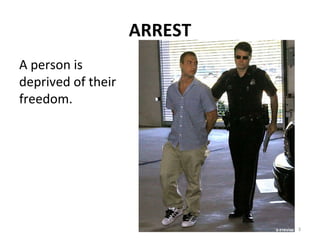
ARREST A person is deprived of their freedom.
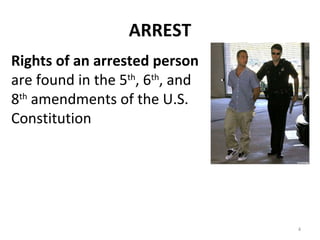
ARREST Rights of an arrested person  are found in the 5 th , 6 th , and 8 th  amendments of the U.S. Constitution
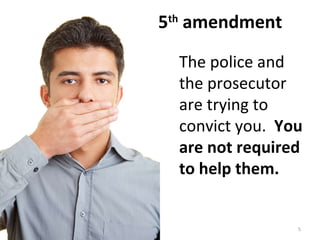
5 th  amendment The police and the prosecutor are trying to convict you.  You are not required to help them.
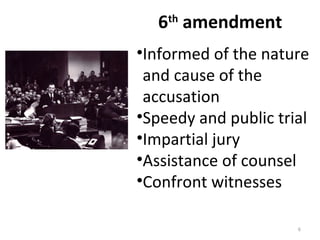
6 th  amendment Informed of the nature and cause of the accusation Speedy and public trial Impartial jury  Assistance of counsel Confront witnesses
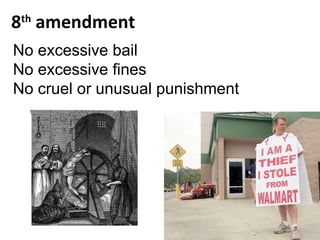
8 th  amendment No excessive bail No excessive fines No cruel or unusual punishment
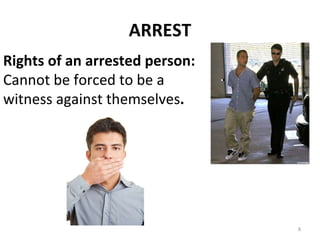
ARREST Rights of an arrested person: Cannot be forced to be a witness against themselves .
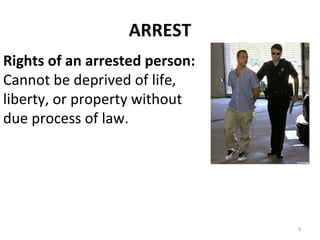
ARREST Rights of an arrested person: Cannot be deprived of life, liberty, or property without due process of law.
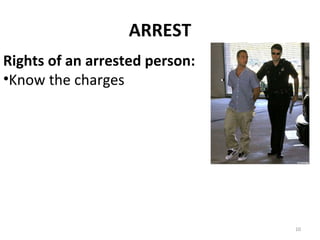
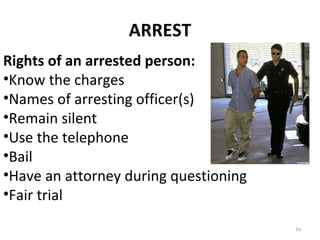
ARREST Rights of an arrested person: Know the charges
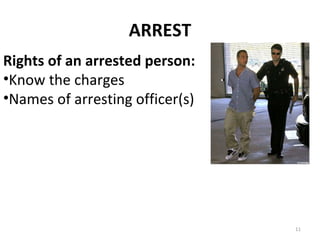
ARREST Rights of an arrested person: Know the charges Names of arresting officer(s)
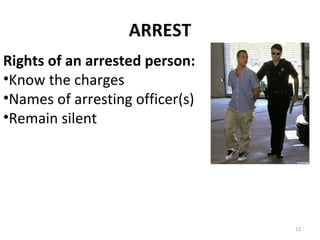
ARREST Rights of an arrested person: Know the charges Names of arresting officer(s) Remain silent
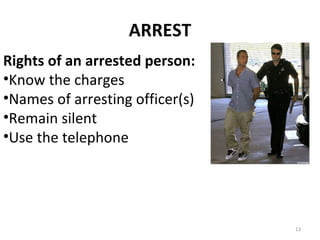
ARREST Rights of an arrested person: Know the charges Names of arresting officer(s) Remain silent Use the telephone
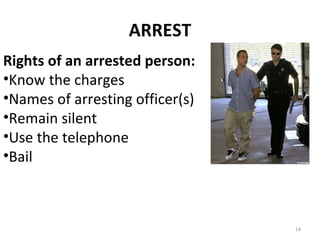
ARREST Rights of an arrested person: Know the charges Names of arresting officer(s) Remain silent Use the telephone Bail
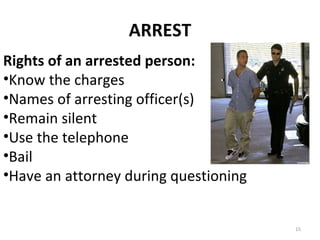
ARREST Rights of an arrested person: Know the charges Names of arresting officer(s) Remain silent Use the telephone Bail Have an attorney during questioning
ARREST Rights of an arrested person: Know the charges Names of arresting officer(s) Remain silent Use the telephone Bail Have an attorney during questioning Fair trial
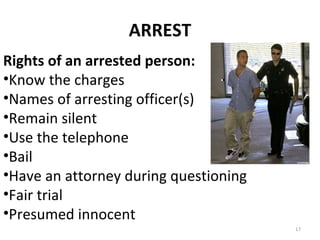
ARREST Rights of an arrested person: Know the charges Names of arresting officer(s) Remain silent Use the telephone Bail Have an attorney during questioning Fair trial Presumed innocent
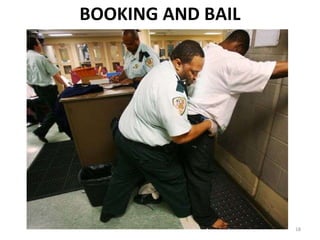
BOOKING AND BAIL
BOOKING AND BAIL Arrested person brought to jail
BOOKING AND BAIL Arrested person brought to jail “ Booking” is the jail intake procedure
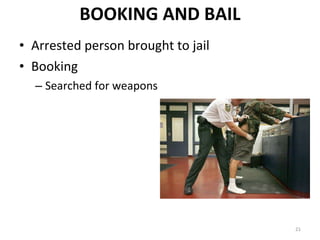
BOOKING AND BAIL Arrested person brought to jail Booking Searched for weapons
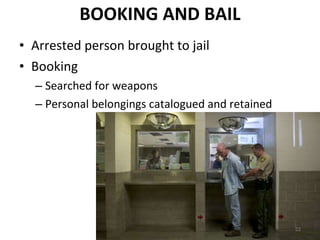
BOOKING AND BAIL Arrested person brought to jail Booking Searched for weapons Personal belongings catalogued and retained
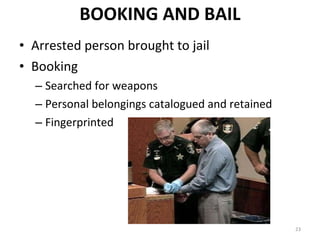
BOOKING AND BAIL Arrested person brought to jail Booking Searched for weapons Personal belongings catalogued and retained  Fingerprinted
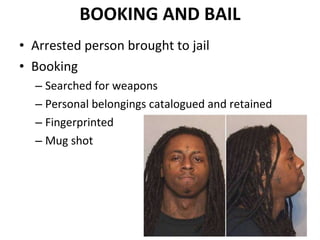
BOOKING AND BAIL Arrested person brought to jail Booking Searched for weapons Personal belongings catalogued and retained  Fingerprinted Mug shot
BOOKING AND BAIL Arrested person brought to jail Booking Searched for weapons Personal belongings catalogued and retained  Fingerprinted Mug shot Check for warrants
BOOKING AND BAIL Arrested person brought to jail Booking Searched for weapons Personal belongings catalogued and retained  Fingerprinted Mug shot Check for warrants Data entered into computer system
BOOKING AND BAIL Arrested person brought to jail Booking Searched for weapons Personal belongings catalogued and retained  Fingerprinted Mug shot Check for warrants Data entered into computer system Bail set
6 ways to get out of jail while waiting for your court date: Cash bail Surety bail Property bond Custody of your parents (for juveniles) O.R. Release on citation (“Cite Out”)
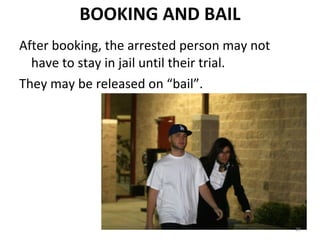
BOOKING AND BAIL After booking, the arrested person may not have to stay in jail until their trial. They may be released on “bail”.
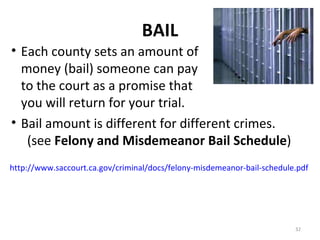
BAIL Each county sets an amount of money (bail) someone can pay to the court as a promise that you will return for your trial.
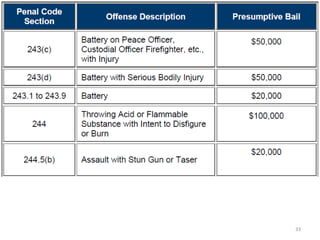
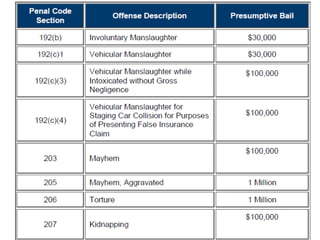
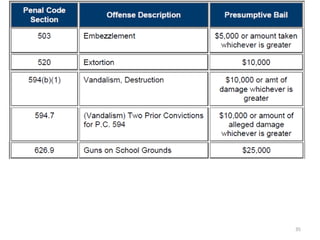
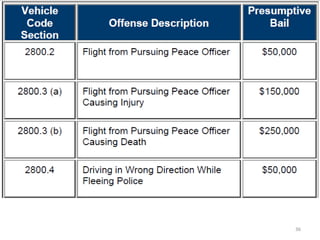
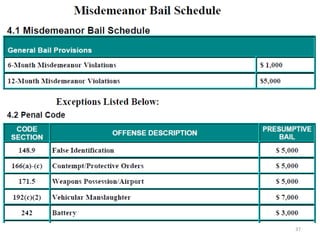
BAIL Each county sets an amount of money (bail) someone can pay to the court as a promise that you will return for your trial. Bail amount is different for different crimes.
BAIL Each county sets an amount of money (bail) someone can pay to the court as a promise that you will return for your trial. Bail amount is different for different crimes. (see  Felony and Misdemeanor Bail Schedule ) http://www.saccourt.ca.gov/criminal/docs/felony-misdemeanor-bail-schedule.pdf
BAIL Two major types of bail: Cash Bail Surety Bail Bond
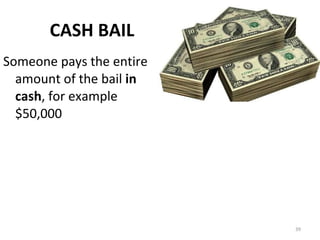
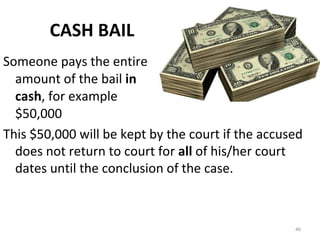
CASH BAIL Someone pays the entire amount of the bail  in cash , for example $50,000
CASH BAIL Someone pays the entire amount of the bail  in cash , for example $50,000 This $50,000 will be kept by the court if the accused does not return to court for  all  of his/her court dates until the conclusion of the case.
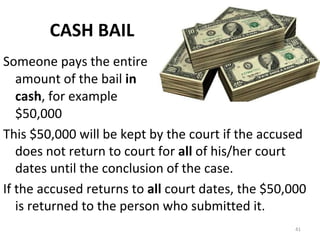
CASH BAIL Someone pays the entire amount of the bail  in cash , for example $50,000 This $50,000 will be kept by the court if the accused does not return to court for  all  of his/her court dates until the conclusion of the case. If the accused returns to  all  court dates, the $50,000 is returned to the person who submitted it.
BAIL Two major types of bail: Cash Bail Surety Bail Bond
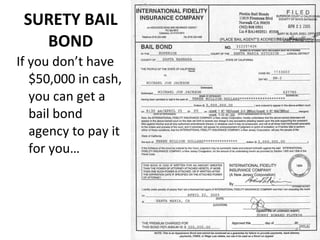
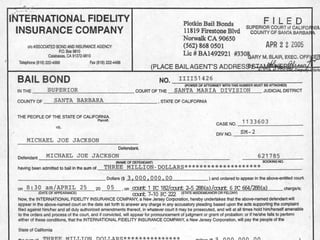
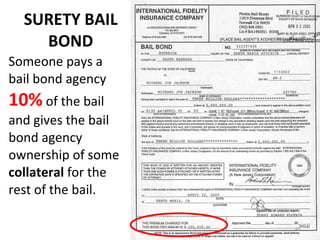
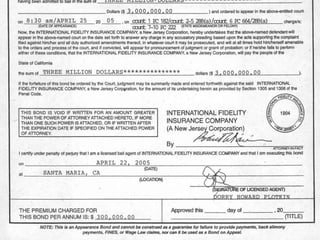
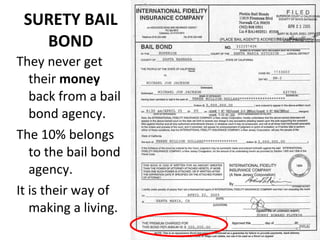
SURETY BAIL BOND If you don’t have $50,000 in cash, you can get a bail bond agency to pay it for you…
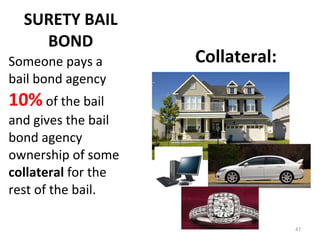
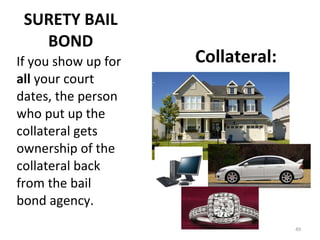
SURETY BAIL BOND Someone pays a bail bond agency  10%  of the bail and gives the bail bond agency ownership of some  collateral  for the rest of the bail.
SURETY BAIL BOND Someone pays a bail bond agency  10%  of the bail and gives the bail bond agency ownership of some  collateral  for the rest of the bail. Collateral:
SURETY BAIL BOND The bail bond agency pays the  entire  bail for you. You get out of jail.
SURETY BAIL BOND If you show up for  all  your court dates, the person who put up the collateral gets ownership of the collateral back from the bail bond agency. Collateral:
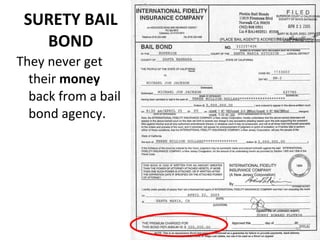
SURETY BAIL BOND They never get their  money  back from a bail bond agency.
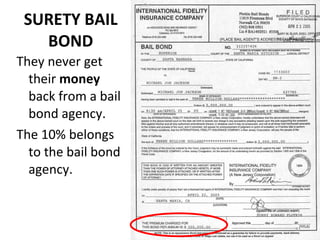
SURETY BAIL BOND They never get their  money  back from a bail bond agency. The 10% belongs to the bail bond agency.
SURETY BAIL BOND They never get their  money  back from a bail bond agency. The 10% belongs to the bail bond agency. It is their way of making a living.
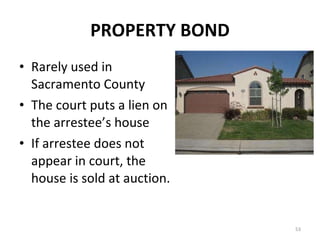
PROPERTY BOND Rarely used in Sacramento County The court puts a lien on the arrestee’s house If arrestee does not appear in court, the house is sold at auction.
PARENT CUSTODY If you are under 18 years old, you can be released to the custody of your parents or legal guardian. There is no “bail” for  juveniles  in Sacramento County.
O.R. You may not have to stay in jail until your trial. At your arraignment (your first time in front of a judge), you may be released on your “own recognizance”, nicknamed “ O.R. ”
O.R. You or your attorney asks the judge to release you from jail on your own recognizance You promise to return to court on your trial date Judges look at Whether the you pose a threat to public safety The seriousness of the crime Your criminal history Your “flight risk”  You are trusted to return to court  on your court date.
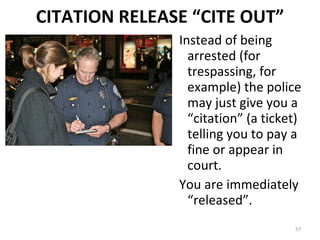
CITATION RELEASE “CITE OUT” Instead of being arrested (for trespassing, for example) the police may just give you a “citation” (a ticket) telling you to pay a fine or appear in court. You are immediately “released”.
6 ways to get out of jail while waiting for your court date: Cash bail Surety bail Property bond Custody of your parents (for juveniles) O.R. Release on citation (“Cite Out”)
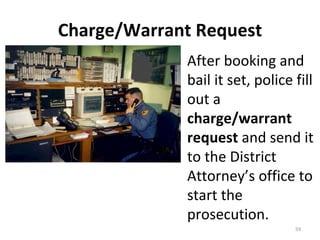
Charge/Warrant Request After booking and bail it set, police fill out a  charge/warrant request  and send it to the District Attorney’s office to start the prosecution.
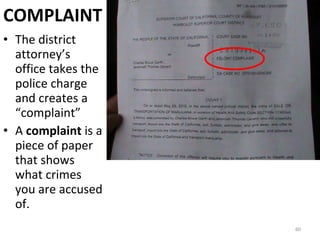
COMPLAINT The district attorney’s office takes the police charge and creates a “complaint” A  complaint  is a piece of paper that shows what crimes you are accused of.
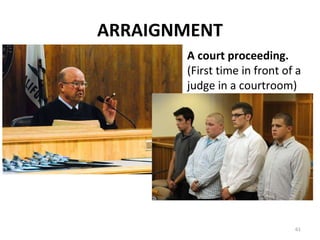
ARRAIGNMENT A court proceeding.  (First time in front of a judge in a courtroom)
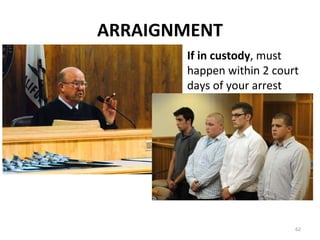
ARRAIGNMENT If in custody , must happen within 2 court days of your arrest
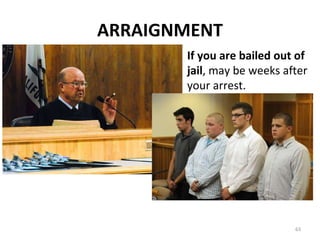
ARRAIGNMENT If you are bailed out of jail , may be weeks after your arrest.
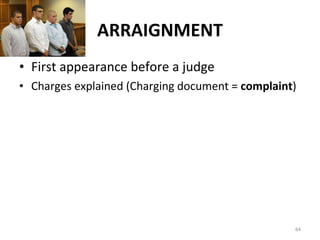
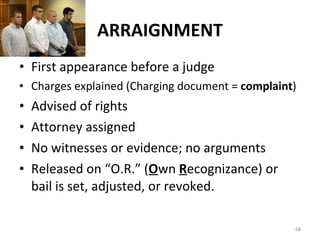
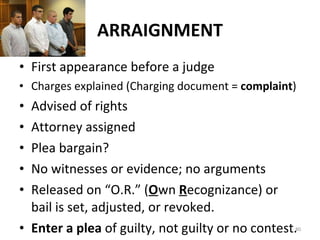
ARRAIGNMENT First appearance before a judge Charges explained (Charging document =  complaint )
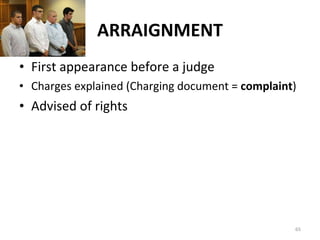
ARRAIGNMENT First appearance before a judge Charges explained (Charging document =  complaint ) Advised of rights
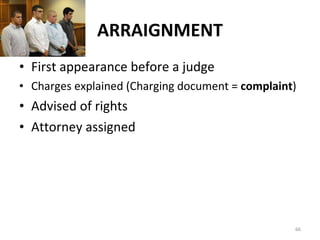
ARRAIGNMENT First appearance before a judge Charges explained (Charging document =  complaint ) Advised of rights Attorney assigned
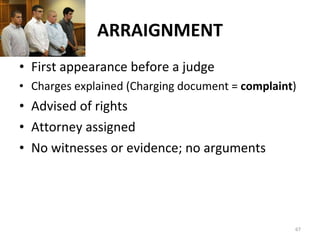
ARRAIGNMENT First appearance before a judge Charges explained (Charging document =  complaint ) Advised of rights Attorney assigned No witnesses or evidence; no arguments
ARRAIGNMENT First appearance before a judge Charges explained (Charging document =  complaint ) Advised of rights Attorney assigned No witnesses or evidence; no arguments Released on “O.R.” ( O wn  R ecognizance) or bail is set, adjusted, or revoked.
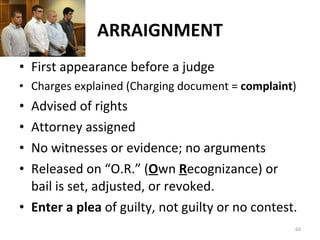
ARRAIGNMENT First appearance before a judge Charges explained (Charging document =  complaint ) Advised of rights Attorney assigned No witnesses or evidence; no arguments Released on “O.R.” ( O wn  R ecognizance) or bail is set, adjusted, or revoked. Enter a plea  of guilty, not guilty or no contest.
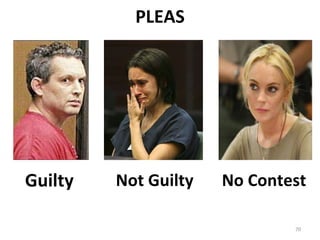
PLEAS Guilty Not Guilty No Contest
PLEAS Guilty  means you admit you did exactly what the complaint says you did and that you’re ready to receive your punishment.
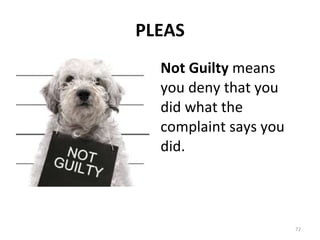
PLEAS Not Guilty  means you deny that you did what the complaint says you did.
PLEAS No contest  means you are not admitting guilt, but you are allowing the court to punish you without defending yourself. http://www.people.com/people/article/0,,1567608,00.html
NO CONTEST PLEA A no contest plea  in a misdemeanor case , cannot be used against you as an admission of guilt in a  civil trial  for your conduct. Here’s an example…
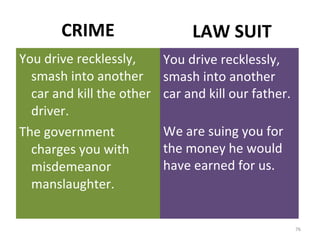
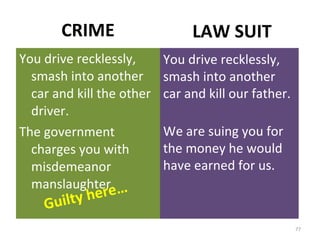
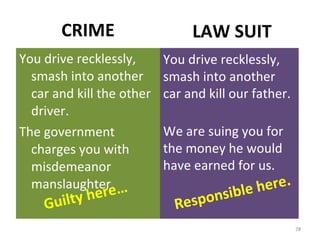
CRIME You drive recklessly, smash into another car and kill the other driver. The government charges you with misdemeanor manslaughter.
CRIME You drive recklessly, smash into another car and kill the other driver. The government charges you with misdemeanor manslaughter. LAW SUIT You drive recklessly, smash into another car and kill our father. We are suing you for the money he would have earned for us.
CRIME You drive recklessly, smash into another car and kill the other driver. The government charges you with misdemeanor manslaughter. LAW SUIT You drive recklessly, smash into another car and kill our father. We are suing you for the money he would have earned for us. Guilty here…
CRIME You drive recklessly, smash into another car and kill the other driver. The government charges you with misdemeanor manslaughter. LAW SUIT You drive recklessly, smash into another car and kill our father. We are suing you for the money he would have earned for us. Guilty here… Responsible here.
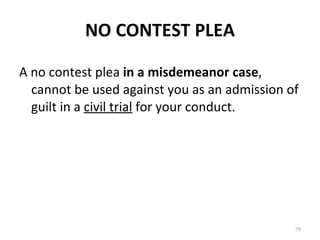
NO CONTEST PLEA A no contest plea  in a misdemeanor case , cannot be used against you as an admission of guilt in a  civil trial  for your conduct.
ARRAIGNMENT First appearance before a judge Charges explained (Charging document =  complaint ) Advised of rights Attorney assigned Plea bargain? No witnesses or evidence; no arguments Released on “O.R.” ( O wn  R ecognizance) or bail is set, adjusted, or revoked. Enter a plea  of guilty, not guilty or no contest.
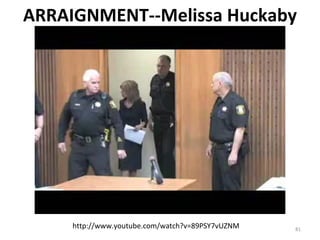
ARRAIGNMENT--Melissa Huckaby http://www.youtube.com/watch?v=89PSY7vUZNM
DISCOVERY Both sides get time to “discover” the truth by:
DISCOVERY Both sides get time to “discover” the truth by: Conducting  depositions  (interviewing witnesses face-to-face under oath)
DISCOVERY Both sides get time to “discover” the truth by: Conducting  depositions  (interviewing witnesses face-to-face under oath) Sending out  interrogatories  (written questionnaires)
DISCOVERY Both sides get time to “discover” the truth by: Conducting  depositions  (interviewing witnesses face-to-face under oath) Sending out  interrogatories  (written questionnaires) Ordering lab tests on physical evidence
DISCOVERY Both sides get time to “discover” the truth by: Conducting  depositions  (interviewing witnesses face-to-face under oath) Sending out  interrogatories  (written questionnaires) Ordering lab tests on physical evidence Ordering medical examinations
DISCOVERY Both sides get time to “discover” the truth by: Conducting  depositions  (interviewing witnesses face-to-face under oath) Sending out  interrogatories  (written questionnaires) Ordering lab tests on physical evidence Ordering medical examinations Ordering mental examinations
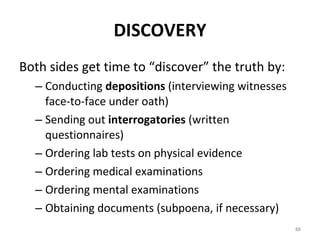
DISCOVERY Both sides get time to “discover” the truth by: Conducting  depositions  (interviewing witnesses face-to-face under oath) Sending out  interrogatories  (written questionnaires) Ordering lab tests on physical evidence Ordering medical examinations Ordering mental examinations Obtaining documents (subpoena, if necessary)
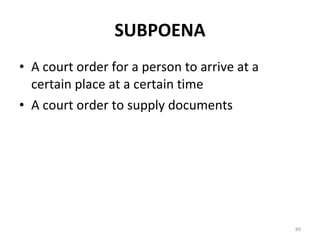
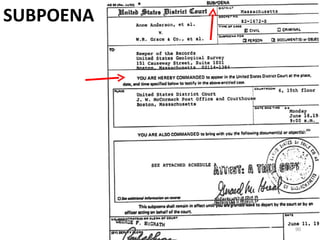
SUBPOENA A court order for a person to arrive at a certain place at a certain time A court order to supply documents
SUBPOENA
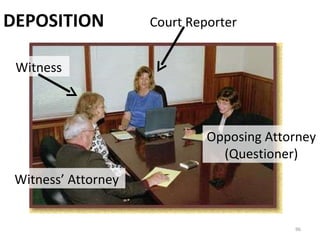
DEPOSITION
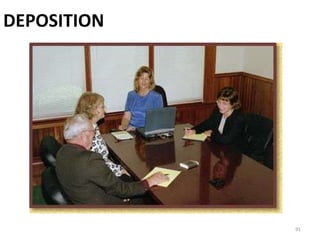
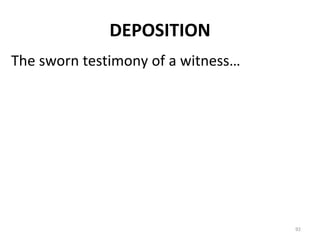
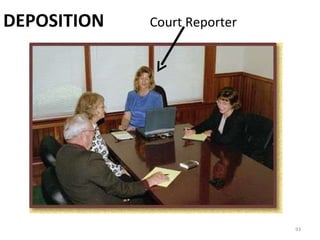
DEPOSITION The sworn testimony of a witness…
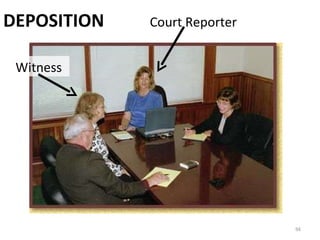
DEPOSITION Court Reporter
DEPOSITION Witness Court Reporter
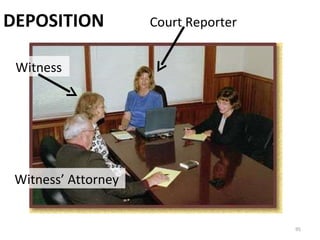
DEPOSITION Court Reporter Witness Witness’ Attorney
DEPOSITION Court Reporter Witness Witness’ Attorney Opposing Attorney (Questioner)
DEPOSITION—Tupac (3min clip) http://www.youtube.com/watch?v=9DBAcZpY90k
DEPOSITION The sworn testimony of a witness… taken before trial, usually in a lawyer’s office
DEPOSITION The sworn testimony of a witness… taken before trial, usually in a lawyer’s office not  testimony taken in a courtroom
DEPOSITION The sworn testimony of a witness… taken before trial, usually in a lawyer’s office not  testimony taken in a courtroom no judge present
DEPOSITION The sworn testimony of a witness… taken before trial, usually in a lawyer’s office not  testimony taken in a courtroom no judge present witness is placed under oath
DEPOSITION The sworn testimony of a witness… taken before trial, usually in a lawyer’s office not  testimony taken in a courtroom no judge present witness is placed under oath questions and answers are recorded
DEPOSITION The sworn testimony of a witness… taken before trial, usually in a lawyer’s office not  testimony taken in a courtroom no judge present witness is placed under oath questions and answers are recorded lawyers for  one  party may ask questions
DEPOSITION The sworn testimony of a witness… taken before trial, usually in a lawyer’s office not  testimony taken in a courtroom no judge present witness is placed under oath questions and answers are recorded lawyers for  one  party may ask questions If the witness is unavailable to testify at trial, the deposition of that person may be used
DEPOSITION The sworn testimony of a witness… taken before trial, usually in a lawyer’s office not  testimony taken in a courtroom no judge present witness is placed under oath questions and answers are recorded lawyers for  one  party may ask questions If the witness is unavailable to testify at trial, the deposition of that person may be used Part of the pre-trial “discovery” (fact-finding) process
DEPOSITION—Cindy Anthony (3min clip) http://www.youtube.com/watch?v=uG-bUi5QFl4
INTERROGATORIES
INTERROGATORIES Written questions to the other party (NOT to a third party) A way to “discover” the truth before a trial Written responses to an interrogatory are given under oath and can be used in court Interrogatory 1: Please identify all persons known to you to have personal knowledge of the facts pertaining to the occurrence, and indicate those who were eye witnesses, and state the substance of their knowledge and articulate their expected testimony.
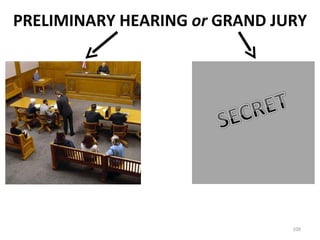
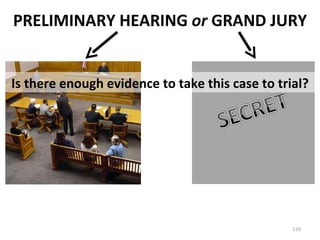
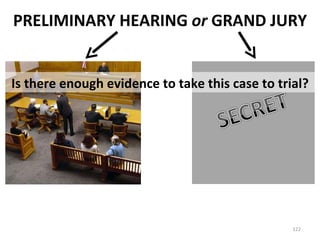
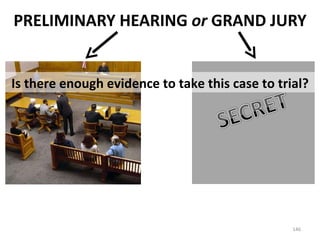
PRELIMINARY HEARING  or  GRAND JURY
PRELIMINARY HEARING  or  GRAND JURY Is there enough evidence to take this case to trial?
PRELIMINARY HEARING In Sacramento County, only for felony cases Not for misdemeanor cases
PRELIMINARY HEARING Happens within  14  days of the arraignment.
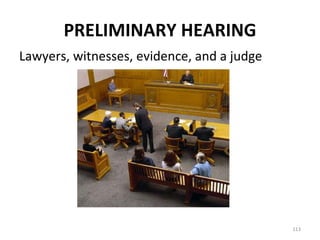
PRELIMINARY HEARING Lawyers, witnesses, evidence, and a judge
PRELIMINARY HEARING No jury at a preliminary hearing
PRELIMINARY HEARING Prosecutor presents enough evidence to convince the judge that a crime probably took place and the defendant probably did it.
PRELIMINARY HEARING Judge decides if the defendant should be:  “ bound over” for trial case should be dismissed charge should be reduced to a misdemeanor.
PRELIMINARY HEARING REVIEW In Sacramento County, only for felony cases Not for misdemeanor cases Happens within 14 days of the arraignment Lawyers, witnesses, evidence, and a judge No jury at a preliminary hearing Prosecutor presents enough evidence to convince the judge that a crime probably took place and the defendant probably did it. Judge decides if the defendant should be “bound over” for trial or the case should be dismissed, or the charge should be reduced to a misdemeanor.
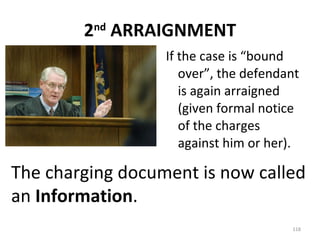
2 nd  ARRAIGNMENT If the case is “bound over”, the defendant is again arraigned (given formal notice of the charges against him or her).  The charging document is now called an  Information .
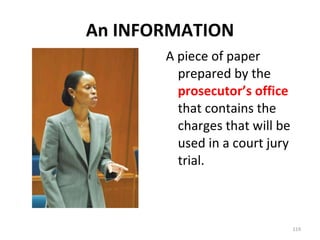
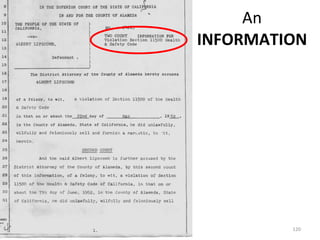
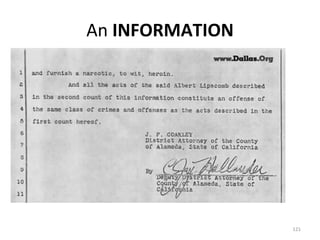
An INFORMATION A piece of paper prepared by the  prosecutor’s office  that contains the charges that will be used in a court jury trial.
An  INFORMATION
An  INFORMATION
PRELIMINARY HEARING  or  GRAND JURY Is there enough evidence to take this case to trial?
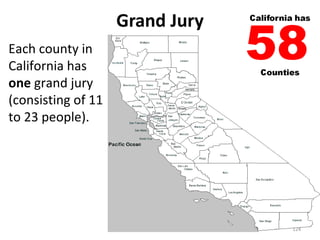
Grand Jury
Grand Jury Each county in California has  one  grand jury (consisting of 11 to 23 people).
Grand Jury Sacramento County’s Grand Jury has 19 people (and 11 alternates)
Grand Jury The same 19 people (and 11 alternates) work on all Grand Jury cases for a one-year term.
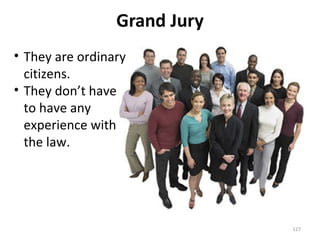
Grand Jury They are ordinary citizens. They don’t have to have any experience with the law.
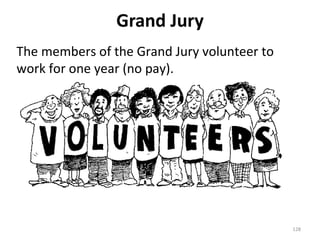
Grand Jury The members of the Grand Jury volunteer to work for one year (no pay).
To be on the  Grand Jury , you need to: Be 18 years old Be a citizen of Sacramento County Not be a felon Read and speak English YOU  can volunteer to be on Sacramento County’s Grand Jury (a  very  good idea if you’re serious about a career in  law).
Grand Jury Citizens apply for a position online in January and, if selected, take a seat on the Grand Jury from July 1 to June 30. www.SacGrandJury.org
Let’s watch 3 short news stories that involve Sacramento County’s  Grand Jury …
http://www.youtube.com/watch?v=H5XfOxQ0rtk (2:16)
http://www.youtube.com/watch?v=UPHTAn3hRvY (2:01)
http://www.youtube.com/watch?v=j8Er9-z6_fM (1:57)
Here’s a 13-minute introduction to Sacramento County’s Grand Jury…
www.SacGrandJury.org (13:00)
Grand Jury Two duties: Investigate public officers, offices and transactions within the county.
Grand Jury Two duties: Investigate public officers, offices and transactions within the county. For example, the Sacramento County Grand Jury investigated the  Sacramento County Library Authority  because a library  employee said there was some funny business going on with money paid to maintenance contracts.
Grand Jury Two duties: Investigate public officers, offices and transactions within the county. Consider criminal matters brought by the District Attorney to determine if sufficient evidence exists to support the case going to trial (just like a Preliminary Hearing does, except the Grand Jury meets in secret—not open to the public).
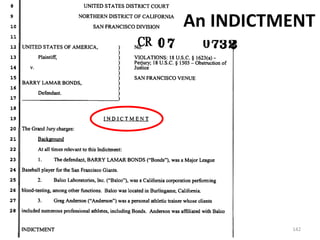
Grand Jury If the Grand Jury finds that there is enough evidence to have a trial, they create a charging document called an  Indictment .
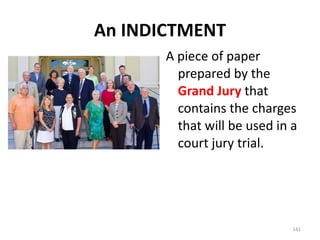
An INDICTMENT A piece of paper prepared by the  Grand Jury  that contains the charges that will be used in a court jury trial.
An INDICTMENT
An INFORMATION Do you remember what this is and who prepares it?
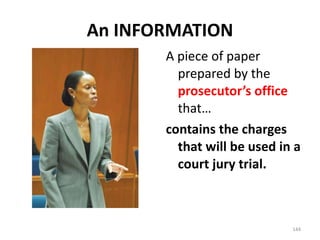
An INFORMATION A piece of paper prepared by the  prosecutor’s office  that… contains the charges that will be used in a court jury trial.
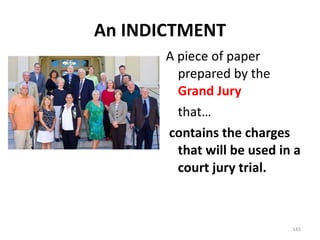
An INDICTMENT A piece of paper prepared by the  Grand Jury  that… contains the charges that will be used in a court jury trial.
PRELIMINARY HEARING  or  GRAND JURY Is there enough evidence to take this case to trial?
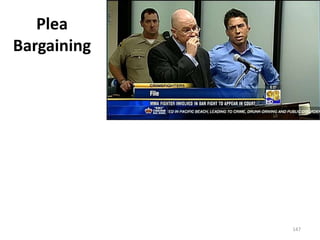
Plea Bargaining
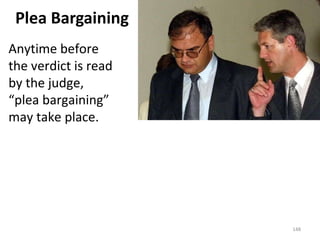
Plea Bargaining Anytime before the verdict is read by the judge, “plea bargaining” may take place.
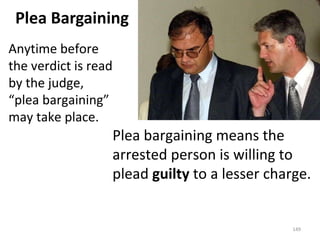
Plea Bargaining Plea bargaining means the arrested person is willing to plead  guilty  to a lesser charge. Anytime before the verdict is read by the judge, “plea bargaining” may take place.
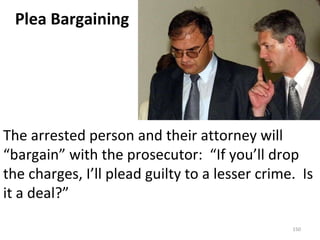
The arrested person and their attorney will “bargain” with the prosecutor:  “If you’ll drop the charges, I’ll plead guilty to a lesser crime.  Is it a deal?” Plea Bargaining
Plea Bargaining Avoids  all the hassle of a jury trial. the possibility of being convicted of a more serious crime and being sentenced more harshly.
Plea Bargaining For example, a person charged with  first-degree murder  may be sentenced to death if convicted by a jury. The person may be willing to plead guilty to  second-degree murder  to avoid the jury and the possibility of the death penalty.
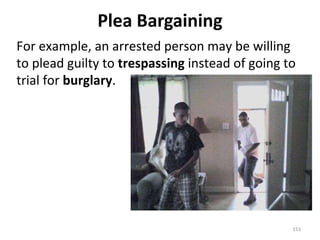
Plea Bargaining For example, an arrested person may be willing to plead guilty to  trespassing  instead of going to trial for  burglary .
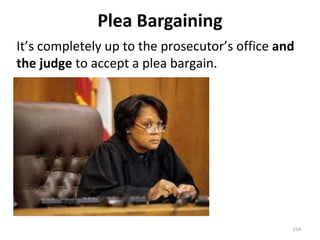
Plea Bargaining It’s completely up to the prosecutor’s office  and the judge  to accept a plea bargain.
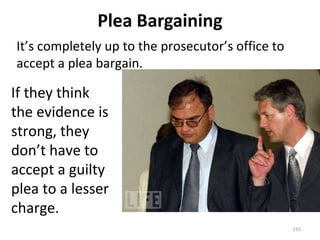
Plea Bargaining It’s completely up to the prosecutor’s office to accept a plea bargain. If they think the evidence is strong, they don’t have to accept a guilty plea to a lesser charge.
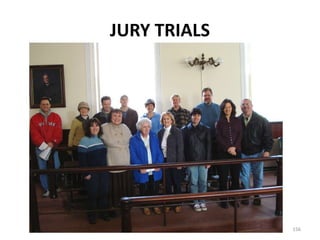
JURY TRIALS
2 Types of Juries
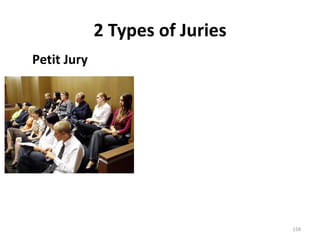
2 Types of Juries Petit Jury
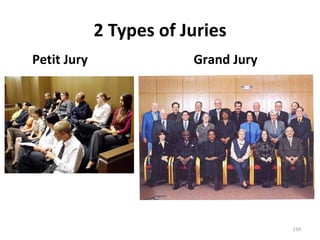
2 Types of Juries Petit Jury Grand Jury
Petit Jury
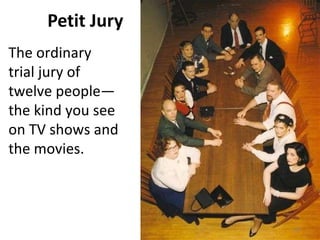
Petit Jury The ordinary trial jury of twelve people—the kind you see on TV shows and the movies.
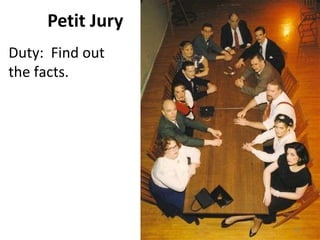
Petit Jury Duty:  Find out the facts.
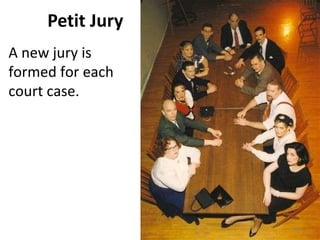
Petit Jury A new jury is formed for each court case.
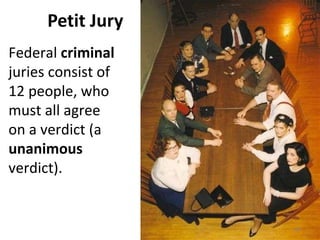
Petit Jury Federal  criminal  juries consist of 12 people, who must all agree on a verdict (a  unanimous  verdict).
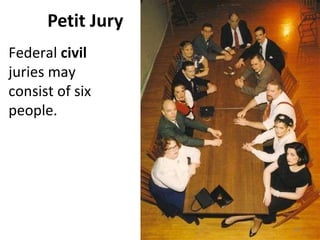
Petit Jury Federal  civil  juries may consist of six people.
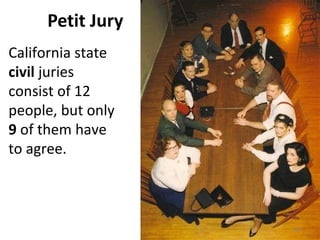
Petit Jury California state  civil  juries consist of 12 people, but only  9  of them have to agree.
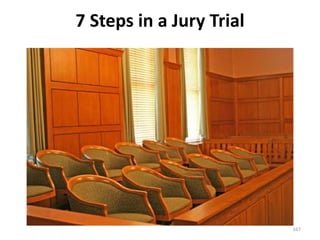
7 Steps in a Jury Trial
7 Steps in a Jury Trial Jury selection Opening statements Introduction of evidence Closing arguments Jury instructions Jury verdict Court sentencing
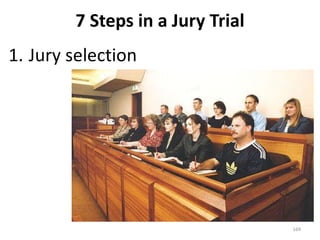
7 Steps in a Jury Trial Jury selection
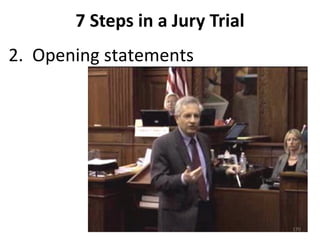
7 Steps in a Jury Trial 2.  Opening statements
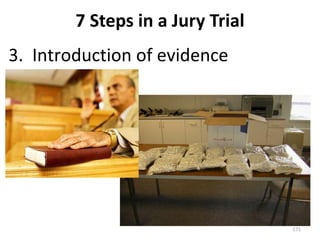
7 Steps in a Jury Trial 3.  Introduction of evidence
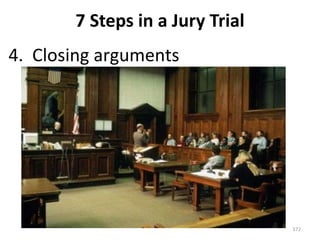
7 Steps in a Jury Trial 4.  Closing arguments
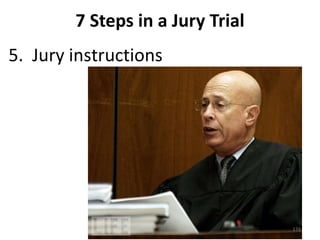
7 Steps in a Jury Trial 5.  Jury instructions
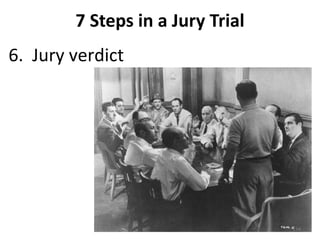
7 Steps in a Jury Trial 6.  Jury verdict
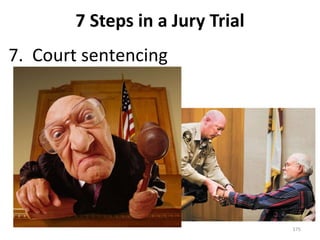
7 Steps in a Jury Trial 7.  Court sentencing
7 Steps in a Jury Trial Jury selection Opening statements Introduction of evidence Closing arguments Jury instructions Jury verdict Court sentencing
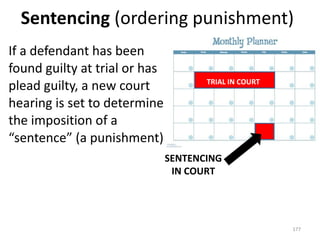
Sentencing  (ordering punishment) If a defendant has been found guilty at trial or has plead guilty, a new court hearing is set to determine the imposition of a “sentence” (a punishment) TRIAL IN COURT SENTENCING IN COURT
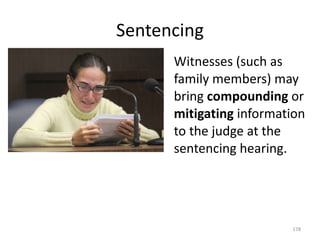
Sentencing Witnesses (such as family members) may bring  compounding  or  mitigating  information to the judge at the sentencing hearing.
Sentencing Compounding information: the punishment should be harsh examples:  previous convictions, heinous crime Mitigating information: the punishment should be lenient examples:  payment of restitution, first offence
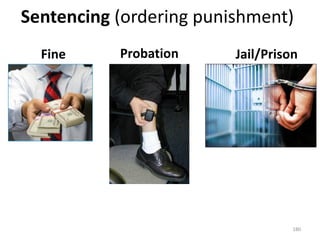
Sentencing  (ordering punishment) Probation Fine Jail/Prison
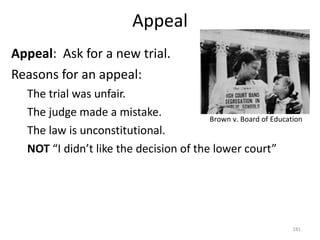
Appeal Appeal :  Ask for a new trial. Reasons for an appeal: The trial was unfair. The judge made a mistake. The law is unconstitutional. NOT  “I didn’t like the decision of the lower court” Brown v. Board of Education
---end of presentation---

Trial procedures

  • 1.
    Trial Procedures Fromarrest to appeal
  • 2.
    Trial Procedures OutlineArrest Booking and Bail Arraignment Discovery Preliminary hearing or Grand Jury Prosecutor “information” or Grand Jury “indictment” Plea bargaining Trial Jury verdict Sentencing Appeal
  • 3.
    ARREST A personis deprived of their freedom.
  • 4.
    ARREST Rights ofan arrested person are found in the 5 th , 6 th , and 8 th amendments of the U.S. Constitution
  • 5.
    5 th amendment The police and the prosecutor are trying to convict you. You are not required to help them.
  • 6.
    6 th amendment Informed of the nature and cause of the accusation Speedy and public trial Impartial jury Assistance of counsel Confront witnesses
  • 7.
    8 th amendment No excessive bail No excessive fines No cruel or unusual punishment
  • 8.
    ARREST Rights ofan arrested person: Cannot be forced to be a witness against themselves .
  • 9.
    ARREST Rights ofan arrested person: Cannot be deprived of life, liberty, or property without due process of law.
  • 10.
    ARREST Rights ofan arrested person: Know the charges
  • 11.
    ARREST Rights ofan arrested person: Know the charges Names of arresting officer(s)
  • 12.
    ARREST Rights ofan arrested person: Know the charges Names of arresting officer(s) Remain silent
  • 13.
    ARREST Rights ofan arrested person: Know the charges Names of arresting officer(s) Remain silent Use the telephone
  • 14.
    ARREST Rights ofan arrested person: Know the charges Names of arresting officer(s) Remain silent Use the telephone Bail
  • 15.
    ARREST Rights ofan arrested person: Know the charges Names of arresting officer(s) Remain silent Use the telephone Bail Have an attorney during questioning
  • 16.
    ARREST Rights ofan arrested person: Know the charges Names of arresting officer(s) Remain silent Use the telephone Bail Have an attorney during questioning Fair trial
  • 17.
    ARREST Rights ofan arrested person: Know the charges Names of arresting officer(s) Remain silent Use the telephone Bail Have an attorney during questioning Fair trial Presumed innocent
  • 18.
  • 19.
    BOOKING AND BAILArrested person brought to jail
  • 20.
    BOOKING AND BAILArrested person brought to jail “ Booking” is the jail intake procedure
  • 21.
    BOOKING AND BAILArrested person brought to jail Booking Searched for weapons
  • 22.
    BOOKING AND BAILArrested person brought to jail Booking Searched for weapons Personal belongings catalogued and retained
  • 23.
    BOOKING AND BAILArrested person brought to jail Booking Searched for weapons Personal belongings catalogued and retained Fingerprinted
  • 24.
    BOOKING AND BAILArrested person brought to jail Booking Searched for weapons Personal belongings catalogued and retained Fingerprinted Mug shot
  • 25.
    BOOKING AND BAILArrested person brought to jail Booking Searched for weapons Personal belongings catalogued and retained Fingerprinted Mug shot Check for warrants
  • 26.
    BOOKING AND BAILArrested person brought to jail Booking Searched for weapons Personal belongings catalogued and retained Fingerprinted Mug shot Check for warrants Data entered into computer system
  • 27.
    BOOKING AND BAILArrested person brought to jail Booking Searched for weapons Personal belongings catalogued and retained Fingerprinted Mug shot Check for warrants Data entered into computer system Bail set
  • 28.
    6 ways toget out of jail while waiting for your court date: Cash bail Surety bail Property bond Custody of your parents (for juveniles) O.R. Release on citation (“Cite Out”)
  • 29.
    BOOKING AND BAILAfter booking, the arrested person may not have to stay in jail until their trial. They may be released on “bail”.
  • 30.
    BAIL Each countysets an amount of money (bail) someone can pay to the court as a promise that you will return for your trial.
  • 31.
    BAIL Each countysets an amount of money (bail) someone can pay to the court as a promise that you will return for your trial. Bail amount is different for different crimes.
  • 32.
    BAIL Each countysets an amount of money (bail) someone can pay to the court as a promise that you will return for your trial. Bail amount is different for different crimes. (see Felony and Misdemeanor Bail Schedule ) http://www.saccourt.ca.gov/criminal/docs/felony-misdemeanor-bail-schedule.pdf
  • 38.
    BAIL Two majortypes of bail: Cash Bail Surety Bail Bond
  • 39.
    CASH BAIL Someonepays the entire amount of the bail in cash , for example $50,000
  • 40.
    CASH BAIL Someonepays the entire amount of the bail in cash , for example $50,000 This $50,000 will be kept by the court if the accused does not return to court for all of his/her court dates until the conclusion of the case.
  • 41.
    CASH BAIL Someonepays the entire amount of the bail in cash , for example $50,000 This $50,000 will be kept by the court if the accused does not return to court for all of his/her court dates until the conclusion of the case. If the accused returns to all court dates, the $50,000 is returned to the person who submitted it.
  • 42.
    BAIL Two majortypes of bail: Cash Bail Surety Bail Bond
  • 43.
    SURETY BAIL BONDIf you don’t have $50,000 in cash, you can get a bail bond agency to pay it for you…
  • 45.
    SURETY BAIL BONDSomeone pays a bail bond agency 10% of the bail and gives the bail bond agency ownership of some collateral for the rest of the bail.
  • 47.
    SURETY BAIL BONDSomeone pays a bail bond agency 10% of the bail and gives the bail bond agency ownership of some collateral for the rest of the bail. Collateral:
  • 48.
    SURETY BAIL BONDThe bail bond agency pays the entire bail for you. You get out of jail.
  • 49.
    SURETY BAIL BONDIf you show up for all your court dates, the person who put up the collateral gets ownership of the collateral back from the bail bond agency. Collateral:
  • 50.
    SURETY BAIL BONDThey never get their money back from a bail bond agency.
  • 51.
    SURETY BAIL BONDThey never get their money back from a bail bond agency. The 10% belongs to the bail bond agency.
  • 52.
    SURETY BAIL BONDThey never get their money back from a bail bond agency. The 10% belongs to the bail bond agency. It is their way of making a living.
  • 53.
    PROPERTY BOND Rarelyused in Sacramento County The court puts a lien on the arrestee’s house If arrestee does not appear in court, the house is sold at auction.
  • 54.
    PARENT CUSTODY Ifyou are under 18 years old, you can be released to the custody of your parents or legal guardian. There is no “bail” for juveniles in Sacramento County.
  • 55.
    O.R. You maynot have to stay in jail until your trial. At your arraignment (your first time in front of a judge), you may be released on your “own recognizance”, nicknamed “ O.R. ”
  • 56.
    O.R. You oryour attorney asks the judge to release you from jail on your own recognizance You promise to return to court on your trial date Judges look at Whether the you pose a threat to public safety The seriousness of the crime Your criminal history Your “flight risk” You are trusted to return to court on your court date.
  • 57.
    CITATION RELEASE “CITEOUT” Instead of being arrested (for trespassing, for example) the police may just give you a “citation” (a ticket) telling you to pay a fine or appear in court. You are immediately “released”.
  • 58.
    6 ways toget out of jail while waiting for your court date: Cash bail Surety bail Property bond Custody of your parents (for juveniles) O.R. Release on citation (“Cite Out”)
  • 59.
    Charge/Warrant Request Afterbooking and bail it set, police fill out a charge/warrant request and send it to the District Attorney’s office to start the prosecution.
  • 60.
    COMPLAINT The districtattorney’s office takes the police charge and creates a “complaint” A complaint is a piece of paper that shows what crimes you are accused of.
  • 61.
    ARRAIGNMENT A courtproceeding. (First time in front of a judge in a courtroom)
  • 62.
    ARRAIGNMENT If incustody , must happen within 2 court days of your arrest
  • 63.
    ARRAIGNMENT If youare bailed out of jail , may be weeks after your arrest.
  • 64.
    ARRAIGNMENT First appearancebefore a judge Charges explained (Charging document = complaint )
  • 65.
    ARRAIGNMENT First appearancebefore a judge Charges explained (Charging document = complaint ) Advised of rights
  • 66.
    ARRAIGNMENT First appearancebefore a judge Charges explained (Charging document = complaint ) Advised of rights Attorney assigned
  • 67.
    ARRAIGNMENT First appearancebefore a judge Charges explained (Charging document = complaint ) Advised of rights Attorney assigned No witnesses or evidence; no arguments
  • 68.
    ARRAIGNMENT First appearancebefore a judge Charges explained (Charging document = complaint ) Advised of rights Attorney assigned No witnesses or evidence; no arguments Released on “O.R.” ( O wn R ecognizance) or bail is set, adjusted, or revoked.
  • 69.
    ARRAIGNMENT First appearancebefore a judge Charges explained (Charging document = complaint ) Advised of rights Attorney assigned No witnesses or evidence; no arguments Released on “O.R.” ( O wn R ecognizance) or bail is set, adjusted, or revoked. Enter a plea of guilty, not guilty or no contest.
  • 70.
    PLEAS Guilty NotGuilty No Contest
  • 71.
    PLEAS Guilty means you admit you did exactly what the complaint says you did and that you’re ready to receive your punishment.
  • 72.
    PLEAS Not Guilty means you deny that you did what the complaint says you did.
  • 73.
    PLEAS No contest means you are not admitting guilt, but you are allowing the court to punish you without defending yourself. http://www.people.com/people/article/0,,1567608,00.html
  • 74.
    NO CONTEST PLEAA no contest plea in a misdemeanor case , cannot be used against you as an admission of guilt in a civil trial for your conduct. Here’s an example…
  • 75.
    CRIME You driverecklessly, smash into another car and kill the other driver. The government charges you with misdemeanor manslaughter.
  • 76.
    CRIME You driverecklessly, smash into another car and kill the other driver. The government charges you with misdemeanor manslaughter. LAW SUIT You drive recklessly, smash into another car and kill our father. We are suing you for the money he would have earned for us.
  • 77.
    CRIME You driverecklessly, smash into another car and kill the other driver. The government charges you with misdemeanor manslaughter. LAW SUIT You drive recklessly, smash into another car and kill our father. We are suing you for the money he would have earned for us. Guilty here…
  • 78.
    CRIME You driverecklessly, smash into another car and kill the other driver. The government charges you with misdemeanor manslaughter. LAW SUIT You drive recklessly, smash into another car and kill our father. We are suing you for the money he would have earned for us. Guilty here… Responsible here.
  • 79.
    NO CONTEST PLEAA no contest plea in a misdemeanor case , cannot be used against you as an admission of guilt in a civil trial for your conduct.
  • 80.
    ARRAIGNMENT First appearancebefore a judge Charges explained (Charging document = complaint ) Advised of rights Attorney assigned Plea bargain? No witnesses or evidence; no arguments Released on “O.R.” ( O wn R ecognizance) or bail is set, adjusted, or revoked. Enter a plea of guilty, not guilty or no contest.
  • 81.
  • 82.
    DISCOVERY Both sidesget time to “discover” the truth by:
  • 83.
    DISCOVERY Both sidesget time to “discover” the truth by: Conducting depositions (interviewing witnesses face-to-face under oath)
  • 84.
    DISCOVERY Both sidesget time to “discover” the truth by: Conducting depositions (interviewing witnesses face-to-face under oath) Sending out interrogatories (written questionnaires)
  • 85.
    DISCOVERY Both sidesget time to “discover” the truth by: Conducting depositions (interviewing witnesses face-to-face under oath) Sending out interrogatories (written questionnaires) Ordering lab tests on physical evidence
  • 86.
    DISCOVERY Both sidesget time to “discover” the truth by: Conducting depositions (interviewing witnesses face-to-face under oath) Sending out interrogatories (written questionnaires) Ordering lab tests on physical evidence Ordering medical examinations
  • 87.
    DISCOVERY Both sidesget time to “discover” the truth by: Conducting depositions (interviewing witnesses face-to-face under oath) Sending out interrogatories (written questionnaires) Ordering lab tests on physical evidence Ordering medical examinations Ordering mental examinations
  • 88.
    DISCOVERY Both sidesget time to “discover” the truth by: Conducting depositions (interviewing witnesses face-to-face under oath) Sending out interrogatories (written questionnaires) Ordering lab tests on physical evidence Ordering medical examinations Ordering mental examinations Obtaining documents (subpoena, if necessary)
  • 89.
    SUBPOENA A courtorder for a person to arrive at a certain place at a certain time A court order to supply documents
  • 90.
  • 91.
  • 92.
    DEPOSITION The sworntestimony of a witness…
  • 93.
  • 94.
  • 95.
    DEPOSITION Court ReporterWitness Witness’ Attorney
  • 96.
    DEPOSITION Court ReporterWitness Witness’ Attorney Opposing Attorney (Questioner)
  • 97.
    DEPOSITION—Tupac (3min clip)http://www.youtube.com/watch?v=9DBAcZpY90k
  • 98.
    DEPOSITION The sworntestimony of a witness… taken before trial, usually in a lawyer’s office
  • 99.
    DEPOSITION The sworntestimony of a witness… taken before trial, usually in a lawyer’s office not testimony taken in a courtroom
  • 100.
    DEPOSITION The sworntestimony of a witness… taken before trial, usually in a lawyer’s office not testimony taken in a courtroom no judge present
  • 101.
    DEPOSITION The sworntestimony of a witness… taken before trial, usually in a lawyer’s office not testimony taken in a courtroom no judge present witness is placed under oath
  • 102.
    DEPOSITION The sworntestimony of a witness… taken before trial, usually in a lawyer’s office not testimony taken in a courtroom no judge present witness is placed under oath questions and answers are recorded
  • 103.
    DEPOSITION The sworntestimony of a witness… taken before trial, usually in a lawyer’s office not testimony taken in a courtroom no judge present witness is placed under oath questions and answers are recorded lawyers for one party may ask questions
  • 104.
    DEPOSITION The sworntestimony of a witness… taken before trial, usually in a lawyer’s office not testimony taken in a courtroom no judge present witness is placed under oath questions and answers are recorded lawyers for one party may ask questions If the witness is unavailable to testify at trial, the deposition of that person may be used
  • 105.
    DEPOSITION The sworntestimony of a witness… taken before trial, usually in a lawyer’s office not testimony taken in a courtroom no judge present witness is placed under oath questions and answers are recorded lawyers for one party may ask questions If the witness is unavailable to testify at trial, the deposition of that person may be used Part of the pre-trial “discovery” (fact-finding) process
  • 106.
    DEPOSITION—Cindy Anthony (3minclip) http://www.youtube.com/watch?v=uG-bUi5QFl4
  • 107.
  • 108.
    INTERROGATORIES Written questionsto the other party (NOT to a third party) A way to “discover” the truth before a trial Written responses to an interrogatory are given under oath and can be used in court Interrogatory 1: Please identify all persons known to you to have personal knowledge of the facts pertaining to the occurrence, and indicate those who were eye witnesses, and state the substance of their knowledge and articulate their expected testimony.
  • 109.
    PRELIMINARY HEARING or GRAND JURY
  • 110.
    PRELIMINARY HEARING or GRAND JURY Is there enough evidence to take this case to trial?
  • 111.
    PRELIMINARY HEARING InSacramento County, only for felony cases Not for misdemeanor cases
  • 112.
    PRELIMINARY HEARING Happenswithin 14 days of the arraignment.
  • 113.
    PRELIMINARY HEARING Lawyers,witnesses, evidence, and a judge
  • 114.
    PRELIMINARY HEARING Nojury at a preliminary hearing
  • 115.
    PRELIMINARY HEARING Prosecutorpresents enough evidence to convince the judge that a crime probably took place and the defendant probably did it.
  • 116.
    PRELIMINARY HEARING Judgedecides if the defendant should be: “ bound over” for trial case should be dismissed charge should be reduced to a misdemeanor.
  • 117.
    PRELIMINARY HEARING REVIEWIn Sacramento County, only for felony cases Not for misdemeanor cases Happens within 14 days of the arraignment Lawyers, witnesses, evidence, and a judge No jury at a preliminary hearing Prosecutor presents enough evidence to convince the judge that a crime probably took place and the defendant probably did it. Judge decides if the defendant should be “bound over” for trial or the case should be dismissed, or the charge should be reduced to a misdemeanor.
  • 118.
    2 nd ARRAIGNMENT If the case is “bound over”, the defendant is again arraigned (given formal notice of the charges against him or her). The charging document is now called an Information .
  • 119.
    An INFORMATION Apiece of paper prepared by the prosecutor’s office that contains the charges that will be used in a court jury trial.
  • 120.
  • 121.
  • 122.
    PRELIMINARY HEARING or GRAND JURY Is there enough evidence to take this case to trial?
  • 123.
  • 124.
    Grand Jury Eachcounty in California has one grand jury (consisting of 11 to 23 people).
  • 125.
    Grand Jury SacramentoCounty’s Grand Jury has 19 people (and 11 alternates)
  • 126.
    Grand Jury Thesame 19 people (and 11 alternates) work on all Grand Jury cases for a one-year term.
  • 127.
    Grand Jury Theyare ordinary citizens. They don’t have to have any experience with the law.
  • 128.
    Grand Jury Themembers of the Grand Jury volunteer to work for one year (no pay).
  • 129.
    To be onthe Grand Jury , you need to: Be 18 years old Be a citizen of Sacramento County Not be a felon Read and speak English YOU can volunteer to be on Sacramento County’s Grand Jury (a very good idea if you’re serious about a career in law).
  • 130.
    Grand Jury Citizensapply for a position online in January and, if selected, take a seat on the Grand Jury from July 1 to June 30. www.SacGrandJury.org
  • 131.
    Let’s watch 3short news stories that involve Sacramento County’s Grand Jury …
  • 132.
  • 133.
  • 134.
  • 135.
    Here’s a 13-minuteintroduction to Sacramento County’s Grand Jury…
  • 136.
  • 137.
    Grand Jury Twoduties: Investigate public officers, offices and transactions within the county.
  • 138.
    Grand Jury Twoduties: Investigate public officers, offices and transactions within the county. For example, the Sacramento County Grand Jury investigated the Sacramento County Library Authority because a library employee said there was some funny business going on with money paid to maintenance contracts.
  • 139.
    Grand Jury Twoduties: Investigate public officers, offices and transactions within the county. Consider criminal matters brought by the District Attorney to determine if sufficient evidence exists to support the case going to trial (just like a Preliminary Hearing does, except the Grand Jury meets in secret—not open to the public).
  • 140.
    Grand Jury Ifthe Grand Jury finds that there is enough evidence to have a trial, they create a charging document called an Indictment .
  • 141.
    An INDICTMENT Apiece of paper prepared by the Grand Jury that contains the charges that will be used in a court jury trial.
  • 142.
  • 143.
    An INFORMATION Doyou remember what this is and who prepares it?
  • 144.
    An INFORMATION Apiece of paper prepared by the prosecutor’s office that… contains the charges that will be used in a court jury trial.
  • 145.
    An INDICTMENT Apiece of paper prepared by the Grand Jury that… contains the charges that will be used in a court jury trial.
  • 146.
    PRELIMINARY HEARING or GRAND JURY Is there enough evidence to take this case to trial?
  • 147.
  • 148.
    Plea Bargaining Anytimebefore the verdict is read by the judge, “plea bargaining” may take place.
  • 149.
    Plea Bargaining Pleabargaining means the arrested person is willing to plead guilty to a lesser charge. Anytime before the verdict is read by the judge, “plea bargaining” may take place.
  • 150.
    The arrested personand their attorney will “bargain” with the prosecutor: “If you’ll drop the charges, I’ll plead guilty to a lesser crime. Is it a deal?” Plea Bargaining
  • 151.
    Plea Bargaining Avoids all the hassle of a jury trial. the possibility of being convicted of a more serious crime and being sentenced more harshly.
  • 152.
    Plea Bargaining Forexample, a person charged with first-degree murder may be sentenced to death if convicted by a jury. The person may be willing to plead guilty to second-degree murder to avoid the jury and the possibility of the death penalty.
  • 153.
    Plea Bargaining Forexample, an arrested person may be willing to plead guilty to trespassing instead of going to trial for burglary .
  • 154.
    Plea Bargaining It’scompletely up to the prosecutor’s office and the judge to accept a plea bargain.
  • 155.
    Plea Bargaining It’scompletely up to the prosecutor’s office to accept a plea bargain. If they think the evidence is strong, they don’t have to accept a guilty plea to a lesser charge.
  • 156.
  • 157.
    2 Types ofJuries
  • 158.
    2 Types ofJuries Petit Jury
  • 159.
    2 Types ofJuries Petit Jury Grand Jury
  • 160.
  • 161.
    Petit Jury Theordinary trial jury of twelve people—the kind you see on TV shows and the movies.
  • 162.
    Petit Jury Duty: Find out the facts.
  • 163.
    Petit Jury Anew jury is formed for each court case.
  • 164.
    Petit Jury Federal criminal juries consist of 12 people, who must all agree on a verdict (a unanimous verdict).
  • 165.
    Petit Jury Federal civil juries may consist of six people.
  • 166.
    Petit Jury Californiastate civil juries consist of 12 people, but only 9 of them have to agree.
  • 167.
    7 Steps ina Jury Trial
  • 168.
    7 Steps ina Jury Trial Jury selection Opening statements Introduction of evidence Closing arguments Jury instructions Jury verdict Court sentencing
  • 169.
    7 Steps ina Jury Trial Jury selection
  • 170.
    7 Steps ina Jury Trial 2. Opening statements
  • 171.
    7 Steps ina Jury Trial 3. Introduction of evidence
  • 172.
    7 Steps ina Jury Trial 4. Closing arguments
  • 173.
    7 Steps ina Jury Trial 5. Jury instructions
  • 174.
    7 Steps ina Jury Trial 6. Jury verdict
  • 175.
    7 Steps ina Jury Trial 7. Court sentencing
  • 176.
    7 Steps ina Jury Trial Jury selection Opening statements Introduction of evidence Closing arguments Jury instructions Jury verdict Court sentencing
  • 177.
    Sentencing (orderingpunishment) If a defendant has been found guilty at trial or has plead guilty, a new court hearing is set to determine the imposition of a “sentence” (a punishment) TRIAL IN COURT SENTENCING IN COURT
  • 178.
    Sentencing Witnesses (suchas family members) may bring compounding or mitigating information to the judge at the sentencing hearing.
  • 179.
    Sentencing Compounding information:the punishment should be harsh examples: previous convictions, heinous crime Mitigating information: the punishment should be lenient examples: payment of restitution, first offence
  • 180.
    Sentencing (orderingpunishment) Probation Fine Jail/Prison
  • 181.
    Appeal Appeal : Ask for a new trial. Reasons for an appeal: The trial was unfair. The judge made a mistake. The law is unconstitutional. NOT “I didn’t like the decision of the lower court” Brown v. Board of Education
  • 182.