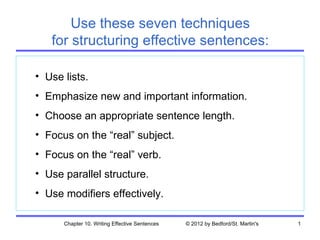
Use these seven techniques
   for structuring effective sentences:

• Use lists.
• Emphasize new and important information.
• Choose an appropriate sentence length.
• Focus on the “real” subject.
• Focus on the “real” verb.
• Use parallel structure.
• Use modifiers effectively.

      Chapter 10. Writing Effective Sentences   © 2012 by Bedford/St. Martin's   1
Use these five guidelines
           for creating effective lists:

• Set off each listed item with a number, a
  letter, or a symbol (usually a bullet).
• Break up long lists.
• Present the items in a parallel structure.
• Structure and punctuate the lead-in correctly.
• Punctuate the list correctly.

     Chapter 10. Writing Effective Sentences   © 2012 by Bedford/St. Martin's   2
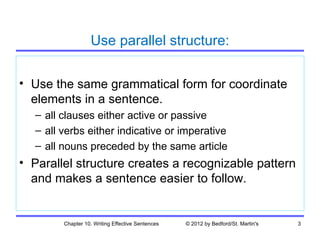
Use parallel structure:

• Use the same grammatical form for coordinate
  elements in a sentence.
  – all clauses either active or passive
  – all verbs either indicative or imperative
  – all nouns preceded by the same article
• Parallel structure creates a recognizable pattern
  and makes a sentence easier to follow.


        Chapter 10. Writing Effective Sentences   © 2012 by Bedford/St. Martin's   3
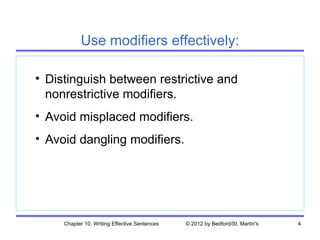
Use modifiers effectively:

• Distinguish between restrictive and
  nonrestrictive modifiers.
• Avoid misplaced modifiers.
• Avoid dangling modifiers.


     Chapter 10. Writing Effective Sentences   © 2012 by Bedford/St. Martin's   4
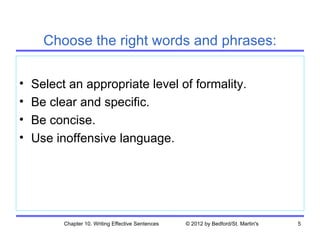
Choose the right words and phrases:

•   Select an appropriate level of formality.
•   Be clear and specific.
•   Be concise.
•   Use inoffensive language.


          Chapter 10. Writing Effective Sentences   © 2012 by Bedford/St. Martin's   5
Select an appropriate level of formality:

There are three levels of formality:
• informal
• moderately formal
• highly formal

Use a level and tone appropriate for your
• audience
• subject
• purpose


       Chapter 10. Writing Effective Sentences   © 2012 by Bedford/St. Martin's   6
Informal writing can cause two problems:

• It tends to be imprecise.
• It can be embarrassing.


     Chapter 10. Writing Effective Sentences   © 2012 by Bedford/St. Martin's   7
Use these seven techniques
    for writing clearly and specifically:

• Use the active and passive voice appropriately.
• Be specific.
• Avoid unnecessary jargon.
• Use positive constructions.
• Avoid long noun strings.
• Avoid clichés.
• Avoid euphemisms.

      Chapter 10. Writing Effective Sentences   © 2012 by Bedford/St. Martin's   8
Use the active and
        passive voice appropriately:

Use the active voice unless
• the agent is clear from the context
• the agent is unknown
• the agent is less important than the action
• a reference to the agent is embarrassing,
  dangerous, or in some other way
  inappropriate
     Chapter 10. Writing Effective Sentences   © 2012 by Bedford/St. Martin's   9
Use these three techniques
          for writing specifically:

• Use precise words.
• Provide adequate detail.
• Avoid ambiguity.


     Chapter 10. Writing Effective Sentences   © 2012 by Bedford/St. Martin's   10
Avoid unnecessary jargon for four reasons:

•    It can be imprecise.
•    It can be confusing.
•    It is often seen as condescending.
•    It is often intimidating.


          Chapter 10. Writing Effective Sentences   © 2012 by Bedford/St. Martin's   11
Be concise:

• Avoid obvious statements.
• Avoid filler.
• Avoid unnecessary prepositional phrases.
• Avoid wordy phrases.
• Avoid fancy words.


      Chapter 10. Writing Effective Sentences   © 2012 by Bedford/St. Martin's   12
Follow these six guidelines
        for avoiding sexist language:

• Replace the male-gender words with non-gender-
  specific words.
• Switch to a different form of the verb.
• Switch to the plural.
• Switch to he or she, he/she, s/he, or his or her.
• Address the reader directly.
• Alternate he and she.


      Chapter 10. Writing Effective Sentences   © 2012 by Bedford/St. Martin's   13
Follow these five guidelines
   for using the people-first approach:

• Refer to the person first, the disability second.
• Don’t confuse handicap with disability.
• Don’t refer to victimization.
• Don’t refer to a person as “wheelchair bound” or
  “confined to a wheelchair.”
• Don’t refer to people with disabilities as abnormal.


      Chapter 10. Writing Effective Sentences   © 2012 by Bedford/St. Martin's   14
Use these seven techniques
         in preparing text for translation:
•   Use short sentences.
•   Use the active voice.
•   Use simple words.
•   Include a glossary.
•   Use words that have only one meaning.
•   Use pronouns carefully.
•   Avoid jokes, puns, and culture-bound
    references.

         Chapter 10. Writing Effective Sentences   © 2012 by Bedford/St. Martin's   15

Ch10 slides

  • 1.
    Use these seventechniques for structuring effective sentences: • Use lists. • Emphasize new and important information. • Choose an appropriate sentence length. • Focus on the “real” subject. • Focus on the “real” verb. • Use parallel structure. • Use modifiers effectively. Chapter 10. Writing Effective Sentences © 2012 by Bedford/St. Martin's 1
  • 2.
    Use these fiveguidelines for creating effective lists: • Set off each listed item with a number, a letter, or a symbol (usually a bullet). • Break up long lists. • Present the items in a parallel structure. • Structure and punctuate the lead-in correctly. • Punctuate the list correctly. Chapter 10. Writing Effective Sentences © 2012 by Bedford/St. Martin's 2
  • 3.
    Use parallel structure: •Use the same grammatical form for coordinate elements in a sentence. – all clauses either active or passive – all verbs either indicative or imperative – all nouns preceded by the same article • Parallel structure creates a recognizable pattern and makes a sentence easier to follow. Chapter 10. Writing Effective Sentences © 2012 by Bedford/St. Martin's 3
  • 4.
    Use modifiers effectively: •Distinguish between restrictive and nonrestrictive modifiers. • Avoid misplaced modifiers. • Avoid dangling modifiers. Chapter 10. Writing Effective Sentences © 2012 by Bedford/St. Martin's 4
  • 5.
    Choose the rightwords and phrases: • Select an appropriate level of formality. • Be clear and specific. • Be concise. • Use inoffensive language. Chapter 10. Writing Effective Sentences © 2012 by Bedford/St. Martin's 5
  • 6.
    Select an appropriatelevel of formality: There are three levels of formality: • informal • moderately formal • highly formal Use a level and tone appropriate for your • audience • subject • purpose Chapter 10. Writing Effective Sentences © 2012 by Bedford/St. Martin's 6
  • 7.
    Informal writing cancause two problems: • It tends to be imprecise. • It can be embarrassing. Chapter 10. Writing Effective Sentences © 2012 by Bedford/St. Martin's 7
  • 8.
    Use these seventechniques for writing clearly and specifically: • Use the active and passive voice appropriately. • Be specific. • Avoid unnecessary jargon. • Use positive constructions. • Avoid long noun strings. • Avoid clichés. • Avoid euphemisms. Chapter 10. Writing Effective Sentences © 2012 by Bedford/St. Martin's 8
  • 9.
    Use the activeand passive voice appropriately: Use the active voice unless • the agent is clear from the context • the agent is unknown • the agent is less important than the action • a reference to the agent is embarrassing, dangerous, or in some other way inappropriate Chapter 10. Writing Effective Sentences © 2012 by Bedford/St. Martin's 9
  • 10.
    Use these threetechniques for writing specifically: • Use precise words. • Provide adequate detail. • Avoid ambiguity. Chapter 10. Writing Effective Sentences © 2012 by Bedford/St. Martin's 10
  • 11.
    Avoid unnecessary jargonfor four reasons: • It can be imprecise. • It can be confusing. • It is often seen as condescending. • It is often intimidating. Chapter 10. Writing Effective Sentences © 2012 by Bedford/St. Martin's 11
  • 12.
    Be concise: • Avoidobvious statements. • Avoid filler. • Avoid unnecessary prepositional phrases. • Avoid wordy phrases. • Avoid fancy words. Chapter 10. Writing Effective Sentences © 2012 by Bedford/St. Martin's 12
  • 13.
    Follow these sixguidelines for avoiding sexist language: • Replace the male-gender words with non-gender- specific words. • Switch to a different form of the verb. • Switch to the plural. • Switch to he or she, he/she, s/he, or his or her. • Address the reader directly. • Alternate he and she. Chapter 10. Writing Effective Sentences © 2012 by Bedford/St. Martin's 13
  • 14.
    Follow these fiveguidelines for using the people-first approach: • Refer to the person first, the disability second. • Don’t confuse handicap with disability. • Don’t refer to victimization. • Don’t refer to a person as “wheelchair bound” or “confined to a wheelchair.” • Don’t refer to people with disabilities as abnormal. Chapter 10. Writing Effective Sentences © 2012 by Bedford/St. Martin's 14
  • 15.
    Use these seventechniques in preparing text for translation: • Use short sentences. • Use the active voice. • Use simple words. • Include a glossary. • Use words that have only one meaning. • Use pronouns carefully. • Avoid jokes, puns, and culture-bound references. Chapter 10. Writing Effective Sentences © 2012 by Bedford/St. Martin's 15