Chapter 10.1 and 10.2: Boolean Algebra
Based on Slides from
Discrete Mathematical Structures:
Theory and Applications
Discrete Mathematical Structures: Theory and Applications 2
Learning Objectives
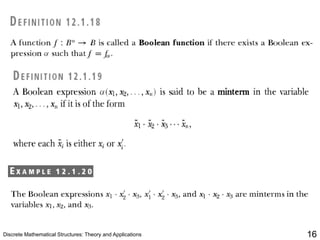
 Learn about Boolean expressions
 Become aware of the basic properties of
Boolean algebra
Discrete Mathematical Structures: Theory and Applications 3
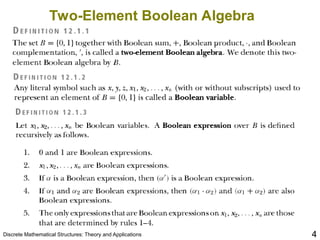
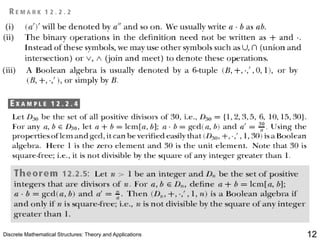
Two-Element Boolean Algebra
Let B = {0, 1}.
Discrete Mathematical Structures: Theory and Applications 4
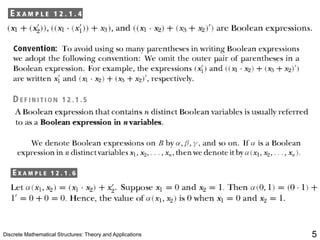
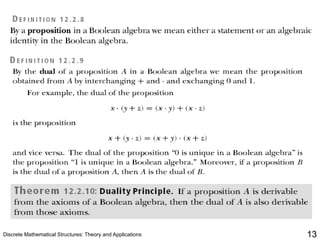
Two-Element Boolean Algebra
Discrete Mathematical Structures: Theory and Applications 5
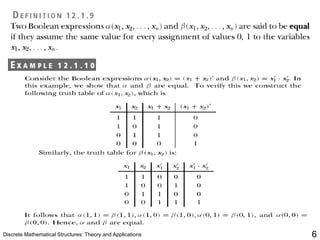
Discrete Mathematical Structures: Theory and Applications 6
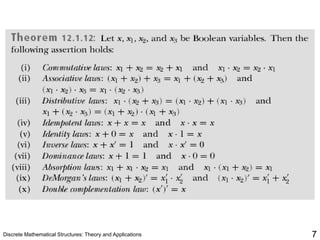
Discrete Mathematical Structures: Theory and Applications 7
Discrete Mathematical Structures: Theory and Applications 8
Two-Element Boolean Algebra
Discrete Mathematical Structures: Theory and Applications 9
Two-Element Boolean Algebra
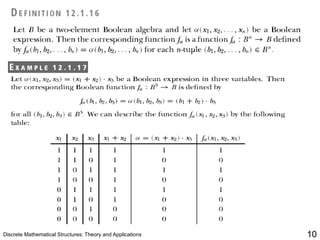
Discrete Mathematical Structures: Theory and Applications 10
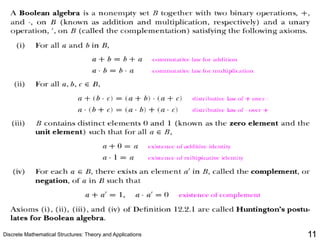
Discrete Mathematical Structures: Theory and Applications 11
Discrete Mathematical Structures: Theory and Applications 12
Discrete Mathematical Structures: Theory and Applications 13
Discrete Mathematical Structures: Theory and Applications 14
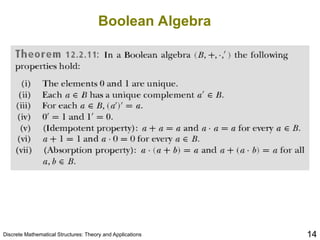
Boolean Algebra
Discrete Mathematical Structures: Theory and Applications 15
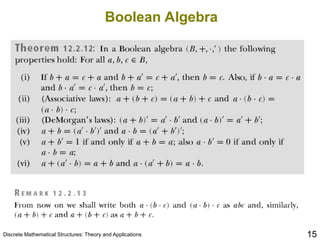
Boolean Algebra
Discrete Mathematical Structures: Theory and Applications 16
Discrete Mathematical Structures: Theory and Applications 17
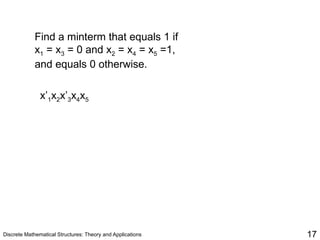
Find a minterm that equals 1 if
x1 = x3 = 0 and x2 = x4 = x5 =1,
and equals 0 otherwise.
x’1x2x’3x4x5
Discrete Mathematical Structures: Theory and Applications 18
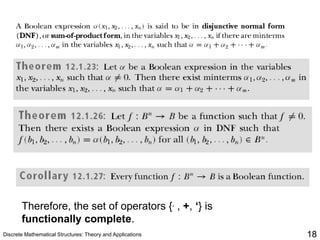
Therefore, the set of operators {.
, +, ‘} is
functionally complete.
Discrete Mathematical Structures: Theory and Applications 19
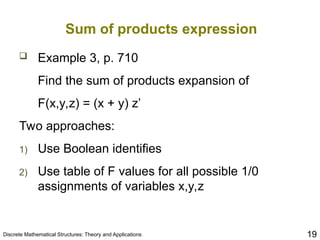
Sum of products expression
 Example 3, p. 710
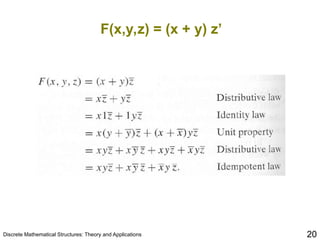
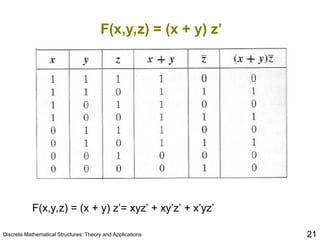
Find the sum of products expansion of
F(x,y,z) = (x + y) z’
Two approaches:
1) Use Boolean identifies
2) Use table of F values for all possible 1/0
assignments of variables x,y,z
Discrete Mathematical Structures: Theory and Applications 20
F(x,y,z) = (x + y) z’
Discrete Mathematical Structures: Theory and Applications 21
F(x,y,z) = (x + y) z’
F(x,y,z) = (x + y) z’= xyz’ + xy’z’ + x’yz’
Discrete Mathematical Structures: Theory and Applications 22
Discrete Mathematical Structures: Theory and Applications 23
Discrete Mathematical Structures: Theory and Applications 24
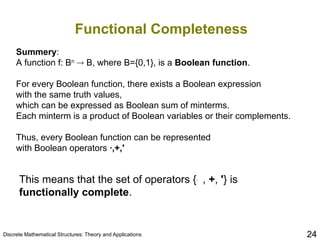
Functional Completeness
This means that the set of operators {.
, +, '} is
functionally complete.
Summery:
A function f: Bn
 B, where B={0,1}, is a Boolean function.
For every Boolean function, there exists a Boolean expression
with the same truth values,
which can be expressed as Boolean sum of minterms.
Each minterm is a product of Boolean variables or their complements.
Thus, every Boolean function can be represented
with Boolean operators ·,+,'
Discrete Mathematical Structures: Theory and Applications 25
Functional Completeness
0
1
0
0
1
1
1 





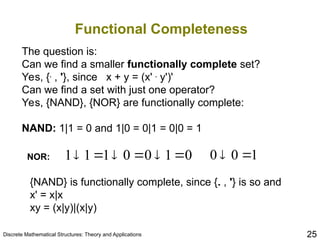
The question is:
Can we find a smaller functionally complete set?
Yes, {.
, '}, since x + y = (x' .
y')'
Can we find a set with just one operator?
Yes, {NAND}, {NOR} are functionally complete:
NAND: 1|1 = 0 and 1|0 = 0|1 = 0|0 = 1
1
0
0 

{NAND} is functionally complete, since {. , '} is so and
x' = x|x
xy = (x|y)|(x|y)
NOR:

ch10.1.ppt boolean Algebra and Logic gates