CMSC 203 - Discrete Structures 1
Yes, No, Maybe...
Boolean
Algebra
CMSC 203 - Discrete Structures 2
Boolean Algebra
Boolean algebra provides the operations and the
rules for working with the set {0, 1}.
These are the rules that underlie electronic
circuits, and the methods we will discuss are
fundamental to VLSI design.
We are going to focus on three operations:
• Boolean complementation,
• Boolean sum, and
• Boolean product
CMSC 203 - Discrete Structures 3
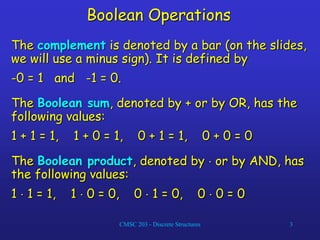
Boolean Operations
The complement is denoted by a bar (on the slides,
we will use a minus sign). It is defined by
-0 = 1 and -1 = 0.
The Boolean sum, denoted by + or by OR, has the
following values:
1 + 1 = 1, 1 + 0 = 1, 0 + 1 = 1, 0 + 0 = 0
The Boolean product, denoted by  or by AND, has
the following values:
1  1 = 1, 1  0 = 0, 0  1 = 0, 0  0 = 0
CMSC 203 - Discrete Structures 4
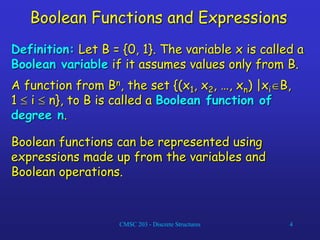
Boolean Functions and Expressions
Definition: Let B = {0, 1}. The variable x is called a
Boolean variable if it assumes values only from B.
A function from Bn, the set {(x1, x2, …, xn) |xiB,
1  i  n}, to B is called a Boolean function of
degree n.
Boolean functions can be represented using
expressions made up from the variables and
Boolean operations.
CMSC 203 - Discrete Structures 5
Boolean Functions and Expressions
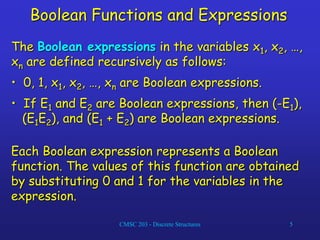
The Boolean expressions in the variables x1, x2, …,
xn are defined recursively as follows:
• 0, 1, x1, x2, …, xn are Boolean expressions.
• If E1 and E2 are Boolean expressions, then (-E1),
(E1E2), and (E1 + E2) are Boolean expressions.
Each Boolean expression represents a Boolean
function. The values of this function are obtained
by substituting 0 and 1 for the variables in the
expression.
CMSC 203 - Discrete Structures 6
Boolean Functions and Expressions
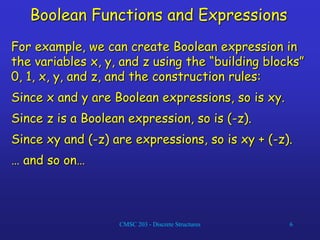
For example, we can create Boolean expression in
the variables x, y, and z using the “building blocks”
0, 1, x, y, and z, and the construction rules:
Since x and y are Boolean expressions, so is xy.
Since z is a Boolean expression, so is (-z).
Since xy and (-z) are expressions, so is xy + (-z).
… and so on…
CMSC 203 - Discrete Structures 7
Boolean Functions and Expressions
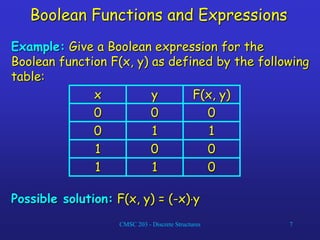
Example: Give a Boolean expression for the
Boolean function F(x, y) as defined by the following
table:
x y F(x, y)
0 0 0
0 1 1
1 0 0
1 1 0
Possible solution: F(x, y) = (-x)y
CMSC 203 - Discrete Structures 8
Boolean Functions and Expressions
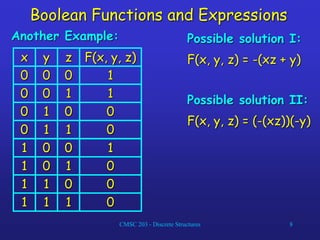
Another Example: Possible solution I:
F(x, y, z) = -(xz + y)
0
0
1
1
F(x, y, z)
1
0
1
0
z
0
0
1
0
1
0
0
0
y
x
0
0
0
1
1
0
1
0
1
1
1
1
0
1
0
1
Possible solution II:
F(x, y, z) = (-(xz))(-y)
CMSC 203 - Discrete Structures 9
Boolean Functions and Expressions
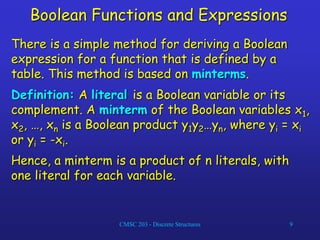
There is a simple method for deriving a Boolean
expression for a function that is defined by a
table. This method is based on minterms.
Definition: A literal is a Boolean variable or its
complement. A minterm of the Boolean variables x1,
x2, …, xn is a Boolean product y1y2…yn, where yi = xi
or yi = -xi.
Hence, a minterm is a product of n literals, with
one literal for each variable.
CMSC 203 - Discrete Structures 10
Boolean Functions and Expressions
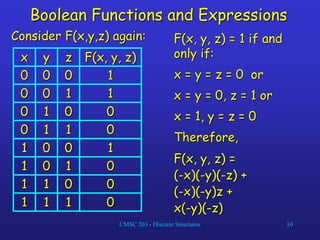
Consider F(x,y,z) again: F(x, y, z) = 1 if and
only if:
x = y = z = 0 or
x = y = 0, z = 1 or
x = 1, y = z = 0
Therefore,
F(x, y, z) =
(-x)(-y)(-z) +
(-x)(-y)z +
x(-y)(-z)
0
0
1
1
F(x, y, z)
1
0
1
0
z
0
0
1
0
1
0
0
0
y
x
0
0
0
1
1
0
1
0
1
1
1
1
0
1
0
1
CMSC 203 - Discrete Structures 11
Boolean Functions and Expressions
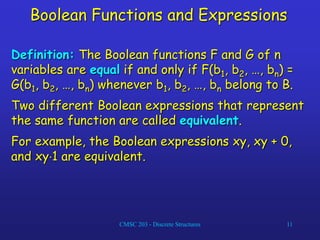
Definition: The Boolean functions F and G of n
variables are equal if and only if F(b1, b2, …, bn) =
G(b1, b2, …, bn) whenever b1, b2, …, bn belong to B.
Two different Boolean expressions that represent
the same function are called equivalent.
For example, the Boolean expressions xy, xy + 0,
and xy1 are equivalent.
CMSC 203 - Discrete Structures 12
Boolean Functions and Expressions
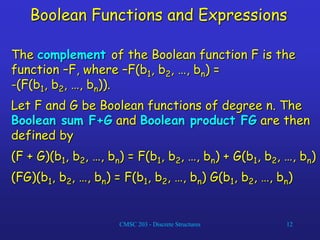
The complement of the Boolean function F is the
function –F, where –F(b1, b2, …, bn) =
-(F(b1, b2, …, bn)).
Let F and G be Boolean functions of degree n. The
Boolean sum F+G and Boolean product FG are then
defined by
(F + G)(b1, b2, …, bn) = F(b1, b2, …, bn) + G(b1, b2, …, bn)
(FG)(b1, b2, …, bn) = F(b1, b2, …, bn) G(b1, b2, …, bn)
CMSC 203 - Discrete Structures 13
Boolean Functions and Expressions
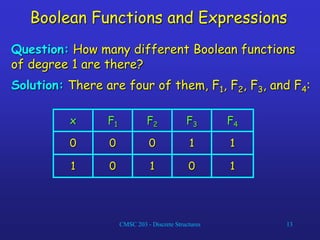
Question: How many different Boolean functions
of degree 1 are there?
Solution: There are four of them, F1, F2, F3, and F4:
x F1 F2 F3 F4
0 0 0 1 1
1 0 1 0 1
CMSC 203 - Discrete Structures 14
Boolean Functions and Expressions
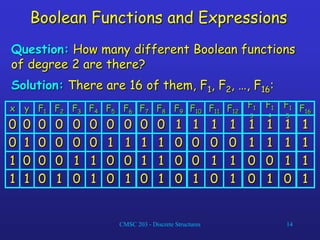
Question: How many different Boolean functions
of degree 2 are there?
Solution: There are 16 of them, F1, F2, …, F16:
1
0
0
0
F2
0
0
0
0
F1
0
1
0
1
0
1
0
1
1
0
0
0
F3
y
x
1
1
1
0
F8
0
1
1
0
F7
0
0
0
1
F9
0
0
1
0
F5
1
1
0
0
F4
1
0
1
0
F6
0
1
0
1
F11
1
0
0
1
F10
0
1
1
1
F12
1
0
1
1
F1
4
0
0
1
1
F1
3
1
1
0
1
F1
5
1
1
1
1
F16
CMSC 203 - Discrete Structures 15
Boolean Functions and Expressions
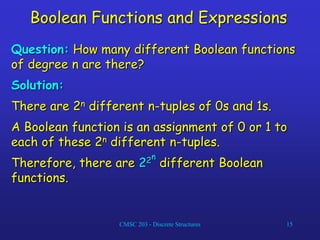
Question: How many different Boolean functions
of degree n are there?
Solution:
There are 2n different n-tuples of 0s and 1s.
A Boolean function is an assignment of 0 or 1 to
each of these 2n different n-tuples.
Therefore, there are 22n
different Boolean
functions.
CMSC 203 - Discrete Structures 16
Duality
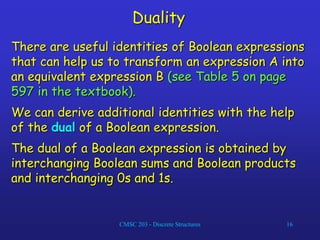
There are useful identities of Boolean expressions
that can help us to transform an expression A into
an equivalent expression B (see Table 5 on page
597 in the textbook).
We can derive additional identities with the help
of the dual of a Boolean expression.
The dual of a Boolean expression is obtained by
interchanging Boolean sums and Boolean products
and interchanging 0s and 1s.
CMSC 203 - Discrete Structures 17
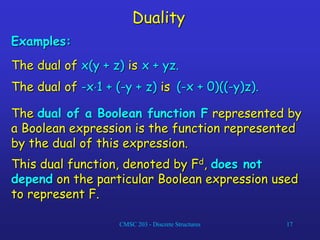
Duality
Examples:
The dual of x(y + z) is x + yz.
The dual of -x1 + (-y + z) is (-x + 0)((-y)z).
The dual of a Boolean function F represented by
a Boolean expression is the function represented
by the dual of this expression.
This dual function, denoted by Fd, does not
depend on the particular Boolean expression used
to represent F.
CMSC 203 - Discrete Structures 18
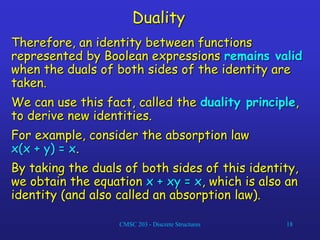
Duality
Therefore, an identity between functions
represented by Boolean expressions remains valid
when the duals of both sides of the identity are
taken.
We can use this fact, called the duality principle,
to derive new identities.
For example, consider the absorption law
x(x + y) = x.
By taking the duals of both sides of this identity,
we obtain the equation x + xy = x, which is also an
identity (and also called an absorption law).
CMSC 203 - Discrete Structures 19
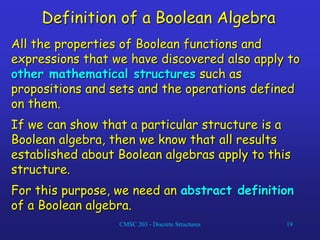
Definition of a Boolean Algebra
All the properties of Boolean functions and
expressions that we have discovered also apply to
other mathematical structures such as
propositions and sets and the operations defined
on them.
If we can show that a particular structure is a
Boolean algebra, then we know that all results
established about Boolean algebras apply to this
structure.
For this purpose, we need an abstract definition
of a Boolean algebra.
CMSC 203 - Discrete Structures 20
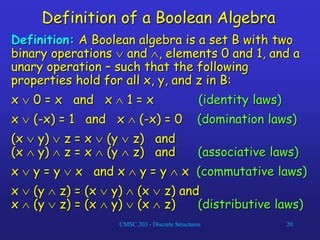
Definition of a Boolean Algebra
Definition: A Boolean algebra is a set B with two
binary operations  and , elements 0 and 1, and a
unary operation – such that the following
properties hold for all x, y, and z in B:
x  0 = x and x  1 = x (identity laws)
x  (-x) = 1 and x  (-x) = 0 (domination laws)
(x  y)  z = x  (y  z) and
(x  y)  z = x  (y  z) and (associative laws)
x  y = y  x and x  y = y  x (commutative laws)
x  (y  z) = (x  y)  (x  z) and
x  (y  z) = (x  y)  (x  z) (distributive laws)
CMSC 203 - Discrete Structures 21
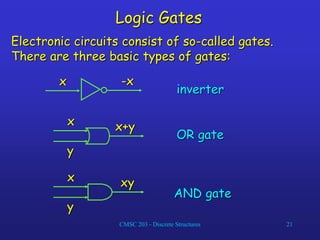
Logic Gates
Electronic circuits consist of so-called gates.
There are three basic types of gates:
x
y
x+y
OR gate
AND gate
x
y
xy
x -x
inverter
CMSC 203 - Discrete Structures 22
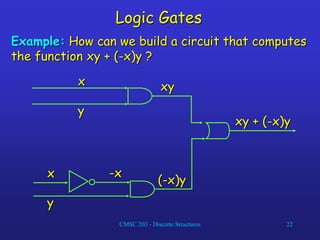
Logic Gates
Example: How can we build a circuit that computes
the function xy + (-x)y ?
xy + (-x)y
x
y
xy
x -x
y
(-x)y
CMSC 203 - Discrete Structures 23
The
End

BooleanAlgebra.ppt

  • 1.
    CMSC 203 -Discrete Structures 1 Yes, No, Maybe... Boolean Algebra
  • 2.
    CMSC 203 -Discrete Structures 2 Boolean Algebra Boolean algebra provides the operations and the rules for working with the set {0, 1}. These are the rules that underlie electronic circuits, and the methods we will discuss are fundamental to VLSI design. We are going to focus on three operations: • Boolean complementation, • Boolean sum, and • Boolean product
  • 3.
    CMSC 203 -Discrete Structures 3 Boolean Operations The complement is denoted by a bar (on the slides, we will use a minus sign). It is defined by -0 = 1 and -1 = 0. The Boolean sum, denoted by + or by OR, has the following values: 1 + 1 = 1, 1 + 0 = 1, 0 + 1 = 1, 0 + 0 = 0 The Boolean product, denoted by  or by AND, has the following values: 1  1 = 1, 1  0 = 0, 0  1 = 0, 0  0 = 0
  • 4.
    CMSC 203 -Discrete Structures 4 Boolean Functions and Expressions Definition: Let B = {0, 1}. The variable x is called a Boolean variable if it assumes values only from B. A function from Bn, the set {(x1, x2, …, xn) |xiB, 1  i  n}, to B is called a Boolean function of degree n. Boolean functions can be represented using expressions made up from the variables and Boolean operations.
  • 5.
    CMSC 203 -Discrete Structures 5 Boolean Functions and Expressions The Boolean expressions in the variables x1, x2, …, xn are defined recursively as follows: • 0, 1, x1, x2, …, xn are Boolean expressions. • If E1 and E2 are Boolean expressions, then (-E1), (E1E2), and (E1 + E2) are Boolean expressions. Each Boolean expression represents a Boolean function. The values of this function are obtained by substituting 0 and 1 for the variables in the expression.
  • 6.
    CMSC 203 -Discrete Structures 6 Boolean Functions and Expressions For example, we can create Boolean expression in the variables x, y, and z using the “building blocks” 0, 1, x, y, and z, and the construction rules: Since x and y are Boolean expressions, so is xy. Since z is a Boolean expression, so is (-z). Since xy and (-z) are expressions, so is xy + (-z). … and so on…
  • 7.
    CMSC 203 -Discrete Structures 7 Boolean Functions and Expressions Example: Give a Boolean expression for the Boolean function F(x, y) as defined by the following table: x y F(x, y) 0 0 0 0 1 1 1 0 0 1 1 0 Possible solution: F(x, y) = (-x)y
  • 8.
    CMSC 203 -Discrete Structures 8 Boolean Functions and Expressions Another Example: Possible solution I: F(x, y, z) = -(xz + y) 0 0 1 1 F(x, y, z) 1 0 1 0 z 0 0 1 0 1 0 0 0 y x 0 0 0 1 1 0 1 0 1 1 1 1 0 1 0 1 Possible solution II: F(x, y, z) = (-(xz))(-y)
  • 9.
    CMSC 203 -Discrete Structures 9 Boolean Functions and Expressions There is a simple method for deriving a Boolean expression for a function that is defined by a table. This method is based on minterms. Definition: A literal is a Boolean variable or its complement. A minterm of the Boolean variables x1, x2, …, xn is a Boolean product y1y2…yn, where yi = xi or yi = -xi. Hence, a minterm is a product of n literals, with one literal for each variable.
  • 10.
    CMSC 203 -Discrete Structures 10 Boolean Functions and Expressions Consider F(x,y,z) again: F(x, y, z) = 1 if and only if: x = y = z = 0 or x = y = 0, z = 1 or x = 1, y = z = 0 Therefore, F(x, y, z) = (-x)(-y)(-z) + (-x)(-y)z + x(-y)(-z) 0 0 1 1 F(x, y, z) 1 0 1 0 z 0 0 1 0 1 0 0 0 y x 0 0 0 1 1 0 1 0 1 1 1 1 0 1 0 1
  • 11.
    CMSC 203 -Discrete Structures 11 Boolean Functions and Expressions Definition: The Boolean functions F and G of n variables are equal if and only if F(b1, b2, …, bn) = G(b1, b2, …, bn) whenever b1, b2, …, bn belong to B. Two different Boolean expressions that represent the same function are called equivalent. For example, the Boolean expressions xy, xy + 0, and xy1 are equivalent.
  • 12.
    CMSC 203 -Discrete Structures 12 Boolean Functions and Expressions The complement of the Boolean function F is the function –F, where –F(b1, b2, …, bn) = -(F(b1, b2, …, bn)). Let F and G be Boolean functions of degree n. The Boolean sum F+G and Boolean product FG are then defined by (F + G)(b1, b2, …, bn) = F(b1, b2, …, bn) + G(b1, b2, …, bn) (FG)(b1, b2, …, bn) = F(b1, b2, …, bn) G(b1, b2, …, bn)
  • 13.
    CMSC 203 -Discrete Structures 13 Boolean Functions and Expressions Question: How many different Boolean functions of degree 1 are there? Solution: There are four of them, F1, F2, F3, and F4: x F1 F2 F3 F4 0 0 0 1 1 1 0 1 0 1
  • 14.
    CMSC 203 -Discrete Structures 14 Boolean Functions and Expressions Question: How many different Boolean functions of degree 2 are there? Solution: There are 16 of them, F1, F2, …, F16: 1 0 0 0 F2 0 0 0 0 F1 0 1 0 1 0 1 0 1 1 0 0 0 F3 y x 1 1 1 0 F8 0 1 1 0 F7 0 0 0 1 F9 0 0 1 0 F5 1 1 0 0 F4 1 0 1 0 F6 0 1 0 1 F11 1 0 0 1 F10 0 1 1 1 F12 1 0 1 1 F1 4 0 0 1 1 F1 3 1 1 0 1 F1 5 1 1 1 1 F16
  • 15.
    CMSC 203 -Discrete Structures 15 Boolean Functions and Expressions Question: How many different Boolean functions of degree n are there? Solution: There are 2n different n-tuples of 0s and 1s. A Boolean function is an assignment of 0 or 1 to each of these 2n different n-tuples. Therefore, there are 22n different Boolean functions.
  • 16.
    CMSC 203 -Discrete Structures 16 Duality There are useful identities of Boolean expressions that can help us to transform an expression A into an equivalent expression B (see Table 5 on page 597 in the textbook). We can derive additional identities with the help of the dual of a Boolean expression. The dual of a Boolean expression is obtained by interchanging Boolean sums and Boolean products and interchanging 0s and 1s.
  • 17.
    CMSC 203 -Discrete Structures 17 Duality Examples: The dual of x(y + z) is x + yz. The dual of -x1 + (-y + z) is (-x + 0)((-y)z). The dual of a Boolean function F represented by a Boolean expression is the function represented by the dual of this expression. This dual function, denoted by Fd, does not depend on the particular Boolean expression used to represent F.
  • 18.
    CMSC 203 -Discrete Structures 18 Duality Therefore, an identity between functions represented by Boolean expressions remains valid when the duals of both sides of the identity are taken. We can use this fact, called the duality principle, to derive new identities. For example, consider the absorption law x(x + y) = x. By taking the duals of both sides of this identity, we obtain the equation x + xy = x, which is also an identity (and also called an absorption law).
  • 19.
    CMSC 203 -Discrete Structures 19 Definition of a Boolean Algebra All the properties of Boolean functions and expressions that we have discovered also apply to other mathematical structures such as propositions and sets and the operations defined on them. If we can show that a particular structure is a Boolean algebra, then we know that all results established about Boolean algebras apply to this structure. For this purpose, we need an abstract definition of a Boolean algebra.
  • 20.
    CMSC 203 -Discrete Structures 20 Definition of a Boolean Algebra Definition: A Boolean algebra is a set B with two binary operations  and , elements 0 and 1, and a unary operation – such that the following properties hold for all x, y, and z in B: x  0 = x and x  1 = x (identity laws) x  (-x) = 1 and x  (-x) = 0 (domination laws) (x  y)  z = x  (y  z) and (x  y)  z = x  (y  z) and (associative laws) x  y = y  x and x  y = y  x (commutative laws) x  (y  z) = (x  y)  (x  z) and x  (y  z) = (x  y)  (x  z) (distributive laws)
  • 21.
    CMSC 203 -Discrete Structures 21 Logic Gates Electronic circuits consist of so-called gates. There are three basic types of gates: x y x+y OR gate AND gate x y xy x -x inverter
  • 22.
    CMSC 203 -Discrete Structures 22 Logic Gates Example: How can we build a circuit that computes the function xy + (-x)y ? xy + (-x)y x y xy x -x y (-x)y
  • 23.
    CMSC 203 -Discrete Structures 23 The End