GROWTH AND
DEVELOPMENT
LEARNING OBJECTIVES:
• Define terms related to growth and development
• Discuss the principles of growth and development
• Describe the various factors, including genetics, that
affect growth and development
• Discuss the following theorist: Piaget, Freud, Erikson
and Kohlberg.
GROWTH AND DEVELOPMENT
INVOLVE CHANGE
DEVELOPMENT
IS CONTINUOUS
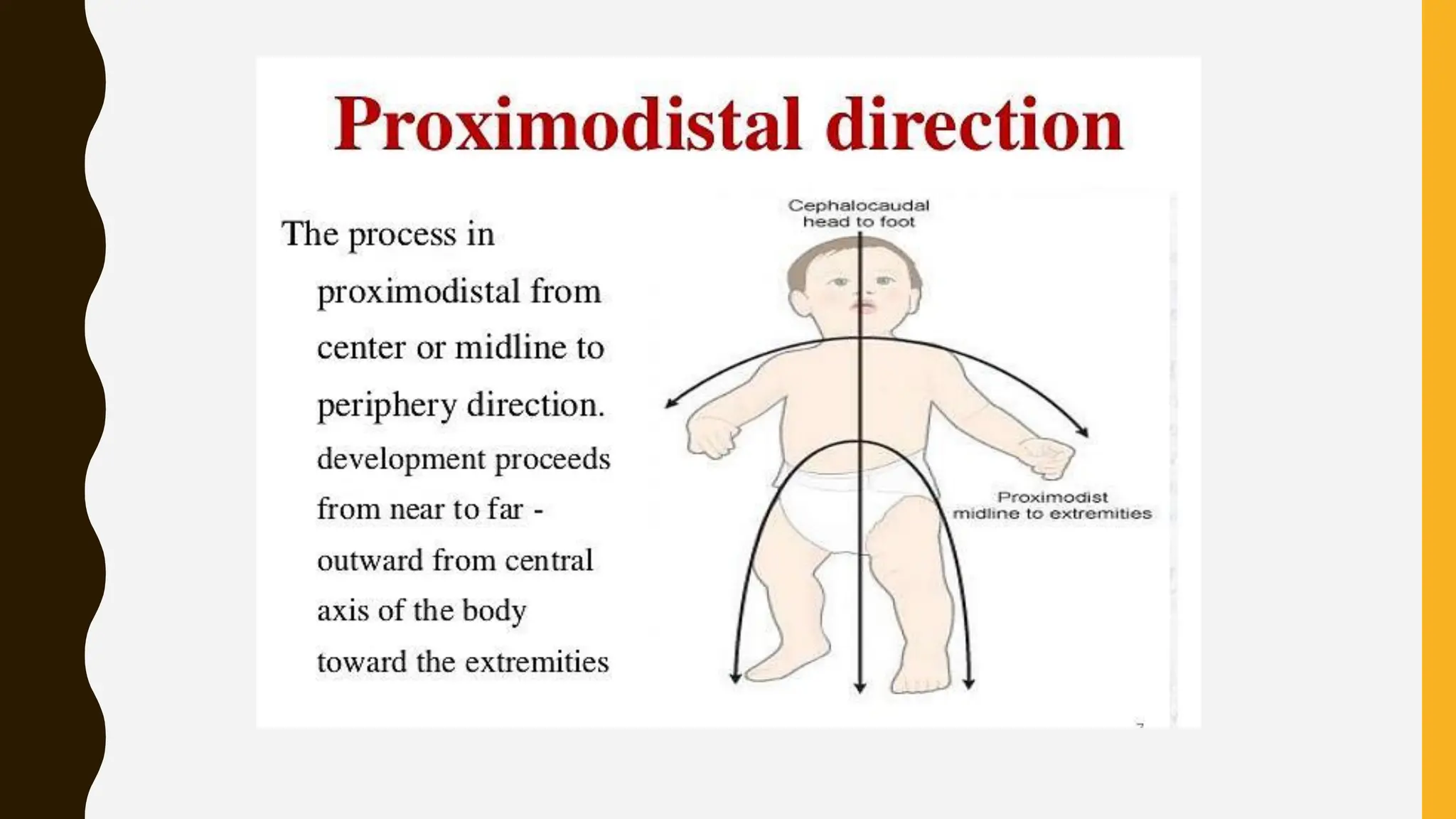
ALL HUMANS FOLLOW THE SAME
PATTERN OF GROWTH AND
DEVELOPMENT
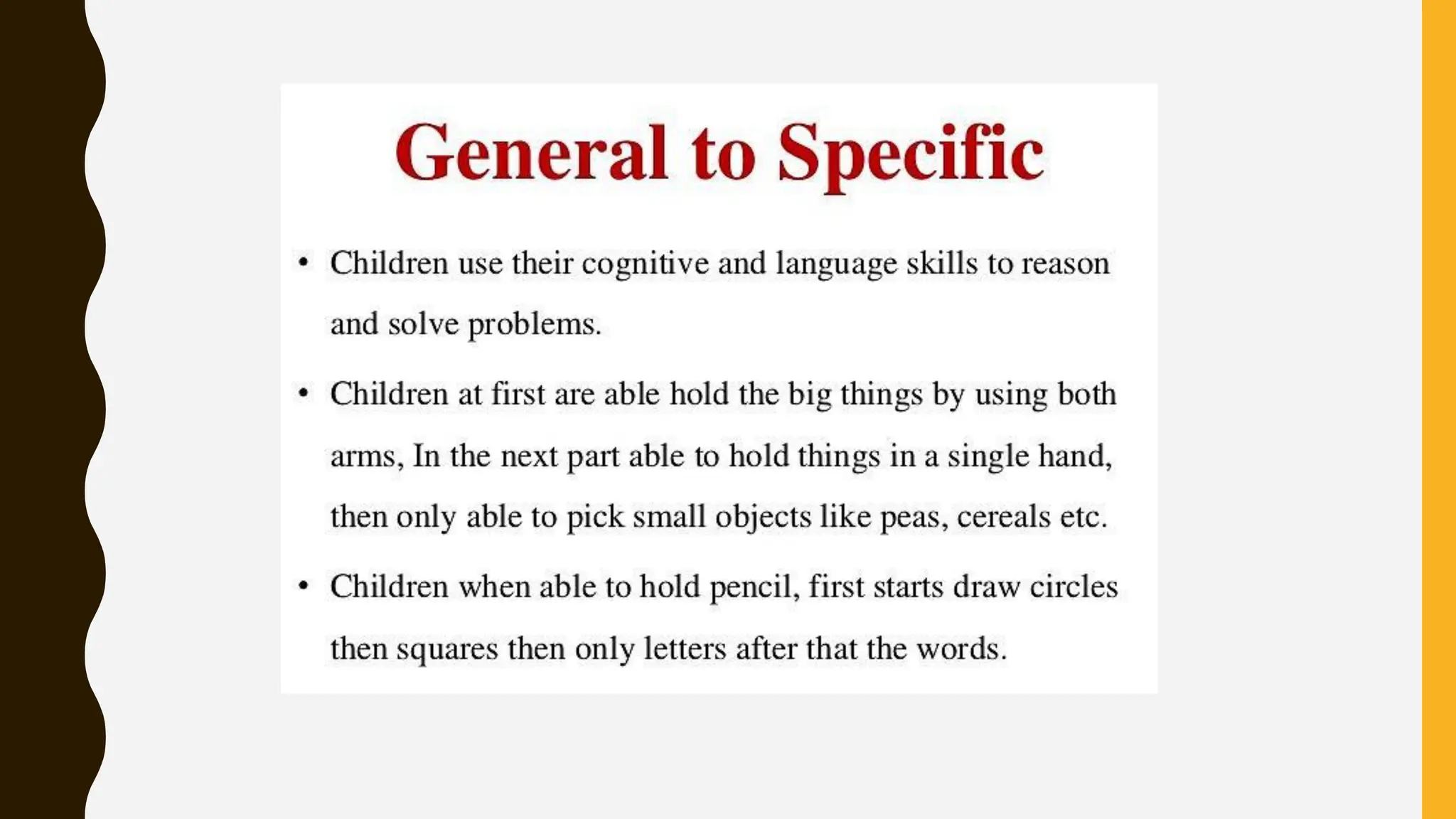
DEVELOPMENT PROCEEDS
FROM SIMPLE TO COMPLEX
-Children use their cognitive and language skills to reason and solve problems
-Children at first are able hold the big things by using both arms; in the next part able to hold things in
a single hand, then only able to pick small objects like peas, cereals etc.
-Children when able to hold pencil, first starts draw circles then squares then only letters after that
words
EARLY DEVELOPMENT IS MORE
CRITICAL THAN LATER
DEVELOPMENT
The first 10-12 weeks after conception are critical.The incidence of congenital anomalies as a result of
exposure to certain viruses, chemicals, or drugs is greater during this stage than others
DEVELOPMENT IS A PRODUCT OF
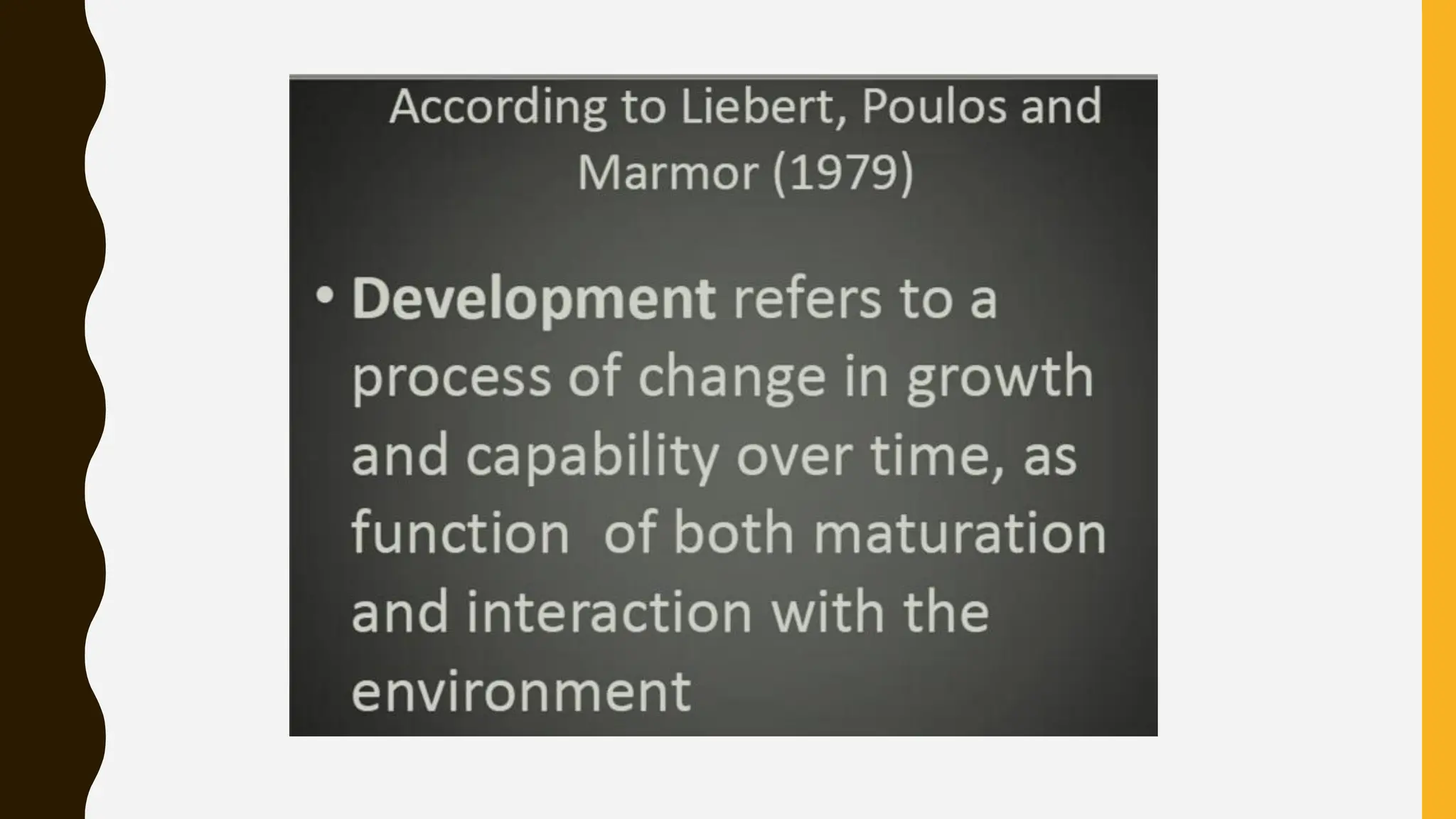
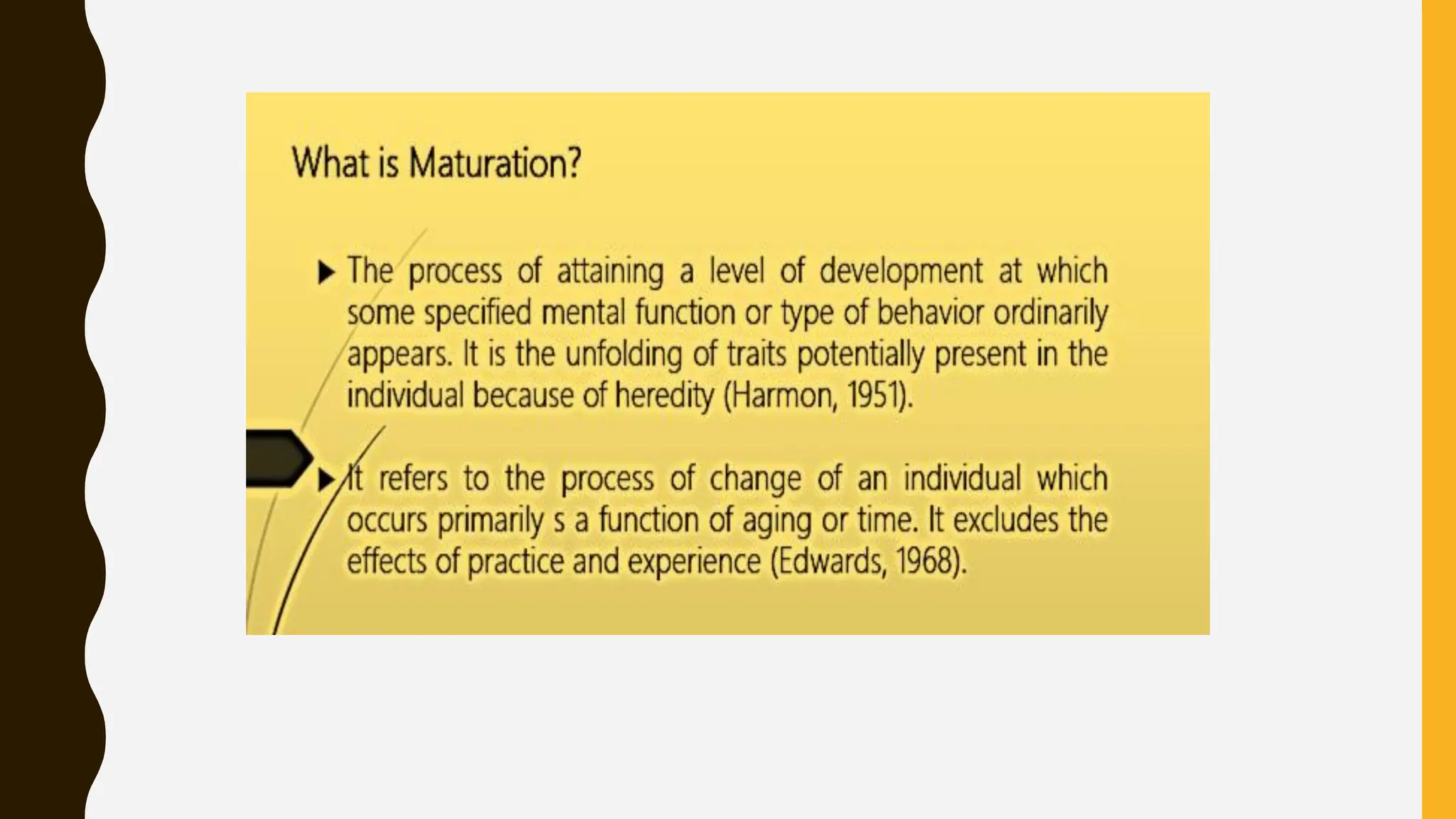
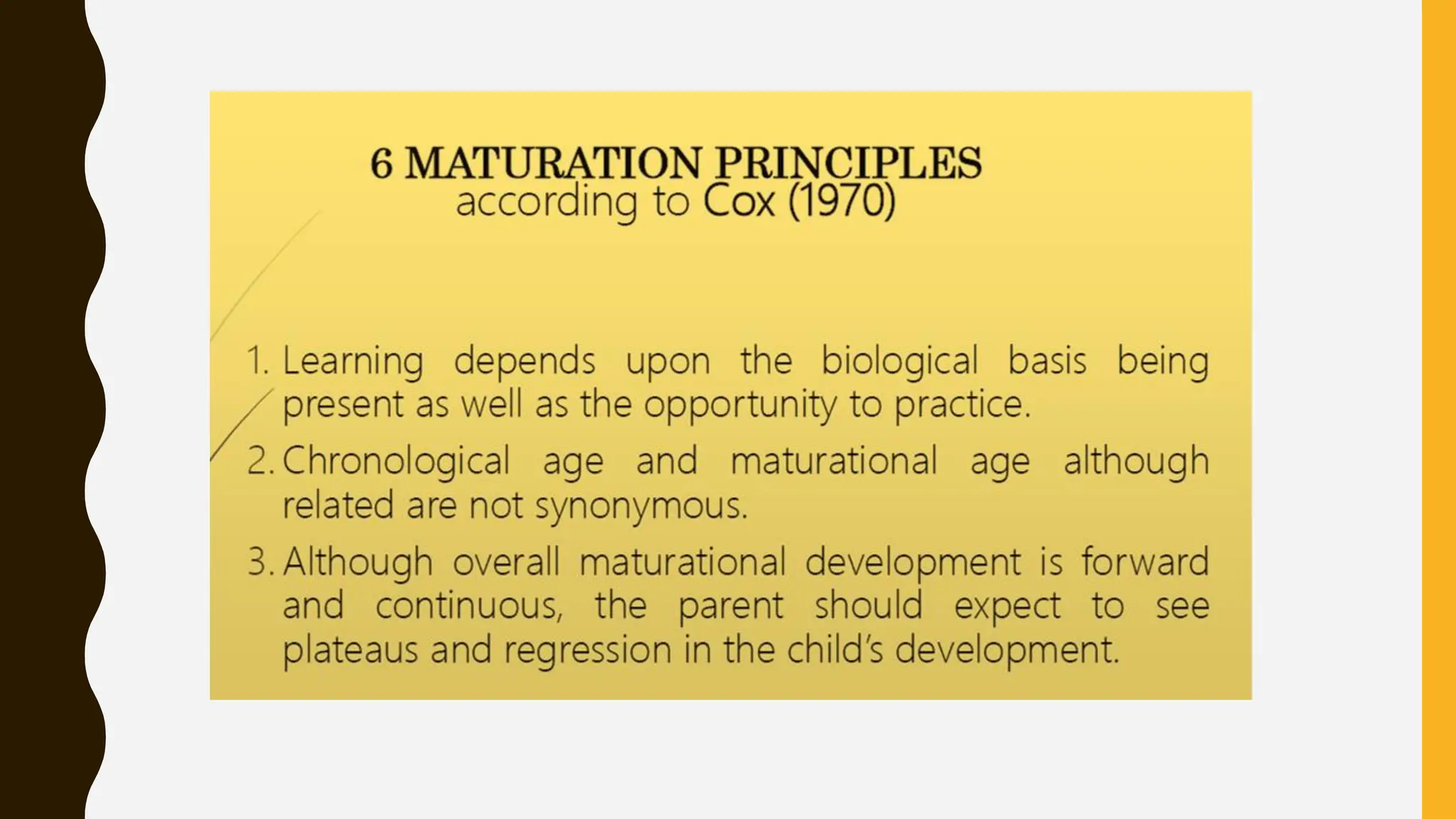
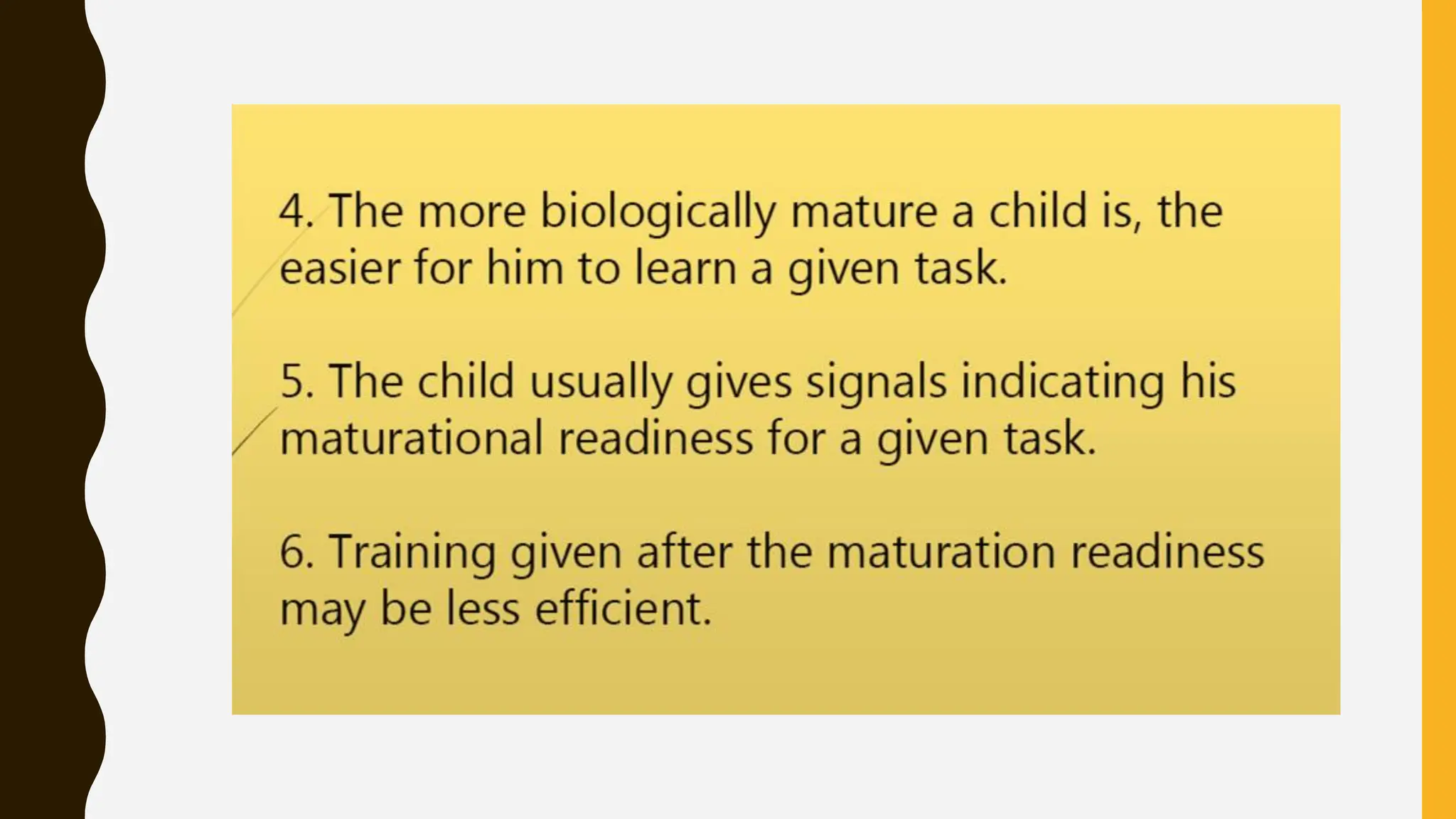
MATURATION AND LEARNING
THE DEVELOPMENT PATTERN
IS PREDICTABLE
THERE ARE INDIVIDUAL
DIFFERENCES IN DEVELOPMENT
THE CHILD DEVELOPS AS A
UNIFIED WHOLE
DEVELOPMENT FOLLOWS AN
ORDERLY PROCESS
EACH DEVELOPMENT TAKES
PLACE IN STAGES
EACH DEVELOPMENTAL STAGE
HAS CERTAIN CHARACTERISTIC
TRAIT
THERE ARE PERIODS OF
ACCELERATED GROWTH AND
DECELERATED GROWTH
Growth is greater during infancy than during childhood. Asynchronous development is
demonstrated by rapid growth of the head during infancy and the extremities at
puberty
DEVELOPMENT IS INFLUENCED
BY HEREDITY AND ENVIRONMENT
DEVELOPMENT PROCEEDS AT
DIFFERENT RATES FOR
DIFFERENT BEHAVIOR
Rate and amount of growth is not same for all. This is caused by both heredity and environment.
There is no two individual whose development rate is name. There is no validity in comparing one
child’s progress with or against another child. Each child grows in his own personal manner. He/she
should be permitted to grow at his/her own rate. If we expect too much, he/she may do even less
than he/she is able to do.
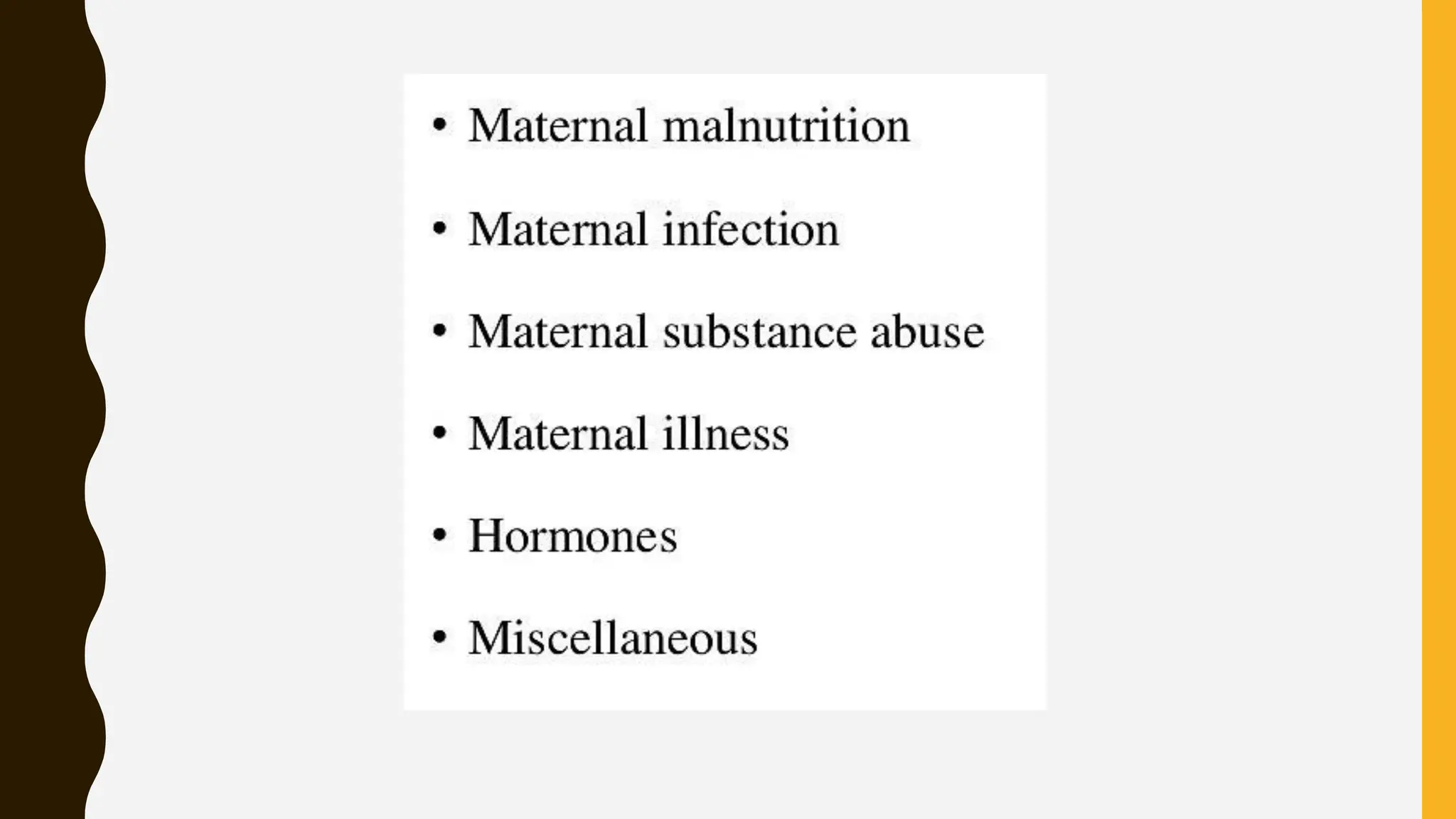
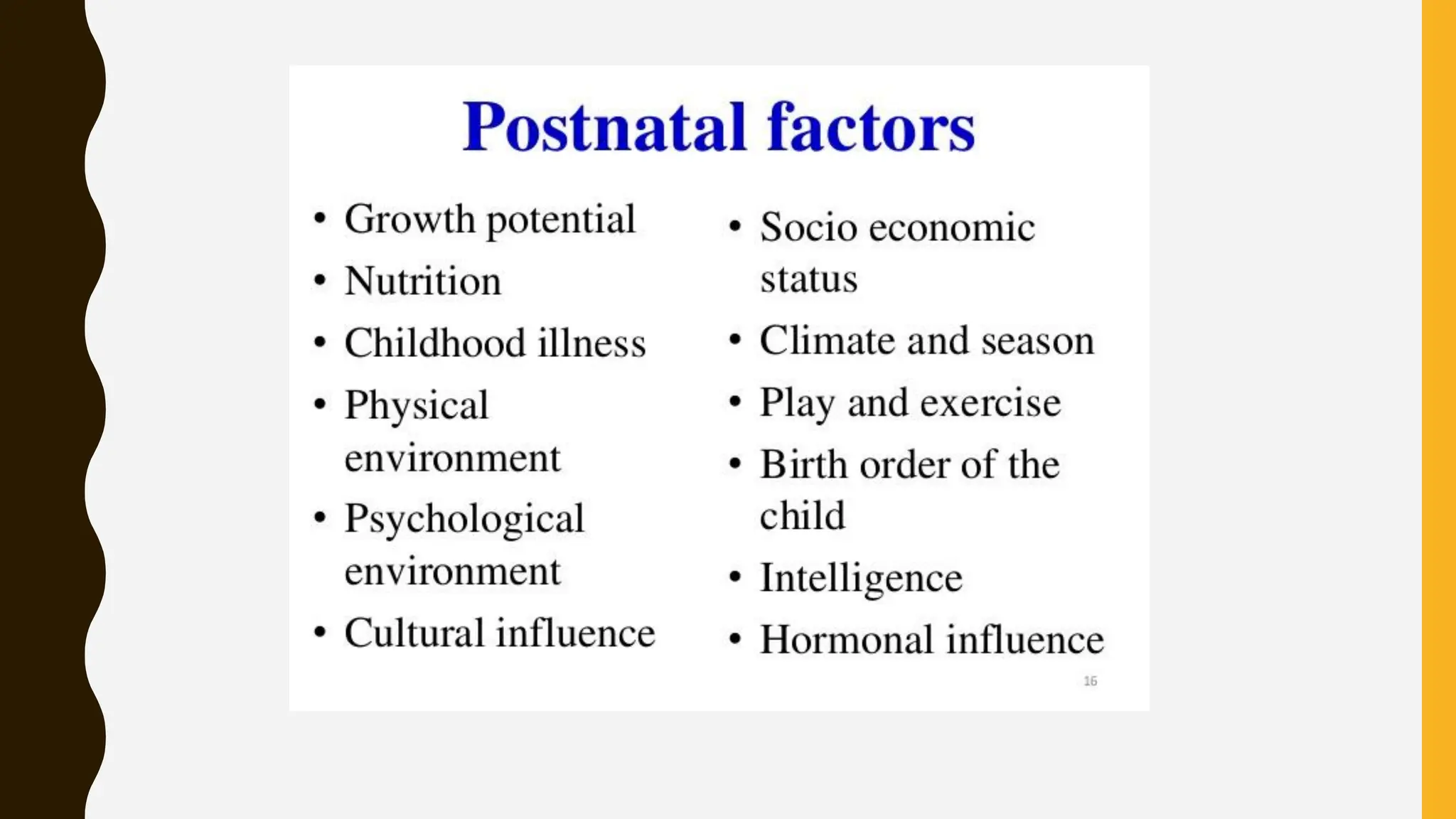
FACTORS
INFLUENCING
GROWTH AND
DEVELOPMENT
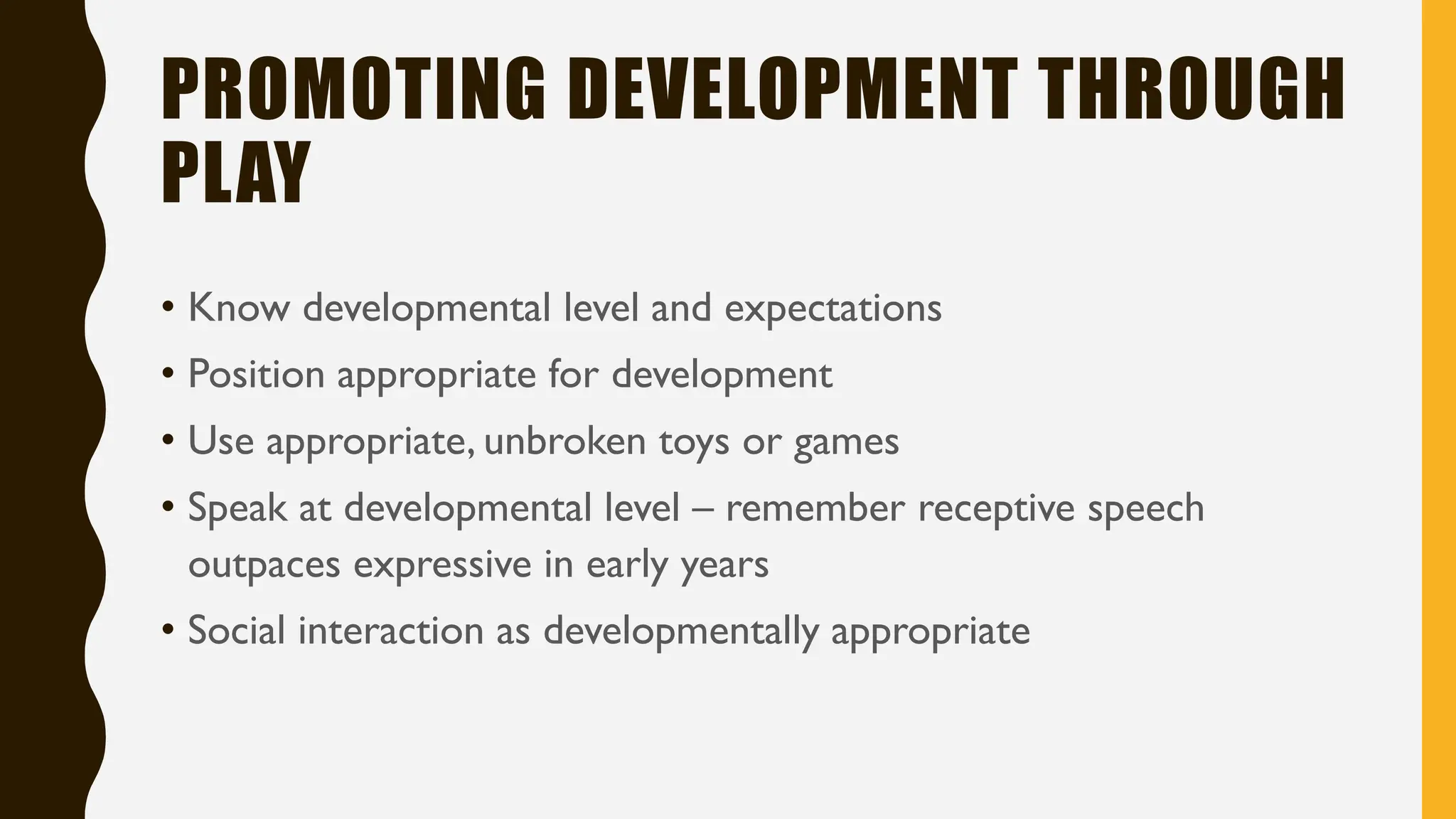
PROMOTING DEVELOPMENT THROUGH
PLAY
• Know developmental level and expectations
• Position appropriate for development
• Use appropriate, unbroken toys or games
• Speak at developmental level – remember receptive speech
outpaces expressive in early years
• Social interaction as developmentally appropriate
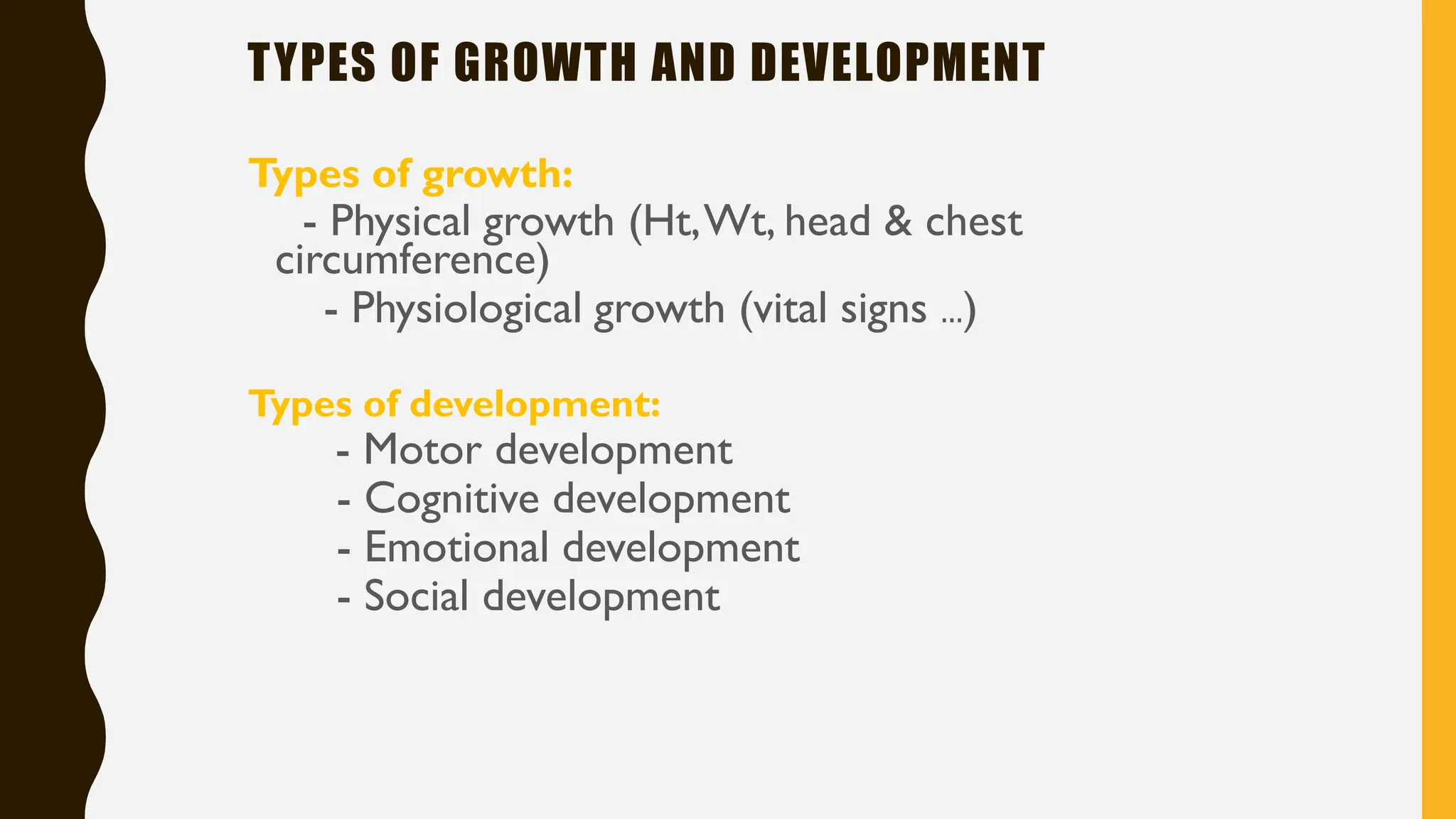
TYPES OF GROWTH AND DEVELOPMENT
Types of growth:
- Physical growth (Ht,Wt, head & chest
circumference)
- Physiological growth (vital signs …)
Types of development:
- Motor development
- Cognitive development
- Emotional development
- Social development
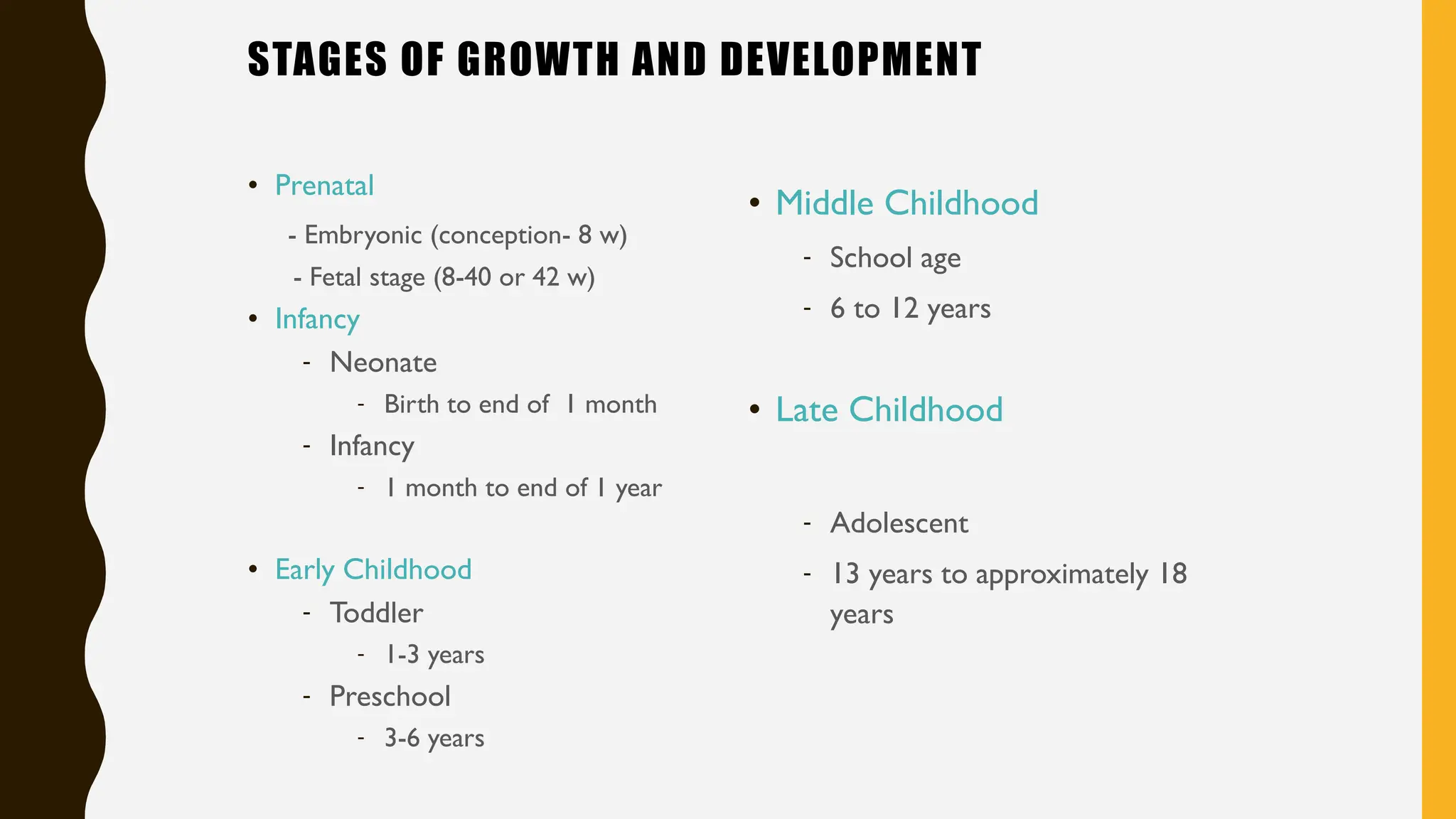
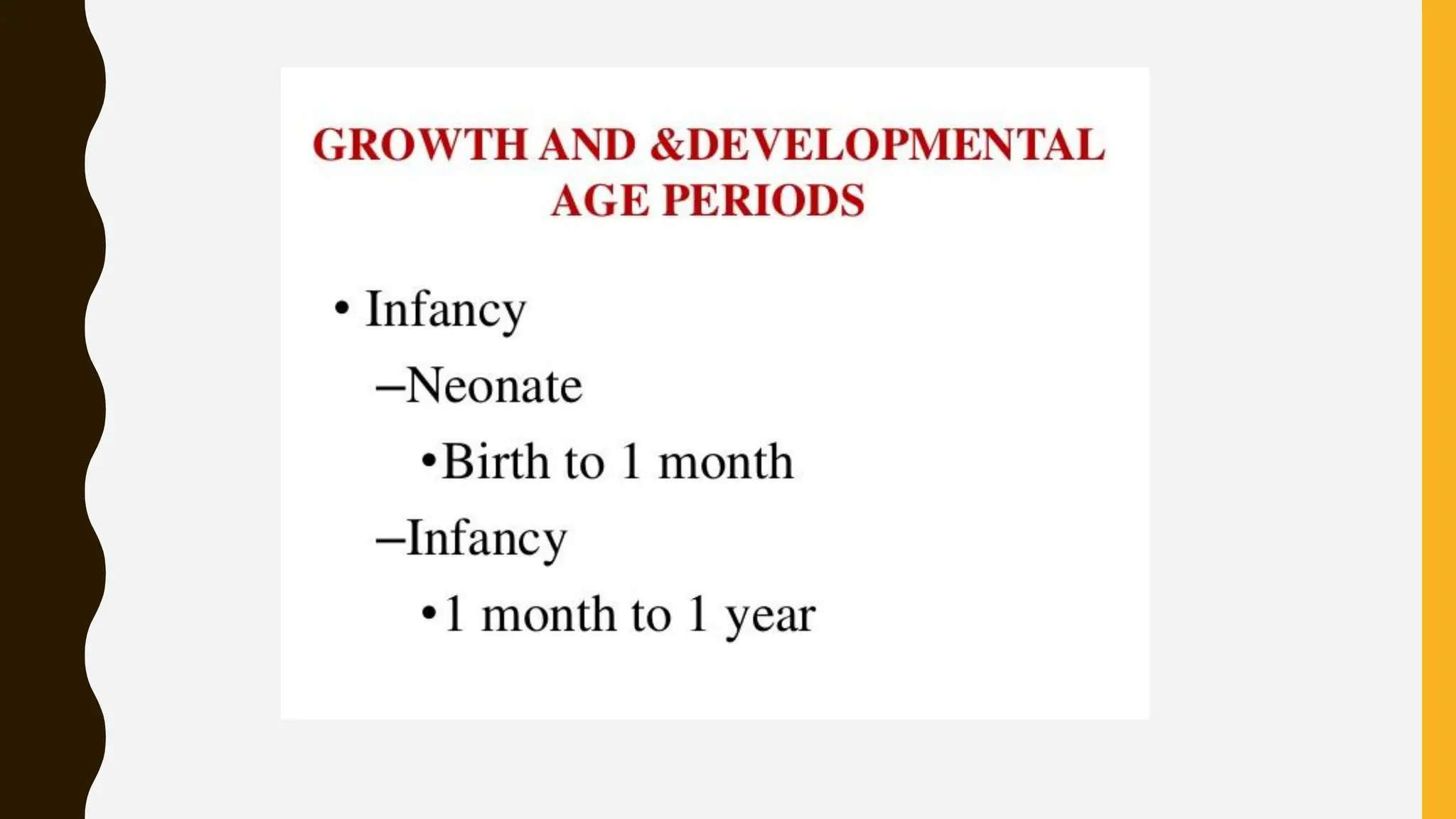
STAGES OF GROWTH AND DEVELOPMENT
• Prenatal
- Embryonic (conception- 8 w)
- Fetal stage (8-40 or 42 w)
• Infancy
- Neonate
- Birth to end of 1 month
- Infancy
- 1 month to end of 1 year
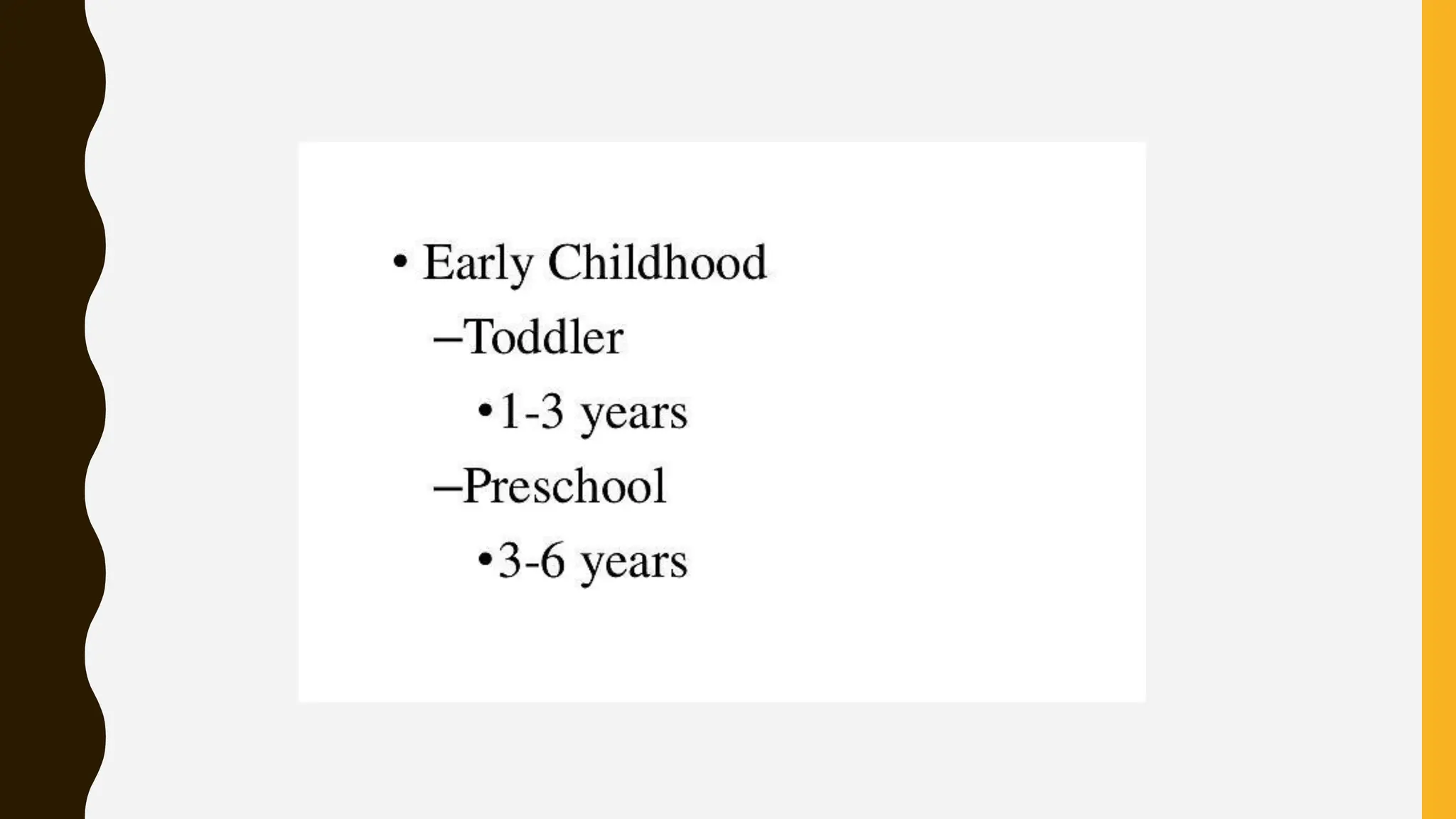
• Early Childhood
- Toddler
- 1-3 years
- Preschool
- 3-6 years
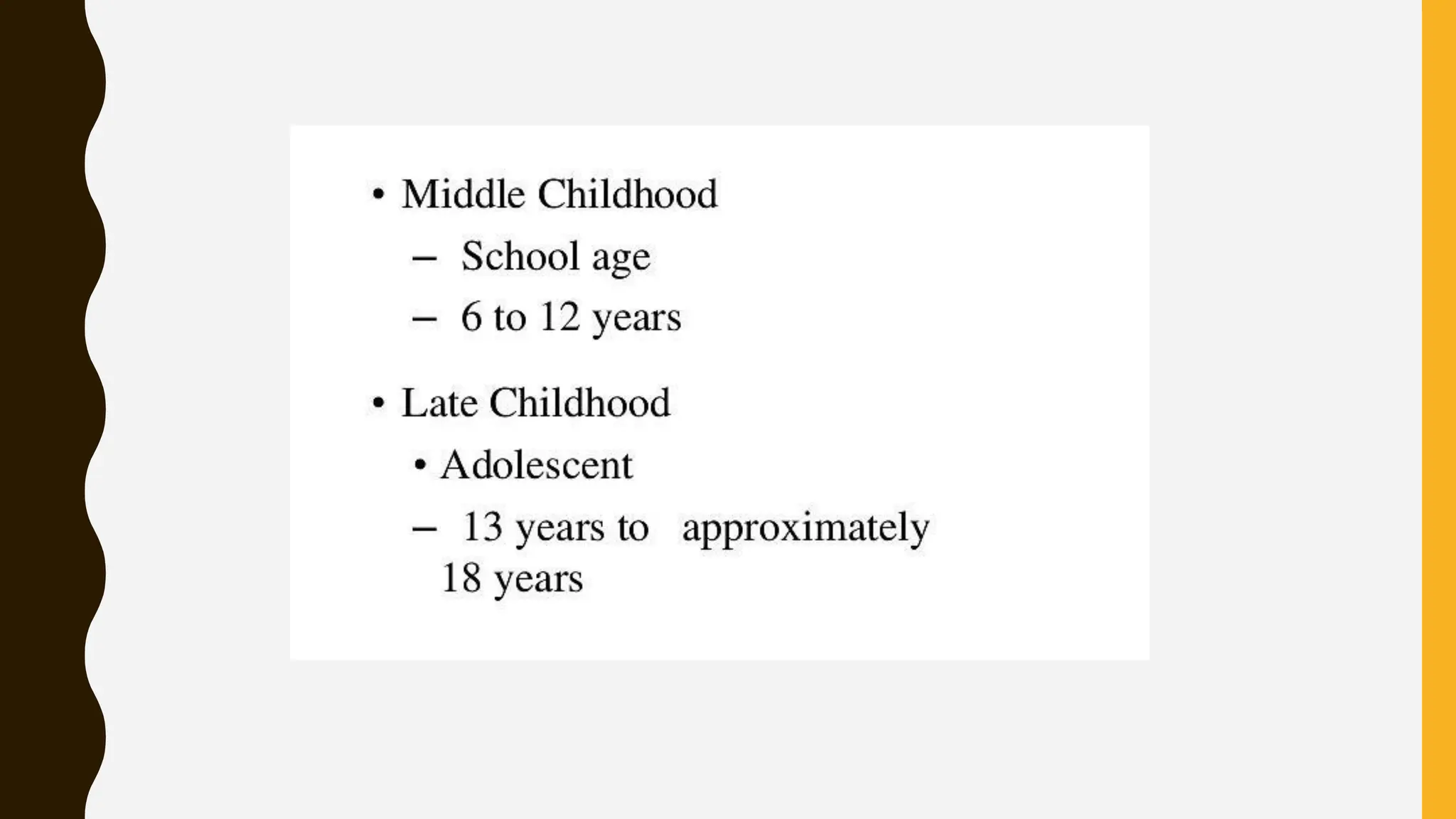
• Middle Childhood
- School age
- 6 to 12 years
• Late Childhood
- Adolescent
- 13 years to approximately 18
years
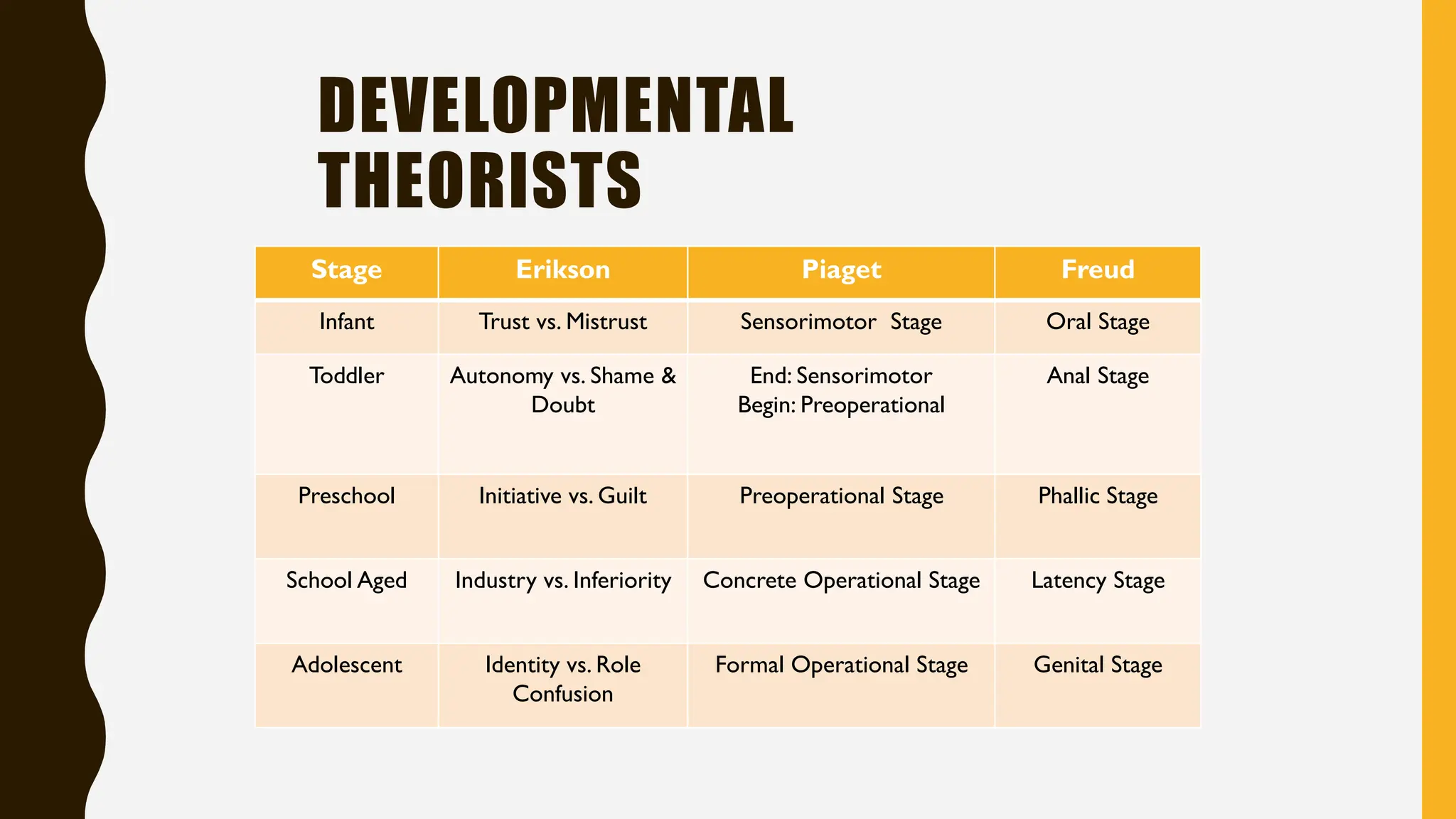
DEVELOPMENTAL
THEORISTS
Stage Erikson Piaget Freud
Infant Trust vs. Mistrust Sensorimotor Stage Oral Stage
Toddler Autonomy vs. Shame &
Doubt
End: Sensorimotor
Begin: Preoperational
Anal Stage
Preschool Initiative vs. Guilt Preoperational Stage Phallic Stage
School Aged Industry vs. Inferiority Concrete Operational Stage Latency Stage
Adolescent Identity vs. Role
Confusion
Formal Operational Stage Genital Stage
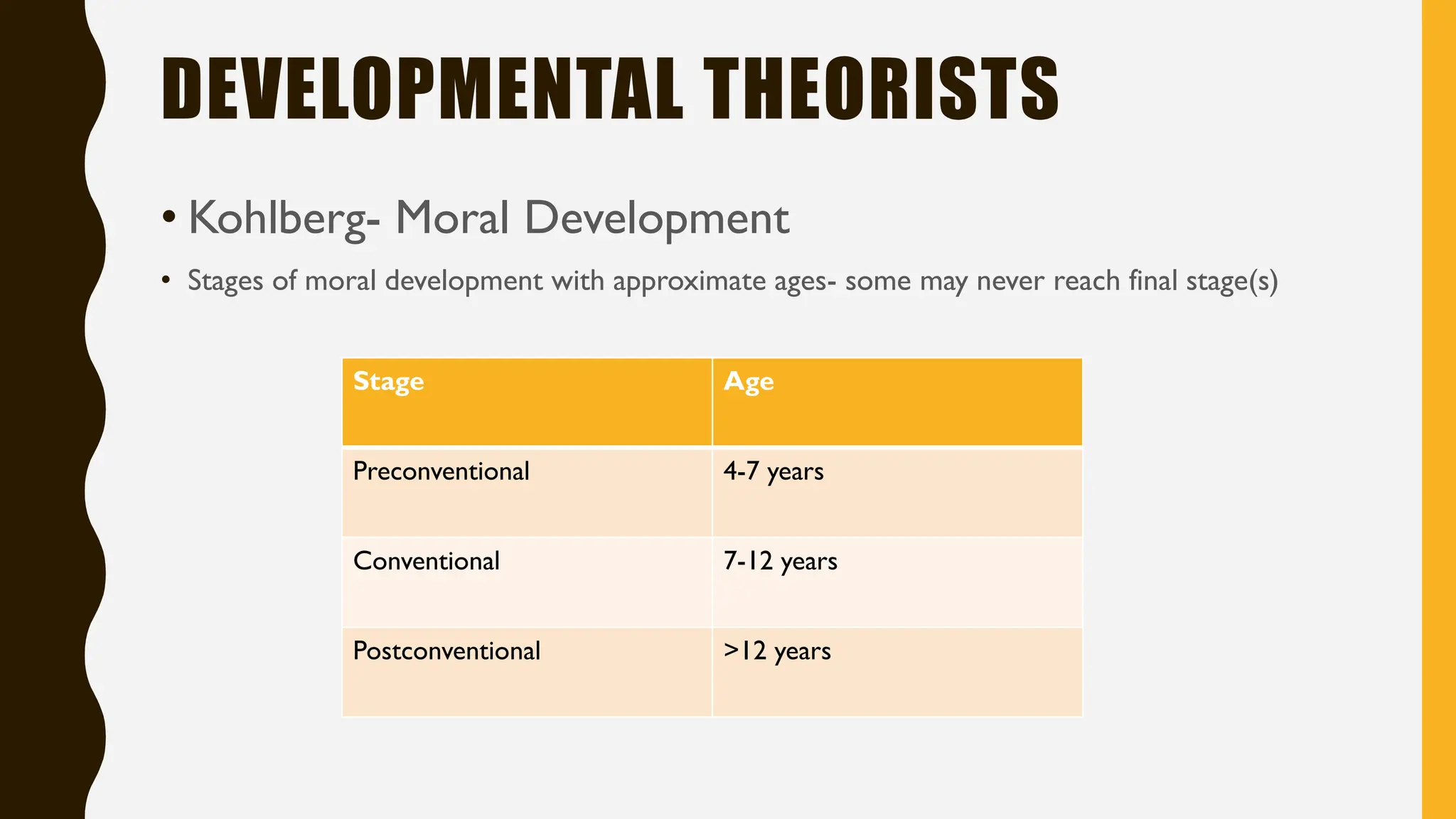
DEVELOPMENTAL THEORISTS
• Kohlberg- Moral Development
• Stages of moral development with approximate ages- some may never reach final stage(s)
Stage Age
Preconventional 4-7 years
Conventional 7-12 years
Postconventional >12 years
ERIK ERIKSON’S
PSYCHOSOCIAL
DEVELOPMENT
• Psychosocial – psychological (or the root,
“psycho” relating to the mind, brain,
personality, etc.) & social (external
relationships and environment)
• Erikson’s theory was greatly influenced by
Sigmund Freud
PSYCHOSOCIAL DEVELOPMENT
• One of the main elements of Erikson's psychosocial stage
theory is the development of ego identity. Ego identity is the
conscious sense of self that we develop through social
interaction. According to Erikson, our ego identity is constantly
changing due to new experiences and information we acquire in
our daily interactions with others.
• Shows impact of social experiences across ones whole lifespan.
•There are eight stages over a lifespan showing the development.
MALADAPTATION- develop from tending
towards the extreme of the first ('positive')
disposition in each crisis
MALIGNANCY- develop from tending towards
the extreme of the second ('negative') disposition
in each crisis.
VIRTUES- are characteristic strengths which the
ego can use to resolve subsequent crises.
DEFINITION OF TERMS:
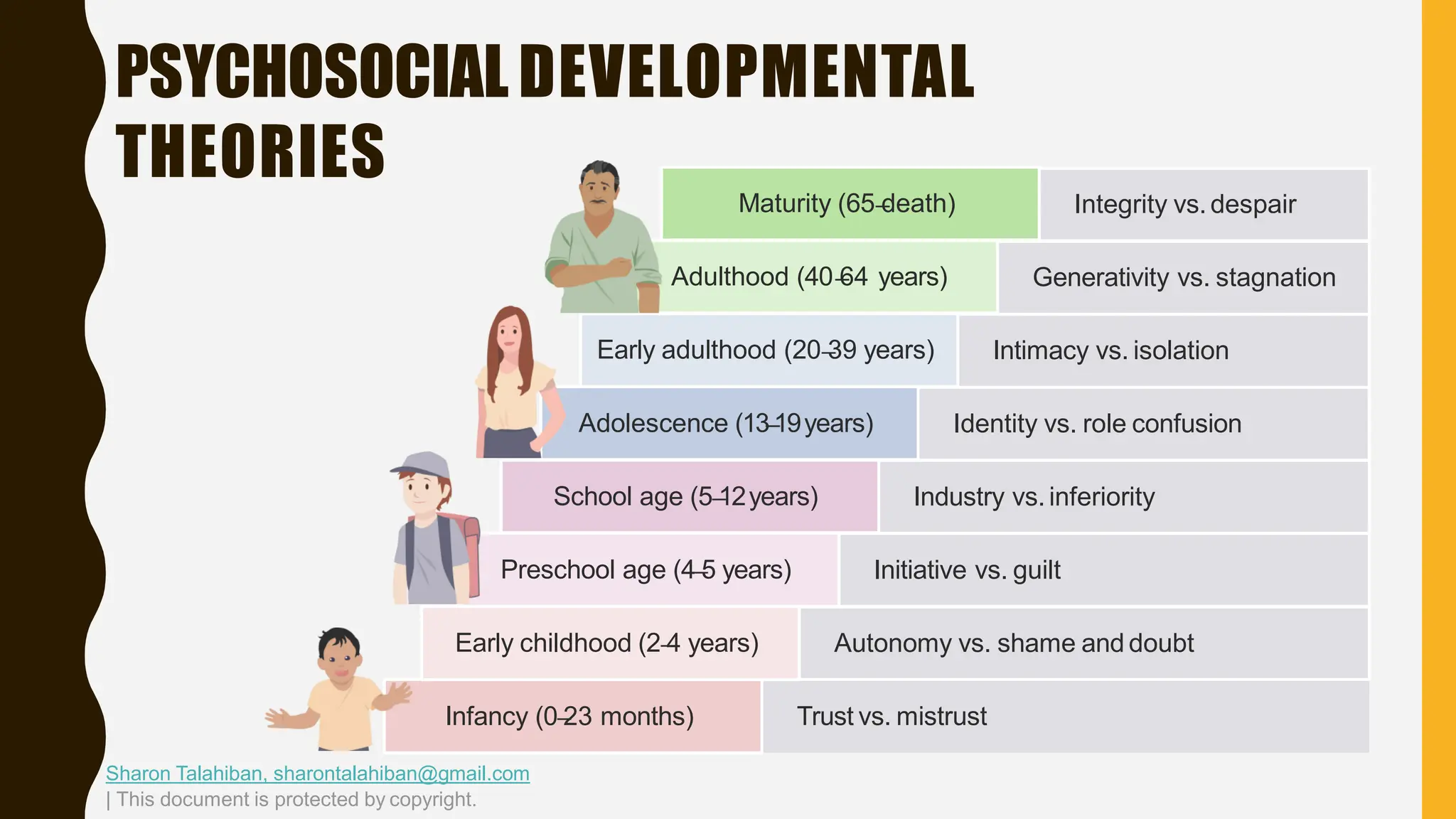
PSYCHOSOCIALDEVELOPMENTAL
THEORIES
Trust vs. mistrust
Autonomy vs. shame and doubt
Initiative vs. guilt
Industry vs.inferiority
Identity vs. role confusion
Intimacy vs. isolation
Generativity vs. stagnation
Infancy (0 23 months)
Early childhood (2 4 years)
Preschool age (4 5 years)
School age (5 12years)
Adolescence (1319years)
Early adulthood (20 39 years)
Adulthood (40 64 years)
Integrity vs.despair
Maturity (65 death)
Sharon Talahiban, sharontalahiban@gmail.com
| This document is protected by copyright.
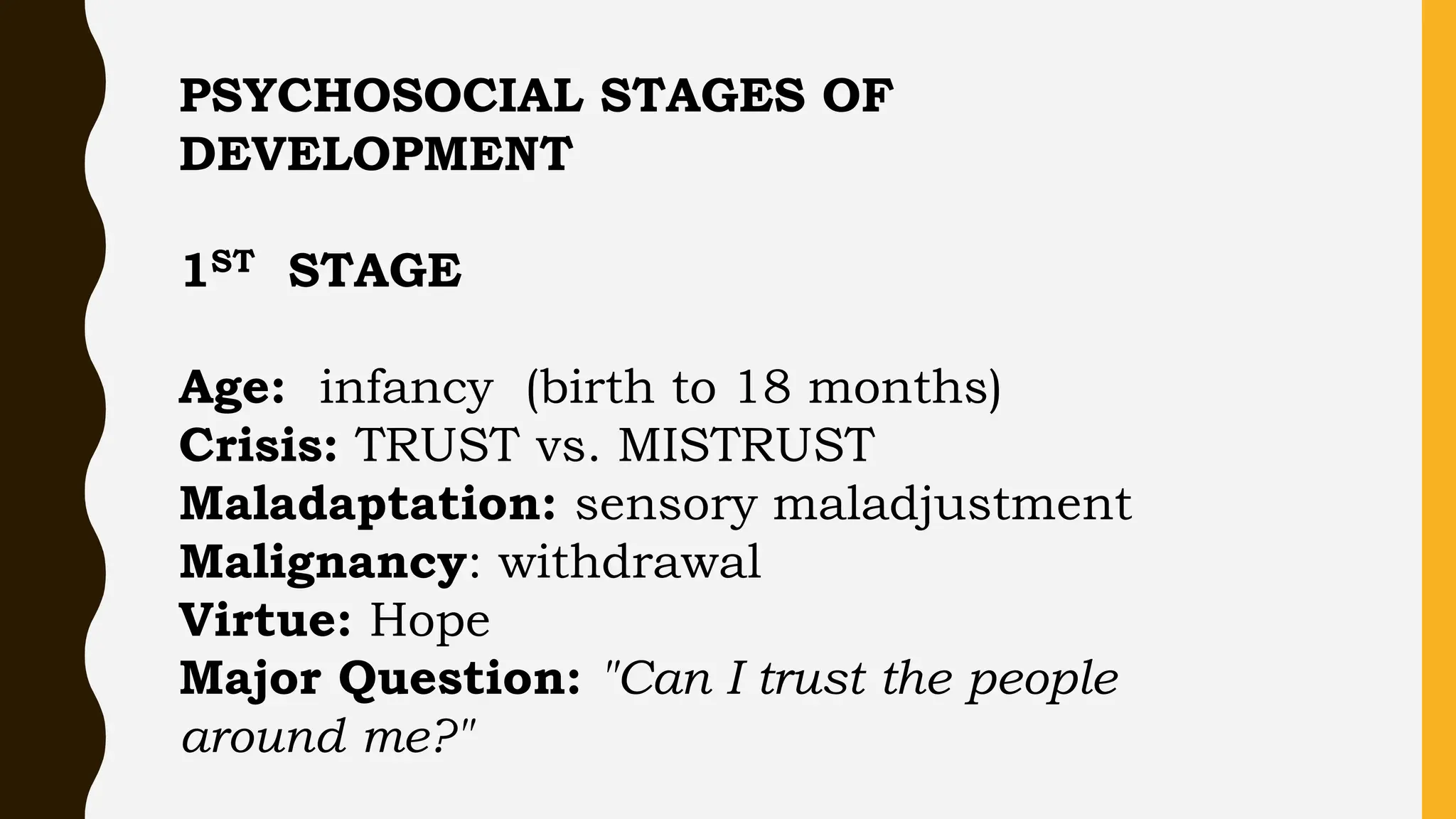
PSYCHOSOCIAL STAGES OF
DEVELOPMENT
1ST STAGE
Age: infancy (birth to 18 months)
Crisis: TRUST vs. MISTRUST
Maladaptation: sensory maladjustment
Malignancy: withdrawal
Virtue: Hope
Major Question: "Can I trust the people
around me?"
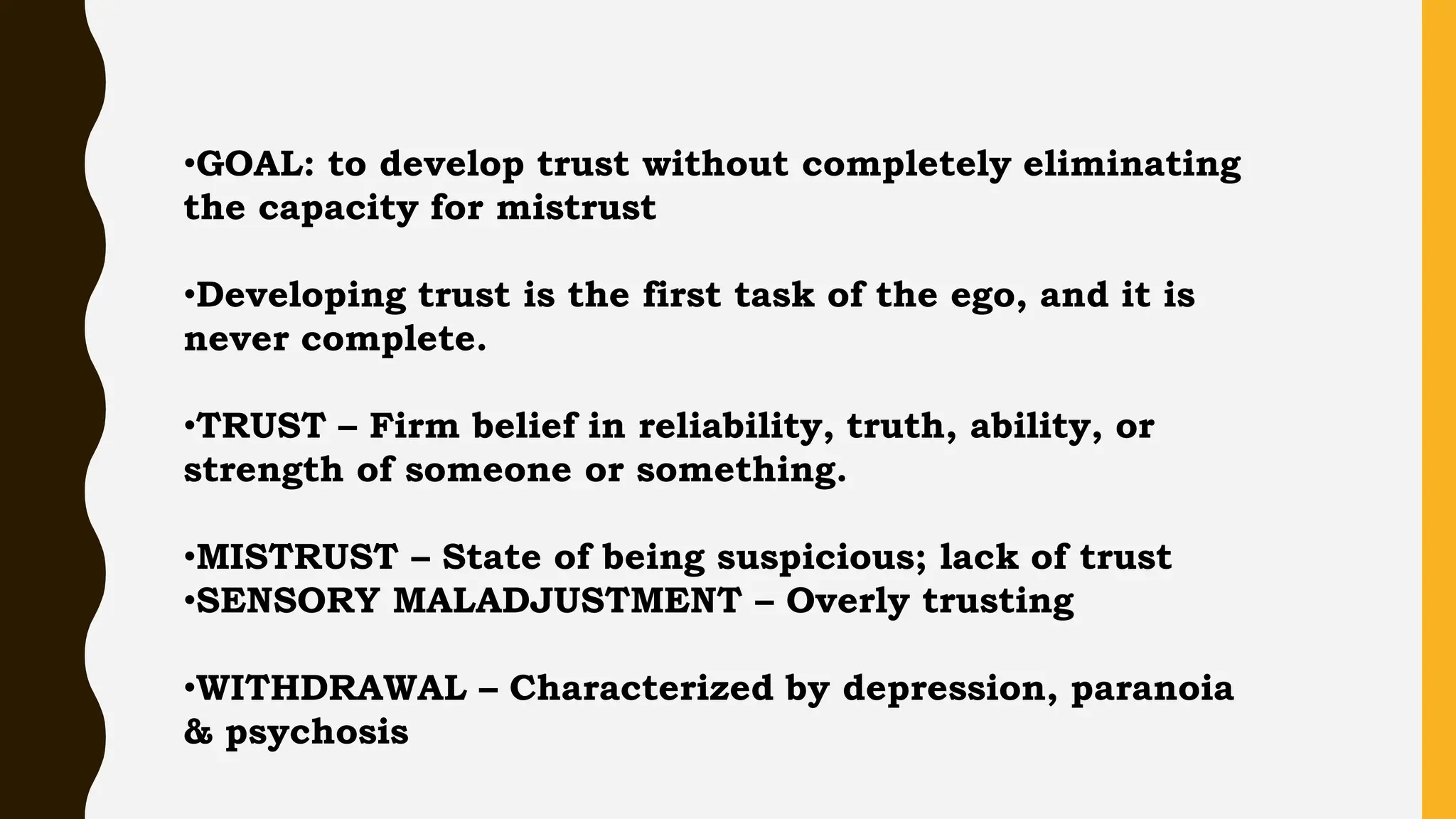
•GOAL: to develop trust without completely eliminating
the capacity for mistrust
•Developing trust is the first task of the ego, and it is
never complete.
•TRUST – Firm belief in reliability, truth, ability, or
strength of someone or something.
•MISTRUST – State of being suspicious; lack of trust
•SENSORY MALADJUSTMENT – Overly trusting
•WITHDRAWAL – Characterized by depression, paranoia
& psychosis
HOPE – strong belief that when things
are not going well, they will work out
well in the end.
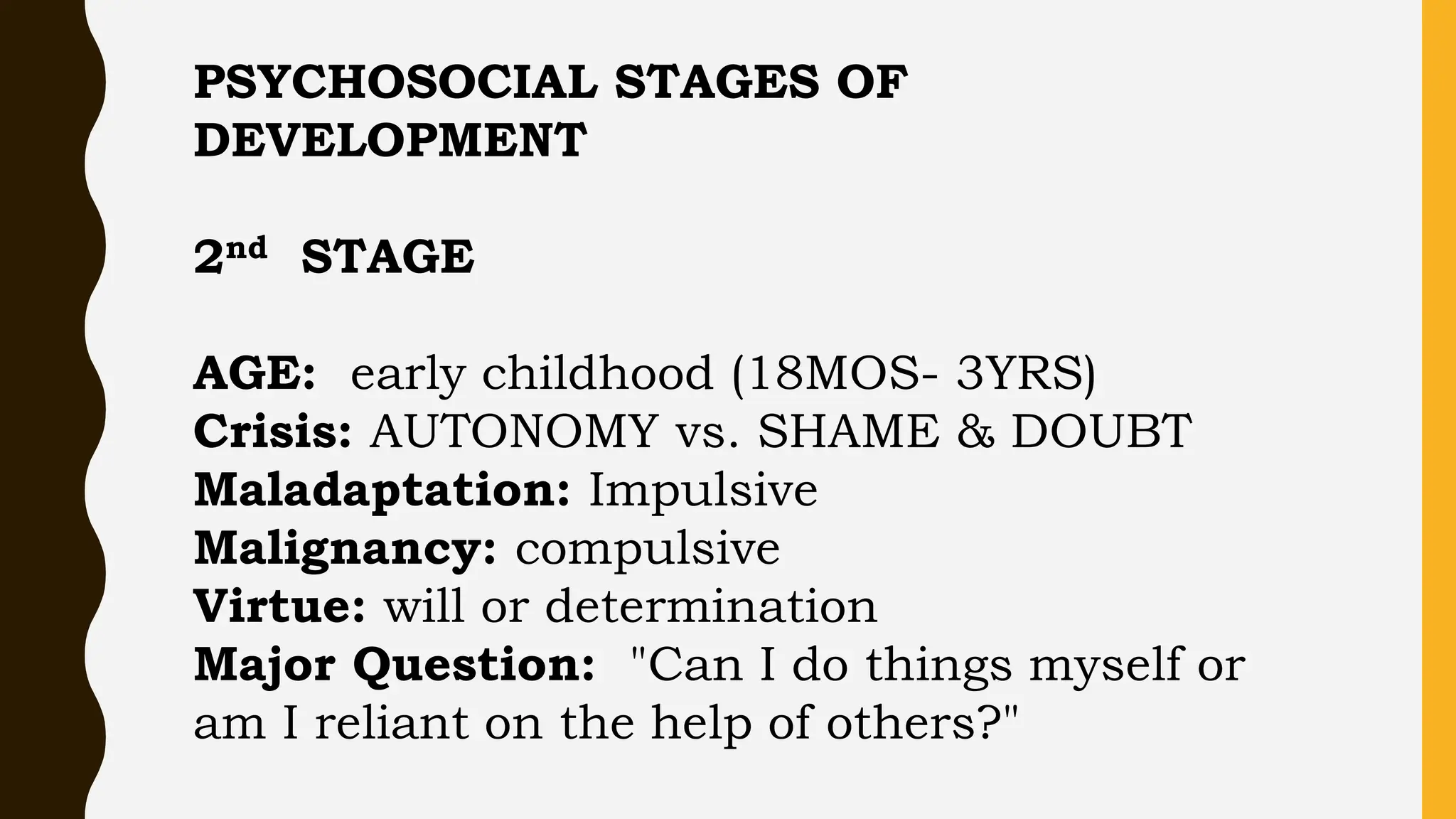
PSYCHOSOCIAL STAGES OF
DEVELOPMENT
2nd STAGE
AGE: early childhood (18MOS- 3YRS)
Crisis: AUTONOMY vs. SHAME & DOUBT
Maladaptation: Impulsive
Malignancy: compulsive
Virtue: will or determination
Major Question: "Can I do things myself or
am I reliant on the help of others?"
•GOAL: to achieve autonomy while minimizing shame
and doubt.
•AUTONOMY – Independence
•SHAME – A painful feeling of humiliation or distress
caused by the consciousness of wrong or foolish
behavior.
•DOUBT – Feeling of uncertainty or lack of conviction
•IMPULSIVENESS – Sort of shameless willfulness that
leads you in later childhood and even adulthood, to
jump into things without proper consideration of your
abilities.
•COMPULSIVENESS – A person feels as if their
entire being rides on everything they do, and so
everything, must be done perfectly
• WILL POWER – Controlling deliberately
exerted to do something or to restrain one’s
own impulses.
PSYCHOSOCIAL STAGES OF DEVELOPMENT
3rd STAGE
AGE: pre- school (3-5yrs)
Crisis: INITIATIVE vs. GUILT
Maladaptation: Ruthlessness
Malignancy: Inhibition
Virtue: Purpose
Major Question: Am I good or bad?”
•GOAL: to learn initiative without too much guilt.
•INITIATIVE – a positive response to the world’s
challenges, taking on responsibilities, learning new
skills, feeling purposeful.
• GUILT – the attempt to make that non-reality a
reality.
•RUTHLESNESS – to be heartless or unfeeling or be
“without mercy.”
•INHIBITION – too much guilt.
• COURAGE – the capacity for action
despite a clear understanding of your
limitations and past failings
PSYCHOSOCIAL STAGES OF DEVELOPMENT
4th STAGE
AGE: school age (5-12yrs)
Crisis: INDUSTRY vs. INFERIORITY
Maladaptation: Virtuosity
Malignancy: Inertia
Virtue: Competence
Major Question: “how can I be good?”
•They must learn the feeling of success, whether it is in
school or on the playground, academic, or social.
•INFERIORITY – Competence
•Just a touch of inferiority keeps us sensible and
humble.
•Virtuosity- not allowed to be children and pushed to
competence without allowing development of broad
interest; kids without a life
•Inertia- inferiority complexes
PSYCHOSOCIAL STAGES OF DEVELOPMENT
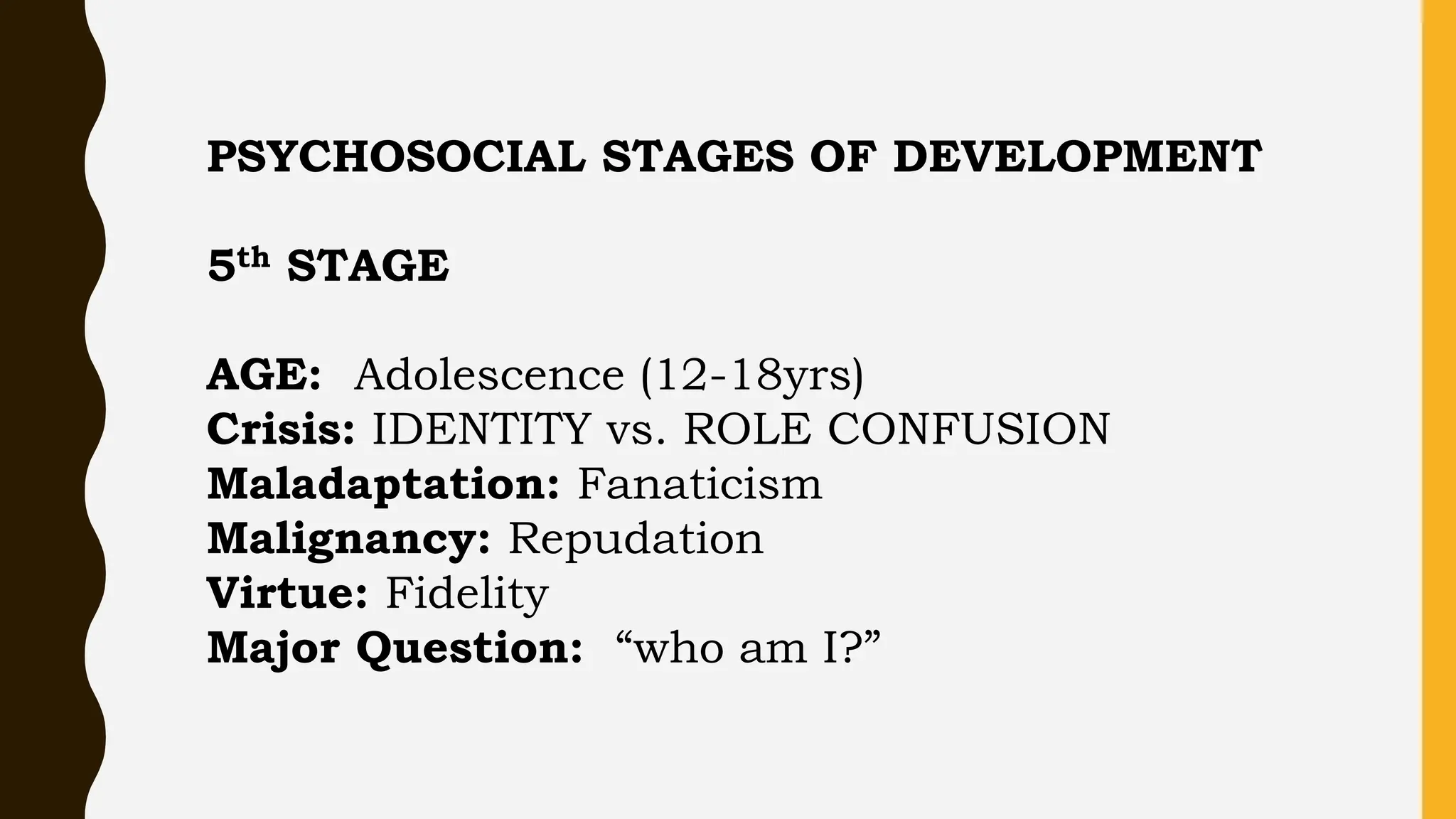
5th STAGE
AGE: Adolescence (12-18yrs)
Crisis: IDENTITY vs. ROLE CONFUSION
Maladaptation: Fanaticism
Malignancy: Repudation
Virtue: Fidelity
Major Question: “who am I?”
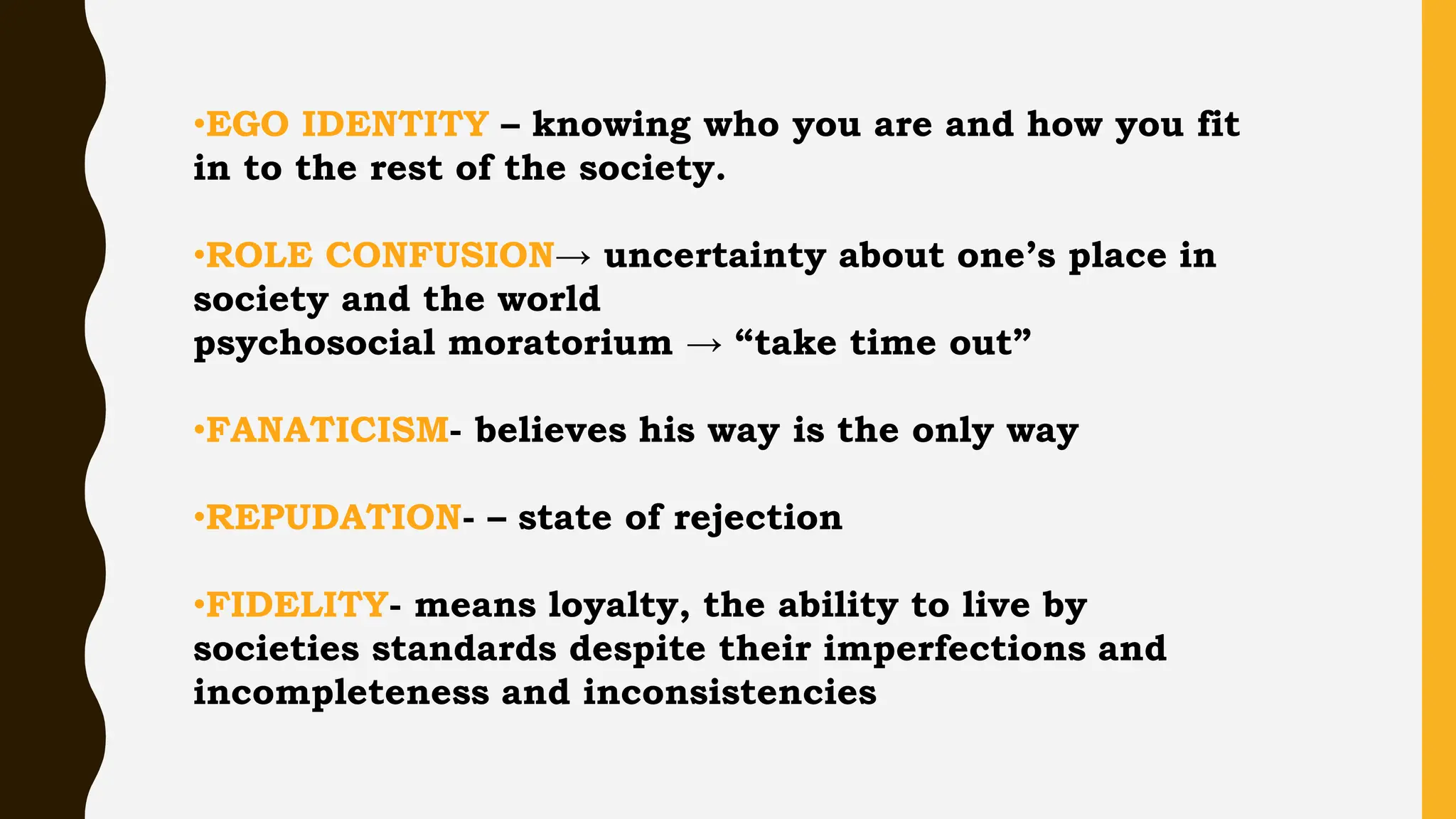
•EGO IDENTITY – knowing who you are and how you fit
in to the rest of the society.
•ROLE CONFUSION→ uncertainty about one’s place in
society and the world
psychosocial moratorium → “take time out”
•FANATICISM- believes his way is the only way
•REPUDATION- – state of rejection
•FIDELITY- means loyalty, the ability to live by
societies standards despite their imperfections and
incompleteness and inconsistencies
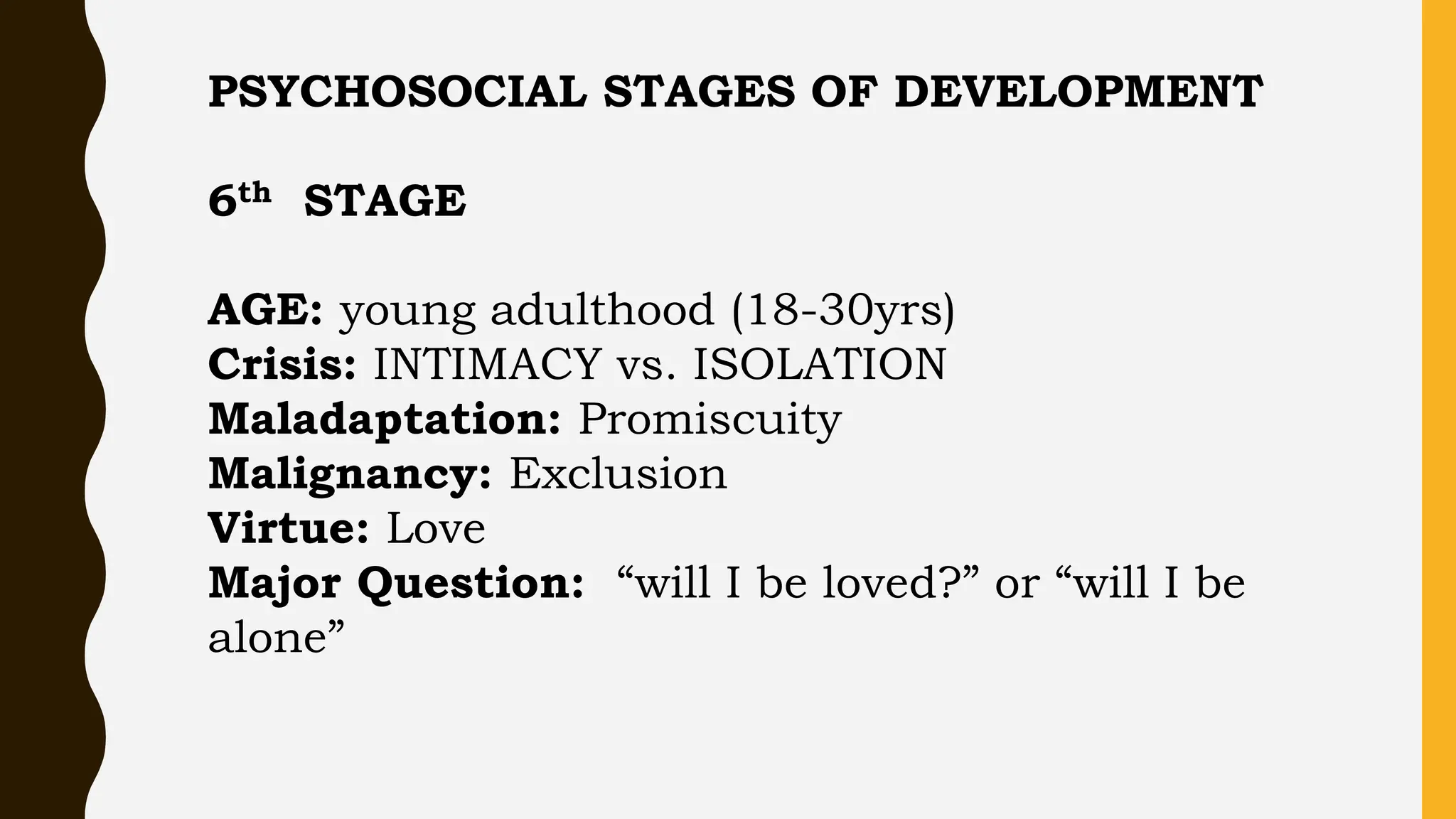
PSYCHOSOCIAL STAGES OF DEVELOPMENT
6th STAGE
AGE: young adulthood (18-30yrs)
Crisis: INTIMACY vs. ISOLATION
Maladaptation: Promiscuity
Malignancy: Exclusion
Virtue: Love
Major Question: “will I be loved?” or “will I be
alone”
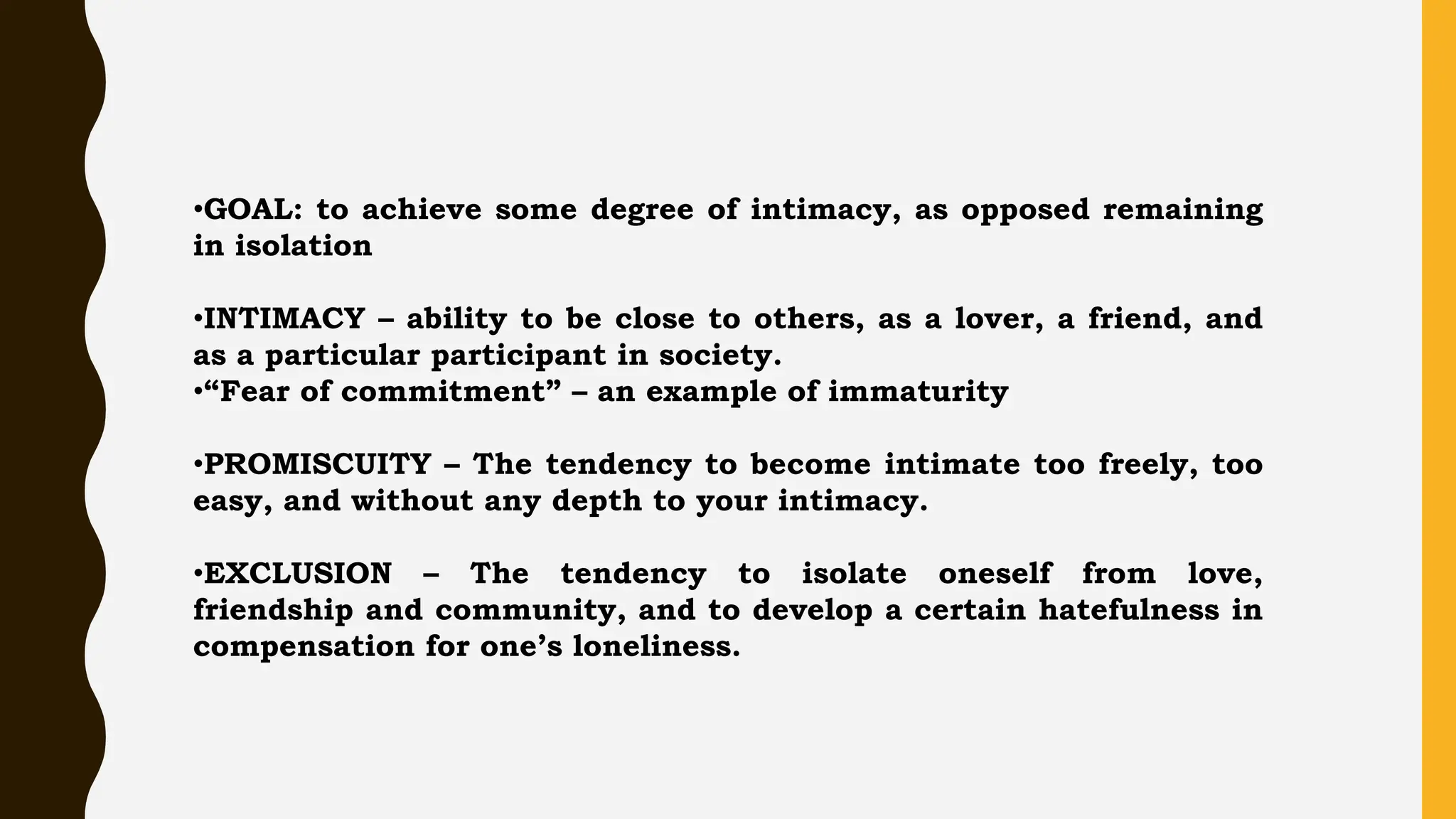
•GOAL: to achieve some degree of intimacy, as opposed remaining
in isolation
•INTIMACY – ability to be close to others, as a lover, a friend, and
as a particular participant in society.
•“Fear of commitment” – an example of immaturity
•PROMISCUITY – The tendency to become intimate too freely, too
easy, and without any depth to your intimacy.
•EXCLUSION – The tendency to isolate oneself from love,
friendship and community, and to develop a certain hatefulness in
compensation for one’s loneliness.
LOVE – Being able to put aside
differences and antagonisms through
“mutuality of devotion.”
PSYCHOSOCIAL STAGES OF DEVELOPMENT
7th STAGE
AGE: middle adulthood (mid 20’s- late 50’s)
Crisis: GENERATIVITY vs. STAGNATION
Maladaptation: Over extension
Malignancy: Rejectivity
Virtue: Competence
Major Question: “how can I contribute to the
world”
•GENERATIVITY – an extension of love into the future.
•STAGNATION – self absorption, caring for no one.
•The stagnant person STOPS to be a reproductive
member of the society.
•OVEREXTENSION – Some people try to be generative
that they no longer allow time for themselves, for rest
and relaxation.
•REJECTIVITY – Too little generativity and too much
stagnation and you are no longer participating in or
contributing to society.
PSYCHOSOCIAL STAGES OF DEVELOPMENT
8th STAGE
AGE: late adulthood (around 60yrs)
Crisis: INTEGRITY vs. DESPAIR
Maladaptation: Presumption
Malignancy: Disdain
Virtue: Wisdom
Major Question: “did I live a meaningful life?”
•INTEGRITY – Coming to terms with your life, and thereby coming
to terms with the end of life.
•DESPAIR – The complete loss or absence of hope.
• PRESUMPTION – Happens when a person “presumes” ego
integrity without actually facing the difficulties of old age.
•DISDAIN – A contempt of life, one’s own, or anyone.
•WISDOM – Someone who approaches death without fear.
Piaget’s Cognitive
Development
Theory
Piaget’s Cognitive Development theory
● Piaget’s Cognitive Development Theory of 1936 talks about how
children create a mental representation of the world. Piaget
argued that intelligence was not a rigid characteristic. Instead he
believed that intellectual growth was a result of biological
expansion and relation to their environment/surroundings.
● The theory concentrated on comprehending how children gain
knowledge and understanding the origin of intelligence
● The idea is to describe the process of how a child learns to
reason and think using propositions.
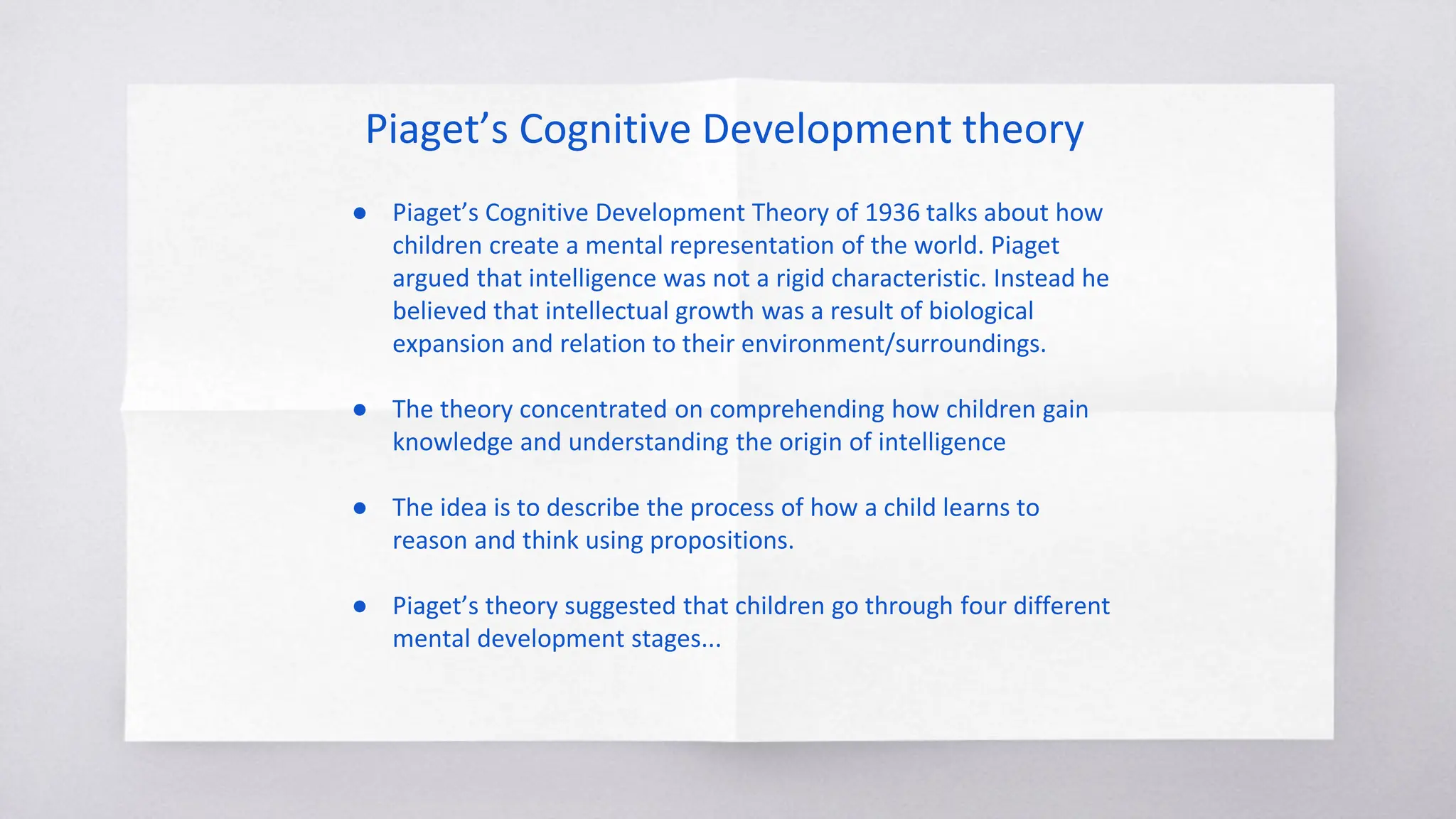
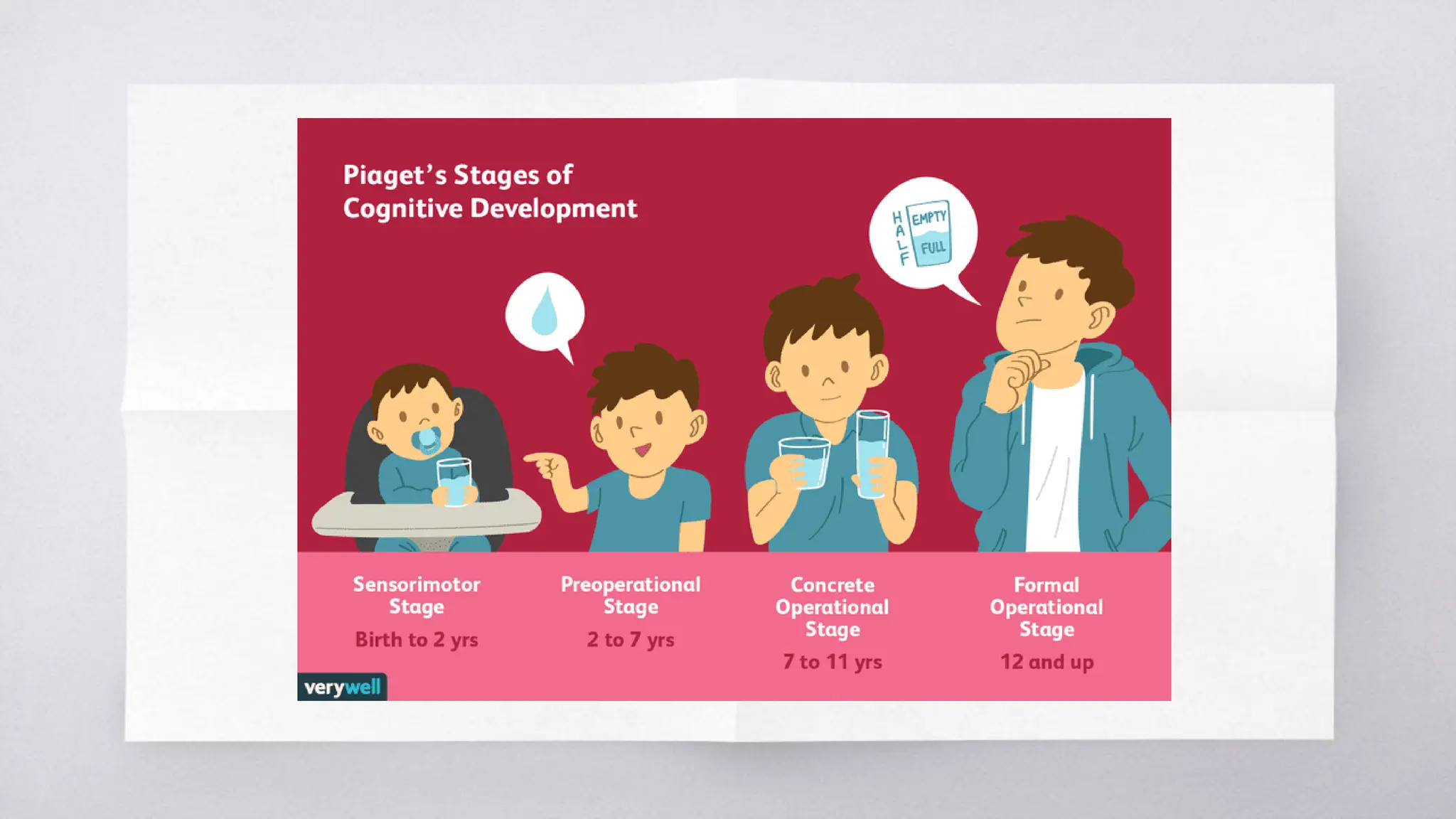
● Piaget’s theory suggested that children go through four different
mental development stages...
Sensorimotor Stage
➔ Birth to 2 years...
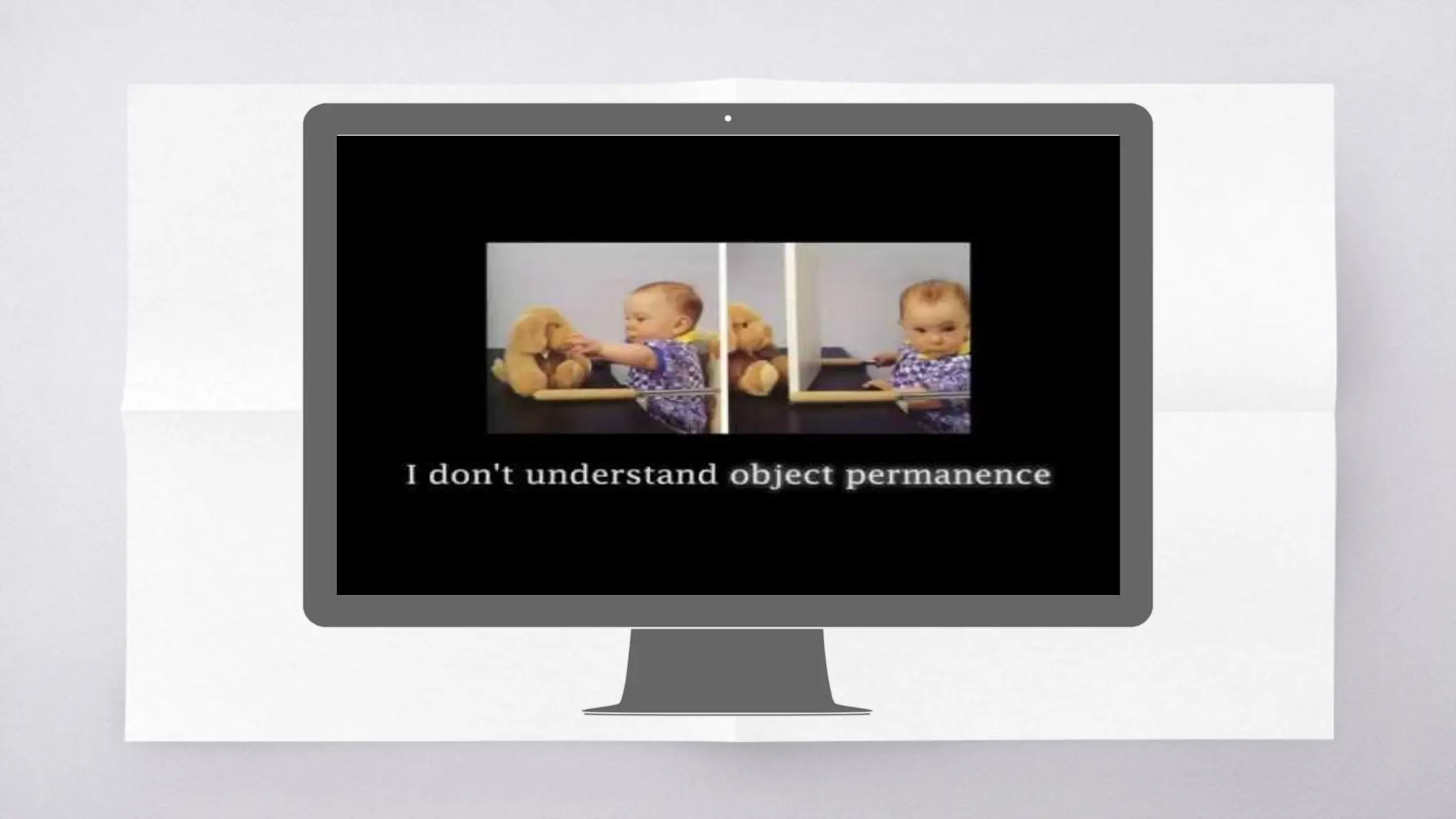
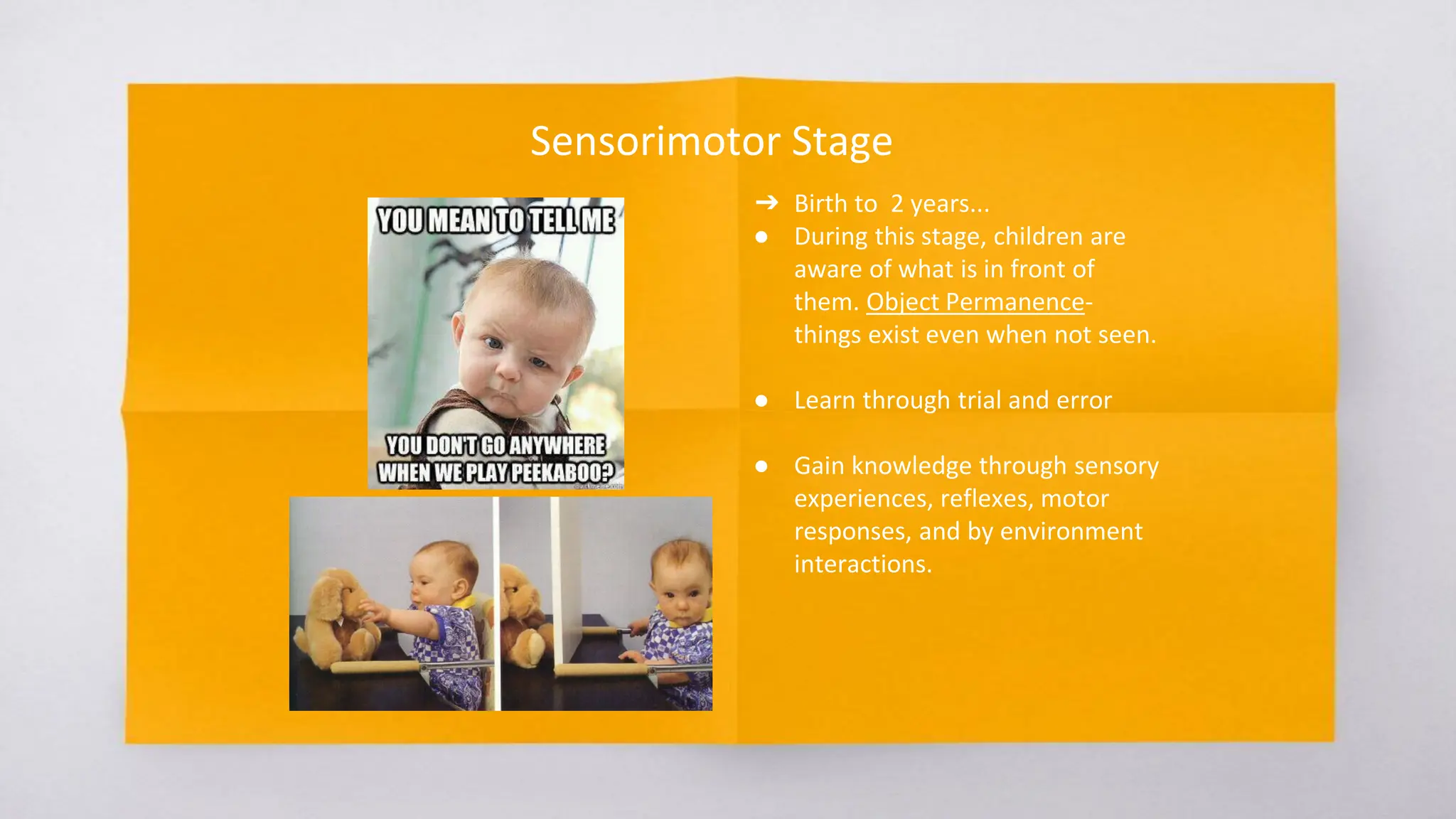
● During this stage, children are
aware of what is in front of
them. Object Permanence-
things exist even when not seen.
● Learn through trial and error
● Gain knowledge through sensory
experiences, reflexes, motor
responses, and by environment
interactions.
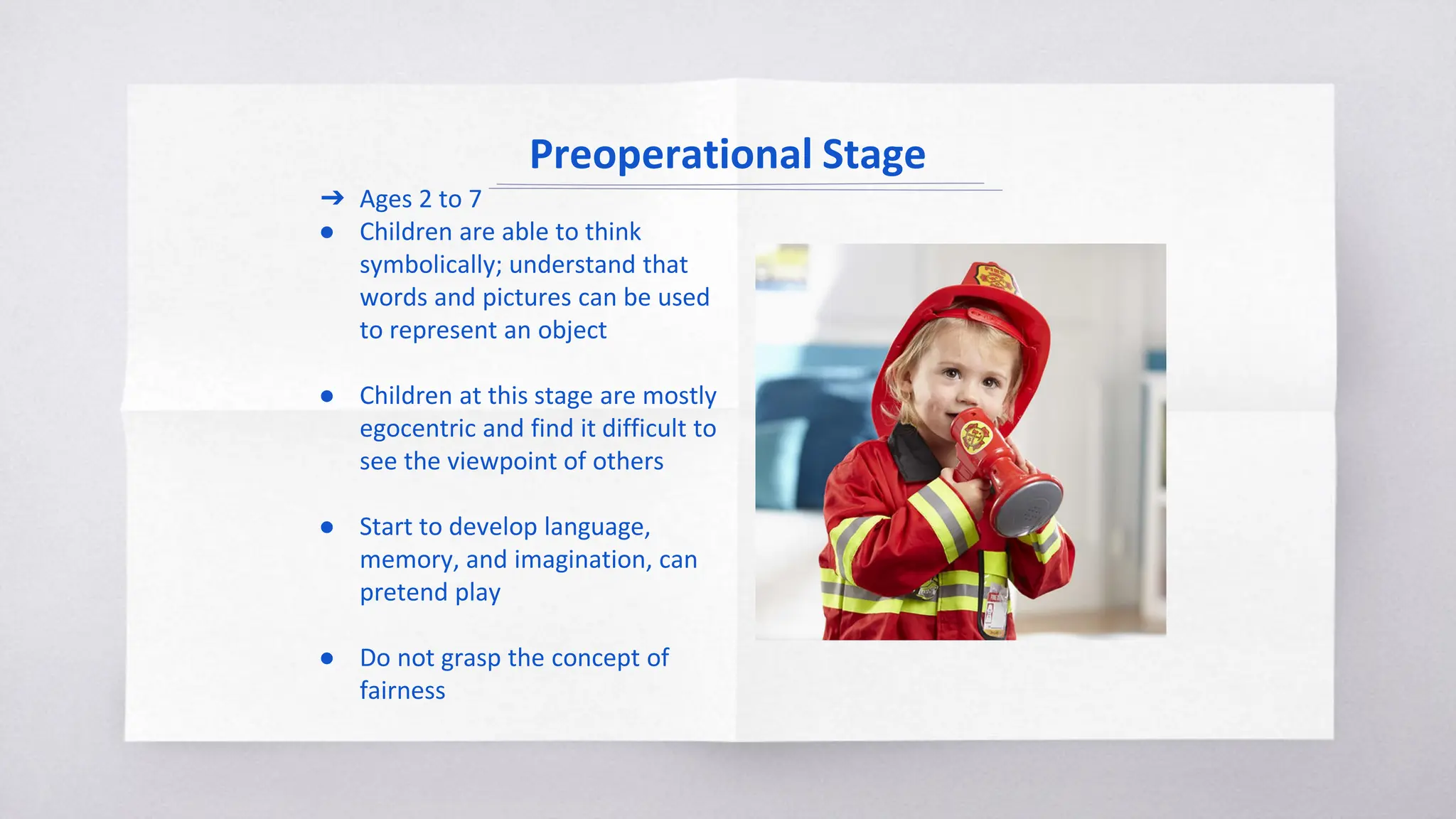
Preoperational Stage
➔ Ages 2 to 7
● Children are able to think
symbolically; understand that
words and pictures can be used
to represent an object
● Children at this stage are mostly
egocentric and find it difficult to
see the viewpoint of others
● Start to develop language,
memory, and imagination, can
pretend play
● Do not grasp the concept of
fairness
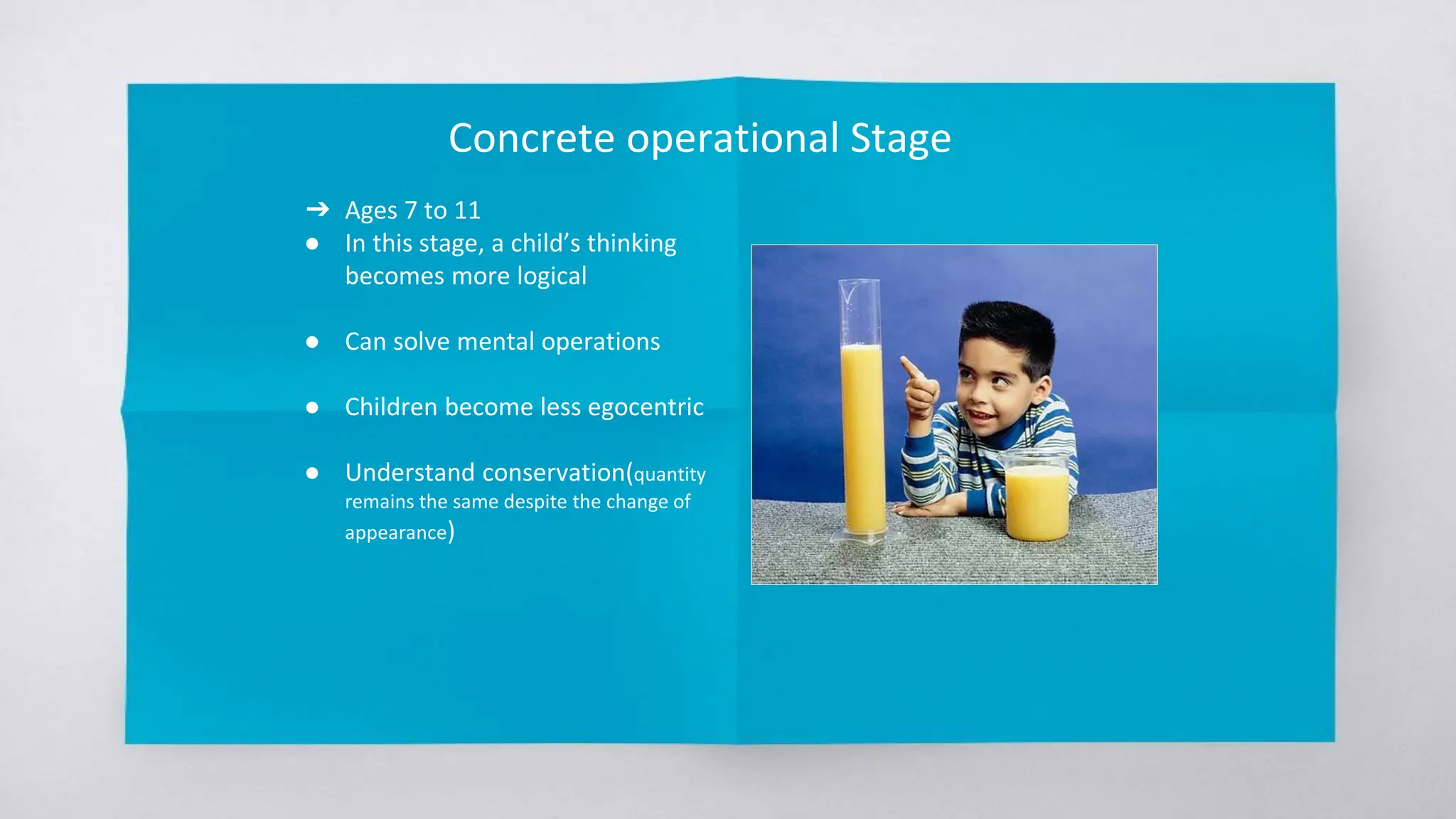
Concrete operational Stage
➔ Ages 7 to 11
● In this stage, a child’s thinking
becomes more logical
● Can solve mental operations
● Children become less egocentric
● Understand conservation(quantity
remains the same despite the change of
appearance)
Formal Operational ➔ Ages 12 to adulthood
● In this stage, the individual
develops abstract thinking
● Understand deductive
reasoning
● Can form hypotheses
● Develop moral reasoning; can
differentiate between good and
bad.
● Piaget believed that
psychological evolution of an
individual depended on how
much knowledge he/she
accumulated
PSYCHOSEXUAL
THEORY
D E V E L O P M E N T O F T H E P E R S O N A L I T Y
T H R O U G H S TA G E S .
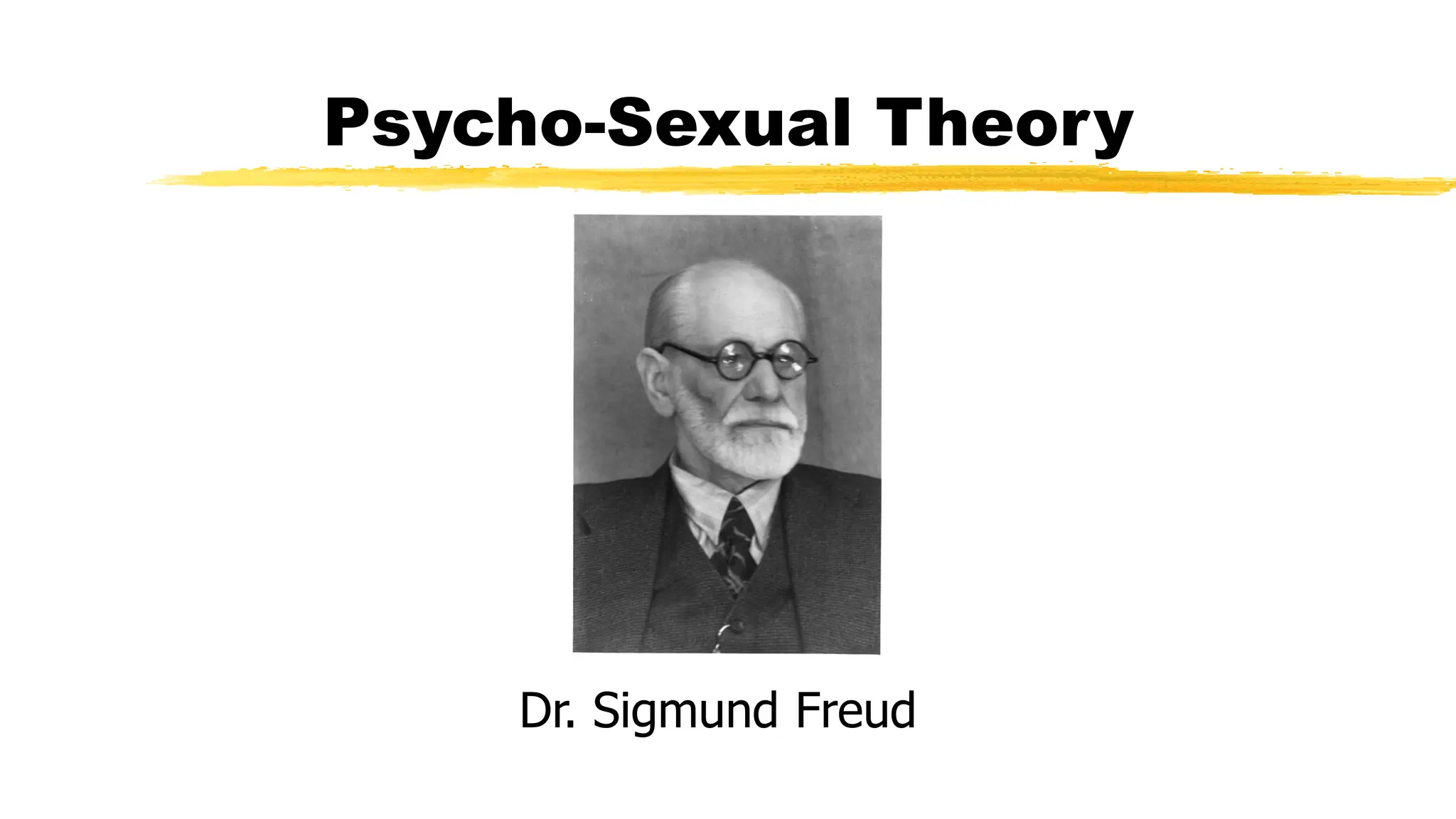
Psycho-Sexual Theory
Dr. Sigmund Freud
Freud proposed that there were 5 stages of development.
Freud believed that few people successfully completed all 5
of the stages. Instead, he felt that most people tied up
their libido at one of the stages, which prevented them
from using that energy at a later stage.
Freud Psycho-Sexual Theory
Five stages
Each stage focuses on a part of the body for
experiencing pleasure.
How conflicts between sources of pleasure are resolved
determines adult personality.
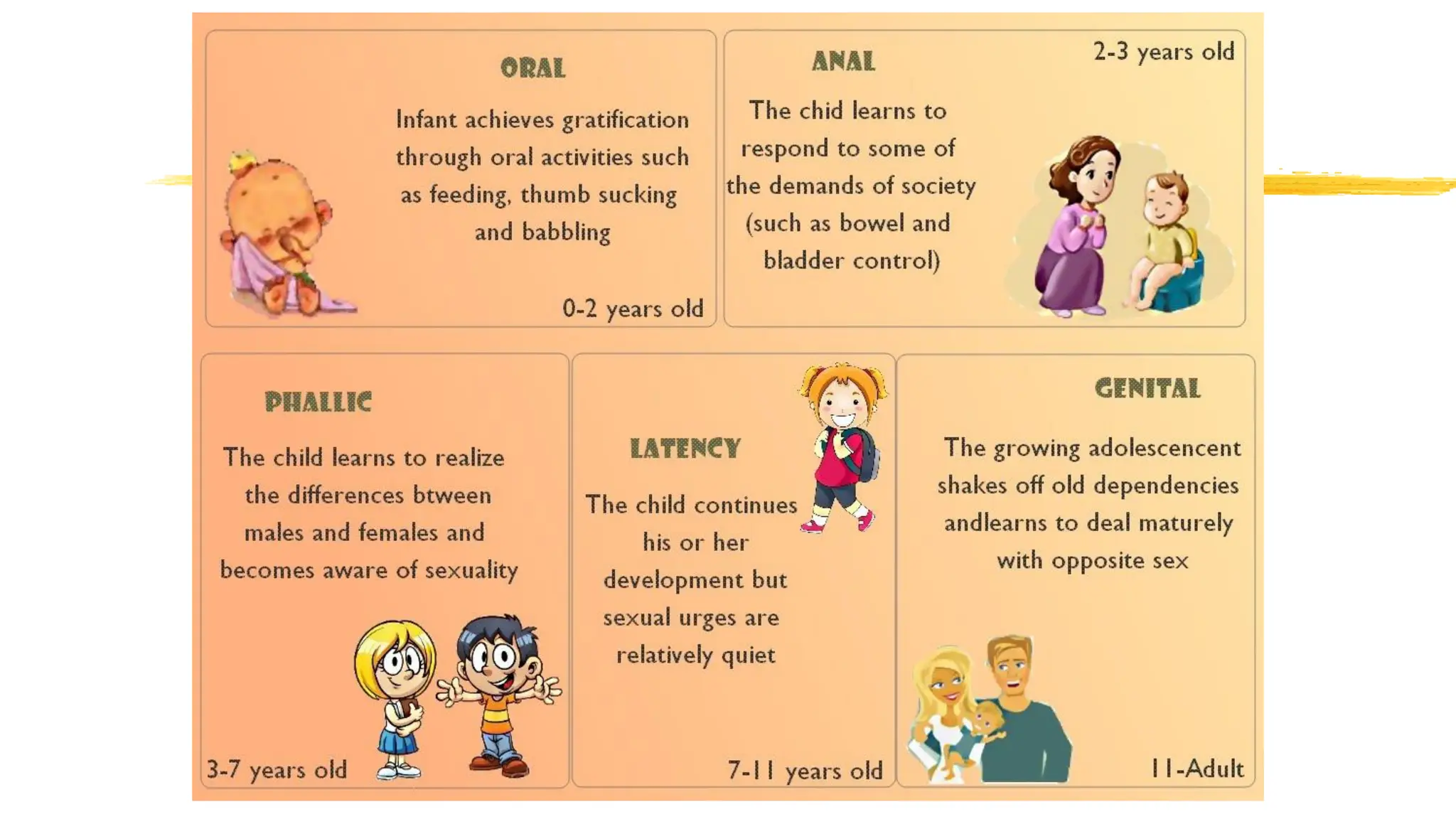
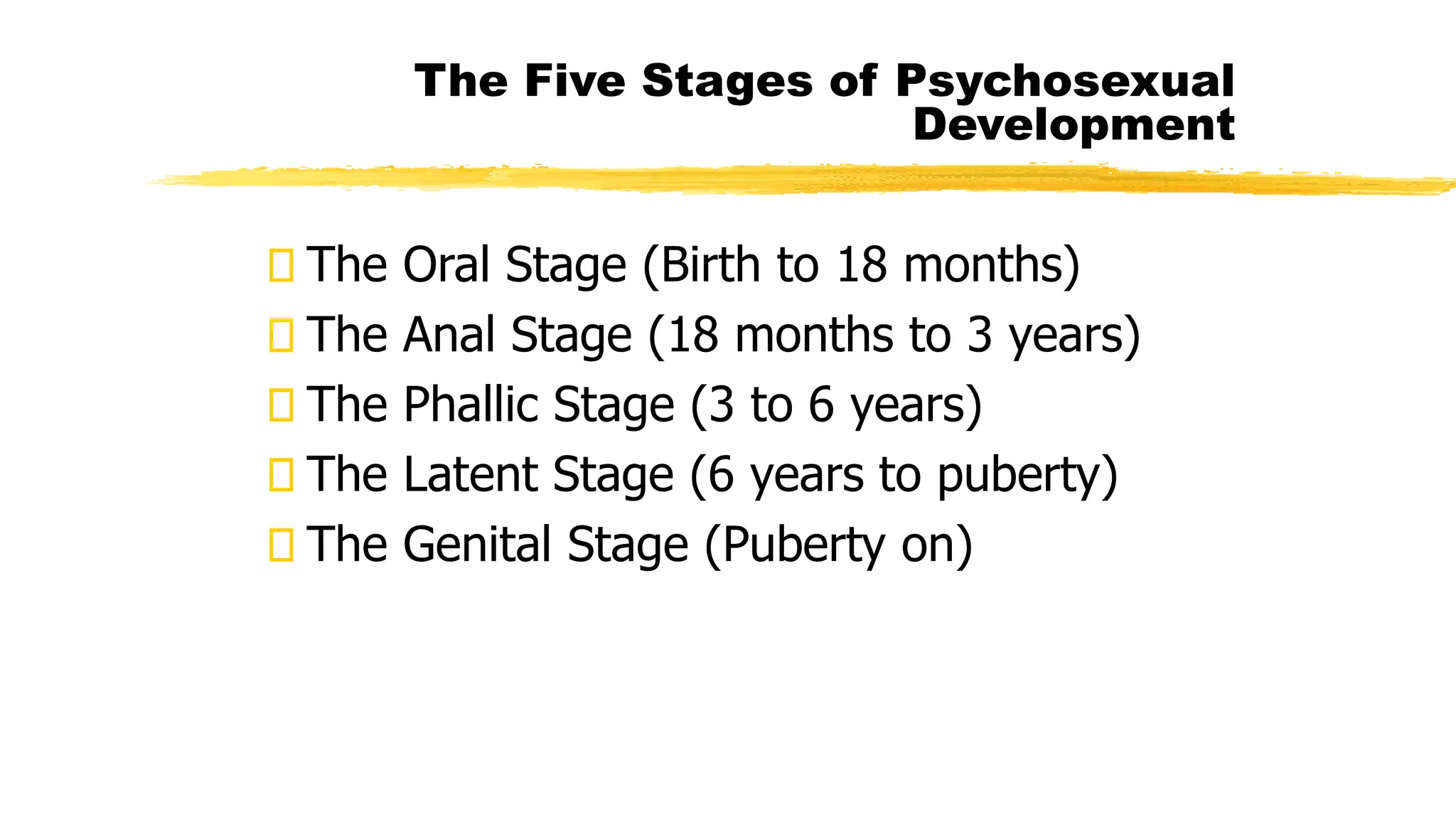
Psychosexual Development
The Oral Stage (Birth to 18 months)
The Anal Stage (18 months to 3 years)
The Phallic Stage (3 to 6 years)
The Latent Stage (6 years to puberty)
The Genital Stage (Puberty on)
The Five Stages of Psychosexual
Development
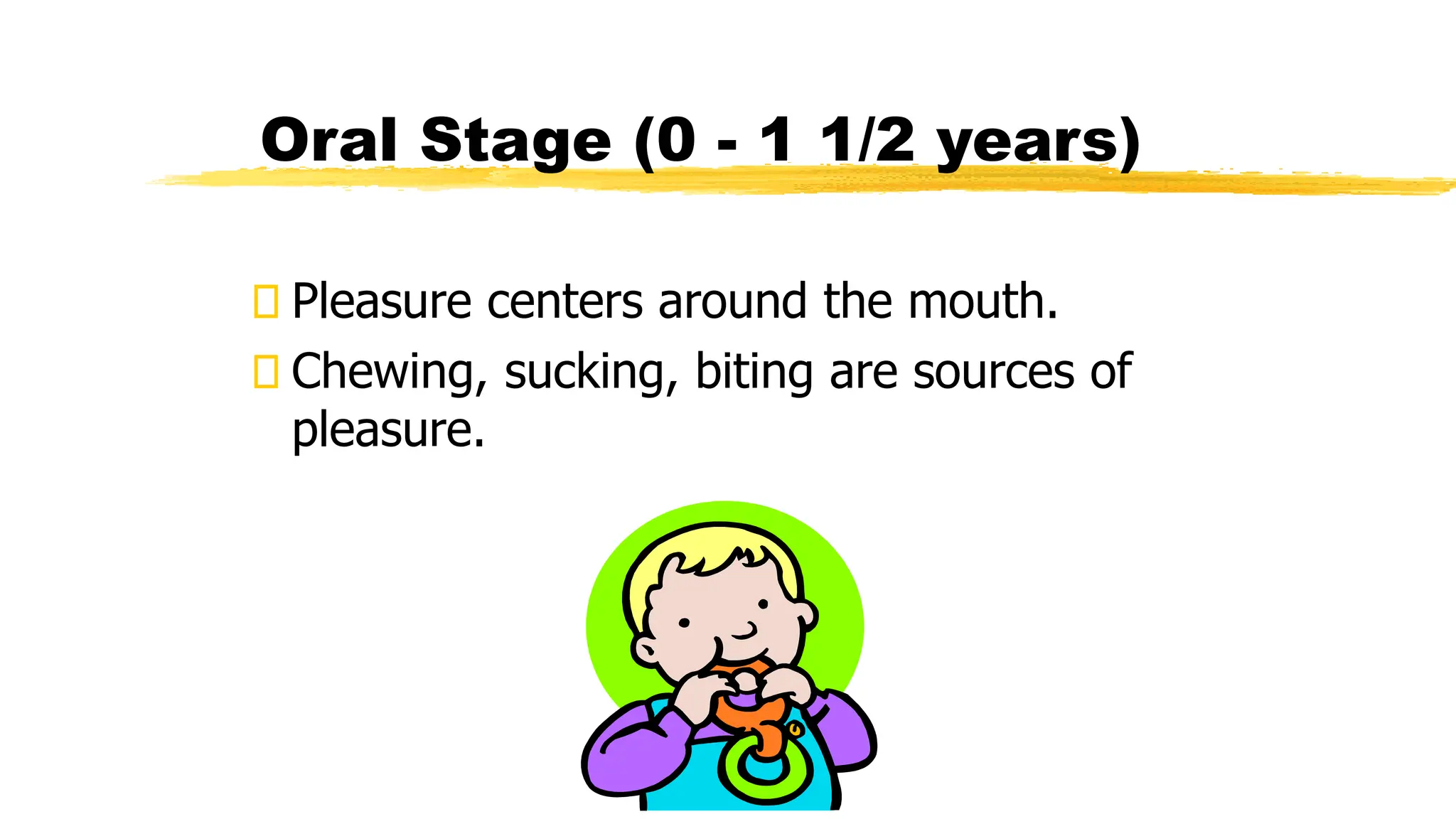
Pleasure centers around the mouth.
Chewing, sucking, biting are sources of
pleasure.
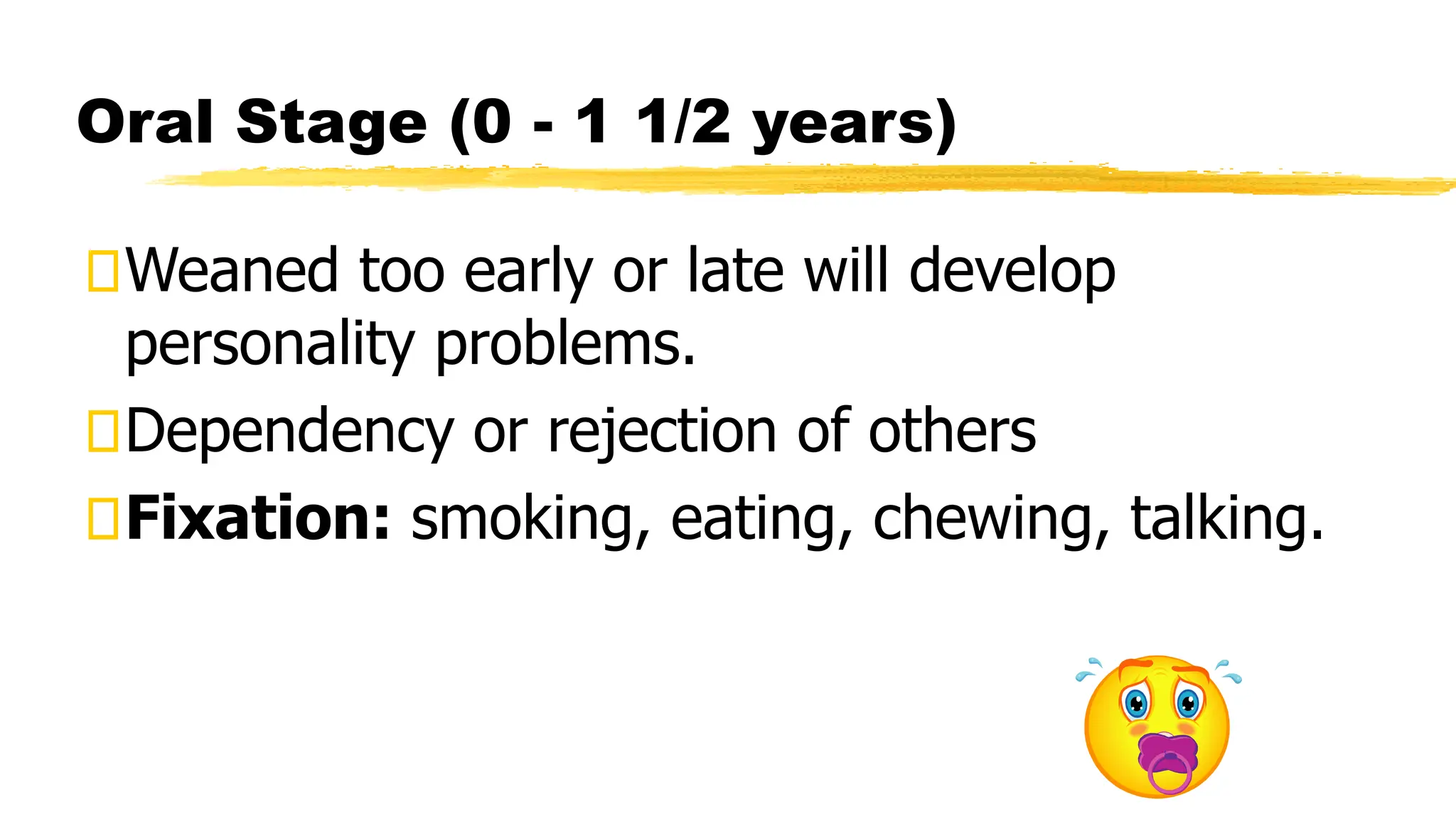
Oral Stage (0 - 1 1/2 years)
Weaned too early or late will develop
personality problems.
Dependency or rejection of others
Fixation: smoking, eating, chewing, talking.
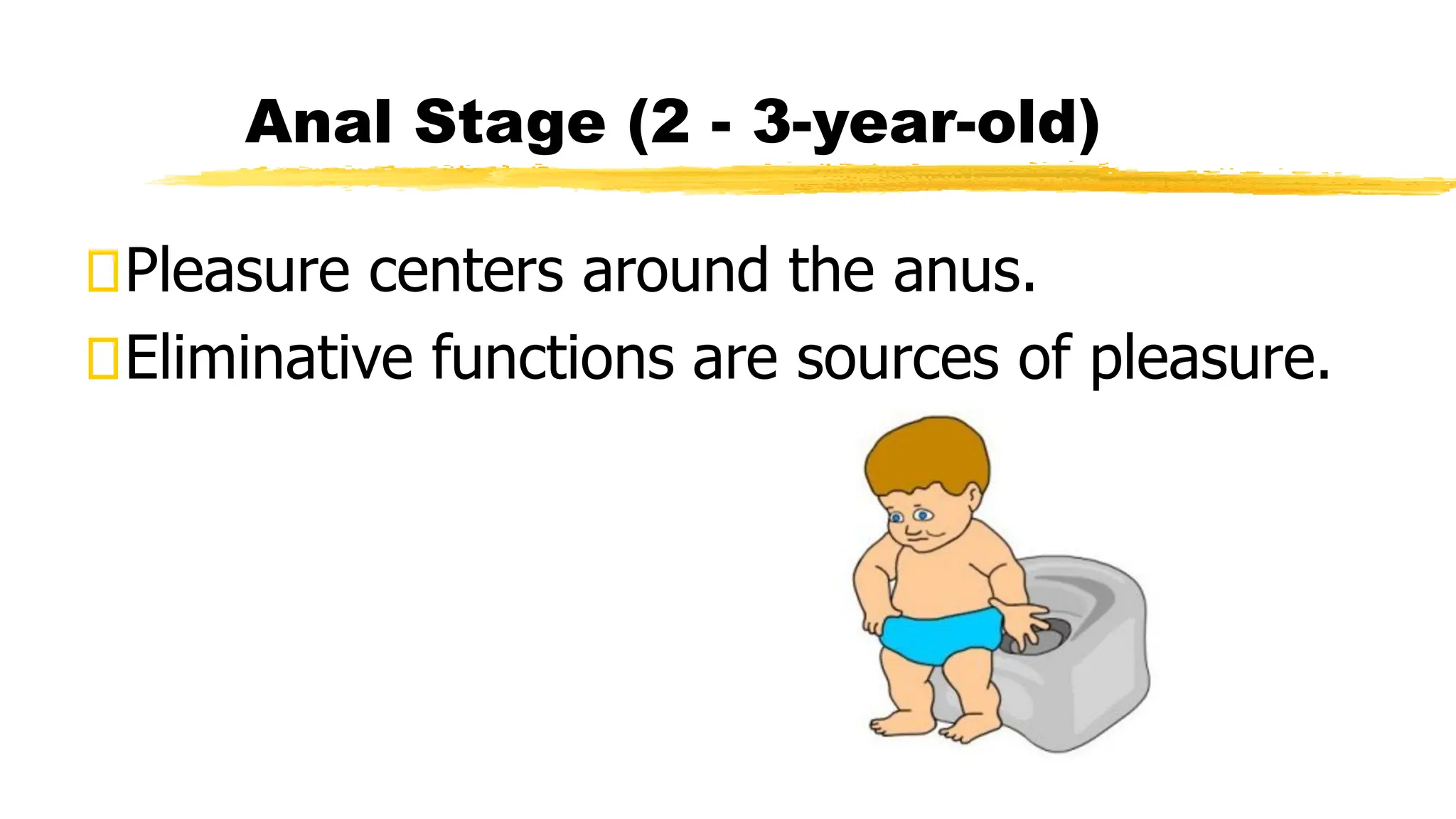
Pleasure centers around the anus.
Eliminative functions are sources of pleasure.
Anal Stage (2 - 3-year-old)
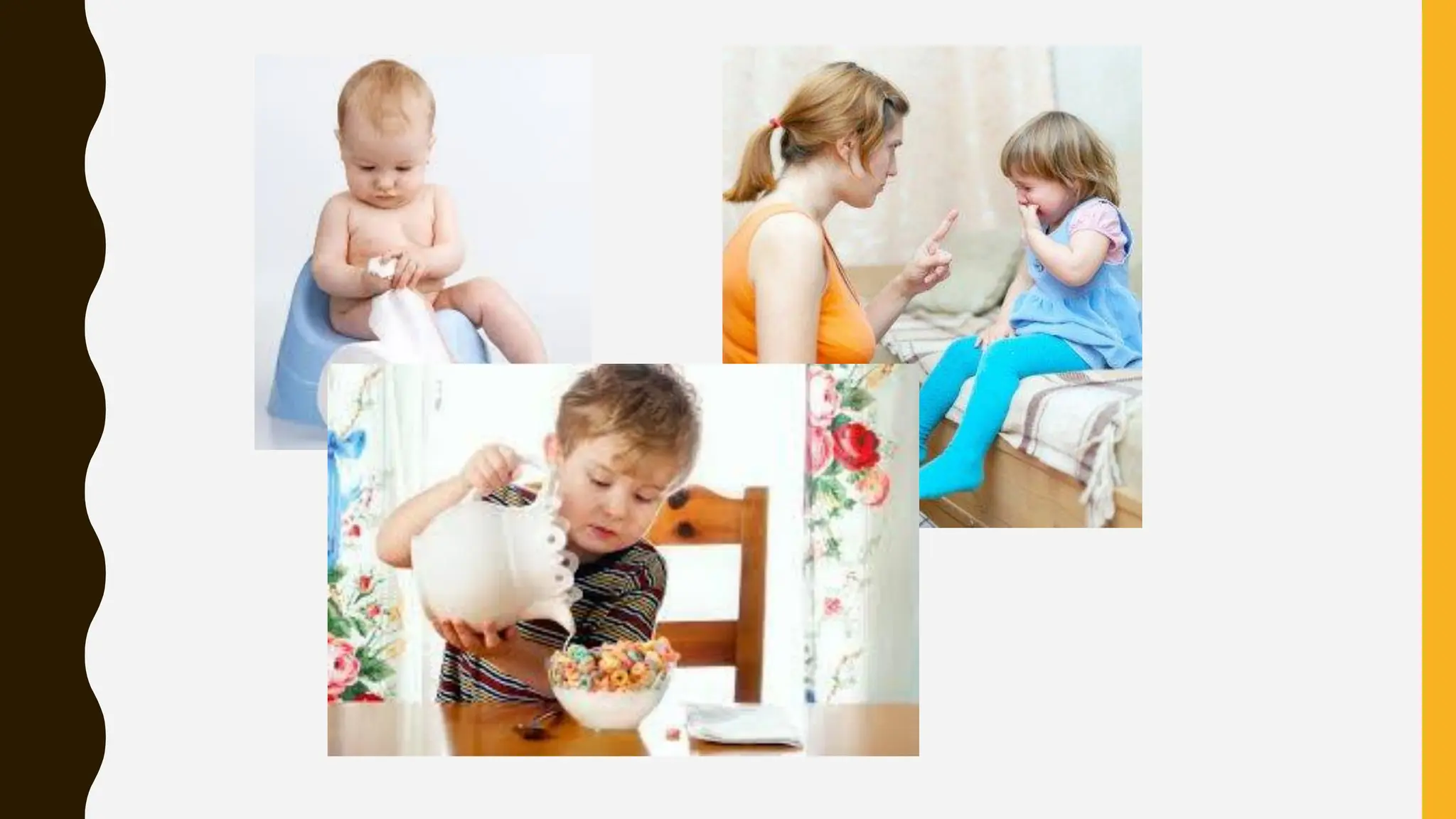
Issue is control through Toilet training.
Child view = Giving the gift
Dirty vs. Lavish Praise
Stingy or Overly Generous
Rigid rules or Irresponsible & Rebellious
Anal Stage (2 - 3-year-old)
Fixation
Leniency leads to: Anal-expulsive personality-- messy,
wasteful, or destructive.
Strictness leads to: Anal-retentive personality:
stringent, orderly, rigid, and obsessive.
Pleasure focuses on the genitals.
Self-manipulation is a source of pleasure.
Oedipus Complex appears.
Phallic Stage (3rd to 5th year)
Focus is on the genital areas
(Boys vs. Girls)
Oedipal Complex: Parents seen as threats.
Wide range of psychological disorders through failure to
resolve this conflict, (unreasonable anxiety, phobias, &
depression)
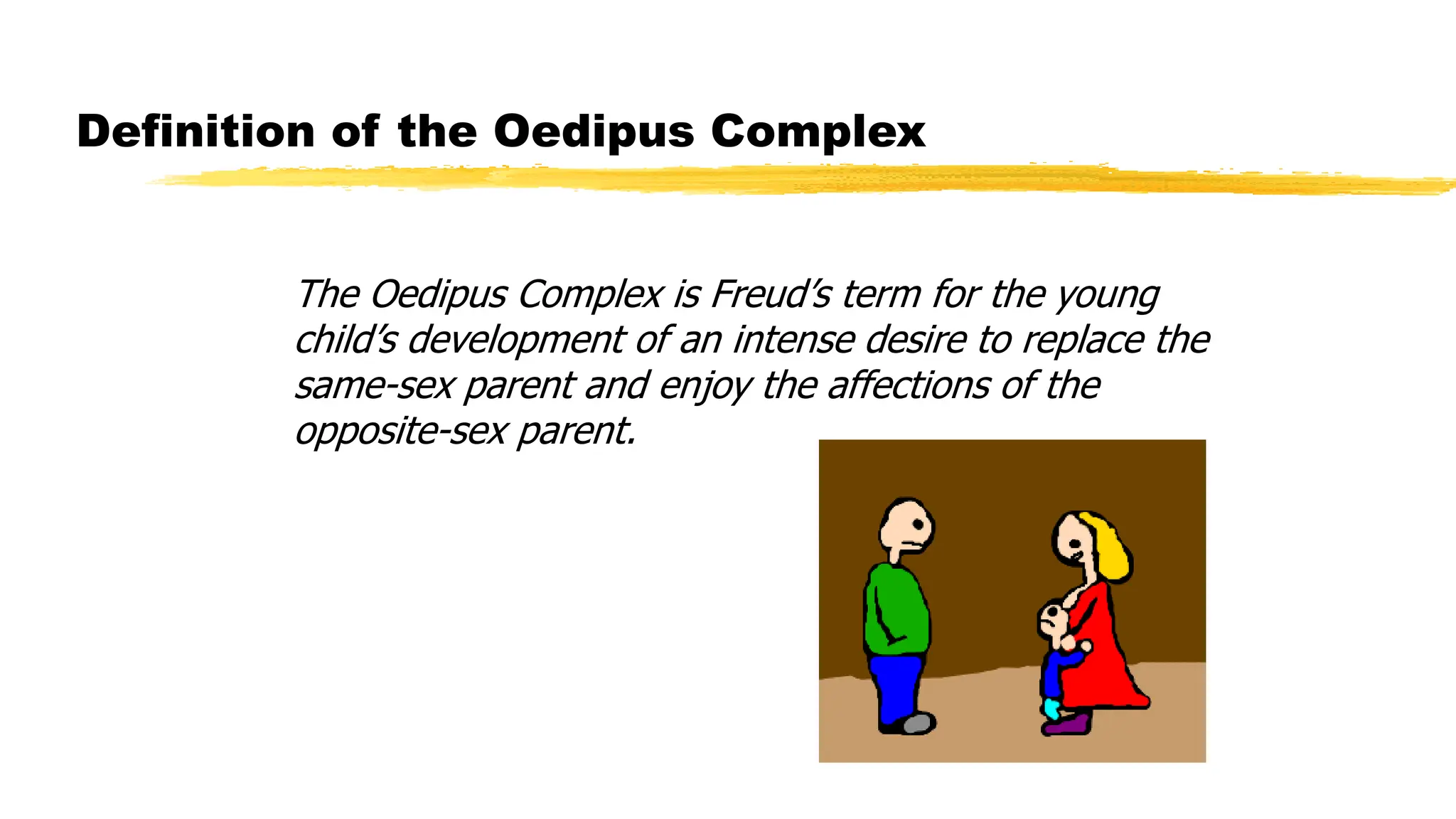
The Oedipus Complex is Freud’s term for the young
child’s development of an intense desire to replace the
same-sex parent and enjoy the affections of the
opposite-sex parent.
Definition of the Oedipus Complex
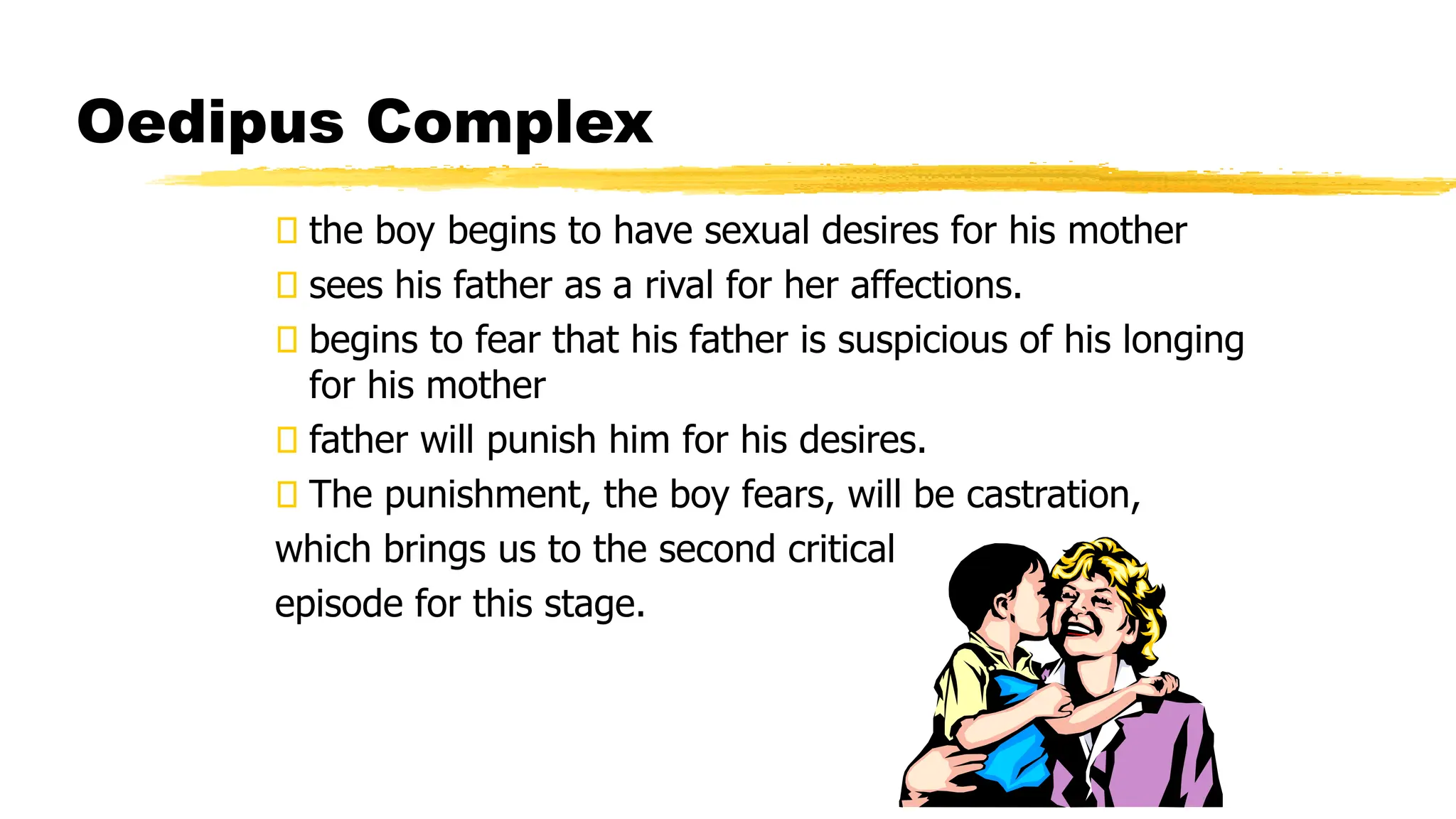
Oedipus Complex
the boy begins to have sexual desires for his mother
sees his father as a rival for her affections.
begins to fear that his father is suspicious of his longing
for his mother
father will punish him for his desires.
The punishment, the boy fears, will be castration,
which brings us to the second critical
episode for this stage.
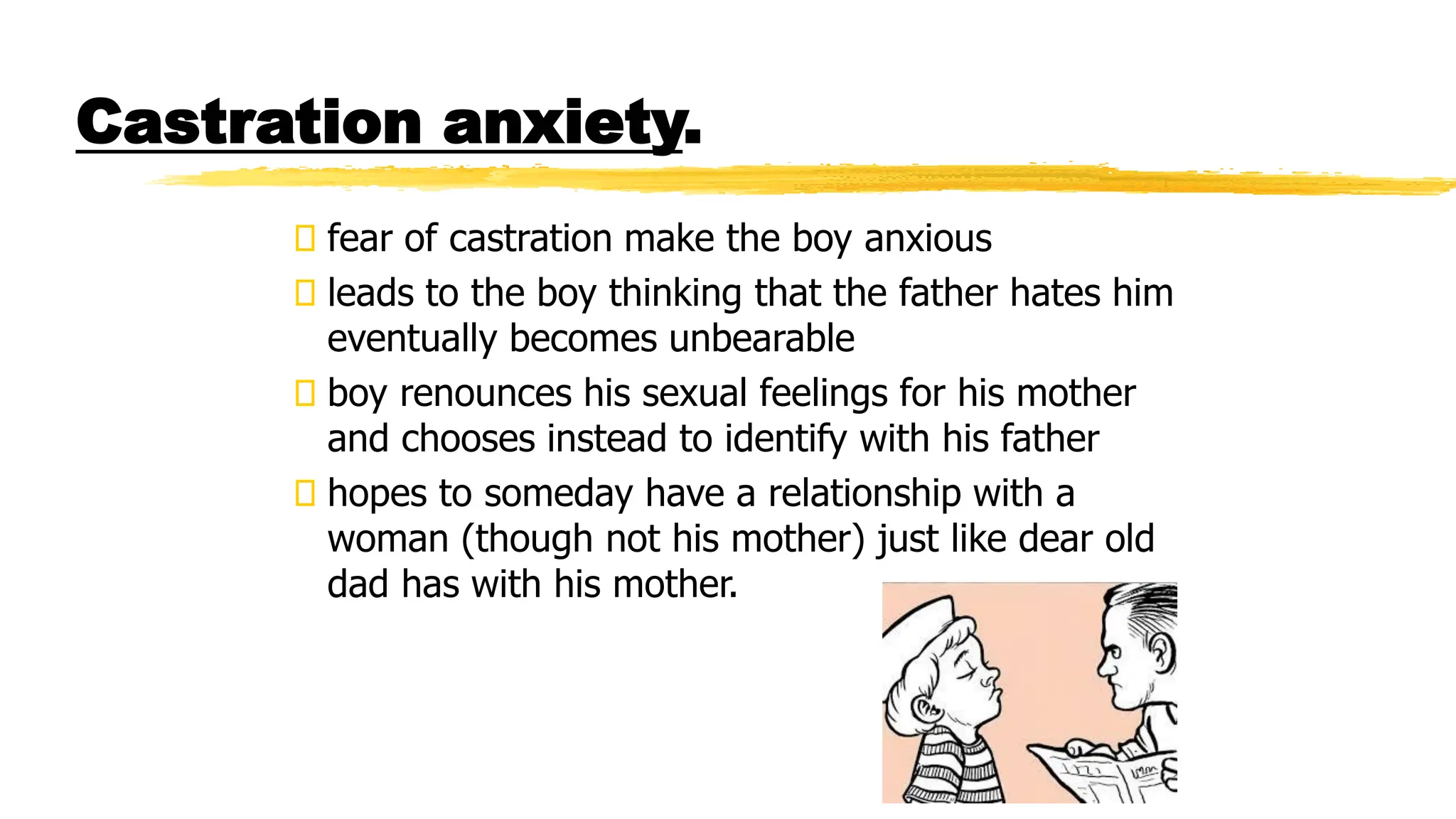
Castration anxiety.
fear of castration make the boy anxious
leads to the boy thinking that the father hates him
eventually becomes unbearable
boy renounces his sexual feelings for his mother
and chooses instead to identify with his father
hopes to someday have a relationship with a
woman (though not his mother) just like dear old
dad has with his mother.
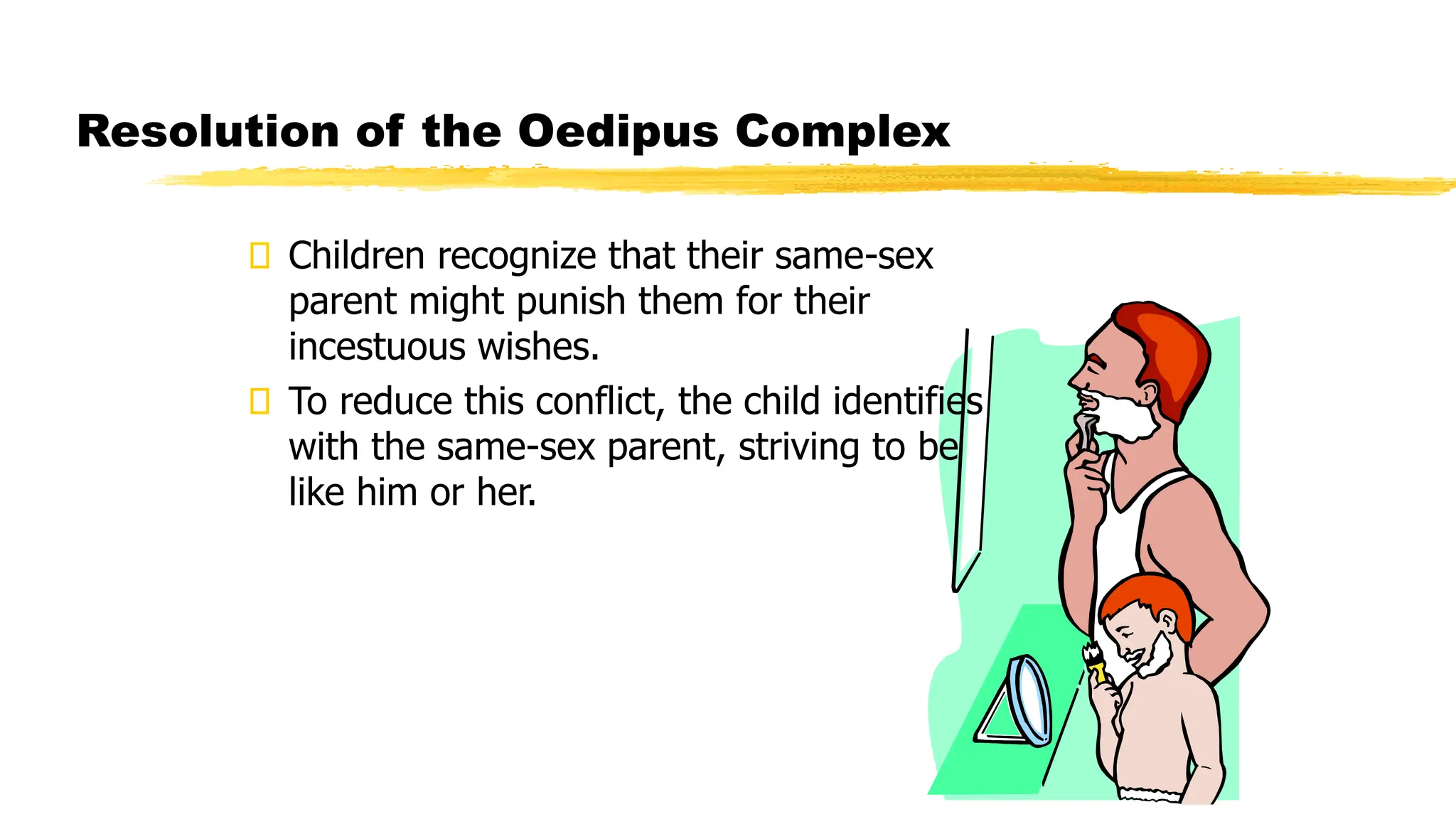
Children recognize that their same-sex
parent might punish them for their
incestuous wishes.
To reduce this conflict, the child identifies
with the same-sex parent, striving to be
like him or her.
Resolution of the Oedipus Complex
Electra Complex
Feelings go round and round for awhile until the point when the girls
renounce their feelings for their fathers
Identify with their mothers.
focus changes, for girls, from the mother to the father, when the girls
realize that they don't have penises, so they develop penis envy.
coupled with the knowledge that her mother doesn't have a penis leads
to her thinking her mother unworthy, and becoming attracted to her
father, as he does have a penis.
FIXATION
If a man finds himself fixated because he fails to join
forces with dad, he’s been successfully emasculated.
He becomes a failure at life, unable to strive for
achievement because of his disabling guilt generated
from competing with his father for his mother’s attention.
With successful resolution of the Electra
complex, a girl finds herself equipped to
deal with her adult sexual and intimate
relationships. She turns her penis envy
into a healthy search for a “fatherly”
husband.
But if she fails, she becomes fixated and
may be overly seductive and
flirtatious.
FIXATION
Latency Stage (5th to Puberty)
Sexual Desires pushed into background.
The child represses all interest in sexuality.
The child develops social and intellectual skills.
Energy is channeled into emotionally safe
areas.
The child forgets the highly stressful conflicts
of the phallic stage.
Latency Stage (5th to Puberty)
This is a time of sexual reawakening.
The source of sexual pleasure comes from
someone outside the family.
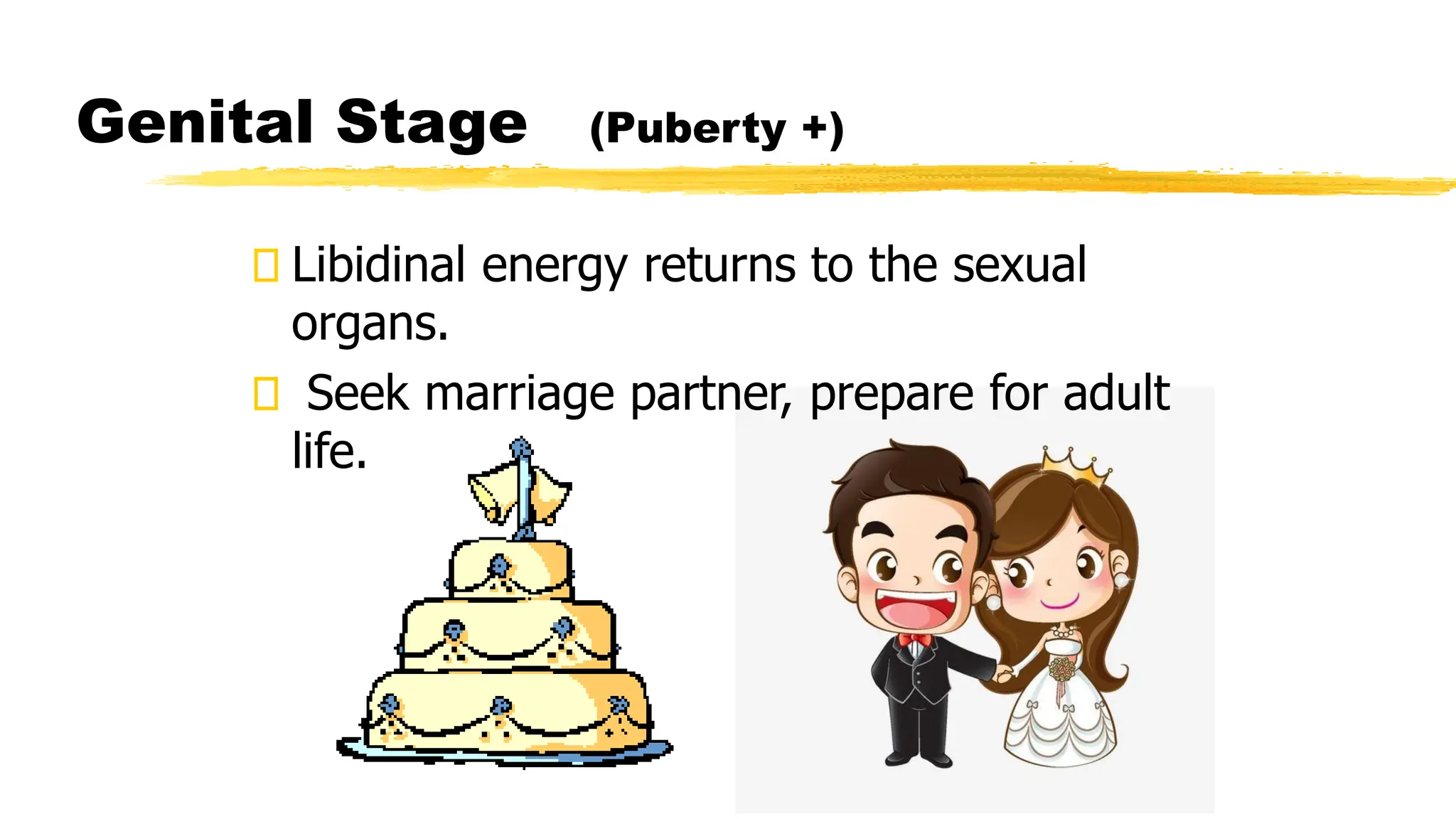
Genital Stage (Puberty +)
Libidinal energy returns to the sexual
organs.
Seek marriage partner, prepare for adult
life.
Fixation
Due to a parent smothering a child with too much
attention, as an adult the individual has difficulty in
romantic relationships due to being extremely
“needy.”
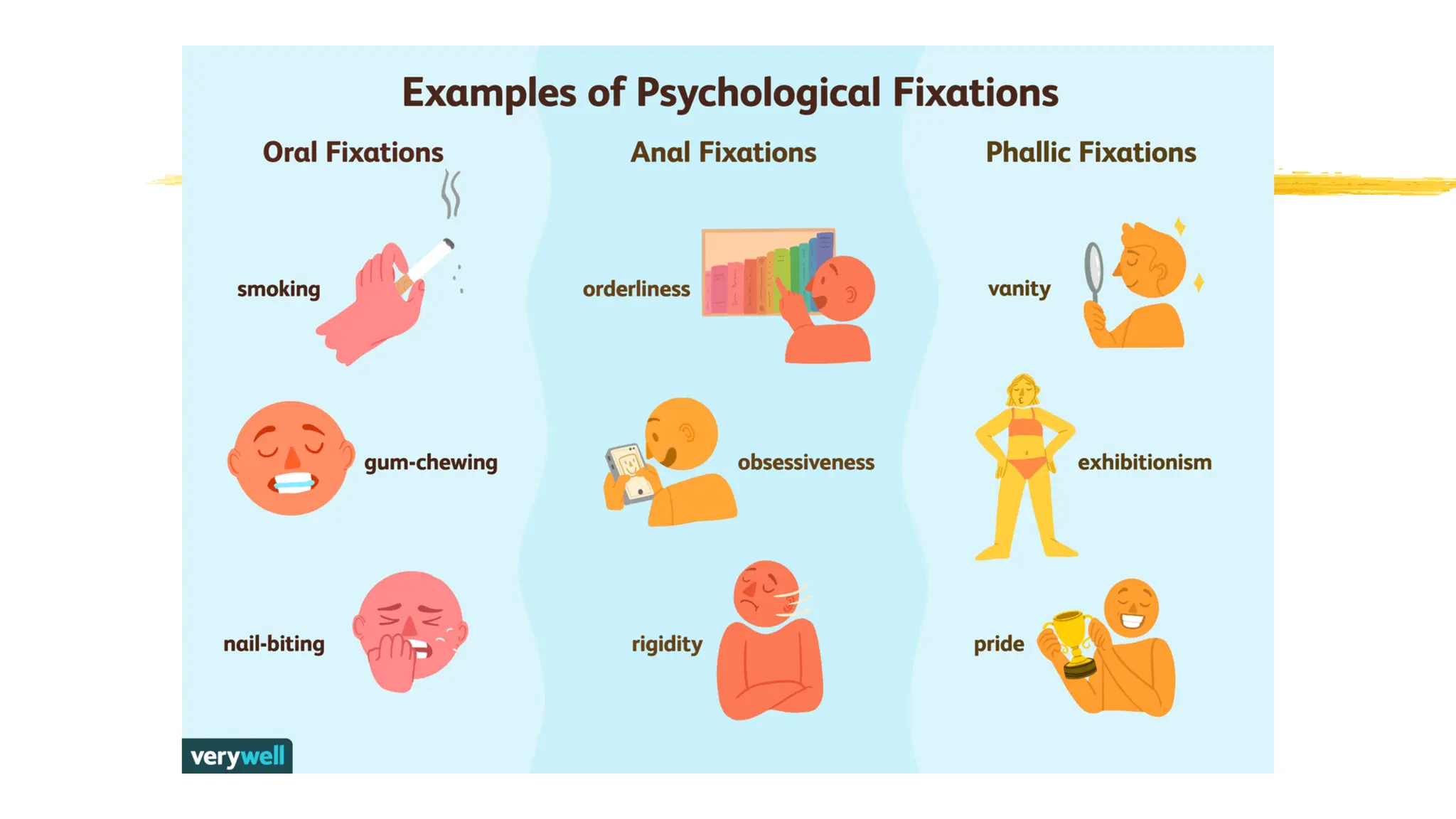
Oral - Due to a parent weaning too early, as an adult
the individual seeks out oral gratification through
smoking, drinking, gum chewing.
Anal - Due to a parent being too strict with potty
training, as an adult the individual is excessively neat
and orderly (known as “Anal Retentive”).
Phallic - Due to a parent punishing the child for
masturbating, as an adult the individual seeks out
pornography.
Genital - Due to a parent smothering a child with too
much attention, as an adult the individual has difficulty
in romantic relationships due to being extremely
“needy.”
FIXATION
THANK YOU

GROWTH-AND-DEVELOPMENT-1.pdf

  • 1.
  • 2.
    LEARNING OBJECTIVES: • Defineterms related to growth and development • Discuss the principles of growth and development • Describe the various factors, including genetics, that affect growth and development • Discuss the following theorist: Piaget, Freud, Erikson and Kohlberg.
  • 20.
  • 21.
  • 22.
    ALL HUMANS FOLLOWTHE SAME PATTERN OF GROWTH AND DEVELOPMENT
  • 27.
    DEVELOPMENT PROCEEDS FROM SIMPLETO COMPLEX -Children use their cognitive and language skills to reason and solve problems -Children at first are able hold the big things by using both arms; in the next part able to hold things in a single hand, then only able to pick small objects like peas, cereals etc. -Children when able to hold pencil, first starts draw circles then squares then only letters after that words
  • 28.
    EARLY DEVELOPMENT ISMORE CRITICAL THAN LATER DEVELOPMENT The first 10-12 weeks after conception are critical.The incidence of congenital anomalies as a result of exposure to certain viruses, chemicals, or drugs is greater during this stage than others
  • 29.
    DEVELOPMENT IS APRODUCT OF MATURATION AND LEARNING
  • 31.
  • 32.
  • 33.
    THE CHILD DEVELOPSAS A UNIFIED WHOLE
  • 34.
  • 35.
  • 39.
    EACH DEVELOPMENTAL STAGE HASCERTAIN CHARACTERISTIC TRAIT
  • 40.
    THERE ARE PERIODSOF ACCELERATED GROWTH AND DECELERATED GROWTH Growth is greater during infancy than during childhood. Asynchronous development is demonstrated by rapid growth of the head during infancy and the extremities at puberty
  • 41.
    DEVELOPMENT IS INFLUENCED BYHEREDITY AND ENVIRONMENT
  • 42.
    DEVELOPMENT PROCEEDS AT DIFFERENTRATES FOR DIFFERENT BEHAVIOR Rate and amount of growth is not same for all. This is caused by both heredity and environment. There is no two individual whose development rate is name. There is no validity in comparing one child’s progress with or against another child. Each child grows in his own personal manner. He/she should be permitted to grow at his/her own rate. If we expect too much, he/she may do even less than he/she is able to do.
  • 44.
  • 50.
    PROMOTING DEVELOPMENT THROUGH PLAY •Know developmental level and expectations • Position appropriate for development • Use appropriate, unbroken toys or games • Speak at developmental level – remember receptive speech outpaces expressive in early years • Social interaction as developmentally appropriate
  • 51.
    TYPES OF GROWTHAND DEVELOPMENT Types of growth: - Physical growth (Ht,Wt, head & chest circumference) - Physiological growth (vital signs …) Types of development: - Motor development - Cognitive development - Emotional development - Social development
  • 52.
    STAGES OF GROWTHAND DEVELOPMENT • Prenatal - Embryonic (conception- 8 w) - Fetal stage (8-40 or 42 w) • Infancy - Neonate - Birth to end of 1 month - Infancy - 1 month to end of 1 year • Early Childhood - Toddler - 1-3 years - Preschool - 3-6 years • Middle Childhood - School age - 6 to 12 years • Late Childhood - Adolescent - 13 years to approximately 18 years
  • 53.
    DEVELOPMENTAL THEORISTS Stage Erikson PiagetFreud Infant Trust vs. Mistrust Sensorimotor Stage Oral Stage Toddler Autonomy vs. Shame & Doubt End: Sensorimotor Begin: Preoperational Anal Stage Preschool Initiative vs. Guilt Preoperational Stage Phallic Stage School Aged Industry vs. Inferiority Concrete Operational Stage Latency Stage Adolescent Identity vs. Role Confusion Formal Operational Stage Genital Stage
  • 54.
    DEVELOPMENTAL THEORISTS • Kohlberg-Moral Development • Stages of moral development with approximate ages- some may never reach final stage(s) Stage Age Preconventional 4-7 years Conventional 7-12 years Postconventional >12 years
  • 55.
  • 56.
    • Psychosocial –psychological (or the root, “psycho” relating to the mind, brain, personality, etc.) & social (external relationships and environment) • Erikson’s theory was greatly influenced by Sigmund Freud PSYCHOSOCIAL DEVELOPMENT
  • 57.
    • One ofthe main elements of Erikson's psychosocial stage theory is the development of ego identity. Ego identity is the conscious sense of self that we develop through social interaction. According to Erikson, our ego identity is constantly changing due to new experiences and information we acquire in our daily interactions with others. • Shows impact of social experiences across ones whole lifespan. •There are eight stages over a lifespan showing the development.
  • 58.
    MALADAPTATION- develop fromtending towards the extreme of the first ('positive') disposition in each crisis MALIGNANCY- develop from tending towards the extreme of the second ('negative') disposition in each crisis. VIRTUES- are characteristic strengths which the ego can use to resolve subsequent crises. DEFINITION OF TERMS:
  • 59.
    PSYCHOSOCIALDEVELOPMENTAL THEORIES Trust vs. mistrust Autonomyvs. shame and doubt Initiative vs. guilt Industry vs.inferiority Identity vs. role confusion Intimacy vs. isolation Generativity vs. stagnation Infancy (0 23 months) Early childhood (2 4 years) Preschool age (4 5 years) School age (5 12years) Adolescence (1319years) Early adulthood (20 39 years) Adulthood (40 64 years) Integrity vs.despair Maturity (65 death) Sharon Talahiban, sharontalahiban@gmail.com | This document is protected by copyright.
  • 60.
    PSYCHOSOCIAL STAGES OF DEVELOPMENT 1STSTAGE Age: infancy (birth to 18 months) Crisis: TRUST vs. MISTRUST Maladaptation: sensory maladjustment Malignancy: withdrawal Virtue: Hope Major Question: "Can I trust the people around me?"
  • 61.
    •GOAL: to developtrust without completely eliminating the capacity for mistrust •Developing trust is the first task of the ego, and it is never complete. •TRUST – Firm belief in reliability, truth, ability, or strength of someone or something. •MISTRUST – State of being suspicious; lack of trust •SENSORY MALADJUSTMENT – Overly trusting •WITHDRAWAL – Characterized by depression, paranoia & psychosis
  • 62.
    HOPE – strongbelief that when things are not going well, they will work out well in the end.
  • 64.
    PSYCHOSOCIAL STAGES OF DEVELOPMENT 2ndSTAGE AGE: early childhood (18MOS- 3YRS) Crisis: AUTONOMY vs. SHAME & DOUBT Maladaptation: Impulsive Malignancy: compulsive Virtue: will or determination Major Question: "Can I do things myself or am I reliant on the help of others?"
  • 65.
    •GOAL: to achieveautonomy while minimizing shame and doubt. •AUTONOMY – Independence •SHAME – A painful feeling of humiliation or distress caused by the consciousness of wrong or foolish behavior. •DOUBT – Feeling of uncertainty or lack of conviction •IMPULSIVENESS – Sort of shameless willfulness that leads you in later childhood and even adulthood, to jump into things without proper consideration of your abilities.
  • 66.
    •COMPULSIVENESS – Aperson feels as if their entire being rides on everything they do, and so everything, must be done perfectly • WILL POWER – Controlling deliberately exerted to do something or to restrain one’s own impulses.
  • 68.
    PSYCHOSOCIAL STAGES OFDEVELOPMENT 3rd STAGE AGE: pre- school (3-5yrs) Crisis: INITIATIVE vs. GUILT Maladaptation: Ruthlessness Malignancy: Inhibition Virtue: Purpose Major Question: Am I good or bad?”
  • 69.
    •GOAL: to learninitiative without too much guilt. •INITIATIVE – a positive response to the world’s challenges, taking on responsibilities, learning new skills, feeling purposeful. • GUILT – the attempt to make that non-reality a reality. •RUTHLESNESS – to be heartless or unfeeling or be “without mercy.” •INHIBITION – too much guilt.
  • 70.
    • COURAGE –the capacity for action despite a clear understanding of your limitations and past failings
  • 72.
    PSYCHOSOCIAL STAGES OFDEVELOPMENT 4th STAGE AGE: school age (5-12yrs) Crisis: INDUSTRY vs. INFERIORITY Maladaptation: Virtuosity Malignancy: Inertia Virtue: Competence Major Question: “how can I be good?”
  • 73.
    •They must learnthe feeling of success, whether it is in school or on the playground, academic, or social. •INFERIORITY – Competence •Just a touch of inferiority keeps us sensible and humble. •Virtuosity- not allowed to be children and pushed to competence without allowing development of broad interest; kids without a life •Inertia- inferiority complexes
  • 74.
    PSYCHOSOCIAL STAGES OFDEVELOPMENT 5th STAGE AGE: Adolescence (12-18yrs) Crisis: IDENTITY vs. ROLE CONFUSION Maladaptation: Fanaticism Malignancy: Repudation Virtue: Fidelity Major Question: “who am I?”
  • 75.
    •EGO IDENTITY –knowing who you are and how you fit in to the rest of the society. •ROLE CONFUSION→ uncertainty about one’s place in society and the world psychosocial moratorium → “take time out” •FANATICISM- believes his way is the only way •REPUDATION- – state of rejection •FIDELITY- means loyalty, the ability to live by societies standards despite their imperfections and incompleteness and inconsistencies
  • 77.
    PSYCHOSOCIAL STAGES OFDEVELOPMENT 6th STAGE AGE: young adulthood (18-30yrs) Crisis: INTIMACY vs. ISOLATION Maladaptation: Promiscuity Malignancy: Exclusion Virtue: Love Major Question: “will I be loved?” or “will I be alone”
  • 78.
    •GOAL: to achievesome degree of intimacy, as opposed remaining in isolation •INTIMACY – ability to be close to others, as a lover, a friend, and as a particular participant in society. •“Fear of commitment” – an example of immaturity •PROMISCUITY – The tendency to become intimate too freely, too easy, and without any depth to your intimacy. •EXCLUSION – The tendency to isolate oneself from love, friendship and community, and to develop a certain hatefulness in compensation for one’s loneliness.
  • 79.
    LOVE – Beingable to put aside differences and antagonisms through “mutuality of devotion.”
  • 81.
    PSYCHOSOCIAL STAGES OFDEVELOPMENT 7th STAGE AGE: middle adulthood (mid 20’s- late 50’s) Crisis: GENERATIVITY vs. STAGNATION Maladaptation: Over extension Malignancy: Rejectivity Virtue: Competence Major Question: “how can I contribute to the world”
  • 82.
    •GENERATIVITY – anextension of love into the future. •STAGNATION – self absorption, caring for no one. •The stagnant person STOPS to be a reproductive member of the society. •OVEREXTENSION – Some people try to be generative that they no longer allow time for themselves, for rest and relaxation. •REJECTIVITY – Too little generativity and too much stagnation and you are no longer participating in or contributing to society.
  • 84.
    PSYCHOSOCIAL STAGES OFDEVELOPMENT 8th STAGE AGE: late adulthood (around 60yrs) Crisis: INTEGRITY vs. DESPAIR Maladaptation: Presumption Malignancy: Disdain Virtue: Wisdom Major Question: “did I live a meaningful life?”
  • 85.
    •INTEGRITY – Comingto terms with your life, and thereby coming to terms with the end of life. •DESPAIR – The complete loss or absence of hope. • PRESUMPTION – Happens when a person “presumes” ego integrity without actually facing the difficulties of old age. •DISDAIN – A contempt of life, one’s own, or anyone. •WISDOM – Someone who approaches death without fear.
  • 87.
  • 89.
    Piaget’s Cognitive Developmenttheory ● Piaget’s Cognitive Development Theory of 1936 talks about how children create a mental representation of the world. Piaget argued that intelligence was not a rigid characteristic. Instead he believed that intellectual growth was a result of biological expansion and relation to their environment/surroundings. ● The theory concentrated on comprehending how children gain knowledge and understanding the origin of intelligence ● The idea is to describe the process of how a child learns to reason and think using propositions. ● Piaget’s theory suggested that children go through four different mental development stages...
  • 91.
    Sensorimotor Stage ➔ Birthto 2 years... ● During this stage, children are aware of what is in front of them. Object Permanence- things exist even when not seen. ● Learn through trial and error ● Gain knowledge through sensory experiences, reflexes, motor responses, and by environment interactions.
  • 92.
    Preoperational Stage ➔ Ages2 to 7 ● Children are able to think symbolically; understand that words and pictures can be used to represent an object ● Children at this stage are mostly egocentric and find it difficult to see the viewpoint of others ● Start to develop language, memory, and imagination, can pretend play ● Do not grasp the concept of fairness
  • 93.
    Concrete operational Stage ➔Ages 7 to 11 ● In this stage, a child’s thinking becomes more logical ● Can solve mental operations ● Children become less egocentric ● Understand conservation(quantity remains the same despite the change of appearance)
  • 94.
    Formal Operational ➔Ages 12 to adulthood ● In this stage, the individual develops abstract thinking ● Understand deductive reasoning ● Can form hypotheses ● Develop moral reasoning; can differentiate between good and bad. ● Piaget believed that psychological evolution of an individual depended on how much knowledge he/she accumulated
  • 95.
    PSYCHOSEXUAL THEORY D E VE L O P M E N T O F T H E P E R S O N A L I T Y T H R O U G H S TA G E S .
  • 96.
  • 97.
    Freud proposed thatthere were 5 stages of development. Freud believed that few people successfully completed all 5 of the stages. Instead, he felt that most people tied up their libido at one of the stages, which prevented them from using that energy at a later stage. Freud Psycho-Sexual Theory
  • 98.
    Five stages Each stagefocuses on a part of the body for experiencing pleasure. How conflicts between sources of pleasure are resolved determines adult personality. Psychosexual Development
  • 99.
    The Oral Stage(Birth to 18 months) The Anal Stage (18 months to 3 years) The Phallic Stage (3 to 6 years) The Latent Stage (6 years to puberty) The Genital Stage (Puberty on) The Five Stages of Psychosexual Development
  • 101.
    Pleasure centers aroundthe mouth. Chewing, sucking, biting are sources of pleasure. Oral Stage (0 - 1 1/2 years)
  • 102.
    Oral Stage (0- 1 1/2 years) Weaned too early or late will develop personality problems. Dependency or rejection of others Fixation: smoking, eating, chewing, talking.
  • 103.
    Pleasure centers aroundthe anus. Eliminative functions are sources of pleasure. Anal Stage (2 - 3-year-old)
  • 104.
    Anal Stage (2- 3-year-old) Issue is control through Toilet training. Child view = Giving the gift Dirty vs. Lavish Praise Stingy or Overly Generous Rigid rules or Irresponsible & Rebellious Anal Stage (2 - 3-year-old)
  • 105.
    Fixation Leniency leads to:Anal-expulsive personality-- messy, wasteful, or destructive. Strictness leads to: Anal-retentive personality: stringent, orderly, rigid, and obsessive.
  • 106.
    Pleasure focuses onthe genitals. Self-manipulation is a source of pleasure. Oedipus Complex appears. Phallic Stage (3rd to 5th year)
  • 107.
    Phallic Stage (3rdto 5th year) Focus is on the genital areas (Boys vs. Girls) Oedipal Complex: Parents seen as threats. Wide range of psychological disorders through failure to resolve this conflict, (unreasonable anxiety, phobias, & depression)
  • 108.
    The Oedipus Complexis Freud’s term for the young child’s development of an intense desire to replace the same-sex parent and enjoy the affections of the opposite-sex parent. Definition of the Oedipus Complex
  • 109.
    Oedipus Complex the boybegins to have sexual desires for his mother sees his father as a rival for her affections. begins to fear that his father is suspicious of his longing for his mother father will punish him for his desires. The punishment, the boy fears, will be castration, which brings us to the second critical episode for this stage.
  • 110.
    Castration anxiety. fear ofcastration make the boy anxious leads to the boy thinking that the father hates him eventually becomes unbearable boy renounces his sexual feelings for his mother and chooses instead to identify with his father hopes to someday have a relationship with a woman (though not his mother) just like dear old dad has with his mother.
  • 111.
    Children recognize thattheir same-sex parent might punish them for their incestuous wishes. To reduce this conflict, the child identifies with the same-sex parent, striving to be like him or her. Resolution of the Oedipus Complex
  • 112.
    Electra Complex Feelings goround and round for awhile until the point when the girls renounce their feelings for their fathers Identify with their mothers. focus changes, for girls, from the mother to the father, when the girls realize that they don't have penises, so they develop penis envy. coupled with the knowledge that her mother doesn't have a penis leads to her thinking her mother unworthy, and becoming attracted to her father, as he does have a penis.
  • 113.
    FIXATION If a manfinds himself fixated because he fails to join forces with dad, he’s been successfully emasculated. He becomes a failure at life, unable to strive for achievement because of his disabling guilt generated from competing with his father for his mother’s attention.
  • 114.
    With successful resolutionof the Electra complex, a girl finds herself equipped to deal with her adult sexual and intimate relationships. She turns her penis envy into a healthy search for a “fatherly” husband. But if she fails, she becomes fixated and may be overly seductive and flirtatious. FIXATION
  • 115.
    Latency Stage (5thto Puberty) Sexual Desires pushed into background.
  • 116.
    The child repressesall interest in sexuality. The child develops social and intellectual skills. Energy is channeled into emotionally safe areas. The child forgets the highly stressful conflicts of the phallic stage. Latency Stage (5th to Puberty)
  • 117.
    This is atime of sexual reawakening. The source of sexual pleasure comes from someone outside the family. Genital Stage (Puberty +)
  • 118.
    Genital Stage (Puberty+) Libidinal energy returns to the sexual organs. Seek marriage partner, prepare for adult life.
  • 119.
    Fixation Due to aparent smothering a child with too much attention, as an adult the individual has difficulty in romantic relationships due to being extremely “needy.”
  • 121.
    Oral - Dueto a parent weaning too early, as an adult the individual seeks out oral gratification through smoking, drinking, gum chewing. Anal - Due to a parent being too strict with potty training, as an adult the individual is excessively neat and orderly (known as “Anal Retentive”). Phallic - Due to a parent punishing the child for masturbating, as an adult the individual seeks out pornography. Genital - Due to a parent smothering a child with too much attention, as an adult the individual has difficulty in romantic relationships due to being extremely “needy.” FIXATION
  • 122.