PhD. Đặng Văn Hân
Office: 112B2 or 804H3 Building
Email: dvhan@hcmut.edu.vn
Chapter 1
Atomic Structure
Faculty of Chemical Engineering
Department of Inorganic Technology
General Chemistry
2
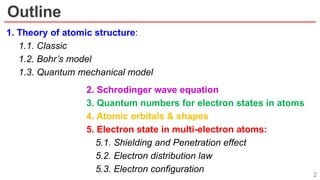
Outline
2. Schrodinger wave equation
3. Quantum numbers for electron states in atoms
4. Atomic orbitals & shapes
5. Electron state in multi-electron atoms:
5.1. Shielding and Penetration effect
5.2. Electron distribution law
5.3. Electron configuration
1. Theory of atomic structure:
1.1. Classic
1.2. Bohr’s model
1.3. Quantum mechanical model
3
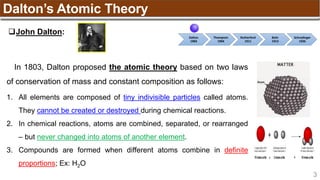
John Dalton:
In 1803, Dalton proposed the atomic theory based on two laws
of conservation of mass and constant composition as follows:
1. All elements are composed of tiny indivisible particles called atoms.
They cannot be created or destroyed during chemical reactions.
2. In chemical reactions, atoms are combined, separated, or rearranged
– but never changed into atoms of another element.
3. Compounds are formed when different atoms combine in definite
proportions; Ex: H2O
Dalton
1983
Thompson
1904
Rutherford
1911
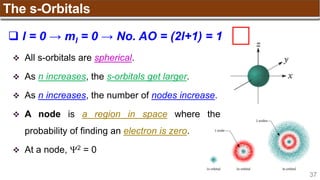
Bohr
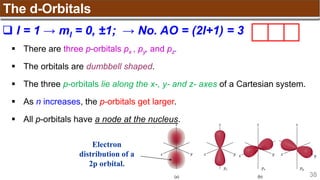
1913
Schrodinger
1926
Dalton’s Atomic Theory
4
Discovery of Electron
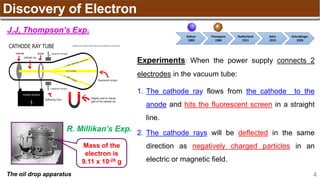
J.J, Thompson’s Exp.
Experiments: When the power supply connects 2
electrodes in the vacuum tube:
1. The cathode ray flows from the cathode to the
anode and hits the fluorescent screen in a straight
line.
2. The cathode rays will be deflected in the same
direction as negatively charged particles in an
electric or magnetic field.
Dalton
1983
Thompson
1904
Rutherford
1911
Bohr
1913
Schrodinger
1926
The oil drop apparatus
Mass of the
electron is
9.11 x 10⁻²⁸ g
R. Millikan’s Exp.
5
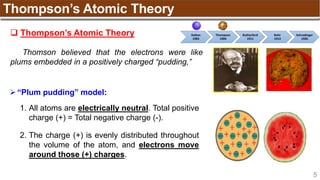
Thompson’s Atomic Theory
“Plum pudding” model:
1. All atoms are electrically neutral. Total positive
charge (+) = Total negative charge (-).
2. The charge (+) is evenly distributed throughout
the volume of the atom, and electrons move
around those (+) charges.
Dalton
1983
Thompson
1904
Rutherford
1911
Bohr
1913
Schrodinger
1926
 Thompson’s Atomic Theory
Thomson believed that the electrons were like
plums embedded in a positively charged “pudding,”
6
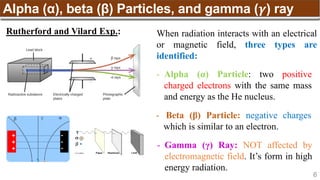
Alpha (α), beta (β) Particles, and gamma (𝜸) ray
- Alpha (α) Particle: two positive
charged electrons with the same mass
and energy as the He nucleus.
- Beta (β) Particle: negative charges
which is similar to an electron.
- Gamma (γ) Ray: NOT affected by
electromagnetic field. It’s form in high
energy radiation.
When radiation interacts with an electrical
or magnetic field, three types are
identified:
Rutherford and Vilard Exp.:
7
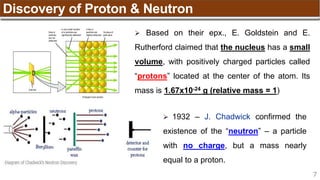
Discovery of Proton & Neutron
 Based on their epx., E. Goldstein and E.
Rutherford claimed that the nucleus has a small
volume, with positively charged particles called
“protons” located at the center of the atom. Its
mass is 1.67x10⁻²⁴ g (relative mass = 1)
 1932 – J. Chadwick confirmed the
existence of the “neutron” – a particle
with no charge, but a mass nearly
equal to a proton.
8
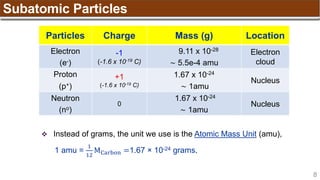
Subatomic Particles
Particles Charge Mass (g) Location
Electron
(e-)
-1
(-1.6 x 10⁻¹⁹ C)
9.11 x 10⁻²⁸
~ 5.5e-4 amu
Electron
cloud
Proton
(p+)
+1
(-1.6 x 10⁻¹⁹ C)
1.67 x 10⁻²⁴
~ 1amu
Nucleus
Neutron
(no)
0
1.67 x 10⁻²⁴
~ 1amu
Nucleus
 Instead of grams, the unit we use is the Atomic Mass Unit (amu),
1 amu =
1
12
MCarbon =1.67 × 10⁻²⁴ grams.
9
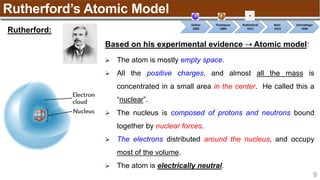
Rutherford’s Atomic Model
Dalton
1803
Thompson
1904
Rutherford
1911
Bohr
1913
Schrodinger
1926
Based on his experimental evidence ⇢ Atomic model:
 The atom is mostly empty space.
 All the positive charges, and almost all the mass is
concentrated in a small area in the center. He called this a
“nuclear”.
 The nucleus is composed of protons and neutrons bound
together by nuclear forces.
 The electrons distributed around the nucleus, and occupy
most of the volume.
 The atom is electrically neutral.
Rutherford:
1
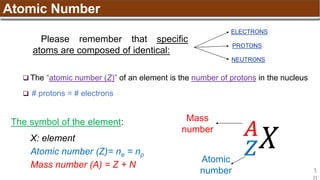
Atomic Number
𝑍
𝐴
𝑋
X: element
Atomic number (Z)= ne = np
Mass number (A) = Z + N
Please remember that specific
atoms are composed of identical:
PROTONS
NEUTRONS
ELECTRONS
 The “atomic number (Z)” of an element is the number of protons in the nucleus
 # protons = # electrons
The symbol of the element: Mass
number
Atomic
number
11
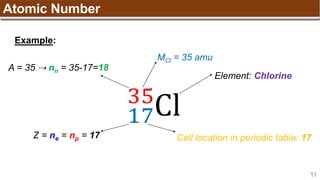
Atomic Number
Example:
17
35
Cl
Z = ne = np = 17
A = 35 ⇢ nn = 35-17=18
Cell location in periodic table: 17
Element: Chlorine
MCl = 35 amu
12
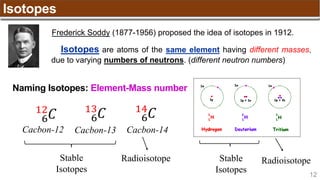
Isotopes
Isotopes are atoms of the same element having different masses,
due to varying numbers of neutrons. (different neutron numbers)
Frederick Soddy (1877-1956) proposed the idea of isotopes in 1912.
Naming Isotopes: Element-Mass number
Stable
Isotopes
Radioisotope
Cacbon-12 Cacbon-13 Cacbon-14
6
12
𝐶 6
13
𝐶 6
14
𝐶
Stable
Isotopes
Radioisotope
13
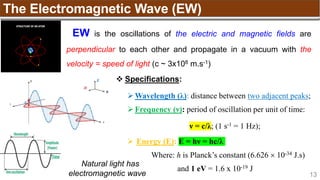
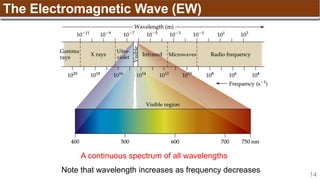
The Electromagnetic Wave (EW)
EW is the oscillations of the electric and magnetic fields are
perpendicular to each other and propagate in a vacuum with the
velocity = speed of light (c ~ 3x10⁸ m.s-1)
Natural light has
electromagnetic wave
 Specifications:
Wavelength (λ): distance between two adjacent peaks;
Frequency (ν): period of oscillation per unit of time:
ν = c/λ; (1 s-1 = 1 Hz);
 Energy (E): E = hν = hc/λ
Where: h is Planck’s constant (6.626  10-34 J.s)
and 1 eV = 1.6 x 10⁻¹⁹ J
14
The Electromagnetic Wave (EW)
A continuous spectrum of all wavelengths
Note that wavelength increases as frequency decreases
15
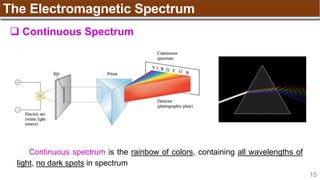
The Electromagnetic Spectrum
 Continuous Spectrum
Continuous spectrum is the rainbow of colors, containing all wavelengths of
light, no dark spots in spectrum
16
The Electromagnetic Spectrum
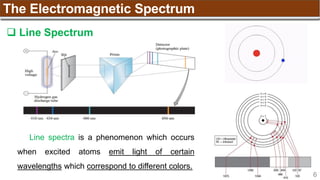
 Line Spectrum
Line spectra is a phenomenon which occurs
when excited atoms emit light of certain
wavelengths which correspond to different colors.
17
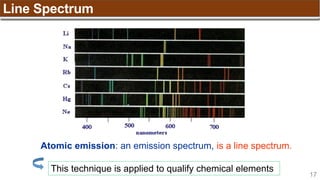
Line Spectrum
Atomic emission: an emission spectrum, is a line spectrum.
This technique is applied to qualify chemical elements
18
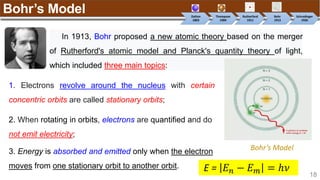
Bohr’s Model
Bohr’s Model
In 1913, Bohr proposed a new atomic theory based on the merger
of Rutherford's atomic model and Planck's quantity theory of light,
which included three main topics:
1. Electrons revolve around the nucleus with certain
concentric orbits are called stationary orbits;
2. When rotating in orbits, electrons are quantified and do
not emit electricity;
3. Energy is absorbed and emitted only when the electron
moves from one stationary orbit to another orbit. E = 𝐸𝑛 − 𝐸𝑚 = ℎ𝜈
Dalton
1803
Thompson
1904
Rutherford
1911
Bohr
1913
Schrodinger
1926
19
Limitations of Bohr’s Model
1. Cannot explain why electrons can only locate positions when moving in
orbits
2. Can only explain the line spectrum of hydrogen or one-electron ions
(He+, Li2+) adequately.
4. It’s not suitable to calculate electron energy for multi-electron atoms.
3. Cannot determine clearly the line-spectrum intensity of specific
elements.
S
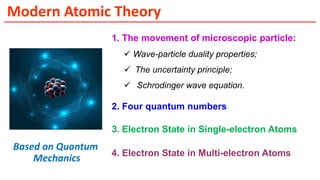
Modern Atomic Theory
Based on Quantum
Mechanics
1. The movement of microscopic particle:
 Wave-particle duality properties;
 The uncertainty principle;
 Schrodinger wave equation.
4. Electron State in Multi-electron Atoms
3. Electron State in Single-electron Atoms
2. Four quantum numbers
21
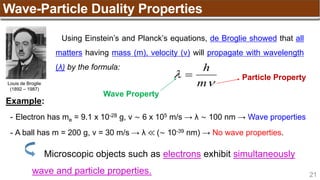
Wave-Particle Duality Properties
Louis de Broglie
(1892 – 1987)
Example:
- Electron has me = 9.1 x 10⁻²⁸ g, v ~ 6 x 10⁵ m/s → λ ~ 100 nm → Wave properties
- A ball has m = 200 g, v = 30 m/s → λ ≪ (~ 10-39 nm) → No wave properties.
Using Einstein’s and Planck’s equations, de Broglie showed that all
matters having mass (m), velocity (v) will propagate with wavelength
(λ) by the formula:


m
h
 Particle Property
Wave Property
Microscopic objects such as electrons exhibit simultaneously
wave and particle properties.
22
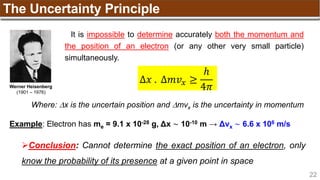
The Uncertainty Principle
Werner Heisenberg
(1901 – 1976)
Δ𝑥 . Δ𝑚𝑣𝑥 ≥
ℎ
4𝜋
Example: Electron has me = 9.1 x 10⁻²⁸ g, Δx ~ 10-10 m → Δvx ~ 6.6 x 10⁶ m/s
Conclusion: Cannot determine the exact position of an electron, only
know the probability of its presence at a given point in space
It is impossible to determine accurately both the momentum and
the position of an electron (or any other very small particle)
simultaneously.
Where: x is the uncertain position and mvx is the uncertainty in momentum
23
Quantum Mechanics
Electrons in atom are clouds surrounding their nucleus and has
wave-particle properties.
So, why can we use Schrodinger Equation to describe atomic
structure?
1. Schrödinger Eq. contains both wave and particle terms.
2. Solving his equation leads to wave functions:
 The wave function gives the shape of the electronic orbital.
 The square of the wave function (2) gives the probability of finding the
electron. That is, gives the electron density for the atom.
24
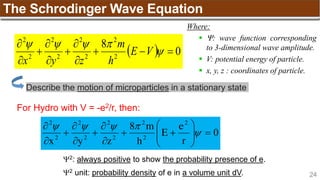
The Schrodinger Wave Equation
  0
8
2
2
2
2
2
2
2
2
















V
E
h
m
z
y
x
Where:
 : wave function corresponding
to 3-dimensional wave amplitude.
 V: potential energy of particle.
 x, y, z : coordinates of particle.
Describe the motion of microparticles in a stationary state
0
8 2
2
2
2
2
2
2
2
2
























r
e
E
h
m
z
y
x
For Hydro with V = -e2/r, then:
2: always positive to show the probability presence of e.
2 unit: probability density of e in a volume unit dV.
25
The Schrodinger Wave Equation
)
,
(
).
(
)
,
,
( ,
,
,
, 



 
 

 m
n
m
n Y
r
R
r 
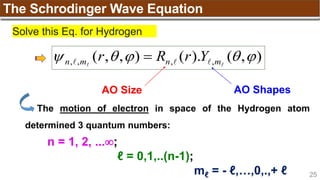
Solve this Eq. for Hydrogen
AO Shapes
AO Size
The motion of electron in space of the Hydrogen atom
determined 3 quantum numbers:
n = 1, 2, ...;
ℓ = 0,1,..(n-1);
mℓ = - ℓ,…,0,.,+ ℓ
26
The Atomic Orbital (AO)
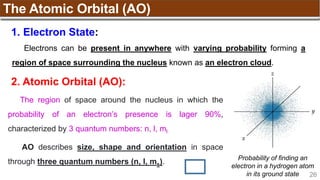
1. Electron State:
Electrons can be present in anywhere with varying probability forming a
region of space surrounding the nucleus known as an electron cloud.
Probability of finding an
electron in a hydrogen atom
in its ground state
2. Atomic Orbital (AO):
The region of space around the nucleus in which the
probability of an electron’s presence is lager 90%,
characterized by 3 quantum numbers: n, l, ml
AO describes size, shape and orientation in space
through three quantum numbers (n, l, ms).
27
The Atomic Orbital (AO)
Choose the correct statement(s). An atomic orbital (AO) is:
1) The region in which there is maximum probability (> 90%) of finding an electron.
2) The surface with equal electron density cloud.
3) The orbital motion of electrons in an atom.
4) The energy state of an electron in an atom.
5) An AO is a wave function that describes the state of an electron in an atom defined by 4
quantum numbers: n, ℓ, mℓ, ms.
A. 1 and 5 B. only 1 C. 1, 2 and 3 D. 1, 2, 3, 4 and 5.
Review:
28
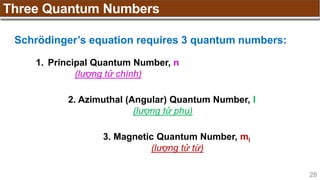
Three Quantum Numbers
1. Principal Quantum Number, n
(lượng tử chính)
2. Azimuthal (Angular) Quantum Number, l
(lượng tử phụ)
3. Magnetic Quantum Number, ml
(lượng tử từ)
Schrödinger’s equation requires 3 quantum numbers:
29
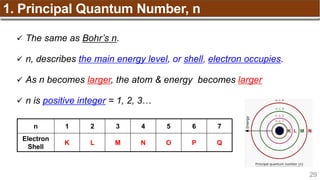
1. Principal Quantum Number, n
 The same as Bohr’s n.
 n, describes the main energy level, or shell, electron occupies.
 As n becomes larger, the atom & energy becomes larger
 n is positive integer = 1, 2, 3…
n 1 2 3 4 5 6 7
Electron
Shell
K L M N O P Q
30
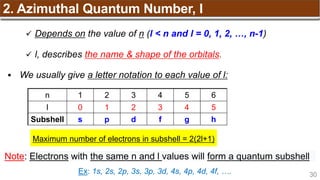
2. Azimuthal Quantum Number, l
n 1 2 3 4 5 6
l 0 1 2 3 4 5
Subshell s p d f g h
Note: Electrons with the same n and l values ​​will form a quantum subshell
Ex: 1s, 2s, 2p, 3s, 3p, 3d, 4s, 4p, 4d, 4f, ….
Maximum number of electrons in subshell = 2(2l+1)
 Depends on the value of n (l < n and l = 0, 1, 2, …, n-1)
 l, describes the name & shape of the orbitals.
 We usually give a letter notation to each value of l:
31
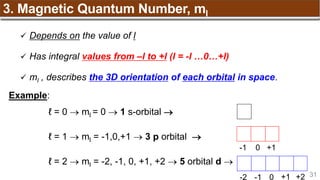
3. Magnetic Quantum Number, ml
 Depends on the value of l
 Has integral values from –l to +l (l = -l …0…+l)
 ml , describes the 3D orientation of each orbital in space.
Example:
ℓ = 0  ml = 0  1 s-orbital 
ℓ = 1  ml = -1,0,+1  3 p orbital 
ℓ = 2  ml = -2, -1, 0, +1, +2  5 orbital d 
-1 0 +1
-2 -1 0 +1 +2
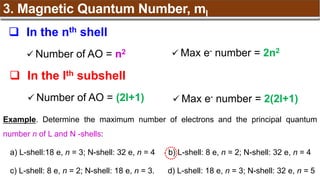
3. Magnetic Quantum Number, ml
 In the nth shell
 Number of AO = n2  Max e- number = 2n2
 In the lth subshell
 Number of AO = (2l+1)  Max e- number = 2(2l+1)
Example. Determine the maximum number of electrons and the principal quantum
number n of L and N -shells:
a) L-shell:18 e, n = 3; N-shell: 32 e, n = 4 b) L-shell: 8 e, n = 2; N-shell: 32 e, n = 4
c) L-shell: 8 e, n = 2; N-shell: 18 e, n = 3. d) L-shell: 18 e, n = 3; N-shell: 32 e, n = 5
33
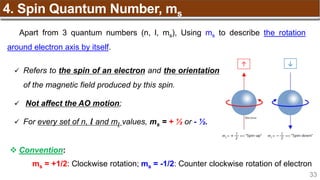
4. Spin Quantum Number, ms
Apart from 3 quantum numbers (n, l, ms), Using ms to describe the rotation
around electron axis by itself.
 Convention:
ms = +1/2: Clockwise rotation; ms = -1/2: Counter clockwise rotation of electron
↑ ↓
 Refers to the spin of an electron and the orientation
of the magnetic field produced by this spin.
 Not affect the AO motion;
 For every set of n, l and ml values, ms = + ½ or - ½.
34
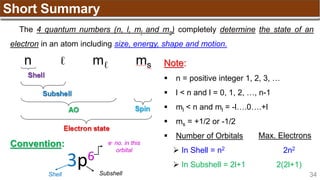
Short Summary
The 4 quantum numbers (n, l, ml and ms) completely determine the state of an
electron in an atom including size, energy, shape and motion.
3p6
e- no. in this
orbital
Subshell
Shell
Convention:
Note:
 n = positive integer 1, 2, 3, …
 l < n and l = 0, 1, 2, …, n-1
 ml < n and ml = -l….0….+l
 ms = +1/2 or -1/2
 Number of Orbitals
 In Shell = n2 2n2
 In Subshell = 2l+1 2(2l+1)
Max. Electrons
35
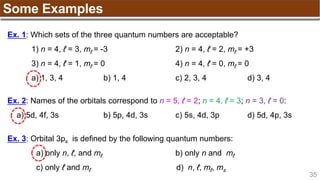
Some Examples
Ex. 1: Which sets of the three quantum numbers are acceptable?
1) n = 4, ℓ = 3, mℓ = -3 2) n = 4, ℓ = 2, mℓ = +3
3) n = 4, ℓ = 1, mℓ = 0 4) n = 4, ℓ = 0, mℓ = 0
a) 1, 3, 4 b) 1, 4 c) 2, 3, 4 d) 3, 4
Ex. 2: Names of the orbitals correspond to n = 5, ℓ = 2; n = 4, ℓ = 3; n = 3, ℓ = 0:
a) 5d, 4f, 3s b) 5p, 4d, 3s c) 5s, 4d, 3p d) 5d, 4p, 3s
Ex. 3: Orbital 3px is defined by the following quantum numbers:
a) only n, ℓ, and mℓ b) only n and mℓ
c) only ℓ and mℓ d) n, ℓ, mℓ, ms
36
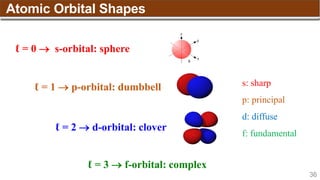
Atomic Orbital Shapes
ℓ = 0  s-orbital: sphere
ℓ = 3  f-orbital: complex
s: sharp
p: principal
d: diffuse
f: fundamental
ℓ = 1  p-orbital: dumbbell
ℓ = 2  d-orbital: clover
37
The s-Orbitals
 All s-orbitals are spherical.
 As n increases, the s-orbitals get larger.
 As n increases, the number of nodes increase.
 A node is a region in space where the
probability of finding an electron is zero.
 At a node, 2 = 0
 l = 0 → ml = 0 → No. AO = (2l+1) = 1
38
The d-Orbitals
 l = 1 → ml = 0, ±1; → No. AO = (2l+1) = 3
 There are three p-orbitals px , py, and pz.
 The orbitals are dumbbell shaped.
 The three p-orbitals lie along the x-, y- and z- axes of a Cartesian system.
 As n increases, the p-orbitals get larger.
 All p-orbitals have a node at the nucleus.
Electron
distribution of a
2p orbital.
39
The d-Orbitals
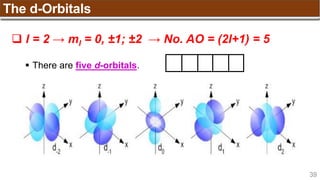
 There are five d-orbitals.
 l = 2 → ml = 0, ±1; ±2 → No. AO = (2l+1) = 5
40
The d-Orbitals
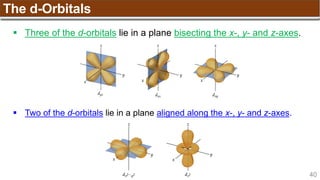
 Two of the d-orbitals lie in a plane aligned along the x-, y- and z-axes.
 Three of the d-orbitals lie in a plane bisecting the x-, y- and z-axes.
The f-Orbitals
41
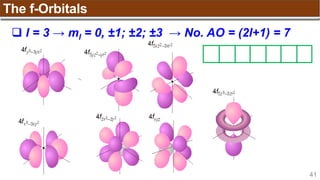
 l = 3 → ml = 0, ±1; ±2; ±3 → No. AO = (2l+1) = 7
42
Electron State in Multi-electron Atoms
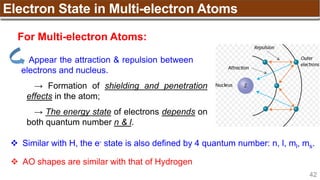
For Multi-electron Atoms:
Appear the attraction & repulsion between
electrons and nucleus.
→ Formation of shielding and penetration
effects in the atom;
→ The energy state of electrons depends on
both quantum number n & l.
 Similar with H, the e- state is also defined by 4 quantum number: n, l, ml, ms.
 AO shapes are similar with that of Hydrogen
43
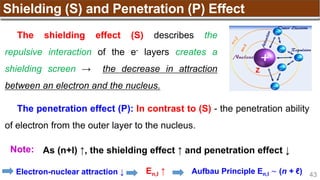
Shielding (S) and Penetration (P) Effect
The shielding effect (S) describes the
repulsive interaction of the e- layers creates a
shielding screen → the decrease in attraction
between an electron and the nucleus.
Z
The penetration effect (P): In contrast to (S) - the penetration ability
of electron from the outer layer to the nucleus.
As (n+l) ↑, the shielding effect ↑ and penetration effect ↓
Note:
Electron-nuclear attraction ↓ En,l ↑ Aufbau Principle En,l ~ (n + ℓ)
44
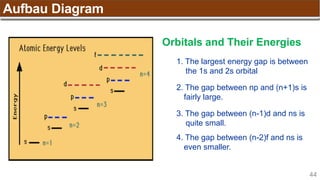
Aufbau Diagram
Orbitals and Their Energies
1. The largest energy gap is between
the 1s and 2s orbital
2. The gap between np and (n+1)s is
fairly large.
3. The gap between (n-1)d and ns is
quite small.
4. The gap between (n-2)f and ns is
even smaller.
45
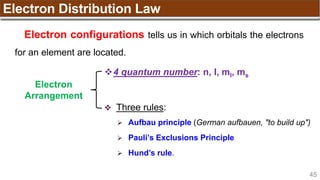
Electron Distribution Law
 Three rules:
 Aufbau principle (German aufbauen, "to build up")
 Pauli’s Exclusions Principle
 Hund’s rule.
Electron configurations tells us in which orbitals the electrons
for an element are located.
4 quantum number: n, l, ml, ms
Electron
Arrangement
46
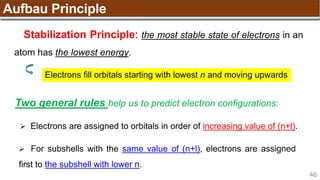
Aufbau Principle
Stabilization Principle: the most stable state of electrons in an
atom has the lowest energy.
Electrons fill orbitals starting with lowest n and moving upwards
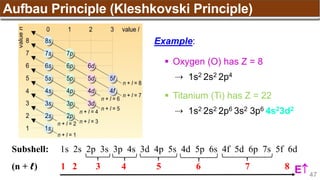
 Electrons are assigned to orbitals in order of increasing value of (n+l).
Two general rules help us to predict electron configurations:
 For subshells with the same value of (n+l), electrons are assigned
first to the subshell with lower n.
47
Aufbau Principle (Kleshkovski Principle)
Subshell: 1s 2s 2p 3s 3p 4s 3d 4p 5s 4d 5p 6s 4f 5d 6p 7s 5f 6d
(n + ℓ) 1 2 3 4 5 6 7 8 E
Example:
 Oxygen (O) has Z = 8
⇢ 1s2 2s2 2p4
 Titanium (Ti) has Z = 22
⇢ 1s2 2s2 2p6 3s2 3p6 4s23d2
48
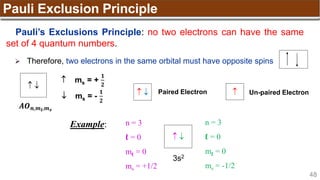
Pauli Exclusion Principle
Pauli’s Exclusions Principle: no two electrons can have the same
set of 4 quantum numbers.
  Paired Electron  Un-paired Electron
 
 Therefore, two electrons in the same orbital must have opposite spins
3s2
 
Example: n = 3
ℓ = 0
mℓ = 0
ms = +1/2
n = 3
ℓ = 0
mℓ = 0
ms = -1/2
49
Hund’s Rule
Hund’s Rule: electrons in the same subshell must be
distributed so that the absolute value of the total spin or unpair
electrons is maximized
Electrons fill each orbital singly before any orbital gets a second electron
6
12
C → Z = 6 → 1s22s22p2 → ↑↓
1s2
↑↓
2s2 ↑↓
2p2
↑ ↑
-1 0 +1
-1 0 +1
Example:
[Trong phân lớp, điền spin dương (↑) đủ các obitals sau đó điền spin âm (↓)]
Nitrogen (N) has Z = 7 ➡
1s 2s 2p
50
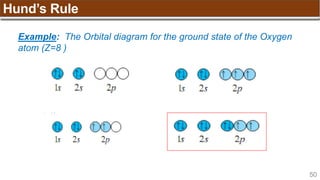
Hund’s Rule
Example: The Orbital diagram for the ground state of the Oxygen
atom (Z=8 )
51
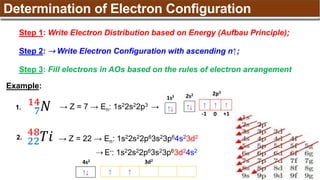
Determination of Electron Configuration
Step 1: Write Electron Distribution based on Energy (Aufbau Principle);
Step 2: ⇢ Write Electron Configuration with ascending n↑;
Step 3: Fill electrons in AOs based on the rules of electron arrangement
→ Z = 7 → En: 1s22s22p3 →
7
14
𝑁
1. ↑↓
1s2
↑↓
2s2
↑ ↑ ↑
-1 0 +1
2p3
Example:
→ Z = 22 → En: 1s22s22p63s23p64s23d2
22
48
𝑇𝑖
2.
↑↓
4s2
↑ ↑
3d2
⇢ E-: 1s22s22p63s23p63d24s2
52
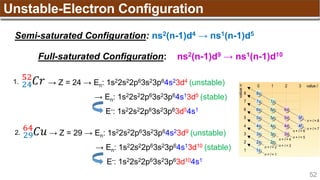
Unstable-Electron Configuration
Semi-saturated Configuration: ns2(n-1)d4 → ns1(n-1)d5
Full-saturated Configuration: ns2(n-1)d9 → ns1(n-1)d10
24
52
𝐶𝑟
1. → Z = 24 → En: 1s22s22p63s23p64s23d4 (unstable)
→ En: 1s22s22p63s23p64s13d5 (stable)
E-: 1s22s22p63s23p63d54s1
29
64
𝐶𝑢
2. → Z = 29 → En: 1s22s22p63s23p64s23d9 (unstable)
→ En: 1s22s22p63s23p64s13d10 (stable)
E-: 1s22s22p63s23p63d104s1
53
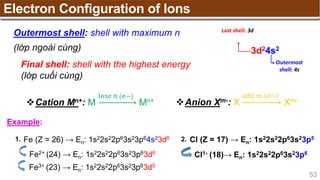
Electron Configuration of Ions
Outermost shell: shell with maximum n
(lớp ngoài cùng) 3d24s2
Outermost
shell: 4s
Last shell: 3d
Final shell: shell with the highest energy
(lớp cuối cùng)
Cation Mn+: M
lose 𝑛 (e−)
Mn+ Anion Xm-: X
add 𝑚 (e−)
Xm-
1. Fe (Z = 26) → En: 1s22s22p63s23p64s23d6
Fe2+ (24) → En: 1s22s22p63s23p63d6
Example:
Fe3+ (23) → En: 1s22s22p63s23p63d5
2.
Cl1- (18)→ En: 1s22s22p63s23p6
Cl (Z = 17) → En: 1s22s22p63s23p5
54
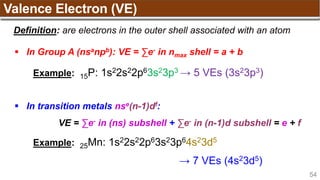
Valence Electron (VE)
Definition: are electrons in the outer shell associated with an atom
 In Group A (nsanpb): VE = ∑e- in nmax shell = a + b
Example: 15P: 1s22s22p63s23p3 → 5 VEs (3s23p3)
 In transition metals nse(n-1)df:
VE = ∑e- in (ns) subshell + ∑e- in (n-1)d subshell = e + f
Example: 25Mn: 1s22s22p63s23p64s23d5
→ 7 VEs (4s23d5)
55
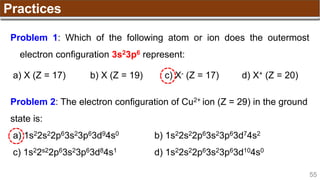
Practices
Problem 1: Which of the following atom or ion does the outermost
electron configuration 3s23p6 represent:
a) X (Z = 17) b) X (Z = 19) c) X- (Z = 17) d) X+ (Z = 20)
Problem 2: The electron configuration of Cu2+ ion (Z = 29) in the ground
state is:
a) 1s22s22p63s23p63d94s0 b) 1s22s22p63s23p63d74s2
c) 1s22s22p63s23p63d84s1 d) 1s22s22p63s23p63d104s0
56
Practices
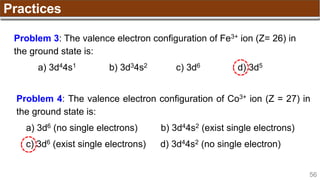
Problem 3: The valence electron configuration of Fe3+ ion (Z= 26) in
the ground state is:
a) 3d44s1 b) 3d34s2 c) 3d6 d) 3d5
Problem 4: The valence electron configuration of Co3+ ion (Z = 27) in
the ground state is:
a) 3d6 (no single electrons) b) 3d44s2 (exist single electrons)
c) 3d6 (exist single electrons) d) 3d44s2 (no single electron)
57
Practices
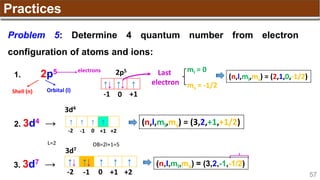
Problem 5: Determine 4 quantum number from electron
configuration of atoms and ions:
1. 2p5
Shell (n) Orbital (l)
electrons
↑↓ ↑↓ ↑
-1 0 +1
2p5 Last
electron
ml = 0
ms = -1/2
(n,l,ml,ms) = (2,1,0,-1/2)
2. 3d4 → ↑ ↑ ↑
-2 -1 0
3d4
↑
+1 +2
↑↓ ↑↓ ↑
-2 -1 0
3d7
↑ ↑
+1 +2
(n,l,ml,ms) = (3,2,-1,-1/2)
(n,l,ml,ms) = (3,2,+1,+1/2)
3. 3d7 →
L=2 OB=2l+1=5

Chapter 1_Atomic Structure_PDF_GENERAL CHEMISTRY

  • 1.
    PhD. Đặng VănHân Office: 112B2 or 804H3 Building Email: dvhan@hcmut.edu.vn Chapter 1 Atomic Structure Faculty of Chemical Engineering Department of Inorganic Technology General Chemistry
  • 2.
    2 Outline 2. Schrodinger waveequation 3. Quantum numbers for electron states in atoms 4. Atomic orbitals & shapes 5. Electron state in multi-electron atoms: 5.1. Shielding and Penetration effect 5.2. Electron distribution law 5.3. Electron configuration 1. Theory of atomic structure: 1.1. Classic 1.2. Bohr’s model 1.3. Quantum mechanical model
  • 3.
    3 John Dalton: In 1803,Dalton proposed the atomic theory based on two laws of conservation of mass and constant composition as follows: 1. All elements are composed of tiny indivisible particles called atoms. They cannot be created or destroyed during chemical reactions. 2. In chemical reactions, atoms are combined, separated, or rearranged – but never changed into atoms of another element. 3. Compounds are formed when different atoms combine in definite proportions; Ex: H2O Dalton 1983 Thompson 1904 Rutherford 1911 Bohr 1913 Schrodinger 1926 Dalton’s Atomic Theory
  • 4.
    4 Discovery of Electron J.J,Thompson’s Exp. Experiments: When the power supply connects 2 electrodes in the vacuum tube: 1. The cathode ray flows from the cathode to the anode and hits the fluorescent screen in a straight line. 2. The cathode rays will be deflected in the same direction as negatively charged particles in an electric or magnetic field. Dalton 1983 Thompson 1904 Rutherford 1911 Bohr 1913 Schrodinger 1926 The oil drop apparatus Mass of the electron is 9.11 x 10⁻²⁸ g R. Millikan’s Exp.
  • 5.
    5 Thompson’s Atomic Theory “Plumpudding” model: 1. All atoms are electrically neutral. Total positive charge (+) = Total negative charge (-). 2. The charge (+) is evenly distributed throughout the volume of the atom, and electrons move around those (+) charges. Dalton 1983 Thompson 1904 Rutherford 1911 Bohr 1913 Schrodinger 1926  Thompson’s Atomic Theory Thomson believed that the electrons were like plums embedded in a positively charged “pudding,”
  • 6.
    6 Alpha (α), beta(β) Particles, and gamma (𝜸) ray - Alpha (α) Particle: two positive charged electrons with the same mass and energy as the He nucleus. - Beta (β) Particle: negative charges which is similar to an electron. - Gamma (γ) Ray: NOT affected by electromagnetic field. It’s form in high energy radiation. When radiation interacts with an electrical or magnetic field, three types are identified: Rutherford and Vilard Exp.:
  • 7.
    7 Discovery of Proton& Neutron  Based on their epx., E. Goldstein and E. Rutherford claimed that the nucleus has a small volume, with positively charged particles called “protons” located at the center of the atom. Its mass is 1.67x10⁻²⁴ g (relative mass = 1)  1932 – J. Chadwick confirmed the existence of the “neutron” – a particle with no charge, but a mass nearly equal to a proton.
  • 8.
    8 Subatomic Particles Particles ChargeMass (g) Location Electron (e-) -1 (-1.6 x 10⁻¹⁹ C) 9.11 x 10⁻²⁸ ~ 5.5e-4 amu Electron cloud Proton (p+) +1 (-1.6 x 10⁻¹⁹ C) 1.67 x 10⁻²⁴ ~ 1amu Nucleus Neutron (no) 0 1.67 x 10⁻²⁴ ~ 1amu Nucleus  Instead of grams, the unit we use is the Atomic Mass Unit (amu), 1 amu = 1 12 MCarbon =1.67 × 10⁻²⁴ grams.
  • 9.
    9 Rutherford’s Atomic Model Dalton 1803 Thompson 1904 Rutherford 1911 Bohr 1913 Schrodinger 1926 Basedon his experimental evidence ⇢ Atomic model:  The atom is mostly empty space.  All the positive charges, and almost all the mass is concentrated in a small area in the center. He called this a “nuclear”.  The nucleus is composed of protons and neutrons bound together by nuclear forces.  The electrons distributed around the nucleus, and occupy most of the volume.  The atom is electrically neutral. Rutherford:
  • 10.
    1 Atomic Number 𝑍 𝐴 𝑋 X: element Atomicnumber (Z)= ne = np Mass number (A) = Z + N Please remember that specific atoms are composed of identical: PROTONS NEUTRONS ELECTRONS  The “atomic number (Z)” of an element is the number of protons in the nucleus  # protons = # electrons The symbol of the element: Mass number Atomic number
  • 11.
    11 Atomic Number Example: 17 35 Cl Z =ne = np = 17 A = 35 ⇢ nn = 35-17=18 Cell location in periodic table: 17 Element: Chlorine MCl = 35 amu
  • 12.
    12 Isotopes Isotopes are atomsof the same element having different masses, due to varying numbers of neutrons. (different neutron numbers) Frederick Soddy (1877-1956) proposed the idea of isotopes in 1912. Naming Isotopes: Element-Mass number Stable Isotopes Radioisotope Cacbon-12 Cacbon-13 Cacbon-14 6 12 𝐶 6 13 𝐶 6 14 𝐶 Stable Isotopes Radioisotope
  • 13.
    13 The Electromagnetic Wave(EW) EW is the oscillations of the electric and magnetic fields are perpendicular to each other and propagate in a vacuum with the velocity = speed of light (c ~ 3x10⁸ m.s-1) Natural light has electromagnetic wave  Specifications: Wavelength (λ): distance between two adjacent peaks; Frequency (ν): period of oscillation per unit of time: ν = c/λ; (1 s-1 = 1 Hz);  Energy (E): E = hν = hc/λ Where: h is Planck’s constant (6.626  10-34 J.s) and 1 eV = 1.6 x 10⁻¹⁹ J
  • 14.
    14 The Electromagnetic Wave(EW) A continuous spectrum of all wavelengths Note that wavelength increases as frequency decreases
  • 15.
    15 The Electromagnetic Spectrum Continuous Spectrum Continuous spectrum is the rainbow of colors, containing all wavelengths of light, no dark spots in spectrum
  • 16.
    16 The Electromagnetic Spectrum Line Spectrum Line spectra is a phenomenon which occurs when excited atoms emit light of certain wavelengths which correspond to different colors.
  • 17.
    17 Line Spectrum Atomic emission:an emission spectrum, is a line spectrum. This technique is applied to qualify chemical elements
  • 18.
    18 Bohr’s Model Bohr’s Model In1913, Bohr proposed a new atomic theory based on the merger of Rutherford's atomic model and Planck's quantity theory of light, which included three main topics: 1. Electrons revolve around the nucleus with certain concentric orbits are called stationary orbits; 2. When rotating in orbits, electrons are quantified and do not emit electricity; 3. Energy is absorbed and emitted only when the electron moves from one stationary orbit to another orbit. E = 𝐸𝑛 − 𝐸𝑚 = ℎ𝜈 Dalton 1803 Thompson 1904 Rutherford 1911 Bohr 1913 Schrodinger 1926
  • 19.
    19 Limitations of Bohr’sModel 1. Cannot explain why electrons can only locate positions when moving in orbits 2. Can only explain the line spectrum of hydrogen or one-electron ions (He+, Li2+) adequately. 4. It’s not suitable to calculate electron energy for multi-electron atoms. 3. Cannot determine clearly the line-spectrum intensity of specific elements.
  • 20.
    S Modern Atomic Theory Basedon Quantum Mechanics 1. The movement of microscopic particle:  Wave-particle duality properties;  The uncertainty principle;  Schrodinger wave equation. 4. Electron State in Multi-electron Atoms 3. Electron State in Single-electron Atoms 2. Four quantum numbers
  • 21.
    21 Wave-Particle Duality Properties Louisde Broglie (1892 – 1987) Example: - Electron has me = 9.1 x 10⁻²⁸ g, v ~ 6 x 10⁵ m/s → λ ~ 100 nm → Wave properties - A ball has m = 200 g, v = 30 m/s → λ ≪ (~ 10-39 nm) → No wave properties. Using Einstein’s and Planck’s equations, de Broglie showed that all matters having mass (m), velocity (v) will propagate with wavelength (λ) by the formula:   m h  Particle Property Wave Property Microscopic objects such as electrons exhibit simultaneously wave and particle properties.
  • 22.
    22 The Uncertainty Principle WernerHeisenberg (1901 – 1976) Δ𝑥 . Δ𝑚𝑣𝑥 ≥ ℎ 4𝜋 Example: Electron has me = 9.1 x 10⁻²⁸ g, Δx ~ 10-10 m → Δvx ~ 6.6 x 10⁶ m/s Conclusion: Cannot determine the exact position of an electron, only know the probability of its presence at a given point in space It is impossible to determine accurately both the momentum and the position of an electron (or any other very small particle) simultaneously. Where: x is the uncertain position and mvx is the uncertainty in momentum
  • 23.
    23 Quantum Mechanics Electrons inatom are clouds surrounding their nucleus and has wave-particle properties. So, why can we use Schrodinger Equation to describe atomic structure? 1. Schrödinger Eq. contains both wave and particle terms. 2. Solving his equation leads to wave functions:  The wave function gives the shape of the electronic orbital.  The square of the wave function (2) gives the probability of finding the electron. That is, gives the electron density for the atom.
  • 24.
    24 The Schrodinger WaveEquation   0 8 2 2 2 2 2 2 2 2                 V E h m z y x Where:  : wave function corresponding to 3-dimensional wave amplitude.  V: potential energy of particle.  x, y, z : coordinates of particle. Describe the motion of microparticles in a stationary state 0 8 2 2 2 2 2 2 2 2 2                         r e E h m z y x For Hydro with V = -e2/r, then: 2: always positive to show the probability presence of e. 2 unit: probability density of e in a volume unit dV.
  • 25.
    25 The Schrodinger WaveEquation ) , ( ). ( ) , , ( , , , ,           m n m n Y r R r  Solve this Eq. for Hydrogen AO Shapes AO Size The motion of electron in space of the Hydrogen atom determined 3 quantum numbers: n = 1, 2, ...; ℓ = 0,1,..(n-1); mℓ = - ℓ,…,0,.,+ ℓ
  • 26.
    26 The Atomic Orbital(AO) 1. Electron State: Electrons can be present in anywhere with varying probability forming a region of space surrounding the nucleus known as an electron cloud. Probability of finding an electron in a hydrogen atom in its ground state 2. Atomic Orbital (AO): The region of space around the nucleus in which the probability of an electron’s presence is lager 90%, characterized by 3 quantum numbers: n, l, ml AO describes size, shape and orientation in space through three quantum numbers (n, l, ms).
  • 27.
    27 The Atomic Orbital(AO) Choose the correct statement(s). An atomic orbital (AO) is: 1) The region in which there is maximum probability (> 90%) of finding an electron. 2) The surface with equal electron density cloud. 3) The orbital motion of electrons in an atom. 4) The energy state of an electron in an atom. 5) An AO is a wave function that describes the state of an electron in an atom defined by 4 quantum numbers: n, ℓ, mℓ, ms. A. 1 and 5 B. only 1 C. 1, 2 and 3 D. 1, 2, 3, 4 and 5. Review:
  • 28.
    28 Three Quantum Numbers 1.Principal Quantum Number, n (lượng tử chính) 2. Azimuthal (Angular) Quantum Number, l (lượng tử phụ) 3. Magnetic Quantum Number, ml (lượng tử từ) Schrödinger’s equation requires 3 quantum numbers:
  • 29.
    29 1. Principal QuantumNumber, n  The same as Bohr’s n.  n, describes the main energy level, or shell, electron occupies.  As n becomes larger, the atom & energy becomes larger  n is positive integer = 1, 2, 3… n 1 2 3 4 5 6 7 Electron Shell K L M N O P Q
  • 30.
    30 2. Azimuthal QuantumNumber, l n 1 2 3 4 5 6 l 0 1 2 3 4 5 Subshell s p d f g h Note: Electrons with the same n and l values ​​will form a quantum subshell Ex: 1s, 2s, 2p, 3s, 3p, 3d, 4s, 4p, 4d, 4f, …. Maximum number of electrons in subshell = 2(2l+1)  Depends on the value of n (l < n and l = 0, 1, 2, …, n-1)  l, describes the name & shape of the orbitals.  We usually give a letter notation to each value of l:
  • 31.
    31 3. Magnetic QuantumNumber, ml  Depends on the value of l  Has integral values from –l to +l (l = -l …0…+l)  ml , describes the 3D orientation of each orbital in space. Example: ℓ = 0  ml = 0  1 s-orbital  ℓ = 1  ml = -1,0,+1  3 p orbital  ℓ = 2  ml = -2, -1, 0, +1, +2  5 orbital d  -1 0 +1 -2 -1 0 +1 +2
  • 32.
    3. Magnetic QuantumNumber, ml  In the nth shell  Number of AO = n2  Max e- number = 2n2  In the lth subshell  Number of AO = (2l+1)  Max e- number = 2(2l+1) Example. Determine the maximum number of electrons and the principal quantum number n of L and N -shells: a) L-shell:18 e, n = 3; N-shell: 32 e, n = 4 b) L-shell: 8 e, n = 2; N-shell: 32 e, n = 4 c) L-shell: 8 e, n = 2; N-shell: 18 e, n = 3. d) L-shell: 18 e, n = 3; N-shell: 32 e, n = 5
  • 33.
    33 4. Spin QuantumNumber, ms Apart from 3 quantum numbers (n, l, ms), Using ms to describe the rotation around electron axis by itself.  Convention: ms = +1/2: Clockwise rotation; ms = -1/2: Counter clockwise rotation of electron ↑ ↓  Refers to the spin of an electron and the orientation of the magnetic field produced by this spin.  Not affect the AO motion;  For every set of n, l and ml values, ms = + ½ or - ½.
  • 34.
    34 Short Summary The 4quantum numbers (n, l, ml and ms) completely determine the state of an electron in an atom including size, energy, shape and motion. 3p6 e- no. in this orbital Subshell Shell Convention: Note:  n = positive integer 1, 2, 3, …  l < n and l = 0, 1, 2, …, n-1  ml < n and ml = -l….0….+l  ms = +1/2 or -1/2  Number of Orbitals  In Shell = n2 2n2  In Subshell = 2l+1 2(2l+1) Max. Electrons
  • 35.
    35 Some Examples Ex. 1:Which sets of the three quantum numbers are acceptable? 1) n = 4, ℓ = 3, mℓ = -3 2) n = 4, ℓ = 2, mℓ = +3 3) n = 4, ℓ = 1, mℓ = 0 4) n = 4, ℓ = 0, mℓ = 0 a) 1, 3, 4 b) 1, 4 c) 2, 3, 4 d) 3, 4 Ex. 2: Names of the orbitals correspond to n = 5, ℓ = 2; n = 4, ℓ = 3; n = 3, ℓ = 0: a) 5d, 4f, 3s b) 5p, 4d, 3s c) 5s, 4d, 3p d) 5d, 4p, 3s Ex. 3: Orbital 3px is defined by the following quantum numbers: a) only n, ℓ, and mℓ b) only n and mℓ c) only ℓ and mℓ d) n, ℓ, mℓ, ms
  • 36.
    36 Atomic Orbital Shapes ℓ= 0  s-orbital: sphere ℓ = 3  f-orbital: complex s: sharp p: principal d: diffuse f: fundamental ℓ = 1  p-orbital: dumbbell ℓ = 2  d-orbital: clover
  • 37.
    37 The s-Orbitals  Alls-orbitals are spherical.  As n increases, the s-orbitals get larger.  As n increases, the number of nodes increase.  A node is a region in space where the probability of finding an electron is zero.  At a node, 2 = 0  l = 0 → ml = 0 → No. AO = (2l+1) = 1
  • 38.
    38 The d-Orbitals  l= 1 → ml = 0, ±1; → No. AO = (2l+1) = 3  There are three p-orbitals px , py, and pz.  The orbitals are dumbbell shaped.  The three p-orbitals lie along the x-, y- and z- axes of a Cartesian system.  As n increases, the p-orbitals get larger.  All p-orbitals have a node at the nucleus. Electron distribution of a 2p orbital.
  • 39.
    39 The d-Orbitals  Thereare five d-orbitals.  l = 2 → ml = 0, ±1; ±2 → No. AO = (2l+1) = 5
  • 40.
    40 The d-Orbitals  Twoof the d-orbitals lie in a plane aligned along the x-, y- and z-axes.  Three of the d-orbitals lie in a plane bisecting the x-, y- and z-axes.
  • 41.
    The f-Orbitals 41  l= 3 → ml = 0, ±1; ±2; ±3 → No. AO = (2l+1) = 7
  • 42.
    42 Electron State inMulti-electron Atoms For Multi-electron Atoms: Appear the attraction & repulsion between electrons and nucleus. → Formation of shielding and penetration effects in the atom; → The energy state of electrons depends on both quantum number n & l.  Similar with H, the e- state is also defined by 4 quantum number: n, l, ml, ms.  AO shapes are similar with that of Hydrogen
  • 43.
    43 Shielding (S) andPenetration (P) Effect The shielding effect (S) describes the repulsive interaction of the e- layers creates a shielding screen → the decrease in attraction between an electron and the nucleus. Z The penetration effect (P): In contrast to (S) - the penetration ability of electron from the outer layer to the nucleus. As (n+l) ↑, the shielding effect ↑ and penetration effect ↓ Note: Electron-nuclear attraction ↓ En,l ↑ Aufbau Principle En,l ~ (n + ℓ)
  • 44.
    44 Aufbau Diagram Orbitals andTheir Energies 1. The largest energy gap is between the 1s and 2s orbital 2. The gap between np and (n+1)s is fairly large. 3. The gap between (n-1)d and ns is quite small. 4. The gap between (n-2)f and ns is even smaller.
  • 45.
    45 Electron Distribution Law Three rules:  Aufbau principle (German aufbauen, "to build up")  Pauli’s Exclusions Principle  Hund’s rule. Electron configurations tells us in which orbitals the electrons for an element are located. 4 quantum number: n, l, ml, ms Electron Arrangement
  • 46.
    46 Aufbau Principle Stabilization Principle:the most stable state of electrons in an atom has the lowest energy. Electrons fill orbitals starting with lowest n and moving upwards  Electrons are assigned to orbitals in order of increasing value of (n+l). Two general rules help us to predict electron configurations:  For subshells with the same value of (n+l), electrons are assigned first to the subshell with lower n.
  • 47.
    47 Aufbau Principle (KleshkovskiPrinciple) Subshell: 1s 2s 2p 3s 3p 4s 3d 4p 5s 4d 5p 6s 4f 5d 6p 7s 5f 6d (n + ℓ) 1 2 3 4 5 6 7 8 E Example:  Oxygen (O) has Z = 8 ⇢ 1s2 2s2 2p4  Titanium (Ti) has Z = 22 ⇢ 1s2 2s2 2p6 3s2 3p6 4s23d2
  • 48.
    48 Pauli Exclusion Principle Pauli’sExclusions Principle: no two electrons can have the same set of 4 quantum numbers.   Paired Electron  Un-paired Electron    Therefore, two electrons in the same orbital must have opposite spins 3s2   Example: n = 3 ℓ = 0 mℓ = 0 ms = +1/2 n = 3 ℓ = 0 mℓ = 0 ms = -1/2
  • 49.
    49 Hund’s Rule Hund’s Rule:electrons in the same subshell must be distributed so that the absolute value of the total spin or unpair electrons is maximized Electrons fill each orbital singly before any orbital gets a second electron 6 12 C → Z = 6 → 1s22s22p2 → ↑↓ 1s2 ↑↓ 2s2 ↑↓ 2p2 ↑ ↑ -1 0 +1 -1 0 +1 Example: [Trong phân lớp, điền spin dương (↑) đủ các obitals sau đó điền spin âm (↓)] Nitrogen (N) has Z = 7 ➡ 1s 2s 2p
  • 50.
    50 Hund’s Rule Example: TheOrbital diagram for the ground state of the Oxygen atom (Z=8 )
  • 51.
    51 Determination of ElectronConfiguration Step 1: Write Electron Distribution based on Energy (Aufbau Principle); Step 2: ⇢ Write Electron Configuration with ascending n↑; Step 3: Fill electrons in AOs based on the rules of electron arrangement → Z = 7 → En: 1s22s22p3 → 7 14 𝑁 1. ↑↓ 1s2 ↑↓ 2s2 ↑ ↑ ↑ -1 0 +1 2p3 Example: → Z = 22 → En: 1s22s22p63s23p64s23d2 22 48 𝑇𝑖 2. ↑↓ 4s2 ↑ ↑ 3d2 ⇢ E-: 1s22s22p63s23p63d24s2
  • 52.
    52 Unstable-Electron Configuration Semi-saturated Configuration:ns2(n-1)d4 → ns1(n-1)d5 Full-saturated Configuration: ns2(n-1)d9 → ns1(n-1)d10 24 52 𝐶𝑟 1. → Z = 24 → En: 1s22s22p63s23p64s23d4 (unstable) → En: 1s22s22p63s23p64s13d5 (stable) E-: 1s22s22p63s23p63d54s1 29 64 𝐶𝑢 2. → Z = 29 → En: 1s22s22p63s23p64s23d9 (unstable) → En: 1s22s22p63s23p64s13d10 (stable) E-: 1s22s22p63s23p63d104s1
  • 53.
    53 Electron Configuration ofIons Outermost shell: shell with maximum n (lớp ngoài cùng) 3d24s2 Outermost shell: 4s Last shell: 3d Final shell: shell with the highest energy (lớp cuối cùng) Cation Mn+: M lose 𝑛 (e−) Mn+ Anion Xm-: X add 𝑚 (e−) Xm- 1. Fe (Z = 26) → En: 1s22s22p63s23p64s23d6 Fe2+ (24) → En: 1s22s22p63s23p63d6 Example: Fe3+ (23) → En: 1s22s22p63s23p63d5 2. Cl1- (18)→ En: 1s22s22p63s23p6 Cl (Z = 17) → En: 1s22s22p63s23p5
  • 54.
    54 Valence Electron (VE) Definition:are electrons in the outer shell associated with an atom  In Group A (nsanpb): VE = ∑e- in nmax shell = a + b Example: 15P: 1s22s22p63s23p3 → 5 VEs (3s23p3)  In transition metals nse(n-1)df: VE = ∑e- in (ns) subshell + ∑e- in (n-1)d subshell = e + f Example: 25Mn: 1s22s22p63s23p64s23d5 → 7 VEs (4s23d5)
  • 55.
    55 Practices Problem 1: Whichof the following atom or ion does the outermost electron configuration 3s23p6 represent: a) X (Z = 17) b) X (Z = 19) c) X- (Z = 17) d) X+ (Z = 20) Problem 2: The electron configuration of Cu2+ ion (Z = 29) in the ground state is: a) 1s22s22p63s23p63d94s0 b) 1s22s22p63s23p63d74s2 c) 1s22s22p63s23p63d84s1 d) 1s22s22p63s23p63d104s0
  • 56.
    56 Practices Problem 3: Thevalence electron configuration of Fe3+ ion (Z= 26) in the ground state is: a) 3d44s1 b) 3d34s2 c) 3d6 d) 3d5 Problem 4: The valence electron configuration of Co3+ ion (Z = 27) in the ground state is: a) 3d6 (no single electrons) b) 3d44s2 (exist single electrons) c) 3d6 (exist single electrons) d) 3d44s2 (no single electron)
  • 57.
    57 Practices Problem 5: Determine4 quantum number from electron configuration of atoms and ions: 1. 2p5 Shell (n) Orbital (l) electrons ↑↓ ↑↓ ↑ -1 0 +1 2p5 Last electron ml = 0 ms = -1/2 (n,l,ml,ms) = (2,1,0,-1/2) 2. 3d4 → ↑ ↑ ↑ -2 -1 0 3d4 ↑ +1 +2 ↑↓ ↑↓ ↑ -2 -1 0 3d7 ↑ ↑ +1 +2 (n,l,ml,ms) = (3,2,-1,-1/2) (n,l,ml,ms) = (3,2,+1,+1/2) 3. 3d7 → L=2 OB=2l+1=5