Introduction to Information Technology 
Turban, Rainer and Potter 
John Wiley & Sons, Inc. 
Copyright 2005 
Chapter 8
Enterprise Systems: 
From Supply Chains to 
EPR to CRM 
Chapter7 2 
“ Copyright 2005 John Wiley & Sons Inc.”
Chapter Outline 
 Essentials of enterprise systems and supply 
chains 
 Supply chain problems and solutions 
 Computerized enterprise systems: MPR, 
MRPII, SCM, and software integration 
 Enterprise resource planning and supply 
chain management 
 CRM and its support by IT 
Chapter 8 3 “ Copyright 2005 John Wiley & Sons Inc.”
Learning Objectives 
Understand essentials of enterprise systems and 
computerized supply chain management. 
Describe the various types of supply chains 
Describe the problems of managing supply chains 
and some innovative solutions. 
Describe the major types of software that support 
activities along the supply chain 
Describe the need for integrated software and 
how ERP does it 
Describe CRM and its support by IT. 
Chapter 8 4 “ Copyright 2005 John Wiley & Sons Inc.”
8.1 Essentials of Enterprise Systems 
and Supply Chains 
Enterprise systems: System or process that involve the 
entire enterprise or major portions of it. 
Enterprise resource planning (ERP): supports the 
internal SC 
Extended EPR: supports business partners as well 
Customer relationship management (CRM): provides 
customer care. 
Partner relationship management (PRM): is designed to 
provide care to business partners. 
Decision support systems (DSSs): support decision 
making throughout the enterprise. 
Knowledge management (KM) systems: support 
knowledge creation, storage, maintenance and 
distribution. 
Chapter 8 5 “ Copyright 2005 John Wiley & Sons Inc.”
Definitions 
Supply chain: The flow of materials, 
information, money, and services from raw 
material suppliers, through factories and 
warehouses to the end customer; includes 
the organizations and processes involved. 
Supply chain management (SCM): The 
planning, organizing and coordinating of all 
supply chain’s activities. 
E-supply chain: A supply chain that is 
managed electronically usually with Web-based 
software. 
Chapter 8 6 “ Copyright 2005 John Wiley & Sons Inc.”
The Flows in the Supply Chain 
Materials flows: These are all physical products, raw 
materials, supplies, and so forth, that flow along the 
chain. The concept of materials flows include reverse 
flows-returned products, recycled products and 
disposal of materials or products. 
Information flows: All data related to demand, 
shipments, orders, returns, and schedules. 
Financial flows: All transfers of money, payments, 
credit card information and authorization, payment 
schedules, e-payments and credit related data. 
Chapter 8 7 “ Copyright 2005 John Wiley & Sons Inc.”
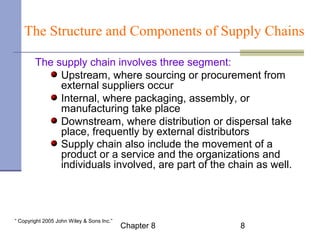
The Structure and Components of Supply Chains 
The supply chain involves three segment: 
Upstream, where sourcing or procurement from 
external suppliers occur 
Internal, where packaging, assembly, or 
manufacturing take place 
Downstream, where distribution or dispersal take 
place, frequently by external distributors 
Supply chain also include the movement of a 
product or a service and the organizations and 
individuals involved, are part of the chain as well. 
Chapter 8 8 “ Copyright 2005 John Wiley & Sons Inc.”
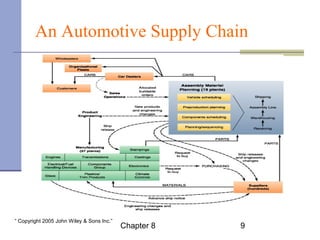
An Automotive Supply Chain 
Chapter 8 9 “ Copyright 2005 John Wiley & Sons Inc.”
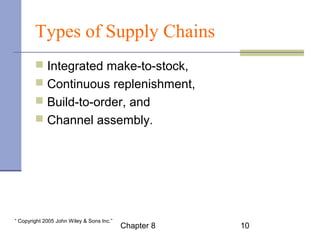
Types of Supply Chains 
 Integrated make-to-stock, 
 Continuous replenishment, 
 Build-to-order, and 
 Channel assembly. 
Chapter 8 10 “ Copyright 2005 John Wiley & Sons Inc.”
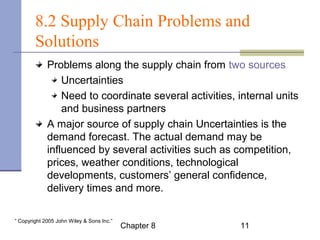
8.2 Supply Chain Problems and 
Solutions 
Problems along the supply chain from two sources: 
Uncertainties 
Need to coordinate several activities, internal units 
and business partners 
A major source of supply chain Uncertainties is the 
demand forecast. The actual demand may be 
influenced by several activities such as competition, 
prices, weather conditions, technological 
developments, customers’ general confidence, 
delivery times and more. 
Chapter 8 11 “ Copyright 2005 John Wiley & Sons Inc.”
Bullwhip Effect 
 Erratic shifts in orders up and down the 
supply chain. It is related to properly setting 
inventory levels in various parts of the supply 
chain 
Chapter 8 12 “ Copyright 2005 John Wiley & Sons Inc.”
Solution to Supply Chain Problems 
Vertical integration: the upstream part of the 
supply chain with the internal part, typically 
by purchasing up- steam suppliers, in order to 
ensure availability of supplier . 
Using inventories: The most common solution 
used by companies to solve supply chain 
problems is building inventories as an 
“insurance“ against supply chain 
uncertainties. 
Chapter 8 13 “ Copyright 2005 John Wiley & Sons Inc.”
Solutions to SC Problems cont… 
Information sharing: sharing information 
along the supply chain can improve demand 
forecasts. Such sharing can be facilitated by 
EDI, extranets, and groupware technologies. 
Vendor-managed inventory (VMI): allowing 
suppliers to monitor, the inventory levels of 
their products in the retailors’ stores and to 
replenish inventory when needed. 
Chapter 8 14 “ Copyright 2005 John Wiley & Sons Inc.”
Solutions to SC Problems cont… 
Changing a linear SC to a Hub: In linear supply 
chains, information is processed in a sequence , 
which slows down its flow. One solution is to change 
the linear chain into hub. Each partner in the supply 
chain can directly access the images in the data bank 
Supply chain collaboration:. Proper supply chain and 
inventory management requires coordination of all 
different activities and links of the supply chain. 
Successful coordination enables goods to move 
smoothly and on time from supplier to manufacturers 
to customers, which enables a firm to keep 
inventories low and costs down 
Chapter 8 15 “ Copyright 2005 John Wiley & Sons Inc.”
Solutions to SC problems cont… 
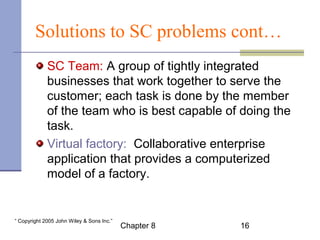
SC Team: A group of tightly integrated 
businesses that work together to serve the 
customer; each task is done by the member 
of the team who is best capable of doing the 
task. 
Virtual factory:. Collaborative enterprise 
application that provides a computerized 
model of a factory. 
Chapter 8 16 “ Copyright 2005 John Wiley & Sons Inc.”
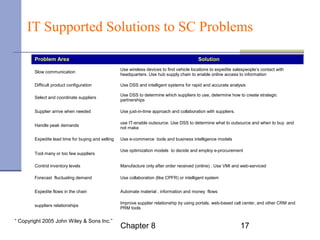
IT Supported Solutions to SC Problems 
Problem Area Solution 
Slow communication Use wireless devices to find vehicle locations to expedite salespeople’s contact with 
headquarters. Use hub supply chain to enable online access to information 
Difficult product configuration Use DSS and intelligent systems for rapid and accurate analysis 
Select and coordinate suppliers Use DSS to determine which suppliers to use, determine how to create strategic 
partnerships 
Supplier arrive when needed Use just-in-time approach and collaboration with suppliers. 
Handle peak demands use IT-enable outsource. Use DSS to determine what to outsource and when to buy and 
not make 
Expedite lead time for buying and selling Use e-commerce tools and business intelligence models 
Tool many or too few suppliers Use optimization models to decide and employ e-procurement 
Control inventory levels Manufacture only after order received (online) . Use VMI and web-serviced 
Forecast fluctuating demand Use collaboration (like CPFR) or intelligent system 
Expedite flows in the chain Automate material , information and money flows 
suppliers relationships Improve supplier relationship by using portals, web-based call center, and other CRM and 
PRM tools 
Chapter 8 17 “ Copyright 2005 John Wiley & Sons Inc.”
8.3 Computerized Enterprise Systems: MRP, 
MRPII, SCM, and Software Integration 
 Material requirement planning (MRP). A 
planning model that integrates production, 
purchasing and inventory management of 
interrelated product. 
 Manufacturing resource planning (MRP II). 
An enhanced planning model that adds labor 
requirements and financial planning to MPR. 
Chapter 8 18 “ Copyright 2005 John Wiley & Sons Inc.”
8.3 Why system integration? 
Sandoe et al.(2001) list the following major 
benefits of systems integration: 
Tangible benefits 
Intangible benefits 
Chapter 8 19 “ Copyright 2005 John Wiley & Sons Inc.”
Internal versus external integration 
 Internal integration refers to integration within 
a company between (or among) application, 
and/or between application and data bases. 
 External integration refers to integration of 
applications and databases among business 
partners. 
Chapter 8 20 “ Copyright 2005 John Wiley & Sons Inc.”
8.4 Enterprise Resource Planning and 
Supply Chain Management 
 Enterprise resource planning (EPR): Software 
that integrates the planning, management 
and use of all resource in the entire 
enterprise. 
 SAP R/3 the leading EPR software (form SAP 
AG Crop.): a highly integrated package 
containing more than 70 business activities 
modules. 
Chapter 8 21 “ Copyright 2005 John Wiley & Sons Inc.”
Generations of ERP 
The first generation of ERP concentrated on 
activities within the enterprise that were 
routine and repetitive in nature. 
The objective of second –generation EPR is 
to leverage existing information systems in 
order to increase efficiency in handling, 
transaction, improve decision making, and 
transform ways of doing business into e-business. 
Chapter 8 22 “ Copyright 2005 John Wiley & Sons Inc.”
8.5 CRM and its Support by IT 
 Customer relationship management (CRM): 
An enterprise wide effort to acquire and retain 
customers, often supported by IT. 
Chapter 8 23 “ Copyright 2005 John Wiley & Sons Inc.”
Type of CRM 
Operational CRM: activities involving 
customer services, order management, 
invoice /billing and sale/marketing automation 
and management . 
Analytical CRM: activities that capture, store, 
extract , process, interpret, and report 
customer data a corporate. user. 
Collaboration CRM: deals with all the 
necessary communication coordination and 
collaboration between vendors and 
customers. 
Chapter 8 24 “ Copyright 2005 John Wiley & Sons Inc.”
Classification of CRM Application 
Customer-facing applications 
Customer-touching applications 
Customer-centric intelligence applications 
Online networking applications 
Chapter 8 25 “ Copyright 2005 John Wiley & Sons Inc.”
E-CRM (Electronic CRM) 
The use of web brewers, the Internet and 
other electronic touchpoints to manage 
customer relationships. 
Chapter 8 26 “ Copyright 2005 John Wiley & Sons Inc.”
The Scope of E-CRM 
Foundational service 
Customer-centered services 
Value-added services 
Chapter 8 27 “ Copyright 2005 John Wiley & Sons Inc.”
Customer Service on the Web 
Search and comparison capabilities 
Free products and services 
Technical and other information and services 
Customized products and services 
Account or order status tracking 
Chapter 8 28 “ Copyright 2005 John Wiley & Sons Inc.”
Other tools for customer service 
Personalized Web pages 
FAQs 
E-mail and automated response 
Chat rooms 
Call center 
Troubleshooting tools 
Chapter 8 29 “ Copyright 2005 John Wiley & Sons Inc.”
All rights reserved. Reproduction or translation of this 
work beyond that permitted in section 117 of the United 
States Copyright Act without express permission of the 
copyright owner is unlawful. Request for information 
should be addressed to the permission department, John 
Wiley & Sons, Inc. The purchaser may make back-up 
copies for his/her own use only and not for distribution or 
resale. The publisher assumes no responsibility for error, 
omissions, or damages caused by the use of these 
programs or from the use of the information herein. 
Chapter 8 30 “ Copyright 2005 John Wiley & Sons Inc.”

Ch08

  • 1.
    Introduction to InformationTechnology Turban, Rainer and Potter John Wiley & Sons, Inc. Copyright 2005 Chapter 8
  • 2.
    Enterprise Systems: FromSupply Chains to EPR to CRM Chapter7 2 “ Copyright 2005 John Wiley & Sons Inc.”
  • 3.
    Chapter Outline Essentials of enterprise systems and supply chains  Supply chain problems and solutions  Computerized enterprise systems: MPR, MRPII, SCM, and software integration  Enterprise resource planning and supply chain management  CRM and its support by IT Chapter 8 3 “ Copyright 2005 John Wiley & Sons Inc.”
  • 4.
    Learning Objectives Understandessentials of enterprise systems and computerized supply chain management. Describe the various types of supply chains Describe the problems of managing supply chains and some innovative solutions. Describe the major types of software that support activities along the supply chain Describe the need for integrated software and how ERP does it Describe CRM and its support by IT. Chapter 8 4 “ Copyright 2005 John Wiley & Sons Inc.”
  • 5.
    8.1 Essentials ofEnterprise Systems and Supply Chains Enterprise systems: System or process that involve the entire enterprise or major portions of it. Enterprise resource planning (ERP): supports the internal SC Extended EPR: supports business partners as well Customer relationship management (CRM): provides customer care. Partner relationship management (PRM): is designed to provide care to business partners. Decision support systems (DSSs): support decision making throughout the enterprise. Knowledge management (KM) systems: support knowledge creation, storage, maintenance and distribution. Chapter 8 5 “ Copyright 2005 John Wiley & Sons Inc.”
  • 6.
    Definitions Supply chain:The flow of materials, information, money, and services from raw material suppliers, through factories and warehouses to the end customer; includes the organizations and processes involved. Supply chain management (SCM): The planning, organizing and coordinating of all supply chain’s activities. E-supply chain: A supply chain that is managed electronically usually with Web-based software. Chapter 8 6 “ Copyright 2005 John Wiley & Sons Inc.”
  • 7.
    The Flows inthe Supply Chain Materials flows: These are all physical products, raw materials, supplies, and so forth, that flow along the chain. The concept of materials flows include reverse flows-returned products, recycled products and disposal of materials or products. Information flows: All data related to demand, shipments, orders, returns, and schedules. Financial flows: All transfers of money, payments, credit card information and authorization, payment schedules, e-payments and credit related data. Chapter 8 7 “ Copyright 2005 John Wiley & Sons Inc.”
  • 8.
    The Structure andComponents of Supply Chains The supply chain involves three segment: Upstream, where sourcing or procurement from external suppliers occur Internal, where packaging, assembly, or manufacturing take place Downstream, where distribution or dispersal take place, frequently by external distributors Supply chain also include the movement of a product or a service and the organizations and individuals involved, are part of the chain as well. Chapter 8 8 “ Copyright 2005 John Wiley & Sons Inc.”
  • 9.
    An Automotive SupplyChain Chapter 8 9 “ Copyright 2005 John Wiley & Sons Inc.”
  • 10.
    Types of SupplyChains  Integrated make-to-stock,  Continuous replenishment,  Build-to-order, and  Channel assembly. Chapter 8 10 “ Copyright 2005 John Wiley & Sons Inc.”
  • 11.
    8.2 Supply ChainProblems and Solutions Problems along the supply chain from two sources: Uncertainties Need to coordinate several activities, internal units and business partners A major source of supply chain Uncertainties is the demand forecast. The actual demand may be influenced by several activities such as competition, prices, weather conditions, technological developments, customers’ general confidence, delivery times and more. Chapter 8 11 “ Copyright 2005 John Wiley & Sons Inc.”
  • 12.
    Bullwhip Effect Erratic shifts in orders up and down the supply chain. It is related to properly setting inventory levels in various parts of the supply chain Chapter 8 12 “ Copyright 2005 John Wiley & Sons Inc.”
  • 13.
    Solution to SupplyChain Problems Vertical integration: the upstream part of the supply chain with the internal part, typically by purchasing up- steam suppliers, in order to ensure availability of supplier . Using inventories: The most common solution used by companies to solve supply chain problems is building inventories as an “insurance“ against supply chain uncertainties. Chapter 8 13 “ Copyright 2005 John Wiley & Sons Inc.”
  • 14.
    Solutions to SCProblems cont… Information sharing: sharing information along the supply chain can improve demand forecasts. Such sharing can be facilitated by EDI, extranets, and groupware technologies. Vendor-managed inventory (VMI): allowing suppliers to monitor, the inventory levels of their products in the retailors’ stores and to replenish inventory when needed. Chapter 8 14 “ Copyright 2005 John Wiley & Sons Inc.”
  • 15.
    Solutions to SCProblems cont… Changing a linear SC to a Hub: In linear supply chains, information is processed in a sequence , which slows down its flow. One solution is to change the linear chain into hub. Each partner in the supply chain can directly access the images in the data bank Supply chain collaboration:. Proper supply chain and inventory management requires coordination of all different activities and links of the supply chain. Successful coordination enables goods to move smoothly and on time from supplier to manufacturers to customers, which enables a firm to keep inventories low and costs down Chapter 8 15 “ Copyright 2005 John Wiley & Sons Inc.”
  • 16.
    Solutions to SCproblems cont… SC Team: A group of tightly integrated businesses that work together to serve the customer; each task is done by the member of the team who is best capable of doing the task. Virtual factory:. Collaborative enterprise application that provides a computerized model of a factory. Chapter 8 16 “ Copyright 2005 John Wiley & Sons Inc.”
  • 17.
    IT Supported Solutionsto SC Problems Problem Area Solution Slow communication Use wireless devices to find vehicle locations to expedite salespeople’s contact with headquarters. Use hub supply chain to enable online access to information Difficult product configuration Use DSS and intelligent systems for rapid and accurate analysis Select and coordinate suppliers Use DSS to determine which suppliers to use, determine how to create strategic partnerships Supplier arrive when needed Use just-in-time approach and collaboration with suppliers. Handle peak demands use IT-enable outsource. Use DSS to determine what to outsource and when to buy and not make Expedite lead time for buying and selling Use e-commerce tools and business intelligence models Tool many or too few suppliers Use optimization models to decide and employ e-procurement Control inventory levels Manufacture only after order received (online) . Use VMI and web-serviced Forecast fluctuating demand Use collaboration (like CPFR) or intelligent system Expedite flows in the chain Automate material , information and money flows suppliers relationships Improve supplier relationship by using portals, web-based call center, and other CRM and PRM tools Chapter 8 17 “ Copyright 2005 John Wiley & Sons Inc.”
  • 18.
    8.3 Computerized EnterpriseSystems: MRP, MRPII, SCM, and Software Integration  Material requirement planning (MRP). A planning model that integrates production, purchasing and inventory management of interrelated product.  Manufacturing resource planning (MRP II). An enhanced planning model that adds labor requirements and financial planning to MPR. Chapter 8 18 “ Copyright 2005 John Wiley & Sons Inc.”
  • 19.
    8.3 Why systemintegration? Sandoe et al.(2001) list the following major benefits of systems integration: Tangible benefits Intangible benefits Chapter 8 19 “ Copyright 2005 John Wiley & Sons Inc.”
  • 20.
    Internal versus externalintegration  Internal integration refers to integration within a company between (or among) application, and/or between application and data bases.  External integration refers to integration of applications and databases among business partners. Chapter 8 20 “ Copyright 2005 John Wiley & Sons Inc.”
  • 21.
    8.4 Enterprise ResourcePlanning and Supply Chain Management  Enterprise resource planning (EPR): Software that integrates the planning, management and use of all resource in the entire enterprise.  SAP R/3 the leading EPR software (form SAP AG Crop.): a highly integrated package containing more than 70 business activities modules. Chapter 8 21 “ Copyright 2005 John Wiley & Sons Inc.”
  • 22.
    Generations of ERP The first generation of ERP concentrated on activities within the enterprise that were routine and repetitive in nature. The objective of second –generation EPR is to leverage existing information systems in order to increase efficiency in handling, transaction, improve decision making, and transform ways of doing business into e-business. Chapter 8 22 “ Copyright 2005 John Wiley & Sons Inc.”
  • 23.
    8.5 CRM andits Support by IT  Customer relationship management (CRM): An enterprise wide effort to acquire and retain customers, often supported by IT. Chapter 8 23 “ Copyright 2005 John Wiley & Sons Inc.”
  • 24.
    Type of CRM Operational CRM: activities involving customer services, order management, invoice /billing and sale/marketing automation and management . Analytical CRM: activities that capture, store, extract , process, interpret, and report customer data a corporate. user. Collaboration CRM: deals with all the necessary communication coordination and collaboration between vendors and customers. Chapter 8 24 “ Copyright 2005 John Wiley & Sons Inc.”
  • 25.
    Classification of CRMApplication Customer-facing applications Customer-touching applications Customer-centric intelligence applications Online networking applications Chapter 8 25 “ Copyright 2005 John Wiley & Sons Inc.”
  • 26.
    E-CRM (Electronic CRM) The use of web brewers, the Internet and other electronic touchpoints to manage customer relationships. Chapter 8 26 “ Copyright 2005 John Wiley & Sons Inc.”
  • 27.
    The Scope ofE-CRM Foundational service Customer-centered services Value-added services Chapter 8 27 “ Copyright 2005 John Wiley & Sons Inc.”
  • 28.
    Customer Service onthe Web Search and comparison capabilities Free products and services Technical and other information and services Customized products and services Account or order status tracking Chapter 8 28 “ Copyright 2005 John Wiley & Sons Inc.”
  • 29.
    Other tools forcustomer service Personalized Web pages FAQs E-mail and automated response Chat rooms Call center Troubleshooting tools Chapter 8 29 “ Copyright 2005 John Wiley & Sons Inc.”
  • 30.
    All rights reserved.Reproduction or translation of this work beyond that permitted in section 117 of the United States Copyright Act without express permission of the copyright owner is unlawful. Request for information should be addressed to the permission department, John Wiley & Sons, Inc. The purchaser may make back-up copies for his/her own use only and not for distribution or resale. The publisher assumes no responsibility for error, omissions, or damages caused by the use of these programs or from the use of the information herein. Chapter 8 30 “ Copyright 2005 John Wiley & Sons Inc.”