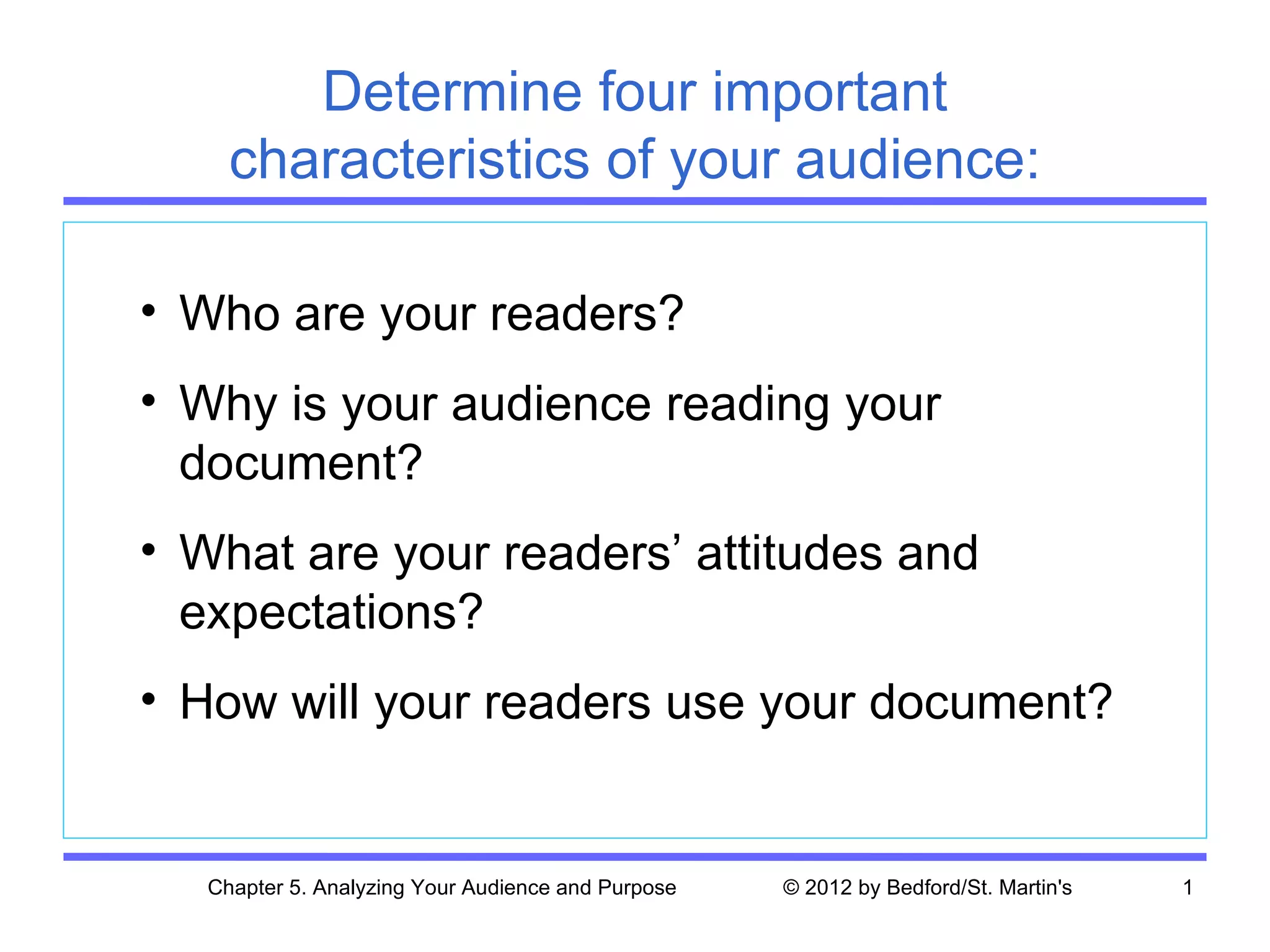
Determine four important
     characteristics of your audience:

• Who are your readers?
• Why is your audience reading your
  document?
• What are your readers’ attitudes and
  expectations?
• How will your readers use your document?


   Chapter 5. Analyzing Your Audience and Purpose   © 2012 by Bedford/St. Martin's   1
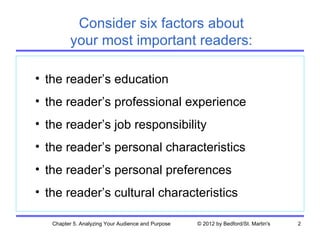
Consider six factors about
         your most important readers:

• the reader’s education
• the reader’s professional experience
• the reader’s job responsibility
• the reader’s personal characteristics
• the reader’s personal preferences
• the reader’s cultural characteristics

   Chapter 5. Analyzing Your Audience and Purpose   © 2012 by Bedford/St. Martin's   2
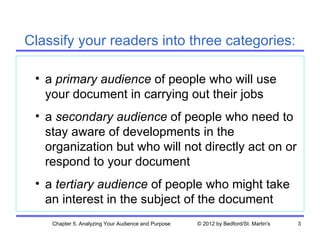
Classify your readers into three categories:

 • a primary audience of people who will use
   your document in carrying out their jobs
 • a secondary audience of people who need to
   stay aware of developments in the
   organization but who will not directly act on or
   respond to your document
 • a tertiary audience of people who might take
   an interest in the subject of the document
    Chapter 5. Analyzing Your Audience and Purpose   © 2012 by Bedford/St. Martin's   3
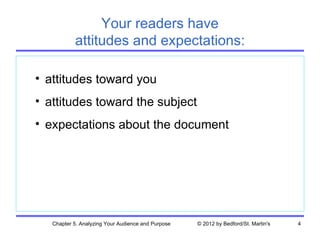
Your readers have
           attitudes and expectations:

• attitudes toward you
• attitudes toward the subject
• expectations about the document


   Chapter 5. Analyzing Your Audience and Purpose   © 2012 by Bedford/St. Martin's   4
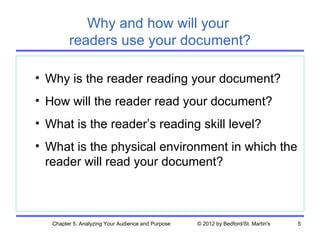
Why and how will your
         readers use your document?

• Why is the reader reading your document?
• How will the reader read your document?
• What is the reader’s reading skill level?
• What is the physical environment in which the
  reader will read your document?


   Chapter 5. Analyzing Your Audience and Purpose   © 2012 by Bedford/St. Martin's   5
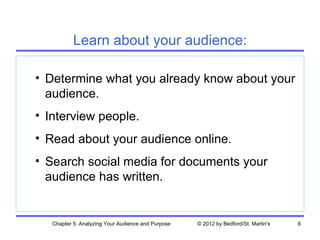
Learn about your audience:

• Determine what you already know about your
  audience.
• Interview people.
• Read about your audience online.
• Search social media for documents your
  audience has written.


   Chapter 5. Analyzing Your Audience and Purpose   © 2012 by Bedford/St. Martin's   6
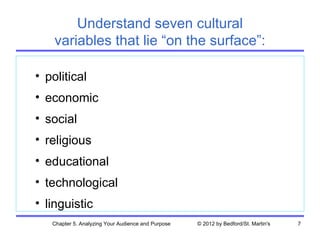
Understand seven cultural
    variables that lie “on the surface”:

• political
• economic
• social
• religious
• educational
• technological
• linguistic
   Chapter 5. Analyzing Your Audience and Purpose   © 2012 by Bedford/St. Martin's   7
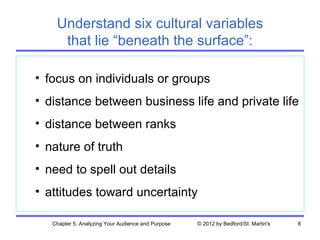
Understand six cultural variables
     that lie “beneath the surface”:

• focus on individuals or groups
• distance between business life and private life
• distance between ranks
• nature of truth
• need to spell out details
• attitudes toward uncertainty

   Chapter 5. Analyzing Your Audience and Purpose   © 2012 by Bedford/St. Martin's   8
Consider four points about
cultural variables “beneath the surface”:

• Each variable represents a spectrum of
  attitudes.
• The six variables do not line up in a clear
  pattern.
• Different organizations within the same culture
  can vary greatly.
• An organization’s cultural attitudes are fluid,
  not static.
   Chapter 5. Analyzing Your Audience and Purpose   © 2012 by Bedford/St. Martin's   9
Use these eight strategies when
   writing for readers from other cultures:

• Limit your vocabulary.
• Keep sentences short.
• Define abbreviations and acronyms in a
  glossary.
• Avoid jargon unless you know your readers are
  familiar with it.


     Chapter 5. Analyzing Your Audience and Purpose   © 2012 by Bedford/St. Martin's   10
Use these eight strategies when writing
    for readers from other cultures (cont.):

•   Avoid idioms and slang.
•   Use the active voice whenever possible.
•   Be careful with graphics.
•   Be sure someone from the target culture reviews
    the document.


       Chapter 5. Analyzing Your Audience and Purpose   © 2012 by Bedford/St. Martin's
Determine your purpose:


Ask yourself:
• What do I want this document to accomplish?
• What do I want readers to know or believe?
• What do I want readers to do?


   Chapter 5. Analyzing Your Audience and Purpose   © 2012 by Bedford/St. Martin's   12

Ch05 slides

  • 1.
    Determine four important characteristics of your audience: • Who are your readers? • Why is your audience reading your document? • What are your readers’ attitudes and expectations? • How will your readers use your document? Chapter 5. Analyzing Your Audience and Purpose © 2012 by Bedford/St. Martin's 1
  • 2.
    Consider six factorsabout your most important readers: • the reader’s education • the reader’s professional experience • the reader’s job responsibility • the reader’s personal characteristics • the reader’s personal preferences • the reader’s cultural characteristics Chapter 5. Analyzing Your Audience and Purpose © 2012 by Bedford/St. Martin's 2
  • 3.
    Classify your readersinto three categories: • a primary audience of people who will use your document in carrying out their jobs • a secondary audience of people who need to stay aware of developments in the organization but who will not directly act on or respond to your document • a tertiary audience of people who might take an interest in the subject of the document Chapter 5. Analyzing Your Audience and Purpose © 2012 by Bedford/St. Martin's 3
  • 4.
    Your readers have attitudes and expectations: • attitudes toward you • attitudes toward the subject • expectations about the document Chapter 5. Analyzing Your Audience and Purpose © 2012 by Bedford/St. Martin's 4
  • 5.
    Why and howwill your readers use your document? • Why is the reader reading your document? • How will the reader read your document? • What is the reader’s reading skill level? • What is the physical environment in which the reader will read your document? Chapter 5. Analyzing Your Audience and Purpose © 2012 by Bedford/St. Martin's 5
  • 6.
    Learn about youraudience: • Determine what you already know about your audience. • Interview people. • Read about your audience online. • Search social media for documents your audience has written. Chapter 5. Analyzing Your Audience and Purpose © 2012 by Bedford/St. Martin's 6
  • 7.
    Understand seven cultural variables that lie “on the surface”: • political • economic • social • religious • educational • technological • linguistic Chapter 5. Analyzing Your Audience and Purpose © 2012 by Bedford/St. Martin's 7
  • 8.
    Understand six culturalvariables that lie “beneath the surface”: • focus on individuals or groups • distance between business life and private life • distance between ranks • nature of truth • need to spell out details • attitudes toward uncertainty Chapter 5. Analyzing Your Audience and Purpose © 2012 by Bedford/St. Martin's 8
  • 9.
    Consider four pointsabout cultural variables “beneath the surface”: • Each variable represents a spectrum of attitudes. • The six variables do not line up in a clear pattern. • Different organizations within the same culture can vary greatly. • An organization’s cultural attitudes are fluid, not static. Chapter 5. Analyzing Your Audience and Purpose © 2012 by Bedford/St. Martin's 9
  • 10.
    Use these eightstrategies when writing for readers from other cultures: • Limit your vocabulary. • Keep sentences short. • Define abbreviations and acronyms in a glossary. • Avoid jargon unless you know your readers are familiar with it. Chapter 5. Analyzing Your Audience and Purpose © 2012 by Bedford/St. Martin's 10
  • 11.
    Use these eightstrategies when writing for readers from other cultures (cont.): • Avoid idioms and slang. • Use the active voice whenever possible. • Be careful with graphics. • Be sure someone from the target culture reviews the document. Chapter 5. Analyzing Your Audience and Purpose © 2012 by Bedford/St. Martin's
  • 12.
    Determine your purpose: Askyourself: • What do I want this document to accomplish? • What do I want readers to know or believe? • What do I want readers to do? Chapter 5. Analyzing Your Audience and Purpose © 2012 by Bedford/St. Martin's 12