Technical communication
                has two meanings:

• the process of making and sharing technical
  information in the workplace
• a set of applications—the documents you
  write and the presentations you deliver


  Chapter 1. Introduction to Technical Communication   © 2012 by Bedford/St. Martin's   1
You have three roles
                as a communicator:

• the writer of a document
• a member of a project team
• an information resource for others


  Chapter 1. Introduction to Technical Communication   © 2012 by Bedford/St. Martin's   2
Technical communication
                affects your career:

• Companies say communication skills are
  important.
• Strong communication skills make you a more
  valuable employee.


  Chapter 1. Introduction to Technical Communication   © 2012 by Bedford/St. Martin's   3
Technical communication
          has six main characteristics:

• It addresses particular readers.
• It helps readers solve problems.
• It reflects the organization’s goals and culture.
• It is produced collaboratively.
• It uses design to increase readability.
• It consists of words or images or both.


  Chapter 1. Introduction to Technical Communication   © 2012 by Bedford/St. Martin's   4
Communicators use design features
 to accomplish three basic purposes:

• to make the document look attractive and
  professional
• to help readers navigate the document
• to help readers understand the document


  Chapter 1. Introduction to Technical Communication   © 2012 by Bedford/St. Martin's   5
Images help the writer
           perform five main functions:


• to make the document more interesting and
  appealing
• to communicate and reinforce difficult concepts
• to communicate instructions and descriptions of
  objects and processes
• to communicate large amounts of quantifiable data
• to communicate with nonnative speakers

  Chapter 1. Introduction to Technical Communication   © 2012 by Bedford/St. Martin's   6
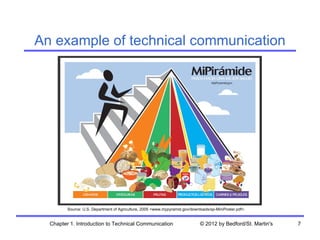
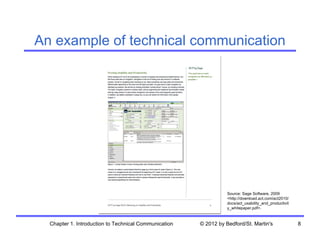
An example of technical communication


         Source: U.S. Department of Agriculture, 2005 <www.mypyramid.gov/downloads/sp-MiniPoster.pdf>.


  Chapter 1. Introduction to Technical Communication                          © 2012 by Bedford/St. Martin's   7
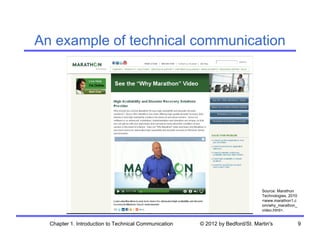
An example of technical communication


                                                                  Source: Sage Software, 2009
                                                                  <http://download.act.com/act2010/
                                                                  docs/act_usability_and_productivit
                                                                  y_whitepaper.pdf>.


  Chapter 1. Introduction to Technical Communication   © 2012 by Bedford/St. Martin's                  8
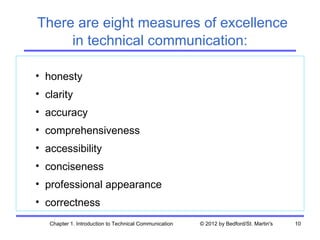
An example of technical communication


                                                                                Source: Marathon
                                                                                Technologies, 2010
                                                                                <www.marathon1.c
                                                                                om/why_marathon_
                                                                                video.html>.


  Chapter 1. Introduction to Technical Communication   © 2012 by Bedford/St. Martin's                9
There are eight measures of excellence
     in technical communication:

• honesty
• clarity
• accuracy
• comprehensiveness
• accessibility
• conciseness
• professional appearance
• correctness
   Chapter 1. Introduction to Technical Communication   © 2012 by Bedford/St. Martin's   10
You must communicate
            honestly for three reasons:

• It is the right thing to do.
• If you are dishonest, readers can get hurt.
• If you are dishonest, you and your
  organization could face serious legal charges.


  Chapter 1. Introduction to Technical Communication   © 2012 by Bedford/St. Martin's   11
Technical communication
       must be clear for two reasons:

• Unclear technical communication can be
  dangerous.
• Unclear technical communication is
  expensive.


  Chapter 1. Introduction to Technical Communication   © 2012 by Bedford/St. Martin's   12

Ch01 slides

  • 1.
    Technical communication has two meanings: • the process of making and sharing technical information in the workplace • a set of applications—the documents you write and the presentations you deliver Chapter 1. Introduction to Technical Communication © 2012 by Bedford/St. Martin's 1
  • 2.
    You have threeroles as a communicator: • the writer of a document • a member of a project team • an information resource for others Chapter 1. Introduction to Technical Communication © 2012 by Bedford/St. Martin's 2
  • 3.
    Technical communication affects your career: • Companies say communication skills are important. • Strong communication skills make you a more valuable employee. Chapter 1. Introduction to Technical Communication © 2012 by Bedford/St. Martin's 3
  • 4.
    Technical communication has six main characteristics: • It addresses particular readers. • It helps readers solve problems. • It reflects the organization’s goals and culture. • It is produced collaboratively. • It uses design to increase readability. • It consists of words or images or both. Chapter 1. Introduction to Technical Communication © 2012 by Bedford/St. Martin's 4
  • 5.
    Communicators use designfeatures to accomplish three basic purposes: • to make the document look attractive and professional • to help readers navigate the document • to help readers understand the document Chapter 1. Introduction to Technical Communication © 2012 by Bedford/St. Martin's 5
  • 6.
    Images help thewriter perform five main functions: • to make the document more interesting and appealing • to communicate and reinforce difficult concepts • to communicate instructions and descriptions of objects and processes • to communicate large amounts of quantifiable data • to communicate with nonnative speakers Chapter 1. Introduction to Technical Communication © 2012 by Bedford/St. Martin's 6
  • 7.
    An example oftechnical communication Source: U.S. Department of Agriculture, 2005 <www.mypyramid.gov/downloads/sp-MiniPoster.pdf>. Chapter 1. Introduction to Technical Communication © 2012 by Bedford/St. Martin's 7
  • 8.
    An example oftechnical communication Source: Sage Software, 2009 <http://download.act.com/act2010/ docs/act_usability_and_productivit y_whitepaper.pdf>. Chapter 1. Introduction to Technical Communication © 2012 by Bedford/St. Martin's 8
  • 9.
    An example oftechnical communication Source: Marathon Technologies, 2010 <www.marathon1.c om/why_marathon_ video.html>. Chapter 1. Introduction to Technical Communication © 2012 by Bedford/St. Martin's 9
  • 10.
    There are eightmeasures of excellence in technical communication: • honesty • clarity • accuracy • comprehensiveness • accessibility • conciseness • professional appearance • correctness Chapter 1. Introduction to Technical Communication © 2012 by Bedford/St. Martin's 10
  • 11.
    You must communicate honestly for three reasons: • It is the right thing to do. • If you are dishonest, readers can get hurt. • If you are dishonest, you and your organization could face serious legal charges. Chapter 1. Introduction to Technical Communication © 2012 by Bedford/St. Martin's 11
  • 12.
    Technical communication must be clear for two reasons: • Unclear technical communication can be dangerous. • Unclear technical communication is expensive. Chapter 1. Introduction to Technical Communication © 2012 by Bedford/St. Martin's 12