Chapter 26  Ambulatory Aids
Question Is the following statement true or false? Gluteal setting is a type of isometric exercise in which the client alternately tenses and relaxes the quadriceps muscles.
Answer False. Quadriceps setting is the isometric exercise in which the client alternately tenses and relaxes the quadriceps muscles.
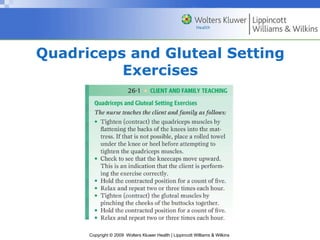
Preparing for Ambulation  Isometric exercises: Quadriceps setting: client alternately tenses and relaxes the quadriceps muscles Gluteal setting: client contracts and relaxes the gluteal muscles to strengthen and tone them
Quadriceps and Gluteal Setting Exercises
Upper arm strengthening: flexion and extension of the arms and wrists; raising and lowering weights with the hands; squeezing a ball or spring grip; modified hand push-ups in bed Dangling: normalizes blood pressure Using a tilt table Preparing for Ambulation
Assistive Devices Devices to support and assist walking: Parallel bars (handrails) provide practice in ambulating Walking belt applied around client’s waist provides secure grip to prevent injury while ambulating
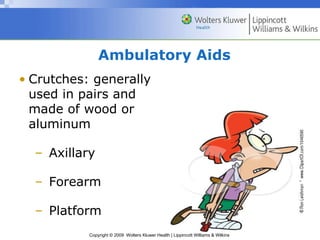
Ambulatory Aids Crutches: generally used in pairs and made of wood or aluminum Axillary Forearm Platform
Ambulatory Aids (Cont’d) Cane: a hand-held ambulation device made of wood or aluminum Rubber tips reduce possibility of slipping Walker: most stable device; has curved aluminum bars and three-sided enclosure with four legs for support
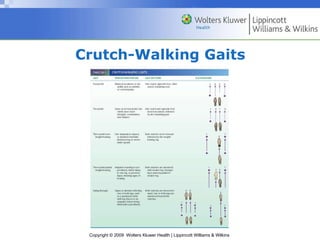
Ambulatory Aids (cont’d) Crutch-walking gaits: pattern of walking when ambulating with crutches Four-point gait Three-point gait  Two-point gait Swing-through gait
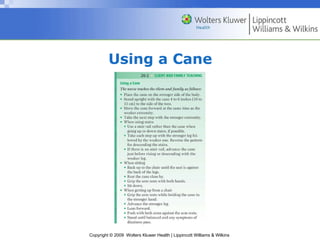
Using a Cane
Crutch-Walking Gaits
Question Which of the following ambulatory aids are used mostly by clients who are diagnosed with arthritis of the hands or wrists? a. Canes b. Auxiliary crutches c. Walkers d. Forearm crutches
Answer d.  Forearm crutches The use of crutches requires a great deal of upper arm strength; hence, forearm crutches are used by clients who have arthritis of the hands or wrists since weight is placed upon forearms.
Measuring for  Crutches, Canes, and Walkers (Refer to Skill 26-1 in the textbook.)
Assisting With Crutch-Walking (Refer to Skill 26-2 in the textbook.)
Prosthetic Limbs   Temporary prosthetic limb: immediate postoperative prosthesis (IPOP) Permanent prosthetic components delayed for several weeks or months to be sure:  Incision has healed Stump size is relatively stable
Prosthetic Limbs (cont’d) Prosthetic components include: Below the knee: socket, shank, ankle/foot system Above the knee: below-the-knee components plus a knee system Ambulation with a lower limb prosthesis requires strength and endurance
Applying a Leg Prosthesis (Refer to Skill 26-3 in the textbook.)
Question Is the following statement true or false? Amputees should avoid strenuous activities, as these can lead to further complications.
Answer False. Amputees can take up strenuous activities such as snow skiing if they use a sturdier modified prosthesis.
Nursing Implications  Nursing diagnoses include: Impaired physical mobility Risk for disuse syndrome, trauma Unilateral neglect Risk for activity intolerance  Risk for peripheral neurovascular dysfunction
General Gerontologic Considerations Functional ability involves mobility and making adaptations to compensate for changes occurring with aging or disease processes May need encouragement and support integrating adaptations into their activities of daily living and maintaining their self-concept and body image Maintaining independence is important to older adults
General Gerontologic Considerations (cont’d) Mobility facilitates staying active and independent As a person ages, he or she may develop flexion of the spine which alters the center of gravity and may increase falls Ensure adequate lighting without laying electric cords in passageways Elevate toilet seats; install grab bars Rearrange home furnishings

Ch 26 ambulatory aids

  • 1.
    Chapter 26 Ambulatory Aids
  • 2.
    Question Is thefollowing statement true or false? Gluteal setting is a type of isometric exercise in which the client alternately tenses and relaxes the quadriceps muscles.
  • 3.
    Answer False. Quadricepssetting is the isometric exercise in which the client alternately tenses and relaxes the quadriceps muscles.
  • 4.
    Preparing for Ambulation Isometric exercises: Quadriceps setting: client alternately tenses and relaxes the quadriceps muscles Gluteal setting: client contracts and relaxes the gluteal muscles to strengthen and tone them
  • 5.
    Quadriceps and GlutealSetting Exercises
  • 6.
    Upper arm strengthening:flexion and extension of the arms and wrists; raising and lowering weights with the hands; squeezing a ball or spring grip; modified hand push-ups in bed Dangling: normalizes blood pressure Using a tilt table Preparing for Ambulation
  • 7.
    Assistive Devices Devicesto support and assist walking: Parallel bars (handrails) provide practice in ambulating Walking belt applied around client’s waist provides secure grip to prevent injury while ambulating
  • 8.
    Ambulatory Aids Crutches:generally used in pairs and made of wood or aluminum Axillary Forearm Platform
  • 9.
    Ambulatory Aids (Cont’d)Cane: a hand-held ambulation device made of wood or aluminum Rubber tips reduce possibility of slipping Walker: most stable device; has curved aluminum bars and three-sided enclosure with four legs for support
  • 10.
    Ambulatory Aids (cont’d)Crutch-walking gaits: pattern of walking when ambulating with crutches Four-point gait Three-point gait Two-point gait Swing-through gait
  • 11.
  • 12.
  • 13.
    Question Which ofthe following ambulatory aids are used mostly by clients who are diagnosed with arthritis of the hands or wrists? a. Canes b. Auxiliary crutches c. Walkers d. Forearm crutches
  • 14.
    Answer d. Forearm crutches The use of crutches requires a great deal of upper arm strength; hence, forearm crutches are used by clients who have arthritis of the hands or wrists since weight is placed upon forearms.
  • 15.
    Measuring for Crutches, Canes, and Walkers (Refer to Skill 26-1 in the textbook.)
  • 16.
    Assisting With Crutch-Walking(Refer to Skill 26-2 in the textbook.)
  • 17.
    Prosthetic Limbs Temporary prosthetic limb: immediate postoperative prosthesis (IPOP) Permanent prosthetic components delayed for several weeks or months to be sure: Incision has healed Stump size is relatively stable
  • 18.
    Prosthetic Limbs (cont’d)Prosthetic components include: Below the knee: socket, shank, ankle/foot system Above the knee: below-the-knee components plus a knee system Ambulation with a lower limb prosthesis requires strength and endurance
  • 19.
    Applying a LegProsthesis (Refer to Skill 26-3 in the textbook.)
  • 20.
    Question Is thefollowing statement true or false? Amputees should avoid strenuous activities, as these can lead to further complications.
  • 21.
    Answer False. Amputeescan take up strenuous activities such as snow skiing if they use a sturdier modified prosthesis.
  • 22.
    Nursing Implications Nursing diagnoses include: Impaired physical mobility Risk for disuse syndrome, trauma Unilateral neglect Risk for activity intolerance Risk for peripheral neurovascular dysfunction
  • 23.
    General Gerontologic ConsiderationsFunctional ability involves mobility and making adaptations to compensate for changes occurring with aging or disease processes May need encouragement and support integrating adaptations into their activities of daily living and maintaining their self-concept and body image Maintaining independence is important to older adults
  • 24.
    General Gerontologic Considerations(cont’d) Mobility facilitates staying active and independent As a person ages, he or she may develop flexion of the spine which alters the center of gravity and may increase falls Ensure adequate lighting without laying electric cords in passageways Elevate toilet seats; install grab bars Rearrange home furnishings