11/3/200910.4 European Motivations in the Age of Imperialism1The Age of ImperialismChapter 25 Section One
11/3/200910.4 European Motivations in the Age of Imperialism2Imperialism is the process of extending control over other territories.
11/3/200910.4 European Motivations in the Age of Imperialism3The New ImperialismWho were the imperial powers.What motivated them to dominate much of the World?Why was Europe so successful?
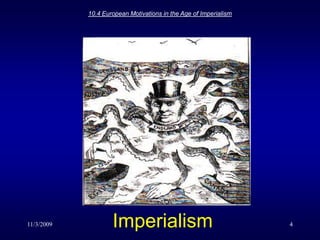
11/3/200910.4 European Motivations in the Age of Imperialism4Imperialism
11/3/200910.4 European Motivations in the Age of Imperialism5I. Who were the Imperial powers?Early powers were Britain, France, Spain, Denmark, Portugal and Russia.By 1870 Germany, Italy, Belgium all began to compete for colonies.The United States and Japan will also enter late in the 19th centaury.Competition for colonies will become a driving force among these nations.
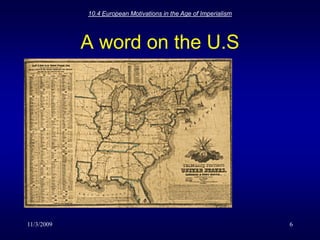
11/3/200910.4 European Motivations in the Age of Imperialism6A word on the U.S                  
11/3/200910.4 European Motivations in the Age of Imperialism7II. Motivations For Imperialism.EconomicPoliticalReligiousExplorationIdeological
11/3/200910.4 European Motivations in the Age of Imperialism8A. Economic motivations.Colonies can provide raw materials for nations.Increased International competition posed a challenge to many nationsBritain was challenged by U.S and GermanyNeeded colonies to act as markets for manufactured goodsEurope had become industrialized, and was looking for a new place to invest to gain more of a profit.Many nations looked to create their own empires for trade.
11/3/200910.4 European Motivations in the Age of Imperialism9B. Political motivations.More colonies would lead to greater wealth and power for a nation.As one nation achieved power, others would want toGreater wealth and power for a nation  would lead to greater security.And greater insecurity for other nationsBalance of Power theoryAgain European nations were competing against each other to be more dominant.
11/3/200910.4 European Motivations in the Age of Imperialism10C. Religious Motivations.Missionaries hoped to spread Christianity and Catholicism around the world.	Christian MissionariesSpanish mission SystemThe world was full of “heathens” that had to be saved.Not all agreed to this moticvation
11/3/200910.4 European Motivations in the Age of Imperialism11D. Exploration and Adventure.It gave the rich something to do.Safari’s and hunts.See exotic places.Treasure hunting for gold and silver.The Infamous Dr. Livingstone.The lower classes could read about it in stories and newspapers.Tarzan
11/3/200910.4 European Motivations in the Age of Imperialism12E. Ideological.Europe had become more technologically advanced than the rest of the world. Europe assumed that it was superior to that of other people and cultures of the world.Elements of Racism also were evident.Rudyard Kipling and The Whiteman’s BurdenRobinson Crusoe.
11/3/200910.4 European Motivations in the Age of Imperialism13III. Why was Europe successful?The Industrial PowerInternal Issues
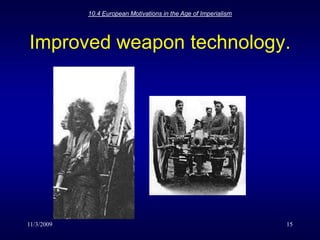
11/3/200910.4 European Motivations in the Age of Imperialism14A. Industrial PowerMass Production and new technologyMilitary technologyMaxim machine gunBolt action rifleNew vaccines and medicines (malaria)Transportation Revolution would allow Europe to project PowerTrains Steam ships
11/3/200910.4 European Motivations in the Age of Imperialism15Improved weapon technology.
11/3/200910.4 European Motivations in the Age of Imperialism16B. Internal IssuesLow level of technologyEven a resistance to changeExcept in JapanDivisions between ethnic groupsEspecially AfricaIndia
11/3/200910.4 European Motivations in the Age of Imperialism17TermsImperialismLivingstoneStanley	Kipling
11/3/200910.4 European Motivations in the Age of Imperialism18In summaryWho were the major Imperial powers?What were the motivations for imperialism?What enabled Europe to dominate?

Ch 25 Section 1 Motives

  • 1.
    11/3/200910.4 European Motivationsin the Age of Imperialism1The Age of ImperialismChapter 25 Section One
  • 2.
    11/3/200910.4 European Motivationsin the Age of Imperialism2Imperialism is the process of extending control over other territories.
  • 3.
    11/3/200910.4 European Motivationsin the Age of Imperialism3The New ImperialismWho were the imperial powers.What motivated them to dominate much of the World?Why was Europe so successful?
  • 4.
    11/3/200910.4 European Motivationsin the Age of Imperialism4Imperialism
  • 5.
    11/3/200910.4 European Motivationsin the Age of Imperialism5I. Who were the Imperial powers?Early powers were Britain, France, Spain, Denmark, Portugal and Russia.By 1870 Germany, Italy, Belgium all began to compete for colonies.The United States and Japan will also enter late in the 19th centaury.Competition for colonies will become a driving force among these nations.
  • 6.
    11/3/200910.4 European Motivationsin the Age of Imperialism6A word on the U.S                  
  • 7.
    11/3/200910.4 European Motivationsin the Age of Imperialism7II. Motivations For Imperialism.EconomicPoliticalReligiousExplorationIdeological
  • 8.
    11/3/200910.4 European Motivationsin the Age of Imperialism8A. Economic motivations.Colonies can provide raw materials for nations.Increased International competition posed a challenge to many nationsBritain was challenged by U.S and GermanyNeeded colonies to act as markets for manufactured goodsEurope had become industrialized, and was looking for a new place to invest to gain more of a profit.Many nations looked to create their own empires for trade.
  • 9.
    11/3/200910.4 European Motivationsin the Age of Imperialism9B. Political motivations.More colonies would lead to greater wealth and power for a nation.As one nation achieved power, others would want toGreater wealth and power for a nation would lead to greater security.And greater insecurity for other nationsBalance of Power theoryAgain European nations were competing against each other to be more dominant.
  • 10.
    11/3/200910.4 European Motivationsin the Age of Imperialism10C. Religious Motivations.Missionaries hoped to spread Christianity and Catholicism around the world. Christian MissionariesSpanish mission SystemThe world was full of “heathens” that had to be saved.Not all agreed to this moticvation
  • 11.
    11/3/200910.4 European Motivationsin the Age of Imperialism11D. Exploration and Adventure.It gave the rich something to do.Safari’s and hunts.See exotic places.Treasure hunting for gold and silver.The Infamous Dr. Livingstone.The lower classes could read about it in stories and newspapers.Tarzan
  • 12.
    11/3/200910.4 European Motivationsin the Age of Imperialism12E. Ideological.Europe had become more technologically advanced than the rest of the world. Europe assumed that it was superior to that of other people and cultures of the world.Elements of Racism also were evident.Rudyard Kipling and The Whiteman’s BurdenRobinson Crusoe.
  • 13.
    11/3/200910.4 European Motivationsin the Age of Imperialism13III. Why was Europe successful?The Industrial PowerInternal Issues
  • 14.
    11/3/200910.4 European Motivationsin the Age of Imperialism14A. Industrial PowerMass Production and new technologyMilitary technologyMaxim machine gunBolt action rifleNew vaccines and medicines (malaria)Transportation Revolution would allow Europe to project PowerTrains Steam ships
  • 15.
    11/3/200910.4 European Motivationsin the Age of Imperialism15Improved weapon technology.
  • 16.
    11/3/200910.4 European Motivationsin the Age of Imperialism16B. Internal IssuesLow level of technologyEven a resistance to changeExcept in JapanDivisions between ethnic groupsEspecially AfricaIndia
  • 17.
    11/3/200910.4 European Motivationsin the Age of Imperialism17TermsImperialismLivingstoneStanley Kipling
  • 18.
    11/3/200910.4 European Motivationsin the Age of Imperialism18In summaryWho were the major Imperial powers?What were the motivations for imperialism?What enabled Europe to dominate?