CHAPTER TWO
BASIC HEMATOLOGICAL TESTS
By: Eyuel Getnet (MLS)
November 16, 2024
Objectives:
At the end of this chapter students should be able to:
• Explain the composition of blood
• Describe the formation of blood
• Indicate the site of formation of blood in infancy,
childhood and adulthood
• Perform basic hematological tests
November 16, 2024
outline
• Definition of hematology
• Composition of blood
• Sample collection
• Hemocytometry (blood cell counting)
• Hemoglobin determination
• Determination of PCV
• Red cell sedimentation rate(ESR)
• Red cell indices
November 16, 2024
Hematology
Definition of hematology
 Derived from Greek terms, Haima means blood and
logos means study/discourse
Hence hematology is the science or study of blood
It encompasses :
 The study of blood cells and coagulation factors
 Analysis of concentration, structure and functions of cells in blood
and their precursors in the bone marrow
November 16, 2024
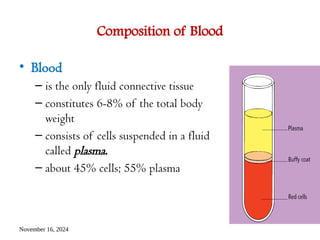
Composition of Blood
• Blood
– is the only fluid connective tissue
– constitutes 6-8% of the total body
weight
– consists of cells suspended in a fluid
called plasma.
– about 45% cells; 55% plasma
November 16, 2024
Erythrocytes (Red Blood Cells)
• Are the most numerous cells in the blood
• Their primary function is gas exchange.
• are non-nucleated cells containing few organelles
• a large proportion of their cytoplasm consists of
the iron containing oxygen transport molecule
hemoglobin.
November 16, 2024
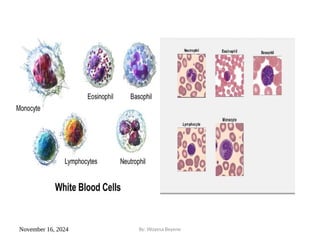
Leukocytes (White Blood Cells)
• Leukocytes are :
– a heterogeneous group of nucleated cells
– responsible for the body’s defenses mechanism
• The normalWBC count is ~4,000 to 10,000/L (4.0–10.0 x
103
/L)
• Leukocytes are usually divided into:
– Granulocytes, which have specific granules
– Neutrophils
– Eosinophils
– Basophils
– Agranulocytes, which lack specific granules
– Lymphocytes
– Monocytes
November 16, 2024 By: Woyesa Beyene
November 16, 2024
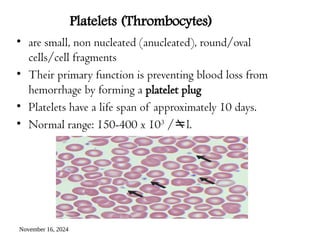
Platelets (Thrombocytes)
• are small, non nucleated (anucleated), round/oval
cells/cell fragments
• Their primary function is preventing blood loss from
hemorrhage by forming a platelet plug
• Platelets have a life span of approximately 10 days.
• Normal range: 150-400 x 103
/l.
November 16, 2024
Blood Sample Collection
What are the types of blood sample collection?
1. Capillary blood collection
• Also referred to as micro blood Sample
collection/dermal puncture
• Is collecting blood from the capillaries after an incision is
made to the skin with a lancet (finger pricking)
• Preferred only when small quantities of blood are
required
• E.g. for Hgb quantification and for blood film
preparation
November 16, 2024
Capillary blood collection cont’d
Sites of puncture
For Adults and children
• Palmer surface of the tip of the ring finger or
middle finger or free margin of the ear lobe
For Infants
• plantar surface of the big toe or the heel is a
preferred site for collection of capillary blood
November 16, 2024
2.Venous Blood Collection
 Also known as Venipuncture
 Is a collection of blood from the veins
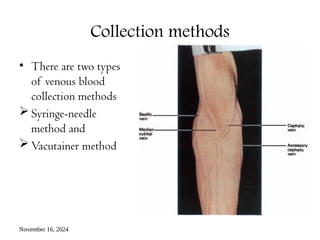
The three main veins( Areas of venipuncture) in the forearm
of an adult are
1. Median cubital vein- First choice for venipuncture -well
anchored and easy to penetrate
2. Cephalic vein- on the outside surface
- well anchored
3. Basilic vein- not well anchored, tends to roll, painful and
can cause nerve damage
November 16, 2024
Collection methods
• There are two types
of venous blood
collection methods
 Syringe-needle
method and
 Vacutainer method
November 16, 2024
Basic hematological tests
• Cell counts (WBC and RBCs)
• Determination of hemoglobin
• Determination of PCV(hematocrit)
• Red cell sedimentation rate (ESR)
• Calculating red cell indices
November 16, 2024
CELL COUNTS
• The manual counting involves:
– Diluting the blood specimen
– Loading it into a special counting chamber known as a
Hemocytometer
– Counting the cells
• Automated cell count involves:
– Giving sample to the analyzer
– Process automatically
– Can give about 25 parameters with a single process
November 16, 2024
White Blood Cell (WBC) Count
i. aboutWBC count
• Is the number of white cells in 1 liter (L) of whole blood
ii. Significance of WBC count:
– to investigate infections and unexplained fever
– to follow prognosis and
– to monitor treatments, which can cause leukopenia
iii. Principle
• Whole blood is diluted 1 in 20 in an acid reagent
• Mature red cells are hemolysed, leaving the white cells to be counted
• White cells are counted
• The number of WBCs per liter or per microlitre of blood is calculated
November 16, 2024
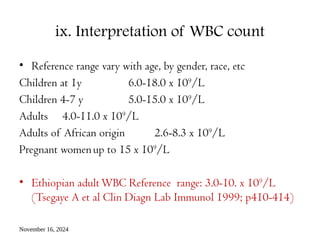
ix. Interpretation of WBC count
• Reference range vary with age, by gender, race, etc
Children at 1y 6.0-18.0 x 10⁹
/L
Children 4-7 y 5.0-15.0 x 10⁹
/L
Adults 4.0-11.0 x 10⁹
/L
Adults of African origin 2.6-8.3 x 10⁹
/L
Pregnant womenup to 15 x 109
/L
• Ethiopian adultWBC Reference range: 3.0-10. x 109
/L
(Tsegaye A et al Clin Diagn Lab Immunol 1999; p410-414)
November 16, 2024
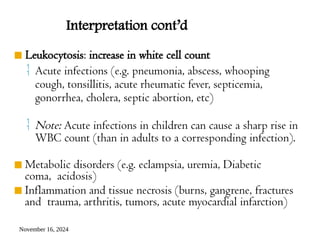
◾ Leukocytosis: increase in white cell count
 Acute infections (e.g. pneumonia, abscess, whooping
cough, tonsillitis, acute rheumatic fever, septicemia,
gonorrhea, cholera, septic abortion, etc)
 Note: Acute infections in children can cause a sharp rise in
WBC count (than in adults to a corresponding infection).
◾ Metabolic disorders (e.g. eclampsia, uremia, Diabetic
coma, acidosis)
◾ Inflammation and tissue necrosis (burns, gangrene, fractures
and trauma, arthritis, tumors, acute myocardial infarction)
Interpretation cont’d
November 16, 2024
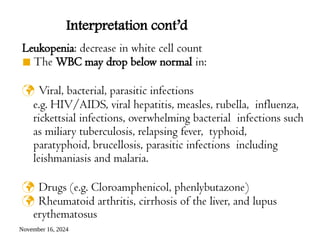
Leukopenia: decrease in white cell count
◾ The WBC may drop below normal in:
 Viral, bacterial, parasitic infections
e.g. HIV/AIDS, viral hepatitis, measles, rubella, influenza,
rickettsial infections, overwhelming bacterial infections such
as miliary tuberculosis, relapsing fever, typhoid,
paratyphoid, brucellosis, parasitic infections including
leishmaniasis and malaria.
 Drugs (e.g. Cloroamphenicol, phenlybutazone)
 Rheumatoid arthritis, cirrhosis of the liver, and lupus
erythematosus
Interpretation cont’d
November 16, 2024
Red Blood Cell (RBC) count
i. About RBC count: is the total number of red cells in 1Litre of whole
blood
ii. Significance of RBC count
– is used to diagnose anemia
– to know the number of RBCs in other pathological conditions
and
– during normal physiological conditions
iii. Principle
– A sample of blood is diluted with a diluent that maintains
(preserves) the disc-like shape of the red cells and prevents
agglutination
– Diluted specimen is loaded in a counting chamber and the cells
are counted
November 16, 2024
ix. Interpretation of RBC count
• Normal values
– Females 3.6 – 5.6 x 10¹²
/L
– Males 4.2 – 6.0 x 10¹²
/L
• The newborn shows an RBC of 5.0 – 6.5 x 10¹²
/L at birth
which gradually decreases to 3.5 to 5.1 x 10¹²
/L at 1 year of age
• RBC count is increased in:
– Polycythemia vera
– Secondary polycythemia due to other causes such as
dehydration and the effect of altitude
• RBC counts below Normal in:
– anemia
– secondary to other disorders
November 16, 2024
Platelet count
i. About platelet count
– Is the total number of platelets per liter of whole
blood
ii. Clinical significance of Platelet count
– to investigate bleeding disorders,
iii. Principle
• Blood is diluted 1 in 20 in a filtered solution of 1%
ammonium oxalate reagent which lyses the red cells
• Platelets are counted microscopically using an Improved
Neubauer ruled counting chamber
• the number of platelets per liter of blood calculated
November 16, 2024
ix. Interpretation of platelet count
• Reference range
– 150-400 x 109
platelets per liter of blood
– Ethiopian: 98 – 337 x 109/L ((Tsegaye A et al Clin
Diagn Lab Immunol 1999; p410-414)
November 16, 2024
Interpretation cont’d
Thrombocytosis
The main causes for an increase in PLT numbers include:
• Chronic myeloproliferative diseases:
– essential thrombocythemia
– polycythaemia vera
– chronic myelogenous leukemia
– myelofibrosis.
• Following splenoctomy
• Chronic inflammatory disease, e.g. tuberculosis
• Hemorrhage
November 16, 2024
Interpretation cont’d
Thrombocytopenia
The main causes for a reduction in platelet numbers are:
• Thrombocytopenic purpura
• Aplastic anemia
• Acute leukemia
• Gaucher’s disease
• Infections, e.g. typhoid and other septicemias
• Deficiency of folate or vitamin B12
• Following chemotherapy and radiation
November 16, 2024
Differential count
i. About Differential white cell count:
– Is the enumeration of the relative proportions
(percentages) of the various types of white cells as seen
in stained blood films
• A smear is examined and each time a leukocyte is seen, it is
both tabulated and classified on a special counter
• The counting and classifying continues until 100 cells have
been observed
November 16, 2024
Diff count cont’d
• The differential cell count also includes:
– an evaluation of RBC morphology,
– platelet morphology and numbers, and
– generalWBC morphology and estimation
• Is used to determine the relative numbers of each type of
leukocyte i.e
- Neutrophils - Monocyte
- Eosinophils - Lymphocyte
- Basophils
November 16, 2024
Neutrophils
• are the most common type of WBCs in adults
• The segmented neutrophils “segs,” also called
polymorphonuclear leukocytes [PMNs or
“polys”]
• are the primary defense against bacterial
infection
November 16, 2024
Interpretation
Neutrophilia/neutrophilic leucocytosis:
– An increase in the number of circulating neutrophils
above normal (>2.0-7.0 x 10⁹
/L)
– Overwhelming infections
– Metabolic disorders: uremia, diabetic acidosis
– Hematological disorders: myelogenous leukemia
November 16, 2024
Interpretation cont’d
Neutropenia:
• A reduction of the absolute neutrophil count below 2.0 x
109
/L
– Myeloid hypoplasia
– Drugs (chloramphenicol, phenylbutazone)
– Ionizing radiation
November 16, 2024
Eosinophils
• They are involved in allergic reactions and in combating
helminthic infections.
• Normal range: 40-400/l.
• Increase in their number (eosinophilia) is associated with
allergic reactions and helminthiasis.
November 16, 2024
Interpretation
Eosinophilia:
– an eosinophil count above 0.5 x 10⁹
/L
– Occurs during:
• Allergic diseases: bronchial asthma, seasonal rhinitis
• Intestinal parasitic infections: e.g. trichinosis, taeniasis
• Chronic myelogenous leukemia
Eosinopenia:
– an eosinophil count below 0.04 x 10⁹
/L
– Occurs during:
• Acute stress due to secretion of adrenal
glucocorticoid and epinephrine
• Acute inflammatory states
November 16, 2024
Basophils
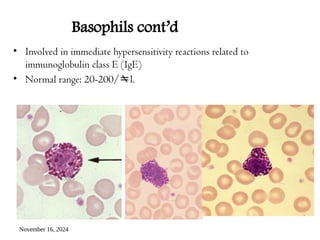
• are the least common type of leukocytes, normally
≤1% of totalWBCs.
• The granules contain:
– heparin (an anticoagulant),
– histamine (a fast vasodilator),
– the slow-reacting substance of anaphylaxis (a
slow vasodilator), and other compounds.
November 16, 2024
Basophils cont’d
• Involved in immediate hypersensitivity reactions related to
immunoglobulin class E (IgE)
• Normal range: 20-200/l.
November 16, 2024
Interpretation
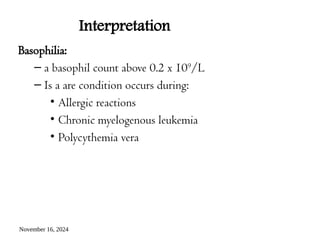
Basophilia:
– a basophil count above 0.2 x 10⁹
/L
– Is a are condition occurs during:
• Allergic reactions
• Chronic myelogenous leukemia
• Polycythemia vera
November 16, 2024
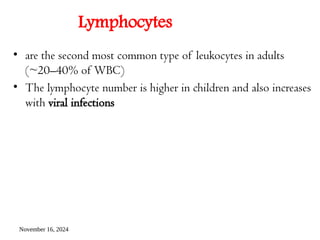
Lymphocytes
• are the second most common type of leukocytes in adults
(~20–40% of WBC)
• The lymphocyte number is higher in children and also increases
with viral infections
November 16, 2024
Interpretation
Lymphocytosis:
– absolute lymphocyte count above 4.0 x 10⁹
/L in adults
and above 8.0 x 10⁹
/L in children.
– Seen during
• Infectious lymphocytosis associated with virus such
as Epstein-Barr virus, cytomegalovirus
• Acute and chronic lymphocytic leukemia
• Toxoplasmosis
November 16, 2024
Interpretation cont’d
Lymphocytopenia:
– a lymphocyte count below 1.0 x 10⁹/l in adults and below
3.0 x 10⁹/l in children
– Seen in
• Immune deficiency disorders: HIV/AIDS
• Drugs, radiation therapy
Atypical lymphocytes:
– Large cell; abundant pale blue cytoplasm with peripheral
basophilia, may have azurophilic granules
– They are primarily seen in
• infectious mononucleosis which is an acute, self-limiting
infectious disease of the reticuloendothelial tissues,
especially the lymphatic tissues
November 16, 2024
Monocytes
• Are the largest white cells
• Normally comprise ~2 to 8% of leukocytes
• After 8 to 14 hours in the blood, they enter tissue to
become tissue macrophages (also called histiocytes)
November 16, 2024
Monocytes cont’d
• Monocytes have two functions:
1. Phagocytosis of microorganisms (particularly fungi and
mycobacteria) and debris
2. Antigen processing and presentation. In this role, they
are critical in initiation of immune reactions
• Normal range: 700-1500/l.
• Monocytosis is seen in bacterial infections (e.g.,
tuberculosis) and protozoan infections.
November 16, 2024
Interpretation
Monocytosis:
– a monocyte count above 1.0 x 10⁹/l
– Occurs during
• Recovery from acute infections
• Tuberculosis
• Monocytic leukemia
Monocytopenia:
– a monocyte count below 0.2 x 10⁹/l
– Occurs during
• Treatment with prednisone
• Hairy cell leukemia
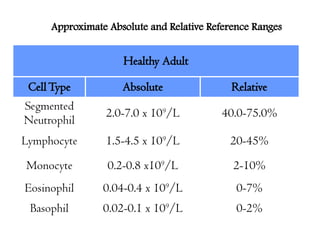
Approximate Absolute and Relative Reference Ranges
Healthy Adult
CellType Absolute Relative
Segmented
Neutrophil
2.0-7.0 x 10⁹
/L 40.0-75.0%
Lymphocyte 1.5-4.5 x 10⁹
/L 20-45%
Monocyte 0.2-0.8 x10⁹
/L 2-10%
Eosinophil 0.04-0.4 x 10⁹
/L 0-7%
Basophil 0.02-0.1 x 10⁹
/L 0-2%
November 16, 2024
Determination of hemoglobin
Structure of Hemoglobin
 Hemoglobin is an iron containing oxygen transport molecule
which is normally present in red cells only
• Two primary structures
– Globin
– Heme which is composed of
• Protoporphyrin
• Iron
• The heme structure consists of a ring of C, H and N atoms
called Protoporphyrin IX with an atom of Ferrous ( Fe 2+)
iron attached ( ferroprotoporphyrin).
November 16, 2024
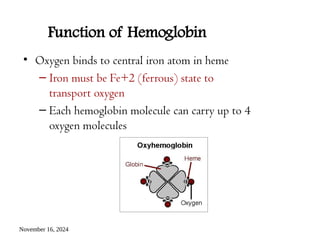
Function of Hemoglobin
• Oxygen binds to central iron atom in heme
– Iron must be Fe+2 (ferrous) state to
transport oxygen
– Each hemoglobin molecule can carry up to 4
oxygen molecules
November 16, 2024
Methods of Hemoglobin Measurement
(1) Spectrophotometric
a) Cyanmethemoglobin
b) Hemo-Cue
c) Oxyhemoglobin
d) Direct Read- Out
(2.)Visual comparative method
a)Sahli - Hellinge method
b)BMS Hemoglobinometry
( 3) Cu SO4 specific gravity
•Is the measurement of concentration of Hgb in red cells
(whole blood)
•Hgb is reported in g/dL
•There are different methods
November 16, 2024
Cont’d
Reference range
• Adult males 12-18g/dl
• Adult females 11-16g/dl
• New born 14-23g/dl
Note : reference values vary with age , sex, physiologic condition,
altitude.
November 16, 2024
Packed cell volume (PCV)
i. Definition
• Commonly referred to as hematocrit
• is a measure of the ratio of the volume occupied by the red
cells to the volume of whole blood in a sample of capillary
or venous blood
• The ratio is measured after appropriate centrifugation
• Expressed as a decimal fraction (in l/l) or as a percentage
(%).
November 16, 2024
PCV cont’d
• Buffy coat is
composed of
WBC and
platelets
November 16, 2024
Hematocrit Determination cont’d
Significance of the test
• Enables the calculation of the red cell indices that are
widely used in the classification of anemias.These are:
– Mean cell volume (MCV),
– Mean cell Hb concentration (MCHC) and
• To screen for anemia when it is not possible to measure
hemoglobin, and
• To diagnose polycythemia vera and to monitor its
treatment.
November 16, 2024
Hematocrit Determination
Methods
• Macro method
– Wintrobe
• Micro methods
– Adams microhematocrit method
– Most applicable
• Electronic method
– based on the principle that the average red cell volume is
determined, the red cell count made , and the hematocrit
found by calculation e.g. coulter counter
November 16, 2024
Interpretation
• Reference range varies between age, gender and altitude
Children at birth 44-54%
Children 2-5 years 34-40%
Children 6-12 years 35-45%
Adult men 40-54%
Adult women 36-46
Ethiopia: Adult Males 41.6 – 55.1%
Adult Females 35.3 – 48.8%
 Decreased PCV value can be seen in Anemia
 Increased PCV value can be seen in polycythemia vera
November 16, 2024
Red cell Indices
• The red cell indices:
– are absolute values calculated from:
• the measured hemoglobin,
• PCV
• RBC count
– are of considerable clinical importance in the diagnosis
and classification of anemia
– are dependent upon the accuracy of the various red cell
parameter estimations
November 16, 2024
Introduction cont’d
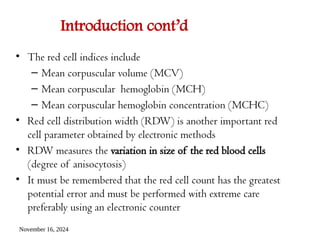
• The red cell indices include
– Mean corpuscular volume (MCV)
– Mean corpuscular hemoglobin (MCH)
– Mean corpuscular hemoglobin concentration (MCHC)
• Red cell distribution width (RDW) is another important red
cell parameter obtained by electronic methods
• RDW measures the variation in size of the red blood cells
(degree of anisocytosis)
• It must be remembered that the red cell count has the greatest
potential error and must be performed with extreme care
preferably using an electronic counter
November 16, 2024
The Mean Cell Volume (MCV)
• Is the average volume occupied by a single red blood cell,
expressed in femto litres (fL)
• Femtoliter is 10-15
of a liter
• MCV is obtained by dividing the PCV by red cell number
• MCV (fl) = PCV (l/l)
No. of RBC/L
Example: PCV = 0.45(l/l)
RBC = 5  1012/l
MCV = 0.45 (l/l) = 90  10-15 = 90fl
5  1012
November 16, 2024
MCV in general term means the relative size
of RBC
55
November 16, 2024
Interpretation
NormalValues
– Men andWomen: 80-100 fl
• MCV
– increased in
• macrocytic anemias
– decreased in
• iron deficiency anemia
• Thalassemia
• Other microcytic anemia
November 16, 2024
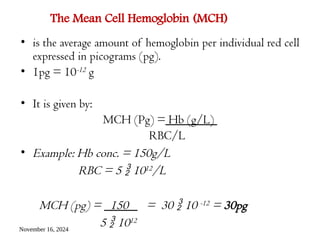
The Mean Cell Hemoglobin (MCH)
• is the average amount of hemoglobin per individual red cell
expressed in picograms (pg).
• 1pg = 10-12 g
• It is given by:
MCH (Pg) = Hb (g/L)
RBC/L
• Example: Hb conc. = 150g/L
RBC = 5  1012/L
MCH (pg) = 150 = 30  10 -12 = 30pg
5  1012
November 16, 2024 58
November 16, 2024
Interpretation
• NormalValue: Men and women: 27-31 pg
• MCH is increased in
– macrocytic anemia
• MCH is decreased in - microcytic anemia
- iron deficiency anemia
November 16, 2024
The Mean Cell Hemoglobin Concentration (MCHC)
• Is the average hemoglobin per unit volume of red cells.
MCHC (g/l) = Hb (g/L)
PCV (L/L)
• Example: Hb conc. = 148g/L
PCV = 0.45 (L/L)
MCHC = 148 = 328g/L
0.45
November 16, 2024 61
November 16, 2024
Interpretation
• NormalValues: Men and women: 32-36 % (320-360 g/L)
• MCHC is increased in some cases of hereditary
spherocytosis
• MCHC is decreased in iron deficiency anemia
November 16, 2024
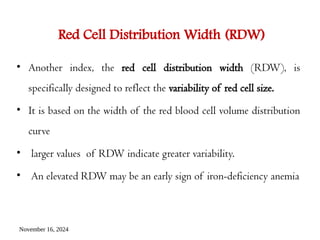
Red Cell Distribution Width (RDW)
• Another index, the red cell distribution width (RDW), is
specifically designed to reflect the variability of red cell size.
• It is based on the width of the red blood cell volume distribution
curve
• larger values of RDW indicate greater variability.
• An elevated RDW may be an early sign of iron-deficiency anemia
November 16, 2024 64
November 16, 2024
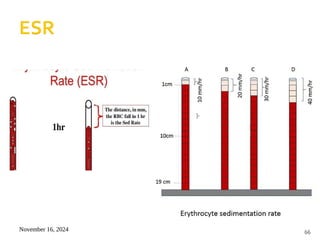
Erythrocyte Sedimentation rate/ESR/
i. Definition
• Erythrocyte sedimentation rate is the rate of fall (sedimentation) of
red cells when an anticoagulated blood is allowed to stand
undisturbed for a specified period of time, usually 1 hour. The rate
is expressed in mm/hr.
• It is:
– a non specific test
– used as an index of the presence and extent of inflammation
(the so-called 'acute phase response' ) and its response to
treatment, e.g., tuberculosis, rheumatoid arthritis.
November 16, 2024 66
November 16, 2024
ii. Significance of Measuring the ESR
• Normal ESR cannot be taken to exclude the presence of organic
disease
• Majority of acute or chronic infections and most neoplastic and
degenerative diseases are associated with changes in the plasma
proteins which lead to an acceleration of the sedimentation rate.
November 16, 2024
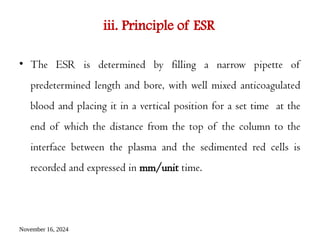
iii. Principle of ESR
• The ESR is determined by filling a narrow pipette of
predetermined length and bore, with well mixed anticoagulated
blood and placing it in a vertical position for a set time at the
end of which the distance from the top of the column to the
interface between the plasma and the sedimented red cells is
recorded and expressed in mm/unit time.
November 16, 2024
Normal Range:
Men: 0-15mm/hr
Women: 0-20mm/hr
Factors which can affect rate of the
sedimentation of red cells are:
 Plasma protein, temperature, mechanical
influences(vibration, degree of inclination), effect of
plasma viscosity, effect of RBCs
69
BLOOD CELL DISORDERS AND
HEMOSTASIS
Anemia
Definition of Anemia
• Anemia is a decrease in the RBC count, Hgb
and/or HCT values as compared to normal
reference range for age and sex
• Anemia is functionally defined as a decrease in
the competence of blood to carry oxygen to
tissues, thereby causing tissue hypoxia.
• Anemia is not a disease but the expression of an
underlying disorder or disease.
Symptoms cont’d
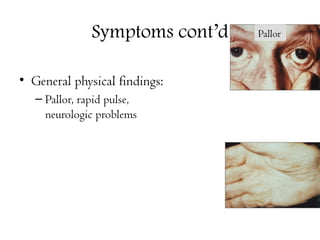
• General physical findings:
– Pallor, rapid pulse,
neurologic problems
Pallor
Morphological Categories of Anemia
• Morphological classification is based on how the cells
appear on a stained smear and should correspond with the
red cell indices.
– Normocytic Normochromic (NCNC): anemia due to
decrease in the number of erythrocytes
• e.g. aplastic anemia, or acute blood loss
– Microcytic hypochromic
– Macrocytic Normochromic
Morphologic Categories of Anemia cont’d
1. Microcytic Hypochromic Anemia
– low MCH
– low MCV
 These include:
1. Iron deficiency anemia
2. Sideroblastic anemia
3. Thalassemias
4. Anemia of chronic disease (rare cases)
Morphologic Categories of Anemia cont’d
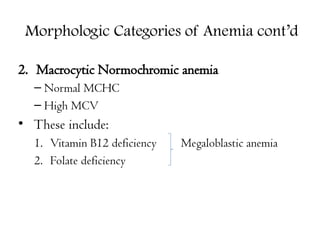
2. Macrocytic Normochromic anemia
– Normal MCHC
– High MCV
• These include:
1. Vitamin B12 deficiency Megaloblastic anemia
2. Folate deficiency
Morphologic Categories of Anemia cont’d
3. Normocytic Normochromic (NCNC) anemia
– Normal MCV
– Normal MCHC
– Normal MCH
• These include:
1. Anemia of acute hemorrhage
2. Aplastic anemias (those characterized by disappearance of
RBC precursors from the marrow)
3. Hemolytic anemias (those characterized by accelerated
destruction of RBC’s)
1 Microcytic/hypochromic
3
1 2
2 Macrocytic/normochromic
3 Normocytic/normochromic
Morphologic Categories of Anemia
N.B. The nucleus of a small
lymphocyte (shown by the arrow)
is used as a reference to a normal
red cell size
Microcytic/Hypochromic Anemia
• Characterized by impaired hemoglobin synthesis
IDA
ACD
Sideroblastic
anemia
Thalassemia ( or)
Iron Deficiency Anemia (IDA)
• Is a condition in which the total body iron content is
decreased below a normal level
• This results in a reduced red blood cell and hemoglobin
production
• Causes:
– Nutritional deficiency
– Malabsorption (insufficient or defective absorption)
– Inefficient transport, storage or utilization of iron
– Increased need
– Chronic blood loss (GI bleeding, ulcer, heavy menstruation, etc)
Lab Investigation cont’d
• Total Iron Binding Capacity (TIBC)
– Is an indirect measure of the amount of transferrin
protein in the serum
– Inversely proportional to the serum iron level
• If serum iron is decreased, total iron binding capacity
of transferrin increased (transferrin has more empty
space to carry iron)
Lab Investigation cont’d
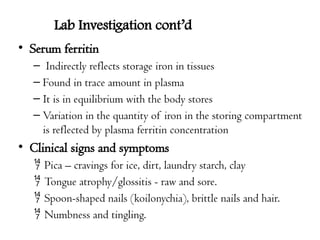
• Serum ferritin
– Indirectly reflects storage iron in tissues
– Found in trace amount in plasma
– It is in equilibrium with the body stores
– Variation in the quantity of iron in the storing compartment
is reflected by plasma ferritin concentration
• Clinical signs and symptoms
 Pica – cravings for ice, dirt, laundry starch, clay
 Tongue atrophy/glossitis - raw and sore.
 Spoon-shaped nails (koilonychia), brittle nails and hair.
 Numbness and tingling.
Iron Deficiency Anemia
• Lab findings
– Low RBC, Hgb, Hct
– Low MCV, MCH, MCHC
– NormalWBC and PLT
Blood smear
IDA cont’d
• Treatment
– Identify the underlying cause
– Oral iron is given; see increased Retic count post-therapy.
– May see dimorphism following treatment
• A dual red cell population with older microcytic red
cells along with the newly produced normocytic red
cells.
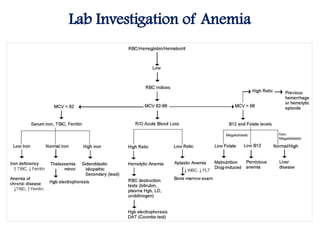
Lab Investigation of Anemia
Leukemia
• The leukemias are a group of disorders characterized by the
accumulation of abnormal white cells in the bone marrow
“or”
• The clonal leukocyte disorders result from acquired
mutations of DNA within a multipotential marrow cell or
very early progenitor cell.
• Hematopoietic neoplasms are believed to occur as the result
of a somatic mutation of a single hematopoietic stem or
progenitor cell.
Causes of Leukemia
Viruses such as epstein-Barr virus, associated with Burkitt's
lymphoma, humanT-cell lymphotropic virus type I,
associated with some T-cell leukemias and lymphomas
Exposure to ionizing radiation and certain chemicals (e.g.,
benzene, some anti-neoplastic drugs) is associated with an
increased risk of leukemia
Some genetic defects (e.g., Down syndrome, Fanconi's
anemia) also predispose to leukemia
Classification of leukemia
The main classification is into acute and chronic leukemia
On the basis of morphology and cytochemistry, acute
leukemia is further subdivided into:
 Acute myeloid (myeloblastic/myelogenous) leukemia
(AML)
 Acute lymphoblastic (lymphocytic) leukemia (ALL)
AML is further subdivided into eight variants on a
morphological basis according to the French-American-
British (FAB) scheme (M0 – M7)
Classification of Leukemia cont’d
ALL is subdivided on a morphological basis according to
the French-American-British (FAB) classification into L1,
L2, and L3
The chronic leukemias comprise two main types:
 Chronic myeloid leukemia (CML)
 Chronic lymphocytic (lymphatic) leukemia (CLL)
Other chronic types include:
 Hairy cell leukemia
 Prolymphocytic leukemia
 Various leukemia/lymphoma syndromes
Classification of Leukemia cont’d
Incidence
• Acute leukemias can occur in all age groups
– ALL is more common in children
–AML is more common in adults
• Chronic leukemias are usually a disease of adults
–CLL is extremely rare in children and unusual before
the age of 40
–CML has a peak age of 30-50
Classification of Leukemia cont’d
Comparison of acute and chronic leukemias:
Acute Chronic
Age all ages usually adults
Clinical onset sudden insidious
Course (untreated) 6 mo. or less 2-6 years
Leukemic cells immature >30% blasts more mature cells
Anemia prominent mild
Thrombocytopenia prominent mild
WBC count variable increased
Lymphadenopathy mild present;often prominent
Splenomegaly mild present;often prominent
Laboratory investigation for leukemia
 The lab diagnosis is based on this things
– Finding a significant increase in the number of immature cells in
the bone marrow including blasts, promyelocytes, promonocytes
(>20% blasts is diagnostic) in acute leukemia
– Finding a significant increase in mature but abnormal leukocyte
(>30x109
/l) in chronic leukemia
– Identification of the cell lineage of the leukemic cells
 Peripheral blood:
• Anemia (normochromic, normocytic)
• Decreased platelets
• VariableWBC count
– The degree of peripheral blood involvement determines
classification:
» increasedWBCs due to blasts
» blasts without increasedWBCs
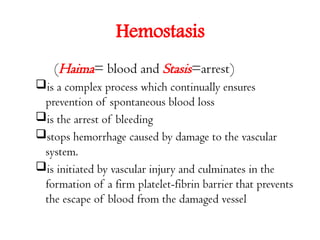
Hemostasis
(Haima= blood and Stasis=arrest)
is a complex process which continually ensures
prevention of spontaneous blood loss
is the arrest of bleeding
stops hemorrhage caused by damage to the vascular
system.
is initiated by vascular injury and culminates in the
formation of a firm platelet-fibrin barrier that prevents
the escape of blood from the damaged vessel
Phases
Generally, this is described as a three –phase
process
Division is arbitrary since the various
phenomena are strongly interrelated:
»I primary hemostasis
»II coagulation
»III fibrinolysis
Phases cont’d
I. Primary hemostasis
 Involves the blood vessels and the platelet (thrombocytes)
Function of platelets
o Maintain the functional integrity of the endothelial surface
o When there is an injury platelets undergo the following
actions:
 Adhesion
 Release reaction
 Aggregation
 After 3 to 5 minutes , blood flow is arrested with the
formation of a platelet plug.
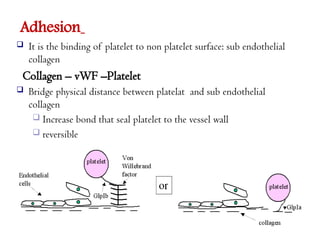
Adhesion
 It is the binding of platelet to non platelet surface: sub endothelial
collagen
Collagen – vWF –Platelet
 Bridge physical distance between platelat and sub endothelial
collagen
 Increase bond that seal platelet to the vessel wall
 reversible
Release reaction
 It is release of contents of the granules of platelet
 Primarily ADP  stimulates aggregation
 Cathecolamine (especially epinephrine) and serotonin enhance
vasoconstriction
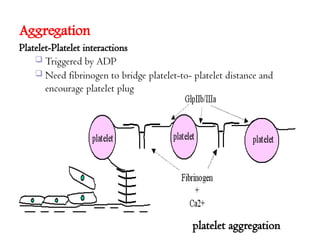
Aggregation
platelet aggregation
Platelet-Platelet interactions
 Triggered by ADP
 Need fibrinogen to bridge platelet-to- platelet distance and
encourage platelet plug
Phases cont’d
II. Coagulation
In the coagulation or plasma phase , blood changes
from the fluid state to the gelled state , a result of the
transformation of a soluble protein , fibrinogen , into
an insoluble protein , fibrin .
o Involves
• plasma coagulation factors (plasma phase)
• platelet factor 3
• provides for definitive hemostasis
o Takes 5 to 10 minutes by formation of fibrin
• reinforces the platelet plug.
• The coagulation cascade
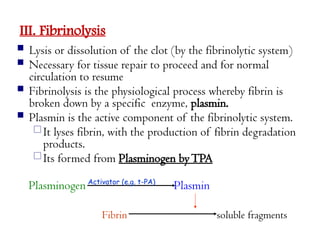
III. Fibrinolysis
 Lysis or dissolution of the clot (by the fibrinolytic system)
 Necessary for tissue repair to proceed and for normal
circulation to resume
 Fibrinolysis is the physiological process whereby fibrin is
broken down by a specific enzyme, plasmin.
 Plasmin is the active component of the fibrinolytic system.
It lyses fibrin, with the production of fibrin degradation
products.
Its formed from Plasminogen byTPA
Plasminogen Plasmin
Activator (e.g. t-PA)
Fibrin soluble fragments
Laboratory investigation of bleeding and
coagulation disorders
BleedingTime
Coagulation time
Platelet count
Clot retraction time
 Prothrombin time (PT)
 Activated PartialThromboplastinTime (APTT)
TheThrombin time
 Fibrinogen quantitative assays
Prothrombin time (PT)
• PT is the time required for plasma to clot after an optimal
amount of tissue thromboplastin and calcium chloride have
been added to trigger the coagulation process.
• To diagnose deficiencies in the coagulation factors of the
extrinsic system
• Especially useful for initiation and monitoring of oral
anticoagulant therapy to adjust the dose.
• Normal values range from 10-13 sec.
Activated Partial Thromboplastin Time (APTT)
• Major screening test for coagulation disorders in the
intrinsic system
• Especially for sensitive detection of factorsVIII and IX and
the contact factors (except for platelets and factor XIII)
• Also a method of choice for monitoring heparin therapy
• Reference range is 25–36 sec.

CH 2 basic hematological tests.pptx clinical

  • 1.
    CHAPTER TWO BASIC HEMATOLOGICALTESTS By: Eyuel Getnet (MLS)
  • 2.
    November 16, 2024 Objectives: Atthe end of this chapter students should be able to: • Explain the composition of blood • Describe the formation of blood • Indicate the site of formation of blood in infancy, childhood and adulthood • Perform basic hematological tests
  • 3.
    November 16, 2024 outline •Definition of hematology • Composition of blood • Sample collection • Hemocytometry (blood cell counting) • Hemoglobin determination • Determination of PCV • Red cell sedimentation rate(ESR) • Red cell indices
  • 4.
    November 16, 2024 Hematology Definitionof hematology  Derived from Greek terms, Haima means blood and logos means study/discourse Hence hematology is the science or study of blood It encompasses :  The study of blood cells and coagulation factors  Analysis of concentration, structure and functions of cells in blood and their precursors in the bone marrow
  • 5.
    November 16, 2024 Compositionof Blood • Blood – is the only fluid connective tissue – constitutes 6-8% of the total body weight – consists of cells suspended in a fluid called plasma. – about 45% cells; 55% plasma
  • 6.
    November 16, 2024 Erythrocytes(Red Blood Cells) • Are the most numerous cells in the blood • Their primary function is gas exchange. • are non-nucleated cells containing few organelles • a large proportion of their cytoplasm consists of the iron containing oxygen transport molecule hemoglobin.
  • 7.
    November 16, 2024 Leukocytes(White Blood Cells) • Leukocytes are : – a heterogeneous group of nucleated cells – responsible for the body’s defenses mechanism • The normalWBC count is ~4,000 to 10,000/L (4.0–10.0 x 10³ /L) • Leukocytes are usually divided into: – Granulocytes, which have specific granules – Neutrophils – Eosinophils – Basophils – Agranulocytes, which lack specific granules – Lymphocytes – Monocytes
  • 8.
    November 16, 2024By: Woyesa Beyene
  • 9.
    November 16, 2024 Platelets(Thrombocytes) • are small, non nucleated (anucleated), round/oval cells/cell fragments • Their primary function is preventing blood loss from hemorrhage by forming a platelet plug • Platelets have a life span of approximately 10 days. • Normal range: 150-400 x 103 /l.
  • 10.
    November 16, 2024 BloodSample Collection What are the types of blood sample collection? 1. Capillary blood collection • Also referred to as micro blood Sample collection/dermal puncture • Is collecting blood from the capillaries after an incision is made to the skin with a lancet (finger pricking) • Preferred only when small quantities of blood are required • E.g. for Hgb quantification and for blood film preparation
  • 11.
    November 16, 2024 Capillaryblood collection cont’d Sites of puncture For Adults and children • Palmer surface of the tip of the ring finger or middle finger or free margin of the ear lobe For Infants • plantar surface of the big toe or the heel is a preferred site for collection of capillary blood
  • 12.
    November 16, 2024 2.VenousBlood Collection  Also known as Venipuncture  Is a collection of blood from the veins The three main veins( Areas of venipuncture) in the forearm of an adult are 1. Median cubital vein- First choice for venipuncture -well anchored and easy to penetrate 2. Cephalic vein- on the outside surface - well anchored 3. Basilic vein- not well anchored, tends to roll, painful and can cause nerve damage
  • 13.
    November 16, 2024 Collectionmethods • There are two types of venous blood collection methods  Syringe-needle method and  Vacutainer method
  • 14.
    November 16, 2024 Basichematological tests • Cell counts (WBC and RBCs) • Determination of hemoglobin • Determination of PCV(hematocrit) • Red cell sedimentation rate (ESR) • Calculating red cell indices
  • 15.
    November 16, 2024 CELLCOUNTS • The manual counting involves: – Diluting the blood specimen – Loading it into a special counting chamber known as a Hemocytometer – Counting the cells • Automated cell count involves: – Giving sample to the analyzer – Process automatically – Can give about 25 parameters with a single process
  • 16.
    November 16, 2024 WhiteBlood Cell (WBC) Count i. aboutWBC count • Is the number of white cells in 1 liter (L) of whole blood ii. Significance of WBC count: – to investigate infections and unexplained fever – to follow prognosis and – to monitor treatments, which can cause leukopenia iii. Principle • Whole blood is diluted 1 in 20 in an acid reagent • Mature red cells are hemolysed, leaving the white cells to be counted • White cells are counted • The number of WBCs per liter or per microlitre of blood is calculated
  • 17.
    November 16, 2024 ix.Interpretation of WBC count • Reference range vary with age, by gender, race, etc Children at 1y 6.0-18.0 x 10⁹ /L Children 4-7 y 5.0-15.0 x 10⁹ /L Adults 4.0-11.0 x 10⁹ /L Adults of African origin 2.6-8.3 x 10⁹ /L Pregnant womenup to 15 x 109 /L • Ethiopian adultWBC Reference range: 3.0-10. x 109 /L (Tsegaye A et al Clin Diagn Lab Immunol 1999; p410-414)
  • 18.
    November 16, 2024 ◾Leukocytosis: increase in white cell count  Acute infections (e.g. pneumonia, abscess, whooping cough, tonsillitis, acute rheumatic fever, septicemia, gonorrhea, cholera, septic abortion, etc)  Note: Acute infections in children can cause a sharp rise in WBC count (than in adults to a corresponding infection). ◾ Metabolic disorders (e.g. eclampsia, uremia, Diabetic coma, acidosis) ◾ Inflammation and tissue necrosis (burns, gangrene, fractures and trauma, arthritis, tumors, acute myocardial infarction) Interpretation cont’d
  • 19.
    November 16, 2024 Leukopenia:decrease in white cell count ◾ The WBC may drop below normal in:  Viral, bacterial, parasitic infections e.g. HIV/AIDS, viral hepatitis, measles, rubella, influenza, rickettsial infections, overwhelming bacterial infections such as miliary tuberculosis, relapsing fever, typhoid, paratyphoid, brucellosis, parasitic infections including leishmaniasis and malaria.  Drugs (e.g. Cloroamphenicol, phenlybutazone)  Rheumatoid arthritis, cirrhosis of the liver, and lupus erythematosus Interpretation cont’d
  • 20.
    November 16, 2024 RedBlood Cell (RBC) count i. About RBC count: is the total number of red cells in 1Litre of whole blood ii. Significance of RBC count – is used to diagnose anemia – to know the number of RBCs in other pathological conditions and – during normal physiological conditions iii. Principle – A sample of blood is diluted with a diluent that maintains (preserves) the disc-like shape of the red cells and prevents agglutination – Diluted specimen is loaded in a counting chamber and the cells are counted
  • 21.
    November 16, 2024 ix.Interpretation of RBC count • Normal values – Females 3.6 – 5.6 x 10¹² /L – Males 4.2 – 6.0 x 10¹² /L • The newborn shows an RBC of 5.0 – 6.5 x 10¹² /L at birth which gradually decreases to 3.5 to 5.1 x 10¹² /L at 1 year of age • RBC count is increased in: – Polycythemia vera – Secondary polycythemia due to other causes such as dehydration and the effect of altitude • RBC counts below Normal in: – anemia – secondary to other disorders
  • 22.
    November 16, 2024 Plateletcount i. About platelet count – Is the total number of platelets per liter of whole blood ii. Clinical significance of Platelet count – to investigate bleeding disorders, iii. Principle • Blood is diluted 1 in 20 in a filtered solution of 1% ammonium oxalate reagent which lyses the red cells • Platelets are counted microscopically using an Improved Neubauer ruled counting chamber • the number of platelets per liter of blood calculated
  • 23.
    November 16, 2024 ix.Interpretation of platelet count • Reference range – 150-400 x 109 platelets per liter of blood – Ethiopian: 98 – 337 x 109/L ((Tsegaye A et al Clin Diagn Lab Immunol 1999; p410-414)
  • 24.
    November 16, 2024 Interpretationcont’d Thrombocytosis The main causes for an increase in PLT numbers include: • Chronic myeloproliferative diseases: – essential thrombocythemia – polycythaemia vera – chronic myelogenous leukemia – myelofibrosis. • Following splenoctomy • Chronic inflammatory disease, e.g. tuberculosis • Hemorrhage
  • 25.
    November 16, 2024 Interpretationcont’d Thrombocytopenia The main causes for a reduction in platelet numbers are: • Thrombocytopenic purpura • Aplastic anemia • Acute leukemia • Gaucher’s disease • Infections, e.g. typhoid and other septicemias • Deficiency of folate or vitamin B12 • Following chemotherapy and radiation
  • 26.
    November 16, 2024 Differentialcount i. About Differential white cell count: – Is the enumeration of the relative proportions (percentages) of the various types of white cells as seen in stained blood films • A smear is examined and each time a leukocyte is seen, it is both tabulated and classified on a special counter • The counting and classifying continues until 100 cells have been observed
  • 27.
    November 16, 2024 Diffcount cont’d • The differential cell count also includes: – an evaluation of RBC morphology, – platelet morphology and numbers, and – generalWBC morphology and estimation • Is used to determine the relative numbers of each type of leukocyte i.e - Neutrophils - Monocyte - Eosinophils - Lymphocyte - Basophils
  • 28.
    November 16, 2024 Neutrophils •are the most common type of WBCs in adults • The segmented neutrophils “segs,” also called polymorphonuclear leukocytes [PMNs or “polys”] • are the primary defense against bacterial infection
  • 29.
    November 16, 2024 Interpretation Neutrophilia/neutrophilicleucocytosis: – An increase in the number of circulating neutrophils above normal (>2.0-7.0 x 10⁹ /L) – Overwhelming infections – Metabolic disorders: uremia, diabetic acidosis – Hematological disorders: myelogenous leukemia
  • 30.
    November 16, 2024 Interpretationcont’d Neutropenia: • A reduction of the absolute neutrophil count below 2.0 x 10⁹ /L – Myeloid hypoplasia – Drugs (chloramphenicol, phenylbutazone) – Ionizing radiation
  • 31.
    November 16, 2024 Eosinophils •They are involved in allergic reactions and in combating helminthic infections. • Normal range: 40-400/l. • Increase in their number (eosinophilia) is associated with allergic reactions and helminthiasis.
  • 32.
    November 16, 2024 Interpretation Eosinophilia: –an eosinophil count above 0.5 x 10⁹ /L – Occurs during: • Allergic diseases: bronchial asthma, seasonal rhinitis • Intestinal parasitic infections: e.g. trichinosis, taeniasis • Chronic myelogenous leukemia Eosinopenia: – an eosinophil count below 0.04 x 10⁹ /L – Occurs during: • Acute stress due to secretion of adrenal glucocorticoid and epinephrine • Acute inflammatory states
  • 33.
    November 16, 2024 Basophils •are the least common type of leukocytes, normally ≤1% of totalWBCs. • The granules contain: – heparin (an anticoagulant), – histamine (a fast vasodilator), – the slow-reacting substance of anaphylaxis (a slow vasodilator), and other compounds.
  • 34.
    November 16, 2024 Basophilscont’d • Involved in immediate hypersensitivity reactions related to immunoglobulin class E (IgE) • Normal range: 20-200/l.
  • 35.
    November 16, 2024 Interpretation Basophilia: –a basophil count above 0.2 x 10⁹ /L – Is a are condition occurs during: • Allergic reactions • Chronic myelogenous leukemia • Polycythemia vera
  • 36.
    November 16, 2024 Lymphocytes •are the second most common type of leukocytes in adults (~20–40% of WBC) • The lymphocyte number is higher in children and also increases with viral infections
  • 37.
    November 16, 2024 Interpretation Lymphocytosis: –absolute lymphocyte count above 4.0 x 10⁹ /L in adults and above 8.0 x 10⁹ /L in children. – Seen during • Infectious lymphocytosis associated with virus such as Epstein-Barr virus, cytomegalovirus • Acute and chronic lymphocytic leukemia • Toxoplasmosis
  • 38.
    November 16, 2024 Interpretationcont’d Lymphocytopenia: – a lymphocyte count below 1.0 x 10⁹/l in adults and below 3.0 x 10⁹/l in children – Seen in • Immune deficiency disorders: HIV/AIDS • Drugs, radiation therapy Atypical lymphocytes: – Large cell; abundant pale blue cytoplasm with peripheral basophilia, may have azurophilic granules – They are primarily seen in • infectious mononucleosis which is an acute, self-limiting infectious disease of the reticuloendothelial tissues, especially the lymphatic tissues
  • 39.
    November 16, 2024 Monocytes •Are the largest white cells • Normally comprise ~2 to 8% of leukocytes • After 8 to 14 hours in the blood, they enter tissue to become tissue macrophages (also called histiocytes)
  • 40.
    November 16, 2024 Monocytescont’d • Monocytes have two functions: 1. Phagocytosis of microorganisms (particularly fungi and mycobacteria) and debris 2. Antigen processing and presentation. In this role, they are critical in initiation of immune reactions • Normal range: 700-1500/l. • Monocytosis is seen in bacterial infections (e.g., tuberculosis) and protozoan infections.
  • 41.
    November 16, 2024 Interpretation Monocytosis: –a monocyte count above 1.0 x 10⁹/l – Occurs during • Recovery from acute infections • Tuberculosis • Monocytic leukemia Monocytopenia: – a monocyte count below 0.2 x 10⁹/l – Occurs during • Treatment with prednisone • Hairy cell leukemia
  • 42.
    Approximate Absolute andRelative Reference Ranges Healthy Adult CellType Absolute Relative Segmented Neutrophil 2.0-7.0 x 10⁹ /L 40.0-75.0% Lymphocyte 1.5-4.5 x 10⁹ /L 20-45% Monocyte 0.2-0.8 x10⁹ /L 2-10% Eosinophil 0.04-0.4 x 10⁹ /L 0-7% Basophil 0.02-0.1 x 10⁹ /L 0-2%
  • 43.
    November 16, 2024 Determinationof hemoglobin Structure of Hemoglobin  Hemoglobin is an iron containing oxygen transport molecule which is normally present in red cells only • Two primary structures – Globin – Heme which is composed of • Protoporphyrin • Iron • The heme structure consists of a ring of C, H and N atoms called Protoporphyrin IX with an atom of Ferrous ( Fe 2+) iron attached ( ferroprotoporphyrin).
  • 44.
    November 16, 2024 Functionof Hemoglobin • Oxygen binds to central iron atom in heme – Iron must be Fe+2 (ferrous) state to transport oxygen – Each hemoglobin molecule can carry up to 4 oxygen molecules
  • 45.
    November 16, 2024 Methodsof Hemoglobin Measurement (1) Spectrophotometric a) Cyanmethemoglobin b) Hemo-Cue c) Oxyhemoglobin d) Direct Read- Out (2.)Visual comparative method a)Sahli - Hellinge method b)BMS Hemoglobinometry ( 3) Cu SO4 specific gravity •Is the measurement of concentration of Hgb in red cells (whole blood) •Hgb is reported in g/dL •There are different methods
  • 46.
    November 16, 2024 Cont’d Referencerange • Adult males 12-18g/dl • Adult females 11-16g/dl • New born 14-23g/dl Note : reference values vary with age , sex, physiologic condition, altitude.
  • 47.
    November 16, 2024 Packedcell volume (PCV) i. Definition • Commonly referred to as hematocrit • is a measure of the ratio of the volume occupied by the red cells to the volume of whole blood in a sample of capillary or venous blood • The ratio is measured after appropriate centrifugation • Expressed as a decimal fraction (in l/l) or as a percentage (%).
  • 48.
    November 16, 2024 PCVcont’d • Buffy coat is composed of WBC and platelets
  • 49.
    November 16, 2024 HematocritDetermination cont’d Significance of the test • Enables the calculation of the red cell indices that are widely used in the classification of anemias.These are: – Mean cell volume (MCV), – Mean cell Hb concentration (MCHC) and • To screen for anemia when it is not possible to measure hemoglobin, and • To diagnose polycythemia vera and to monitor its treatment.
  • 50.
    November 16, 2024 HematocritDetermination Methods • Macro method – Wintrobe • Micro methods – Adams microhematocrit method – Most applicable • Electronic method – based on the principle that the average red cell volume is determined, the red cell count made , and the hematocrit found by calculation e.g. coulter counter
  • 51.
    November 16, 2024 Interpretation •Reference range varies between age, gender and altitude Children at birth 44-54% Children 2-5 years 34-40% Children 6-12 years 35-45% Adult men 40-54% Adult women 36-46 Ethiopia: Adult Males 41.6 – 55.1% Adult Females 35.3 – 48.8%  Decreased PCV value can be seen in Anemia  Increased PCV value can be seen in polycythemia vera
  • 52.
    November 16, 2024 Redcell Indices • The red cell indices: – are absolute values calculated from: • the measured hemoglobin, • PCV • RBC count – are of considerable clinical importance in the diagnosis and classification of anemia – are dependent upon the accuracy of the various red cell parameter estimations
  • 53.
    November 16, 2024 Introductioncont’d • The red cell indices include – Mean corpuscular volume (MCV) – Mean corpuscular hemoglobin (MCH) – Mean corpuscular hemoglobin concentration (MCHC) • Red cell distribution width (RDW) is another important red cell parameter obtained by electronic methods • RDW measures the variation in size of the red blood cells (degree of anisocytosis) • It must be remembered that the red cell count has the greatest potential error and must be performed with extreme care preferably using an electronic counter
  • 54.
    November 16, 2024 TheMean Cell Volume (MCV) • Is the average volume occupied by a single red blood cell, expressed in femto litres (fL) • Femtoliter is 10-15 of a liter • MCV is obtained by dividing the PCV by red cell number • MCV (fl) = PCV (l/l) No. of RBC/L Example: PCV = 0.45(l/l) RBC = 5  1012/l MCV = 0.45 (l/l) = 90  10-15 = 90fl 5  1012
  • 55.
    November 16, 2024 MCVin general term means the relative size of RBC 55
  • 56.
    November 16, 2024 Interpretation NormalValues –Men andWomen: 80-100 fl • MCV – increased in • macrocytic anemias – decreased in • iron deficiency anemia • Thalassemia • Other microcytic anemia
  • 57.
    November 16, 2024 TheMean Cell Hemoglobin (MCH) • is the average amount of hemoglobin per individual red cell expressed in picograms (pg). • 1pg = 10-12 g • It is given by: MCH (Pg) = Hb (g/L) RBC/L • Example: Hb conc. = 150g/L RBC = 5  1012/L MCH (pg) = 150 = 30  10 -12 = 30pg 5  1012
  • 58.
  • 59.
    November 16, 2024 Interpretation •NormalValue: Men and women: 27-31 pg • MCH is increased in – macrocytic anemia • MCH is decreased in - microcytic anemia - iron deficiency anemia
  • 60.
    November 16, 2024 TheMean Cell Hemoglobin Concentration (MCHC) • Is the average hemoglobin per unit volume of red cells. MCHC (g/l) = Hb (g/L) PCV (L/L) • Example: Hb conc. = 148g/L PCV = 0.45 (L/L) MCHC = 148 = 328g/L 0.45
  • 61.
  • 62.
    November 16, 2024 Interpretation •NormalValues: Men and women: 32-36 % (320-360 g/L) • MCHC is increased in some cases of hereditary spherocytosis • MCHC is decreased in iron deficiency anemia
  • 63.
    November 16, 2024 RedCell Distribution Width (RDW) • Another index, the red cell distribution width (RDW), is specifically designed to reflect the variability of red cell size. • It is based on the width of the red blood cell volume distribution curve • larger values of RDW indicate greater variability. • An elevated RDW may be an early sign of iron-deficiency anemia
  • 64.
  • 65.
    November 16, 2024 ErythrocyteSedimentation rate/ESR/ i. Definition • Erythrocyte sedimentation rate is the rate of fall (sedimentation) of red cells when an anticoagulated blood is allowed to stand undisturbed for a specified period of time, usually 1 hour. The rate is expressed in mm/hr. • It is: – a non specific test – used as an index of the presence and extent of inflammation (the so-called 'acute phase response' ) and its response to treatment, e.g., tuberculosis, rheumatoid arthritis.
  • 66.
  • 67.
    November 16, 2024 ii.Significance of Measuring the ESR • Normal ESR cannot be taken to exclude the presence of organic disease • Majority of acute or chronic infections and most neoplastic and degenerative diseases are associated with changes in the plasma proteins which lead to an acceleration of the sedimentation rate.
  • 68.
    November 16, 2024 iii.Principle of ESR • The ESR is determined by filling a narrow pipette of predetermined length and bore, with well mixed anticoagulated blood and placing it in a vertical position for a set time at the end of which the distance from the top of the column to the interface between the plasma and the sedimented red cells is recorded and expressed in mm/unit time.
  • 69.
    November 16, 2024 NormalRange: Men: 0-15mm/hr Women: 0-20mm/hr Factors which can affect rate of the sedimentation of red cells are:  Plasma protein, temperature, mechanical influences(vibration, degree of inclination), effect of plasma viscosity, effect of RBCs 69
  • 70.
    BLOOD CELL DISORDERSAND HEMOSTASIS
  • 71.
    Anemia Definition of Anemia •Anemia is a decrease in the RBC count, Hgb and/or HCT values as compared to normal reference range for age and sex • Anemia is functionally defined as a decrease in the competence of blood to carry oxygen to tissues, thereby causing tissue hypoxia. • Anemia is not a disease but the expression of an underlying disorder or disease.
  • 72.
    Symptoms cont’d • Generalphysical findings: – Pallor, rapid pulse, neurologic problems Pallor
  • 73.
    Morphological Categories ofAnemia • Morphological classification is based on how the cells appear on a stained smear and should correspond with the red cell indices. – Normocytic Normochromic (NCNC): anemia due to decrease in the number of erythrocytes • e.g. aplastic anemia, or acute blood loss – Microcytic hypochromic – Macrocytic Normochromic
  • 74.
    Morphologic Categories ofAnemia cont’d 1. Microcytic Hypochromic Anemia – low MCH – low MCV  These include: 1. Iron deficiency anemia 2. Sideroblastic anemia 3. Thalassemias 4. Anemia of chronic disease (rare cases)
  • 75.
    Morphologic Categories ofAnemia cont’d 2. Macrocytic Normochromic anemia – Normal MCHC – High MCV • These include: 1. Vitamin B12 deficiency Megaloblastic anemia 2. Folate deficiency
  • 76.
    Morphologic Categories ofAnemia cont’d 3. Normocytic Normochromic (NCNC) anemia – Normal MCV – Normal MCHC – Normal MCH • These include: 1. Anemia of acute hemorrhage 2. Aplastic anemias (those characterized by disappearance of RBC precursors from the marrow) 3. Hemolytic anemias (those characterized by accelerated destruction of RBC’s)
  • 77.
    1 Microcytic/hypochromic 3 1 2 2Macrocytic/normochromic 3 Normocytic/normochromic Morphologic Categories of Anemia N.B. The nucleus of a small lymphocyte (shown by the arrow) is used as a reference to a normal red cell size
  • 78.
    Microcytic/Hypochromic Anemia • Characterizedby impaired hemoglobin synthesis IDA ACD Sideroblastic anemia Thalassemia ( or)
  • 79.
    Iron Deficiency Anemia(IDA) • Is a condition in which the total body iron content is decreased below a normal level • This results in a reduced red blood cell and hemoglobin production • Causes: – Nutritional deficiency – Malabsorption (insufficient or defective absorption) – Inefficient transport, storage or utilization of iron – Increased need – Chronic blood loss (GI bleeding, ulcer, heavy menstruation, etc)
  • 80.
    Lab Investigation cont’d •Total Iron Binding Capacity (TIBC) – Is an indirect measure of the amount of transferrin protein in the serum – Inversely proportional to the serum iron level • If serum iron is decreased, total iron binding capacity of transferrin increased (transferrin has more empty space to carry iron)
  • 81.
    Lab Investigation cont’d •Serum ferritin – Indirectly reflects storage iron in tissues – Found in trace amount in plasma – It is in equilibrium with the body stores – Variation in the quantity of iron in the storing compartment is reflected by plasma ferritin concentration • Clinical signs and symptoms  Pica – cravings for ice, dirt, laundry starch, clay  Tongue atrophy/glossitis - raw and sore.  Spoon-shaped nails (koilonychia), brittle nails and hair.  Numbness and tingling.
  • 82.
    Iron Deficiency Anemia •Lab findings – Low RBC, Hgb, Hct – Low MCV, MCH, MCHC – NormalWBC and PLT Blood smear
  • 83.
    IDA cont’d • Treatment –Identify the underlying cause – Oral iron is given; see increased Retic count post-therapy. – May see dimorphism following treatment • A dual red cell population with older microcytic red cells along with the newly produced normocytic red cells.
  • 84.
  • 85.
    Leukemia • The leukemiasare a group of disorders characterized by the accumulation of abnormal white cells in the bone marrow “or” • The clonal leukocyte disorders result from acquired mutations of DNA within a multipotential marrow cell or very early progenitor cell. • Hematopoietic neoplasms are believed to occur as the result of a somatic mutation of a single hematopoietic stem or progenitor cell.
  • 86.
    Causes of Leukemia Virusessuch as epstein-Barr virus, associated with Burkitt's lymphoma, humanT-cell lymphotropic virus type I, associated with some T-cell leukemias and lymphomas Exposure to ionizing radiation and certain chemicals (e.g., benzene, some anti-neoplastic drugs) is associated with an increased risk of leukemia Some genetic defects (e.g., Down syndrome, Fanconi's anemia) also predispose to leukemia
  • 87.
    Classification of leukemia Themain classification is into acute and chronic leukemia On the basis of morphology and cytochemistry, acute leukemia is further subdivided into:  Acute myeloid (myeloblastic/myelogenous) leukemia (AML)  Acute lymphoblastic (lymphocytic) leukemia (ALL) AML is further subdivided into eight variants on a morphological basis according to the French-American- British (FAB) scheme (M0 – M7)
  • 88.
    Classification of Leukemiacont’d ALL is subdivided on a morphological basis according to the French-American-British (FAB) classification into L1, L2, and L3 The chronic leukemias comprise two main types:  Chronic myeloid leukemia (CML)  Chronic lymphocytic (lymphatic) leukemia (CLL) Other chronic types include:  Hairy cell leukemia  Prolymphocytic leukemia  Various leukemia/lymphoma syndromes
  • 89.
    Classification of Leukemiacont’d Incidence • Acute leukemias can occur in all age groups – ALL is more common in children –AML is more common in adults • Chronic leukemias are usually a disease of adults –CLL is extremely rare in children and unusual before the age of 40 –CML has a peak age of 30-50
  • 90.
    Classification of Leukemiacont’d Comparison of acute and chronic leukemias: Acute Chronic Age all ages usually adults Clinical onset sudden insidious Course (untreated) 6 mo. or less 2-6 years Leukemic cells immature >30% blasts more mature cells Anemia prominent mild Thrombocytopenia prominent mild WBC count variable increased Lymphadenopathy mild present;often prominent Splenomegaly mild present;often prominent
  • 91.
    Laboratory investigation forleukemia  The lab diagnosis is based on this things – Finding a significant increase in the number of immature cells in the bone marrow including blasts, promyelocytes, promonocytes (>20% blasts is diagnostic) in acute leukemia – Finding a significant increase in mature but abnormal leukocyte (>30x109 /l) in chronic leukemia – Identification of the cell lineage of the leukemic cells  Peripheral blood: • Anemia (normochromic, normocytic) • Decreased platelets • VariableWBC count – The degree of peripheral blood involvement determines classification: » increasedWBCs due to blasts » blasts without increasedWBCs
  • 92.
    Hemostasis (Haima= blood andStasis=arrest) is a complex process which continually ensures prevention of spontaneous blood loss is the arrest of bleeding stops hemorrhage caused by damage to the vascular system. is initiated by vascular injury and culminates in the formation of a firm platelet-fibrin barrier that prevents the escape of blood from the damaged vessel
  • 93.
    Phases Generally, this isdescribed as a three –phase process Division is arbitrary since the various phenomena are strongly interrelated: »I primary hemostasis »II coagulation »III fibrinolysis
  • 94.
    Phases cont’d I. Primaryhemostasis  Involves the blood vessels and the platelet (thrombocytes) Function of platelets o Maintain the functional integrity of the endothelial surface o When there is an injury platelets undergo the following actions:  Adhesion  Release reaction  Aggregation  After 3 to 5 minutes , blood flow is arrested with the formation of a platelet plug.
  • 95.
    Adhesion  It isthe binding of platelet to non platelet surface: sub endothelial collagen Collagen – vWF –Platelet  Bridge physical distance between platelat and sub endothelial collagen  Increase bond that seal platelet to the vessel wall  reversible
  • 96.
    Release reaction  Itis release of contents of the granules of platelet  Primarily ADP  stimulates aggregation  Cathecolamine (especially epinephrine) and serotonin enhance vasoconstriction
  • 97.
    Aggregation platelet aggregation Platelet-Platelet interactions Triggered by ADP  Need fibrinogen to bridge platelet-to- platelet distance and encourage platelet plug
  • 98.
    Phases cont’d II. Coagulation Inthe coagulation or plasma phase , blood changes from the fluid state to the gelled state , a result of the transformation of a soluble protein , fibrinogen , into an insoluble protein , fibrin . o Involves • plasma coagulation factors (plasma phase) • platelet factor 3 • provides for definitive hemostasis o Takes 5 to 10 minutes by formation of fibrin • reinforces the platelet plug.
  • 99.
  • 101.
    III. Fibrinolysis  Lysisor dissolution of the clot (by the fibrinolytic system)  Necessary for tissue repair to proceed and for normal circulation to resume  Fibrinolysis is the physiological process whereby fibrin is broken down by a specific enzyme, plasmin.  Plasmin is the active component of the fibrinolytic system. It lyses fibrin, with the production of fibrin degradation products. Its formed from Plasminogen byTPA Plasminogen Plasmin Activator (e.g. t-PA) Fibrin soluble fragments
  • 103.
    Laboratory investigation ofbleeding and coagulation disorders BleedingTime Coagulation time Platelet count Clot retraction time  Prothrombin time (PT)  Activated PartialThromboplastinTime (APTT) TheThrombin time  Fibrinogen quantitative assays
  • 104.
    Prothrombin time (PT) •PT is the time required for plasma to clot after an optimal amount of tissue thromboplastin and calcium chloride have been added to trigger the coagulation process. • To diagnose deficiencies in the coagulation factors of the extrinsic system • Especially useful for initiation and monitoring of oral anticoagulant therapy to adjust the dose. • Normal values range from 10-13 sec.
  • 105.
    Activated Partial ThromboplastinTime (APTT) • Major screening test for coagulation disorders in the intrinsic system • Especially for sensitive detection of factorsVIII and IX and the contact factors (except for platelets and factor XIII) • Also a method of choice for monitoring heparin therapy • Reference range is 25–36 sec.

Editor's Notes

  • #43 Carries oxygen to tissues and removes CO2
  • #47 The PCV measures the volume of packed red cells in a given volume of whole blood
  • #49 The red cells cannot conduct an electric current where as the serum or plasma will conduct an electric current, the greater the percentage of red cells, the less the conduction of the electric current.
  • #50 The red cells cannot conduct an electric current where as the serum or plasma will conduct an electric current, the greater the percentage of red cells, the less the conduction of the electric current.
  • #71 Blood volume = RBC mass + plasma volume An increase in plasma volume may cause a dilutional or pseudo anemia (with low Hgb & HCT values) even though the RBC mass is normal ....can occur during pregnancy or caused by volume overload (IVs), congestive heart failure. IV=intravenous fluid
  • #75  Limitation: the morphologic classification does not tell the cause of anemia
  • #77  The nucleus of a small lymphocyte, which has a diameter of approximately 8.5 μm, is a useful guide to the size of a red cell
  • #78 Blocks in Hgb synthesis; normoblastic RBC maturation (all supplies available) results in normocytic rbcs versus lack of a hgb building block that results in microcytic rbcs
  • #79 A. IDA is the final stage in the progressive ●depletion of iron in the body. More than half of all anemias are due to iron deficiency…consider1st. B. Iron deficiency is that state in which the iron content of the body is inadequate to sustain iron stores or maintain normal levels of iron containing pigments (e.g. hemoglobin). Normally, transferrin supplies iron to the developing RBCs in the bone marrow for hemoglobin production. Most is recycled iron. Transferrin levels are regulated by iron availability. *Increased synthesis of transferrin occurs in iron deficient states. When transferrin is <16% saturated with iron (normal is about 33%), the production rate of RBCs and hemoglobin is reduced resulting in anemia with microcytic/hypochromic red cells and low retic count. (Due to lack of iron delivered to the bone marrow). When iron loss or use exceeds absorption, there is a ●sequence of iron depletion in the body: 1st - Storage iron decreases/ low serum ferritin; serum iron & TIBC are normal, no anemia, normal red cells. 2nd - Serum iron decreases/TIBC increases (increased transferrin); no anemia, normal red cells. 3rd - Anemia with microcytic/hypochromic red cells = IDA.
  • #80 Iron studies - includes serum iron level, TIBC, and serum ferritin; useful to differentiate the microcytic anemias or detect iron overload (repeat transfusions or haemochromatosis). Iron circulates bound to the transport protein transferrin which carries iron to bone marrow red cells for haemoglobin synthesis or to tissue sites (liver, spleen, bone marrow) for storage as ferritin. Iron studies: Serum iron level - measures the amount of iron bound to transferrin; normally about 33% of transferrin binding sites are occupied with iron (% saturation). Total iron binding capacity (TIBC) - measures the total amount of iron transferrin can bind when fully saturated ; an indirect measure of the amount of transferrin protein. Serum ferritin level - indirectly reflects storage iron in tissues without doing a bone marrow or tissue biopsy.
  • #82 Blood findings in untreated IDA: 1. Mild to severe anemia (11 to 5 g/dl Hgb); microcytic/hypochromic RBCs. 2. Low RBC indices (MCV 50-70 fl; MCH < 27 pg; MCHC <32%). 3. Aniso with high RDW; ovalocytes/pencil cells, may see target cells, normal or elevated platelet count. 4. No basophilic stippling - if present, rules out IDA and helps differentiate IDA from thalassemia minor. No pappenheimer bodies (composed of iron) are seen in IDA. 5. Low retic count – red cell production is restricted by lack of iron. 6. Low serum iron, high TIBC, low serum ferritin (stores), low % saturation of transferrin. *Increased transferrin synthesis occurs in iron deficient states. Clinical symptoms (due to decreased tissue iron): 1. Pica – cravings for ice, dirt, laundry starch, clay 2. Tongue atrophy/glossitis - raw and sore. 3. Spoon‑shaped nails, brittle nails and hair. 4. Numbness and tingling.
  • #83 Bone marrow findings (not usually performed): 1. No storage iron in macrophages - negative Prussian blue iron stain; it is normal to have iron present in the bone marrow. 2.No stainable iron in immature RBCs. 3. RBCs are small with decreased hemoglobin concentration…blue cytoplasm with ragged margins. Treatment: Identify/treat underlying cause. 1.
  • #95 Adhesion