CBC Count
Dr. Sakar Ahmed Abdullah
CBC COUNT
The complete blood count is an investigation that gives
important information about different blood cells,
mainly focuses on RBCs, WBCs, platelets and their
parameters.
COMPONENTS OF CBC
► Hematocrit (Hct)
► Hemoglobin (Hbg)
► Red blood cell count (RBC or erythrocyte count)
► RBC INDICES
► Mean corpuscular volume (MCV)
► Mean corpuscular hemoglobin (MCH)
► Mean corpuscular hemoglobin concentration (MCHC)
► White blood cell count (WBC or Leukocyte count)
► WBC differential count
► Platelet count
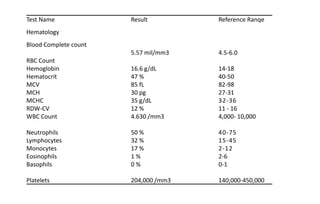
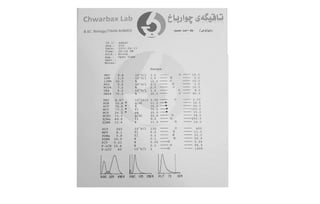
Test Name Result Reference Ranqe
Hematology
Blood Complete count
RBC Count
5.57 mil/mm3 4.5-6.0
Hemoglobin 16.6 g/dL 14-18
Hematocrit 47 % 40-50
MCV 85 fL 82-98
MCH 30 pg 27-31
MCHC 35 g/dL 32-36
RDW-CV 12 % 11 - 16
WBC Count 4.630 /mm3 4,000- 10,000
Neutrophils 50 % 40-75
Lymphocytes 32 % 15-45
Monocytes 17 % 2-12
Eosinophils 1 % 2-6
Basophils 0 % 0-1
Platelets 204,000 /mm3 140,000-450,000
Blood
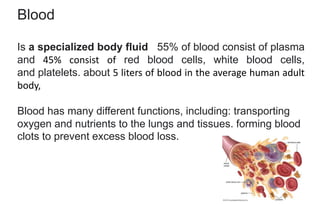
Is a specialized body fluid 55% of blood consist of plasma
and 45% consist of red blood cells, white blood cells,
and platelets. about 5 liters of blood in the average human adult
body,
Blood has many different functions, including: transporting
oxygen and nutrients to the lungs and tissues. forming blood
clots to prevent excess blood loss.
Hematopoiesis
Red blood cells
Erythrocyte, biconcave disks, diameter is about 7-8 µm. They lack
a cell nucleus and organelles, to accommodate maximum space for
hemoglobin, Approximately 84% of the cells in the human body are
20–30 trillion red blood cells
A normal RBC count would be around:
men – 4.0 to 5.9 x 10*12/L
women – 3.8 to 5.2 x 10*12/L
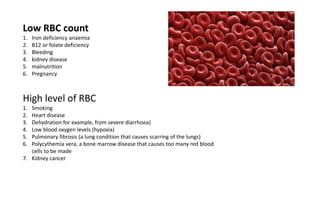
Low RBC count
1. Iron deficiency anaemia
2. B12 or folate deficiency
3. Bleeding
4. kidney disease
5. malnutrition
6. Pregnancy
High level of RBC
1. Smoking
2. Heart disease
3. Dehydration for example, from severe diarrhoea)
4. Low blood oxygen levels (hypoxia)
5. Pulmonary fibrosis (a lung condition that causes scarring of the lungs)
6. Polycythemia vera, a bone marrow disease that causes too many red blood
cells to be made
7. Kidney cancer
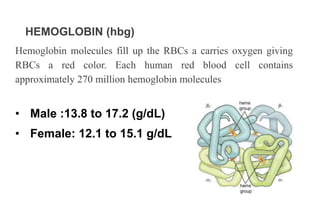
HEMOGLOBIN (hbg)
Hemoglobin molecules fill up the RBCs a carries oxygen giving
RBCs a red color. Each human red blood cell contains
approximately 270 million hemoglobin molecules
• Male :13.8 to 17.2 (g/dL)
• Female: 12.1 to 15.1 g/dL
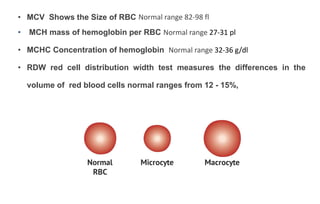
• MCV Shows the Size of RBC Normal range 82-98 fl
• MCH mass of hemoglobin per RBC Normal range 27-31 pl
• MCHC Concentration of hemoglobin Normal range 32-36 g/dl
• RDW red cell distribution width test measures the differences in the
volume of red blood cells normal ranges from 12 - 15%,
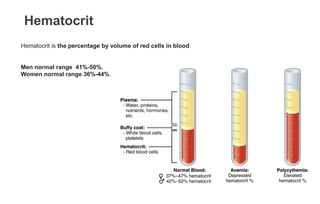
Hematocrit
Hematocrit is the percentage by volume of red cells in blood.
Men normal range 41%-50%.
Women normal range 36%-44%.
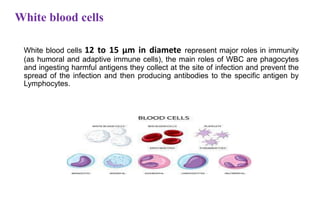
White blood cells 12 to 15 µm in diamete represent major roles in immunity
(as humoral and adaptive immune cells), the main roles of WBC are phagocytes
and ingesting harmful antigens they collect at the site of infection and prevent the
spread of the infection and then producing antibodies to the specific antigen by
Lymphocytes.
White blood cells
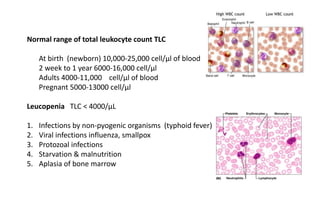
Normal range of total leukocyte count TLC
At birth (newborn) 10,000-25,000 cell/µl of blood
2 week to 1 year 6000-16,000 cell/µl
Adults 4000-11,000 cell/µl of blood
Pregnant 5000-13000 cell/µl
Leucopenia TLC < 4000/µL
1. Infections by non-pyogenic organisms (typhoid fever)
2. Viral infections influenza, smallpox
3. Protozoal infections
4. Starvation & malnutrition
5. Aplasia of bone marrow
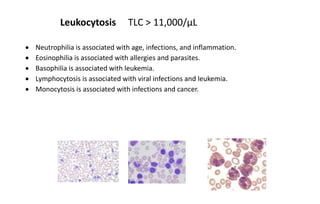
Leukocytosis TLC > 11,000/µL
 Neutrophilia is associated with age, infections, and inflammation.
 Eosinophilia is associated with allergies and parasites.
 Basophilia is associated with leukemia.
 Lymphocytosis is associated with viral infections and leukemia.
 Monocytosis is associated with infections and cancer.
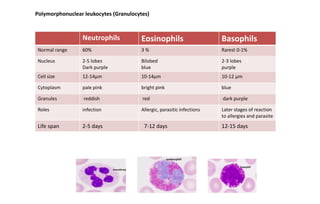
Neutrophils Eosinophils Basophils
Normal range 60% 3 % Rarest 0-1%
Nucleus 2-5 lobes
Dark purple
Bilobed
blue
2-3 lobes
purple
Cell size 12-14µm 10-14µm 10-12 µm
Cytoplasm pale pink bright pink blue
Granules reddish red dark purple
Roles infection Allergic, parasitic infections Later stages of reaction
to allergies and parasite
Life span 2-5 days 7-12 days 12-15 days
Polymorphonuclear leukocytes (Granulocytes)
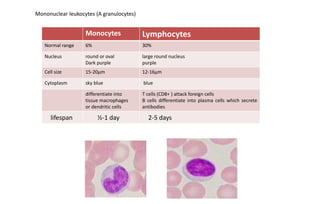
Monocytes Lymphocytes
Normal range 6% 30%
Nucleus round or oval
Dark purple
large round nucleus
purple
Cell size 15-20µm 12-16µm
Cytoplasm sky blue blue
differentiate into
tissue macrophages
or dendritic cells
T cells (CD8+ ) attack foreign cells
B cells differentiate into plasma cells which secrete
antibodies
lifespan ½-1 day 2-5 days
Mononuclear leukocytes (A granulocytes)
White blood cells represent major roles in immunity (as humoral and adaptive
immune cells), the main roles of WBC are phagocytes and ingesting harmful
antigens they collect at the site of infection and prevent the spread of the infection
and then producing antibodies to the specific antigen by Lymphocytes.
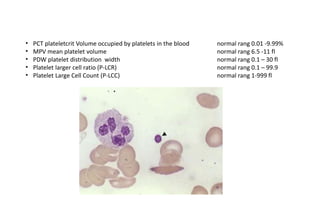
Platelet
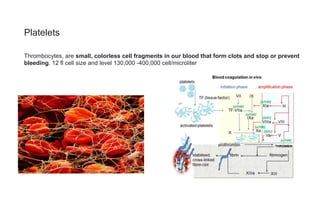
Platelets
Thrombocytes, are small, colorless cell fragments in our blood that form clots and stop or prevent
bleeding. 12 fl cell size and level 130,000 -400,000 cell/microliter
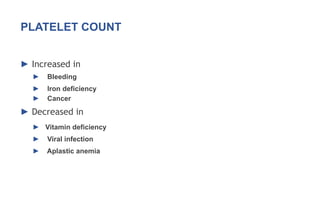
PLATELET COUNT
► Increased in
► Bleeding
► Iron deficiency
► Cancer
► Decreased in
► Vitamin deficiency
► Viral infection
► Aplastic anemia
• PCT plateletcrit Volume occupied by platelets in the blood normal rang 0.01 -9.99%
• MPV mean platelet volume normal rang 6.5 -11 fl
• PDW platelet distribution width normal rang 0.1 – 30 fl
• Platelet larger cell ratio (P-LCR) normal rang 0.1 – 99.9
• Platelet Large Cell Count (P-LCC) normal rang 1-999 fl
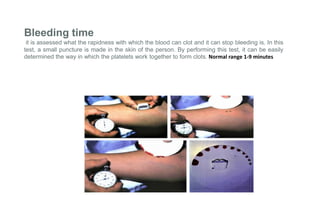
Bleeding time
it is assessed what the rapidness with which the blood can clot and it can stop bleeding is. In this
test, a small puncture is made in the skin of the person. By performing this test, it can be easily
determined the way in which the platelets work together to form clots. Normal range 1-9 minutes
Prothrombin time (PT)
clotting time Clotting time is the time taken for blood to clot in a person. Clotting factors determine
the clotting time in a person. Thus blood clotting factors play an important role in bleeding and
clotting. blood to clot is about Normal range 2-6 minute

complete blood count.ppt

  • 1.
    CBC Count Dr. SakarAhmed Abdullah
  • 2.
    CBC COUNT The completeblood count is an investigation that gives important information about different blood cells, mainly focuses on RBCs, WBCs, platelets and their parameters.
  • 3.
    COMPONENTS OF CBC ►Hematocrit (Hct) ► Hemoglobin (Hbg) ► Red blood cell count (RBC or erythrocyte count) ► RBC INDICES ► Mean corpuscular volume (MCV) ► Mean corpuscular hemoglobin (MCH) ► Mean corpuscular hemoglobin concentration (MCHC) ► White blood cell count (WBC or Leukocyte count) ► WBC differential count ► Platelet count
  • 4.
    Test Name ResultReference Ranqe Hematology Blood Complete count RBC Count 5.57 mil/mm3 4.5-6.0 Hemoglobin 16.6 g/dL 14-18 Hematocrit 47 % 40-50 MCV 85 fL 82-98 MCH 30 pg 27-31 MCHC 35 g/dL 32-36 RDW-CV 12 % 11 - 16 WBC Count 4.630 /mm3 4,000- 10,000 Neutrophils 50 % 40-75 Lymphocytes 32 % 15-45 Monocytes 17 % 2-12 Eosinophils 1 % 2-6 Basophils 0 % 0-1 Platelets 204,000 /mm3 140,000-450,000
  • 5.
    Blood Is a specializedbody fluid 55% of blood consist of plasma and 45% consist of red blood cells, white blood cells, and platelets. about 5 liters of blood in the average human adult body, Blood has many different functions, including: transporting oxygen and nutrients to the lungs and tissues. forming blood clots to prevent excess blood loss.
  • 6.
  • 7.
    Red blood cells Erythrocyte,biconcave disks, diameter is about 7-8 µm. They lack a cell nucleus and organelles, to accommodate maximum space for hemoglobin, Approximately 84% of the cells in the human body are 20–30 trillion red blood cells A normal RBC count would be around: men – 4.0 to 5.9 x 10*12/L women – 3.8 to 5.2 x 10*12/L
  • 8.
    Low RBC count 1.Iron deficiency anaemia 2. B12 or folate deficiency 3. Bleeding 4. kidney disease 5. malnutrition 6. Pregnancy High level of RBC 1. Smoking 2. Heart disease 3. Dehydration for example, from severe diarrhoea) 4. Low blood oxygen levels (hypoxia) 5. Pulmonary fibrosis (a lung condition that causes scarring of the lungs) 6. Polycythemia vera, a bone marrow disease that causes too many red blood cells to be made 7. Kidney cancer
  • 9.
    HEMOGLOBIN (hbg) Hemoglobin moleculesfill up the RBCs a carries oxygen giving RBCs a red color. Each human red blood cell contains approximately 270 million hemoglobin molecules • Male :13.8 to 17.2 (g/dL) • Female: 12.1 to 15.1 g/dL
  • 10.
    • MCV Showsthe Size of RBC Normal range 82-98 fl • MCH mass of hemoglobin per RBC Normal range 27-31 pl • MCHC Concentration of hemoglobin Normal range 32-36 g/dl • RDW red cell distribution width test measures the differences in the volume of red blood cells normal ranges from 12 - 15%,
  • 11.
    Hematocrit Hematocrit is thepercentage by volume of red cells in blood. Men normal range 41%-50%. Women normal range 36%-44%.
  • 12.
    White blood cells12 to 15 µm in diamete represent major roles in immunity (as humoral and adaptive immune cells), the main roles of WBC are phagocytes and ingesting harmful antigens they collect at the site of infection and prevent the spread of the infection and then producing antibodies to the specific antigen by Lymphocytes. White blood cells
  • 13.
    Normal range oftotal leukocyte count TLC At birth (newborn) 10,000-25,000 cell/µl of blood 2 week to 1 year 6000-16,000 cell/µl Adults 4000-11,000 cell/µl of blood Pregnant 5000-13000 cell/µl Leucopenia TLC < 4000/µL 1. Infections by non-pyogenic organisms (typhoid fever) 2. Viral infections influenza, smallpox 3. Protozoal infections 4. Starvation & malnutrition 5. Aplasia of bone marrow
  • 14.
    Leukocytosis TLC >11,000/µL  Neutrophilia is associated with age, infections, and inflammation.  Eosinophilia is associated with allergies and parasites.  Basophilia is associated with leukemia.  Lymphocytosis is associated with viral infections and leukemia.  Monocytosis is associated with infections and cancer.
  • 15.
    Neutrophils Eosinophils Basophils Normalrange 60% 3 % Rarest 0-1% Nucleus 2-5 lobes Dark purple Bilobed blue 2-3 lobes purple Cell size 12-14µm 10-14µm 10-12 µm Cytoplasm pale pink bright pink blue Granules reddish red dark purple Roles infection Allergic, parasitic infections Later stages of reaction to allergies and parasite Life span 2-5 days 7-12 days 12-15 days Polymorphonuclear leukocytes (Granulocytes)
  • 16.
    Monocytes Lymphocytes Normal range6% 30% Nucleus round or oval Dark purple large round nucleus purple Cell size 15-20µm 12-16µm Cytoplasm sky blue blue differentiate into tissue macrophages or dendritic cells T cells (CD8+ ) attack foreign cells B cells differentiate into plasma cells which secrete antibodies lifespan ½-1 day 2-5 days Mononuclear leukocytes (A granulocytes)
  • 17.
    White blood cellsrepresent major roles in immunity (as humoral and adaptive immune cells), the main roles of WBC are phagocytes and ingesting harmful antigens they collect at the site of infection and prevent the spread of the infection and then producing antibodies to the specific antigen by Lymphocytes. Platelet
  • 18.
    Platelets Thrombocytes, are small,colorless cell fragments in our blood that form clots and stop or prevent bleeding. 12 fl cell size and level 130,000 -400,000 cell/microliter
  • 19.
    PLATELET COUNT ► Increasedin ► Bleeding ► Iron deficiency ► Cancer ► Decreased in ► Vitamin deficiency ► Viral infection ► Aplastic anemia
  • 21.
    • PCT plateletcritVolume occupied by platelets in the blood normal rang 0.01 -9.99% • MPV mean platelet volume normal rang 6.5 -11 fl • PDW platelet distribution width normal rang 0.1 – 30 fl • Platelet larger cell ratio (P-LCR) normal rang 0.1 – 99.9 • Platelet Large Cell Count (P-LCC) normal rang 1-999 fl
  • 22.
    Bleeding time it isassessed what the rapidness with which the blood can clot and it can stop bleeding is. In this test, a small puncture is made in the skin of the person. By performing this test, it can be easily determined the way in which the platelets work together to form clots. Normal range 1-9 minutes
  • 23.
    Prothrombin time (PT) clottingtime Clotting time is the time taken for blood to clot in a person. Clotting factors determine the clotting time in a person. Thus blood clotting factors play an important role in bleeding and clotting. blood to clot is about Normal range 2-6 minute