Chapter 10
Structural Equation Modelling
PowerPoint Lecture Slides
Multivariate Data Analysis
Seventh Edition
by Joseph F. Hair Jr.; William C. Black; Barry J. Babin; Rolph E. Anderson
Chapter 10 Learning Outcomes
• The use and characteristics Structural Equation
Modelling
1
• Model development in Structural Equation Modelling
2
• Confirmatory Factor Analysis with SEM
3
• Stages statistical assessment in CFA with SEM
4
Complexity of Research
Question
• All too often the researcher is faced with a set of interrelated
questions. For example:
– What variables determine a store’s image?
– How does that image combine with other variables to affect purchase
decisions and satisfaction at the store?
– How does satisfaction with the store result in long-term loyalty to it?
• This series of issues has both managerial (practical) and theoretical
importance.
Store Image
Purchase
Decisions
Satisfaction Loyalty
The Use of Structural
Equation Modelling
• Structural equation modeling can examine a series of
dependence relationships simultaneously, particularly in
testing theories that contain multiple equations involving
dependence relationships.
• Example:
– If we believe that image creates satisfaction, and then
satisfaction creates loyalty, then satisfaction is both a
dependent and an independent variable in the same theory.
– Thus, a hypothesized dependent variable becomes an
independent variable in a subsequent dependence
relationship.
• An extension of several multivariate techniques, most
notably factor analysis and multiple regression analysis.
The Use of Structural
Equation Modelling
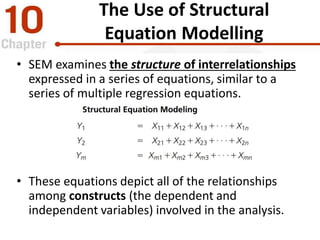
• SEM examines the structure of interrelationships
expressed in a series of equations, similar to a
series of multiple regression equations.
• These equations depict all of the relationships
among constructs (the dependent and
independent variables) involved in the analysis.
The Use of Structural
Equation Modelling
• SEM is known by many names: covariance structure
analysis, latent variable analysis, and sometimes it is
even referred to by the name of the specialized
software package used
– Covariance Based SEM e.g., a LISREL or AMOS model
– Variance Based SEM e.g., SmartPLS
The Characteristics of
Structural Equation Modelling
1. Estimation of multiple and interrelated
dependence relationships
2. An ability to represent unobserved concepts
in these relationships and account for
measurement error in the estimation process
3. Defining a model to explain the entire set of
relationships
Estimation of multiple and interrelated
dependence relationships
• SEM estimates a series of separate, but interdependent,
multiple regression equations simultaneously by
specifying the structural model used by the statistical
program.
• The structural model expresses these dependence
relationships among independent and dependent
variables, even when a dependent variable becomes an
independent variable in other relationships.
Estimation of multiple and interrelated
dependence relationships
• Interdependency among variables:
• The researcher draws model upon theory, prior experience,
and the research objectives to distinguish which independent
variables predict each dependent variable.
• Dependent variables in one relationship can become
independent variables in subsequent relationships, giving rise
to the interdependent nature of the structural model.
• Moreover, many of the same variables affect each of the
dependent variables, but with differing effects.
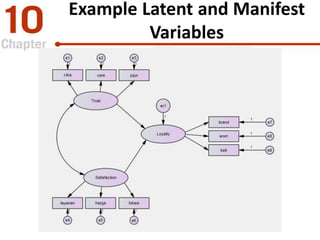
Incorporating Latent Variables That is
Not Measured Directly
• SEM also has the ability to incorporate latent variables
into the analysis.
• A latent construct (also termed a latent variable) is a
hypothesized and unobserved concept that can be
represented by observable or measurable variables.
• A latent construct is measured indirectly by examining
consistency among multiple measured variables,
sometimes referred to as manifest variables, or
indicators, which are gathered through various data
collection methods (e.g., surveys, tests, observational
methods).
Example Latent and Manifest
Variables
Benefit Using Latent
Construct (1)
1. Better represent theoretical concepts by using
multiple measures of a concept to reduce the
measurement error of that concept.
–From a theoretical perspective, most concepts are
relatively complex (e.g., patriotism, consumer confidence,
or even satisfaction) and have many meanings and/or
dimensions.
–With concepts such as these, the researcher tries to
design the best questions to measure the concept
knowing that individuals may interpret any single question
somewhat differently.
–The intent is for the collective set of questions to
represent the concept better than any single item.
Measurement Error in SEM
• The researcher must also be aware of measurement
error that occurs with any form of measurement.
• Any more theoretical or abstract concept is necessarily
subject to measurement error, due to inaccurate
responses.
– It occurs when respondents may be somewhat unsure
about how to respond or may interpret the questions in a
way that is different from what the researcher intended.
– Finally, it can result from a natural degree of inconsistency
on the part of the respondent when we use multiple
perspectives or items to measure the same concept.
• All of these situations give rise to measurement error
How to quantify
measurement error?
• SEM provides the measurement model, which specifies
the rules of correspondence between measured and
latent variables (constructs).
• The measurement model enables the researcher to use
any number of variables for a single independent or
dependent construct.
• Once the constructs are defined, then the model can be
used to assess the extent of measurement error (known
as reliability).
The measurement assessment
component of SEM
• The researcher identifies the specific indicator
variables associated with each construct, typically
based on a combination of previous similar studies and
the situation at hand.
• When SEM is applied, the researcher can assess the
contribution of each indicator variable in representing
its associated construct and measure how well the
combined set of indicator variables represents the
construct (reliability and validity).
• After the constructs have met the required
measurement standards, the relationships between
the constructs can be estimated.
Example
• PT ABC would like to determine which factors
may influence the job satisfaction of its
employees.
Perception
towards
Supervisor
Working
Environment
Satisfaction
INDICATORS
(1) My supervisor recognizes my potential;
(2) My supervisor helps me resolve
problems at work;
(3) My supervisor understands the
challenges of balancing work and home
demands.
Benefit Using Latent
Construct (2)
2. Improves the statistical estimation of the
relationships between concepts by accounting
for the measurement error in the concepts.
– From both practical and theoretical perspectives, we
cannot perfectly measure a concept without
measurement error.
– The measurement error affects the estimate of the
true structural coefficient
Reliability and Validity
Measurement Model
• Construct Reliability is a measure of the degree to which a
set of indicators of a latent construct is internally
consistent based on how highly interrelated the indicators
are with each other.
– It represents the extent to which the indicators all measure the
same thing.
– High reliability is associated with lower measurement error.
– As reliability goes up, the relationships between a construct and
the indicators are greater, meaning that the construct explains
more of the variance in each indicator.
– Just as we learned in multiple regression, as more of an
outcome is explained (in this case a measured indicator of a
construct), the amount of error decreases.
Reliability and Validity
Measurement Model
• Although reliability is important, high reliability does
not guarantee that a construct is measured
accurately.
• Reliability is a necessary but not sufficient condition
for validity.
• Construct validity
– Extent to which a set of measured variables actually
represent the theoretical latent construct they are
designed to measure – fit to its purpose.
Exogenous vs Endogenous
Latent Constructs
• Exogenous constructs are the latent, multi-item equivalent
of independent variables.
– They are determined by factors outside of the model (i.e., they are
not explained by any other construct or variable in the model).
– Visually an exogenous construct does not have any paths (one-
headed arrows) from any other construct or variable going into it.
• Endogenous constructs are the latent, multi-item equivalent
to dependent variables.
– These constructs are theoretically determined by factors within the
model.
– Thus, they are dependent on other constructs, and this dependence
is represented visually by a path to an endogenous construct from
an exogenous construct.
Model Development
• A model should not be developed without some
underlying theory.
• A model is a representation of a theory.
– Theory can be thought of as a systematic set of relationships
providing a consistent and comprehensive explanation of
phenomena.
– Theory is not the exclusive domain of academia, but can be
rooted in experience and practice obtained by observation of
real-world behavior.
– Theory is often a primary objective of academic research, but
practitioners may develop or propose a set of relationships that
are as complex and interrelated as any academically based
theory.
Model Development
• A model in SEM terminology consists of two models:
– the measurement model (representing how
measured variables come together to represent
constructs)
– the structural model (showing how constructs are
associated with each other).
• Path diagram is visual portrayal of the relationships
employs specific conventions both for the constructs
and measured variables as well as the relationships
between them.
Depicting the Constructs
(Measurement Model)
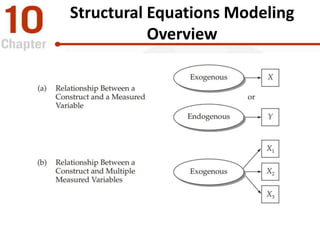
• Latent constructs are related to measured
(observed) variables with a measurement
relationship.
• These variables are referred to as indicators
because no single variable can completely
represent a construct, but it can be used as an
indication of the construct.
• The researcher must justify the theoretical basis of
the indicators because SEM only examines the
empirical characteristics of the variables.
Depicting Structural
Relationship
• A structural model involves specifying structural
relationships between latent constructs.
• Specifying a relationship generally means that we
either specify that a relationship exists or that it
does not exist.
– If it exists, an arrow is drawn; if no relationship is
expected, then no arrow is drawn.
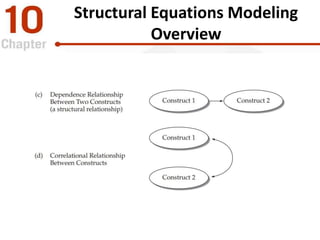
• Two types of relationships are possible among
constructs: dependence relationships and
correlational (covariance) relationships.
Structural Equations Modeling
Overview
Structural Equations Modeling
Overview
Combining Measurement and
Structural Relationships
The Role of Theory in SEM
1. specifying relationships that define the
model;
2. establishing causation, particularly when
using cross-sectional data;
3. the development of a modeling strategy
Relationship Specification
• Although theory can be important in all
multivariate procedures, it is particularly
important for SEM because it is considered a
confirmatory analysis.
– It is useful for testing and potentially confirming
theory.
– Theory is needed to specify relationships in both
measurement and structural models,
modifications to the proposed relationships, and
many other aspects of estimating a model.
Establishing Causation
• Dependence relationships can sometimes be theoretically
hypothesized as causal.
– Causal research designs traditionally involve an experiment with some
controlled manipulation (e.g., a categorical independent variable as found
in ANOVA).
• SEM models are typically used in nonexperimental situations in
which the exogenous constructs are not experimentally
controlled variables.
– This limits the researcher’s ability to draw causal inferences and SEM
alone cannot establish causality.
• SEM can treat dependence relationships as causal if four types
of evidence are reflected in the SEM model, they are (1)
covariation, (2) sequence, (3) nonspurious covariation, and (4)
theoretical support.
Condition for Causation in SEM
models
1. Covariance
– Causality means that a change in a cause brings about a
corresponding change in an effect.
– Thus, systematic covariance (correlation) between the cause
and effect is necessary, but not sufficient, to establish causality.
2. Sequence
– Sequence in causation means that improvements in the cause
must occur before the effect increases, if the relationship
between the two variables is causal.
– Example: Improvements in supervisor perception must occur
before job satisfaction increases. OR, the changes in supervisor
perception cannot occur after the change in job satisfaction.
Condition for Causation in SEM
models
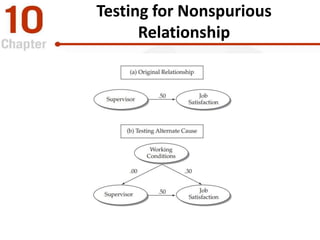
3. Nonspurious covariation
– A spurious relationship is one that is false or misleading. It happens
when there is high collinearity among predictors.
– Nonspurious relationship describes the size and nature of the
relationship between a cause and the relevant effect should not be
affected by including other constructs (or variables) in a model.
– A causal inference is supported when we can show that some third
construct does not affect the relationship between the cause and
effect (a lack of collinearity among the predictors is desirable)
– When collinearity is not present, the researcher comes closest to
reproducing the conditions that are present in an experimental
design.
Testing for Nonspurious
Relationship
Condition for Causation in SEM
models
4. Theoretical support
– Unless theory can be used to establish a causal ordering and a
rationale for the observed covariance, the relationships remain
simple association and should not be attributed with any
further causal power.
– This condition emphasizes the fact that simply testing a SEM
model and analyzing its results cannot establish causality.
– Theoretical support becomes especially important with cross-
sectional data.
Estimation Techniques in SEM
• Maximum likelihood estimation (MLE), which is
more efficient and unbiased when the assumption
of multivariate normality is met.
– MLE is a flexible approach to parameter estimation in
which the “most likely” parameter values to achieve the
best model fit are found.
– Cons: Sensitive to non-normal data
• MLE continues to be the most widely used approach
and is the default in most SEM programs. In fact, it
has proven fairly robust to violations of the
normality assumption.
Estimation Techniques in SEM
• Another methods: (1) weighted least squares (WLS); (2)
generalized least squares (GLS); and (3) asymptotically
distribution free (ADF) estimation.
– The ADF technique has received particular attention due to its
insensitivity to non-normality of the data, but its requirement
of rather large sample sizes limits its use.
Confirmatory Factor Analysis
With SEM
Highlight Exploratory Factor
Analysis (EFA)
• In EFA, the factors are derived from statistical results, not
from theory.
– This means that the researcher runs the software and lets
the underlying pattern of the data determine the factor
structure.
• EFA is conducted without knowing how many factors really
exist (if any) or which variables belong with which constructs.
• When EFA is applied, the researcher uses established
guidelines to determine which variables load on a particular
factor and how many factors are appropriate.
• The factors that emerge can only be named after the factor
analysis is performed.
Intro to Confirmatory Factor
Analysis (CFA)
• CFA is applied to test the extent to which a researcher’s
theoretical pattern of factor loadings on prespecified
constructs represents the actual data.
– In CFA, the researcher must specify both the number of factors that
exist for a set of variables and which factor each variable will load
on before results can be computed.
• The researcher makes this assignment based on the theory
being tested before any results can be obtained.
• A variable is assigned to only a single factor (construct), and
cross-loadings (loading on more than a single factor) are not
assigned.
• CFA statistics tell us how well our theoretical specification of
the factors matches reality (the actual data).
– In a sense, CFA is a tool that enables us to either “confirm” or
“reject” our preconceived theory.
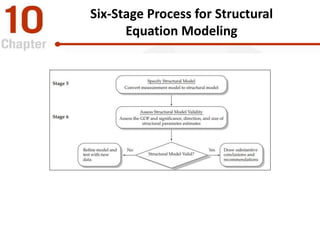
Six-Stage Process for CFA with
SEM
Six-Stage Process for Structural
Equation Modeling
Measurement Model
Development
• Unidimensional measures
mean that a set of measured
variables (indicators) can be
explained by only one
underlying construct.
– Unidimensionality becomes
critically important when more
than two constructs are
involved.
– In such a situation, each
measured variable is
hypothesized to relate to only
a single construct.
Type of Relationships Impacts on
Unidimensionality
 a single measured variable
is associated with more
than one construct
 within-construct error
covariance
 between-construct error
covariance
Items (indicators) per Latent
Construct – Rules of Thumb
• More items (measured variables or indicators) are not
necessarily better.
– Even though more items do produce higher reliability estimates and
generalizability [4], more items also require larger sample sizes and
can make it difficult to produce truly unidimensional factors.
– Good practice dictates a minimum of three items per factor,
preferably four, not only to provide minimum coverage of the
construct’s theoretical domain, but also to provide adequate
identification for the construct.
– Use four indicators whenever possible.
– Having three indicators per construct is acceptable, particularly
when other constructs have more than three.
– Constructs with fewer than three indicators should be avoided.
Items per construct and Model
Identification
• Number of indicators influences model identification, which
can be seen through degree of freedom.
• Possible SEM model identification:
a. Under-identified has more parameters to be estimated
than unique indicator variable variances and covariances in
the observed variance/covariance matrix. It has no
solution.
b. Just-Identified has just enough degrees of freedom to
estimate all free parameters. It has exactly one solution.
c. Overidentified models have more unique covariance and
variance terms than parameters to be estimated. It has
more than one solution.
Underidentified vs Just Identified
Overidentified
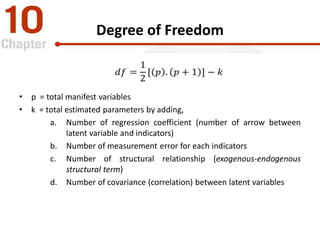
Degree of Freedom
• p = total manifest variables
• k = total estimated parameters by adding,
a. Number of regression coefficient (number of arrow between
latent variable and indicators)
b. Number of measurement error for each indicators
c. Number of structural relationship (exogenous-endogenous
structural term)
d. Number of covariance (correlation) between latent variables
Reflective vs Formative Construct
• A reflective measurement theory is based on the idea
that latent constructs cause the measured variables
and that the error results in an inability to fully explain
these measured variables.
– Thus, the arrows are drawn from latent constructs to measured variables.
• A formative measurement theory is modeled based on
the assumption that the measured variables cause the
construct.
– The error in formative measurement models, therefore, is an inability of
the measured variables to fully explain the construct.
– A key assumption is that formative constructs are not considered latent,
they are viewed as indices where each indicator is a cause of the
construct.
Example Reflective vs Formative
Construct
• Latent Variable: SATISFACTION with hotel accommodations
• Reflective model might have the representative measures
– “I feel well in this hotel”
– “This hotel belongs to my favorites”
– “I recommend this hotel to others”
– “I am always happy to stay overnight in this hotel.”
• Formative model, in contrast, might have the constituent
measures
– “The room is well equipped”
– “I can find silence here”
– “The fitness area is good”
– “The personnel are friendly”
– “The service is good”
COMPUTER SELF-EFFICACY
• Reflective
– I am capable at performing tasks on my computer.
– I feel confident in my ability to perform computer-related tasks.
• Formative
– I am confident at my ability to perform tasks in MS Word.
– I am skillful at using Excel.
SYSTEM QUALITY
• Reflective
– Overall, I would rate the system quality of the system highly.
– The quality of the system is appropriate for my needs.
• Formative
– Reliability, Ease of Use, Complexity, Accessibility, Responsiveness
Example Reflective vs Formative
Construct
Heywood Case
• An error variance estimate of less than zero (a negative
error variance) is termed a Heywood case.
• Such a result is logically impossible because it implies a
less than 0 percent error in an item, and by inference it
implies that more than 100 percent of the variance in an
item or a construct is explained.
• Heywood cases are particularly problematic in CFA
models with small samples or when the three-indicator
rule is not followed.
– Models with sample size greater than 300 that adhere to the
three-indicator rule are unlikely to produce Heywood cases.
Assessing Measurement Model (1)
• Reliability refers to consistency or stability of
measurement.
a. Can our measure or other form of observation be
confirmed by further measurements or observations?
b. If you measure the same thing would you get the same
score?
• Internal consistency: Internal consistency reliability
is a measure of how well the items on a test
measure the same construct or idea.
 Measured by Composite Reliability and Cronbach’s
Alpha
• Validity: refers to the suitability or meaningfulness of
the measurement. It indicates how well an instrument
measures the construct it purpose to measure.
– Does this instrument describe accurately the
construct I am attempting to measure?
• Convergent Validity: measures of constructs that
theoretically should be related to each other are, in
fact, observed to be related to each other. Measured
using factor loading and average variance extracted
(AVE).
Assessing Measurement Model (2)
• Discriminant validity: measures of constructs that
theoretically should not be related to each other are, in
fact, observed to not be related to each other.
Measured using cross loadings and the Fornell–Larcker
criterion.
– Cross loadings - an indicator’s loading with its associated
latent construct should be higher than its loadings with all the
remaining constructs (i.e., the cross loadings)
– Fornell–Larcker criterion - the AVE of each latent construct
should be greater than the latent construct’s highest squared
correlation with any other latent construct
Assessing Measurement Model (3)
Rules of Thumb Construct Reliability
and Validity (Reflective Model)
• Standardized loading estimates (factor loading) should
be 0.5 or higher, and ideally 0.7 or higher.
• Construct reliability should be .7 or higher to indicate
adequate convergence or internal consistency.
• AVE should be .5 or greater to suggest adequate
convergent validity.
• To provide evidence of discriminant validity
– AVE estimates for two factors also should be greater than the
square of the correlation between the two factors.
– An indicator’s loadings should be higher than all of its cross
loadings
Rules of Thumb Construct Reliability
and Validity (Formative Model)
• Examine the significance of each indicator’s weight
(relative importance) and indicator’s loading (absolute
importance).
• Use two-tailed test for significance test with significance level
0,01 or 0,05 or 0,1 (T value = 2,58 or 1,96 or 1,69 respectively)
• Use bootstrapping (resampling) to assess the significance.
• Minimum bootstrap sample as much as the number of valid
samples.
• Examine multicollinearity (should be less than 0,9) or
each indicator’s variance inflation factor (VIF) value
should be less than 5.
Assessing Structural Model
• R square - coefficient of determination, measuring the
amount of variation accounted for in the endogenous
constructs by the exogenous constructs.
• Level of significance of the path coefficients –
assessing prior hypotheses (should be less than
significance level).

Ch 10. SEM Structural Equation Modelling

  • 1.
    Chapter 10 Structural EquationModelling PowerPoint Lecture Slides Multivariate Data Analysis Seventh Edition by Joseph F. Hair Jr.; William C. Black; Barry J. Babin; Rolph E. Anderson
  • 2.
    Chapter 10 LearningOutcomes • The use and characteristics Structural Equation Modelling 1 • Model development in Structural Equation Modelling 2 • Confirmatory Factor Analysis with SEM 3 • Stages statistical assessment in CFA with SEM 4
  • 3.
    Complexity of Research Question •All too often the researcher is faced with a set of interrelated questions. For example: – What variables determine a store’s image? – How does that image combine with other variables to affect purchase decisions and satisfaction at the store? – How does satisfaction with the store result in long-term loyalty to it? • This series of issues has both managerial (practical) and theoretical importance. Store Image Purchase Decisions Satisfaction Loyalty
  • 4.
    The Use ofStructural Equation Modelling • Structural equation modeling can examine a series of dependence relationships simultaneously, particularly in testing theories that contain multiple equations involving dependence relationships. • Example: – If we believe that image creates satisfaction, and then satisfaction creates loyalty, then satisfaction is both a dependent and an independent variable in the same theory. – Thus, a hypothesized dependent variable becomes an independent variable in a subsequent dependence relationship. • An extension of several multivariate techniques, most notably factor analysis and multiple regression analysis.
  • 5.
    The Use ofStructural Equation Modelling • SEM examines the structure of interrelationships expressed in a series of equations, similar to a series of multiple regression equations. • These equations depict all of the relationships among constructs (the dependent and independent variables) involved in the analysis.
  • 6.
    The Use ofStructural Equation Modelling • SEM is known by many names: covariance structure analysis, latent variable analysis, and sometimes it is even referred to by the name of the specialized software package used – Covariance Based SEM e.g., a LISREL or AMOS model – Variance Based SEM e.g., SmartPLS
  • 7.
    The Characteristics of StructuralEquation Modelling 1. Estimation of multiple and interrelated dependence relationships 2. An ability to represent unobserved concepts in these relationships and account for measurement error in the estimation process 3. Defining a model to explain the entire set of relationships
  • 8.
    Estimation of multipleand interrelated dependence relationships • SEM estimates a series of separate, but interdependent, multiple regression equations simultaneously by specifying the structural model used by the statistical program. • The structural model expresses these dependence relationships among independent and dependent variables, even when a dependent variable becomes an independent variable in other relationships.
  • 9.
    Estimation of multipleand interrelated dependence relationships • Interdependency among variables: • The researcher draws model upon theory, prior experience, and the research objectives to distinguish which independent variables predict each dependent variable. • Dependent variables in one relationship can become independent variables in subsequent relationships, giving rise to the interdependent nature of the structural model. • Moreover, many of the same variables affect each of the dependent variables, but with differing effects.
  • 10.
    Incorporating Latent VariablesThat is Not Measured Directly • SEM also has the ability to incorporate latent variables into the analysis. • A latent construct (also termed a latent variable) is a hypothesized and unobserved concept that can be represented by observable or measurable variables. • A latent construct is measured indirectly by examining consistency among multiple measured variables, sometimes referred to as manifest variables, or indicators, which are gathered through various data collection methods (e.g., surveys, tests, observational methods).
  • 11.
    Example Latent andManifest Variables
  • 12.
    Benefit Using Latent Construct(1) 1. Better represent theoretical concepts by using multiple measures of a concept to reduce the measurement error of that concept. –From a theoretical perspective, most concepts are relatively complex (e.g., patriotism, consumer confidence, or even satisfaction) and have many meanings and/or dimensions. –With concepts such as these, the researcher tries to design the best questions to measure the concept knowing that individuals may interpret any single question somewhat differently. –The intent is for the collective set of questions to represent the concept better than any single item.
  • 13.
    Measurement Error inSEM • The researcher must also be aware of measurement error that occurs with any form of measurement. • Any more theoretical or abstract concept is necessarily subject to measurement error, due to inaccurate responses. – It occurs when respondents may be somewhat unsure about how to respond or may interpret the questions in a way that is different from what the researcher intended. – Finally, it can result from a natural degree of inconsistency on the part of the respondent when we use multiple perspectives or items to measure the same concept. • All of these situations give rise to measurement error
  • 14.
    How to quantify measurementerror? • SEM provides the measurement model, which specifies the rules of correspondence between measured and latent variables (constructs). • The measurement model enables the researcher to use any number of variables for a single independent or dependent construct. • Once the constructs are defined, then the model can be used to assess the extent of measurement error (known as reliability).
  • 15.
    The measurement assessment componentof SEM • The researcher identifies the specific indicator variables associated with each construct, typically based on a combination of previous similar studies and the situation at hand. • When SEM is applied, the researcher can assess the contribution of each indicator variable in representing its associated construct and measure how well the combined set of indicator variables represents the construct (reliability and validity). • After the constructs have met the required measurement standards, the relationships between the constructs can be estimated.
  • 16.
    Example • PT ABCwould like to determine which factors may influence the job satisfaction of its employees. Perception towards Supervisor Working Environment Satisfaction INDICATORS (1) My supervisor recognizes my potential; (2) My supervisor helps me resolve problems at work; (3) My supervisor understands the challenges of balancing work and home demands.
  • 17.
    Benefit Using Latent Construct(2) 2. Improves the statistical estimation of the relationships between concepts by accounting for the measurement error in the concepts. – From both practical and theoretical perspectives, we cannot perfectly measure a concept without measurement error. – The measurement error affects the estimate of the true structural coefficient
  • 18.
    Reliability and Validity MeasurementModel • Construct Reliability is a measure of the degree to which a set of indicators of a latent construct is internally consistent based on how highly interrelated the indicators are with each other. – It represents the extent to which the indicators all measure the same thing. – High reliability is associated with lower measurement error. – As reliability goes up, the relationships between a construct and the indicators are greater, meaning that the construct explains more of the variance in each indicator. – Just as we learned in multiple regression, as more of an outcome is explained (in this case a measured indicator of a construct), the amount of error decreases.
  • 19.
    Reliability and Validity MeasurementModel • Although reliability is important, high reliability does not guarantee that a construct is measured accurately. • Reliability is a necessary but not sufficient condition for validity. • Construct validity – Extent to which a set of measured variables actually represent the theoretical latent construct they are designed to measure – fit to its purpose.
  • 20.
    Exogenous vs Endogenous LatentConstructs • Exogenous constructs are the latent, multi-item equivalent of independent variables. – They are determined by factors outside of the model (i.e., they are not explained by any other construct or variable in the model). – Visually an exogenous construct does not have any paths (one- headed arrows) from any other construct or variable going into it. • Endogenous constructs are the latent, multi-item equivalent to dependent variables. – These constructs are theoretically determined by factors within the model. – Thus, they are dependent on other constructs, and this dependence is represented visually by a path to an endogenous construct from an exogenous construct.
  • 21.
    Model Development • Amodel should not be developed without some underlying theory. • A model is a representation of a theory. – Theory can be thought of as a systematic set of relationships providing a consistent and comprehensive explanation of phenomena. – Theory is not the exclusive domain of academia, but can be rooted in experience and practice obtained by observation of real-world behavior. – Theory is often a primary objective of academic research, but practitioners may develop or propose a set of relationships that are as complex and interrelated as any academically based theory.
  • 22.
    Model Development • Amodel in SEM terminology consists of two models: – the measurement model (representing how measured variables come together to represent constructs) – the structural model (showing how constructs are associated with each other). • Path diagram is visual portrayal of the relationships employs specific conventions both for the constructs and measured variables as well as the relationships between them.
  • 23.
    Depicting the Constructs (MeasurementModel) • Latent constructs are related to measured (observed) variables with a measurement relationship. • These variables are referred to as indicators because no single variable can completely represent a construct, but it can be used as an indication of the construct. • The researcher must justify the theoretical basis of the indicators because SEM only examines the empirical characteristics of the variables.
  • 24.
    Depicting Structural Relationship • Astructural model involves specifying structural relationships between latent constructs. • Specifying a relationship generally means that we either specify that a relationship exists or that it does not exist. – If it exists, an arrow is drawn; if no relationship is expected, then no arrow is drawn. • Two types of relationships are possible among constructs: dependence relationships and correlational (covariance) relationships.
  • 25.
  • 26.
  • 27.
  • 28.
    The Role ofTheory in SEM 1. specifying relationships that define the model; 2. establishing causation, particularly when using cross-sectional data; 3. the development of a modeling strategy
  • 29.
    Relationship Specification • Althoughtheory can be important in all multivariate procedures, it is particularly important for SEM because it is considered a confirmatory analysis. – It is useful for testing and potentially confirming theory. – Theory is needed to specify relationships in both measurement and structural models, modifications to the proposed relationships, and many other aspects of estimating a model.
  • 30.
    Establishing Causation • Dependencerelationships can sometimes be theoretically hypothesized as causal. – Causal research designs traditionally involve an experiment with some controlled manipulation (e.g., a categorical independent variable as found in ANOVA). • SEM models are typically used in nonexperimental situations in which the exogenous constructs are not experimentally controlled variables. – This limits the researcher’s ability to draw causal inferences and SEM alone cannot establish causality. • SEM can treat dependence relationships as causal if four types of evidence are reflected in the SEM model, they are (1) covariation, (2) sequence, (3) nonspurious covariation, and (4) theoretical support.
  • 31.
    Condition for Causationin SEM models 1. Covariance – Causality means that a change in a cause brings about a corresponding change in an effect. – Thus, systematic covariance (correlation) between the cause and effect is necessary, but not sufficient, to establish causality. 2. Sequence – Sequence in causation means that improvements in the cause must occur before the effect increases, if the relationship between the two variables is causal. – Example: Improvements in supervisor perception must occur before job satisfaction increases. OR, the changes in supervisor perception cannot occur after the change in job satisfaction.
  • 32.
    Condition for Causationin SEM models 3. Nonspurious covariation – A spurious relationship is one that is false or misleading. It happens when there is high collinearity among predictors. – Nonspurious relationship describes the size and nature of the relationship between a cause and the relevant effect should not be affected by including other constructs (or variables) in a model. – A causal inference is supported when we can show that some third construct does not affect the relationship between the cause and effect (a lack of collinearity among the predictors is desirable) – When collinearity is not present, the researcher comes closest to reproducing the conditions that are present in an experimental design.
  • 33.
  • 34.
    Condition for Causationin SEM models 4. Theoretical support – Unless theory can be used to establish a causal ordering and a rationale for the observed covariance, the relationships remain simple association and should not be attributed with any further causal power. – This condition emphasizes the fact that simply testing a SEM model and analyzing its results cannot establish causality. – Theoretical support becomes especially important with cross- sectional data.
  • 35.
    Estimation Techniques inSEM • Maximum likelihood estimation (MLE), which is more efficient and unbiased when the assumption of multivariate normality is met. – MLE is a flexible approach to parameter estimation in which the “most likely” parameter values to achieve the best model fit are found. – Cons: Sensitive to non-normal data • MLE continues to be the most widely used approach and is the default in most SEM programs. In fact, it has proven fairly robust to violations of the normality assumption.
  • 36.
    Estimation Techniques inSEM • Another methods: (1) weighted least squares (WLS); (2) generalized least squares (GLS); and (3) asymptotically distribution free (ADF) estimation. – The ADF technique has received particular attention due to its insensitivity to non-normality of the data, but its requirement of rather large sample sizes limits its use.
  • 37.
  • 38.
    Highlight Exploratory Factor Analysis(EFA) • In EFA, the factors are derived from statistical results, not from theory. – This means that the researcher runs the software and lets the underlying pattern of the data determine the factor structure. • EFA is conducted without knowing how many factors really exist (if any) or which variables belong with which constructs. • When EFA is applied, the researcher uses established guidelines to determine which variables load on a particular factor and how many factors are appropriate. • The factors that emerge can only be named after the factor analysis is performed.
  • 39.
    Intro to ConfirmatoryFactor Analysis (CFA) • CFA is applied to test the extent to which a researcher’s theoretical pattern of factor loadings on prespecified constructs represents the actual data. – In CFA, the researcher must specify both the number of factors that exist for a set of variables and which factor each variable will load on before results can be computed. • The researcher makes this assignment based on the theory being tested before any results can be obtained. • A variable is assigned to only a single factor (construct), and cross-loadings (loading on more than a single factor) are not assigned. • CFA statistics tell us how well our theoretical specification of the factors matches reality (the actual data). – In a sense, CFA is a tool that enables us to either “confirm” or “reject” our preconceived theory.
  • 40.
  • 41.
    Six-Stage Process forStructural Equation Modeling
  • 42.
    Measurement Model Development • Unidimensionalmeasures mean that a set of measured variables (indicators) can be explained by only one underlying construct. – Unidimensionality becomes critically important when more than two constructs are involved. – In such a situation, each measured variable is hypothesized to relate to only a single construct.
  • 43.
    Type of RelationshipsImpacts on Unidimensionality  a single measured variable is associated with more than one construct  within-construct error covariance  between-construct error covariance
  • 44.
    Items (indicators) perLatent Construct – Rules of Thumb • More items (measured variables or indicators) are not necessarily better. – Even though more items do produce higher reliability estimates and generalizability [4], more items also require larger sample sizes and can make it difficult to produce truly unidimensional factors. – Good practice dictates a minimum of three items per factor, preferably four, not only to provide minimum coverage of the construct’s theoretical domain, but also to provide adequate identification for the construct. – Use four indicators whenever possible. – Having three indicators per construct is acceptable, particularly when other constructs have more than three. – Constructs with fewer than three indicators should be avoided.
  • 45.
    Items per constructand Model Identification • Number of indicators influences model identification, which can be seen through degree of freedom. • Possible SEM model identification: a. Under-identified has more parameters to be estimated than unique indicator variable variances and covariances in the observed variance/covariance matrix. It has no solution. b. Just-Identified has just enough degrees of freedom to estimate all free parameters. It has exactly one solution. c. Overidentified models have more unique covariance and variance terms than parameters to be estimated. It has more than one solution.
  • 46.
  • 47.
  • 48.
    Degree of Freedom •p = total manifest variables • k = total estimated parameters by adding, a. Number of regression coefficient (number of arrow between latent variable and indicators) b. Number of measurement error for each indicators c. Number of structural relationship (exogenous-endogenous structural term) d. Number of covariance (correlation) between latent variables
  • 49.
    Reflective vs FormativeConstruct • A reflective measurement theory is based on the idea that latent constructs cause the measured variables and that the error results in an inability to fully explain these measured variables. – Thus, the arrows are drawn from latent constructs to measured variables. • A formative measurement theory is modeled based on the assumption that the measured variables cause the construct. – The error in formative measurement models, therefore, is an inability of the measured variables to fully explain the construct. – A key assumption is that formative constructs are not considered latent, they are viewed as indices where each indicator is a cause of the construct.
  • 50.
    Example Reflective vsFormative Construct • Latent Variable: SATISFACTION with hotel accommodations • Reflective model might have the representative measures – “I feel well in this hotel” – “This hotel belongs to my favorites” – “I recommend this hotel to others” – “I am always happy to stay overnight in this hotel.” • Formative model, in contrast, might have the constituent measures – “The room is well equipped” – “I can find silence here” – “The fitness area is good” – “The personnel are friendly” – “The service is good”
  • 51.
    COMPUTER SELF-EFFICACY • Reflective –I am capable at performing tasks on my computer. – I feel confident in my ability to perform computer-related tasks. • Formative – I am confident at my ability to perform tasks in MS Word. – I am skillful at using Excel. SYSTEM QUALITY • Reflective – Overall, I would rate the system quality of the system highly. – The quality of the system is appropriate for my needs. • Formative – Reliability, Ease of Use, Complexity, Accessibility, Responsiveness Example Reflective vs Formative Construct
  • 52.
    Heywood Case • Anerror variance estimate of less than zero (a negative error variance) is termed a Heywood case. • Such a result is logically impossible because it implies a less than 0 percent error in an item, and by inference it implies that more than 100 percent of the variance in an item or a construct is explained. • Heywood cases are particularly problematic in CFA models with small samples or when the three-indicator rule is not followed. – Models with sample size greater than 300 that adhere to the three-indicator rule are unlikely to produce Heywood cases.
  • 53.
    Assessing Measurement Model(1) • Reliability refers to consistency or stability of measurement. a. Can our measure or other form of observation be confirmed by further measurements or observations? b. If you measure the same thing would you get the same score? • Internal consistency: Internal consistency reliability is a measure of how well the items on a test measure the same construct or idea.  Measured by Composite Reliability and Cronbach’s Alpha
  • 54.
    • Validity: refersto the suitability or meaningfulness of the measurement. It indicates how well an instrument measures the construct it purpose to measure. – Does this instrument describe accurately the construct I am attempting to measure? • Convergent Validity: measures of constructs that theoretically should be related to each other are, in fact, observed to be related to each other. Measured using factor loading and average variance extracted (AVE). Assessing Measurement Model (2)
  • 55.
    • Discriminant validity:measures of constructs that theoretically should not be related to each other are, in fact, observed to not be related to each other. Measured using cross loadings and the Fornell–Larcker criterion. – Cross loadings - an indicator’s loading with its associated latent construct should be higher than its loadings with all the remaining constructs (i.e., the cross loadings) – Fornell–Larcker criterion - the AVE of each latent construct should be greater than the latent construct’s highest squared correlation with any other latent construct Assessing Measurement Model (3)
  • 56.
    Rules of ThumbConstruct Reliability and Validity (Reflective Model) • Standardized loading estimates (factor loading) should be 0.5 or higher, and ideally 0.7 or higher. • Construct reliability should be .7 or higher to indicate adequate convergence or internal consistency. • AVE should be .5 or greater to suggest adequate convergent validity. • To provide evidence of discriminant validity – AVE estimates for two factors also should be greater than the square of the correlation between the two factors. – An indicator’s loadings should be higher than all of its cross loadings
  • 57.
    Rules of ThumbConstruct Reliability and Validity (Formative Model) • Examine the significance of each indicator’s weight (relative importance) and indicator’s loading (absolute importance). • Use two-tailed test for significance test with significance level 0,01 or 0,05 or 0,1 (T value = 2,58 or 1,96 or 1,69 respectively) • Use bootstrapping (resampling) to assess the significance. • Minimum bootstrap sample as much as the number of valid samples. • Examine multicollinearity (should be less than 0,9) or each indicator’s variance inflation factor (VIF) value should be less than 5.
  • 58.
    Assessing Structural Model •R square - coefficient of determination, measuring the amount of variation accounted for in the endogenous constructs by the exogenous constructs. • Level of significance of the path coefficients – assessing prior hypotheses (should be less than significance level).