www.rizvi.com.br
Using real-world tasks in
 language immersions

      Daniela Ferreira
      Fabiane Aguiar
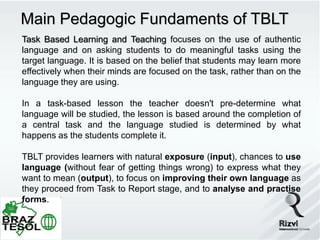
Main Pedagogic Fundaments of TBLT
Task Based Learning and Teaching focuses on the use of authentic
language and on asking students to do meaningful tasks using the
target language. It is based on the belief that students may learn more
effectively when their minds are focused on the task, rather than on the
language they are using.

In a task-based lesson the teacher doesn't pre-determine what
language will be studied, the lesson is based around the completion of
a central task and the language studied is determined by what
happens as the students complete it.

TBLT provides learners with natural exposure (input), chances to use
language (without fear of getting things wrong) to express what they
want to mean (output), to focus on improving their own language as
they proceed from Task to Report stage, and to analyse and practise
forms.
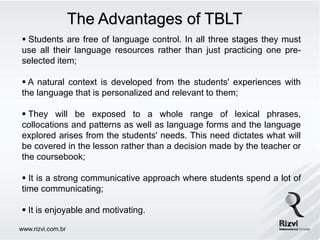
The Advantages of TBLT
 Students are free of language control. In all three stages they must
use all their language resources rather than just practicing one pre-
selected item;

 A natural context is developed from the students' experiences with
the language that is personalized and relevant to them;

 They will be exposed to a whole range of lexical phrases,
collocations and patterns as well as language forms and the language
explored arises from the students' needs. This need dictates what will
be covered in the lesson rather than a decision made by the teacher or
the coursebook;

 It is a strong communicative approach where students spend a lot of
time communicating;

 It is enjoyable and motivating.

www.rizvi.com.br
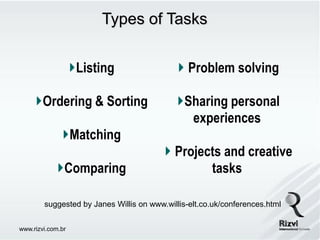
Types of Tasks


                    Listing                     Problem solving

        Ordering & Sorting                     Sharing personal
                                                experiences
                   Matching
                                            Projects and creative
               Comparing                          tasks

        suggested by Janes Willis on www.willis-elt.co.uk/conferences.html


www.rizvi.com.br
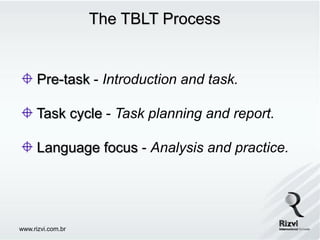
The TBLT Process


      Pre-task - Introduction and task.

     Task cycle - Task planning and report.

      Language focus - Analysis and practice.


www.rizvi.com.br
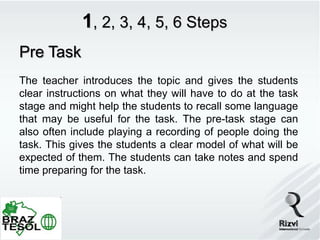
1, 2, 3, 4, 5, 6 Steps
Pre Task
The teacher introduces the topic and gives the students
clear instructions on what they will have to do at the task
stage and might help the students to recall some language
that may be useful for the task. The pre-task stage can
also often include playing a recording of people doing the
task. This gives the students a clear model of what will be
expected of them. The students can take notes and spend
time preparing for the task.
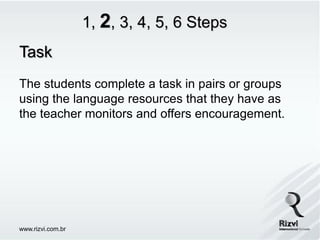
1, 2, 3, 4, 5, 6 Steps
Task
The students complete a task in pairs or groups
using the language resources that they have as
the teacher monitors and offers encouragement.


www.rizvi.com.br
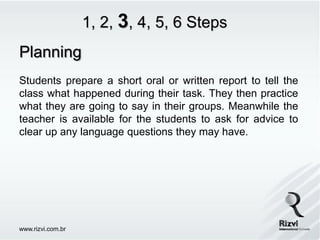
1, 2, 3, 4, 5, 6 Steps
Planning
Students prepare a short oral or written report to tell the
class what happened during their task. They then practice
what they are going to say in their groups. Meanwhile the
teacher is available for the students to ask for advice to
clear up any language questions they may have.


www.rizvi.com.br
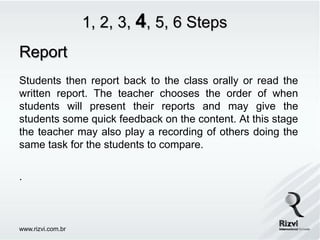
1, 2, 3, 4, 5, 6 Steps
Report
Students then report back to the class orally or read the
written report. The teacher chooses the order of when
students will present their reports and may give the
students some quick feedback on the content. At this stage
the teacher may also play a recording of others doing the
same task for the students to compare.


.


www.rizvi.com.br
1, 2, 3, 4, 5, 6 Steps
Analysis
The teacher then highlights relevant parts from the text of
the recording for the students to analyze. They may ask
students to notice interesting features within this text. The
teacher can also highlight the language that the students
used during the report phase for analysis.


.


www.rizvi.com.br
1, 2, 3, 4, 5,   6 Steps
Practice
Finally, the teacher selects language areas to practise
based upon the needs of the students and what emerged
from the task and report phases. The students then do
practice activities to increase their confidence and make a
note of useful language.


www.rizvi.com.br
Why TBLT?
   Grammar is far too complex and extensive to explain and practice
bit by bit;

  Learners often avoid speaking because they are worried about
getting their grammar right;

  Tasks give learners the chance to focus on using language to create
their own meanings – using words and expressions they can recall,
and then refine and build on that language as the task cycle
progresses;

   When they find they can achieve the task goals, even with their
limited English, they gain confidence, feel liberated, their motivation
increases, they learn more and become better communicators.


www.rizvi.com.br
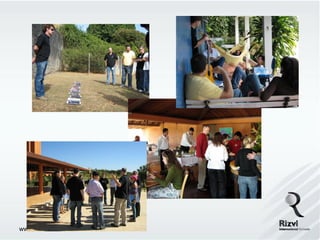
Sample Program for a Day Immersion
    Target Public: Executive Secretaries
    Level: Elementary


8:00 – 9:00: Welcoming Breakfast
9:00 – 10:30: Activity 1 (Organize your boss’s schedule
for the day) + Task 1 (Arrange a meeting over the phone)
10:30 – 10:45: Coffee Break + Oral Game
Sample Program for a Day Immersion
10:45 – 12:00: Activity 2 (Putting random emails in the
correct order)
12:00 – 14:00: Lunch
14:00 – 15:00: Listening Activity (Travel Arrangements) +
Task 2 (Booking a hotel room)
15:00 – 15:15: Coffee Break + Oral Game
15:15 – 16:45: Activity 3 (CV Preparation) + Task 3 (Job
Interview)
16:45 – 17:00: Feedback
Guidelines
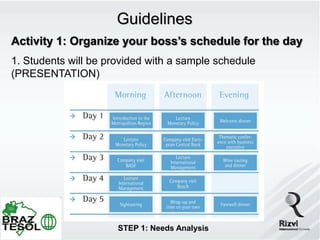
Activity 1: Organize your boss’s schedule for the day
1. Students will be provided with a sample schedule
(PRESENTATION)


                      STEP 1: Needs Analysis
Guidelines
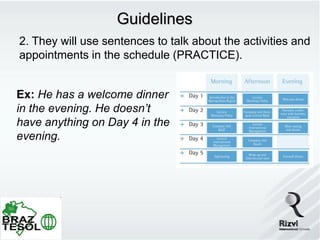
2. They will use sentences to talk about the activities and
appointments in the schedule (PRACTICE).


Ex: He has a welcome dinner
in the evening. He doesn’t
have anything on Day 4 in the
evening.
Guidelines
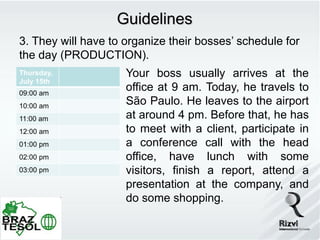
3. They will have to organize their bosses’ schedule for
the day (PRODUCTION).
Thursday,            Your boss usually arrives at the
July 15th
09:00 am
                     office at 9 am. Today, he travels to
10:00 am
                     São Paulo. He leaves to the airport
11:00 am             at around 4 pm. Before that, he has
12:00 am             to meet with a client, participate in
01:00 pm             a conference call with the head
02:00 pm             office, have lunch with some
03:00 pm             visitors, finish a report, attend a
                     presentation at the company, and
                     do some shopping.
Guidelines
Task 1: Arrange a meeting over the phone


Now that students have received some input and
practiced some aspects of the language with the
teacher guidance, they will perform a task. In pairs,
students will negotiate over the phone so they can
arrange a meeting, based on the spots they still have
left in their bosses’ schedule.
Conclusion


A day immersion program is a great opportunity for ESL
students to get an extensive language training, using
the language as a tool of communication, and not only
an object of study.
Real-world tasks promote this communication in an
interactive and genuine way, making the use of
language meaningful and authentic.
Hands on!
Profile 1: A group of 8 lawyers, aged 26 to
35 years old. Level: Pre-Intermediate.


Profile 2: A group of 6 engineers and 4
accountants. Level: Upper Intermediate.


Profile 3: A group of 5 flight attendants.
Level: Elementary.
References

A Task-Based Approach.
http://www.teachingenglish.org.uk/think/articles/a-task-based-approach
Willis-ELT.
http://www.willis-elt.co.uk/
www.rizvi.com.br

C:\fakepath\braz tesol presentation

  • 1.
  • 2.
    Using real-world tasksin language immersions Daniela Ferreira Fabiane Aguiar
  • 3.
    Main Pedagogic Fundamentsof TBLT Task Based Learning and Teaching focuses on the use of authentic language and on asking students to do meaningful tasks using the target language. It is based on the belief that students may learn more effectively when their minds are focused on the task, rather than on the language they are using. In a task-based lesson the teacher doesn't pre-determine what language will be studied, the lesson is based around the completion of a central task and the language studied is determined by what happens as the students complete it. TBLT provides learners with natural exposure (input), chances to use language (without fear of getting things wrong) to express what they want to mean (output), to focus on improving their own language as they proceed from Task to Report stage, and to analyse and practise forms.
  • 4.
    The Advantages ofTBLT  Students are free of language control. In all three stages they must use all their language resources rather than just practicing one pre- selected item;  A natural context is developed from the students' experiences with the language that is personalized and relevant to them;  They will be exposed to a whole range of lexical phrases, collocations and patterns as well as language forms and the language explored arises from the students' needs. This need dictates what will be covered in the lesson rather than a decision made by the teacher or the coursebook;  It is a strong communicative approach where students spend a lot of time communicating;  It is enjoyable and motivating. www.rizvi.com.br
  • 5.
    Types of Tasks Listing Problem solving Ordering & Sorting Sharing personal experiences Matching Projects and creative Comparing tasks suggested by Janes Willis on www.willis-elt.co.uk/conferences.html www.rizvi.com.br
  • 6.
    The TBLT Process Pre-task - Introduction and task. Task cycle - Task planning and report. Language focus - Analysis and practice. www.rizvi.com.br
  • 7.
    1, 2, 3,4, 5, 6 Steps Pre Task The teacher introduces the topic and gives the students clear instructions on what they will have to do at the task stage and might help the students to recall some language that may be useful for the task. The pre-task stage can also often include playing a recording of people doing the task. This gives the students a clear model of what will be expected of them. The students can take notes and spend time preparing for the task.
  • 8.
    1, 2, 3,4, 5, 6 Steps Task The students complete a task in pairs or groups using the language resources that they have as the teacher monitors and offers encouragement. www.rizvi.com.br
  • 9.
    1, 2, 3,4, 5, 6 Steps Planning Students prepare a short oral or written report to tell the class what happened during their task. They then practice what they are going to say in their groups. Meanwhile the teacher is available for the students to ask for advice to clear up any language questions they may have. www.rizvi.com.br
  • 10.
    1, 2, 3,4, 5, 6 Steps Report Students then report back to the class orally or read the written report. The teacher chooses the order of when students will present their reports and may give the students some quick feedback on the content. At this stage the teacher may also play a recording of others doing the same task for the students to compare. . www.rizvi.com.br
  • 11.
    1, 2, 3,4, 5, 6 Steps Analysis The teacher then highlights relevant parts from the text of the recording for the students to analyze. They may ask students to notice interesting features within this text. The teacher can also highlight the language that the students used during the report phase for analysis. . www.rizvi.com.br
  • 12.
    1, 2, 3,4, 5, 6 Steps Practice Finally, the teacher selects language areas to practise based upon the needs of the students and what emerged from the task and report phases. The students then do practice activities to increase their confidence and make a note of useful language. www.rizvi.com.br
  • 13.
    Why TBLT? Grammar is far too complex and extensive to explain and practice bit by bit; Learners often avoid speaking because they are worried about getting their grammar right; Tasks give learners the chance to focus on using language to create their own meanings – using words and expressions they can recall, and then refine and build on that language as the task cycle progresses; When they find they can achieve the task goals, even with their limited English, they gain confidence, feel liberated, their motivation increases, they learn more and become better communicators. www.rizvi.com.br
  • 14.
    Sample Program fora Day Immersion Target Public: Executive Secretaries Level: Elementary 8:00 – 9:00: Welcoming Breakfast 9:00 – 10:30: Activity 1 (Organize your boss’s schedule for the day) + Task 1 (Arrange a meeting over the phone) 10:30 – 10:45: Coffee Break + Oral Game
  • 15.
    Sample Program fora Day Immersion 10:45 – 12:00: Activity 2 (Putting random emails in the correct order) 12:00 – 14:00: Lunch 14:00 – 15:00: Listening Activity (Travel Arrangements) + Task 2 (Booking a hotel room) 15:00 – 15:15: Coffee Break + Oral Game 15:15 – 16:45: Activity 3 (CV Preparation) + Task 3 (Job Interview) 16:45 – 17:00: Feedback
  • 16.
    Guidelines Activity 1: Organizeyour boss’s schedule for the day 1. Students will be provided with a sample schedule (PRESENTATION) STEP 1: Needs Analysis
  • 17.
    Guidelines 2. They willuse sentences to talk about the activities and appointments in the schedule (PRACTICE). Ex: He has a welcome dinner in the evening. He doesn’t have anything on Day 4 in the evening.
  • 18.
    Guidelines 3. They willhave to organize their bosses’ schedule for the day (PRODUCTION). Thursday, Your boss usually arrives at the July 15th 09:00 am office at 9 am. Today, he travels to 10:00 am São Paulo. He leaves to the airport 11:00 am at around 4 pm. Before that, he has 12:00 am to meet with a client, participate in 01:00 pm a conference call with the head 02:00 pm office, have lunch with some 03:00 pm visitors, finish a report, attend a presentation at the company, and do some shopping.
  • 19.
    Guidelines Task 1: Arrangea meeting over the phone Now that students have received some input and practiced some aspects of the language with the teacher guidance, they will perform a task. In pairs, students will negotiate over the phone so they can arrange a meeting, based on the spots they still have left in their bosses’ schedule.
  • 20.
    Conclusion A day immersionprogram is a great opportunity for ESL students to get an extensive language training, using the language as a tool of communication, and not only an object of study. Real-world tasks promote this communication in an interactive and genuine way, making the use of language meaningful and authentic.
  • 21.
    Hands on! Profile 1:A group of 8 lawyers, aged 26 to 35 years old. Level: Pre-Intermediate. Profile 2: A group of 6 engineers and 4 accountants. Level: Upper Intermediate. Profile 3: A group of 5 flight attendants. Level: Elementary.
  • 22.
  • 23.