Scaling ColdFusion
Presenter Mike Collins, Sr. ColdFusion Consultant - SupportObjective
Our Goals Today
▪ Help you develop Strategy for Scaling
▪ Improve overall server stability
▪ Giving your End-users a better Experience
Agenda
1. Deciding on a Platform
2. Understanding Key Metrics
3. Learning Key Metrics thru Load Testing
4. Scaling Strategies - VMs and Orchestration
5. Understanding ColdFusion Clustering
6. Tomcat Load Balancing and Status Worker
7. Session Management Strategies
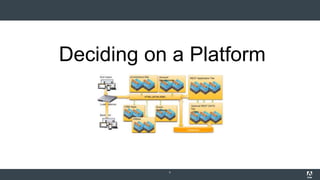
Deciding on a Platform
4
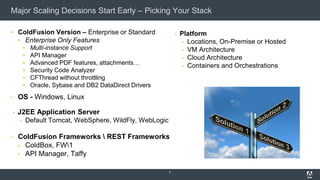
Major Scaling Decisions Start Early – Picking Your Stack
▪ ColdFusion Version – Enterprise or Standard
▪ Enterprise Only Features
▪ Multi-instance Support
▪ API Manager
▪ Advanced PDF features, attachments…
▪ Security Code Analyzer
▪ CFThread without throttling
▪ Oracle, Sybase and DB2 DataDirect Drivers
5
▪ ColdFusion Frameworks  REST Frameworks
▪ ColdBox, FW1
▪ API Manager, Taffy
▪ J2EE Application Server
▪ Default Tomcat, WebSphere, WildFly, WebLogic
▪ Platform
▪ Locations, On-Premise or Hosted
▪ VM Architecture
▪ Cloud Architecture
▪ Containers and Orchestrations
▪ OS - Windows, Linux
Once Platform is Built – Time for Tuning
Tuning your Platform
ColdFusion Settings and Code Tuning
▪ Review ColdFusion Admin Settings
▪ Review older code for performance issues
▪ Example look for overuse of cflock, evaluate functions, expensive SQL
▪ Look for opportunities to use Caching features
▪ Trusted Cache, Query Cache, EHCache, Redis
JVM Tuning
▪ Memory Allocation
▪ Garbage Collecting
6
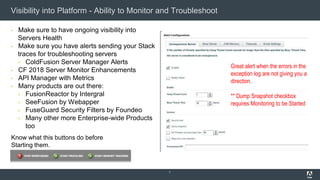
Visibility into Platform - Ability to Monitor and Troubleshoot
▪ Make sure to have ongoing visibility into
Servers Health
▪ Make sure you have alerts sending your Stack
traces for troubleshooting servers
▪ ColdFusion Server Manager Alerts
▪ CF 2018 Server Monitor Enhancements
▪ API Manager with Metrics
▪ Many products are out there:
▪ FusionReactor by Intergral
▪ SeeFusion by Webapper
▪ FuseGuard Security Filters by Foundeo
▪ Many other more Enterprise-wide Products
too
7
Know what this buttons do before
Starting them.
Great alert when the errors in the
exception log are not giving you a
direction.
** Dump Snapshot checkbox
requires Monitoring to be Started
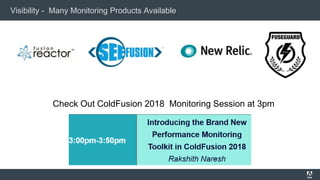
Visibility - Many Monitoring Products Available
Check Out ColdFusion 2018 Monitoring Session at 3pm
Wide Spectrum of Applications
Many Use-Cases Exist for ColdFusion Applications
▪ Classic Applications - Html with CF code mixed in with some cfquery calls
▪ DB heavy
▪ LDAP queries
▪ CFImage conversions
▪ CFDocument PDF Creation heavy
▪ External web service or HTTP calls
▪ REST API based apps
Might look at isolating and tuning VMs separately for better scalability.
9
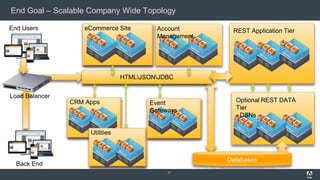
HTMLJSONJDBC
End Goal – Scalable Company Wide Topology
10
Account
Management
Load Balancer
REST Application Tier
Optional REST DATA
Tier
- DSNs
HTMLJSONJDBC
Databases
eCommerce SiteEnd Users
Back End
CRM Apps
Utilities
Event
Gateways
Database
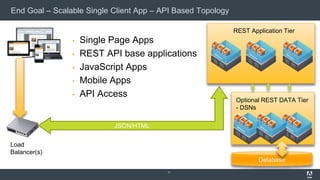
End Goal – Scalable Single Client App – API Based Topology
▪ Single Page Apps
▪ REST API base applications
▪ JavaScript Apps
▪ Mobile Apps
▪ API Access
11
REST Application Tier
Optional REST DATA Tier
- DSNs
Load
Balancer(s)
JSON/HTML
Key Metrics
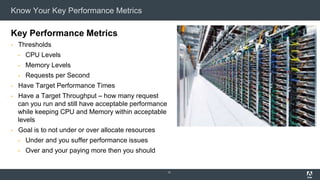
Know Your Key Performance Metrics
Key Performance Metrics
▪ Thresholds
▪ CPU Levels
▪ Memory Levels
▪ Requests per Second
▪ Have Target Performance Times
▪ Have a Target Throughput – how many request
can you run and still have acceptable performance
while keeping CPU and Memory within acceptable
levels
▪ Goal is to not under or over allocate resources
▪ Under and you suffer performance issues
▪ Over and your paying more then you should
13
Learning Your Key Metrics - Load Testing
▪ We can learn your thresholds by load testing your servers
▪ Develop several load test scripts:
▪ Mixed or realistic load patterns
▪ Targeted Scripts at one endpoint
▪ Run Scripts and watch how your Key Metrics perform
▪ Determine your comfort levels with CPU and memory
▪ Resulting in knowing a capacity for simultaneous requests
▪ Stress ColdFusion and Monitor CPU and Memory
14
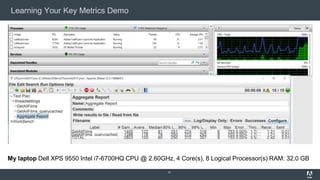
Learning Your Key Metrics Demo
15
My laptop Dell XPS 9550 Intel i7-6700HQ CPU @ 2.60GHz, 4 Core(s), 8 Logical Processor(s) RAM: 32.0 GB
Scaling Concepts
16
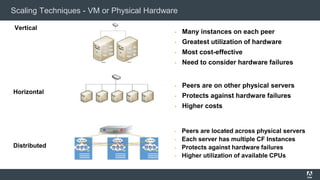
Scaling Techniques - VM or Physical Hardware
▪ Many instances on each peer
▪ Greatest utilization of hardware
▪ Most cost-effective
▪ Need to consider hardware failures
Vertical
Horizontal
▪ Peers are on other physical servers
▪ Protects against hardware failures
▪ Higher costs
Distributed
▪ Peers are located across physical servers
▪ Each server has multiple CF Instances
▪ Protects against hardware failures
▪ Higher utilization of available CPUs
VM Building Blocks
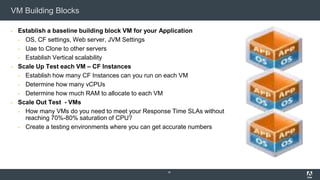
▪ Establish a baseline building block VM for your Application
▪ OS, CF settings, Web server, JVM Settings
▪ Uae to Clone to other servers
▪ Establish Vertical scalability
▪ Scale Up Test each VM – CF Instances
▪ Establish how many CF Instances can you run on each VM
▪ Determine how many vCPUs
▪ Determine how much RAM to allocate to each VM
▪ Scale Out Test - VMs
▪ How many VMs do you need to meet your Response Time SLAs without
reaching 70%-80% saturation of CPU?
▪ Create a testing environments where you can get accurate numbers
18
LB, Scaling and Failover by Category
Category One
Cost $
▪ One server  VM
▪ 2-3 Instances of CF
▪ Load Balanced with
Tomcat Connector
▪ Shared code base
▪ Session might be
lost on failover
▪ Email Alerts
19
Category Three
Cost $$$
▪ Three servers 
VMs
▪ 2-3 Instances per
server
▪ Load Balance
with Hardware
LB
▪ Code is synched
or build script
pushes to servers
▪ Seamless
session state on
failover
▪ Cached Content
▪ Full monitoring
Category Four
Cost $$$$
▪ Six or more servers 
VMs
▪ 2-3 Instances per
application
▪ Load Balance with
Hardware LB
▪ Multi location
▪ VM replication for
backup
▪ Code is synched
▪ Seamless session
state on failover
▪ Dist Cached
Content
▪ Full Monitoring
Category Two
Cost $$
▪ Two servers  VMs
▪ 2-3 Instances per
server
▪ Load Balanced with
Tomcat Connector
or Hardware Load
Balancer
▪ Code is synched or
build updates both
servers
▪ Smaller chance of
lost sessions on
failover
▪ Email Alerts
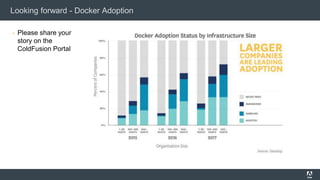
Looking forward - Docker Adoption
▪ Please share your
story on the
ColdFusion Portal
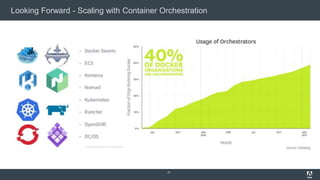
Looking Forward - Scaling with Container Orchestration
21
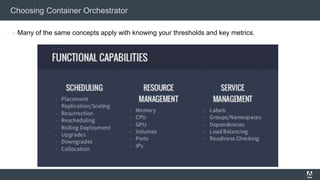
Choosing Container Orchestrator
▪ Many of the same concepts apply with knowing your thresholds and key metrics.
Understanding
ColdFusion
Clustering
23
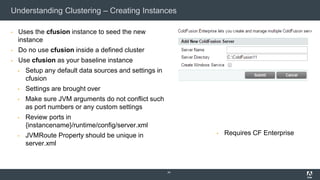
Understanding Clustering – Creating Instances
▪ Uses the cfusion instance to seed the new
instance
▪ Do no use cfusion inside a defined cluster
▪ Use cfusion as your baseline instance
▪ Setup any default data sources and settings in
cfusion
▪ Settings are brought over
▪ Make sure JVM arguments do not conflict such
as port numbers or any custom settings
▪ Review ports in
{instancename}/runtime/config/server.xml
▪ JVMRoute Property should be unique in
server.xml
24
▪ Requires CF Enterprise
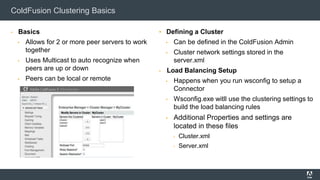
ColdFusion Clustering Basics
▪ Basics
▪ Allows for 2 or more peer servers to work
together
▪ Uses Multicast to auto recognize when
peers are up or down
▪ Peers can be local or remote
▪ Defining a Cluster
▪ Can be defined in the ColdFusion Admin
▪ Cluster network settings stored in the
server.xml
▪ Load Balancing Setup
▪ Happens when you run wsconfig to setup a
Connector
▪ Wsconfig.exe witll use the clustering settings to
build the load balancing rules
▪ Additional Properties and settings are
located in these files
▪ Cluster.xml
▪ Server.xml
ColdFusion Clustering vs Load Balancing
Clustering
▪ Auto discovery of peers required to
support in memory session replication
▪ Edits the Server.xml with multicast
settings so peers can have a
backchannel to communicate
▪ Provides support for in memory
session replication
▪ Keep in mind in-memory replication is not
100% reliable
26
Load balancing
Happens when you run the wsconfig and choose a
predefined CF Cluster
Do I even need to setup a cluster if I just want load
balancing?
▪ No you don’t
▪ However you might want to use it to initially
setup your connector files to get started with
load balancing
▪ Once your connector settings are setup to load
balance you can delete your cluster in the CF
Admin
Load balancing does not require CF Enterprise
just make sure each CF instance has it’s own
Standard license.

Tomcat Load Balancing
27
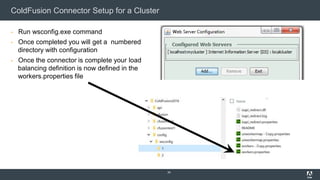
ColdFusion Connector Setup for a Cluster
▪ Run wsconfig.exe command
▪ Once completed you will get a numbered
directory with configuration
▪ Once the connector is complete your load
balancing definition is now defined in the
workers.properties file
28
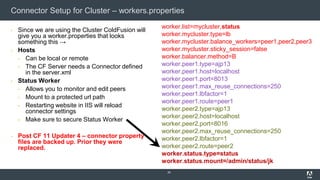
Connector Setup for Cluster – workers.properties
▪ Since we are using the Cluster ColdFusion will
give you a worker.properties that looks
something this →
▪ Hosts
▪ Can be local or remote
▪ The CF Server needs a Connector defined
in the server.xml
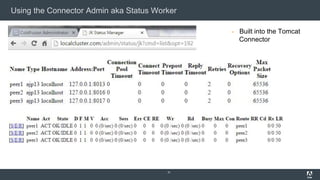
▪ Status Worker
▪ Allows you to monitor and edit peers
▪ Mount to a protected url path
▪ Restarting website in IIS will reload
connector settings
▪ Make sure to secure Status Worker
▪ Post CF 11 Updater 4 – connector property
files are backed up. Prior they were
replaced.
29
worker.list=mycluster,status
worker.mycluster.type=lb
worker.mycluster.balance_workers=peer1,peer2,peer3
worker.mycluster.sticky_session=false
worker.balancer.method=B
worker.peer1.type=ajp13
worker.peer1.host=localhost
worker.peer1.port=8013
worker.peer1.max_reuse_connections=250
worker.peer1.lbfactor=1
worker.peer1.route=peer1
worker.peer2.type=ajp13
worker.peer2.host=localhost
worker.peer2.port=8016
worker.peer2.max_reuse_connections=250
worker.peer2.lbfactor=1
worker.peer2.route=peer2
worker.status.type=status
worker.status.mount=/admin/status/jk
Changing the Workers.Properties
▪ You can edit worker properties anytime
▪ Add Peers, Disable Peers
▪ Change Load Balancer settings
▪ Simply Restart web site reload the connector which will bring in new settings.
30
Using the Connector Admin aka Status Worker
▪ Built into the Tomcat
Connector
31
▪ Demo Status Worker
Session
Management
33
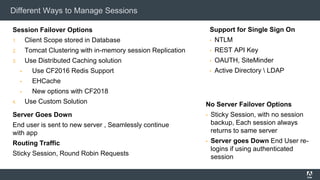
Different Ways to Manage Sessions
No Server Failover Options
▪ Sticky Session, with no session
backup, Each session always
returns to same server
▪ Server goes Down End User re-
logins if using authenticated
session
Session Failover Options
1. Client Scope stored in Database
2. Tomcat Clustering with in-memory session Replication
3. Use Distributed Caching solution
▪ Use CF2016 Redis Support
▪ EHCache
▪ New options with CF2018
4. Use Custom Solution
Support for Single Sign On
▪ NTLM
▪ REST API Key
▪ OAUTH, SiteMinder
▪ Active Directory  LDAP
Server Goes Down
End user is sent to new server , Seamlessly continue
with app
Routing Traffic
Sticky Session, Round Robin Requests
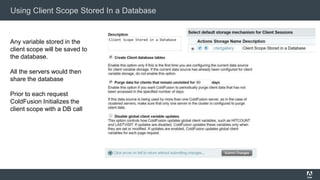
Using Client Scope Stored In a Database
Any variable stored in the
client scope will be saved to
the database.
All the servers would then
share the database
Prior to each request
ColdFusion Initializes the
client scope with a DB call
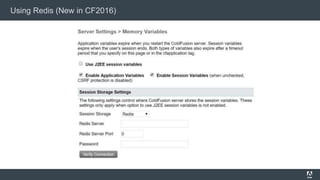
Using Redis (New in CF2016)
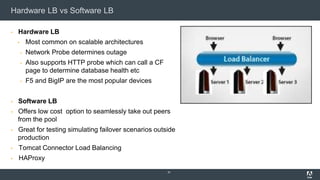
Hardware LB vs Software LB
▪ Hardware LB
▪ Most common on scalable architectures
▪ Network Probe determines outage
▪ Also supports HTTP probe which can call a CF
page to determine database health etc
▪ F5 and BigIP are the most popular devices
▪ Software LB
▪ Offers low cost option to seamlessly take out peers
from the pool
▪ Great for testing simulating failover scenarios outside
production
▪ Tomcat Connector Load Balancing
▪ HAProxy
37
Summary
▪ No matter the platform
▪ Measure and know your Key Performance Metrics
▪ Know your thresholds for Requests per second, CPU and Memory
▪ Only then will you know how many VMs you need or instructions to provide the Container
Orchestrator ie Docker Swarm, Kubernates
▪ Learn your Throughput numbers using load testing
▪ Session Management
▪ Choose a Session Management strategy to meets your needs
▪ Authentication
▪ Choose an authentication strategy that will fit
▪ Use Tomcat Load Balancer with Status Worker for testing session failover
▪ Visibility
▪ Make sure you plan to have visibility into your servers with monitoring and metrics logging
Questions

Cf Summit East 2018 Scaling ColdFusion

  • 1.
    Scaling ColdFusion Presenter MikeCollins, Sr. ColdFusion Consultant - SupportObjective
  • 2.
    Our Goals Today ▪Help you develop Strategy for Scaling ▪ Improve overall server stability ▪ Giving your End-users a better Experience
  • 3.
    Agenda 1. Deciding ona Platform 2. Understanding Key Metrics 3. Learning Key Metrics thru Load Testing 4. Scaling Strategies - VMs and Orchestration 5. Understanding ColdFusion Clustering 6. Tomcat Load Balancing and Status Worker 7. Session Management Strategies
  • 4.
    Deciding on aPlatform 4
  • 5.
    Major Scaling DecisionsStart Early – Picking Your Stack ▪ ColdFusion Version – Enterprise or Standard ▪ Enterprise Only Features ▪ Multi-instance Support ▪ API Manager ▪ Advanced PDF features, attachments… ▪ Security Code Analyzer ▪ CFThread without throttling ▪ Oracle, Sybase and DB2 DataDirect Drivers 5 ▪ ColdFusion Frameworks REST Frameworks ▪ ColdBox, FW1 ▪ API Manager, Taffy ▪ J2EE Application Server ▪ Default Tomcat, WebSphere, WildFly, WebLogic ▪ Platform ▪ Locations, On-Premise or Hosted ▪ VM Architecture ▪ Cloud Architecture ▪ Containers and Orchestrations ▪ OS - Windows, Linux
  • 6.
    Once Platform isBuilt – Time for Tuning Tuning your Platform ColdFusion Settings and Code Tuning ▪ Review ColdFusion Admin Settings ▪ Review older code for performance issues ▪ Example look for overuse of cflock, evaluate functions, expensive SQL ▪ Look for opportunities to use Caching features ▪ Trusted Cache, Query Cache, EHCache, Redis JVM Tuning ▪ Memory Allocation ▪ Garbage Collecting 6
  • 7.
    Visibility into Platform- Ability to Monitor and Troubleshoot ▪ Make sure to have ongoing visibility into Servers Health ▪ Make sure you have alerts sending your Stack traces for troubleshooting servers ▪ ColdFusion Server Manager Alerts ▪ CF 2018 Server Monitor Enhancements ▪ API Manager with Metrics ▪ Many products are out there: ▪ FusionReactor by Intergral ▪ SeeFusion by Webapper ▪ FuseGuard Security Filters by Foundeo ▪ Many other more Enterprise-wide Products too 7 Know what this buttons do before Starting them. Great alert when the errors in the exception log are not giving you a direction. ** Dump Snapshot checkbox requires Monitoring to be Started
  • 8.
    Visibility - ManyMonitoring Products Available Check Out ColdFusion 2018 Monitoring Session at 3pm
  • 9.
    Wide Spectrum ofApplications Many Use-Cases Exist for ColdFusion Applications ▪ Classic Applications - Html with CF code mixed in with some cfquery calls ▪ DB heavy ▪ LDAP queries ▪ CFImage conversions ▪ CFDocument PDF Creation heavy ▪ External web service or HTTP calls ▪ REST API based apps Might look at isolating and tuning VMs separately for better scalability. 9
  • 10.
    HTMLJSONJDBC End Goal –Scalable Company Wide Topology 10 Account Management Load Balancer REST Application Tier Optional REST DATA Tier - DSNs HTMLJSONJDBC Databases eCommerce SiteEnd Users Back End CRM Apps Utilities Event Gateways
  • 11.
    Database End Goal –Scalable Single Client App – API Based Topology ▪ Single Page Apps ▪ REST API base applications ▪ JavaScript Apps ▪ Mobile Apps ▪ API Access 11 REST Application Tier Optional REST DATA Tier - DSNs Load Balancer(s) JSON/HTML
  • 12.
  • 13.
    Know Your KeyPerformance Metrics Key Performance Metrics ▪ Thresholds ▪ CPU Levels ▪ Memory Levels ▪ Requests per Second ▪ Have Target Performance Times ▪ Have a Target Throughput – how many request can you run and still have acceptable performance while keeping CPU and Memory within acceptable levels ▪ Goal is to not under or over allocate resources ▪ Under and you suffer performance issues ▪ Over and your paying more then you should 13
  • 14.
    Learning Your KeyMetrics - Load Testing ▪ We can learn your thresholds by load testing your servers ▪ Develop several load test scripts: ▪ Mixed or realistic load patterns ▪ Targeted Scripts at one endpoint ▪ Run Scripts and watch how your Key Metrics perform ▪ Determine your comfort levels with CPU and memory ▪ Resulting in knowing a capacity for simultaneous requests ▪ Stress ColdFusion and Monitor CPU and Memory 14
  • 15.
    Learning Your KeyMetrics Demo 15 My laptop Dell XPS 9550 Intel i7-6700HQ CPU @ 2.60GHz, 4 Core(s), 8 Logical Processor(s) RAM: 32.0 GB
  • 16.
  • 17.
    Scaling Techniques -VM or Physical Hardware ▪ Many instances on each peer ▪ Greatest utilization of hardware ▪ Most cost-effective ▪ Need to consider hardware failures Vertical Horizontal ▪ Peers are on other physical servers ▪ Protects against hardware failures ▪ Higher costs Distributed ▪ Peers are located across physical servers ▪ Each server has multiple CF Instances ▪ Protects against hardware failures ▪ Higher utilization of available CPUs
  • 18.
    VM Building Blocks ▪Establish a baseline building block VM for your Application ▪ OS, CF settings, Web server, JVM Settings ▪ Uae to Clone to other servers ▪ Establish Vertical scalability ▪ Scale Up Test each VM – CF Instances ▪ Establish how many CF Instances can you run on each VM ▪ Determine how many vCPUs ▪ Determine how much RAM to allocate to each VM ▪ Scale Out Test - VMs ▪ How many VMs do you need to meet your Response Time SLAs without reaching 70%-80% saturation of CPU? ▪ Create a testing environments where you can get accurate numbers 18
  • 19.
    LB, Scaling andFailover by Category Category One Cost $ ▪ One server VM ▪ 2-3 Instances of CF ▪ Load Balanced with Tomcat Connector ▪ Shared code base ▪ Session might be lost on failover ▪ Email Alerts 19 Category Three Cost $$$ ▪ Three servers VMs ▪ 2-3 Instances per server ▪ Load Balance with Hardware LB ▪ Code is synched or build script pushes to servers ▪ Seamless session state on failover ▪ Cached Content ▪ Full monitoring Category Four Cost $$$$ ▪ Six or more servers VMs ▪ 2-3 Instances per application ▪ Load Balance with Hardware LB ▪ Multi location ▪ VM replication for backup ▪ Code is synched ▪ Seamless session state on failover ▪ Dist Cached Content ▪ Full Monitoring Category Two Cost $$ ▪ Two servers VMs ▪ 2-3 Instances per server ▪ Load Balanced with Tomcat Connector or Hardware Load Balancer ▪ Code is synched or build updates both servers ▪ Smaller chance of lost sessions on failover ▪ Email Alerts
  • 20.
    Looking forward -Docker Adoption ▪ Please share your story on the ColdFusion Portal
  • 21.
    Looking Forward -Scaling with Container Orchestration 21
  • 22.
    Choosing Container Orchestrator ▪Many of the same concepts apply with knowing your thresholds and key metrics.
  • 23.
  • 24.
    Understanding Clustering –Creating Instances ▪ Uses the cfusion instance to seed the new instance ▪ Do no use cfusion inside a defined cluster ▪ Use cfusion as your baseline instance ▪ Setup any default data sources and settings in cfusion ▪ Settings are brought over ▪ Make sure JVM arguments do not conflict such as port numbers or any custom settings ▪ Review ports in {instancename}/runtime/config/server.xml ▪ JVMRoute Property should be unique in server.xml 24 ▪ Requires CF Enterprise
  • 25.
    ColdFusion Clustering Basics ▪Basics ▪ Allows for 2 or more peer servers to work together ▪ Uses Multicast to auto recognize when peers are up or down ▪ Peers can be local or remote ▪ Defining a Cluster ▪ Can be defined in the ColdFusion Admin ▪ Cluster network settings stored in the server.xml ▪ Load Balancing Setup ▪ Happens when you run wsconfig to setup a Connector ▪ Wsconfig.exe witll use the clustering settings to build the load balancing rules ▪ Additional Properties and settings are located in these files ▪ Cluster.xml ▪ Server.xml
  • 26.
    ColdFusion Clustering vsLoad Balancing Clustering ▪ Auto discovery of peers required to support in memory session replication ▪ Edits the Server.xml with multicast settings so peers can have a backchannel to communicate ▪ Provides support for in memory session replication ▪ Keep in mind in-memory replication is not 100% reliable 26 Load balancing Happens when you run the wsconfig and choose a predefined CF Cluster Do I even need to setup a cluster if I just want load balancing? ▪ No you don’t ▪ However you might want to use it to initially setup your connector files to get started with load balancing ▪ Once your connector settings are setup to load balance you can delete your cluster in the CF Admin Load balancing does not require CF Enterprise just make sure each CF instance has it’s own Standard license.
  • 27.
  • 28.
    ColdFusion Connector Setupfor a Cluster ▪ Run wsconfig.exe command ▪ Once completed you will get a numbered directory with configuration ▪ Once the connector is complete your load balancing definition is now defined in the workers.properties file 28
  • 29.
    Connector Setup forCluster – workers.properties ▪ Since we are using the Cluster ColdFusion will give you a worker.properties that looks something this → ▪ Hosts ▪ Can be local or remote ▪ The CF Server needs a Connector defined in the server.xml ▪ Status Worker ▪ Allows you to monitor and edit peers ▪ Mount to a protected url path ▪ Restarting website in IIS will reload connector settings ▪ Make sure to secure Status Worker ▪ Post CF 11 Updater 4 – connector property files are backed up. Prior they were replaced. 29 worker.list=mycluster,status worker.mycluster.type=lb worker.mycluster.balance_workers=peer1,peer2,peer3 worker.mycluster.sticky_session=false worker.balancer.method=B worker.peer1.type=ajp13 worker.peer1.host=localhost worker.peer1.port=8013 worker.peer1.max_reuse_connections=250 worker.peer1.lbfactor=1 worker.peer1.route=peer1 worker.peer2.type=ajp13 worker.peer2.host=localhost worker.peer2.port=8016 worker.peer2.max_reuse_connections=250 worker.peer2.lbfactor=1 worker.peer2.route=peer2 worker.status.type=status worker.status.mount=/admin/status/jk
  • 30.
    Changing the Workers.Properties ▪You can edit worker properties anytime ▪ Add Peers, Disable Peers ▪ Change Load Balancer settings ▪ Simply Restart web site reload the connector which will bring in new settings. 30
  • 31.
    Using the ConnectorAdmin aka Status Worker ▪ Built into the Tomcat Connector 31
  • 32.
  • 33.
  • 34.
    Different Ways toManage Sessions No Server Failover Options ▪ Sticky Session, with no session backup, Each session always returns to same server ▪ Server goes Down End User re- logins if using authenticated session Session Failover Options 1. Client Scope stored in Database 2. Tomcat Clustering with in-memory session Replication 3. Use Distributed Caching solution ▪ Use CF2016 Redis Support ▪ EHCache ▪ New options with CF2018 4. Use Custom Solution Support for Single Sign On ▪ NTLM ▪ REST API Key ▪ OAUTH, SiteMinder ▪ Active Directory LDAP Server Goes Down End user is sent to new server , Seamlessly continue with app Routing Traffic Sticky Session, Round Robin Requests
  • 35.
    Using Client ScopeStored In a Database Any variable stored in the client scope will be saved to the database. All the servers would then share the database Prior to each request ColdFusion Initializes the client scope with a DB call
  • 36.
    Using Redis (Newin CF2016)
  • 37.
    Hardware LB vsSoftware LB ▪ Hardware LB ▪ Most common on scalable architectures ▪ Network Probe determines outage ▪ Also supports HTTP probe which can call a CF page to determine database health etc ▪ F5 and BigIP are the most popular devices ▪ Software LB ▪ Offers low cost option to seamlessly take out peers from the pool ▪ Great for testing simulating failover scenarios outside production ▪ Tomcat Connector Load Balancing ▪ HAProxy 37
  • 38.
    Summary ▪ No matterthe platform ▪ Measure and know your Key Performance Metrics ▪ Know your thresholds for Requests per second, CPU and Memory ▪ Only then will you know how many VMs you need or instructions to provide the Container Orchestrator ie Docker Swarm, Kubernates ▪ Learn your Throughput numbers using load testing ▪ Session Management ▪ Choose a Session Management strategy to meets your needs ▪ Authentication ▪ Choose an authentication strategy that will fit ▪ Use Tomcat Load Balancer with Status Worker for testing session failover ▪ Visibility ▪ Make sure you plan to have visibility into your servers with monitoring and metrics logging
  • 39.