CERTIFICATION MARKS IN INDIA
INTRODUCTION : The Standardization Mark refers to a
mandatory mark of quality on all locally manufactured goods
complying with the relevant standards.Certification marks on a
commercial product are usually called as a mark of validity or an
assurance of the fact that the manufacturer has tested the product
and it has ensured that it meets the given quality standard.
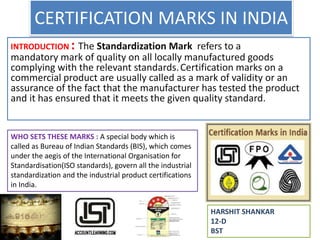
WHO SETS THESE MARKS : A special body which is
called as Bureau of Indian Standards (BIS), which comes
under the aegis of the International Organisation for
Standardisation(ISO standards), govern all the industrial
standardization and the industrial product certifications
in India.
HARSHIT SHANKAR
12-D
BST
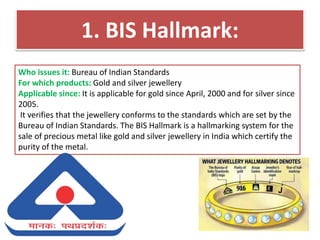
1. BIS Hallmark:
Who issues it: Bureau of Indian Standards
For which products: Gold and silver jewellery
Applicable since: It is applicable for gold since April, 2000 and for silver since
2005.
It verifies that the jewellery conforms to the standards which are set by the
Bureau of Indian Standards. The BIS Hallmark is a hallmarking system for the
sale of precious metal like gold and silver jewellery in India which certify the
purity of the metal.
2. AGMARK
Who Issues: Directorate of Marketing and Inspection of the Government
of India
Which products: Agricultural Products
Applicable Since: 1937 (amended in 1986)
It is the certification mark which is used on the agricultural products in
India. It thus ensures that the products follow a set of standards that are
approved by the Directorate of Marketing and Inspection, an agency of the
Government of India.
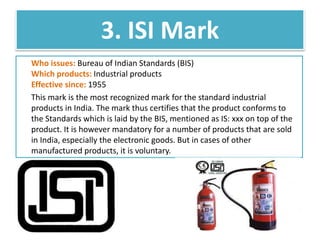
3. ISI Mark
Who issues: Bureau of Indian Standards (BIS)
Which products: Industrial products
Effective since: 1955
This mark is the most recognized mark for the standard industrial
products in India. The mark thus certifies that the product conforms to
the Standards which is laid by the BIS, mentioned as IS: xxx on top of the
product. It is however mandatory for a number of products that are sold
in India, especially the electronic goods. But in cases of other
manufactured products, it is voluntary.
4. FPO Mark
Who issues: Ministry of Food Processing
For which products: processed fruit products
Effective since: 1955
It is a mandatory mark which is required on all the processed food products
in India, certifying that the product was thus manufactured in a ‘food-safe’
environment. It is thus used especially on packaged fruit beverages, fruit-
jams, crushes, squashes, pickles, dehydrated fruit products, and the fruit
extracts, which are following the Food Safety and Standards Act of 2006
5. Eco Mark
Who issues: Bureau of Indian Standard (BIS)
For which products: Eco friendly products
Effective since: 1991
It is a certification mark certifying that the product conforms to a set of
standards whose objective is to cause minimal damage to the ecosystem.
It is issued by the BIS. The marking scheme commenced in 1991. It aims at
increasing environmental awareness among consumers.
REGULATORY BODIES
• Bureau of Indian Standards
(BIS)
• The Bureau of Indian Standards is
the national Standards Body of India
working under the aegis of Ministry
of Consumer Affairs, Food & Public
Distribution, Government of India. It
is established by the Bureau of
Indian Standards Act, 1986 which
came into effect on 23 December
1986.
• Founded: 23 December 1986
• Founder: Parliament of India
• Parent agency: Ministry of
Consumer Affairs, Food and Public
Distribution
• Food Safety and Standards
Authority of India (FSSAI)
• It is an autonomous body established
under the Ministry of Health &
Family Welfare, Government of
India. The FSSAI has been established
under the Food Safety and Standards
Act, 2006, which is a consolidating
statute related to food safety and
regulation in India.
• Founded: August 2011
• Sector: Food safety
• Parent agency: Ministry of Health
and Family Welfare, Government of
India
HARSHIT SHANKAR

Certification marks in india

  • 1.
    CERTIFICATION MARKS ININDIA INTRODUCTION : The Standardization Mark refers to a mandatory mark of quality on all locally manufactured goods complying with the relevant standards.Certification marks on a commercial product are usually called as a mark of validity or an assurance of the fact that the manufacturer has tested the product and it has ensured that it meets the given quality standard. WHO SETS THESE MARKS : A special body which is called as Bureau of Indian Standards (BIS), which comes under the aegis of the International Organisation for Standardisation(ISO standards), govern all the industrial standardization and the industrial product certifications in India. HARSHIT SHANKAR 12-D BST
  • 2.
    1. BIS Hallmark: Whoissues it: Bureau of Indian Standards For which products: Gold and silver jewellery Applicable since: It is applicable for gold since April, 2000 and for silver since 2005. It verifies that the jewellery conforms to the standards which are set by the Bureau of Indian Standards. The BIS Hallmark is a hallmarking system for the sale of precious metal like gold and silver jewellery in India which certify the purity of the metal.
  • 3.
    2. AGMARK Who Issues:Directorate of Marketing and Inspection of the Government of India Which products: Agricultural Products Applicable Since: 1937 (amended in 1986) It is the certification mark which is used on the agricultural products in India. It thus ensures that the products follow a set of standards that are approved by the Directorate of Marketing and Inspection, an agency of the Government of India.
  • 4.
    3. ISI Mark Whoissues: Bureau of Indian Standards (BIS) Which products: Industrial products Effective since: 1955 This mark is the most recognized mark for the standard industrial products in India. The mark thus certifies that the product conforms to the Standards which is laid by the BIS, mentioned as IS: xxx on top of the product. It is however mandatory for a number of products that are sold in India, especially the electronic goods. But in cases of other manufactured products, it is voluntary.
  • 5.
    4. FPO Mark Whoissues: Ministry of Food Processing For which products: processed fruit products Effective since: 1955 It is a mandatory mark which is required on all the processed food products in India, certifying that the product was thus manufactured in a ‘food-safe’ environment. It is thus used especially on packaged fruit beverages, fruit- jams, crushes, squashes, pickles, dehydrated fruit products, and the fruit extracts, which are following the Food Safety and Standards Act of 2006
  • 6.
    5. Eco Mark Whoissues: Bureau of Indian Standard (BIS) For which products: Eco friendly products Effective since: 1991 It is a certification mark certifying that the product conforms to a set of standards whose objective is to cause minimal damage to the ecosystem. It is issued by the BIS. The marking scheme commenced in 1991. It aims at increasing environmental awareness among consumers.
  • 7.
    REGULATORY BODIES • Bureauof Indian Standards (BIS) • The Bureau of Indian Standards is the national Standards Body of India working under the aegis of Ministry of Consumer Affairs, Food & Public Distribution, Government of India. It is established by the Bureau of Indian Standards Act, 1986 which came into effect on 23 December 1986. • Founded: 23 December 1986 • Founder: Parliament of India • Parent agency: Ministry of Consumer Affairs, Food and Public Distribution • Food Safety and Standards Authority of India (FSSAI) • It is an autonomous body established under the Ministry of Health & Family Welfare, Government of India. The FSSAI has been established under the Food Safety and Standards Act, 2006, which is a consolidating statute related to food safety and regulation in India. • Founded: August 2011 • Sector: Food safety • Parent agency: Ministry of Health and Family Welfare, Government of India
  • 8.