Technology of cereals, legumes and
oil seed processing
Submitted to,
Dr. Maya Raman
Associate Professor
KUFOS
Submitted by,
Vishnu Priya K
OST-2022-24-29
MFT2202
1.CORN (Zea mays)
Maizeis the world’s leading crop and is widely cultivated as cereal grain.
maize have many types like normal yellow/ white grain, sweet corn, baby
corn, popcorn, waxy corn, high amylase corn, high oil corn, quality protein
maize, etc. Apart from this, maize is an important industrial raw material
and provides large opportunity for value addition.
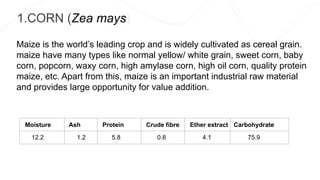
Moisture Ash Protein Crude fibre Ether extract Carbohydrate
12.2 1.2 5.8 0.8 4.1 75.9
4.
1.CORN SYRUP
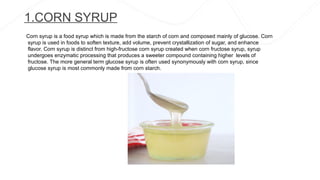
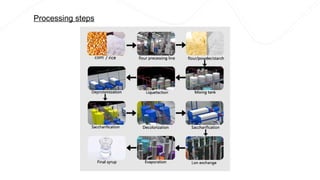
Corn syrupis a food syrup which is made from the starch of corn and composed mainly of glucose. Corn
syrup is used in foods to soften texture, add volume, prevent crystallization of sugar, and enhance
flavor. Corn syrup is distinct from high-fructose corn syrup created when corn fructose syrup, syrup
undergoes enzymatic processing that produces a sweeter compound containing higher levels of
fructose. The more general term glucose syrup is often used synonymously with corn syrup, since
glucose syrup is most commonly made from corn starch.
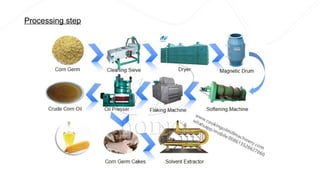
2.CORN OIL
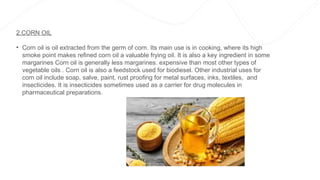
• Cornoil is oil extracted from the germ of corn. Its main use is in cooking, where its high
smoke point makes refined corn oil a valuable frying oil. It is also a key ingredient in some
margarines Corn oil is generally less margarines. expensive than most other types of
vegetable oils . Corn oil is also a feedstock used for biodiesel. Other industrial uses for
corn oil include soap, salve, paint, rust proofing for metal surfaces, inks, textiles, and
insecticides. It is insecticides sometimes used as a carrier for drug molecules in
pharmaceutical preparations.
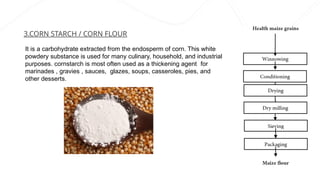
3.CORN STARCH /CORN FLOUR
It is a carbohydrate extracted from the endosperm of corn. This white
powdery substance is used for many culinary, household, and industrial
purposes. cornstarch is most often used as a thickening agent for
marinades , gravies , sauces, glazes, soups, casseroles, pies, and
other desserts.
9.
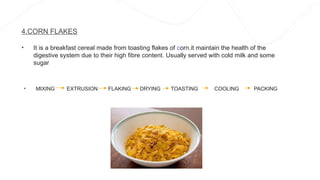
4.CORN FLAKES
• Itis a breakfast cereal made from toasting flakes of corn.it maintain the health of the
digestive system due to their high fibre content. Usually served with cold milk and some
sugar
• MIXING EXTRUSION FLAKING DRYING TOASTING COOLING PACKING
10.
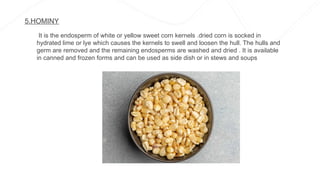
5.HOMINY
It is theendosperm of white or yellow sweet corn kernels .dried corn is socked in
hydrated lime or lye which causes the kernels to swell and loosen the hull. The hulls and
germ are removed and the remaining endosperms are washed and dried . It is available
in canned and frozen forms and can be used as side dish or in stews and soups
11.
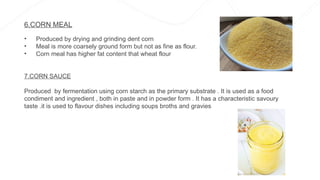
6.CORN MEAL
• Producedby drying and grinding dent corn
• Meal is more coarsely ground form but not as fine as flour.
• Corn meal has higher fat content that wheat flour
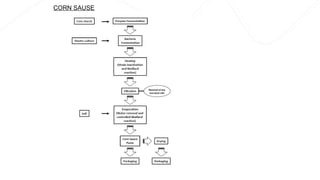
7.CORN SAUCE
Produced by fermentation using corn starch as the primary substrate . It is used as a food
condiment and ingredient , both in paste and in powder form . It has a characteristic savoury
taste .it is used to flavour dishes including soups broths and gravies
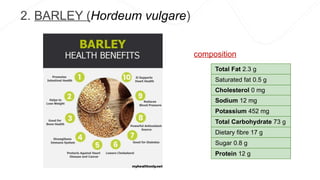
2. BARLEY (Hordeumvulgare)
Total Fat 2.3 g
Saturated fat 0.5 g
Cholesterol 0 mg
Sodium 12 mg
Potassium 452 mg
Total Carbohydrate 73 g
Dietary fibre 17 g
Sugar 0.8 g
Protein 12 g
composition
14.
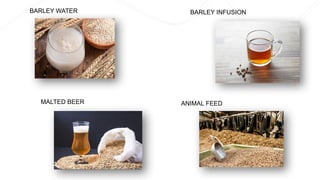
1.Barley infusion: Thisis a substitute of coffee but it will not containing any
caffeine in it, as it is prepared by the toasting and grinding of barley
grains. This is very popular in Europe and Italy as the name Barley Coffee.
2.Barley water: This beverage is prepared by boiling the barley grains in water
and to this beverage flavor can be given by the addition of various fruits
as per the choice in it the time of boiling it or after boiling
3.Malted beverage: This beverage is prepared by the boiling of barley malt in
the water preferably spices can be added to impart the taste in this
beverage. Mostly this beverage is used as weaning food .the major non
feed use of barley is in the production of malt and by far the largest part
of this malt is used for brewing beer.
4.Animal Feed: it is as animal feed, especially for cattle and pigs. Barley
provides a good balance of high energy, because of its starch content,
and reasonable protein quality and content. Hulled barley is less desirable
than other cereal grains, such as maize, for chicken feed formulations
OATS (Avena sativa.)
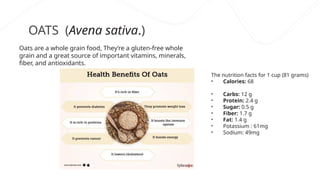
Thenutrition facts for 1 cup (81 grams)
• Calories: 68
• Carbs: 12 g
• Protein: 2.4 g
• Sugar: 0.5 g
• Fiber: 1.7 g
• Fat: 1.4 g
• Potassium : 61mg
• Sodium: 49mg
Oats are a whole grain food, They’re a gluten-free whole
grain and a great source of important vitamins, minerals,
fiber, and antioxidants.
17.
Oatmeal: Oatmeal isa popular breakfast food made by cooking oats in water or milk. It
can be flavored with various ingredients such as fruits, nuts, and spices. Oatmeal is known
for its high fiber content and is often consumed for its health benefits.
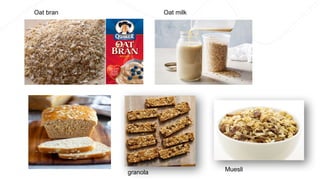
Oat bran: oat flour can be separated into coarse and final fractions. The coarse fraction Is
referred to as bran, that comes from the outer aleurone and sub aleurone layers of the
groat, it is high in fiber, protein, vitamins, and mineral and is slightly higher in fat .the
coarse bran fraction is separated by shifting the oats flour.
Oat milk: Oat milk is a plant-based alternative to dairy milk. It is made by blending oats with
water and then straining the mixture to remove any solid particles. Oat milk is popular
among individuals with lactose intolerance or those following a vegan lifestyle.
bakery products
1.Oats bread
2.Granola bars
3.Laddu
4.Uppma
5.Muesli
6.Oat meal cookies,cakes
MILLET
• Millets area group of cereal grains that belong to
the Poaceae family, commonly known as the grass
family. Millets have numerous health benefits,
including helps to lower blood sugar and
cholesterol levels. They’re also gluten-free , So it
can be consumed by people with celiac disease or
by people who are gluten sensitive.
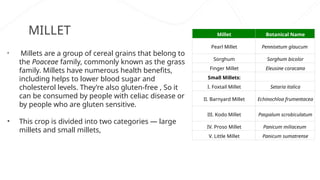
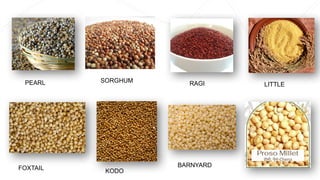
• This crop is divided into two categories — large
millets and small millets,
Millet Botanical Name
Pearl Millet Pennisetum glaucum
Sorghum Sorghum bicolor
Finger Millet Eleusine coracana
Small Millets:
I. Foxtail Millet Setaria italica
II. Barnyard Millet Echinochloa frumentacea
III. Kodo Millet Paspalum scrobiculatum
IV. Proso Millet Panicum miliaceum
V. Little Millet Panicum sumatrense
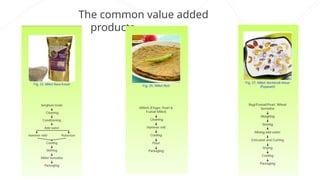
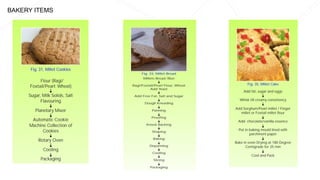
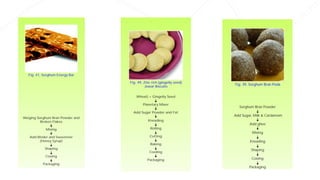
Bakery products :Bakery products are popular all over the world and the production has risen by many folds due to
their low cost, varied taste and textured profiles with attractive package and longer shelf-life to suit easy
marketing [35]. The use of millets in bakery products will not only be superior in terms of fibre content,
micronutrients but also create a good potential for millets to enter in the bakery world for series of value
added products.
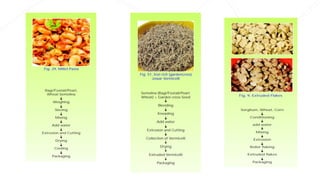
Extruded products : A majority of world population suffers from qualitative and quantitative insufficiency of dietary
protein and calories intake. In all such cases physiological maintenance and growth are impaired and
malnutrition results. In this context, extrusion is a beneficial process. Extrusion cooking is a HTST cooking
process, which could be used for processing of starchy as well as proteinaceous materials. The use of
extrusion cooking has distinct advantages like versatility, high productivity, high product quality, Millet based
extruded snack foods are prepared using twin-screw extruder.
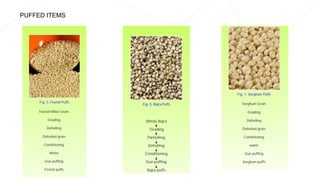
Puffed/Popped and flaked millets: Puffing or popping of cereals is an old traditional practice of cooking grains to be
used as snack or breakfast cereal either plain or with some spices/salt/sweeteners.
Pasta, Noodles: Pasta or papad are made from the flours of cereals or legumes as main ingredient and the dried
products are used as RTC. these foods through cold extrusion system which become hard and brittle after
drying.
Fermented products : Fermented foods like Dosa and Idli are popular and common breakfast foods and even as the
evening meals in many parts of India. Millets are good source of protein but the protein quality in terms of
lysine and tryptophan content is low, hence there is growing emphasis on the improvement of protein quality.
Fermentation not only improves the taste but at the same time enriches the food value in terms of protein,
calcium and fibre, B vitamins, in vitro protein digestibility and decreases the levels of anti-nutrients in food
grain

![Bakery products : Bakery products are popular all over the world and the production has risen by many folds due to
their low cost, varied taste and textured profiles with attractive package and longer shelf-life to suit easy
marketing [35]. The use of millets in bakery products will not only be superior in terms of fibre content,
micronutrients but also create a good potential for millets to enter in the bakery world for series of value
added products.
Extruded products : A majority of world population suffers from qualitative and quantitative insufficiency of dietary
protein and calories intake. In all such cases physiological maintenance and growth are impaired and
malnutrition results. In this context, extrusion is a beneficial process. Extrusion cooking is a HTST cooking
process, which could be used for processing of starchy as well as proteinaceous materials. The use of
extrusion cooking has distinct advantages like versatility, high productivity, high product quality, Millet based
extruded snack foods are prepared using twin-screw extruder.
Puffed/Popped and flaked millets: Puffing or popping of cereals is an old traditional practice of cooking grains to be
used as snack or breakfast cereal either plain or with some spices/salt/sweeteners.
Pasta, Noodles: Pasta or papad are made from the flours of cereals or legumes as main ingredient and the dried
products are used as RTC. these foods through cold extrusion system which become hard and brittle after
drying.
Fermented products : Fermented foods like Dosa and Idli are popular and common breakfast foods and even as the
evening meals in many parts of India. Millets are good source of protein but the protein quality in terms of
lysine and tryptophan content is low, hence there is growing emphasis on the improvement of protein quality.
Fermentation not only improves the taste but at the same time enriches the food value in terms of protein,
calcium and fibre, B vitamins, in vitro protein digestibility and decreases the levels of anti-nutrients in food
grain](https://image.slidesharecdn.com/cereals-250219075052-2d6e9e25/85/cereals-pptx-copy-copy-copy-copy-copy-copy-21-320.jpg)