NAME:Amarjit choudhury
ROLAND INSTITUTE OF TECHNOLOGY
BERHAMPUR.
CONTENTS
 Introduction
Need of the study
 Material
 Procedure
 Properties
 Result
 conclusion
 Reference
INTRODUCTION:
Concrete, as a constructive material, has been used in
construction industry for about two centuries.
 The global production of ceramic tiles in
the world is about 8500 million square meters, this amount
is about 400 million square in Iran, which make Iran the
fifth ceramic tile producer in the world.
 Usually, The wastage related to tile, ceramic and
sanitary waste are created in different forms some of which
are produced in companies during and after production
process due to errors in either construction, human
activities ,and also inappropriate raw materials.
NEED OF STUDY
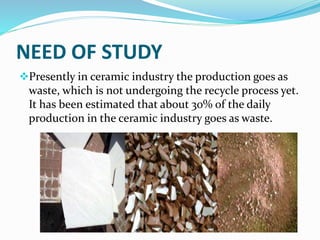
Presently in ceramic industry the production goes as
waste, which is not undergoing the recycle process yet.
It has been estimated that about 30% of the daily
production in the ceramic industry goes as waste.
MATERIALS
 Used as a coarse aggregate, fine aggregate.
 The use of materials with pozzolan properties in cement
achieves:
 Economic Advantages:
 Reduced need for clinker production (lower energy
consumption).
 Environmental Advantages:
 Reduced CO2 emissions (Kyoto Protocol) Technical
Advantages:
 Long-term mechanical strength
 Stable resistance to expansion due to the presence of free lime,
sulphates and aggregate-alkali reactions.
 Durable resistance to the action of pure and acid water.
 Reduced hydration heat
 Impermeability, reducing porosity and increasing compactness.
PROCEDURE
 The test specimens were cast in steel cubic moulds
(150×150×150) and compacted on a vibrating table. After
approximately 24 hours, the specimens were removed from
the moulds. The concrete specimens were cured in lime-
saturated water at 21ºC in cure tanks until the time of
testing.
For each mix, cubic samples were tested to determine the
compressive strengths at 7 and 28 days of curing. A 2000-
kN capacity uniaxial compressive testing machine was used
to compressive strength test.
The compressive strength, specific Wight and water
absorption for each mixture was obtained from average of
three cubic specimens.
Result In Ceramic Waste
 Different proportions of waste ceramic are use as
course aggregate in cement concrete to determine the
compressive strength.
 Compressive Strength
 Ceramic waste as aggregate
 Replace by 10% of aggregate
 7 days test result 28 days test result
 Sample 1 - 620 KN
 Sample 2 - 600 KN
 Sample 3 - 605 KN
Continued……….

 Replace by 20% of aggregate
 7 days test result 28 days test result
 Sample 1 - 620KN
 Sample 2 - 625 KN
 Sample 3 - 615 KN

 Replace by 30% of aggregate
 7 days test result 28 days test result
 Sample 1 - 640 KN
 Sample 2 - 635 KN
 Sample 3 – 645 KN

Continued……….
 Replace by 40% of aggregate
 7 days test result 28 days test result
 Sample 1 - 575 KN
 Sample 2 - 560 KN
 Sample 3 – 570 KN
CONCLUSION
 Finally, the following results were obtained:
 1. Using ceramic wastage in concrete
production causes no remarkable negative effect in the
properties of concrete. The optimal case of using tile
wastage as sand are amounts of 25 to 50 percent,
besides, the best case of their use as coarse aggregate
are as amounts of 10 to 20 percent. In these measures,
not only an increase happens in compressive strength,
but also a decrease in unit weight and lack of
remarkable negative effect on water absorption is
reported.
Continued……….
 2. Using tile wastage in concrete leads to removal of
those materials from environment. Besides, decreasing
the use of raw materials, using the wastage is
considered positive economically.
 3. Using tile wastage in concrete, with regard
to reducing the costs and keeping the environment
clean along with wastage management, and
ameliorating the strength of structures, is an effective
measure in sustainable development.
REFERENCES
 [1] Mohd Mustafa Al Bakri, H. Kamarudin, Che Mohd Ruzaidi,
 Shamsul Baharin, R. Rozaimah, Nur Khairiatun Nisa. Concrete With
 Ceramic Waste and Quarry Dust Aggregates. 5th Annual Conference
 Management in Construction Researchers Association, 2006: 383-
 388
 [2] Nehdi Monce, Khan Ashfaq. Cementitious Composites Containing
 Recycled Tire Rubber: An Overview of Engineering Properties and
 Potential Applications. Cem Concr Aggregates 2001; 23(1): 3–10.
 [3] Basri HB, Mannan MA, Zain MFM. Concrete Using Waste Oil
 Palm Shells As Aggregate. Cem Concr Res 1999(29): 619–22.
 [4] Padmini AK, Ramamurthy K, Mathews MS., Behaviour of Concrete
 With Low-Strength Bricks As Lightweight Coarse Aggregate. Mag
 Concr Res 2001; 53(6):367– 75.

Ceramic waste

  • 1.
  • 2.
    CONTENTS  Introduction Need ofthe study  Material  Procedure  Properties  Result  conclusion  Reference
  • 3.
    INTRODUCTION: Concrete, as aconstructive material, has been used in construction industry for about two centuries.  The global production of ceramic tiles in the world is about 8500 million square meters, this amount is about 400 million square in Iran, which make Iran the fifth ceramic tile producer in the world.  Usually, The wastage related to tile, ceramic and sanitary waste are created in different forms some of which are produced in companies during and after production process due to errors in either construction, human activities ,and also inappropriate raw materials.
  • 4.
    NEED OF STUDY Presentlyin ceramic industry the production goes as waste, which is not undergoing the recycle process yet. It has been estimated that about 30% of the daily production in the ceramic industry goes as waste.
  • 5.
    MATERIALS  Used asa coarse aggregate, fine aggregate.  The use of materials with pozzolan properties in cement achieves:  Economic Advantages:  Reduced need for clinker production (lower energy consumption).  Environmental Advantages:  Reduced CO2 emissions (Kyoto Protocol) Technical Advantages:  Long-term mechanical strength  Stable resistance to expansion due to the presence of free lime, sulphates and aggregate-alkali reactions.  Durable resistance to the action of pure and acid water.  Reduced hydration heat  Impermeability, reducing porosity and increasing compactness.
  • 6.
    PROCEDURE  The testspecimens were cast in steel cubic moulds (150×150×150) and compacted on a vibrating table. After approximately 24 hours, the specimens were removed from the moulds. The concrete specimens were cured in lime- saturated water at 21ºC in cure tanks until the time of testing. For each mix, cubic samples were tested to determine the compressive strengths at 7 and 28 days of curing. A 2000- kN capacity uniaxial compressive testing machine was used to compressive strength test. The compressive strength, specific Wight and water absorption for each mixture was obtained from average of three cubic specimens.
  • 7.
    Result In CeramicWaste  Different proportions of waste ceramic are use as course aggregate in cement concrete to determine the compressive strength.  Compressive Strength  Ceramic waste as aggregate  Replace by 10% of aggregate  7 days test result 28 days test result  Sample 1 - 620 KN  Sample 2 - 600 KN  Sample 3 - 605 KN
  • 8.
    Continued……….   Replace by20% of aggregate  7 days test result 28 days test result  Sample 1 - 620KN  Sample 2 - 625 KN  Sample 3 - 615 KN   Replace by 30% of aggregate  7 days test result 28 days test result  Sample 1 - 640 KN  Sample 2 - 635 KN  Sample 3 – 645 KN 
  • 9.
    Continued……….  Replace by40% of aggregate  7 days test result 28 days test result  Sample 1 - 575 KN  Sample 2 - 560 KN  Sample 3 – 570 KN
  • 10.
    CONCLUSION  Finally, thefollowing results were obtained:  1. Using ceramic wastage in concrete production causes no remarkable negative effect in the properties of concrete. The optimal case of using tile wastage as sand are amounts of 25 to 50 percent, besides, the best case of their use as coarse aggregate are as amounts of 10 to 20 percent. In these measures, not only an increase happens in compressive strength, but also a decrease in unit weight and lack of remarkable negative effect on water absorption is reported.
  • 11.
    Continued……….  2. Usingtile wastage in concrete leads to removal of those materials from environment. Besides, decreasing the use of raw materials, using the wastage is considered positive economically.  3. Using tile wastage in concrete, with regard to reducing the costs and keeping the environment clean along with wastage management, and ameliorating the strength of structures, is an effective measure in sustainable development.
  • 12.
    REFERENCES  [1] MohdMustafa Al Bakri, H. Kamarudin, Che Mohd Ruzaidi,  Shamsul Baharin, R. Rozaimah, Nur Khairiatun Nisa. Concrete With  Ceramic Waste and Quarry Dust Aggregates. 5th Annual Conference  Management in Construction Researchers Association, 2006: 383-  388  [2] Nehdi Monce, Khan Ashfaq. Cementitious Composites Containing  Recycled Tire Rubber: An Overview of Engineering Properties and  Potential Applications. Cem Concr Aggregates 2001; 23(1): 3–10.  [3] Basri HB, Mannan MA, Zain MFM. Concrete Using Waste Oil  Palm Shells As Aggregate. Cem Concr Res 1999(29): 619–22.  [4] Padmini AK, Ramamurthy K, Mathews MS., Behaviour of Concrete  With Low-Strength Bricks As Lightweight Coarse Aggregate. Mag  Concr Res 2001; 53(6):367– 75.