Centrally Planned Economies What are they?
The Goals of a Free Market Economy Living in America, it may be difficult to fully grasp the workings of a Centrally Planned Economy.  Under this economic configuration: The three Key Economic Questions are answered by the Central Government, and not by the inter-relation between the Consumers and the Producers. The Central Government controls the Production Factors of Land, Labor, and Capital, thus allowing it to make all decisions without meaningful opposition. The Central Government prioritizes its needs with little regard to the desires of individual citizens.
Communism v. Socialism Governments operating in such a manner are often referred to as either  Communist  or  Socialist . There are distinct differences between the two.
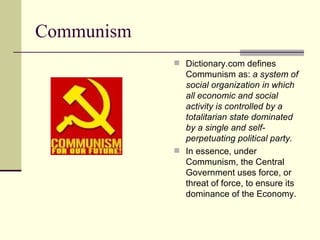
Communism Dictionary.com defines Communism as:  a system of social organization in which all economic and social activity is controlled by a totalitarian state dominated by a single and self-perpetuating political party.   In essence, under Communism, the Central Government uses force, or threat of force, to ensure its dominance of the Economy.
Socialism Socialism, in contrast, is defined, again by Dictionary.com, as:  a theory or system of social  organization that advocates the vesting of the ownership and control of the means of production and distribution, of capital, land, etc., in the community as a whole.    Socialism is implemented democratically as opposed to by force.

Centrally Planned Economies Defined

  • 1.
  • 2.
    The Goals ofa Free Market Economy Living in America, it may be difficult to fully grasp the workings of a Centrally Planned Economy. Under this economic configuration: The three Key Economic Questions are answered by the Central Government, and not by the inter-relation between the Consumers and the Producers. The Central Government controls the Production Factors of Land, Labor, and Capital, thus allowing it to make all decisions without meaningful opposition. The Central Government prioritizes its needs with little regard to the desires of individual citizens.
  • 3.
    Communism v. SocialismGovernments operating in such a manner are often referred to as either Communist or Socialist . There are distinct differences between the two.
  • 4.
    Communism Dictionary.com definesCommunism as:  a system of social organization in which all economic and social activity is controlled by a totalitarian state dominated by a single and self-perpetuating political party.   In essence, under Communism, the Central Government uses force, or threat of force, to ensure its dominance of the Economy.
  • 5.
    Socialism Socialism, incontrast, is defined, again by Dictionary.com, as: a theory or system of social organization that advocates the vesting of the ownership and control of the means of production and distribution, of capital, land, etc., in the community as a whole.  Socialism is implemented democratically as opposed to by force.