India Marketing
INSIGHTS FROM CENSUS 2011
BY
DISHA GHOSHAL
FT201032
Census 2011: Rural-Urban Skews
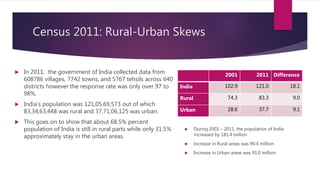
 In 2011, the government of India collected data from
608786 villages, 7742 towns, and 5767 tehsils across 640
districts however the response rate was only over 97 to
98%.
 India’s population was 121,05,69,573 out of which
83,34,63,448 was rural and 37,71,06,125 was urban.
 This goes on to show that about 68.5% percent
population of India is still in rural parts while only 31.5%
approximately stay in the urban areas.
2001 2011 Difference
India 102.9 121.0 18.1
Rural 74.3 83.3 9.0
Urban 28.6 37.7 9.1
 During 2001 – 2011, the population of India
increased by 181.4 million
 Increase in Rural areas was 90.4 million
 Increase in Urban areas was 91.0 million
Insights: Population and Growth
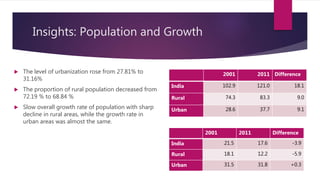
 The level of urbanization rose from 27.81% to
31.16%
 The proportion of rural population decreased from
72.19 % to 68.84 %
 Slow overall growth rate of population with sharp
decline in rural areas, while the growth rate in
urban areas was almost the same.
2001 2011 Difference
India 102.9 121.0 18.1
Rural 74.3 83.3 9.0
Urban 28.6 37.7 9.1
2001 2011 Difference
India 21.5 17.6 -3.9
Rural 18.1 12.2 -5.9
Urban 31.5 31.8 +0.3
Insights: Sex Ratio and Child Sex ratio
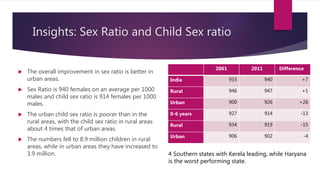
 The overall improvement in sex ratio is better in
urban areas.
 Sex Ratio is 940 females on an average per 1000
males and child sex ratio is 914 females per 1000
males.
 The urban child sex ratio is poorer than in the
rural areas, with the child sex ratio in rural areas
about 4 times that of urban areas.
 The numbers fell to 8.9 million children in rural
areas, while in urban areas they have increased to
3.9 million.
2001 2011 Difference
India 933 940 +7
Rural 946 947 +1
Urban 900 926 +26
0-6 years 927 914 -13
Rural 934 919 -15
Urban 906 902 -4
4 Southern states with Kerela leading, while Haryana
is the worst performing state.
Insights: Literacy Rate, Gender wise
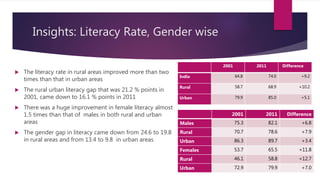
2001 2011 Difference
India 64.8 74.0 +9.2
Rural 58.7 68.9 +10.2
Urban 79.9 85.0 +5.1
 The literacy rate in rural areas improved more than two
times than that in urban areas
 The rural urban literacy gap that was 21.2 % points in
2001, came down to 16.1 % points in 2011
 There was a huge improvement in female literacy almost
1.5 times than that of males in both rural and urban
areas
 The gender gap in literacy came down from 24.6 to 19.8
in rural areas and from 13.4 to 9.8 in urban areas
2001 2011 Difference
Males 75.3 82.1 +6.8
Rural 70.7 78.6 +7.9
Urban 86.3 89.7 +3.4
Females 53.7 65.5 +11.8
Rural 46.1 58.8 +12.7
Urban 72.9 79.9 +7.0
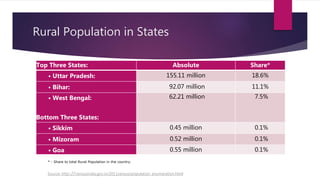
Rural Population in States
Top Three States: Absolute Share*
• Uttar Pradesh: 155.11 million 18.6%
• Bihar: 92.07 million 11.1%
• West Bengal:
Bottom Three States:
62.21 million 7.5%
• Sikkim 0.45 million 0.1%
• Mizoram 0.52 million 0.1%
• Goa 0.55 million 0.1%
* - Share to total Rural Population in the country.
Source: http://censusindia.gov.in/2011census/population_enumeration.html
Thank You

Census 2011: Rural Urban Skews

  • 1.
    India Marketing INSIGHTS FROMCENSUS 2011 BY DISHA GHOSHAL FT201032
  • 2.
    Census 2011: Rural-UrbanSkews  In 2011, the government of India collected data from 608786 villages, 7742 towns, and 5767 tehsils across 640 districts however the response rate was only over 97 to 98%.  India’s population was 121,05,69,573 out of which 83,34,63,448 was rural and 37,71,06,125 was urban.  This goes on to show that about 68.5% percent population of India is still in rural parts while only 31.5% approximately stay in the urban areas. 2001 2011 Difference India 102.9 121.0 18.1 Rural 74.3 83.3 9.0 Urban 28.6 37.7 9.1  During 2001 – 2011, the population of India increased by 181.4 million  Increase in Rural areas was 90.4 million  Increase in Urban areas was 91.0 million
  • 3.
    Insights: Population andGrowth  The level of urbanization rose from 27.81% to 31.16%  The proportion of rural population decreased from 72.19 % to 68.84 %  Slow overall growth rate of population with sharp decline in rural areas, while the growth rate in urban areas was almost the same. 2001 2011 Difference India 102.9 121.0 18.1 Rural 74.3 83.3 9.0 Urban 28.6 37.7 9.1 2001 2011 Difference India 21.5 17.6 -3.9 Rural 18.1 12.2 -5.9 Urban 31.5 31.8 +0.3
  • 4.
    Insights: Sex Ratioand Child Sex ratio  The overall improvement in sex ratio is better in urban areas.  Sex Ratio is 940 females on an average per 1000 males and child sex ratio is 914 females per 1000 males.  The urban child sex ratio is poorer than in the rural areas, with the child sex ratio in rural areas about 4 times that of urban areas.  The numbers fell to 8.9 million children in rural areas, while in urban areas they have increased to 3.9 million. 2001 2011 Difference India 933 940 +7 Rural 946 947 +1 Urban 900 926 +26 0-6 years 927 914 -13 Rural 934 919 -15 Urban 906 902 -4 4 Southern states with Kerela leading, while Haryana is the worst performing state.
  • 5.
    Insights: Literacy Rate,Gender wise 2001 2011 Difference India 64.8 74.0 +9.2 Rural 58.7 68.9 +10.2 Urban 79.9 85.0 +5.1  The literacy rate in rural areas improved more than two times than that in urban areas  The rural urban literacy gap that was 21.2 % points in 2001, came down to 16.1 % points in 2011  There was a huge improvement in female literacy almost 1.5 times than that of males in both rural and urban areas  The gender gap in literacy came down from 24.6 to 19.8 in rural areas and from 13.4 to 9.8 in urban areas 2001 2011 Difference Males 75.3 82.1 +6.8 Rural 70.7 78.6 +7.9 Urban 86.3 89.7 +3.4 Females 53.7 65.5 +11.8 Rural 46.1 58.8 +12.7 Urban 72.9 79.9 +7.0
  • 6.
    Rural Population inStates Top Three States: Absolute Share* • Uttar Pradesh: 155.11 million 18.6% • Bihar: 92.07 million 11.1% • West Bengal: Bottom Three States: 62.21 million 7.5% • Sikkim 0.45 million 0.1% • Mizoram 0.52 million 0.1% • Goa 0.55 million 0.1% * - Share to total Rural Population in the country. Source: http://censusindia.gov.in/2011census/population_enumeration.html
  • 7.