MUGHER CEMENT ENTERPRISE
Raw Meal & Clinker Quality Control
Module Objectives
What is the goal of clinker burning?
What are the testing techniques in cement
industries?
What are the cement manufacturing
process’s variables and factors?
What are the objectives of raw meal
control?
How to calculate raw mix composition?
Module Objectives(Continue)
What is the role of raw meal fineness and
particle size distribution?
What is the importance of raw meal
homogeneity?
What are the reactions during
clinkerization?
What are the objectives of clinker control?
Module Objectives(Continue)
What are operational measurements on clinker?
What are the factors that affects the correlation
between raw meal and clinker composition?
What is the need of clinker cooling?
 What are cement plant control (follow-up)
parameters?
Definition of Cement
Ordinary Portland Cement (OPC):
Portland cement is the finely ground
clinker with some gypsum added.
Pozzolanic Portland Cement (PPC):
Pozzolanic Portland Cement is the finely
ground clinker with some pozzolana
(pumice) & gypsum added.
Portland Cement Clinker
The manufacturing of clinker involves
the conversion, at high temperature of
mineral mixtures of natural origin, into
new mineral mixtures which have
hydraulic properties.
It is an intimate mixture of: Calcareous
materials (CaCO3), Argillaceous, Silica ,
Alumina, Iron Oxide.
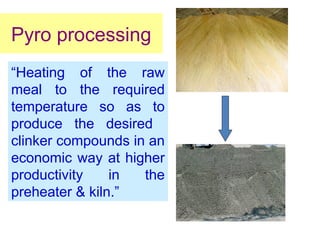
“Heating of the raw
meal to the required
temperature so as to
produce the desired
clinker compounds in an
economic way at higher
productivity in the
preheater & kiln.”
Pyro processing
What is the goal of clinker
burning?
The production of
GOOD QUALITY
cement
What is cement quality?
Cement quality is defined in terms of
characteristics & properties such as:
Chemical composition (Oxides content limits)
Physical properties (Strength, Workability,
Setting behavior etc) in Standard Norms
(ASTM, ISO) and is measured used standard
methods
To many people who make and
market cement, 'quality’ means
conforming to the standards,
codes and manuals
established in accordance with
the modern quality conformity
industry
Factors influencing cement quality
Chemical & mineralogical
composition of clinker
Additives Quality such as Gypsum,
Pozzolana
Mechanical handling of clinker
(grinding)
Production of Good quality clinker from the kiln
depends on :
 Good raw mix design which in turn depends on
1. Desired clinker minerals
2. Allowable free lime
3. Nature of the raw material
 Liquid ratio & Residence time in the kiln
 Fuel quality & Combustion
 Burning process
 Fineness of the raw meal to the desired level
 Circulation phenomena
Quality Control
Quality control concepts
A detailed control plan for quality control of each
raw material, intermediate & final product is
setup by a thorough analysis of the following
questionnaire.
What should be examined?
What information is required for the control?
How often must the test be performed?
How accurate must the result of the testing be?
What is sampling?
Sampling is the process to collect a representative
& sufficient quantity of material (sample) to be
analysed.
Generally there are two types of samples
1.Spot sample:
samples that is collected at a certain moment or the
portion taken from the collected material (i.e. un-
homogenized).
2. Representative sample:
samples that represent the full quantity
or a full period of time.
Are auto samples always representative?
The collection of the sample must be
continuous to ensure representative
auto sampling
Consequence of wrong sampling
& wrong analysis
1.Wrong sample + correct analysis =
Wrong action
2. Correct sample+ Wrong analysis =
Wrong action
3. Correct sample + Correct analysis =
Right action
Common Testing Methods/techniques in
cement industry
1.Chemical composition (Complete analysis ):
Complexometric titration and/or X-ray
Fluorescence
2.CaCO3 : Carbonate titration (back titration) &
Prompt gamma neutron activation technology
(PGNAA)
3.Fineness : Sieving @ different mesh size
4.SO3: Gravimetric, X-ray Fluorescence & LECO
Sulpure analyzer
Common Testing Methods/techniques in
cement industry (continue)
5.Alkalies (K2O & Na2O): Flame photometer,
atomic absorption spectroscopy (AAS) & X-ray
Fluorescence
6.Chlorine: Potentiometeric titration, X-ray
Fluorescence
7.Loss on ignition(LOI): Ignition the sample in
Laboratory muffle furnace @ 10000
C
& LOI analysis
instrument
8.Free lime(uncombined CaO) :Titration(ethylene
glycol method), conductometric (Automatic free
lime analyzers) & X-ray diffraction
Material
Burnability
Material burnability
The readiness with which a raw mix is
transformed into clinker minerals in the
course of high temperature treatment
 Arranged as easy, normal, or difficult to
burn
There is interrelationship between feed meal
burn-ability and clinkering process
properties such as: residence time,
maximum temperature and pressure, and
cooling rate
Reactivity & burnability of Raw
Mix
Reactivity and burnability are properties
which affect the plant capacity and the
process thermal consumption, because
raw meal sintering is considerably altered
by such factors
Reactivity & burnability of Raw
Mix(continues)
Reactivity is related to the rate of
reaction for certain conditions and
temperatures
Burnability expresses the difficulty
for the material to be converted at
any time, in the process temperature
Reactivity & burnability of Raw
Mix(continues)
Reactivity and LSF affect the
burnability value, since reactivity is
a function of the Silica Ratio (SR),
Alumina Ratio (AR), granulometry ,
present mineralogical species and
their chemical activity
Factors influencing the reactivity
1. The raw mix preparation
Chemical factor …………… SM,AM
Granulometric factor ……Fineness and
Particle size distribution (PSD)
2. Inherent characteristics of raw
materials( The intrinsic reactivity of the
raw materials), which can not be
modified:
Factors influencing the reactivity
(continues)
Different raw mix with the same chemical
composition and equal fineness may differ
in their burnability due to their different
mineralogical composition
Some types of silica ,for example, will react
more readily than will other
Quartz
Silica sand
Factors influencing the reactivity
(continues)
Other examples of mineralogical property
Calcite (CaCO3) crystals
Rhombic
Cubic
Clay
Caolinit
Kaolinit (A14(OH)8Si4O10)
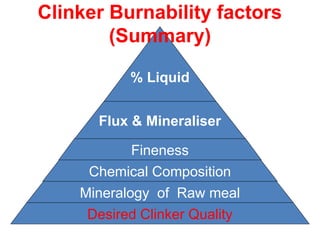
Flux & Mineraliser
Desired Clinker Quality
Mineralogy of Raw meal
Chemical Composition
Fineness
% Liquid
Clinker Burnability factors
(Summary)
Raw meal
Control
Purpose of raw material
preparation
Control of the materials composition prior
to excavation enables selective quarrying
to achieve.
Correct composition of (integrated) stock
piles
Medium to long term uniformity of stock
pile composition
Optimum utilization of materials and
equipment
Raw mix control
Raw mix preparation is the quality key
control parameter upstream for stable,
continuous manufacture of high quality
clinker and cement
Raw mix control aims for the lowest
possible deviations from the quality
targets at the conveyor belts, the mill
and homogenization silos
Raw meal control objectives
Blending of components to obtain the
target composition of raw meal and
clinker
Achievement of target meal fineness to
obtain appropriate clinker burnability
Achievement of a sufficient uniformity
which, together with the homogenization
in the subsequent silo, results in a high
kiln feed uniformity
Raw mill control
Mill % ball charging
Mill speed
Adjustment of feed proportion to the mill
(Raw mix design)
Materials flow rates(Feed rate control)
Materials bed thickness (for VRM)
Air flow rates (Air /gas quantity control)
Air / gas temperature control
Raw mill control(continues)
Pressure inside the mill
Re-circulation rate
Separator speed
Raw meal fineness control
Raw meal composition control
Ref : Page 8 – 11 & 45
Raw Mix
Design
Objectives of proper raw mix design
Obtain good quality clinker with
minimum free lime
Obtain suitable liquid phase to carry the
reactants ( good reaction)
Build up optimum coating to elongate
the refractory life time
Minimize the fuel consumption (cost
factor)
Suitable smooth operation of kilns
Raw mix design parameters
The proportioning of raw mixes for
Ordinary Portland cement is mostly
based on the following specific criteria:
Lime saturation factor (LSF)
Silica Ratio (SR)
Alumina Ratio (AR)
Lime saturation factor (LSF)
The amount of CaO which is enough to
saturate or combine SiO2, Al2O3, and Fe2O3 to
form Portland cement clinker
LSF= [CaO / (2.8SiO2+1.2Al2O3+0.65Fe2O3)]*100
Desired value 92-98 %
Effect of high LSF
Difficult to combine with other oxides
(hard to burn)…. A tendency to high free
lime
Fuel consumption increases
Burning zone temperature increases and
heat loss by radiation increases
Brick life will be short
Presence of Free CaO affects the quality of
clinker and produces unsound cement
Effect of low LSF
Free lime content is usually low…Form less
porous & bally clinker ….. Results, hard to
grind
Excess of liquid phase in the burning Zone,
there is a tendency to ring formation and
coating washing
The potential C3S is lowered and the C2S is
increased proportionally……Reduce early
strength of cement
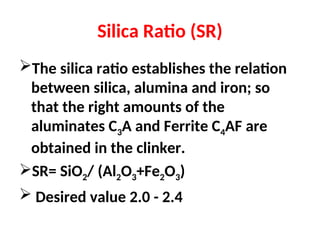
Silica Ratio (SR)
The silica ratio establishes the relation
between silica, alumina and iron; so
that the right amounts of the
aluminates C3A and Ferrite C4AF are
obtained in the clinker.
SR= SiO2/ (Al2O3+Fe2O3)
 Desired value 2.0 - 2.4
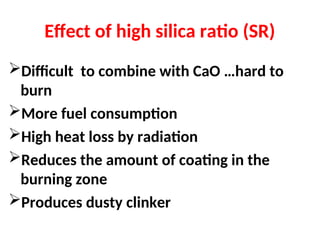
Effect of high silica ratio (SR)
Difficult to combine with CaO …hard to
burn
More fuel consumption
High heat loss by radiation
Reduces the amount of coating in the
burning zone
Produces dusty clinker
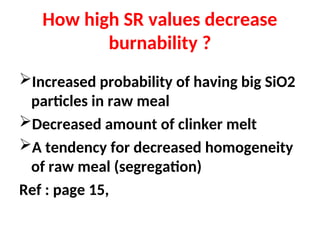
How high SR values decrease
burnability ?
Increased probability of having big SiO2
particles in raw meal
Decreased amount of clinker melt
A tendency for decreased homogeneity
of raw meal (segregation)
Ref : page 15,
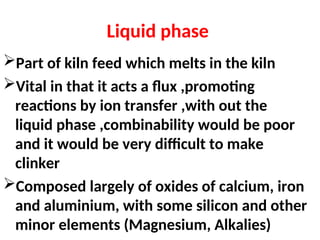
Liquid phase
Part of kiln feed which melts in the kiln
Vital in that it acts a flux ,promoting
reactions by ion transfer ,with out the
liquid phase ,combinability would be poor
and it would be very difficult to make
clinker
Composed largely of oxides of calcium, iron
and aluminium, with some silicon and other
minor elements (Magnesium, Alkalies)
Effect of low silica ratio (SR)
Excessive coating formation (ring
formation)
Fast brick infiltration with clinker melt
Snowman formation in cooler
Shark teeth(Stalagmite & stalasite)build-
up at the nose ring
Resulting bally clinker which is hard to
grind and its strengths are lowered
Relationship of Silica Ratio Vs
Lime Saturation Factor on
burnability
As both the LSF and SR are increased, the
mix becomes harder and harder to burn
and coating tends to disappear. If both
modules are reduced at the same time,
the raw mix becomes easier and easier to
burn and brick wash outs are most likely
to occur
Ref : page 15 - 16
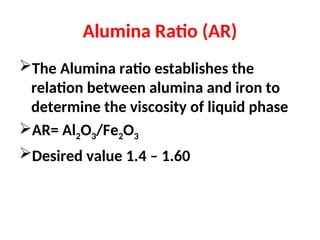
Alumina Ratio (AR)
The Alumina ratio establishes the
relation between alumina and iron to
determine the viscosity of liquid phase
AR= Al2O3/Fe2O3
Desired value 1.4 – 1.60
Effect of high Alumina ratio
1.The more viscous flux at a given
temperatures
Decrease sintering rate due to decrease
in reactant contact (decreases the kinetic
energy of the reactants)
 Increase sintering temperature to make
less viscous ( to increase sintering rate)
• High fuel consumption to increase
sintering temperature
Effect of high Alumina
ratio(continues)
2. High C3A formation
High heat of hydration (Reaction of C3A
with water releases 900KCal energy per
mole of C3A)…… Results concrete thermal
expansion
 Tendency to high early strength due to
high heat of hydration , consequently it
absorbs high amount of water for
quenching
Effect of low Alumina ratio
Means high Fe2O3 content (less viscous
clinker melt )
Hard to grind due to formation of less
porous clinker
Form Dark in color of clinker
Purpose of calculating the
composition of the raw mix
To determine the quantitative
proportions of the raw components,
in order to give the desired chemical
and mineralogical composition of
the clinker at minimum cost
Mix design requirements
It the cardinal rule that the number of
target that can simultaneously be met in
any mix design is equal to the number of
raw components minus one
At least one raw material must have a
value any parameter higher than the
target ,& at least one material must a
value below the target value
Methods for Calculating the Raw mix
Proportioning (Ref : Page 17 – 21)
A) Two component system
 Blending Rule (X-pattern)
 Based on lime saturation factor (LSF)
B) Three component system
 Based on Lime Saturation Factor and Silica Ratio
C. Four component system
 Based on LSF, SR and Alumina ratio(AR)
D) N - component system (n >1 )
 Based on minimum cost with computer
application (E.g Excel solver & Other computer
soft wares)
Raw meal
fineness
Raw meal fineness
 The rates at which reactions take place are
generally depend on the particle size of the
reactants (CaO,SiO2,Al2O3,Fe2O3)
Fine material will evidently react more
readily than will coarser material, so finer
material makes of better combinability
Optimum value 12-14 % @ 90 µm Sieve
residue
Advantages of increasing raw
meal fineness
Shorter time required for preheating of
suspended raw meal in preheater
 Faster calcination and clinkerization
reactions
 Increase in clinker production rate
 Reduction in specific fuel consumption
Disadvantages of increasing the
raw meal fineness
Increase in specific power
consumption of raw mix grinding
Loss of material in the form of
dust
Effect of coarse grains
Studied with optical microscope
Coarse quartz and calcite results in poor burnability,
high free lime and too little C3S in the
clinker…..Reduce strength
Critical size of particle for residual free lime after 30
minutes
Quartz - 45 microns
Calcite - 125 microns
1% increase of
Quartz +45mic ----> 0.93% Free CaO
Calcite +125mic ----> 0.93% Free
Particle Size Distribution(PSD) of
raw meal
The mix having lower fine fraction &
higher average particle size is poor in
burning (Burnability depends on PSD)
Recent studies have demonstrated that
PSD of the raw meal plays a major
decisive role than the simple fineness in
determine in pyroprocessing & final
material characteristics
Raw Meal
Homogenization
Raw meal homogenization
The basic principle of blending process is one or
combination of the following mechanisms.
Distribution of input raw meal at the blending silo
top
Pneumatic dry blending by aeration of raw meal
by the aeration units placed at the bottom of silo
Segmental aeration (octant or quadrant system)
with difference in the pressure of air supplied for
aeration of various segments for thorough mixing
of raw mix
Homogeneity and burnability
Insufficient control of the raw mixture and
its blending will cause large variations in the
chemical composition of the kiln feed
(fluctuations in product quality)
If the kiln is operated at a constant material
residence time and temperature, such
variations also will cause variations in clinker
composition, including free lime
Homogeneity and burnability
(continues)
When unintended variation in kiln feed
composition causes large variation in
free lime, operators may make incorrect
changes to kiln operation, assuming
changes are needed when they are not
Homogeneity and burnability
(continues)
The operator may be obliged to increase the
burning zone temperature to achieve the
desired free lime level — by keeping the kiln on
the hot side, the maximum clinker free lime is
brought to the average value. Results reduced
brick life time
The fuel penalty for burning to an average of
0.8% free lime because of large variability
instead of an average of 1% can easily be on the
order of 4% (high fuel consumption)
Homogeneity and burnability
(continues)
When the kiln is operated on the hot side, alkalis
and sulfate become more volatile. This, in turn,
might increase the possibility for build-ups in the
heater & Kiln inlet (increased tendency to ring and
build up formation
Hard burning tends to cause low clinker porosity,
large crystals of alite, and often contributes to
generation of dust instead of good, nodular clinker
Homogeneity and burnability
(continues)
Slows down the cooling process, both
because of high temperature and low-
porous clinker is more difficult to cool.
Reduced clinker porosity can make the
clinker harder to grind, increasing finish
mill power consumption or reducing
mill production
Reduced cement strength potential
Blending Factor
The ratio of standard deviation of input raw
meal to standard deviation of output raw
meal
 The standard deviation is a measure of how
widely values are dispersed from the average
value (the mean)
For calculation of blending factor of a silo,
input and output raw meal samples are to be
collected in regular intervals and to be tested
for example CaCO3 content
Blending Factor(continues)
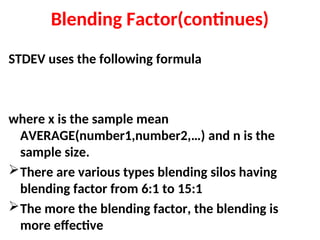
STDEV uses the following formula
where x is the sample mean
AVERAGE(number1,number2,…) and n is the
sample size.
There are various types blending silos having
blending factor from 6:1 to 15:1
The more the blending factor, the blending is
more effective
Kiln Feed
Control
Kiln feed control
Provides guide line information (LSF,SR,AM)
for kiln operation on currently processed
material as well as indications on the raw
material blending and homogenizing
efficiency
Sources of kiln feed fluctuations
Raw components: chemical and
mineralogical composition & inherent
characteristic
Raw meal : chemical and mineralogical
composition, Fineness, disturbances in feed
rate to the mill.
Combustible : ash content, sulphur content,
calorific value, fineness
Sources of kiln feed fluctuations
(continues)
Dust return: different modes of return
during direct or indirect operation
Feed rates: equipment related fluctuations
at constant (kiln feed, combustibles) settings.
Abrupt manual adjustment of kiln operation
parameters
E.g : Sourse of kiln meal CaCO3 variation
Ref : Page 47
Means of improving uniformity
 The kiln feed uniformity is a result of
various factors along the preparation
process, starting from the raw material
deposits and going through several stages of
homogenization and blending
Exploitation planning
Medium to long term exploitation planning,
based on accurate raw materials inventory
Means of improving uniformity
(continues)
Quarry scheduling
Short term quarry scheduling, based on
blast hole dust analysis
Blending control
Blending control at integrated pre-blending
stock pile
Raw meal control
Raw meal homogenization control
Hot Meal
Control
Hot meal control
Determination of concentration of volatile
elements(SO3,Alkalies,chlorine) in the case
of kiln systems affected by build up
formation in the preheaters and/or kiln
inlet area
Determination of non-burnt combustibles
introduced with the kiln feed or the
secondary firing (pre-calciner)
Determination of the degree of pre-
calcination
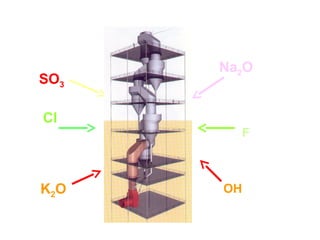
Volatile Matters present
SO3
Cl
K2O
F
OH
Na2O
Circulation of volatile matter
 A fraction of the volatile components evaporates in the
kiln burning zone and condense in the back end or raw
meal and re-enter the burning zone
 The repeated evaporation and condensation results in
an Internal circulation where the concentration can go
up to fifty times the input concentration
 At equilibrium state, the output of volatiles along with
clinker is equal to the total input from raw meal and
fuel
 Higher degree of volatiles concentration exists either
due to more input or due to a high degree of volatility
(high burning)
External circulation
Volatile matter in raw meal like sulfur, is
burnt to SO2 gas in the preheater upper
cyclones at around 400 - 600 deg C and
expelled out from preheater but effectively
precipitated in Electro Static Precipitator
(ESP)
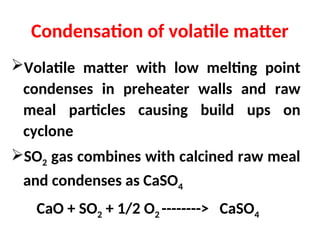
Condensation of volatile matter
Volatile matter with low melting point
condenses in preheater walls and raw
meal particles causing build ups on
cyclone
SO2 gas combines with calcined raw meal
and condenses as CaSO4
CaO + SO2 + 1/2 O2 --------> CaSO4
Operational Aspects of Volatile
Components
Formation of build-ups in preheater riser
pipes and cyclones reduces the air volume
Reduced kiln production and increased
circulation of sulfur compounds due to less
availability of excess oxygen
Higher heat consumption
Dusty (unsintered) clinker formation
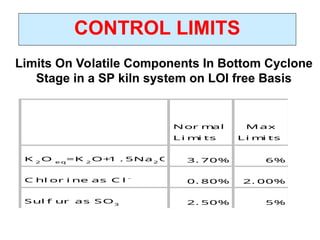
Nor m
al
L i m
i ts
M ax
L i m
i ts
K 2
O e q
=K 2
O+
1 . 5Na2
O 3. 70% 6%
C hl or i ne as C l -
0. 80% 2. 00%
Sul f ur as SO3 2. 50% 5%
Limits On Volatile Components In Bottom Cyclone
Stage in a SP kiln system on LOI free Basis
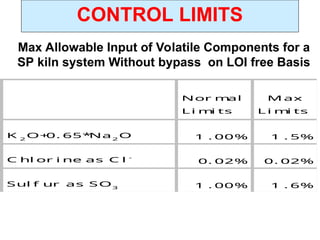
CONTROL LIMITS
Nor m
al
L i m
i ts
M ax
L i m
i ts
K 2
O+
0. 65*
Na2
O 1 . 00% 1 . 5%
C hl or i ne as C l -
0. 02% 0. 02%
Sul f ur as SO3 1 . 00% 1 . 6%
Max Allowable Input of Volatile Components for a
SP kiln system Without bypass on LOI free Basis
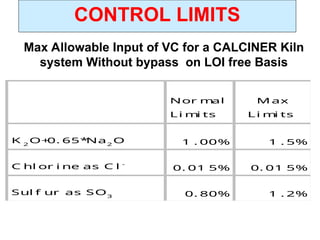
CONTROL LIMITS
Nor m
al
Li m
i ts
M ax
Li m
i ts
K 2
O+
0. 65*
Na2
O 1 . 00% 1 . 5%
C hl or i ne as C l -
0. 01 5% 0. 01 5%
Sul f ur as SO3 0. 80% 1 . 2%
Max Allowable Input of VC for a CALCINER Kiln
system Without bypass on LOI free Basis
CONTROL LIMITS
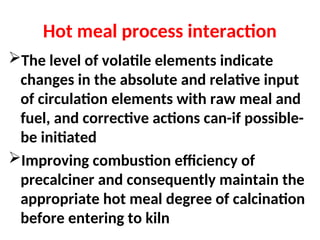
Hot meal process interaction
The level of volatile elements indicate
changes in the absolute and relative input
of circulation elements with raw meal and
fuel, and corrective actions can-if possible-
be initiated
Improving combustion efficiency of
precalciner and consequently maintain the
appropriate hot meal degree of calcination
before entering to kiln
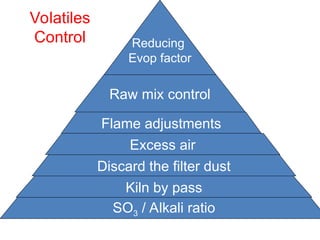
Raw mix control
SO3 / Alkali ratio
Kiln by pass
Excess air
Flame adjustments
Reducing
Evop factor
Volatiles
Control
Methods
Discard the filter dust
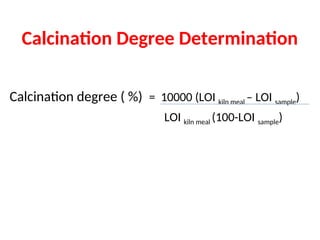
Calcination Degree Determination
Calcination degree ( %) = 10000 (LOI kiln meal – LOI sample)
LOI kiln meal (100-LOI sample)
Clinker
Formation
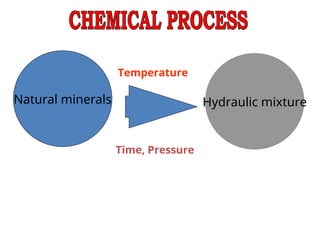
Natural minerals Hydraulic mixture
Temperature
Time, Pressure
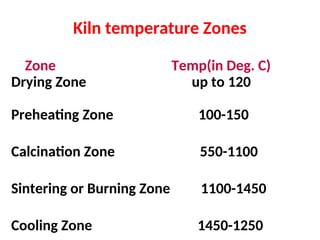
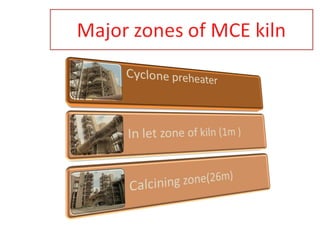
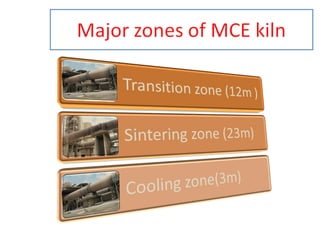
Kiln temperature Zones
Zone Temp(in Deg. C)
Drying Zone up to 120
Preheating Zone 100-150
Calcination Zone 550-1100
Sintering or Burning Zone 1100-1450
Cooling Zone 1450-1250
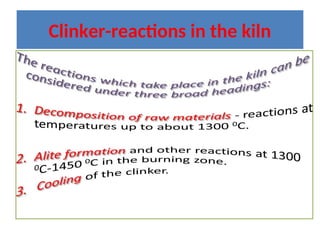
Clinker-reactions in the kiln
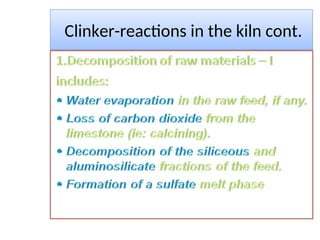
Clinker-reactions in the kiln cont.
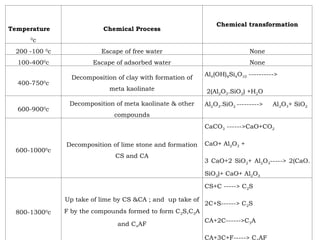
Temperature
0
c
Chemical Process
Chemical transformation
200 -100 0
c Escape of free water None
100-4000
c Escape of adsorbed water None
400-7500
c
Decomposition of clay with formation of
meta kaolinate
Al4(OH)8Si4O10 ---------->
2(Al2O3.SiO2) +H2O
600-9000
c
Decomposition of meta kaolinate & other
compounds
Al2O3.SiO2 ---------> Al2O3+ SiO2
600-10000
c
Decomposition of lime stone and formation
CS and CA
CaCO3 ------>CaO+CO2
CaO+ Al2O3 +
3 CaO+2 SiO2+ Al2O3-----> 2(CaO.
SiO2)+ CaO+ Al2O3
800-13000
c
Up take of lime by CS &CA ; and up take of
F by the compounds formed to form C2S,C3A
and C4AF
CS+C -----> C2S
2C+S------> C2S
CA+2C------>C3A
CA+3C+F-----> C AF
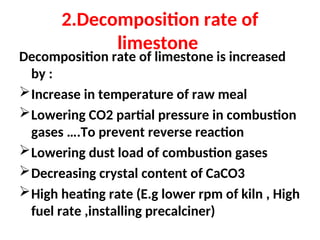
2.Decomposition rate of
limestone
Decomposition rate of limestone is increased
by :
Increase in temperature of raw meal
Lowering CO2 partial pressure in combustion
gases ….To prevent reverse reaction
Lowering dust load of combustion gases
Decreasing crystal content of CaCO3
High heating rate (E.g lower rpm of kiln , High
fuel rate ,installing precalciner)
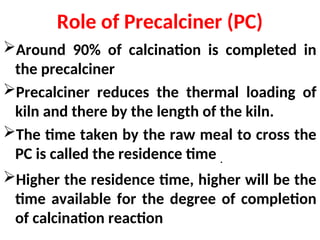
Role of Precalciner (PC)
Around 90% of calcination is completed in
the precalciner
Precalciner reduces the thermal loading of
kiln and there by the length of the kiln.
The time taken by the raw meal to cross the
PC is called the residence time .
Higher the residence time, higher will be the
time available for the degree of completion
of calcination reaction
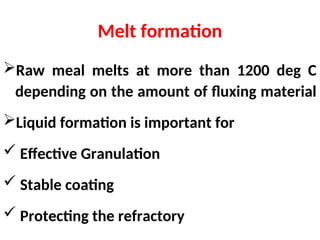
Melt formation
Raw meal melts at more than 1200 deg C
depending on the amount of fluxing material
Liquid formation is important for
 Effective Granulation
 Stable coating
 Protecting the refractory
Melt formation (continues)
Raw mix composition determines the
 temperature of initial liquid formation
 the amount of liquid formation
 physical properties of the liquid such as its
viscosity
Fluxes(Al , Fe , Ba , Sr , Ce , Cr, P , Ti, Zn)
Lower melting temperature and melt
viscosity
Melt formation(continues)
A mineraliser like Fluorides(CaF2,NaF,BaF
MgF2)can also be added to reduce the
temperature at which liquid phase is formed
Mineraliser modifies the viscosity and
surface tension of the clinker liquid to
promote the formation of clinker minerals
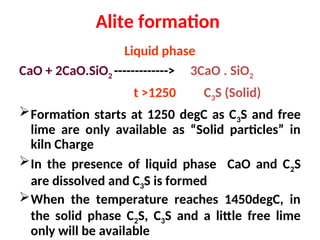
Alite formation
Liquid phase
CaO + 2CaO.SiO2 -------------> 3CaO . SiO2
t >1250 C3S (Solid)
Formation starts at 1250 degC as C3S and free
lime are only available as “Solid particles” in
kiln Charge
In the presence of liquid phase CaO and C2S
are dissolved and C3S is formed
When the temperature reaches 1450degC, in
the solid phase C2S, C3S and a little free lime
only will be available
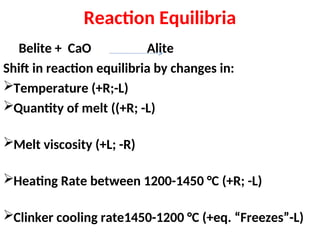
Reaction Equilibria
Belite + CaO Alite
Shift in reaction equilibria by changes in:
Temperature (+R;-L)
Quantity of melt ((+R; -L)
Melt viscosity (+L; -R)
Heating Rate between 1200-1450 °C (+R; -L)
Clinker cooling rate1450-1200 °C (+eq. “Freezes”-L)
Reactions during cooling
Rate of cooling is a critical parameter
Slow cooling results in decomposition of C3S
back to C2S and consequently results in
* Reduced cement strength
* Poor grindability
Cooling process influences the state of
crystallisation and hence the reactivity of
clinker
The maximum rate of decomposition occurs at
1175 degC
Advantages of rapid cooling
Rapid cooled clinker will have
* The same composition as it had around
the clinkerisation temperature
* Improved Grindability
* Lower proportion of decomposed alite
and consequently a higher proportion of
alite in the clinker
Clinker Nodulization
Poor granulometry and Dusty Clinker leads to:
More wear rate in cooler and need more
maintenance
Formation of unstable, porous coating instead of
dense, stable coating
Poor grindability of clinker
Problematic clinker handling and dust nuisance
Unstable kiln operation
Clinker Nodulization(continues)
Particles are held together by capillary forces
of the liquid
Nodulisation depends on the amount of
liquid, particle size and the speed of the kiln
Clinker Nodulization(continues)
Formed C3S crystals sinter together to form
coarse C3S particles and slow down the
nodulisation process
Nodulisation is enhanced by liquid phase and
counteracted by large C3S particles.
At higher BZ temp, the formation of C3S
particles is faster and hence smaller will be
the nodule size
Reducing the Alumina / Iron ratio (1.4 - 1.6)
will improve the nodulisation as the
formation of liquid phase starts at lower
temperature
Lowering of the silica modulus increases the
amount of liquid and thereby improves the
nodulisation
Reducing the LSF reduce the potential C3S and
thus increase the nodulisation
CHANGES IN CHEMISTRY &
CLINKER NODULISATION
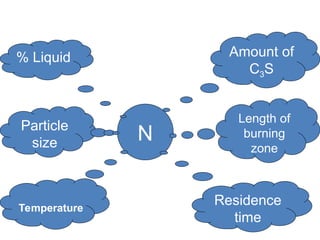
Nodulisation
N
Amount of
C3S
% Liquid
Length of
burning
zone
Particle
size
Temperature
Residence
time
Operational measurements on
Clinker
1.Litre Weight of clinker
It is usually of 5-10mm or 6-12mm particles
that are sieved and weighed in a cup with
fixed volume.
The top of the cup is leveled with a ruler. The
measurement in g/lt is generally between
1100-1300 (desired value 1250-1350)
Operational measurements on
Clinker (continues)
The litre weight of a clinker type at a
specific plant correlates to the free lime
when burnability remains constant.
Higher temperature generally gives higher
litre weight but very high temperatures
can lower the litre weight because of dust
agglomerates.
Operational measurements on
Clinker (continues)
2. Free Lime ( Uncombined CaO )
The primary criteria of clinker
quality. This is because
 Too high free lime: Loss in
strength potential, increase of
cement expansion, disturbances in
cement grinding
Operational measurements on
Clinker (continues)
 Too low free lime : Loss in cement
reactivity, excessive heat consumption,
poor grindability
The free lime measurement to be
carried out on a representative sample
of the clinker product. Generally the
free lime is targeted just below 1.5%.
Operational measurements on
Clinker (continues)
Composition, temperature, residence
time & burnability influence the
achieved free lime level.
CORRELATION BETWEEN FREE
LIME CONTENT & LITERWEIGHT
Generally CaO free inversely to liter
weight at a given SM
But there is loss of such correlation
between Free lime content and
Liter weight for over burnt clinker
Ref : Page 34
Kiln process variables ,control &
interaction
Air flow rates ( by ID fan Speed & cooler fans)
 primary air
Secondary air
Tertiary air
Flame Characteristics (by air , fuel rate &
burner position)
Flame temperature
Flame length
Flame stability
Kiln process variables ,control &
interaction(continues)
Residence time of kiln meal with in the
kiln (kiln speed)
Chemical composition, parameters and
minerals of clinker (By Analysis)
Volatile concentration(By analysis)
What are the factors that
affects the correlation
between raw meal and
clinker composition?
Ref : Page 38 & give
comment
Factors that affects the correlation
between raw meal and clinker
composition
It is known that the set points of the raw
meal composition have to be such that the
target composition of the clinker is being
obtained. Allowance has there fore, to be
made for:
The kiln dust absorption in the raw mill( kiln
dust composition can significantly deviate
from the kiln feed composition)
Factors that affects the correlation
between raw meal and clinker
composition(continues)
The discarding of the kiln dust …..Loss
Systematic errors in sampling and analysis
The primary target is the clinker
composition. If any of the above factors
change, the raw meal set point has to be
adjusted accordingly
Varieties of Dust
The following varieties of dust are
generated in the operation of cement
Raw materials & additives dust
Raw mix dust
Coal dust
Exit dust from kilns
Clinker dust
Cement dust
Varieties of Dust(Continues)
With the exception of the kiln dust ,the
kinds of dust enumerated above, show the
same chemical composition as the original
material
The kiln exit dust represents a mixture of
raw mix and clinker ;the chemical
composition of the kiln exit dust is among
other factors also influenced by the size of
the particles carried away by the kiln gases
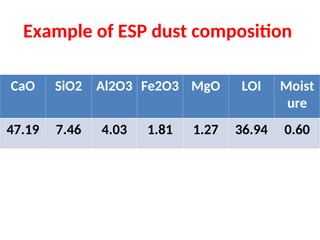
Example of ESP dust composition
CaO SiO2 Al2O3 Fe2O3 MgO LOI Moist
ure
47.19 7.46 4.03 1.81 1.27 36.94 0.60
Clinker
Cooling
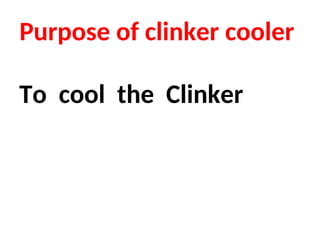
Purpose of clinker cooler
To cool the Clinker
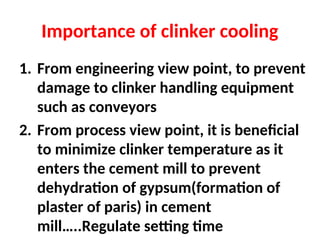
Importance of clinker cooling
1. From engineering view point, to prevent
damage to clinker handling equipment
such as conveyors
2. From process view point, it is beneficial
to minimize clinker temperature as it
enters the cement mill to prevent
dehydration of gypsum(formation of
plaster of paris) in cement
mill…..Regulate setting time
Importance of clinker cooling
(continues)
3.From an environmental & a cost view point,
reduces energy consumption by extracting heat
from the clinker ,enabling it to be used to heat
the raw mix and secondary air & tertiary air
required for fuel combustion
4.From a cement performance view point, faster
cooling of the clinker enhances silicate reactivity
& improve grindability due to the presence of
microcracks in alite & due to the finer crystal size
of the flux phases
Importance of clinker cooling
(continues)
Resistance to chemical attack
C3A content, which is related to the
resistance of Portland cement to attack
by sulfate solution, is mainly present in
the glassy state, when cooled rapidly. In
this form C3A is much less susceptible to
attack by sodium or magnesium sulphate
Cooler Process variables &
interaction
Cooler speed
Materials bed thickness (Grate cooler)
FD fans speed (Grate cooler)
Cement Plant Control (follow-up)
parameters
Ref : Page 39 - 44
Lime Saturation Factor (LSF)
Silica Ratio (SR)
Alumina Iron Ratio (AR)
% Liquid phase at the burning zone (Lph)
Coating index (CI)
Minimum Burning temperature 0
C
Cement Plant Control (follow-up)
parameters(continues)
Burnability index (BI)
Burnability Factor (BF)
Alkalis Equivalent
Alkali sulphate Ratio (ASR)
 Sulphate Modulus (Mso3)
Bogue’s potential composition
Homogenity of the process
Productivity
Productivity=Actual
production/Maximum production
Acceptable approximate level > 0.8
Productivity is a measure of the
following:
System performance
System efficiency
Productivity(continues)
Resource utilization
The relationship between real output and inputs.
Productivity is measured as:
The ratio of output to input
The ratio between the amount produced and the
amount of any resources used in the production
Output per unit of input (resources)
Productivity(continues)
Nowadays the challenge is to change the
cement industry from traditional mass
production into more effective production
system aiming to increase the productivity,
overall performance, and capacity utilisation
to meet high market demand. The cement
industry is forced to reduce the production
costs and delay times in order to take
advantages in the global competition
environments.
Process Optimization
Within the cement production line, Process
Optimation (an effective tool for cost
reduction) is an initiative to improve the
plant performance
The objectives for Process optimization
include:
Optimization of all unit operations
Lowering the specific energy consumption
Process Optimization(continues)
Diagnostic studies of problems in raw
materials, electrical, instrumentation,
mechanical and process engineering
sections and trouble shooting
Quality assurance with optimized
utilization of resources
Measures for improvement in
environment
Lowering the production cost
Conclusion
In current scenario of limited demand,
lower cost realization and increasing
competition in cement industry, lowering
the production cost has become the
need of the hour for survival. An
effective measure to reduce the
production cost is by optimization of the
operational practices
567128122-Raw-Meal-Clinker-Quality-Control.ppt

567128122-Raw-Meal-Clinker-Quality-Control.ppt

  • 2.
    MUGHER CEMENT ENTERPRISE RawMeal & Clinker Quality Control
  • 3.
    Module Objectives What isthe goal of clinker burning? What are the testing techniques in cement industries? What are the cement manufacturing process’s variables and factors? What are the objectives of raw meal control? How to calculate raw mix composition?
  • 4.
    Module Objectives(Continue) What isthe role of raw meal fineness and particle size distribution? What is the importance of raw meal homogeneity? What are the reactions during clinkerization? What are the objectives of clinker control?
  • 5.
    Module Objectives(Continue) What areoperational measurements on clinker? What are the factors that affects the correlation between raw meal and clinker composition? What is the need of clinker cooling?  What are cement plant control (follow-up) parameters?
  • 6.
    Definition of Cement OrdinaryPortland Cement (OPC): Portland cement is the finely ground clinker with some gypsum added. Pozzolanic Portland Cement (PPC): Pozzolanic Portland Cement is the finely ground clinker with some pozzolana (pumice) & gypsum added.
  • 7.
    Portland Cement Clinker Themanufacturing of clinker involves the conversion, at high temperature of mineral mixtures of natural origin, into new mineral mixtures which have hydraulic properties. It is an intimate mixture of: Calcareous materials (CaCO3), Argillaceous, Silica , Alumina, Iron Oxide.
  • 8.
    “Heating of theraw meal to the required temperature so as to produce the desired clinker compounds in an economic way at higher productivity in the preheater & kiln.” Pyro processing
  • 9.
    What is thegoal of clinker burning? The production of GOOD QUALITY cement
  • 10.
    What is cementquality? Cement quality is defined in terms of characteristics & properties such as: Chemical composition (Oxides content limits) Physical properties (Strength, Workability, Setting behavior etc) in Standard Norms (ASTM, ISO) and is measured used standard methods
  • 11.
    To many peoplewho make and market cement, 'quality’ means conforming to the standards, codes and manuals established in accordance with the modern quality conformity industry
  • 12.
    Factors influencing cementquality Chemical & mineralogical composition of clinker Additives Quality such as Gypsum, Pozzolana Mechanical handling of clinker (grinding)
  • 13.
    Production of Goodquality clinker from the kiln depends on :  Good raw mix design which in turn depends on 1. Desired clinker minerals 2. Allowable free lime 3. Nature of the raw material  Liquid ratio & Residence time in the kiln  Fuel quality & Combustion  Burning process  Fineness of the raw meal to the desired level  Circulation phenomena
  • 14.
  • 15.
    Quality control concepts Adetailed control plan for quality control of each raw material, intermediate & final product is setup by a thorough analysis of the following questionnaire. What should be examined? What information is required for the control? How often must the test be performed? How accurate must the result of the testing be?
  • 16.
    What is sampling? Samplingis the process to collect a representative & sufficient quantity of material (sample) to be analysed. Generally there are two types of samples 1.Spot sample: samples that is collected at a certain moment or the portion taken from the collected material (i.e. un- homogenized). 2. Representative sample: samples that represent the full quantity or a full period of time.
  • 17.
    Are auto samplesalways representative? The collection of the sample must be continuous to ensure representative auto sampling
  • 18.
    Consequence of wrongsampling & wrong analysis 1.Wrong sample + correct analysis = Wrong action 2. Correct sample+ Wrong analysis = Wrong action 3. Correct sample + Correct analysis = Right action
  • 19.
    Common Testing Methods/techniquesin cement industry 1.Chemical composition (Complete analysis ): Complexometric titration and/or X-ray Fluorescence 2.CaCO3 : Carbonate titration (back titration) & Prompt gamma neutron activation technology (PGNAA) 3.Fineness : Sieving @ different mesh size 4.SO3: Gravimetric, X-ray Fluorescence & LECO Sulpure analyzer
  • 20.
    Common Testing Methods/techniquesin cement industry (continue) 5.Alkalies (K2O & Na2O): Flame photometer, atomic absorption spectroscopy (AAS) & X-ray Fluorescence 6.Chlorine: Potentiometeric titration, X-ray Fluorescence 7.Loss on ignition(LOI): Ignition the sample in Laboratory muffle furnace @ 10000 C & LOI analysis instrument 8.Free lime(uncombined CaO) :Titration(ethylene glycol method), conductometric (Automatic free lime analyzers) & X-ray diffraction
  • 21.
  • 22.
    Material burnability The readinesswith which a raw mix is transformed into clinker minerals in the course of high temperature treatment  Arranged as easy, normal, or difficult to burn There is interrelationship between feed meal burn-ability and clinkering process properties such as: residence time, maximum temperature and pressure, and cooling rate
  • 23.
    Reactivity & burnabilityof Raw Mix Reactivity and burnability are properties which affect the plant capacity and the process thermal consumption, because raw meal sintering is considerably altered by such factors
  • 24.
    Reactivity & burnabilityof Raw Mix(continues) Reactivity is related to the rate of reaction for certain conditions and temperatures Burnability expresses the difficulty for the material to be converted at any time, in the process temperature
  • 25.
    Reactivity & burnabilityof Raw Mix(continues) Reactivity and LSF affect the burnability value, since reactivity is a function of the Silica Ratio (SR), Alumina Ratio (AR), granulometry , present mineralogical species and their chemical activity
  • 26.
    Factors influencing thereactivity 1. The raw mix preparation Chemical factor …………… SM,AM Granulometric factor ……Fineness and Particle size distribution (PSD) 2. Inherent characteristics of raw materials( The intrinsic reactivity of the raw materials), which can not be modified:
  • 27.
    Factors influencing thereactivity (continues) Different raw mix with the same chemical composition and equal fineness may differ in their burnability due to their different mineralogical composition Some types of silica ,for example, will react more readily than will other Quartz Silica sand
  • 28.
    Factors influencing thereactivity (continues) Other examples of mineralogical property Calcite (CaCO3) crystals Rhombic Cubic Clay Caolinit Kaolinit (A14(OH)8Si4O10)
  • 29.
    Flux & Mineraliser DesiredClinker Quality Mineralogy of Raw meal Chemical Composition Fineness % Liquid Clinker Burnability factors (Summary)
  • 30.
  • 31.
    Purpose of rawmaterial preparation Control of the materials composition prior to excavation enables selective quarrying to achieve. Correct composition of (integrated) stock piles Medium to long term uniformity of stock pile composition Optimum utilization of materials and equipment
  • 32.
    Raw mix control Rawmix preparation is the quality key control parameter upstream for stable, continuous manufacture of high quality clinker and cement Raw mix control aims for the lowest possible deviations from the quality targets at the conveyor belts, the mill and homogenization silos
  • 33.
    Raw meal controlobjectives Blending of components to obtain the target composition of raw meal and clinker Achievement of target meal fineness to obtain appropriate clinker burnability Achievement of a sufficient uniformity which, together with the homogenization in the subsequent silo, results in a high kiln feed uniformity
  • 34.
    Raw mill control Mill% ball charging Mill speed Adjustment of feed proportion to the mill (Raw mix design) Materials flow rates(Feed rate control) Materials bed thickness (for VRM) Air flow rates (Air /gas quantity control) Air / gas temperature control
  • 35.
    Raw mill control(continues) Pressureinside the mill Re-circulation rate Separator speed Raw meal fineness control Raw meal composition control Ref : Page 8 – 11 & 45
  • 36.
  • 37.
    Objectives of properraw mix design Obtain good quality clinker with minimum free lime Obtain suitable liquid phase to carry the reactants ( good reaction) Build up optimum coating to elongate the refractory life time Minimize the fuel consumption (cost factor) Suitable smooth operation of kilns
  • 38.
    Raw mix designparameters The proportioning of raw mixes for Ordinary Portland cement is mostly based on the following specific criteria: Lime saturation factor (LSF) Silica Ratio (SR) Alumina Ratio (AR)
  • 39.
    Lime saturation factor(LSF) The amount of CaO which is enough to saturate or combine SiO2, Al2O3, and Fe2O3 to form Portland cement clinker LSF= [CaO / (2.8SiO2+1.2Al2O3+0.65Fe2O3)]*100 Desired value 92-98 %
  • 40.
    Effect of highLSF Difficult to combine with other oxides (hard to burn)…. A tendency to high free lime Fuel consumption increases Burning zone temperature increases and heat loss by radiation increases Brick life will be short Presence of Free CaO affects the quality of clinker and produces unsound cement
  • 41.
    Effect of lowLSF Free lime content is usually low…Form less porous & bally clinker ….. Results, hard to grind Excess of liquid phase in the burning Zone, there is a tendency to ring formation and coating washing The potential C3S is lowered and the C2S is increased proportionally……Reduce early strength of cement
  • 42.
    Silica Ratio (SR) Thesilica ratio establishes the relation between silica, alumina and iron; so that the right amounts of the aluminates C3A and Ferrite C4AF are obtained in the clinker. SR= SiO2/ (Al2O3+Fe2O3)  Desired value 2.0 - 2.4
  • 43.
    Effect of highsilica ratio (SR) Difficult to combine with CaO …hard to burn More fuel consumption High heat loss by radiation Reduces the amount of coating in the burning zone Produces dusty clinker
  • 44.
    How high SRvalues decrease burnability ? Increased probability of having big SiO2 particles in raw meal Decreased amount of clinker melt A tendency for decreased homogeneity of raw meal (segregation) Ref : page 15,
  • 45.
    Liquid phase Part ofkiln feed which melts in the kiln Vital in that it acts a flux ,promoting reactions by ion transfer ,with out the liquid phase ,combinability would be poor and it would be very difficult to make clinker Composed largely of oxides of calcium, iron and aluminium, with some silicon and other minor elements (Magnesium, Alkalies)
  • 46.
    Effect of lowsilica ratio (SR) Excessive coating formation (ring formation) Fast brick infiltration with clinker melt Snowman formation in cooler Shark teeth(Stalagmite & stalasite)build- up at the nose ring Resulting bally clinker which is hard to grind and its strengths are lowered
  • 47.
    Relationship of SilicaRatio Vs Lime Saturation Factor on burnability As both the LSF and SR are increased, the mix becomes harder and harder to burn and coating tends to disappear. If both modules are reduced at the same time, the raw mix becomes easier and easier to burn and brick wash outs are most likely to occur Ref : page 15 - 16
  • 48.
    Alumina Ratio (AR) TheAlumina ratio establishes the relation between alumina and iron to determine the viscosity of liquid phase AR= Al2O3/Fe2O3 Desired value 1.4 – 1.60
  • 49.
    Effect of highAlumina ratio 1.The more viscous flux at a given temperatures Decrease sintering rate due to decrease in reactant contact (decreases the kinetic energy of the reactants)  Increase sintering temperature to make less viscous ( to increase sintering rate) • High fuel consumption to increase sintering temperature
  • 50.
    Effect of highAlumina ratio(continues) 2. High C3A formation High heat of hydration (Reaction of C3A with water releases 900KCal energy per mole of C3A)…… Results concrete thermal expansion  Tendency to high early strength due to high heat of hydration , consequently it absorbs high amount of water for quenching
  • 51.
    Effect of lowAlumina ratio Means high Fe2O3 content (less viscous clinker melt ) Hard to grind due to formation of less porous clinker Form Dark in color of clinker
  • 52.
    Purpose of calculatingthe composition of the raw mix To determine the quantitative proportions of the raw components, in order to give the desired chemical and mineralogical composition of the clinker at minimum cost
  • 53.
    Mix design requirements Itthe cardinal rule that the number of target that can simultaneously be met in any mix design is equal to the number of raw components minus one At least one raw material must have a value any parameter higher than the target ,& at least one material must a value below the target value
  • 54.
    Methods for Calculatingthe Raw mix Proportioning (Ref : Page 17 – 21) A) Two component system  Blending Rule (X-pattern)  Based on lime saturation factor (LSF) B) Three component system  Based on Lime Saturation Factor and Silica Ratio C. Four component system  Based on LSF, SR and Alumina ratio(AR) D) N - component system (n >1 )  Based on minimum cost with computer application (E.g Excel solver & Other computer soft wares)
  • 55.
  • 56.
    Raw meal fineness The rates at which reactions take place are generally depend on the particle size of the reactants (CaO,SiO2,Al2O3,Fe2O3) Fine material will evidently react more readily than will coarser material, so finer material makes of better combinability Optimum value 12-14 % @ 90 µm Sieve residue
  • 57.
    Advantages of increasingraw meal fineness Shorter time required for preheating of suspended raw meal in preheater  Faster calcination and clinkerization reactions  Increase in clinker production rate  Reduction in specific fuel consumption
  • 58.
    Disadvantages of increasingthe raw meal fineness Increase in specific power consumption of raw mix grinding Loss of material in the form of dust
  • 59.
    Effect of coarsegrains Studied with optical microscope Coarse quartz and calcite results in poor burnability, high free lime and too little C3S in the clinker…..Reduce strength Critical size of particle for residual free lime after 30 minutes Quartz - 45 microns Calcite - 125 microns 1% increase of Quartz +45mic ----> 0.93% Free CaO Calcite +125mic ----> 0.93% Free
  • 60.
    Particle Size Distribution(PSD)of raw meal The mix having lower fine fraction & higher average particle size is poor in burning (Burnability depends on PSD) Recent studies have demonstrated that PSD of the raw meal plays a major decisive role than the simple fineness in determine in pyroprocessing & final material characteristics
  • 61.
  • 62.
    Raw meal homogenization Thebasic principle of blending process is one or combination of the following mechanisms. Distribution of input raw meal at the blending silo top Pneumatic dry blending by aeration of raw meal by the aeration units placed at the bottom of silo Segmental aeration (octant or quadrant system) with difference in the pressure of air supplied for aeration of various segments for thorough mixing of raw mix
  • 63.
    Homogeneity and burnability Insufficientcontrol of the raw mixture and its blending will cause large variations in the chemical composition of the kiln feed (fluctuations in product quality) If the kiln is operated at a constant material residence time and temperature, such variations also will cause variations in clinker composition, including free lime
  • 64.
    Homogeneity and burnability (continues) Whenunintended variation in kiln feed composition causes large variation in free lime, operators may make incorrect changes to kiln operation, assuming changes are needed when they are not
  • 65.
    Homogeneity and burnability (continues) Theoperator may be obliged to increase the burning zone temperature to achieve the desired free lime level — by keeping the kiln on the hot side, the maximum clinker free lime is brought to the average value. Results reduced brick life time The fuel penalty for burning to an average of 0.8% free lime because of large variability instead of an average of 1% can easily be on the order of 4% (high fuel consumption)
  • 66.
    Homogeneity and burnability (continues) Whenthe kiln is operated on the hot side, alkalis and sulfate become more volatile. This, in turn, might increase the possibility for build-ups in the heater & Kiln inlet (increased tendency to ring and build up formation Hard burning tends to cause low clinker porosity, large crystals of alite, and often contributes to generation of dust instead of good, nodular clinker
  • 67.
    Homogeneity and burnability (continues) Slowsdown the cooling process, both because of high temperature and low- porous clinker is more difficult to cool. Reduced clinker porosity can make the clinker harder to grind, increasing finish mill power consumption or reducing mill production Reduced cement strength potential
  • 68.
    Blending Factor The ratioof standard deviation of input raw meal to standard deviation of output raw meal  The standard deviation is a measure of how widely values are dispersed from the average value (the mean) For calculation of blending factor of a silo, input and output raw meal samples are to be collected in regular intervals and to be tested for example CaCO3 content
  • 69.
    Blending Factor(continues) STDEV usesthe following formula where x is the sample mean AVERAGE(number1,number2,…) and n is the sample size. There are various types blending silos having blending factor from 6:1 to 15:1 The more the blending factor, the blending is more effective
  • 70.
  • 71.
    Kiln feed control Providesguide line information (LSF,SR,AM) for kiln operation on currently processed material as well as indications on the raw material blending and homogenizing efficiency
  • 72.
    Sources of kilnfeed fluctuations Raw components: chemical and mineralogical composition & inherent characteristic Raw meal : chemical and mineralogical composition, Fineness, disturbances in feed rate to the mill. Combustible : ash content, sulphur content, calorific value, fineness
  • 73.
    Sources of kilnfeed fluctuations (continues) Dust return: different modes of return during direct or indirect operation Feed rates: equipment related fluctuations at constant (kiln feed, combustibles) settings. Abrupt manual adjustment of kiln operation parameters E.g : Sourse of kiln meal CaCO3 variation Ref : Page 47
  • 74.
    Means of improvinguniformity  The kiln feed uniformity is a result of various factors along the preparation process, starting from the raw material deposits and going through several stages of homogenization and blending Exploitation planning Medium to long term exploitation planning, based on accurate raw materials inventory
  • 75.
    Means of improvinguniformity (continues) Quarry scheduling Short term quarry scheduling, based on blast hole dust analysis Blending control Blending control at integrated pre-blending stock pile Raw meal control Raw meal homogenization control
  • 76.
  • 77.
    Hot meal control Determinationof concentration of volatile elements(SO3,Alkalies,chlorine) in the case of kiln systems affected by build up formation in the preheaters and/or kiln inlet area Determination of non-burnt combustibles introduced with the kiln feed or the secondary firing (pre-calciner) Determination of the degree of pre- calcination
  • 78.
  • 79.
    Circulation of volatilematter  A fraction of the volatile components evaporates in the kiln burning zone and condense in the back end or raw meal and re-enter the burning zone  The repeated evaporation and condensation results in an Internal circulation where the concentration can go up to fifty times the input concentration  At equilibrium state, the output of volatiles along with clinker is equal to the total input from raw meal and fuel  Higher degree of volatiles concentration exists either due to more input or due to a high degree of volatility (high burning)
  • 80.
    External circulation Volatile matterin raw meal like sulfur, is burnt to SO2 gas in the preheater upper cyclones at around 400 - 600 deg C and expelled out from preheater but effectively precipitated in Electro Static Precipitator (ESP)
  • 81.
    Condensation of volatilematter Volatile matter with low melting point condenses in preheater walls and raw meal particles causing build ups on cyclone SO2 gas combines with calcined raw meal and condenses as CaSO4 CaO + SO2 + 1/2 O2 --------> CaSO4
  • 82.
    Operational Aspects ofVolatile Components Formation of build-ups in preheater riser pipes and cyclones reduces the air volume Reduced kiln production and increased circulation of sulfur compounds due to less availability of excess oxygen Higher heat consumption Dusty (unsintered) clinker formation
  • 83.
    Nor m al L im i ts M ax L i m i ts K 2 O e q =K 2 O+ 1 . 5Na2 O 3. 70% 6% C hl or i ne as C l - 0. 80% 2. 00% Sul f ur as SO3 2. 50% 5% Limits On Volatile Components In Bottom Cyclone Stage in a SP kiln system on LOI free Basis CONTROL LIMITS
  • 84.
    Nor m al L im i ts M ax L i m i ts K 2 O+ 0. 65* Na2 O 1 . 00% 1 . 5% C hl or i ne as C l - 0. 02% 0. 02% Sul f ur as SO3 1 . 00% 1 . 6% Max Allowable Input of Volatile Components for a SP kiln system Without bypass on LOI free Basis CONTROL LIMITS
  • 85.
    Nor m al Li m its M ax Li m i ts K 2 O+ 0. 65* Na2 O 1 . 00% 1 . 5% C hl or i ne as C l - 0. 01 5% 0. 01 5% Sul f ur as SO3 0. 80% 1 . 2% Max Allowable Input of VC for a CALCINER Kiln system Without bypass on LOI free Basis CONTROL LIMITS
  • 86.
    Hot meal processinteraction The level of volatile elements indicate changes in the absolute and relative input of circulation elements with raw meal and fuel, and corrective actions can-if possible- be initiated Improving combustion efficiency of precalciner and consequently maintain the appropriate hot meal degree of calcination before entering to kiln
  • 87.
    Raw mix control SO3/ Alkali ratio Kiln by pass Excess air Flame adjustments Reducing Evop factor Volatiles Control Methods Discard the filter dust
  • 88.
    Calcination Degree Determination Calcinationdegree ( %) = 10000 (LOI kiln meal – LOI sample) LOI kiln meal (100-LOI sample)
  • 89.
  • 90.
    Natural minerals Hydraulicmixture Temperature Time, Pressure
  • 91.
    Kiln temperature Zones ZoneTemp(in Deg. C) Drying Zone up to 120 Preheating Zone 100-150 Calcination Zone 550-1100 Sintering or Burning Zone 1100-1450 Cooling Zone 1450-1250
  • 94.
  • 95.
  • 96.
    Temperature 0 c Chemical Process Chemical transformation 200-100 0 c Escape of free water None 100-4000 c Escape of adsorbed water None 400-7500 c Decomposition of clay with formation of meta kaolinate Al4(OH)8Si4O10 ----------> 2(Al2O3.SiO2) +H2O 600-9000 c Decomposition of meta kaolinate & other compounds Al2O3.SiO2 ---------> Al2O3+ SiO2 600-10000 c Decomposition of lime stone and formation CS and CA CaCO3 ------>CaO+CO2 CaO+ Al2O3 + 3 CaO+2 SiO2+ Al2O3-----> 2(CaO. SiO2)+ CaO+ Al2O3 800-13000 c Up take of lime by CS &CA ; and up take of F by the compounds formed to form C2S,C3A and C4AF CS+C -----> C2S 2C+S------> C2S CA+2C------>C3A CA+3C+F-----> C AF
  • 97.
    2.Decomposition rate of limestone Decompositionrate of limestone is increased by : Increase in temperature of raw meal Lowering CO2 partial pressure in combustion gases ….To prevent reverse reaction Lowering dust load of combustion gases Decreasing crystal content of CaCO3 High heating rate (E.g lower rpm of kiln , High fuel rate ,installing precalciner)
  • 98.
    Role of Precalciner(PC) Around 90% of calcination is completed in the precalciner Precalciner reduces the thermal loading of kiln and there by the length of the kiln. The time taken by the raw meal to cross the PC is called the residence time . Higher the residence time, higher will be the time available for the degree of completion of calcination reaction
  • 99.
    Melt formation Raw mealmelts at more than 1200 deg C depending on the amount of fluxing material Liquid formation is important for  Effective Granulation  Stable coating  Protecting the refractory
  • 100.
    Melt formation (continues) Rawmix composition determines the  temperature of initial liquid formation  the amount of liquid formation  physical properties of the liquid such as its viscosity Fluxes(Al , Fe , Ba , Sr , Ce , Cr, P , Ti, Zn) Lower melting temperature and melt viscosity
  • 101.
    Melt formation(continues) A mineraliserlike Fluorides(CaF2,NaF,BaF MgF2)can also be added to reduce the temperature at which liquid phase is formed Mineraliser modifies the viscosity and surface tension of the clinker liquid to promote the formation of clinker minerals
  • 102.
    Alite formation Liquid phase CaO+ 2CaO.SiO2 -------------> 3CaO . SiO2 t >1250 C3S (Solid) Formation starts at 1250 degC as C3S and free lime are only available as “Solid particles” in kiln Charge In the presence of liquid phase CaO and C2S are dissolved and C3S is formed When the temperature reaches 1450degC, in the solid phase C2S, C3S and a little free lime only will be available
  • 103.
    Reaction Equilibria Belite +CaO Alite Shift in reaction equilibria by changes in: Temperature (+R;-L) Quantity of melt ((+R; -L) Melt viscosity (+L; -R) Heating Rate between 1200-1450 °C (+R; -L) Clinker cooling rate1450-1200 °C (+eq. “Freezes”-L)
  • 104.
    Reactions during cooling Rateof cooling is a critical parameter Slow cooling results in decomposition of C3S back to C2S and consequently results in * Reduced cement strength * Poor grindability Cooling process influences the state of crystallisation and hence the reactivity of clinker The maximum rate of decomposition occurs at 1175 degC
  • 105.
    Advantages of rapidcooling Rapid cooled clinker will have * The same composition as it had around the clinkerisation temperature * Improved Grindability * Lower proportion of decomposed alite and consequently a higher proportion of alite in the clinker
  • 106.
    Clinker Nodulization Poor granulometryand Dusty Clinker leads to: More wear rate in cooler and need more maintenance Formation of unstable, porous coating instead of dense, stable coating Poor grindability of clinker Problematic clinker handling and dust nuisance Unstable kiln operation
  • 107.
    Clinker Nodulization(continues) Particles areheld together by capillary forces of the liquid Nodulisation depends on the amount of liquid, particle size and the speed of the kiln
  • 108.
    Clinker Nodulization(continues) Formed C3Scrystals sinter together to form coarse C3S particles and slow down the nodulisation process Nodulisation is enhanced by liquid phase and counteracted by large C3S particles. At higher BZ temp, the formation of C3S particles is faster and hence smaller will be the nodule size
  • 109.
    Reducing the Alumina/ Iron ratio (1.4 - 1.6) will improve the nodulisation as the formation of liquid phase starts at lower temperature Lowering of the silica modulus increases the amount of liquid and thereby improves the nodulisation Reducing the LSF reduce the potential C3S and thus increase the nodulisation CHANGES IN CHEMISTRY & CLINKER NODULISATION
  • 110.
    Nodulisation N Amount of C3S % Liquid Lengthof burning zone Particle size Temperature Residence time
  • 111.
    Operational measurements on Clinker 1.LitreWeight of clinker It is usually of 5-10mm or 6-12mm particles that are sieved and weighed in a cup with fixed volume. The top of the cup is leveled with a ruler. The measurement in g/lt is generally between 1100-1300 (desired value 1250-1350)
  • 112.
    Operational measurements on Clinker(continues) The litre weight of a clinker type at a specific plant correlates to the free lime when burnability remains constant. Higher temperature generally gives higher litre weight but very high temperatures can lower the litre weight because of dust agglomerates.
  • 113.
    Operational measurements on Clinker(continues) 2. Free Lime ( Uncombined CaO ) The primary criteria of clinker quality. This is because  Too high free lime: Loss in strength potential, increase of cement expansion, disturbances in cement grinding
  • 114.
    Operational measurements on Clinker(continues)  Too low free lime : Loss in cement reactivity, excessive heat consumption, poor grindability The free lime measurement to be carried out on a representative sample of the clinker product. Generally the free lime is targeted just below 1.5%.
  • 115.
    Operational measurements on Clinker(continues) Composition, temperature, residence time & burnability influence the achieved free lime level.
  • 116.
    CORRELATION BETWEEN FREE LIMECONTENT & LITERWEIGHT Generally CaO free inversely to liter weight at a given SM But there is loss of such correlation between Free lime content and Liter weight for over burnt clinker Ref : Page 34
  • 117.
    Kiln process variables,control & interaction Air flow rates ( by ID fan Speed & cooler fans)  primary air Secondary air Tertiary air Flame Characteristics (by air , fuel rate & burner position) Flame temperature Flame length Flame stability
  • 118.
    Kiln process variables,control & interaction(continues) Residence time of kiln meal with in the kiln (kiln speed) Chemical composition, parameters and minerals of clinker (By Analysis) Volatile concentration(By analysis)
  • 119.
    What are thefactors that affects the correlation between raw meal and clinker composition? Ref : Page 38 & give comment
  • 120.
    Factors that affectsthe correlation between raw meal and clinker composition It is known that the set points of the raw meal composition have to be such that the target composition of the clinker is being obtained. Allowance has there fore, to be made for: The kiln dust absorption in the raw mill( kiln dust composition can significantly deviate from the kiln feed composition)
  • 121.
    Factors that affectsthe correlation between raw meal and clinker composition(continues) The discarding of the kiln dust …..Loss Systematic errors in sampling and analysis The primary target is the clinker composition. If any of the above factors change, the raw meal set point has to be adjusted accordingly
  • 122.
    Varieties of Dust Thefollowing varieties of dust are generated in the operation of cement Raw materials & additives dust Raw mix dust Coal dust Exit dust from kilns Clinker dust Cement dust
  • 123.
    Varieties of Dust(Continues) Withthe exception of the kiln dust ,the kinds of dust enumerated above, show the same chemical composition as the original material The kiln exit dust represents a mixture of raw mix and clinker ;the chemical composition of the kiln exit dust is among other factors also influenced by the size of the particles carried away by the kiln gases
  • 124.
    Example of ESPdust composition CaO SiO2 Al2O3 Fe2O3 MgO LOI Moist ure 47.19 7.46 4.03 1.81 1.27 36.94 0.60
  • 125.
  • 126.
    Purpose of clinkercooler To cool the Clinker
  • 127.
    Importance of clinkercooling 1. From engineering view point, to prevent damage to clinker handling equipment such as conveyors 2. From process view point, it is beneficial to minimize clinker temperature as it enters the cement mill to prevent dehydration of gypsum(formation of plaster of paris) in cement mill…..Regulate setting time
  • 128.
    Importance of clinkercooling (continues) 3.From an environmental & a cost view point, reduces energy consumption by extracting heat from the clinker ,enabling it to be used to heat the raw mix and secondary air & tertiary air required for fuel combustion 4.From a cement performance view point, faster cooling of the clinker enhances silicate reactivity & improve grindability due to the presence of microcracks in alite & due to the finer crystal size of the flux phases
  • 129.
    Importance of clinkercooling (continues) Resistance to chemical attack C3A content, which is related to the resistance of Portland cement to attack by sulfate solution, is mainly present in the glassy state, when cooled rapidly. In this form C3A is much less susceptible to attack by sodium or magnesium sulphate
  • 130.
    Cooler Process variables& interaction Cooler speed Materials bed thickness (Grate cooler) FD fans speed (Grate cooler)
  • 131.
    Cement Plant Control(follow-up) parameters Ref : Page 39 - 44 Lime Saturation Factor (LSF) Silica Ratio (SR) Alumina Iron Ratio (AR) % Liquid phase at the burning zone (Lph) Coating index (CI) Minimum Burning temperature 0 C
  • 132.
    Cement Plant Control(follow-up) parameters(continues) Burnability index (BI) Burnability Factor (BF) Alkalis Equivalent Alkali sulphate Ratio (ASR)  Sulphate Modulus (Mso3) Bogue’s potential composition Homogenity of the process
  • 133.
    Productivity Productivity=Actual production/Maximum production Acceptable approximatelevel > 0.8 Productivity is a measure of the following: System performance System efficiency
  • 134.
    Productivity(continues) Resource utilization The relationshipbetween real output and inputs. Productivity is measured as: The ratio of output to input The ratio between the amount produced and the amount of any resources used in the production Output per unit of input (resources)
  • 135.
    Productivity(continues) Nowadays the challengeis to change the cement industry from traditional mass production into more effective production system aiming to increase the productivity, overall performance, and capacity utilisation to meet high market demand. The cement industry is forced to reduce the production costs and delay times in order to take advantages in the global competition environments.
  • 136.
    Process Optimization Within thecement production line, Process Optimation (an effective tool for cost reduction) is an initiative to improve the plant performance The objectives for Process optimization include: Optimization of all unit operations Lowering the specific energy consumption
  • 137.
    Process Optimization(continues) Diagnostic studiesof problems in raw materials, electrical, instrumentation, mechanical and process engineering sections and trouble shooting Quality assurance with optimized utilization of resources Measures for improvement in environment Lowering the production cost
  • 138.
    Conclusion In current scenarioof limited demand, lower cost realization and increasing competition in cement industry, lowering the production cost has become the need of the hour for survival. An effective measure to reduce the production cost is by optimization of the operational practices