THE CEMENT MANUFACTURING
PROCESS
Prof. Dr Elshafie Ahmed Gad
Faculty of Applied Science
Chemistry Dept.
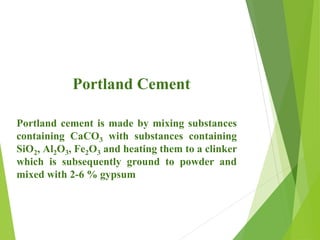
Portland Cement
Portland cement is made by mixing substances
containing CaCO3 with substances containing
SiO2, Al2O3, Fe2O3 and heating them to a clinker
which is subsequently ground to powder and
mixed with 2-6 % gypsum
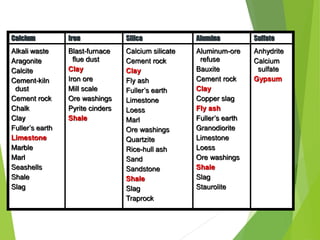
Raw Materials Necessary for
Portland Cement Manufacture
Must Provide the Following
Calcium
Silica
Alumina
Iron
Calcium Iron Silica Alumina Sulfate
Alkali waste
Aragonite
Calcite
Cement-kiln
dust
Cement rock
Chalk
Clay
Fuller’s earth
Limestone
Marble
Marl
Seashells
Shale
Slag
Blast-furnace
flue dust
Clay
Iron ore
Mill scale
Ore washings
Pyrite cinders
Shale
Calcium silicate
Cement rock
Clay
Fly ash
Fuller’s earth
Limestone
Loess
Marl
Ore washings
Quartzite
Rice-hull ash
Sand
Sandstone
Shale
Slag
Traprock
Aluminum-ore
refuse
Bauxite
Cement rock
Clay
Copper slag
Fly ash
Fuller’s earth
Granodiorite
Limestone
Loess
Ore washings
Shale
Slag
Staurolite
Anhydrite
Calcium
sulfate
Gypsum
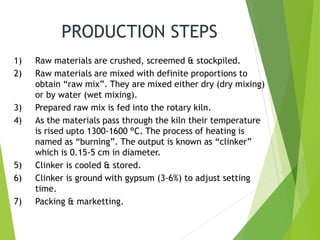
PRODUCTION STEPS
1) Raw materials are crushed, screemed & stockpiled.
2) Raw materials are mixed with definite proportions to
obtain “raw mix”. They are mixed either dry (dry mixing)
or by water (wet mixing).
3) Prepared raw mix is fed into the rotary kiln.
4) As the materials pass through the kiln their temperature
is rised upto 1300-1600 °C. The process of heating is
named as “burning”. The output is known as “clinker”
which is 0.15-5 cm in diameter.
5) Clinker is cooled & stored.
6) Clinker is ground with gypsum (3-6%) to adjust setting
time.
7) Packing & marketting.
Wet process
Dry process
Dry process with preheating tower
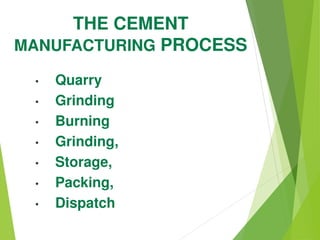
• Quarry
• Grinding
• Burning
• Grinding,
• Storage,
• Packing,
• Dispatch
THE CEMENT
MANUFACTURING PROCESS
THE CEMENT MANUFACTURING PROCESS
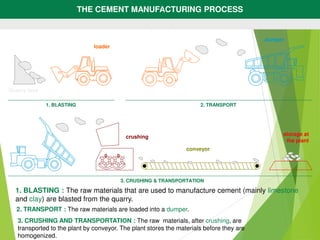
1. BLASTING : The raw materials that are used to manufacture cement (mainly limestone
and clay) are blasted from the quarry.
Quarry face
1. BLASTING 2. TRANSPORT
3. CRUSHING AND TRANSPORTATION : The raw materials, after crushing, are
transported to the plant by conveyor. The plant stores the materials before they are
homogenized.
quarry
3. CRUSHING & TRANSPORTATION
2. TRANSPORT : The raw materials are loaded into a dumper.
crushing
conveyor
dumper
storage at
the plant
loader
THE CEMENT MANUFACTURING PROCESS
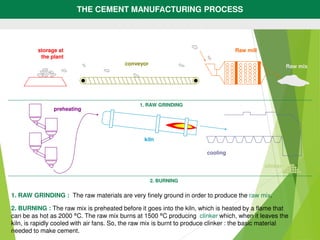
1. RAW GRINDING : The raw materials are very finely ground in order to produce the raw mix.
1. RAW GRINDING
Raw grinding and burning
2. BURNING
2. BURNING : The raw mix is preheated before it goes into the kiln, which is heated by a flame that
can be as hot as 2000 °C. The raw mix burns at 1500 °C producing clinker which, when it leaves the
kiln, is rapidly cooled with air fans. So, the raw mix is burnt to produce clinker : the basic material
needed to make cement.
conveyor
Raw mix
kiln
cooling
preheating
clinker
storage at
the plant
Raw mill
THE CEMENT MANUFACTURING PROCESS
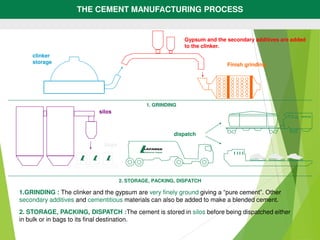
1.GRINDING : The clinker and the gypsum are very finely ground giving a “pure cement”. Other
secondary additives and cementitious materials can also be added to make a blended cement.
1. GRINDING
Grinding, storage, packing, dispatch
2. STORAGE, PACKING, DISPATCH
2. STORAGE, PACKING, DISPATCH :The cement is stored in silos before being dispatched either
in bulk or in bags to its final destination.
clinker
storage
Gypsum and the secondary additives are added
to the clinker.
silos
dispatch
bags
Finish grinding
Quarry
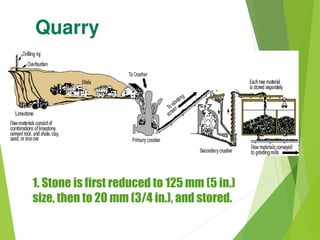
1. Stone is first reduced to 125 mm (5 in.)
size, then to 20 mm (3/4 in.), and stored.
4 materials 225tph
limestone 88%,
sandstone 5%,
kaolin/clay 5%,
mill scale 2%
Raw mill
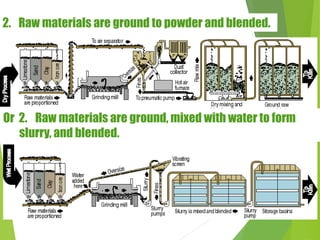
2. Raw materials are ground to powder and blended.
Or 2. Raw materials are ground, mixed with water to form
slurry, and blended.
Kiln
3. Burning changes raw mix chemically into cement clinker.
REACTIONS IN THE KILN
• ~100°C→ free water evaporates.
• ~150-350C°→ loosely bound water is lost from clay.
• ~350-650°C→decomposition of clay→SiO2&Al2O3
• ~600°C→decomposition of MgCO3→MgO&CO2 (evaporates)
• ~900°C→decomposition of CaCO3→CaO&CO2 (evaporates)
• ~1250-1280°C→liquid formation & start of compound formation.
• ~1280°C→clinkering begins.
• ~1400-1500°C→clinkering
• ~100°C→clinker leaves the kiln & falls into a cooler.
 Sometimes the burning process of raw materials is performed in two stages:
preheating upto 900°C & rotary kiln
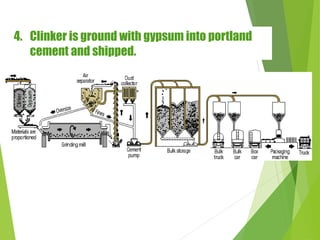
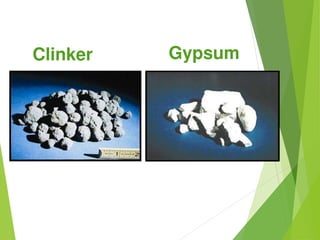
4. Clinker is ground with gypsum into portland
cement and shipped.
Clinker Gypsum
Portland cement is composed of four major
oxides (CaO, SiO2, Al2O3, Fe2O3 ≥90%) &
some minor oxides. Minor refers to the
quantity not importance.
Chemical composition of
Ordinary Portland cement
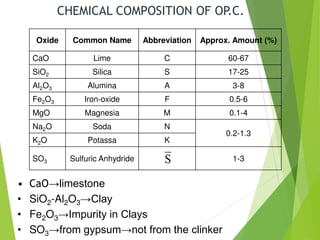
CHEMICAL COMPOSITION OF OP.C.
Oxide Common Name Abbreviation Approx. Amount (%)
CaO Lime C 60-67
SiO2 Silica S 17-25
Al2O3 Alumina A 3-8
Fe2O3 Iron-oxide F 0.5-6
MgO Magnesia M 0.1-4
Na2O Soda N
0.2-1.3
K2O Potassa K
SO3 Sulfuric Anhydride 1-3
• CaO→limestone
• SiO2-Al2O3→Clay
• Fe2O3→Impurity in Clays
• SO3→from gypsum→not from the clinker
S
COMPOUND COMPOSITION OF
O.P.C. (OR CLINKER)
 Oxides interact with each other in the kiln to
form more complex products (compounds).
Basically, the major compounds of O. P.C. can
be listed as:
Name Chemical Formula Abbreviations
Tri Calcium Silicate 3CaO.SiO2 C3S
Di Calcium Silicate 2CaO.SiO2 C2S
Tri Calcium Aluminate 3CaO.Al2O3 C3A
Tetra Calcium Alumino
Ferrite
4CaO.Al2O3.Fe2O3 C4AF
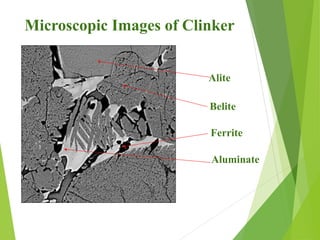
Microscopic Images of Clinker
Alite
Belite
Aluminate
Ferrite
Types of Portland Cement
I Normal
II Moderate sulfate resistance
III High early strength
IV Low heat of hydration
V High sulfate resistance
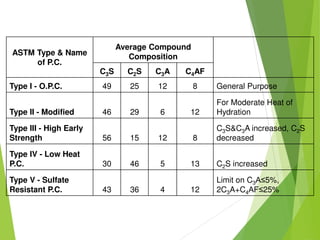
ASTM C 150 (AASHTO M 85)
ASTM Type & Name
of P.C.
Average Compound
Composition
C3S C2S C3A C4AF
Type I - O.P.C. 49 25 12 8 General Purpose
Type II - Modified 46 29 6 12
For Moderate Heat of
Hydration
Type III - High Early
Strength 56 15 12 8
C3S&C3A increased, C2S
decreased
Type IV - Low Heat
P.C. 30 46 5 13 C2S increased
Type V - Sulfate
Resistant P.C. 43 36 4 12
Limit on C3A≤5%,
2C3A+C4AF≤25%

THE_CEMENT_MANUFACTURING_PROCESS.pdf by manas

  • 1.
    THE CEMENT MANUFACTURING PROCESS Prof.Dr Elshafie Ahmed Gad Faculty of Applied Science Chemistry Dept.
  • 2.
    Portland Cement Portland cementis made by mixing substances containing CaCO3 with substances containing SiO2, Al2O3, Fe2O3 and heating them to a clinker which is subsequently ground to powder and mixed with 2-6 % gypsum
  • 3.
    Raw Materials Necessaryfor Portland Cement Manufacture Must Provide the Following Calcium Silica Alumina Iron
  • 4.
    Calcium Iron SilicaAlumina Sulfate Alkali waste Aragonite Calcite Cement-kiln dust Cement rock Chalk Clay Fuller’s earth Limestone Marble Marl Seashells Shale Slag Blast-furnace flue dust Clay Iron ore Mill scale Ore washings Pyrite cinders Shale Calcium silicate Cement rock Clay Fly ash Fuller’s earth Limestone Loess Marl Ore washings Quartzite Rice-hull ash Sand Sandstone Shale Slag Traprock Aluminum-ore refuse Bauxite Cement rock Clay Copper slag Fly ash Fuller’s earth Granodiorite Limestone Loess Ore washings Shale Slag Staurolite Anhydrite Calcium sulfate Gypsum
  • 5.
    PRODUCTION STEPS 1) Rawmaterials are crushed, screemed & stockpiled. 2) Raw materials are mixed with definite proportions to obtain “raw mix”. They are mixed either dry (dry mixing) or by water (wet mixing). 3) Prepared raw mix is fed into the rotary kiln. 4) As the materials pass through the kiln their temperature is rised upto 1300-1600 °C. The process of heating is named as “burning”. The output is known as “clinker” which is 0.15-5 cm in diameter. 5) Clinker is cooled & stored. 6) Clinker is ground with gypsum (3-6%) to adjust setting time. 7) Packing & marketting.
  • 6.
    Wet process Dry process Dryprocess with preheating tower
  • 7.
    • Quarry • Grinding •Burning • Grinding, • Storage, • Packing, • Dispatch THE CEMENT MANUFACTURING PROCESS
  • 8.
    THE CEMENT MANUFACTURINGPROCESS 1. BLASTING : The raw materials that are used to manufacture cement (mainly limestone and clay) are blasted from the quarry. Quarry face 1. BLASTING 2. TRANSPORT 3. CRUSHING AND TRANSPORTATION : The raw materials, after crushing, are transported to the plant by conveyor. The plant stores the materials before they are homogenized. quarry 3. CRUSHING & TRANSPORTATION 2. TRANSPORT : The raw materials are loaded into a dumper. crushing conveyor dumper storage at the plant loader
  • 9.
    THE CEMENT MANUFACTURINGPROCESS 1. RAW GRINDING : The raw materials are very finely ground in order to produce the raw mix. 1. RAW GRINDING Raw grinding and burning 2. BURNING 2. BURNING : The raw mix is preheated before it goes into the kiln, which is heated by a flame that can be as hot as 2000 °C. The raw mix burns at 1500 °C producing clinker which, when it leaves the kiln, is rapidly cooled with air fans. So, the raw mix is burnt to produce clinker : the basic material needed to make cement. conveyor Raw mix kiln cooling preheating clinker storage at the plant Raw mill
  • 10.
    THE CEMENT MANUFACTURINGPROCESS 1.GRINDING : The clinker and the gypsum are very finely ground giving a “pure cement”. Other secondary additives and cementitious materials can also be added to make a blended cement. 1. GRINDING Grinding, storage, packing, dispatch 2. STORAGE, PACKING, DISPATCH 2. STORAGE, PACKING, DISPATCH :The cement is stored in silos before being dispatched either in bulk or in bags to its final destination. clinker storage Gypsum and the secondary additives are added to the clinker. silos dispatch bags Finish grinding
  • 11.
    Quarry 1. Stone isfirst reduced to 125 mm (5 in.) size, then to 20 mm (3/4 in.), and stored.
  • 12.
    4 materials 225tph limestone88%, sandstone 5%, kaolin/clay 5%, mill scale 2% Raw mill
  • 13.
    2. Raw materialsare ground to powder and blended. Or 2. Raw materials are ground, mixed with water to form slurry, and blended.
  • 14.
  • 15.
    3. Burning changesraw mix chemically into cement clinker.
  • 16.
    REACTIONS IN THEKILN • ~100°C→ free water evaporates. • ~150-350C°→ loosely bound water is lost from clay. • ~350-650°C→decomposition of clay→SiO2&Al2O3 • ~600°C→decomposition of MgCO3→MgO&CO2 (evaporates) • ~900°C→decomposition of CaCO3→CaO&CO2 (evaporates) • ~1250-1280°C→liquid formation & start of compound formation. • ~1280°C→clinkering begins. • ~1400-1500°C→clinkering • ~100°C→clinker leaves the kiln & falls into a cooler.  Sometimes the burning process of raw materials is performed in two stages: preheating upto 900°C & rotary kiln
  • 17.
    4. Clinker isground with gypsum into portland cement and shipped.
  • 18.
  • 19.
    Portland cement iscomposed of four major oxides (CaO, SiO2, Al2O3, Fe2O3 ≥90%) & some minor oxides. Minor refers to the quantity not importance. Chemical composition of Ordinary Portland cement
  • 20.
    CHEMICAL COMPOSITION OFOP.C. Oxide Common Name Abbreviation Approx. Amount (%) CaO Lime C 60-67 SiO2 Silica S 17-25 Al2O3 Alumina A 3-8 Fe2O3 Iron-oxide F 0.5-6 MgO Magnesia M 0.1-4 Na2O Soda N 0.2-1.3 K2O Potassa K SO3 Sulfuric Anhydride 1-3 • CaO→limestone • SiO2-Al2O3→Clay • Fe2O3→Impurity in Clays • SO3→from gypsum→not from the clinker S
  • 21.
    COMPOUND COMPOSITION OF O.P.C.(OR CLINKER)  Oxides interact with each other in the kiln to form more complex products (compounds). Basically, the major compounds of O. P.C. can be listed as: Name Chemical Formula Abbreviations Tri Calcium Silicate 3CaO.SiO2 C3S Di Calcium Silicate 2CaO.SiO2 C2S Tri Calcium Aluminate 3CaO.Al2O3 C3A Tetra Calcium Alumino Ferrite 4CaO.Al2O3.Fe2O3 C4AF
  • 22.
    Microscopic Images ofClinker Alite Belite Aluminate Ferrite
  • 23.
    Types of PortlandCement I Normal II Moderate sulfate resistance III High early strength IV Low heat of hydration V High sulfate resistance ASTM C 150 (AASHTO M 85)
  • 24.
    ASTM Type &Name of P.C. Average Compound Composition C3S C2S C3A C4AF Type I - O.P.C. 49 25 12 8 General Purpose Type II - Modified 46 29 6 12 For Moderate Heat of Hydration Type III - High Early Strength 56 15 12 8 C3S&C3A increased, C2S decreased Type IV - Low Heat P.C. 30 46 5 13 C2S increased Type V - Sulfate Resistant P.C. 43 36 4 12 Limit on C3A≤5%, 2C3A+C4AF≤25%