Cellular Networks Frequency
Planning Practice
In a nutshell
➢ Freq. Planning aims at achieving best freq. re-use strategy, for minimizing Interference and improve
the quality of service. It is more common for 2G cellular networks, where we have multiple
frequencies per cell. For higher technologies, planning of the PSC (unique 512) and PCI (unique 504)
is more crucial, but the principles are similar.
➢ Two approaches: Manual & Automated
✓ Manual: for single cell or a small cluster of cells (eg using Mapinfo, with Google Earth help). Mostly when
addressing specific customer complaints or localized site performance issues
✓ Automated: Massive Scale (many cells). Popular Planning SW includes Atoll (Forsk), & ASSET.
➢ Main Inputs and Outputs of Frequency Planning
✓ Inputs: Antenna parameters (location, radiation pattern, height, azimuth); Transmitted power; Intended
coverage distance, Terrain (hills, buildings, etc); Clutter (landscape features), Available Frequencies to
choose from, and their band characteristics.
✓ Outputs: Interference Matrix based on calculated optimal frequency allocations. A summarized report is
generated with key parameters to decide how good or bad the predicted frequencies are wrt the status
quo.
➢ For a network built up from a scratch (e.g Safaricom Ethiopia, to be launched this year), initial
planning is done using the RF planning tools which only rely on Predictions using propagation models.
➢ For a full-fledged operational network, usually vendor specific tools will be employed for Frequency
re-planning: these would factor-in the input from actual measurements from the mobiles. An
example is Nokia’s EdenNet tool. Modern in-house tools can be used in open-loop (measure,
calculate, show) or closed loop (measure, calculate, implement, repeat) modes.
➢MCOM Illustration for Manual / Small Scale Frequency Planning
Summary output from EdenNet GSM Frequency Optimization (GFO) Module Calculations (Open Loop)
Interference Analysis
Layer Average Interference (%) Co-channel Interference (%)
Adjacent channel
Interference (%)
Existing 5.98 4.94 1.04
BCCH 4.31 4.16 0.16
TCH 7.4 5.61 1.8
Proposed 3.87 2.62 1.25
BCCH 1.05 0.77 0.28
TCH 6.28 4.2 2.08
Delta -2.11 -2.32 0.21
BCCH -3.27 -3.39 0.12
TCH -1.12 -1.41 0.29
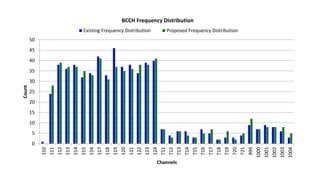
Vetting the rePlanned Frequencies against neighbor relations frequency hits
0
5
10
15
20
25
30
35
40
45
50
110
111
112
113
114
115
116
117
118
119
120
121
122
123
124
711
712
713
714
715
716
717
718
719
720
721
999
1000
1001
1002
1003
1004
Count
Channels
BCCH Frequency Distribution
Existing Frequency Distribution Proposed Frequency Distribution
0
20
40
60
80
100
120 88
91
94
97
100
103
106
109
112
116
711
714
717
720
723
726
729
732
735
738
741
744
747
750
753
756
759
1006
1009
1012
1015
1018
1021
Count
Channels
TCH Frequency Distribution
Existing Frequency Distribution Proposed Frequency Distribution

Cellular Networks Frequency Planning Practice.pdf

  • 1.
  • 2.
    ➢ Freq. Planningaims at achieving best freq. re-use strategy, for minimizing Interference and improve the quality of service. It is more common for 2G cellular networks, where we have multiple frequencies per cell. For higher technologies, planning of the PSC (unique 512) and PCI (unique 504) is more crucial, but the principles are similar. ➢ Two approaches: Manual & Automated ✓ Manual: for single cell or a small cluster of cells (eg using Mapinfo, with Google Earth help). Mostly when addressing specific customer complaints or localized site performance issues ✓ Automated: Massive Scale (many cells). Popular Planning SW includes Atoll (Forsk), & ASSET. ➢ Main Inputs and Outputs of Frequency Planning ✓ Inputs: Antenna parameters (location, radiation pattern, height, azimuth); Transmitted power; Intended coverage distance, Terrain (hills, buildings, etc); Clutter (landscape features), Available Frequencies to choose from, and their band characteristics. ✓ Outputs: Interference Matrix based on calculated optimal frequency allocations. A summarized report is generated with key parameters to decide how good or bad the predicted frequencies are wrt the status quo. ➢ For a network built up from a scratch (e.g Safaricom Ethiopia, to be launched this year), initial planning is done using the RF planning tools which only rely on Predictions using propagation models. ➢ For a full-fledged operational network, usually vendor specific tools will be employed for Frequency re-planning: these would factor-in the input from actual measurements from the mobiles. An example is Nokia’s EdenNet tool. Modern in-house tools can be used in open-loop (measure, calculate, show) or closed loop (measure, calculate, implement, repeat) modes.
  • 3.
    ➢MCOM Illustration forManual / Small Scale Frequency Planning
  • 4.
    Summary output fromEdenNet GSM Frequency Optimization (GFO) Module Calculations (Open Loop) Interference Analysis Layer Average Interference (%) Co-channel Interference (%) Adjacent channel Interference (%) Existing 5.98 4.94 1.04 BCCH 4.31 4.16 0.16 TCH 7.4 5.61 1.8 Proposed 3.87 2.62 1.25 BCCH 1.05 0.77 0.28 TCH 6.28 4.2 2.08 Delta -2.11 -2.32 0.21 BCCH -3.27 -3.39 0.12 TCH -1.12 -1.41 0.29
  • 5.
    Vetting the rePlannedFrequencies against neighbor relations frequency hits
  • 6.
  • 7.