 What is a cell?
 Cell theory
 Basic stuctions of the cell
 Functions of the cell

 Types of cell
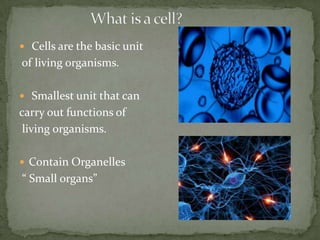
 Cells are the basic unit

of living organisms.
 Smallest unit that can

carry out functions of
living organisms.
 Contain Organelles

“ Small organs”
 Robert Hooke (1500’s) was first to use the term “cell”
 Schleiden (botanist) and Schwann (zoologist) (1800’s) make individual

observations about cells and form the cell theory.
Its postulates state that:
1. All living things are composed of cells
2. The cell is the simplest structural unit of all living things.
3. All cells come from other cells
Basic Structure of the Cell
 Plasma membrane-the outermost envelope
 Cytosol - fluid component within the cell
 Organelles - structures that carry out functions
 Nucleus
Functions of the Cell
 Communication. Cells produce and receive electrical
and chemical signals
 Cell metabolism and energy release
 Inheritance. Each cell contains DNA. Some cells are
specialized as gametes for exchange during sexual
intercourse
What do ALL cells have in common?
 Cell membrane (aka plasma membrane)
 Cytoplasm
 Genetic material (DNA or RNA)
 Ribosomes (produce proteins)
 Metabolism
 Cell membrane

A selectively permeable
phospholipid bilayer that
forms a barrier between
the cell and its environment
 Cytoplasm

Liquid substance that all
chemical reactions of life take
place in Has dissolved ions,
macromolecules Fills in around
the organelles of the cell
 Genetic Material DNA is

found as either: organized
chromosomes (eukaryotes)
Inside Nucleus single, loosely
packed chromosome (prokaryotes)

Ribosomes
Two-piece protein-based organelle
that makes proteins in both major
types of cell Varies structurally in
prokaryotes and eukaryotes
Cell,this micro universe

Cell,this micro universe

  • 1.
     What isa cell?  Cell theory  Basic stuctions of the cell  Functions of the cell  Types of cell
  • 2.
     Cells arethe basic unit of living organisms.  Smallest unit that can carry out functions of living organisms.  Contain Organelles “ Small organs”
  • 3.
     Robert Hooke(1500’s) was first to use the term “cell”  Schleiden (botanist) and Schwann (zoologist) (1800’s) make individual observations about cells and form the cell theory. Its postulates state that: 1. All living things are composed of cells 2. The cell is the simplest structural unit of all living things. 3. All cells come from other cells
  • 4.
    Basic Structure ofthe Cell  Plasma membrane-the outermost envelope  Cytosol - fluid component within the cell  Organelles - structures that carry out functions  Nucleus Functions of the Cell  Communication. Cells produce and receive electrical and chemical signals  Cell metabolism and energy release  Inheritance. Each cell contains DNA. Some cells are specialized as gametes for exchange during sexual intercourse
  • 6.
    What do ALLcells have in common?  Cell membrane (aka plasma membrane)  Cytoplasm  Genetic material (DNA or RNA)  Ribosomes (produce proteins)  Metabolism
  • 7.
     Cell membrane Aselectively permeable phospholipid bilayer that forms a barrier between the cell and its environment  Cytoplasm Liquid substance that all chemical reactions of life take place in Has dissolved ions, macromolecules Fills in around the organelles of the cell
  • 8.
     Genetic MaterialDNA is found as either: organized chromosomes (eukaryotes) Inside Nucleus single, loosely packed chromosome (prokaryotes) Ribosomes Two-piece protein-based organelle that makes proteins in both major types of cell Varies structurally in prokaryotes and eukaryotes