Eukaryotes
&
prokaryotes
Warm up
What is the cell?
 All living things are made of one or more cells .
 The cell is the basic unit of life and is where many life processes
occur.
 Organisms made up of a single cell are called single - celled
organism example : bacteria , protist
 And other organism are made up of trillions of cells are called
multicellular
 exmples : humans , dogs
eukaryotes
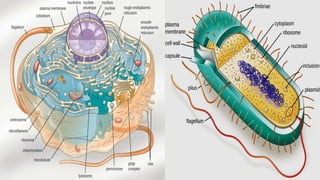
Organisms with cells that contains a nucleus , a
large organelle surrounded by a double
membrane , where the DNA stored of the
organisms
It’s size from 5:100 micrometer
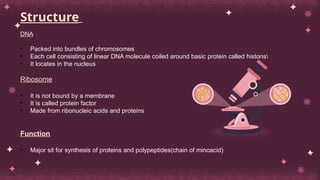
Structure
DNA
‱ Packed into bundles of chromosomes
‱ Each cell consisting of linear DNA molecule coiled around basic protein called histons
‱ It locates in the nucleus
Ribosome
‱ It is not bound by a membrane
‱ It is called protein factor
‱ Made from ribonucleic acids and proteins
Function
‱ Major sit for synthesis of proteins and polypeptides(chain of minoacid)
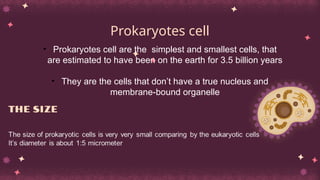
Prokaryotes cell
‱ Prokaryotes cell are the simplest and smallest cells, that
are estimated to have been on the earth for 3.5 billion years
‱ They are the cells that don’t have a true nucleus and
membrane-bound organelle
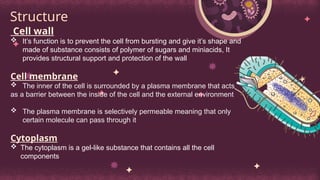
Structure
Cell wall
 It’s function is to prevent the cell from bursting and give it’s shape and
made of substance consists of polymer of sugars and miniacids, It
provides structural support and protection of the wall
Cell membrane
 The inner of the cell is surrounded by a plasma membrane that acts
as a barrier between the inside of the cell and the external environment
 The plasma membrane is selectively permeable meaning that only
certain molecule can pass through it
Cytoplasm
 The cytoplasm is a gel-like substance that contains all the cell
components
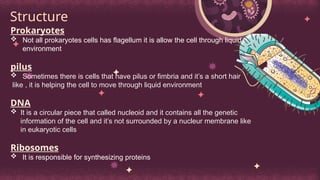
Structure
Prokaryotes
 Not all prokaryotes cells has flagellum it is allow the cell through liquid
environment
pilus
 Sometimes there is cells that have pilus or fimbria and it’s a short hair
like , it is helping the cell to move through liquid environment
DNA
 It is a circular piece that called nucleoid and it contains all the genetic
information of the cell and it’s not surrounded by a nucleur membrane like
in eukaryotic cells
Ribosomes
 It is responsible for synthesizing proteins

Cell types (eukaryotes and prokaryotes) and thier definition

  • 1.
  • 2.
  • 4.
    What is thecell?  All living things are made of one or more cells .  The cell is the basic unit of life and is where many life processes occur.  Organisms made up of a single cell are called single - celled organism example : bacteria , protist  And other organism are made up of trillions of cells are called multicellular  exmples : humans , dogs
  • 5.
    eukaryotes Organisms with cellsthat contains a nucleus , a large organelle surrounded by a double membrane , where the DNA stored of the organisms It’s size from 5:100 micrometer
  • 6.
    Structure DNA ‱ Packed intobundles of chromosomes ‱ Each cell consisting of linear DNA molecule coiled around basic protein called histons ‱ It locates in the nucleus Ribosome ‱ It is not bound by a membrane ‱ It is called protein factor ‱ Made from ribonucleic acids and proteins Function ‱ Major sit for synthesis of proteins and polypeptides(chain of minoacid)
  • 7.
    Prokaryotes cell ‱ Prokaryotescell are the simplest and smallest cells, that are estimated to have been on the earth for 3.5 billion years ‱ They are the cells that don’t have a true nucleus and membrane-bound organelle
  • 8.
    Structure Cell wall  It’sfunction is to prevent the cell from bursting and give it’s shape and made of substance consists of polymer of sugars and miniacids, It provides structural support and protection of the wall Cell membrane  The inner of the cell is surrounded by a plasma membrane that acts as a barrier between the inside of the cell and the external environment  The plasma membrane is selectively permeable meaning that only certain molecule can pass through it Cytoplasm  The cytoplasm is a gel-like substance that contains all the cell components
  • 9.
    Structure Prokaryotes  Not allprokaryotes cells has flagellum it is allow the cell through liquid environment pilus  Sometimes there is cells that have pilus or fimbria and it’s a short hair like , it is helping the cell to move through liquid environment DNA  It is a circular piece that called nucleoid and it contains all the genetic information of the cell and it’s not surrounded by a nucleur membrane like in eukaryotic cells Ribosomes  It is responsible for synthesizing proteins