




Andreza Dantas 
Fall, 2014
WATER 
Access to clean and safe 
has become more and more difficult
HOW TO ACCESS? 
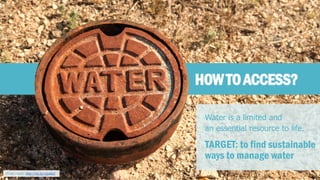
Water is a limited and 
an essential resource to life. 
TARGET: to find sustainable 
ways to manage water 
Photo credit: http://bit.ly/12pBi0Z
WATER? 
Why do we care about
LIFE 
water is the basis for 
Essentialto body processes of all living things. 
(Class notes) 
Fundamental to meet human needs.(Class notes) 
Vital to maintainingspecies, populations, and ecosystems. (Class notes) 
Life would be impossiblewithout water.(Raven, 2012) 
Sources: P.H. Raven, D.M Hassenthal, L.R. Berg. (2012). Environment, 8th ed. John Wiley and Sons, 2012. 263-284. Print./ Class notes from lecture Water and Human Use (2014).
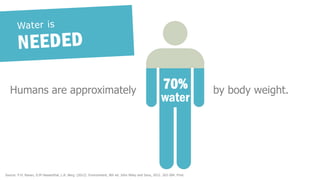
Humans are approximately 
by body weight. 
Source: P.H. Raven, D.M Hassenthal, L.R. Berg. (2012). Environment, 8th ed. John Wiley and Sons, 2012. 263-284. Print. 
70% 
water
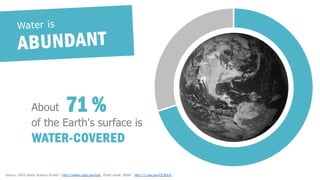
About 71 % 
of the Earth's surface is 
WATER-COVERED 
Source: USGS Water Science School – http://water.usgs.gov/edu .Photo credit: NASA - http://1.usa.gov/QCBUL6
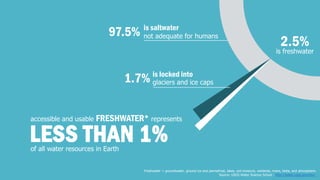
97.5% 
2.5% 
is freshwater 
is saltwater 
not adequate for humans 
LESS THAN 1% 
accessible and usable FRESHWATER*represents 
of all water resources in Earth 
1.7% 
glaciers and ice caps 
is locked into 
Freshwater = groundwater, ground ice and permafrost, lakes, soil moisture, wetlands, rivers, biota, and atmosphere. 
Source: USGS Water Science School -http://water.usgs.gov/edu/
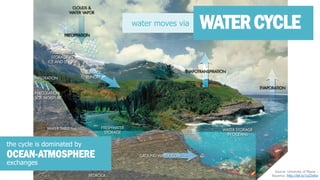
the cycle is dominated by 
OCEAN-ATMOSPHERE 
exchanges 
water moves via 
WATER CYCLE 
Source: University of Maine – Aquarius: http://bit.ly/1yZ2xKw
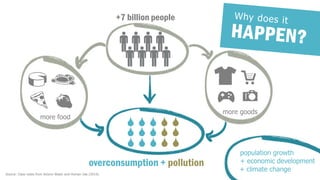
ARISE? 
Why did this issue
more goods 
O 
H 
M 
more food 
q 
d 
k 
f 
+7 billion people 
overconsumption + pollution 
+ economic development 
+ climate change 
population growth 
Source: Class notes from lecture Water and Human Use (2014).
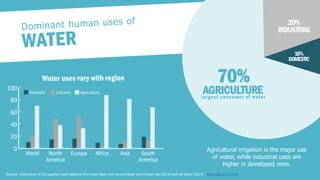
Sources: Information in the graphics were obtained from class notes from lecture Water and Human Use (2014) and UN Water (2014) - http://bit.ly/11AYkBD 
Agricultural irrigation is the major use 
of water, while industrial uses are 
higher in developed ones. 
North Europa Africa Asia 
America 
World South 
America 
Domestic Industry Agriculture 
100 
80 
60 
40 
20 
0
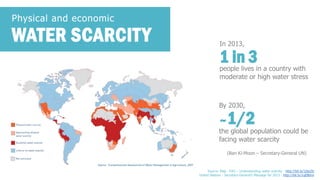
WATER SCARCITY 
Physical and economic 
Source: Map -FAO –Understanding water scarcity -http://bit.ly/1ljsoZb 
United Nations -Secretary-General’s Message for 2013 -http://bit.ly/1qE8bmi 
people lives in a country with 
1 in 3 
moderate or high water stress 
In 2013, 
the global population could be 
~1/2 
facing water scarcity 
(Ban Ki-Moon –Secretary-General UN) 
By 2030,
IMPACTS 
Consequences and
Photo credit: http://bit.ly/1xIJk2A 
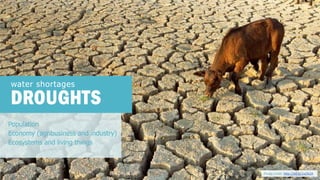
Population 
Economy (agribusiness and industry) 
Ecosystems and living things 
water shortages 
DROUGHTS
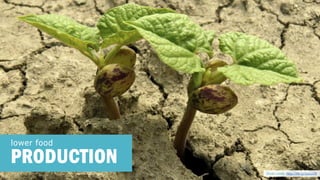
lower food 
PRODUCTION 
Photo credit: http://bit.ly/1yxcu1R
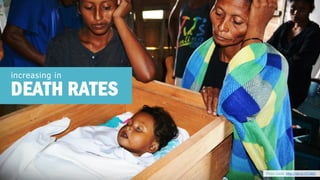
increasing in 
DEATH RATES 
Photo credit: http://bit.ly/1tT2kEz
DROUGHT 
São Paulo, Brazil: a year-long
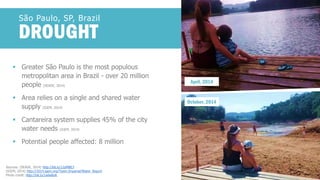
São Paulo, SP, Brazil 
DROUGHT 
Greater São Paulo is the most populous metropolitan area in Brazil -over 20 million people (SEADE, 2014) 
Area relies on a single and shared water supply (IGEM, 2014) 
Cantareira system supplies 45% of the city water needs (IGEM, 2014) 
Potential people affected: 8 million 
Sources: (SEADE, 2014) http://bit.ly/12pM8E3 
(IGEM, 2014) http://2014.igem.org/Team:Imperial/Water_Report 
Photo credit: http://bit.ly/1wlwByR 
April, 2014 
October, 2014
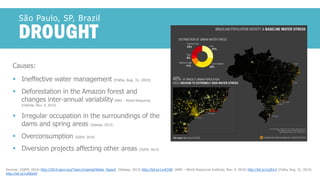
Causes: 
Ineffective water management (Folha, Aug. 31, 2014) 
Deforestation in the Amazon forest and changes inter-annual variability(WRI –World Resources Institute, Nov. 4, 2014) 
Irregular occupation in the surroundings of the dams and spring areas (Sabesp, 2013) 
Overconsumption (IGEM, 2014) 
Diversion projects affecting other areas (IGEM, 2014) 
São Paulo, SP, Brazil 
DROUGHT 
Sources: (IGEM, 2014) http://2014.igem.org/Team:Imperial/Water_Report(Sabesp, 2013) http://bit.ly/1vvE2XB(WRI –World Resources Institute, Nov. 4, 2014) http://bit.ly/1xZEiv3(Folha, Aug. 31, 2014) http://bit.ly/1vE8oGH
WATER RESOURCES? 
How can we sustainably manage our
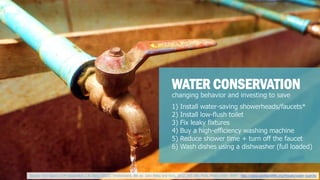
changing behavior and investing to save 
WATER CONSERVATION 
1) Install water-saving showerheads/faucets* 
2) Install low-flush toilet 
3) Fix leaky fixtures 
4) Buy a high-efficiency washing machine 
5) Reduce shower time + turn off the faucet 
6) Wash dishes using a dishwasher (full loaded) 
Source: P.H. Raven, D.M Hassenthal, L.R. Berg. (2012). Environment, 8th ed. John Wiley and Sons, 2012. 263-284. Print. Photo credit: WWF -http://www.worldwildlife.org/threats/water-scarcity
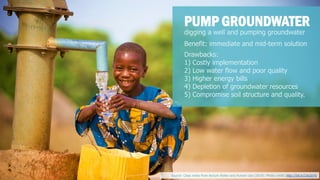
digging a well and pumping groundwater 
PUMP GROUNDWATER 
Benefit: immediate and mid-term solution 
Drawbacks: 
1) Costly implementation 
2) Low water flow and poor quality 
3) Higher energy bills 
4) Depletion of groundwater resources 
5) Compromise soil structure and quality. 
Source: Class notes from lecture Water and Human Use (2014). Photo credit: http://bit.ly/1As3oYb
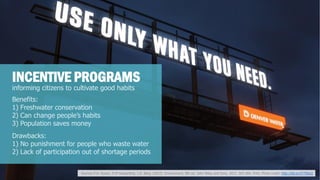
informing citizens to cultivate good habits 
INCENTIVE PROGRAMS 
Benefits: 
1) Freshwater conservation 
2) Can change people’s habits 
3) Population saves money 
Drawbacks: 
1) No punishment for people who waste water 
2) Lack of participation out of shortage periods 
Sources P.H. Raven, D.M Hassenthal, L.R. Berg. (2012). Environment, 8th ed. John Wiley and Sons, 2012. 263-284. Print. Photo credit: http://bit.ly/1F7Z8uQ
SOLUTION(S) 
Sustainable
to manage and conserve water resources 
SUSTAINABLE SOLUTIONS 
Short-term solutions 
1) Seasonal prices for water (all sectors) 
2) Severe fines for waste of water (all sectors) 
3) Social games (awareness + water-conservation habits) 
Mid and long-term solutions 
1) Subsides for sustainable projects 
2) Investments in infrastructure 
3) Sustainability programs in schools 
4) Policies to regulate agricultural and industrial use of water 
Photo credit: http://bit.ly/1F8cUxL
THANK YOU 
"Be the change you want to see in the world." 
Mahatma Gandhi

How can we sustainably manage our water resources?

  • 1.
  • 2.
    WATER Access toclean and safe has become more and more difficult
  • 3.
    HOW TO ACCESS? Water is a limited and an essential resource to life. TARGET: to find sustainable ways to manage water Photo credit: http://bit.ly/12pBi0Z
  • 4.
    WATER? Why dowe care about
  • 5.
    LIFE water isthe basis for Essentialto body processes of all living things. (Class notes) Fundamental to meet human needs.(Class notes) Vital to maintainingspecies, populations, and ecosystems. (Class notes) Life would be impossiblewithout water.(Raven, 2012) Sources: P.H. Raven, D.M Hassenthal, L.R. Berg. (2012). Environment, 8th ed. John Wiley and Sons, 2012. 263-284. Print./ Class notes from lecture Water and Human Use (2014).
  • 6.
    Humans are approximately by body weight. Source: P.H. Raven, D.M Hassenthal, L.R. Berg. (2012). Environment, 8th ed. John Wiley and Sons, 2012. 263-284. Print. 70% water
  • 7.
    About 71 % of the Earth's surface is WATER-COVERED Source: USGS Water Science School – http://water.usgs.gov/edu .Photo credit: NASA - http://1.usa.gov/QCBUL6
  • 8.
    97.5% 2.5% isfreshwater is saltwater not adequate for humans LESS THAN 1% accessible and usable FRESHWATER*represents of all water resources in Earth 1.7% glaciers and ice caps is locked into Freshwater = groundwater, ground ice and permafrost, lakes, soil moisture, wetlands, rivers, biota, and atmosphere. Source: USGS Water Science School -http://water.usgs.gov/edu/
  • 9.
    the cycle isdominated by OCEAN-ATMOSPHERE exchanges water moves via WATER CYCLE Source: University of Maine – Aquarius: http://bit.ly/1yZ2xKw
  • 10.
    ARISE? Why didthis issue
  • 11.
    more goods O H M more food q d k f +7 billion people overconsumption + pollution + economic development + climate change population growth Source: Class notes from lecture Water and Human Use (2014).
  • 12.
    Sources: Information inthe graphics were obtained from class notes from lecture Water and Human Use (2014) and UN Water (2014) - http://bit.ly/11AYkBD Agricultural irrigation is the major use of water, while industrial uses are higher in developed ones. North Europa Africa Asia America World South America Domestic Industry Agriculture 100 80 60 40 20 0
  • 13.
    WATER SCARCITY Physicaland economic Source: Map -FAO –Understanding water scarcity -http://bit.ly/1ljsoZb United Nations -Secretary-General’s Message for 2013 -http://bit.ly/1qE8bmi people lives in a country with 1 in 3 moderate or high water stress In 2013, the global population could be ~1/2 facing water scarcity (Ban Ki-Moon –Secretary-General UN) By 2030,
  • 14.
  • 15.
    Photo credit: http://bit.ly/1xIJk2A Population Economy (agribusiness and industry) Ecosystems and living things water shortages DROUGHTS
  • 16.
    lower food PRODUCTION Photo credit: http://bit.ly/1yxcu1R
  • 17.
    increasing in DEATHRATES Photo credit: http://bit.ly/1tT2kEz
  • 18.
    DROUGHT São Paulo,Brazil: a year-long
  • 19.
    São Paulo, SP,Brazil DROUGHT Greater São Paulo is the most populous metropolitan area in Brazil -over 20 million people (SEADE, 2014) Area relies on a single and shared water supply (IGEM, 2014) Cantareira system supplies 45% of the city water needs (IGEM, 2014) Potential people affected: 8 million Sources: (SEADE, 2014) http://bit.ly/12pM8E3 (IGEM, 2014) http://2014.igem.org/Team:Imperial/Water_Report Photo credit: http://bit.ly/1wlwByR April, 2014 October, 2014
  • 20.
    Causes: Ineffective watermanagement (Folha, Aug. 31, 2014) Deforestation in the Amazon forest and changes inter-annual variability(WRI –World Resources Institute, Nov. 4, 2014) Irregular occupation in the surroundings of the dams and spring areas (Sabesp, 2013) Overconsumption (IGEM, 2014) Diversion projects affecting other areas (IGEM, 2014) São Paulo, SP, Brazil DROUGHT Sources: (IGEM, 2014) http://2014.igem.org/Team:Imperial/Water_Report(Sabesp, 2013) http://bit.ly/1vvE2XB(WRI –World Resources Institute, Nov. 4, 2014) http://bit.ly/1xZEiv3(Folha, Aug. 31, 2014) http://bit.ly/1vE8oGH
  • 21.
    WATER RESOURCES? Howcan we sustainably manage our
  • 22.
    changing behavior andinvesting to save WATER CONSERVATION 1) Install water-saving showerheads/faucets* 2) Install low-flush toilet 3) Fix leaky fixtures 4) Buy a high-efficiency washing machine 5) Reduce shower time + turn off the faucet 6) Wash dishes using a dishwasher (full loaded) Source: P.H. Raven, D.M Hassenthal, L.R. Berg. (2012). Environment, 8th ed. John Wiley and Sons, 2012. 263-284. Print. Photo credit: WWF -http://www.worldwildlife.org/threats/water-scarcity
  • 23.
    digging a welland pumping groundwater PUMP GROUNDWATER Benefit: immediate and mid-term solution Drawbacks: 1) Costly implementation 2) Low water flow and poor quality 3) Higher energy bills 4) Depletion of groundwater resources 5) Compromise soil structure and quality. Source: Class notes from lecture Water and Human Use (2014). Photo credit: http://bit.ly/1As3oYb
  • 24.
    informing citizens tocultivate good habits INCENTIVE PROGRAMS Benefits: 1) Freshwater conservation 2) Can change people’s habits 3) Population saves money Drawbacks: 1) No punishment for people who waste water 2) Lack of participation out of shortage periods Sources P.H. Raven, D.M Hassenthal, L.R. Berg. (2012). Environment, 8th ed. John Wiley and Sons, 2012. 263-284. Print. Photo credit: http://bit.ly/1F7Z8uQ
  • 25.
  • 26.
    to manage andconserve water resources SUSTAINABLE SOLUTIONS Short-term solutions 1) Seasonal prices for water (all sectors) 2) Severe fines for waste of water (all sectors) 3) Social games (awareness + water-conservation habits) Mid and long-term solutions 1) Subsides for sustainable projects 2) Investments in infrastructure 3) Sustainability programs in schools 4) Policies to regulate agricultural and industrial use of water Photo credit: http://bit.ly/1F8cUxL
  • 27.
    THANK YOU "Bethe change you want to see in the world." Mahatma Gandhi

Editor's Notes

  • #10 Picture: Water cycle – NASA - http://aquarius.umaine.edu/cgi/gal_images.htm?id=1
  • #16 Picture: http://mato48.com/tag/water-scarcity/
  • #21 What is happening now? Reservoirs of the Cantareira system fell to 9.61% capacity Taps are running dry without previous notice Monthly water shortages are becoming weekly Population are digging water wells to get groundwater State level: water conservation programs + leaking repair municipal infrastructure + subsides to efficient equipment + (UOL, Nov. 18, 2014) and (UOL, Nov. 11, 2014) References: (IGEM, 2014) http://2014.igem.org/Team:Imperial/Water_Report (Sabesp, 2013) http://www.sabesp.com.br/sabesp/filesmng.nsf/FEE5CAD5B86F3E7C83257CC80071316B/$File/DFs_2013_ingles.pdf (WRI – World Resources Institute, Nov. 4, 2014): http://www.wri.org/blog/2014/11/3-maps-help-explain-s%C3%A3o-paulo-brazil%E2%80%99s-water-crisis (Folha, Aug. 31, 2014) http://www1.folha.uol.com.br/cotidiano/2014/08/1508504-falta-de-agua-e-culpa-do-governo-de-sp-afirma-relatora-da-onu.shtml
  • #23 *Initiative adopted in São Paulo. Check it in the following websites – in Portuguese: (UOL, Nov. 18, 2014) http://noticias.uol.com.br/ultimas-noticias/bbc/2014/11/18/subsidiar-chuveiros-eficientes-pode-ser-alternativa-para-sp-diz-especialista.htm and (UOL, Nov. 11, 2014) http://noticias.uol.com.br/cotidiano/ultimas-noticias/2014/11/04/saiba-como-a-tecnologia-pode-ajudar-a-driblar-a-crise-hidrica-de-sao-paulo.htm