
Rakesh Kumar
School of Ecology and Environmental Studies
Nalanda University, Rajgir (India)
Introduction
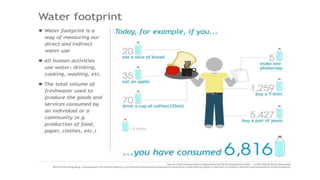
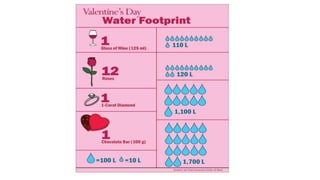
The water footprint measures the amount of water used to produce each of the
goods and services we use.
The water footprint is a measure of humanity’s appropriation of fresh water in
volumes of water consumed and/or polluted.
Why are water footprints important?
Freshwater is a scarce resource; its annual availability is limited and demand is
growing. The water footprint of humanity has exceeded sustainable levels at
several places and is unequally distributed among people. So, water footprints of
communities and businesses will help to understand how we can achieve a more
sustainable and equitable use of fresh water.
What is the difference between water footprint and virtual water?
• The water footprint is a term that refers to the water used to make a product.
• Speak about the ‘virtual water content’ of a product instead of its ‘water
footprint’.
• Furthermore, the water footprint concept does not simply refer to a water
volume only, like in the case of the term ‘virtual water content’ of a product.
The water footprint is a multidimensional indicator, not only referring to a water
volume used, but also making explicit where the water footprint is located,
what source of water is used, and when the water is used. The additional
information is crucial in order to assess the impacts of the water footprint of a
product.
What is the Water Footprint Network?
Established in October 2008 by a number of major global players from business,
civil society, multilateral organizations and academia.
WFN and its partners strive to develop and apply the Water Footprint to support
the transition to sustainable and equitable water use and management globally.
Purpose of the WFN
• aims to come to broadly shared global standards on water footprint accounting
• set of global standards on the water footprint will make efforts of businesses
and communities that strive for a reduction of their water footprint
Unit of Measurement
The water footprint can be measured in cubic metres per
tonne of production, per hectare of cropland, per unit of
currency and in other functional units.
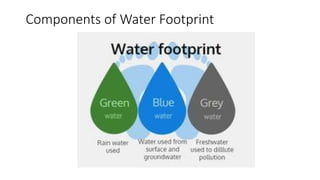
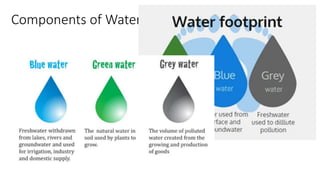
Components of Water Footprint
Water footprint
Water footprint
Water footprint

Water footprint

  • 1.
    Rakesh Kumar School ofEcology and Environmental Studies Nalanda University, Rajgir (India)
  • 2.
    Introduction The water footprintmeasures the amount of water used to produce each of the goods and services we use. The water footprint is a measure of humanity’s appropriation of fresh water in volumes of water consumed and/or polluted. Why are water footprints important? Freshwater is a scarce resource; its annual availability is limited and demand is growing. The water footprint of humanity has exceeded sustainable levels at several places and is unequally distributed among people. So, water footprints of communities and businesses will help to understand how we can achieve a more sustainable and equitable use of fresh water.
  • 3.
    What is thedifference between water footprint and virtual water? • The water footprint is a term that refers to the water used to make a product. • Speak about the ‘virtual water content’ of a product instead of its ‘water footprint’. • Furthermore, the water footprint concept does not simply refer to a water volume only, like in the case of the term ‘virtual water content’ of a product. The water footprint is a multidimensional indicator, not only referring to a water volume used, but also making explicit where the water footprint is located, what source of water is used, and when the water is used. The additional information is crucial in order to assess the impacts of the water footprint of a product.
  • 4.
    What is theWater Footprint Network? Established in October 2008 by a number of major global players from business, civil society, multilateral organizations and academia. WFN and its partners strive to develop and apply the Water Footprint to support the transition to sustainable and equitable water use and management globally. Purpose of the WFN • aims to come to broadly shared global standards on water footprint accounting • set of global standards on the water footprint will make efforts of businesses and communities that strive for a reduction of their water footprint
  • 5.
    Unit of Measurement Thewater footprint can be measured in cubic metres per tonne of production, per hectare of cropland, per unit of currency and in other functional units.
  • 8.
  • 9.