

Centre
Defence
Enterprise
for
Centre
Defence
Enterprise
for
Enduring Challenge Competition
Enduring competition
Perpetual
Radical
£3M per year
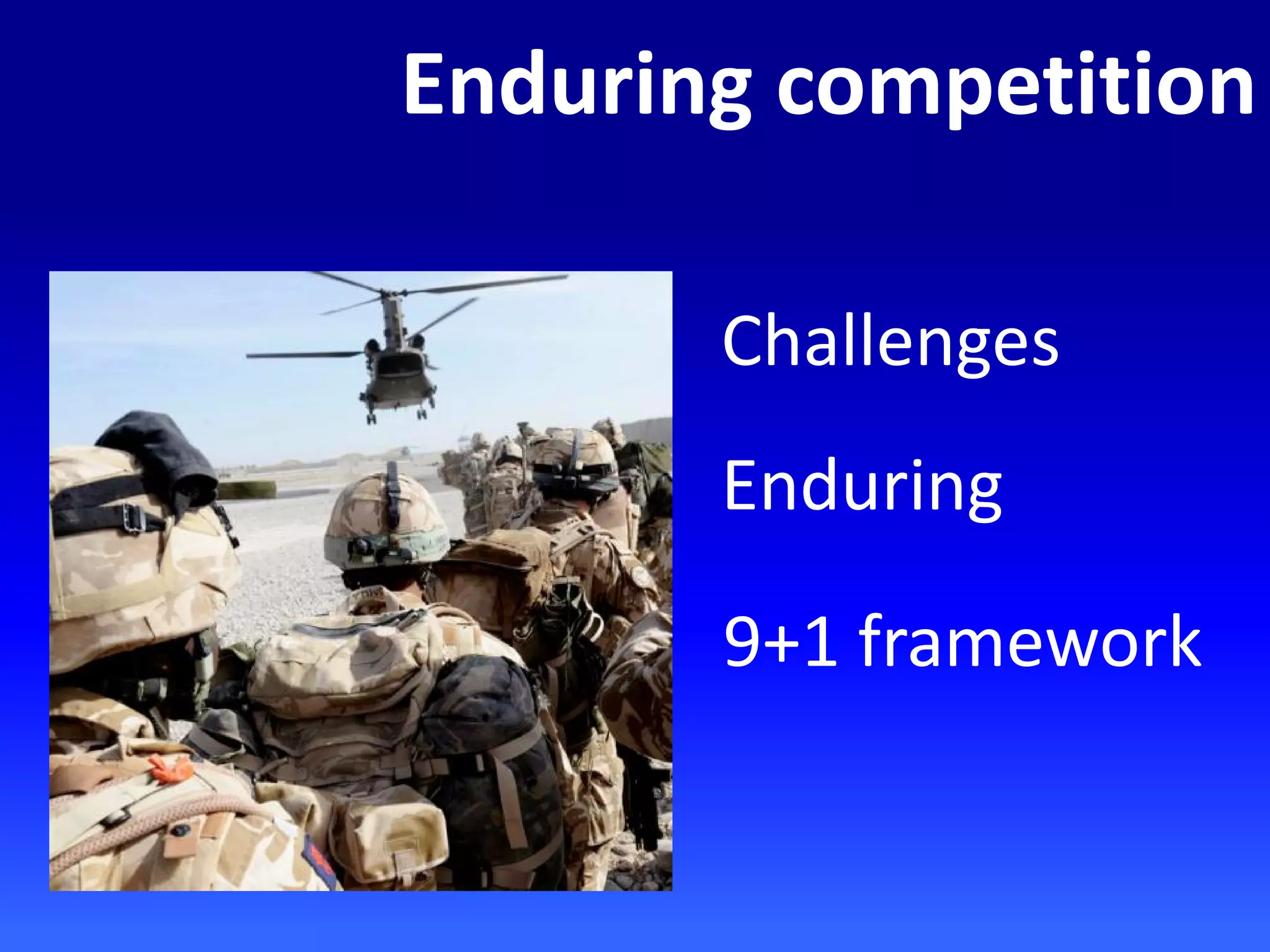
Enduring competition
Challenges
Enduring
9+1 framework
Framework
Protection
Lethality
Human performance
Mobility
Lower cost of ownership
Framework
Situational awareness
Communication
Data
Power
New capabilities
Defining the Maritime Research Requirement
From the customer’s perspective
© Crown copyright 2013 Dstl
26 March 2014
UNCLASSIFIED
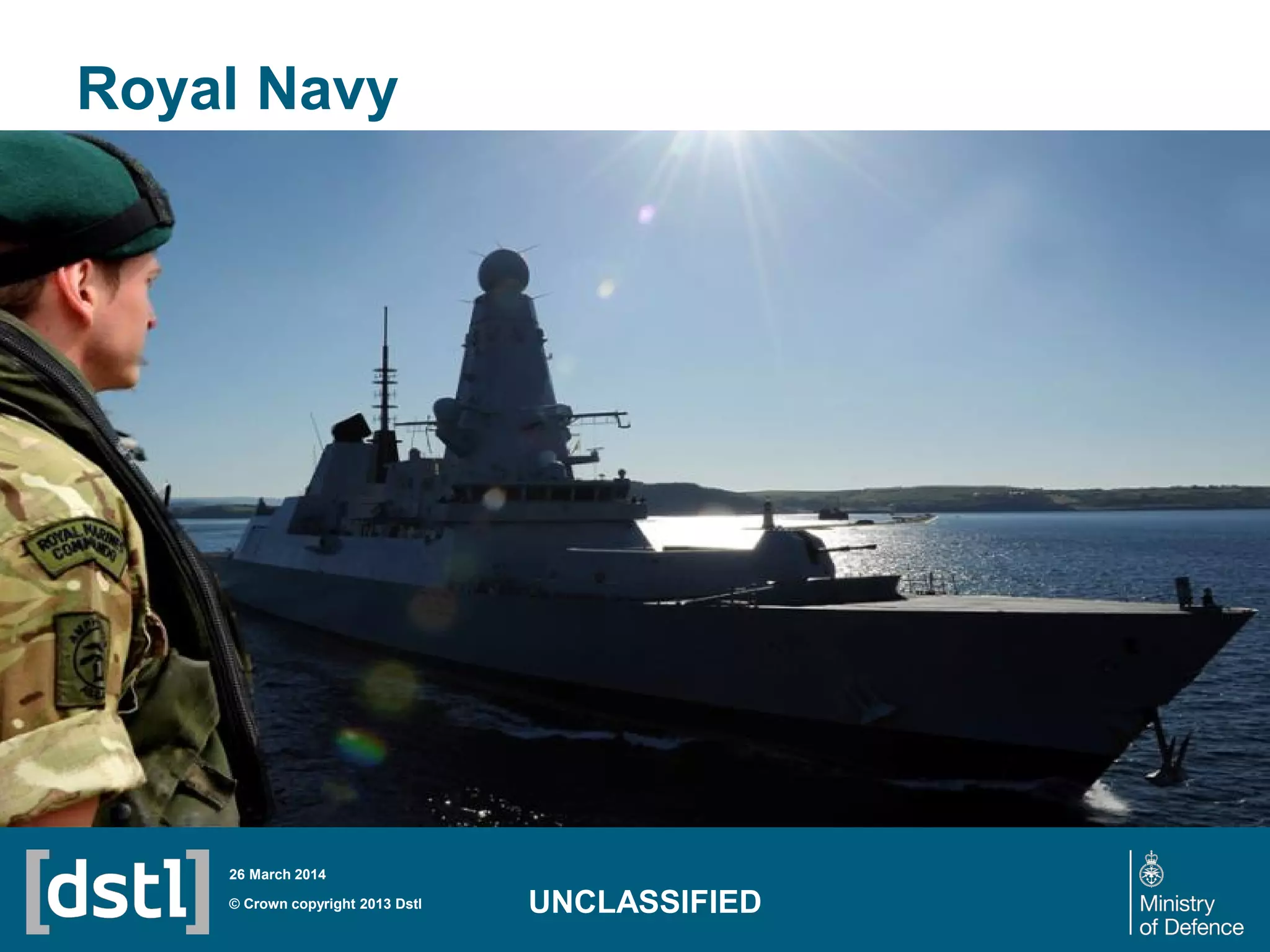
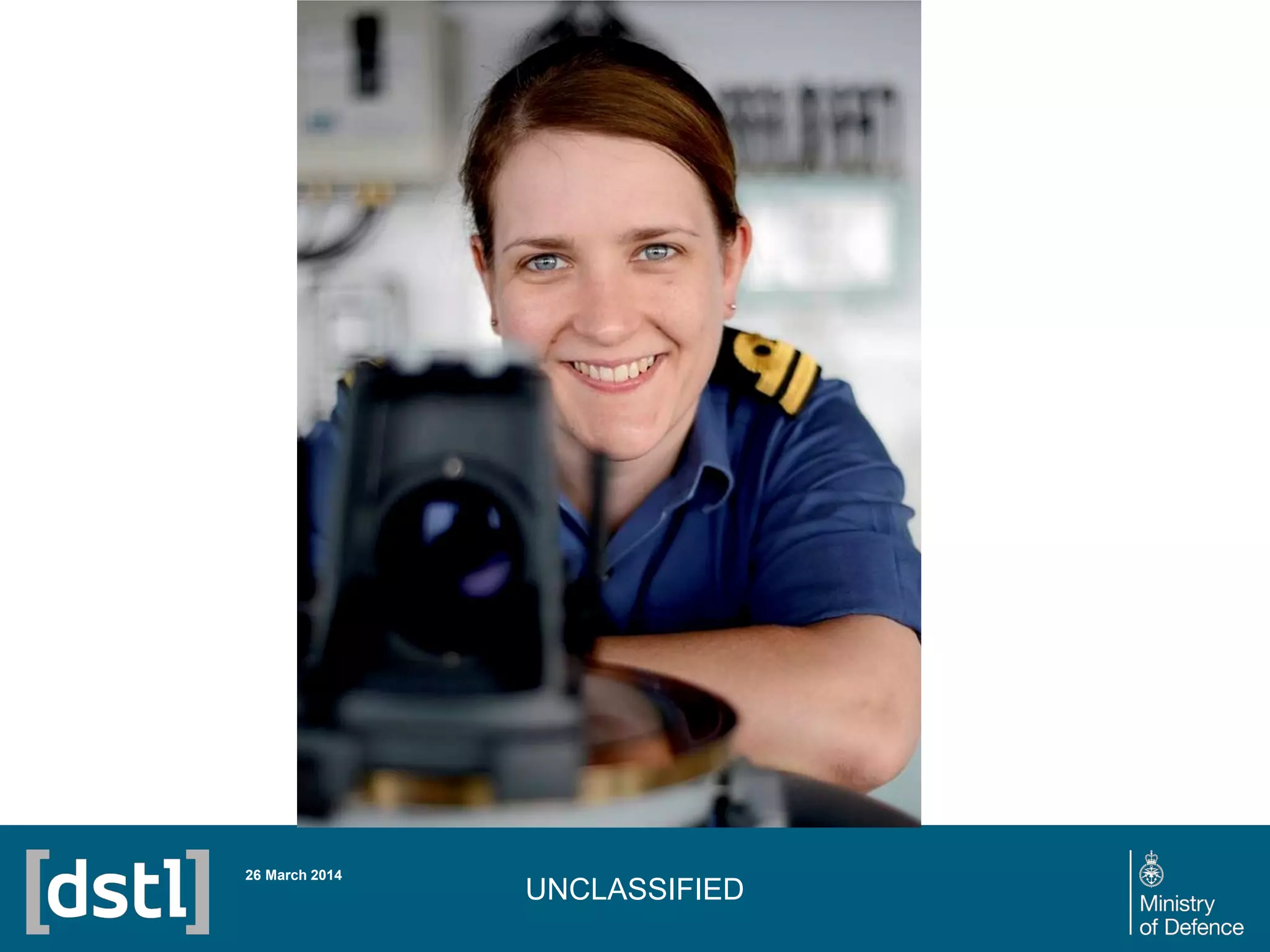
Royal Navy
© Crown copyright 2013 Dstl
26 March 2014
UNCLASSIFIED
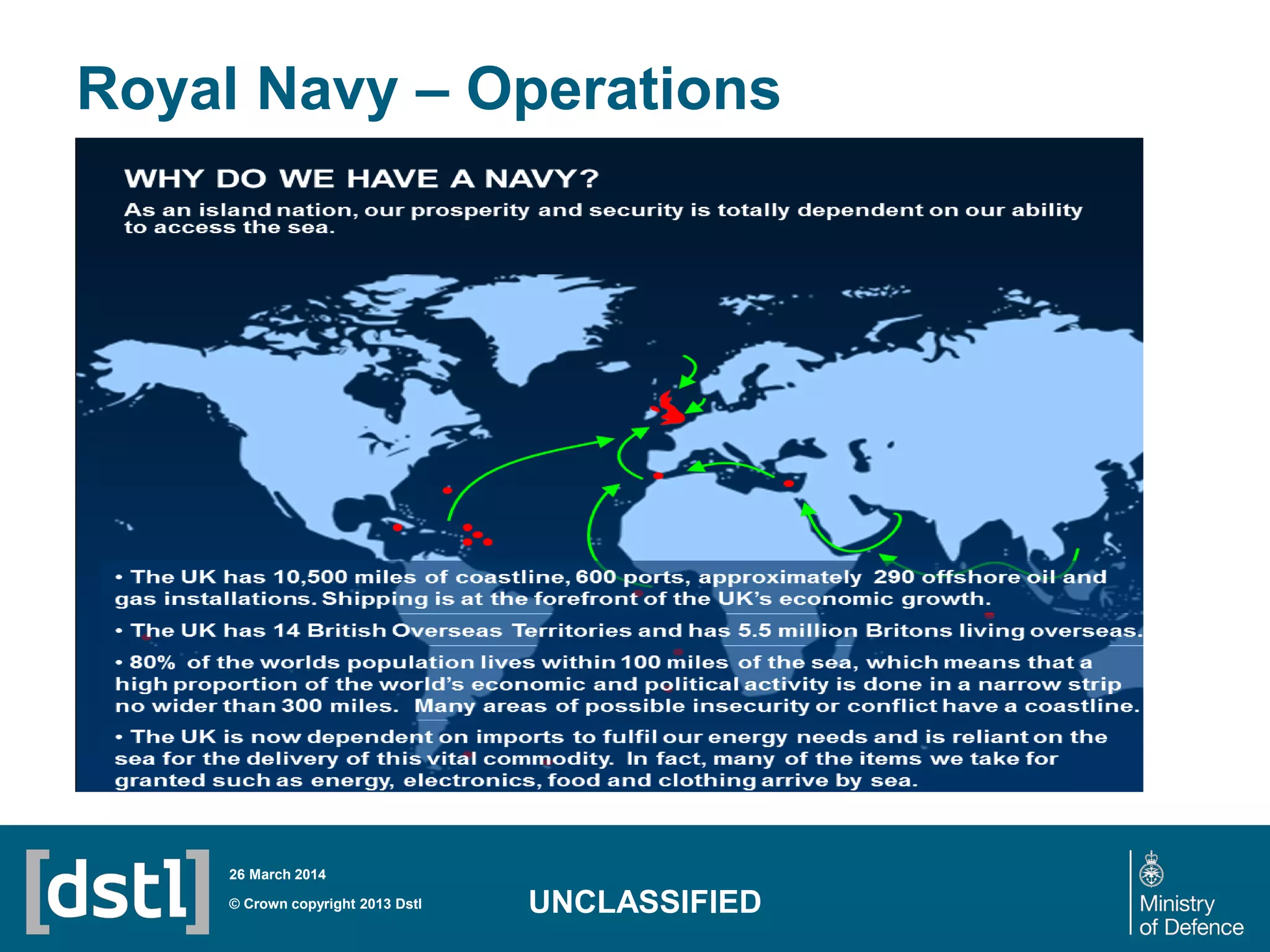
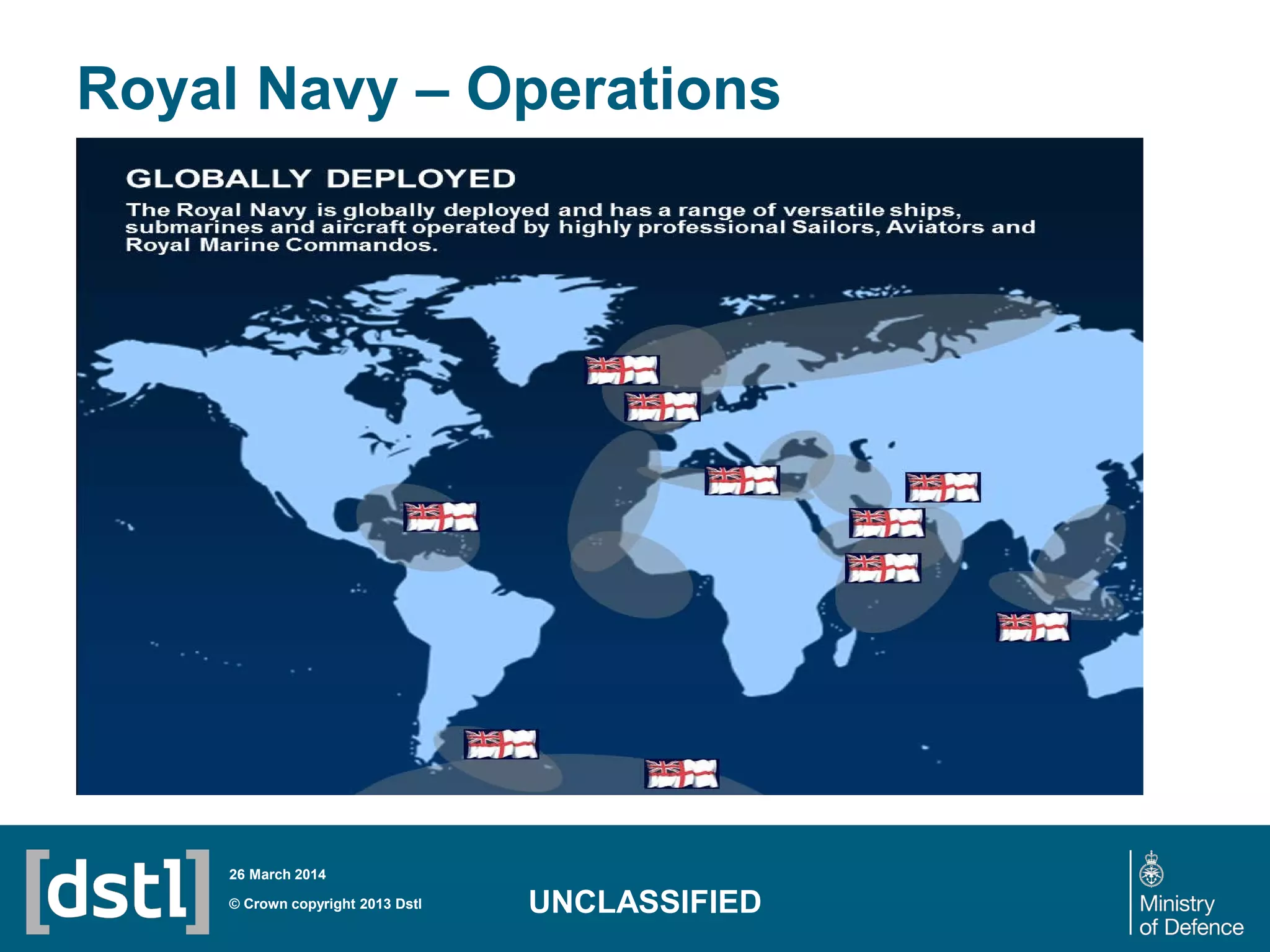
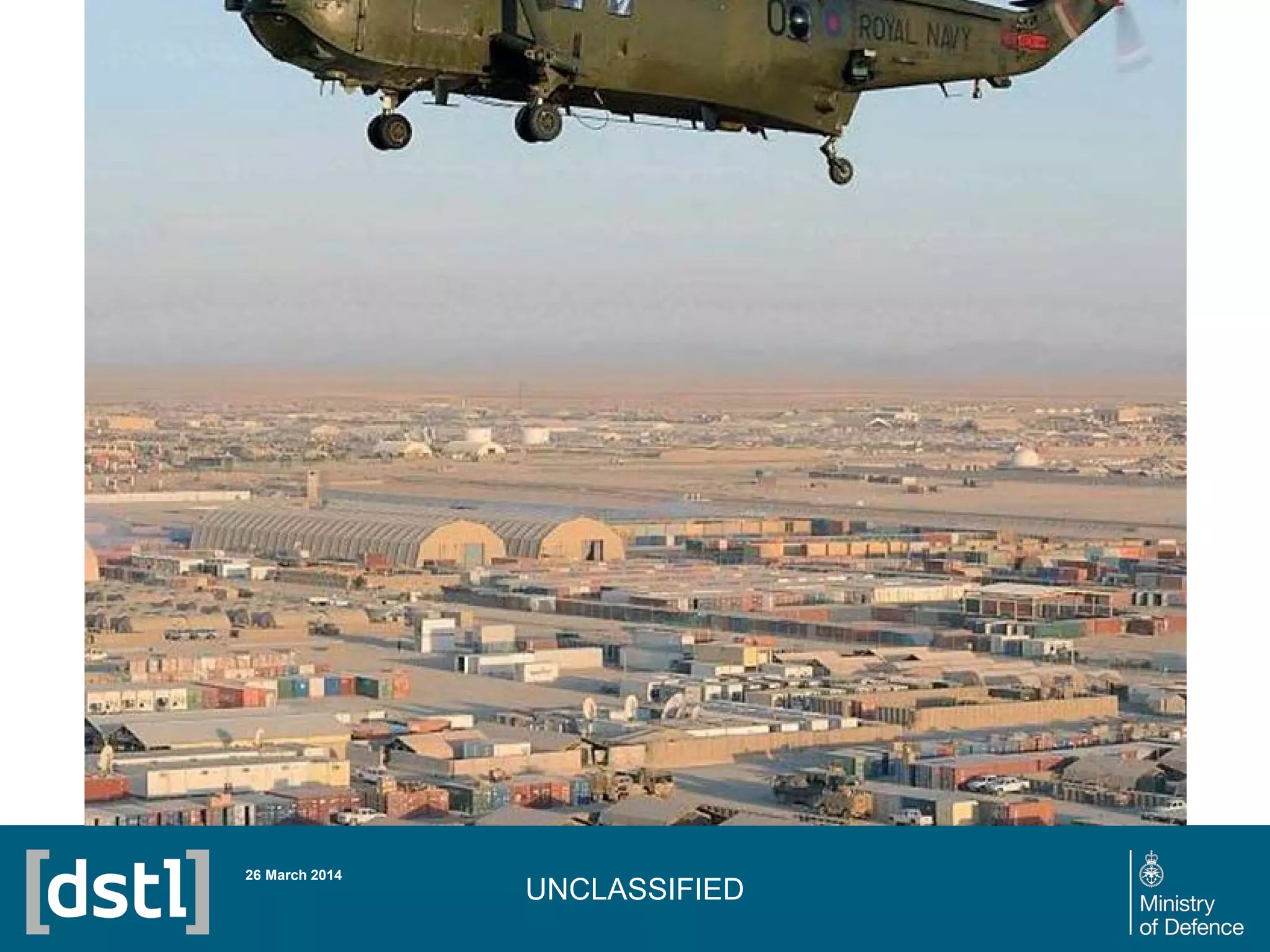
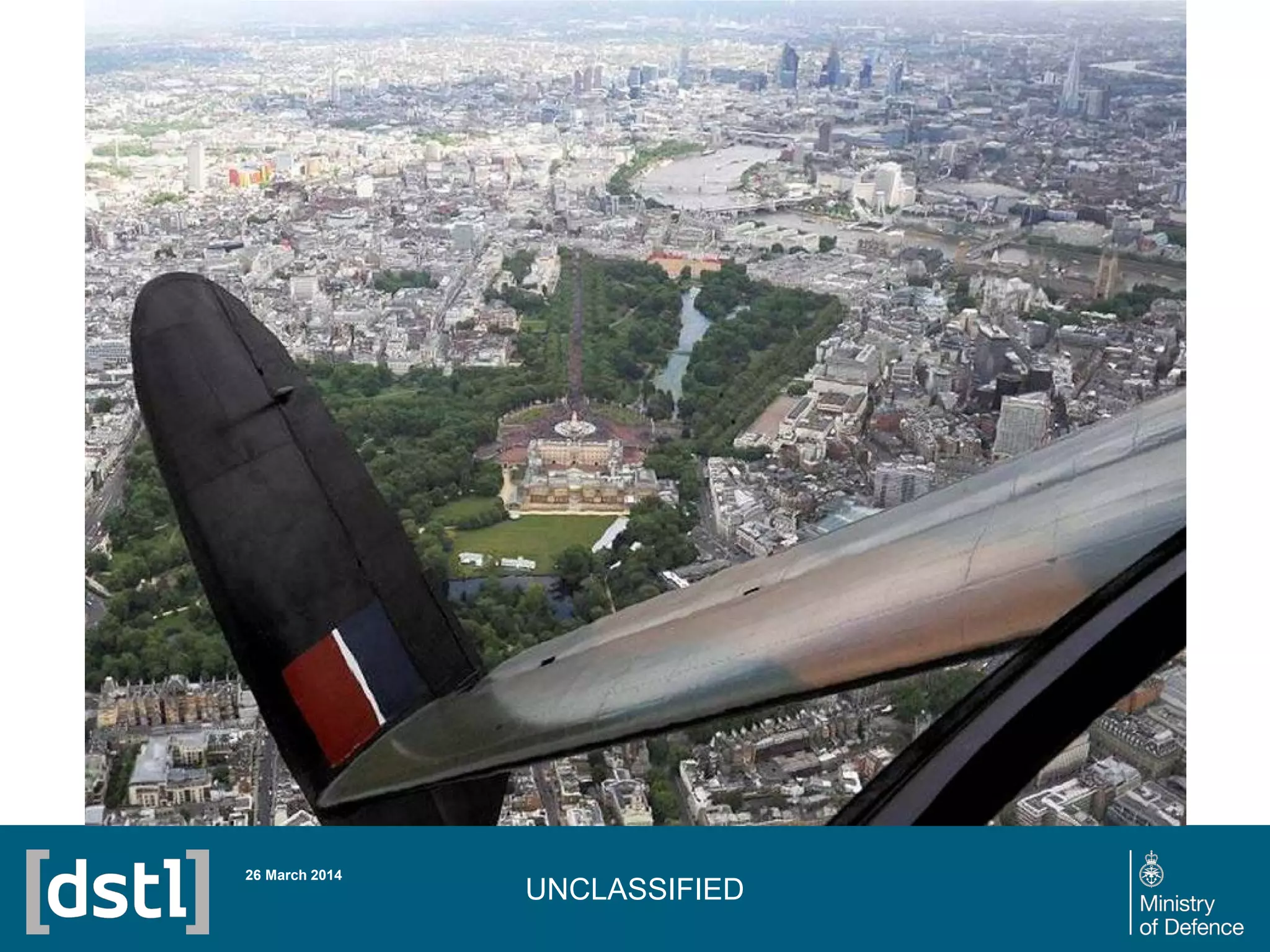
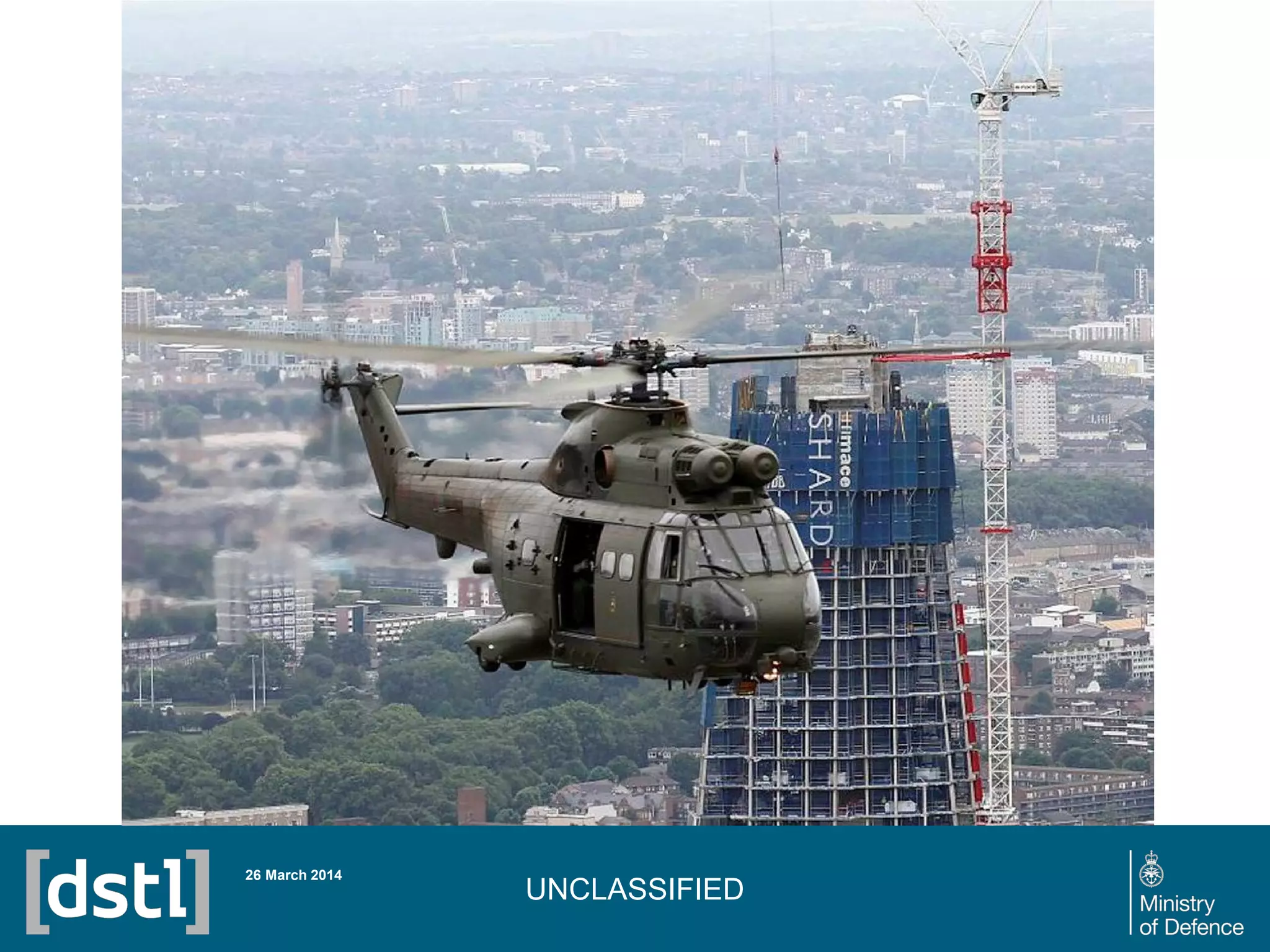
Royal Navy – Operations
• Text
© Crown copyright 2013 Dstl
26 March 2014
UNCLASSIFIED
Royal Navy – Operations
• Text
© Crown copyright 2013 Dstl
26 March 2014
UNCLASSIFIED
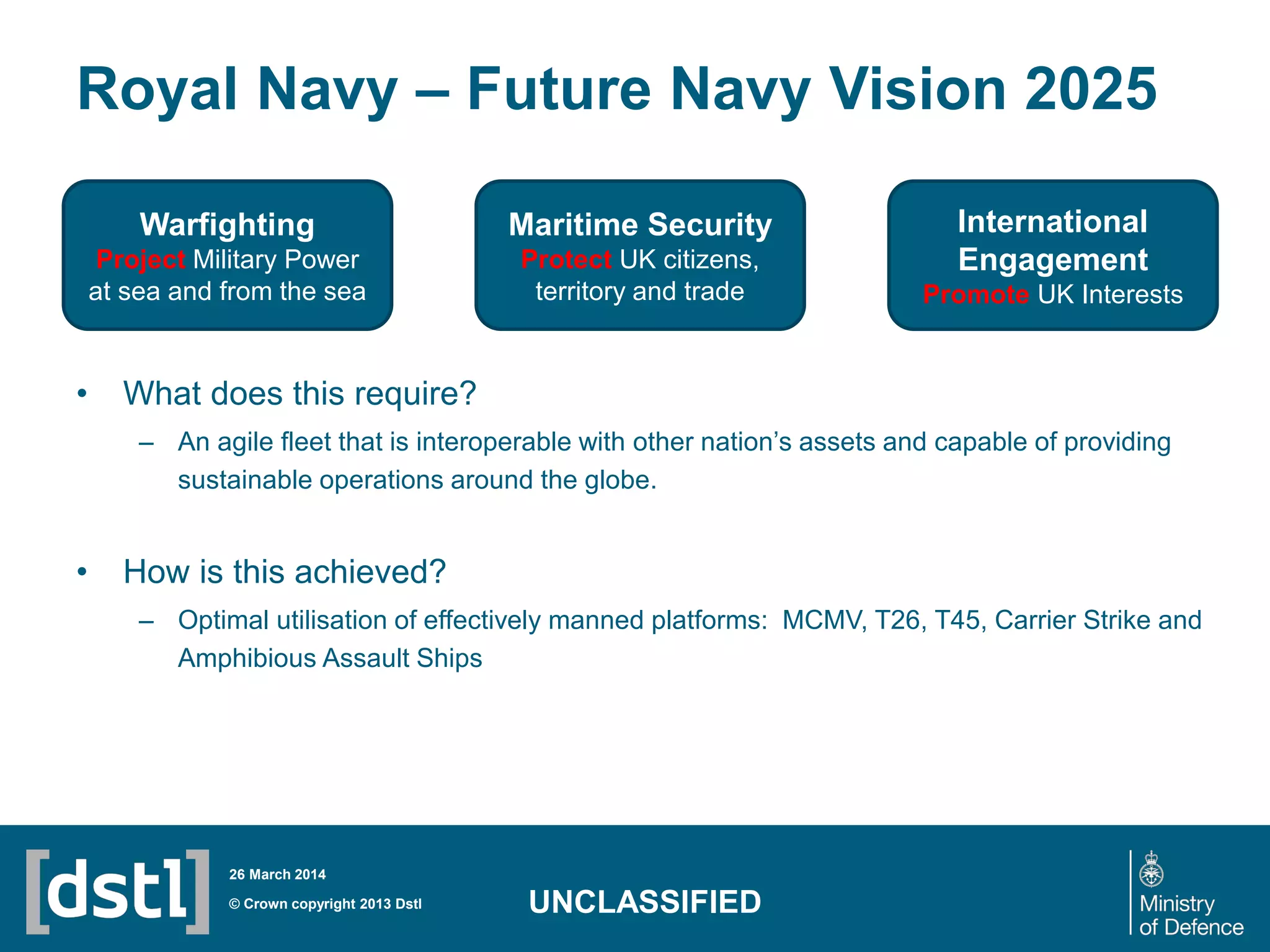
Royal Navy – Future Navy Vision 2025
• What does this require?
– An agile fleet that is interoperable with other nation’s assets and capable of providing
sustainable operations around the globe.
• How is this achieved?
– Optimal utilisation of effectively manned platforms: MCMV, T26, T45, Carrier Strike and
Amphibious Assault Ships
© Crown copyright 2013 Dstl
26 March 2014
UNCLASSIFIED
Warfighting
Project Military Power
at sea and from the sea
Maritime Security
Protect UK citizens,
territory and trade
International
Engagement
Promote UK Interests
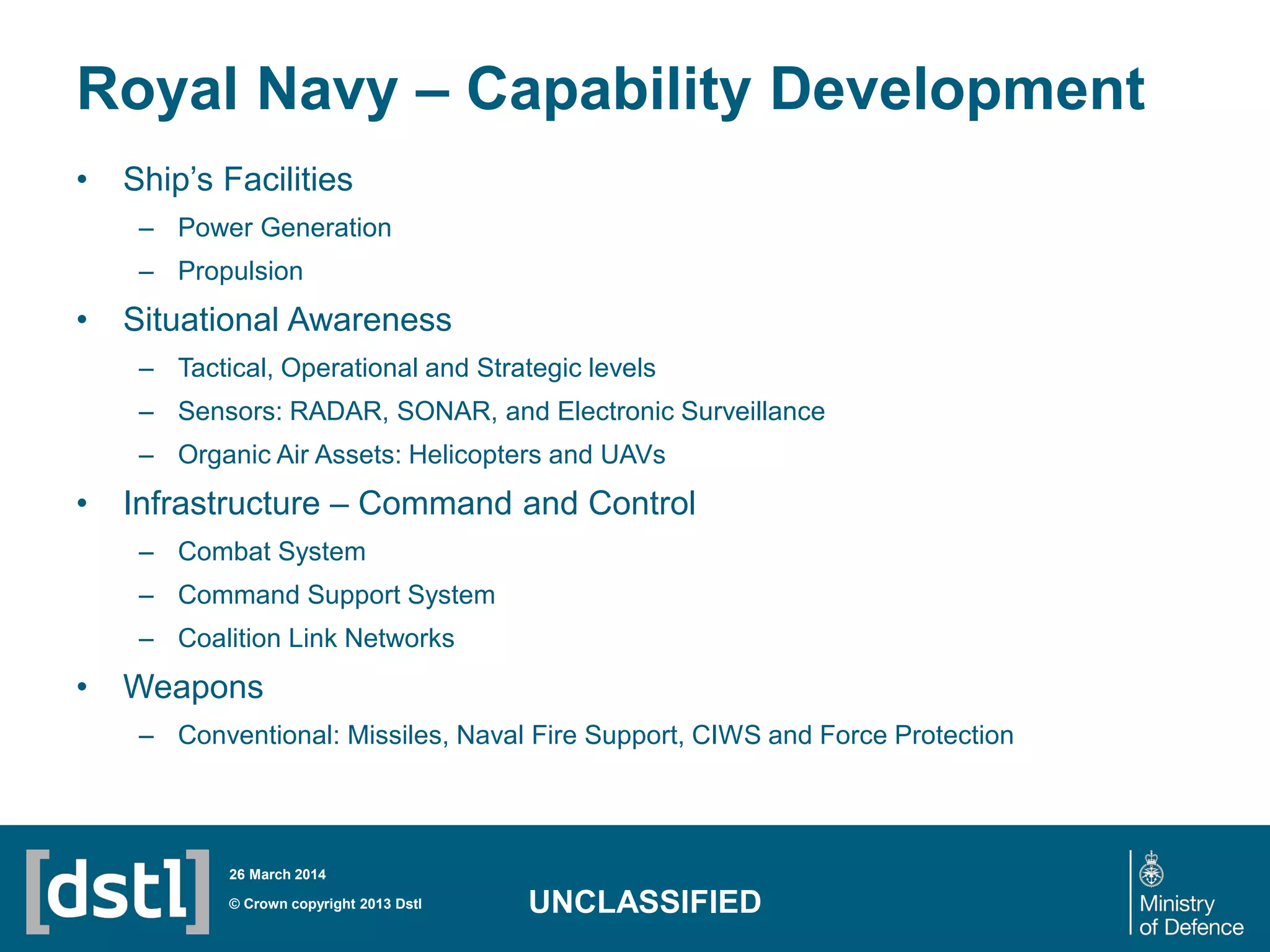
Royal Navy – Capability Development
• Ship’s Facilities
– Power Generation
– Propulsion
• Situational Awareness
– Tactical, Operational and Strategic levels
– Sensors: RADAR, SONAR, and Electronic Surveillance
– Organic Air Assets: Helicopters and UAVs
• Infrastructure – Command and Control
– Combat System
– Command Support System
– Coalition Link Networks
• Weapons
– Conventional: Missiles, Naval Fire Support, CIWS and Force Protection
© Crown copyright 2013 Dstl
26 March 2014
UNCLASSIFIED
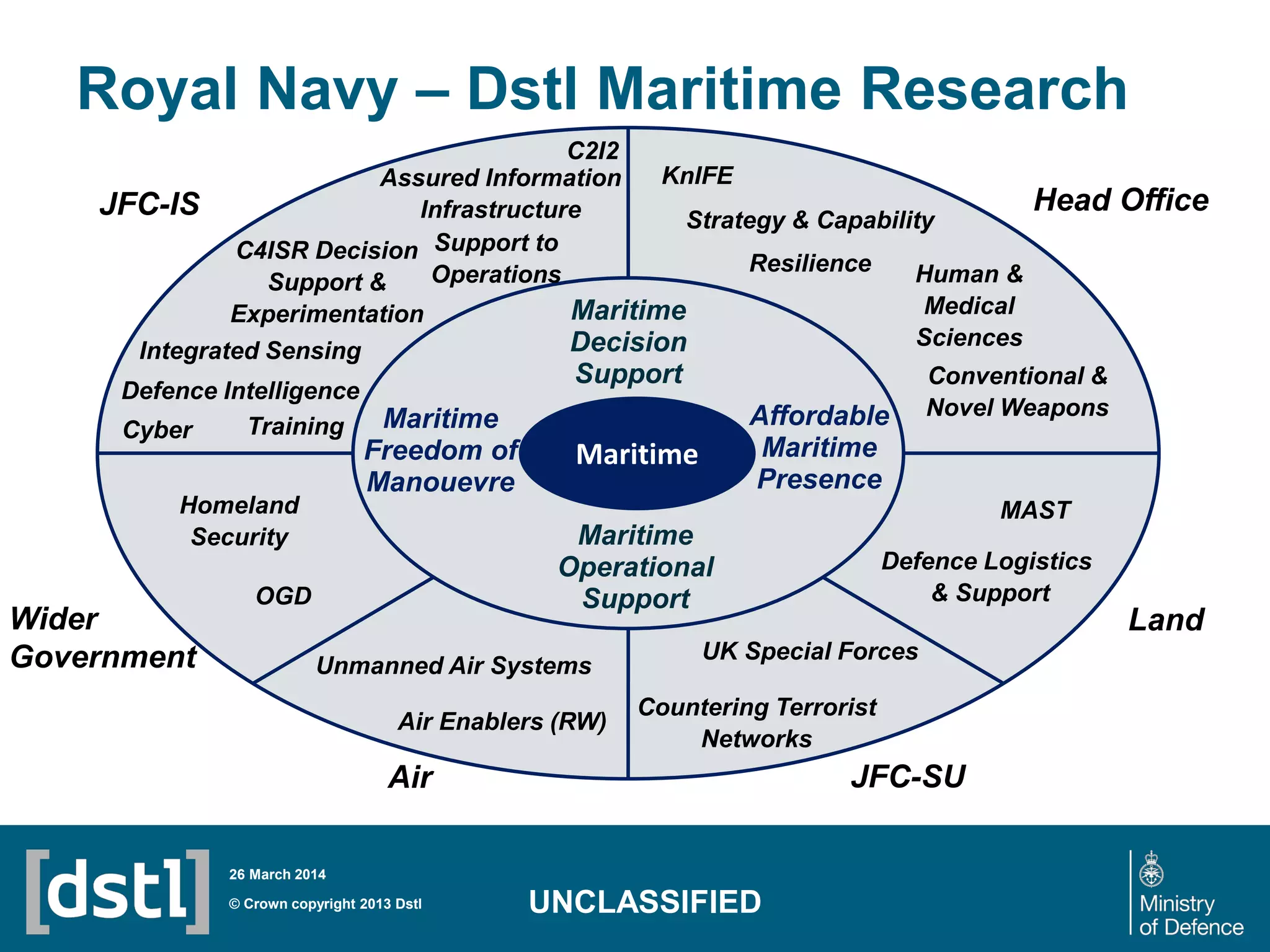
Royal Navy – Dstl Maritime Research
© Crown copyright 2013 Dstl
26 March 2014
UNCLASSIFIED
Maritime
Maritime
Freedom of
Manouevre
Maritime
Decision
Support
Maritime
Operational
Support
Affordable
Maritime
Presence
Human &
Medical
Sciences
MAST
Unmanned Air Systems
Assured Information
Infrastructure
C2I2
Integrated Sensing
Training
Defence Logistics
& Support
C4ISR Decision
Support &
Experimentation
Defence Intelligence
Support to
Operations
KnIFE
OGD
Countering Terrorist
Networks
Cyber
Strategy & Capability
Homeland
Security
Resilience
UK Special Forces
Air Enablers (RW)
Air JFC-SU
Land
JFC-IS
Wider
Government
Head Office
Conventional &
Novel Weapons
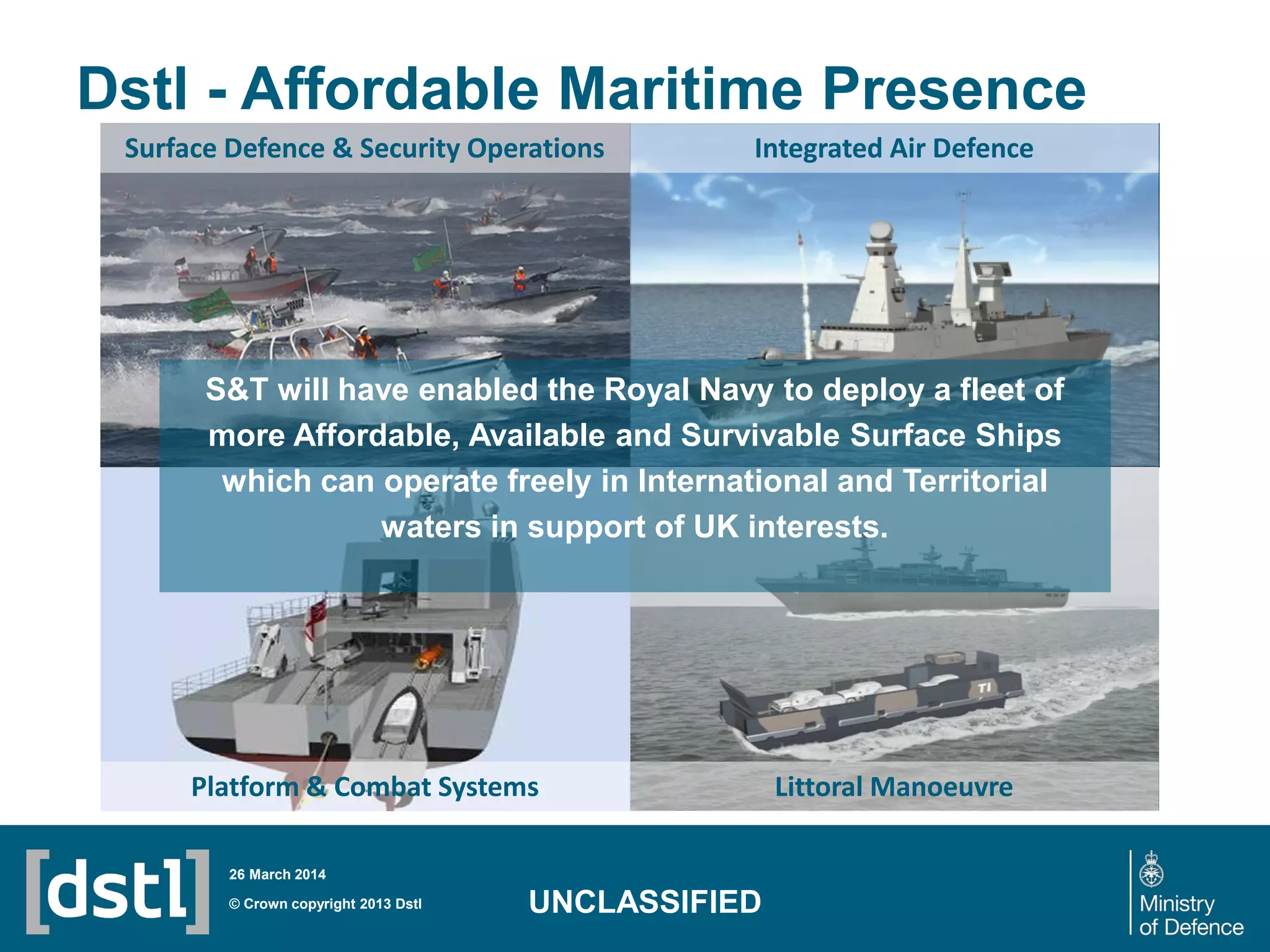
Dstl - Affordable Maritime Presence
© Crown copyright 2013 Dstl
26 March 2014
UNCLASSIFIED
Integrated Air Defence
Littoral ManoeuvrePlatform & Combat Systems
Surface Defence & Security Operations
S&T will have enabled the Royal Navy to deploy a fleet of
more Affordable, Available and Survivable Surface Ships
which can operate freely in International and Territorial
waters in support of UK interests.
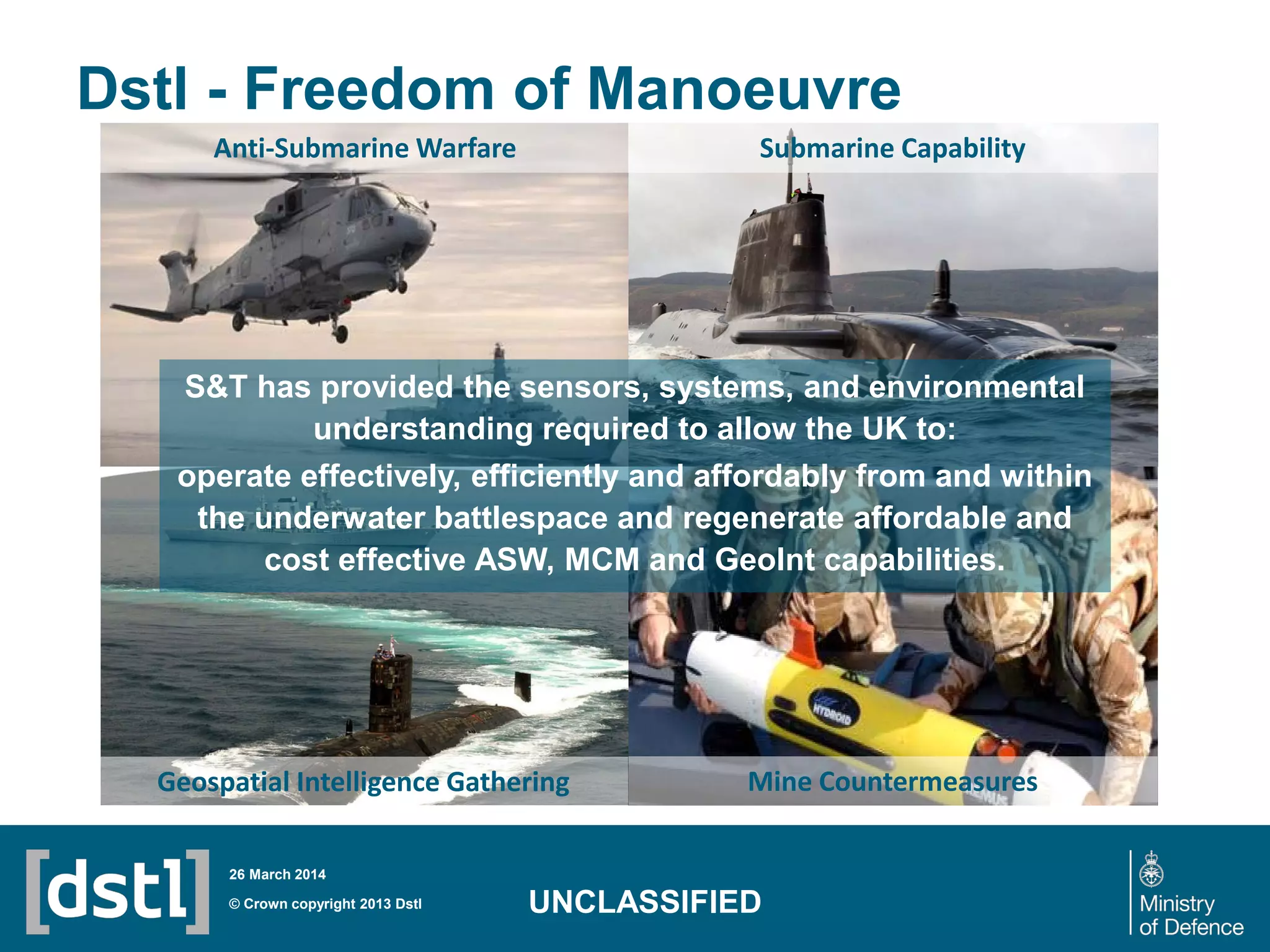
Dstl - Freedom of Manoeuvre
© Crown copyright 2013 Dstl
26 March 2014
UNCLASSIFIED
Anti-Submarine Warfare Submarine Capability
Mine CountermeasuresGeospatial Intelligence Gathering
S&T has provided the sensors, systems, and environmental
understanding required to allow the UK to:
operate effectively, efficiently and affordably from and within
the underwater battlespace and regenerate affordable and
cost effective ASW, MCM and GeoInt capabilities.
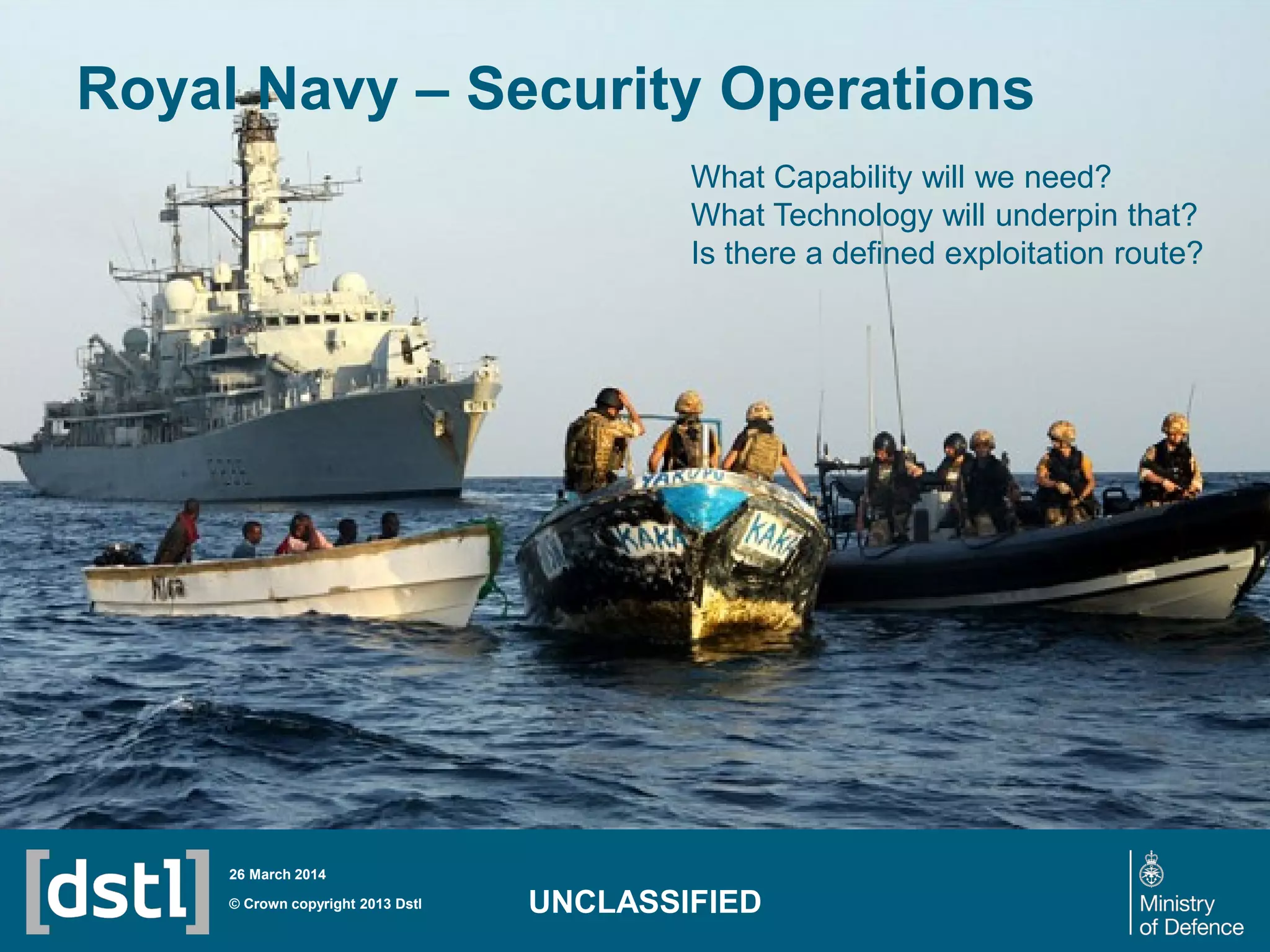
Royal Navy – Security Operations
© Crown copyright 2013 Dstl
26 March 2014
UNCLASSIFIED
What Capability will we need?
What Technology will underpin that?
Is there a defined exploitation route?
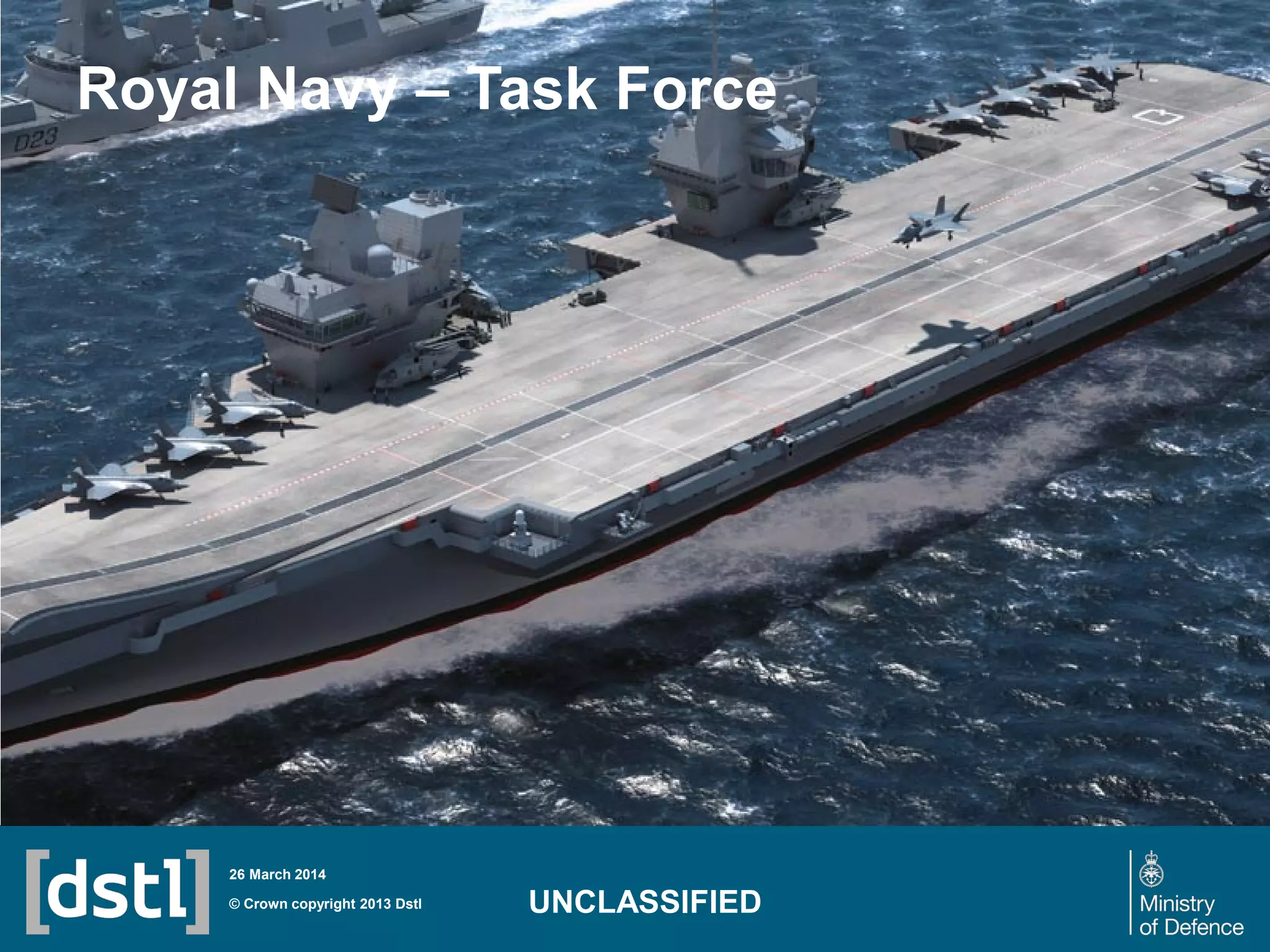
Royal Navy – Task Force
© Crown copyright 2013 Dstl
26 March 2014
UNCLASSIFIED
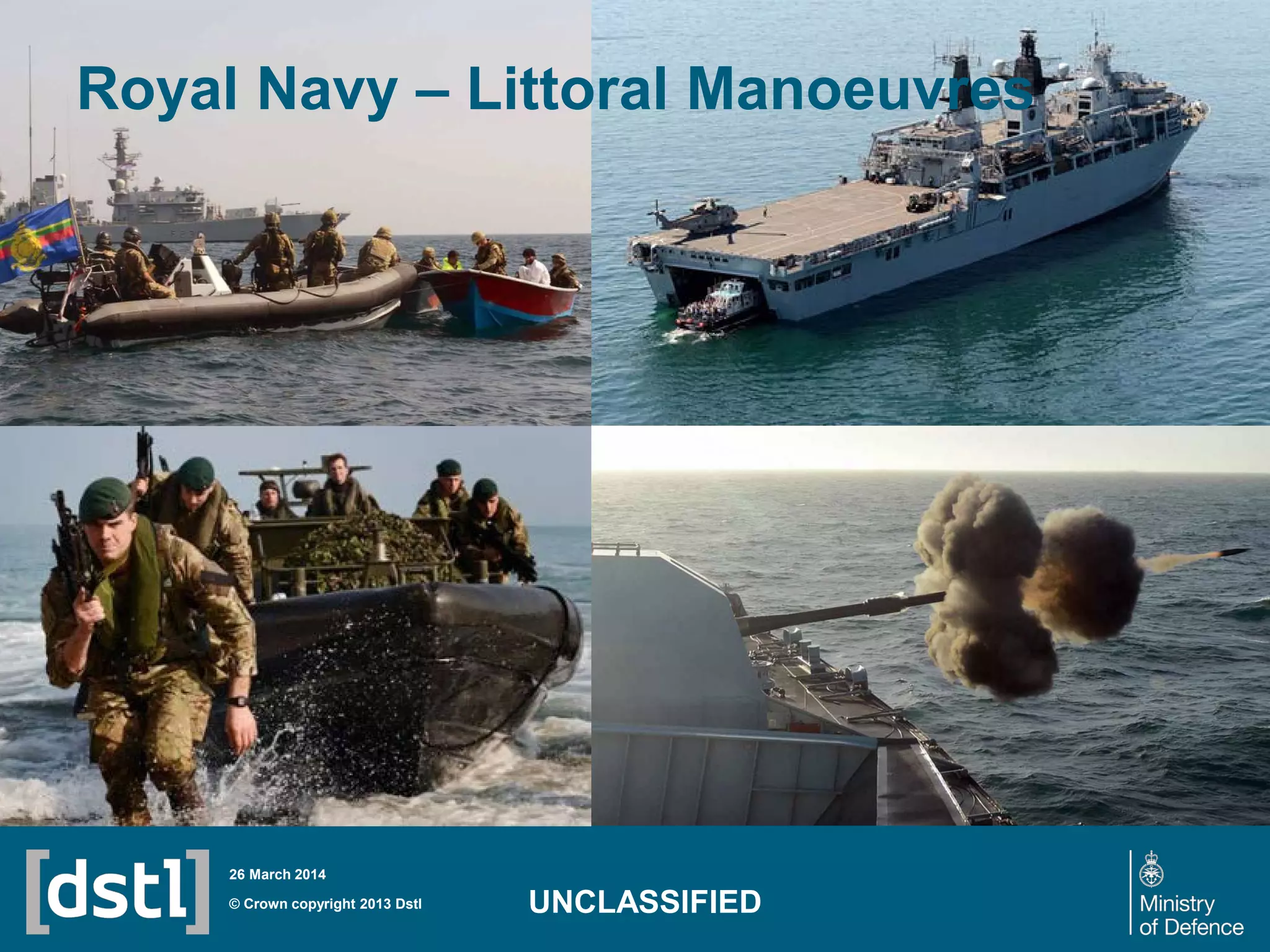
Royal Navy – Littoral Manoeuvres
© Crown copyright 2013 Dstl
26 March 2014
UNCLASSIFIED
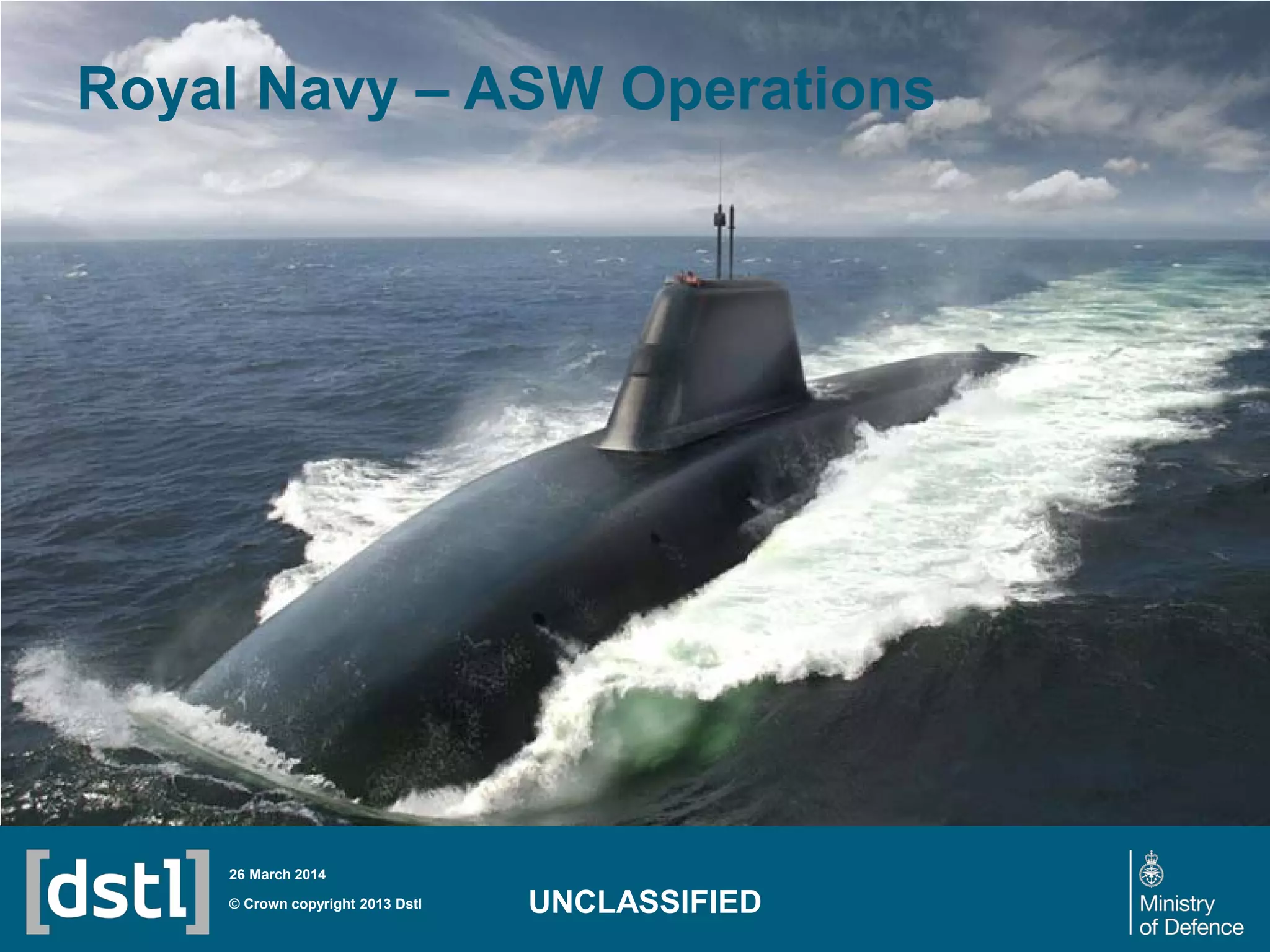
Royal Navy – ASW Operations
© Crown copyright 2013 Dstl
26 March 2014
UNCLASSIFIED
Royal Navy – Enduring Challenges
• AWW
– Integrated Air Defence
• Persistent and recoverable countermeasures
• Novel weapons – directed energy
– Force Protection
• Detection of small/covert craft
• Identification of intent from asymmetric threats
• Non-destructive methods for neutralising unresponsive vessels
– Sensors
• Environmentally aware sensors
• Detection and tracking of difficult targets
– Combat Systems
• Open Architecture with common bearers: security
© Crown copyright 2013 Dstl
26 March 2014
UNCLASSIFIED
Royal Navy – Enduring Challenges
• Information Superiority
– Electronic Surveillance (ES)
• Development of UAS payloads – ES, IR, EO
• Persistent wide area surveillance
• Effective analysis and exploitation of big data
– Military satellite communications
– Denied or degraded operating environment
– Combat ID
• Platform
– Energy efficient power generation and propulsion
– Alternative fuels to diesel
– Large capacity energy storage: 1 – 9 GJ
– Energy harnessed from ‘wild heat’
– Utilisation of 3D printing technology
© Crown copyright 2013 Dstl
26 March 2014
UNCLASSIFIED
Royal Navy – Enduring Challenges
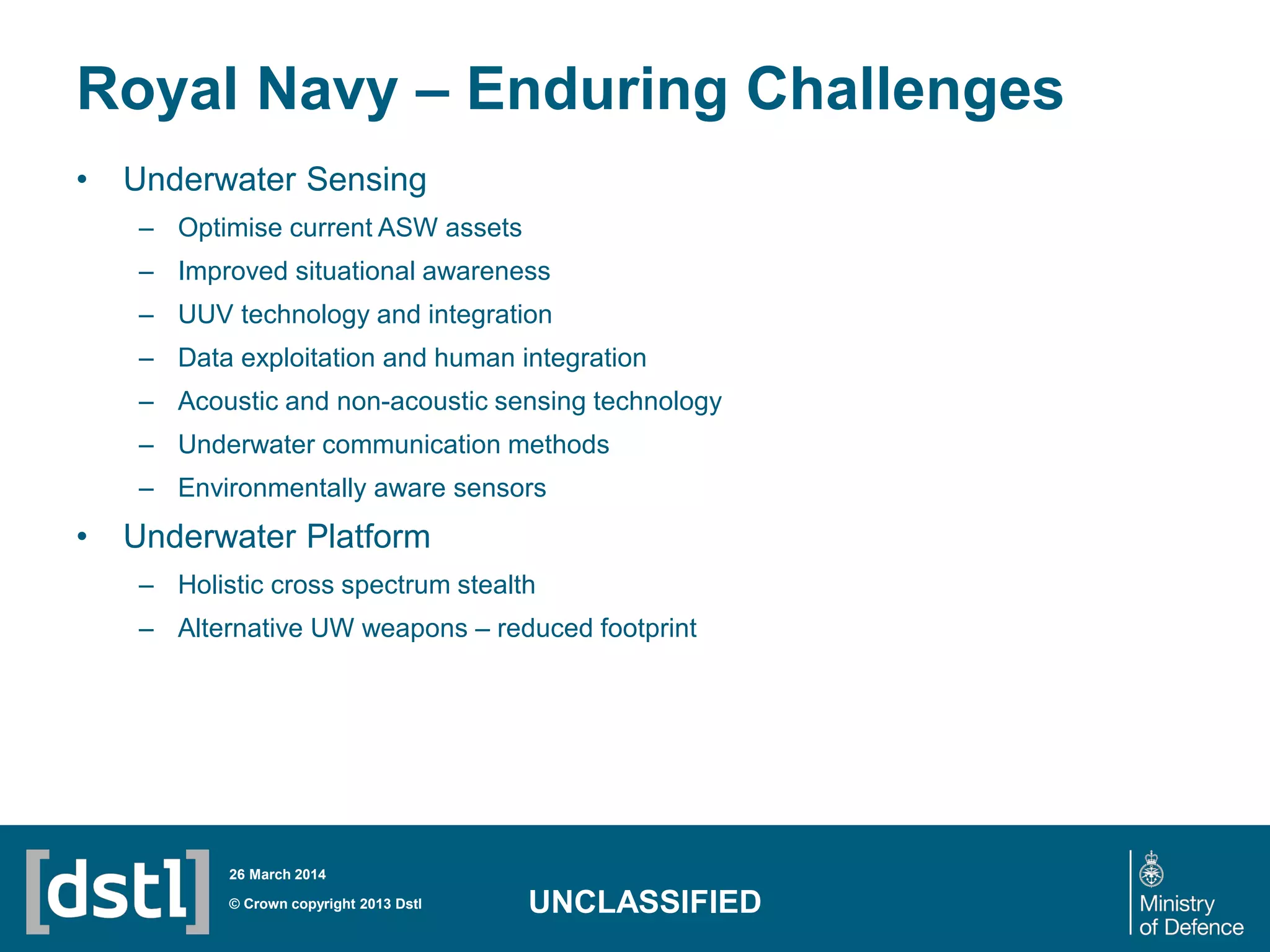
• Underwater Sensing
– Optimise current ASW assets
– Improved situational awareness
– UUV technology and integration
– Data exploitation and human integration
– Acoustic and non-acoustic sensing technology
– Underwater communication methods
– Environmentally aware sensors
• Underwater Platform
– Holistic cross spectrum stealth
– Alternative UW weapons – reduced footprint
© Crown copyright 2013 Dstl
26 March 2014
UNCLASSIFIED
Summary
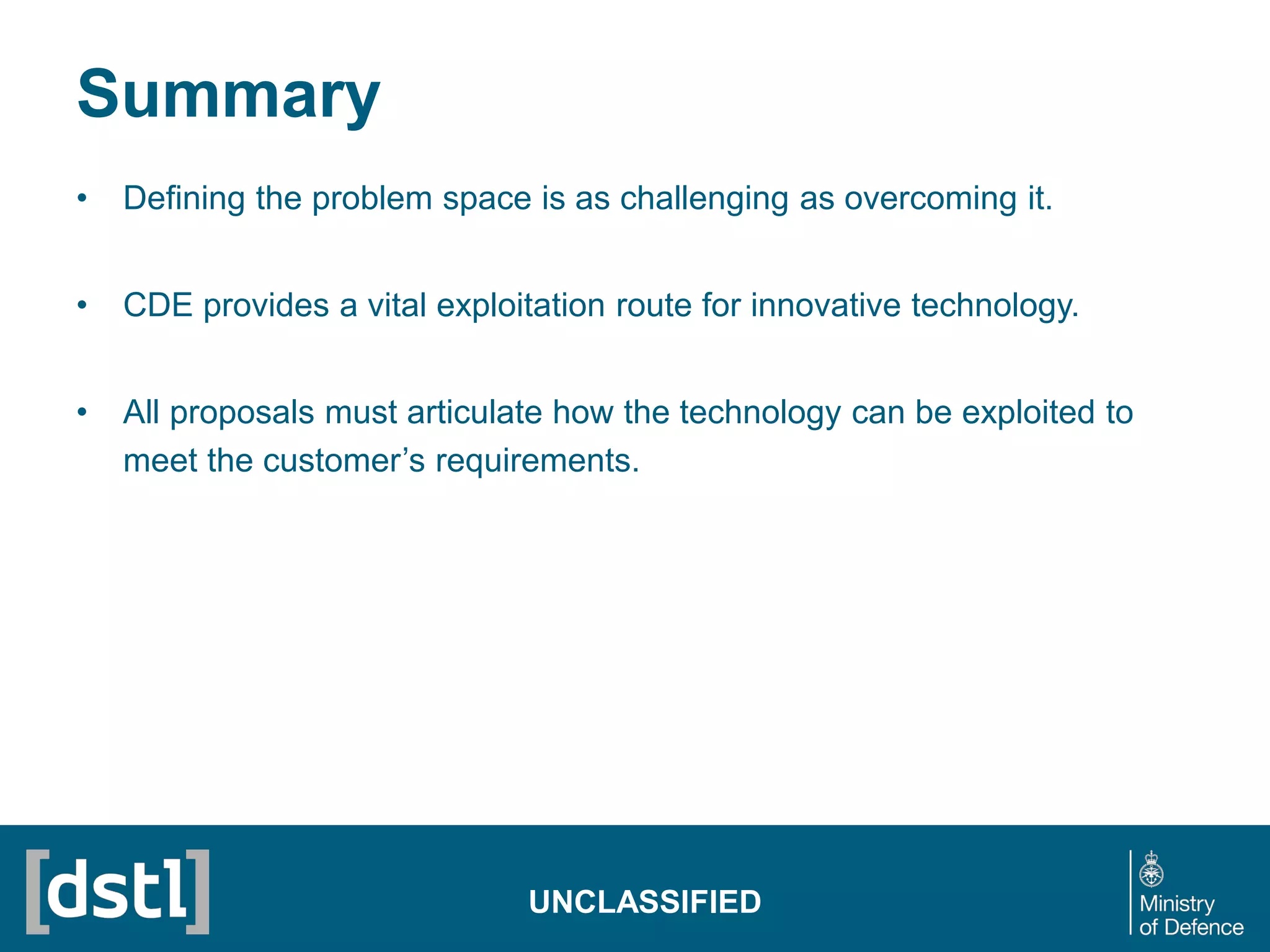
• Defining the problem space is as challenging as overcoming it.
• CDE provides a vital exploitation route for innovative technology.
• All proposals must articulate how the technology can be exploited to
meet the customer’s requirements.
UNCLASSIFIED
Chemical, Biological and
Radiological Science and Technology
Programme
UNCLASSIFIED
Strategic Context
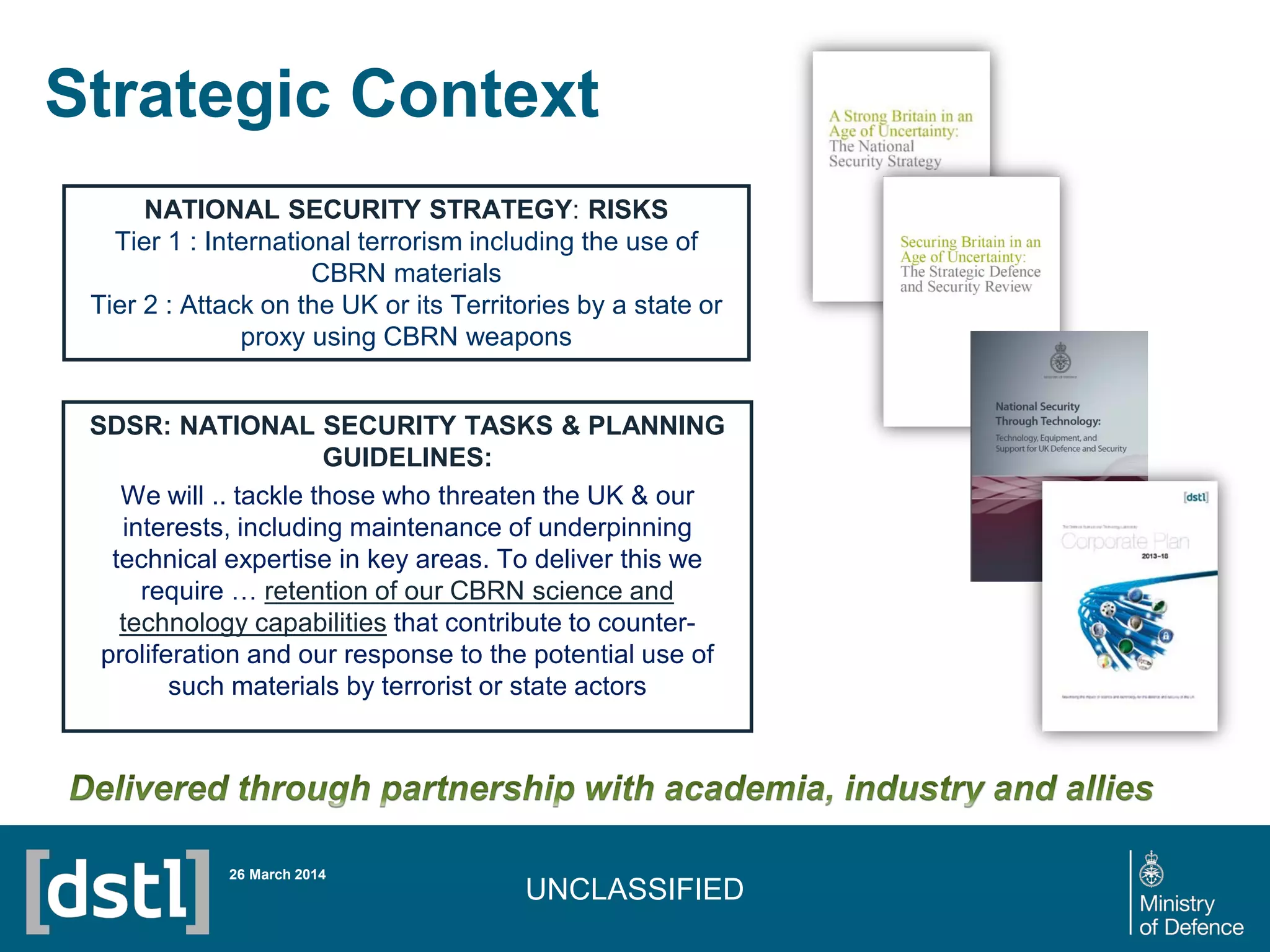
NATIONAL SECURITY STRATEGY: RISKS
Tier 1 : International terrorism including the use of
CBRN materials
Tier 2 : Attack on the UK or its Territories by a state or
proxy using CBRN weapons
SDSR: NATIONAL SECURITY TASKS & PLANNING
GUIDELINES:
We will .. tackle those who threaten the UK & our
interests, including maintenance of underpinning
technical expertise in key areas. To deliver this we
require … retention of our CBRN science and
technology capabilities that contribute to counter-
proliferation and our response to the potential use of
such materials by terrorist or state actors
26 March 2014
UNCLASSIFIED
National Security Through Technology
26 March 2014
• ... ensure small and medium sized companies can
continue to deliver the innovation and flexibility we need.
• Building on the Centre for Defence Enterprise’s (CDE)
success in providing efficient access to innovation, we will
broaden its remit to cover both the defence and security
domains.
• …the most significant challenges currently faced by both
the defence and security communities…where we judge
the UK will get best value-for-money from science &
technology:
– being able to identify and effectively mitigate CBRN
threats to the UK and its interests
UNCLASSIFIED
Defence AND Security
• CONTEST & UK Biological Security Strategy (Home Office)
• National Counter Proliferation Strategy (FCO)
• National Risk Assessment (CO)
26 March 2014
UNCLASSIFIED
26 March 2014
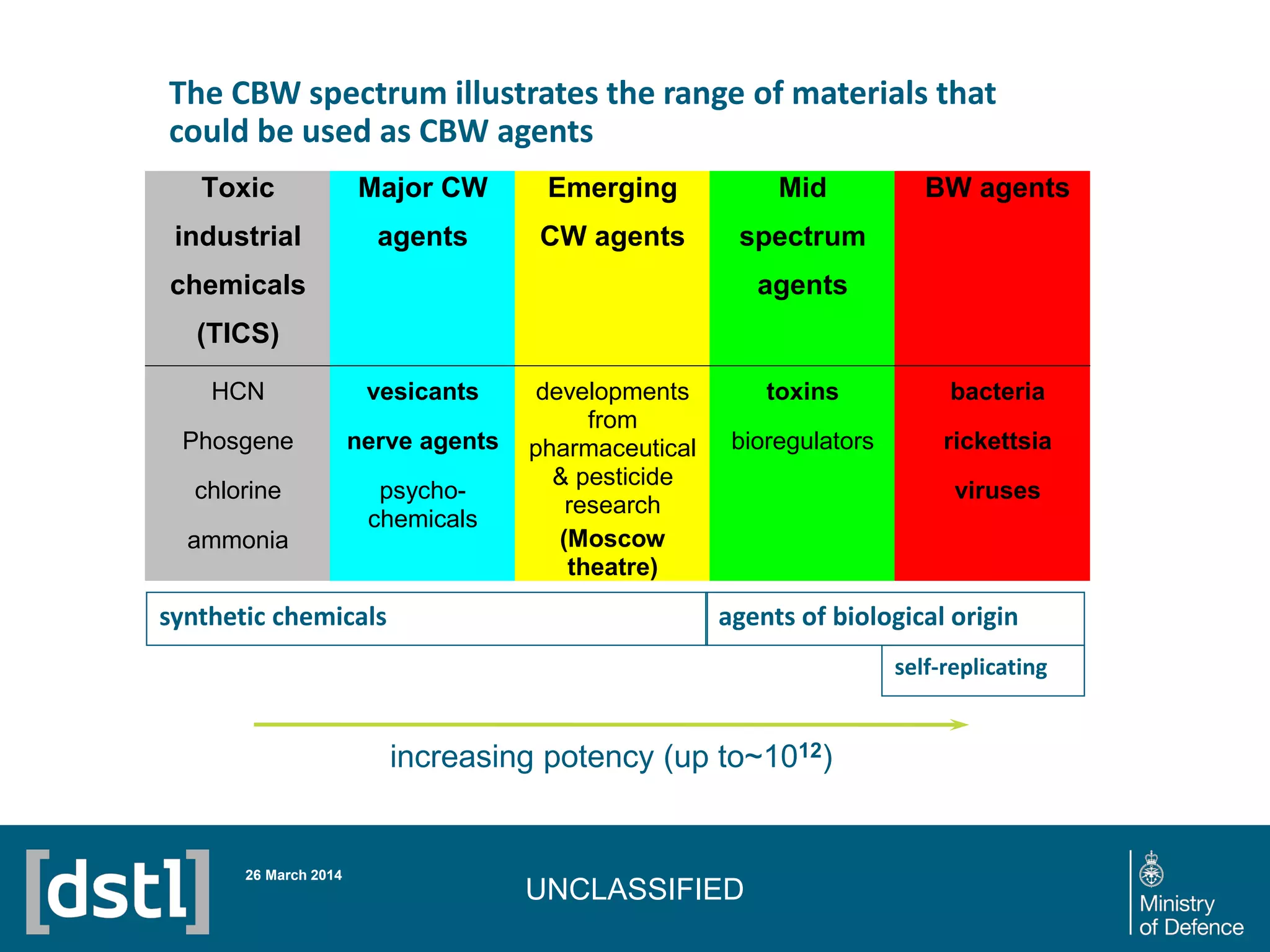
The CBW spectrum illustrates the range of materials that
could be used as CBW agents
Toxic
industrial
chemicals
(TICS)
Major CW
agents
Emerging
CW agents
Mid
spectrum
agents
BW agents
HCN
Phosgene
chlorine
ammonia
vesicants
nerve agents
psycho-
chemicals
developments
from
pharmaceutical
& pesticide
research
(Moscow
theatre)
toxins
bioregulators
bacteria
rickettsia
viruses
increasing potency (up to~1012)
synthetic chemicals
self-replicating
agents of biological origin
UNCLASSIFIED
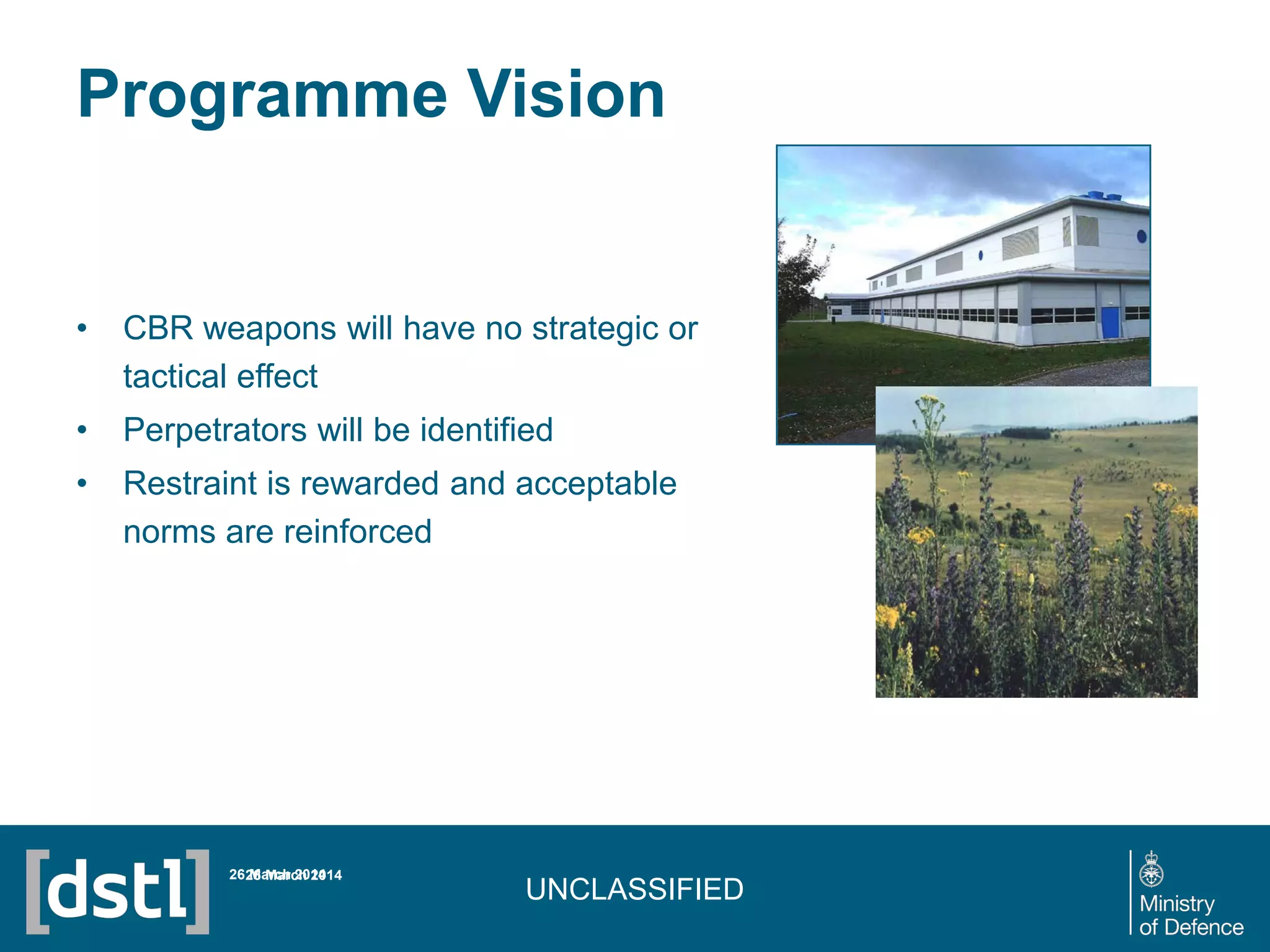
Programme Vision
• CBR weapons will have no strategic or
tactical effect
• Perpetrators will be identified
• Restraint is rewarded and acceptable
norms are reinforced
26 March 201426 March 2014
UNCLASSIFIED
26 March 2014
UNCLASSIFIED
26 March 2014
UNCLASSIFIED
26 March 2014
UNCLASSIFIED
26 March 2014
UNCLASSIFIED
26 March 2014
UNCLASSIFIED
26 March 2014
UNCLASSIFIED
26 March 2014
UNCLASSIFIED
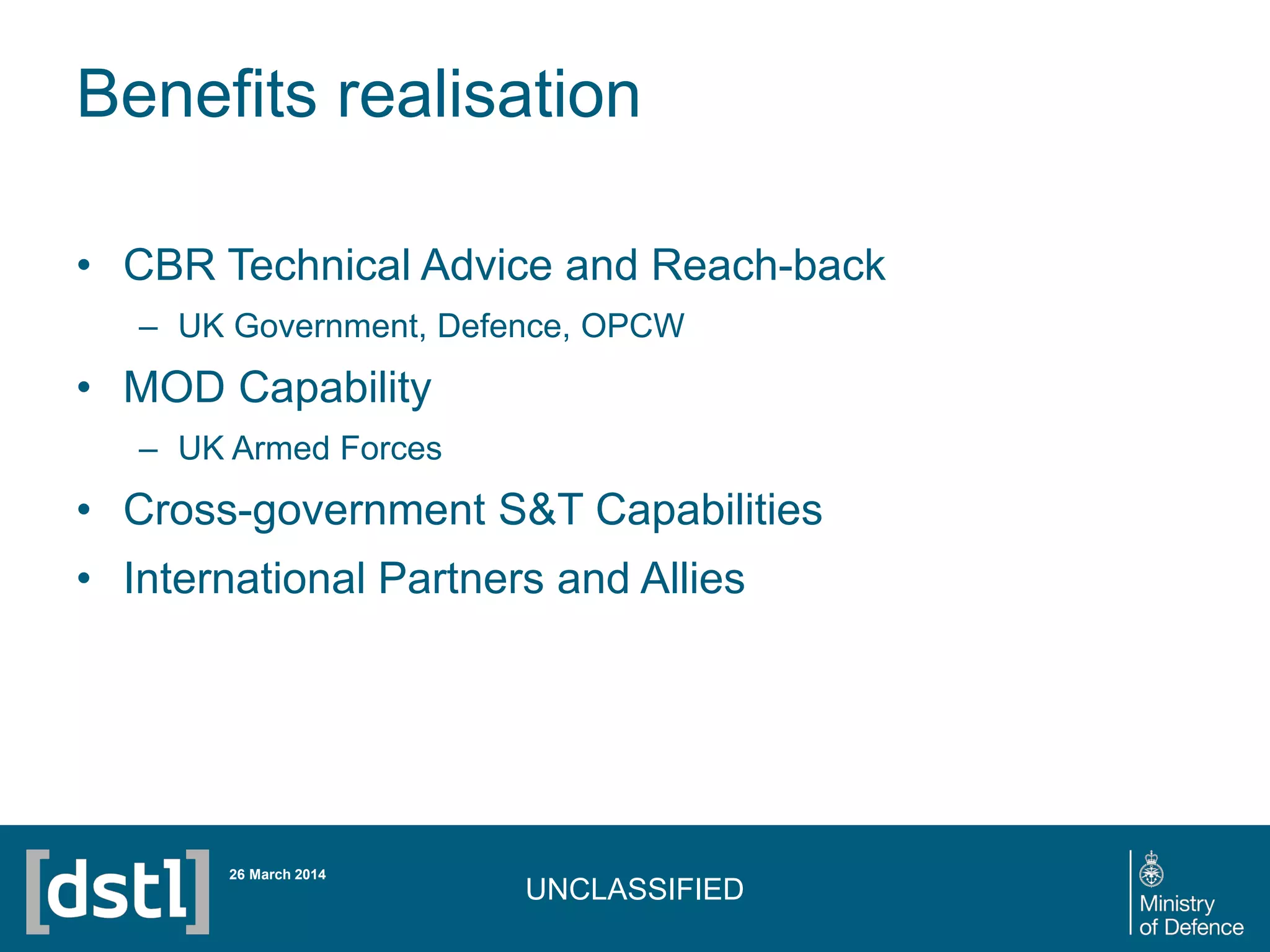
Benefits realisation
• CBR Technical Advice and Reach-back
– UK Government, Defence, OPCW
• MOD Capability
– UK Armed Forces
• Cross-government S&T Capabilities
• International Partners and Allies
26 March 2014
UNCLASSIFIED
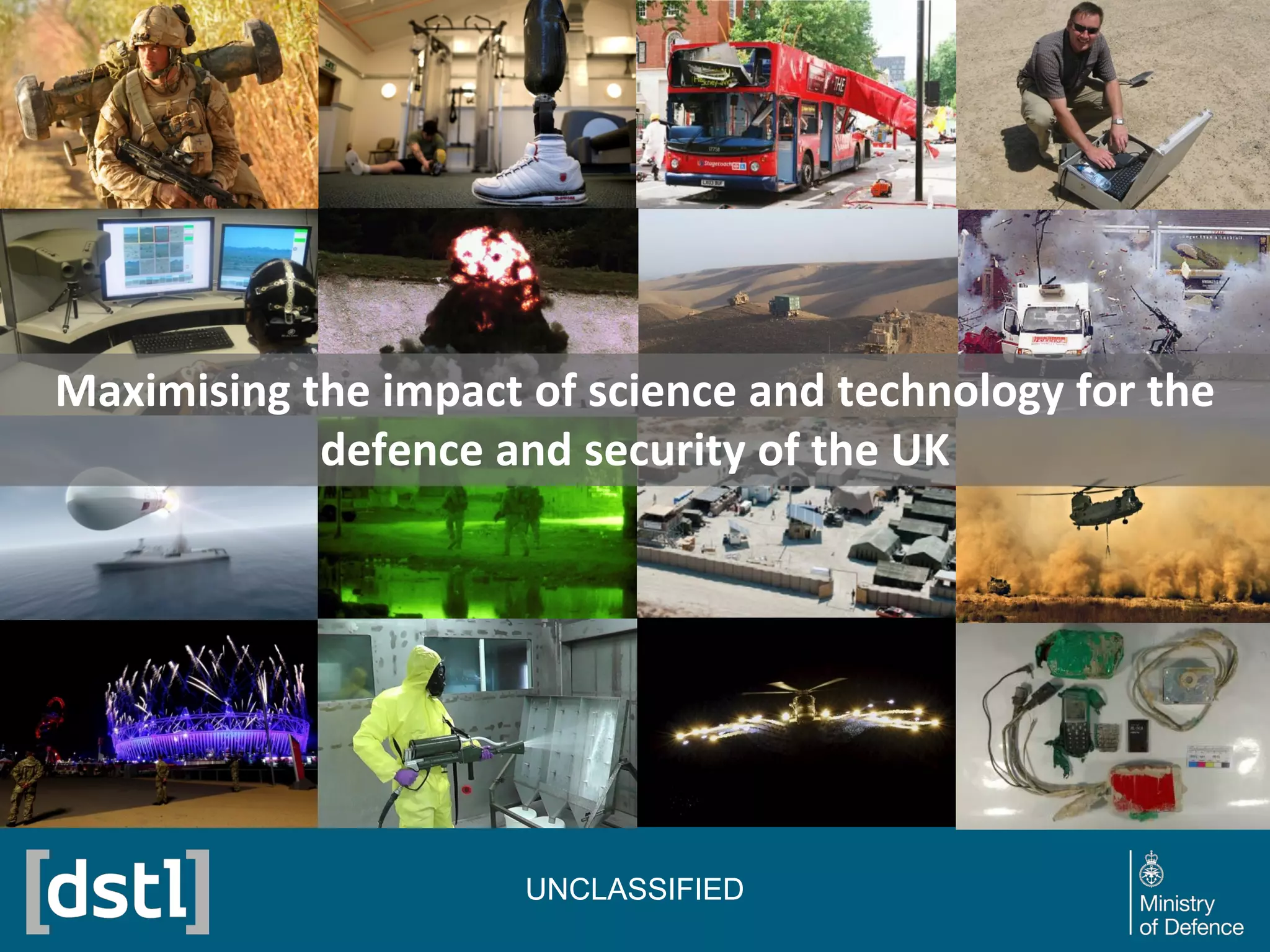
Maximising the impact of science and technology for the
defence and security of the UK
UNCLASSIFIED
Human and Medical Sciences
Enduring Innovation
UNCLASSIFIED© Crown copyright 2014 Dstl
26 March 2014
Human & Medical Sciences
Defence Human and Medical Sciences will be intrinsic to Future Force
Capability. Whole Force supported through Whole Service Life Care will
be the foundation of next generation Defence Personnel. The Future
Force will achieve a symbiotic relationship with technology,
engendering enhanced information management and exploitation,
shaping and influencing the Defence and Security landscape.
UNCLASSIFIED© Crown copyright 2014 Dstl
26 March 2014
People matter
Human & Medical Sciences
UNCLASSIFIED© Crown copyright 2013 Dstl
26 March 2014
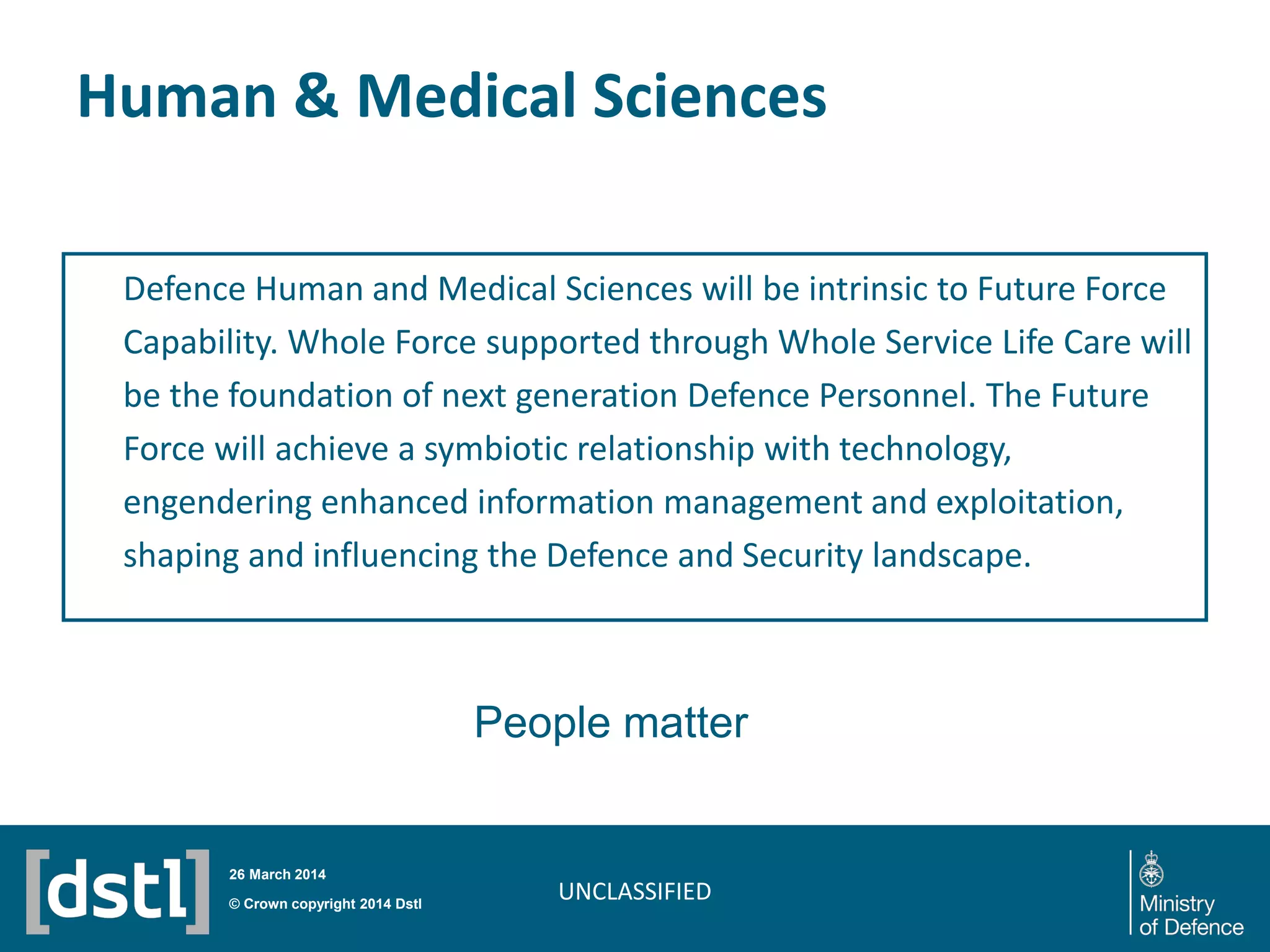
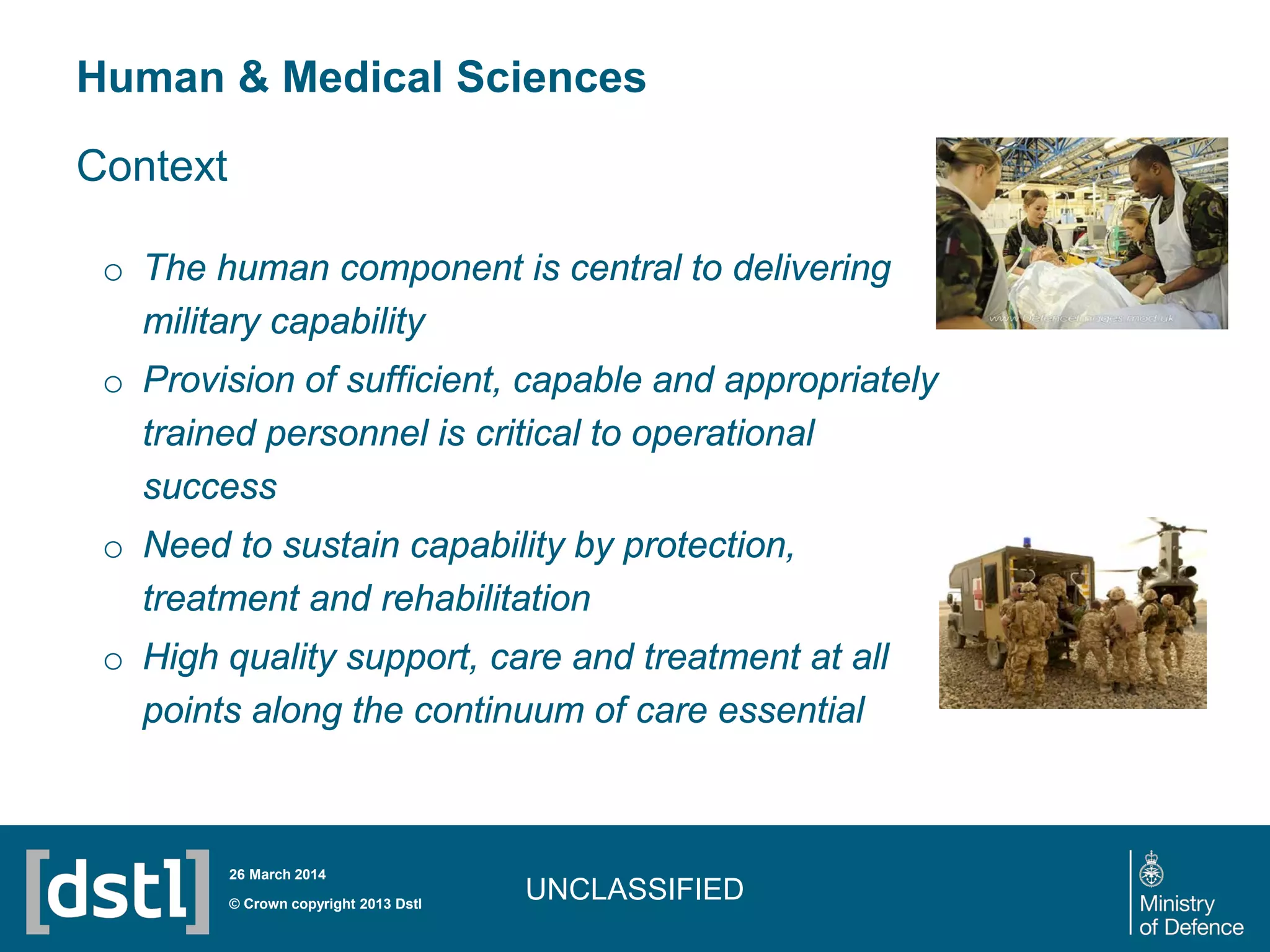
Context
o The human component is central to delivering
military capability
o Provision of sufficient, capable and appropriately
trained personnel is critical to operational
success
o Need to sustain capability by protection,
treatment and rehabilitation
o High quality support, care and treatment at all
points along the continuum of care essential
Defence Medical Sciences
UNCLASSIFIED
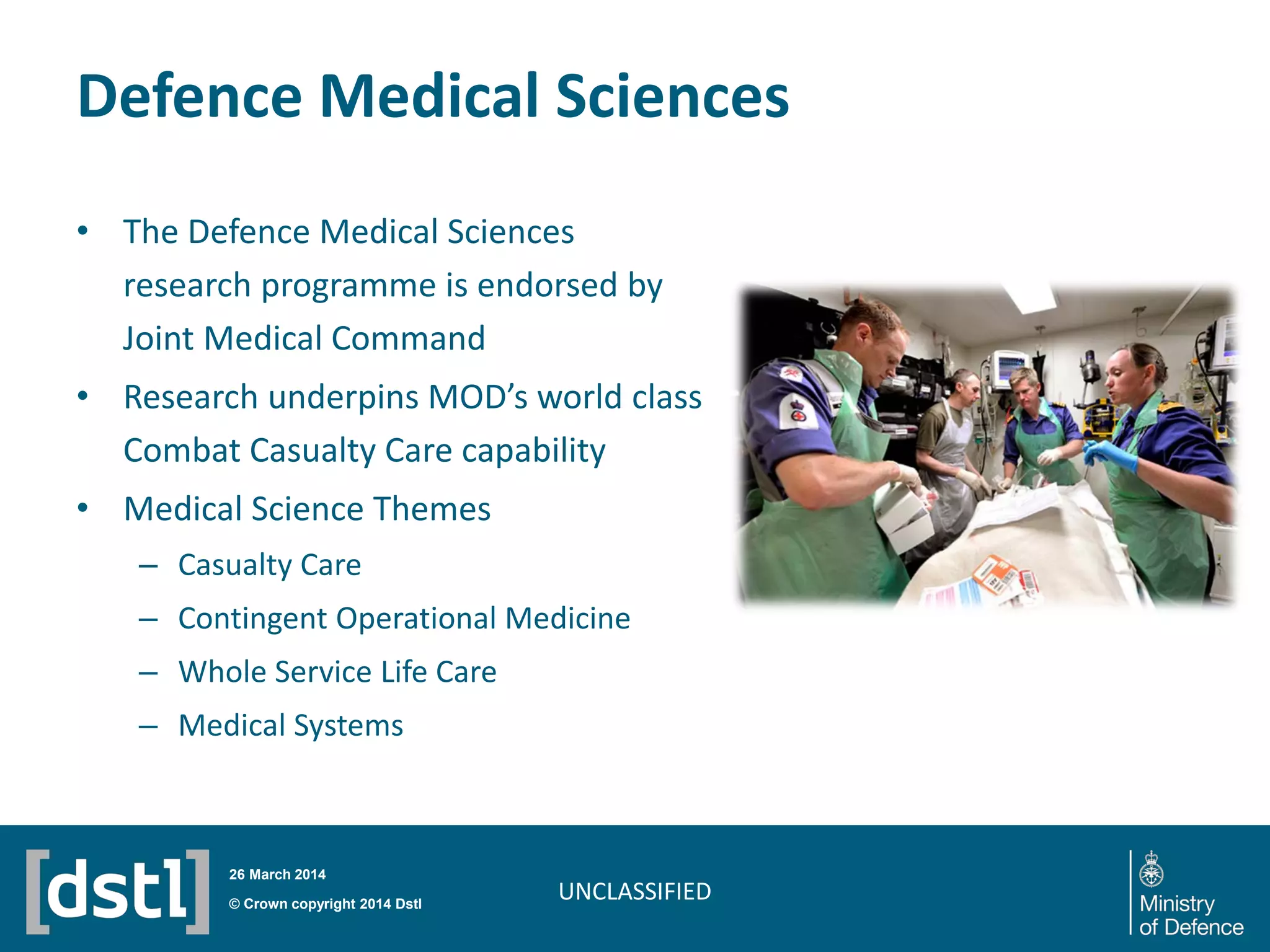
• The Defence Medical Sciences
research programme is endorsed by
Joint Medical Command
• Research underpins MOD’s world class
Combat Casualty Care capability
• Medical Science Themes
– Casualty Care
– Contingent Operational Medicine
– Whole Service Life Care
– Medical Systems
© Crown copyright 2014 Dstl
26 March 2014
Defence Medical Sciences Research Programme
26 March 2014
© Dstl
Casualty Care
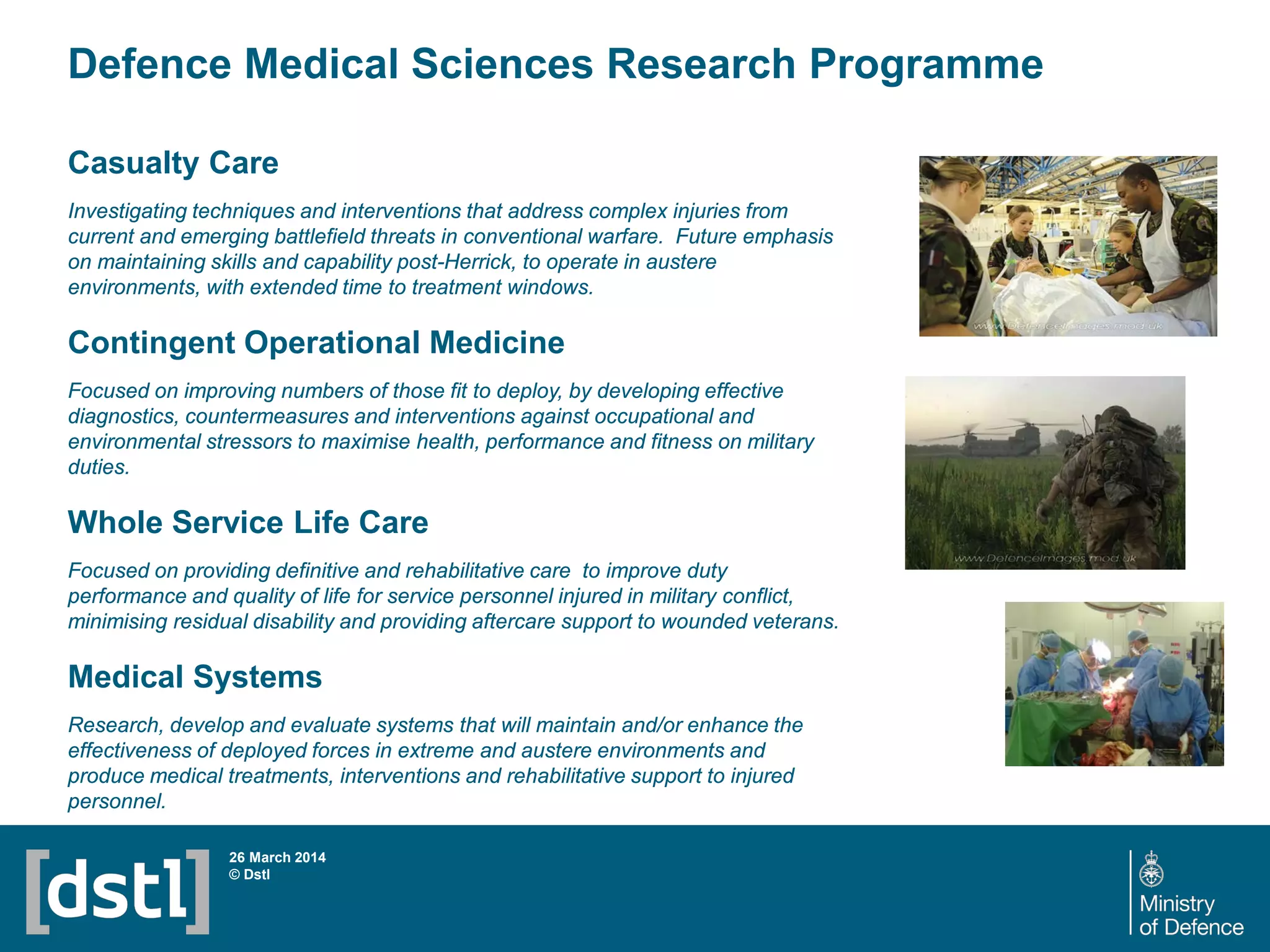
Investigating techniques and interventions that address complex injuries from
current and emerging battlefield threats in conventional warfare. Future emphasis
on maintaining skills and capability post-Herrick, to operate in austere
environments, with extended time to treatment windows.
Contingent Operational Medicine
Focused on improving numbers of those fit to deploy, by developing effective
diagnostics, countermeasures and interventions against occupational and
environmental stressors to maximise health, performance and fitness on military
duties.
Whole Service Life Care
Focused on providing definitive and rehabilitative care to improve duty
performance and quality of life for service personnel injured in military conflict,
minimising residual disability and providing aftercare support to wounded veterans.
Medical Systems
Research, develop and evaluate systems that will maintain and/or enhance the
effectiveness of deployed forces in extreme and austere environments and
produce medical treatments, interventions and rehabilitative support to injured
personnel.
Defence Medical Sciences Research Programme
26 March 2014
© Dstl
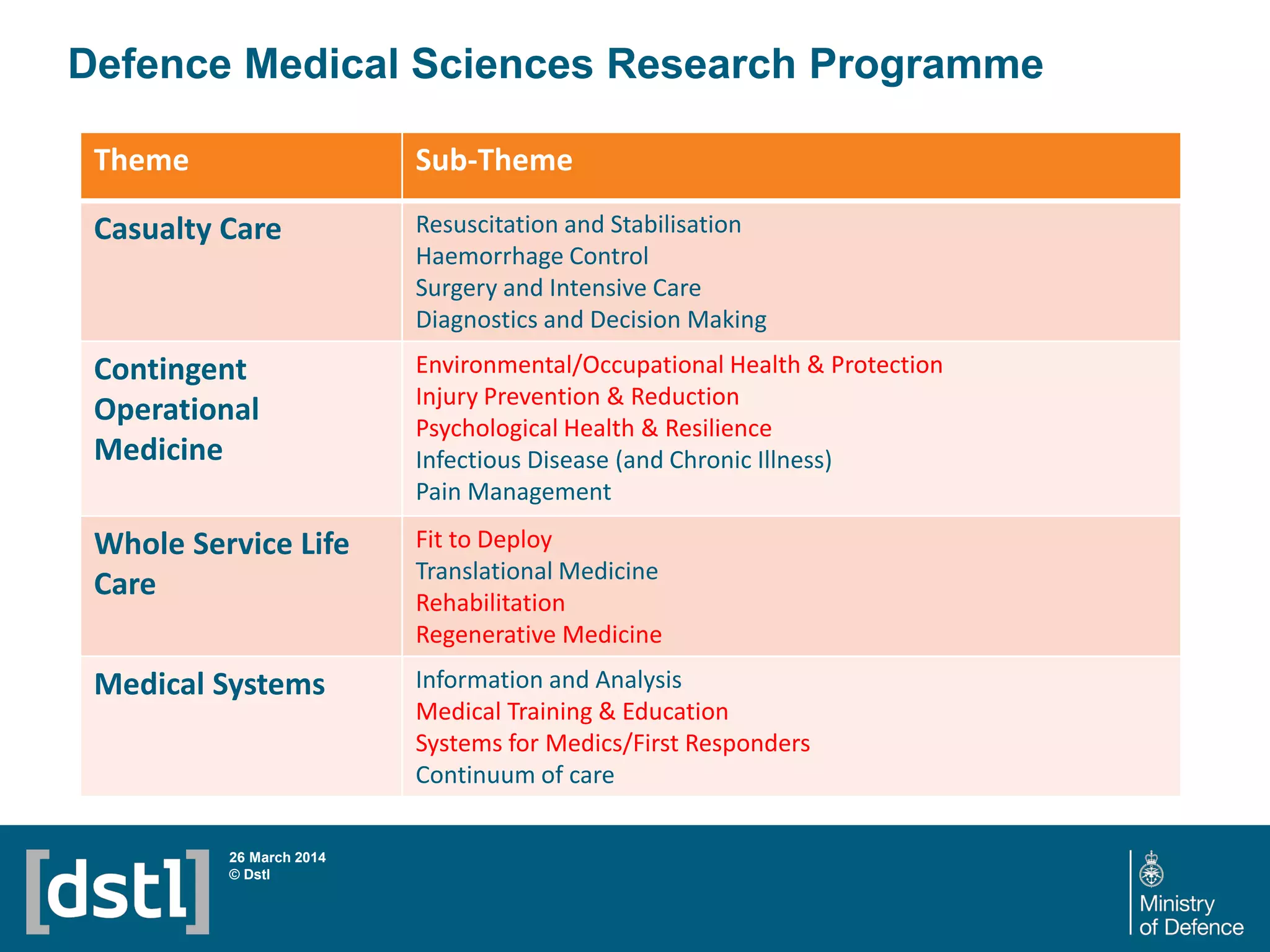
Theme Sub-Theme
Casualty Care Resuscitation and Stabilisation
Haemorrhage Control
Surgery and Intensive Care
Diagnostics and Decision Making
Contingent
Operational
Medicine
Environmental/Occupational Health & Protection
Injury Prevention & Reduction
Psychological Health & Resilience
Infectious Disease (and Chronic Illness)
Pain Management
Whole Service Life
Care
Fit to Deploy
Translational Medicine
Rehabilitation
Regenerative Medicine
Medical Systems Information and Analysis
Medical Training & Education
Systems for Medics/First Responders
Continuum of care
Future Medic Concept
UNCLASSIFIED© Crown copyright 2013 Dstl
26 March 2014
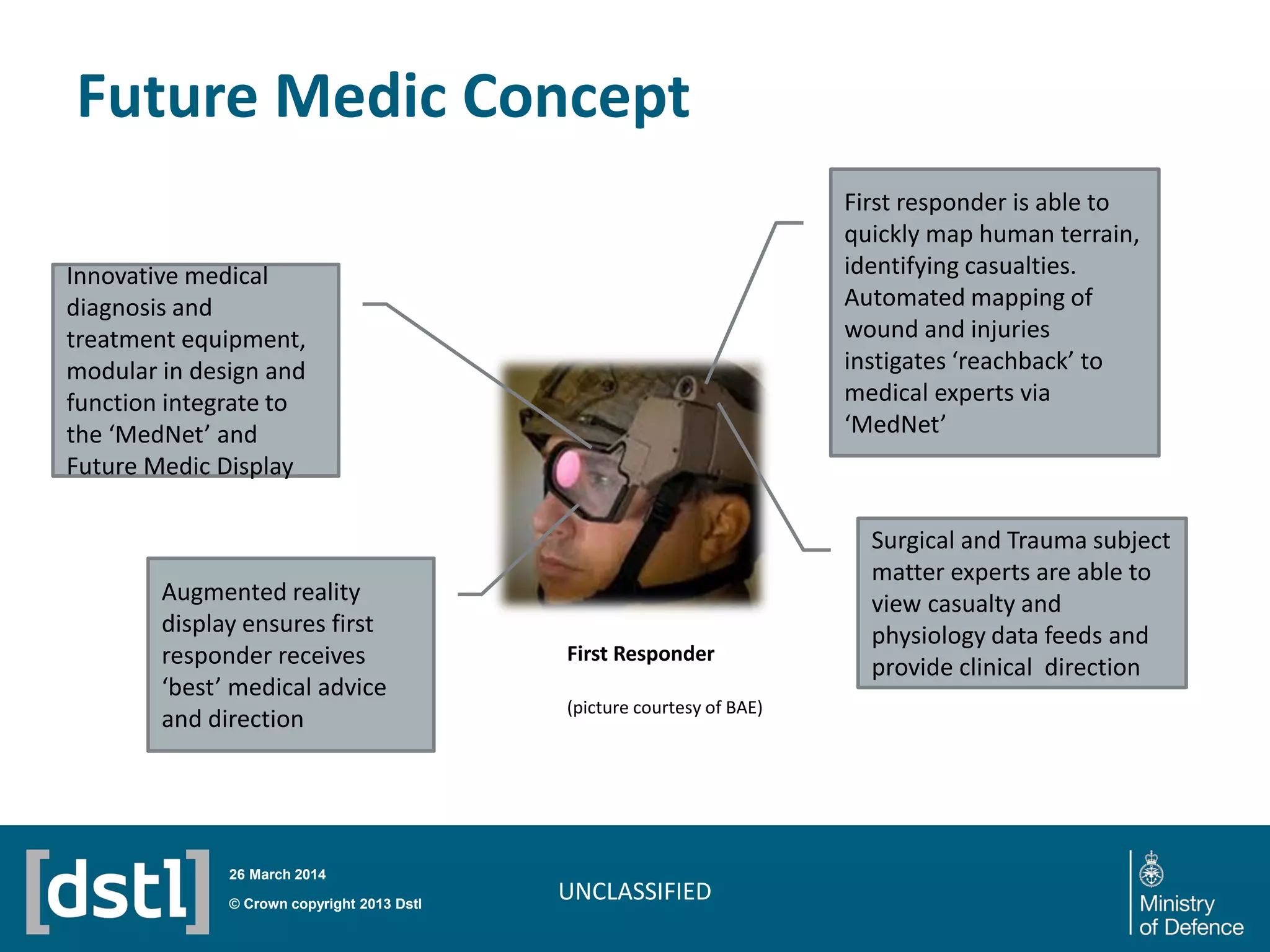
First Responder
(picture courtesy of BAE)
First responder is able to
quickly map human terrain,
identifying casualties.
Automated mapping of
wound and injuries
instigates ‘reachback’ to
medical experts via
‘MedNet’
Innovative medical
diagnosis and
treatment equipment,
modular in design and
function integrate to
the ‘MedNet’ and
Future Medic Display
Augmented reality
display ensures first
responder receives
‘best’ medical advice
and direction
Surgical and Trauma subject
matter experts are able to
view casualty and
physiology data feeds and
provide clinical direction
Defence Medical Sciences: Enduring Innovation
26 March 2014
© Dstl
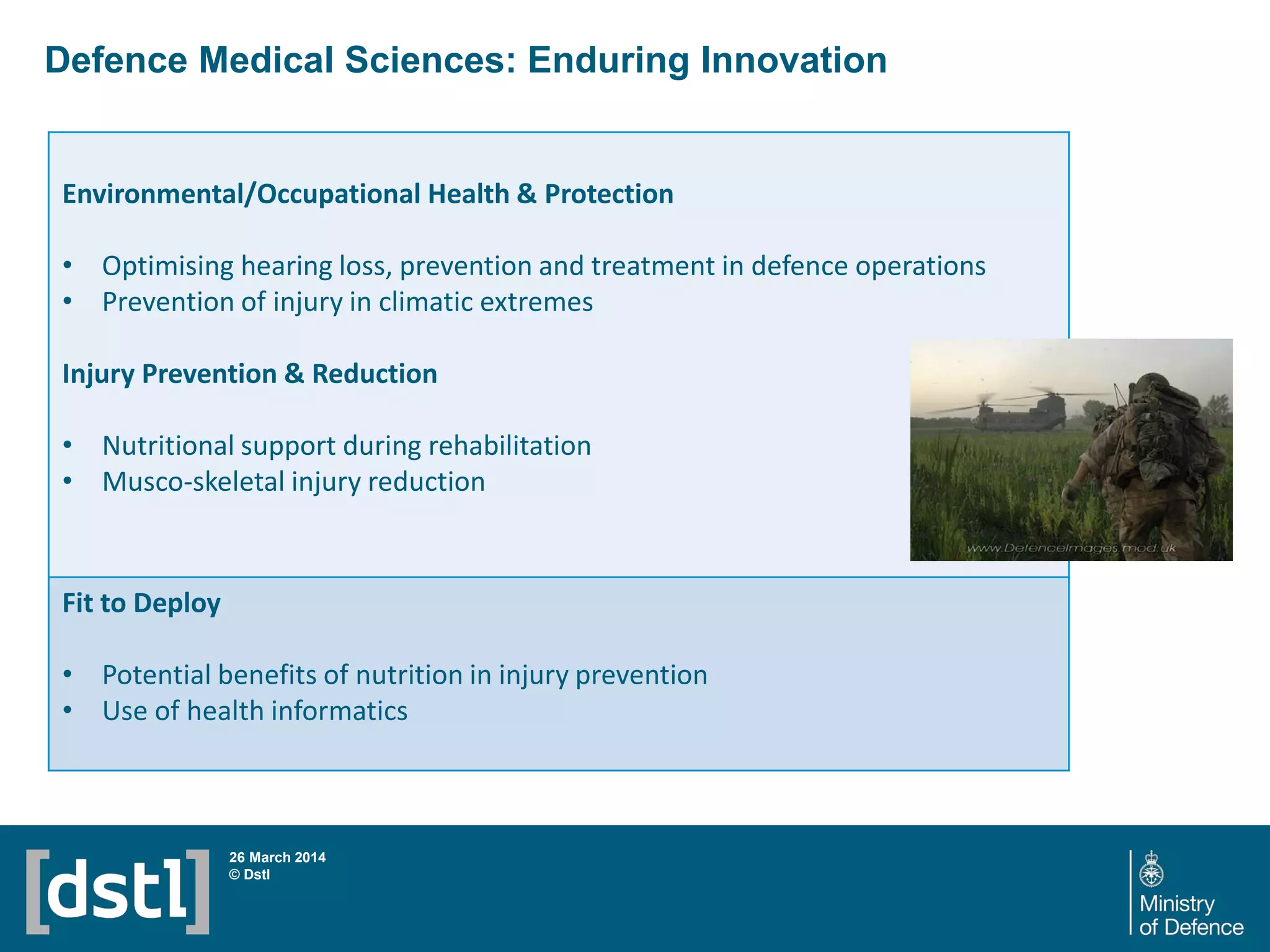
Environmental/Occupational Health & Protection
• Optimising hearing loss, prevention and treatment in defence operations
• Prevention of injury in climatic extremes
Injury Prevention & Reduction
• Nutritional support during rehabilitation
• Musco-skeletal injury reduction
Fit to Deploy
• Potential benefits of nutrition in injury prevention
• Use of health informatics
Defence Medical Sciences: Enduring Innovation
26 March 2014
© Dstl
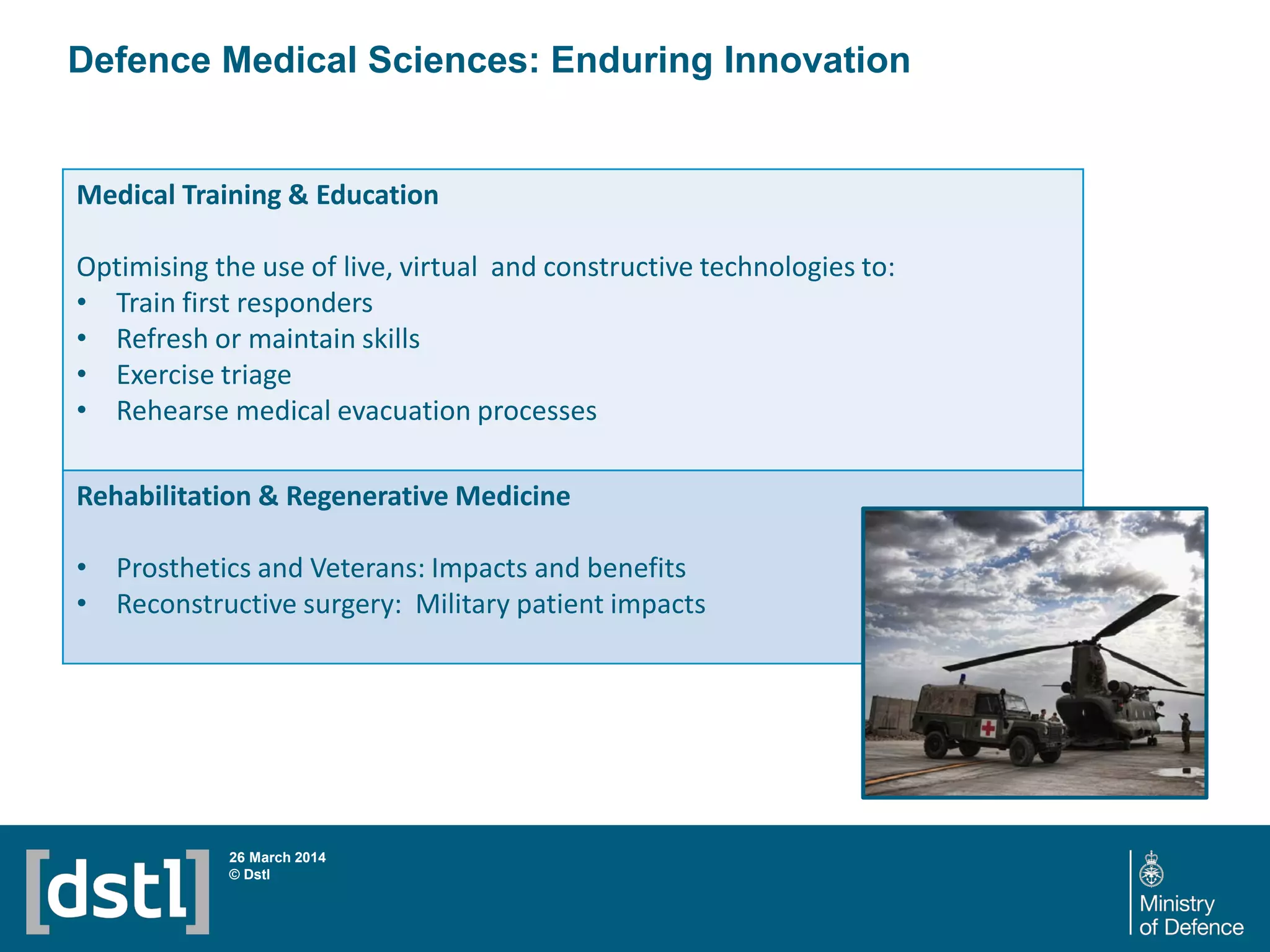
Medical Training & Education
Optimising the use of live, virtual and constructive technologies to:
• Train first responders
• Refresh or maintain skills
• Exercise triage
• Rehearse medical evacuation processes
Rehabilitation & Regenerative Medicine
• Prosthetics and Veterans: Impacts and benefits
• Reconstructive surgery: Military patient impacts
Defence Medical Sciences – Enduring Innovation
© Crown copyright 2013 Dstl
26 March 2014
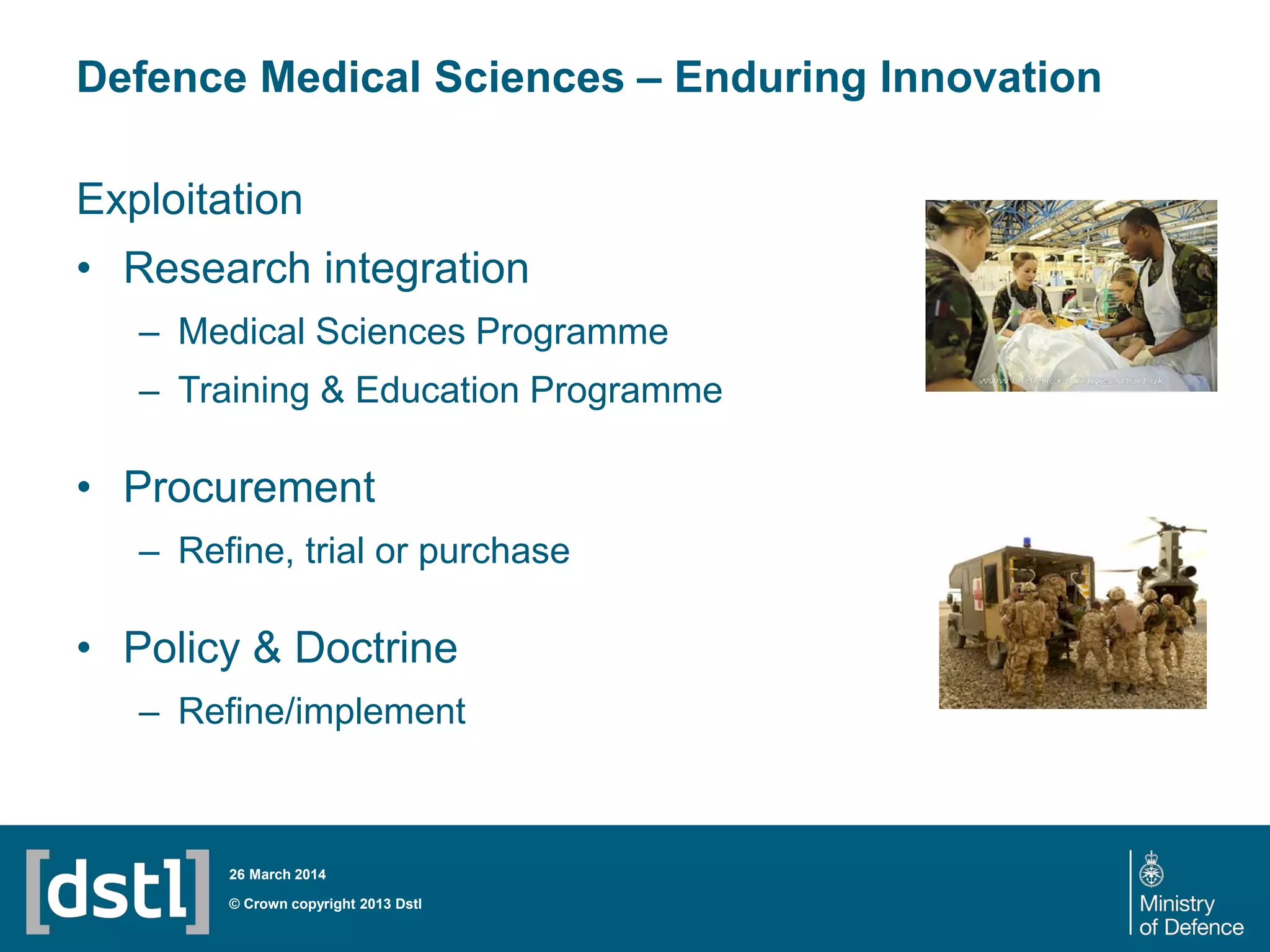
Exploitation
• Research integration
– Medical Sciences Programme
– Training & Education Programme
• Procurement
– Refine, trial or purchase
• Policy & Doctrine
– Refine/implement
Human in Systems
UNCLASSIFIED
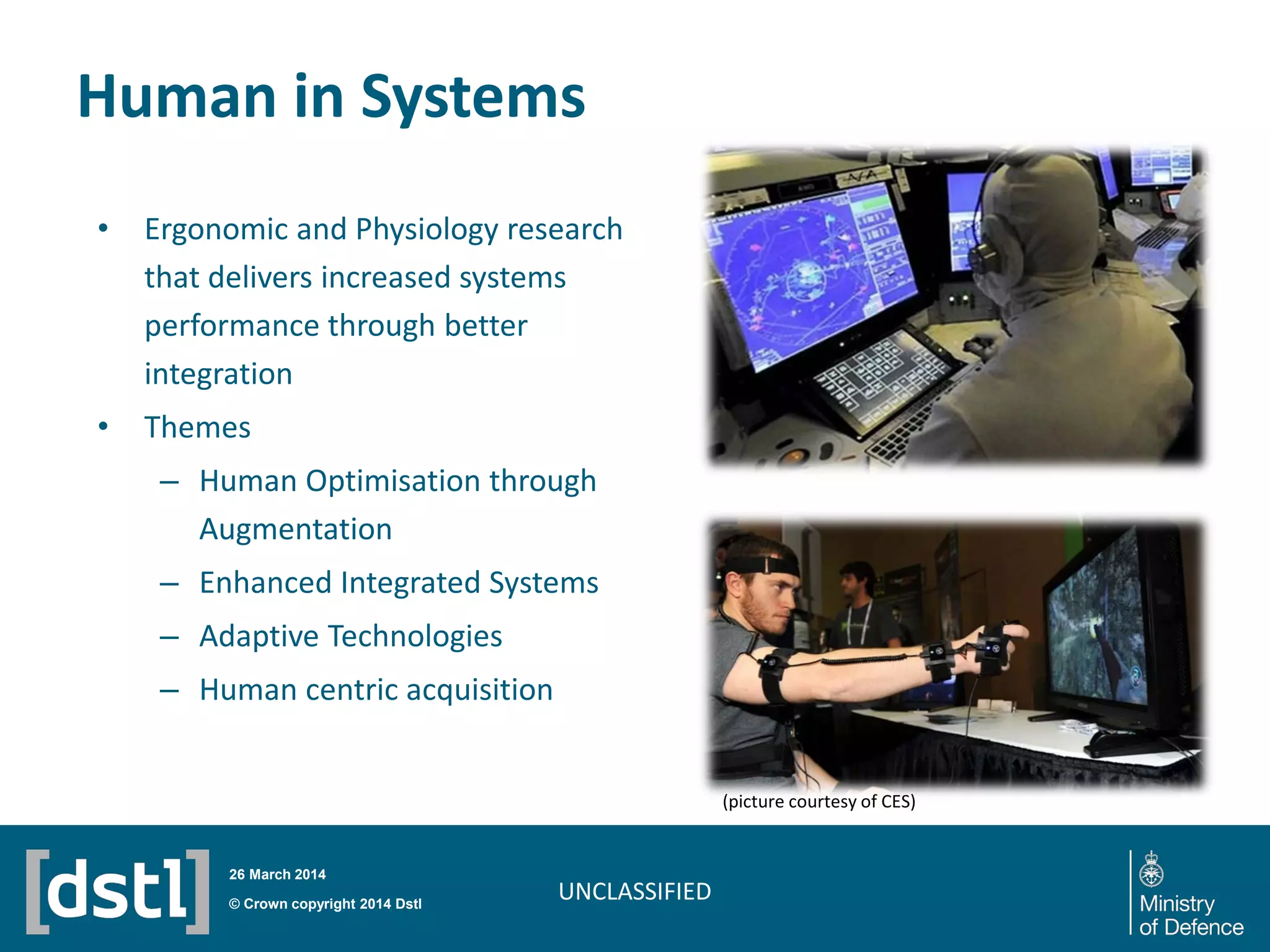
• Ergonomic and Physiology research
that delivers increased systems
performance through better
integration
• Themes
– Human Optimisation through
Augmentation
– Enhanced Integrated Systems
– Adaptive Technologies
– Human centric acquisition
© Crown copyright 2014 Dstl
26 March 2014
(picture courtesy of CES)
Centre
Defence
Enterprise
for

CDE Enduring challenge competition briefing

  • 1.
  • 2.
  • 3.
  • 4.
  • 5.
  • 6.
  • 7.
    Defining the MaritimeResearch Requirement From the customer’s perspective © Crown copyright 2013 Dstl 26 March 2014 UNCLASSIFIED
  • 8.
    Royal Navy © Crowncopyright 2013 Dstl 26 March 2014 UNCLASSIFIED
  • 9.
    Royal Navy –Operations • Text © Crown copyright 2013 Dstl 26 March 2014 UNCLASSIFIED
  • 10.
    Royal Navy –Operations • Text © Crown copyright 2013 Dstl 26 March 2014 UNCLASSIFIED
  • 11.
    Royal Navy –Future Navy Vision 2025 • What does this require? – An agile fleet that is interoperable with other nation’s assets and capable of providing sustainable operations around the globe. • How is this achieved? – Optimal utilisation of effectively manned platforms: MCMV, T26, T45, Carrier Strike and Amphibious Assault Ships © Crown copyright 2013 Dstl 26 March 2014 UNCLASSIFIED Warfighting Project Military Power at sea and from the sea Maritime Security Protect UK citizens, territory and trade International Engagement Promote UK Interests
  • 12.
    Royal Navy –Capability Development • Ship’s Facilities – Power Generation – Propulsion • Situational Awareness – Tactical, Operational and Strategic levels – Sensors: RADAR, SONAR, and Electronic Surveillance – Organic Air Assets: Helicopters and UAVs • Infrastructure – Command and Control – Combat System – Command Support System – Coalition Link Networks • Weapons – Conventional: Missiles, Naval Fire Support, CIWS and Force Protection © Crown copyright 2013 Dstl 26 March 2014 UNCLASSIFIED
  • 13.
    Royal Navy –Dstl Maritime Research © Crown copyright 2013 Dstl 26 March 2014 UNCLASSIFIED Maritime Maritime Freedom of Manouevre Maritime Decision Support Maritime Operational Support Affordable Maritime Presence Human & Medical Sciences MAST Unmanned Air Systems Assured Information Infrastructure C2I2 Integrated Sensing Training Defence Logistics & Support C4ISR Decision Support & Experimentation Defence Intelligence Support to Operations KnIFE OGD Countering Terrorist Networks Cyber Strategy & Capability Homeland Security Resilience UK Special Forces Air Enablers (RW) Air JFC-SU Land JFC-IS Wider Government Head Office Conventional & Novel Weapons
  • 14.
    Dstl - AffordableMaritime Presence © Crown copyright 2013 Dstl 26 March 2014 UNCLASSIFIED Integrated Air Defence Littoral ManoeuvrePlatform & Combat Systems Surface Defence & Security Operations S&T will have enabled the Royal Navy to deploy a fleet of more Affordable, Available and Survivable Surface Ships which can operate freely in International and Territorial waters in support of UK interests.
  • 15.
    Dstl - Freedomof Manoeuvre © Crown copyright 2013 Dstl 26 March 2014 UNCLASSIFIED Anti-Submarine Warfare Submarine Capability Mine CountermeasuresGeospatial Intelligence Gathering S&T has provided the sensors, systems, and environmental understanding required to allow the UK to: operate effectively, efficiently and affordably from and within the underwater battlespace and regenerate affordable and cost effective ASW, MCM and GeoInt capabilities.
  • 16.
    Royal Navy –Security Operations © Crown copyright 2013 Dstl 26 March 2014 UNCLASSIFIED What Capability will we need? What Technology will underpin that? Is there a defined exploitation route?
  • 17.
    Royal Navy –Task Force © Crown copyright 2013 Dstl 26 March 2014 UNCLASSIFIED
  • 18.
    Royal Navy –Littoral Manoeuvres © Crown copyright 2013 Dstl 26 March 2014 UNCLASSIFIED
  • 19.
    Royal Navy –ASW Operations © Crown copyright 2013 Dstl 26 March 2014 UNCLASSIFIED
  • 20.
    Royal Navy –Enduring Challenges • AWW – Integrated Air Defence • Persistent and recoverable countermeasures • Novel weapons – directed energy – Force Protection • Detection of small/covert craft • Identification of intent from asymmetric threats • Non-destructive methods for neutralising unresponsive vessels – Sensors • Environmentally aware sensors • Detection and tracking of difficult targets – Combat Systems • Open Architecture with common bearers: security © Crown copyright 2013 Dstl 26 March 2014 UNCLASSIFIED
  • 21.
    Royal Navy –Enduring Challenges • Information Superiority – Electronic Surveillance (ES) • Development of UAS payloads – ES, IR, EO • Persistent wide area surveillance • Effective analysis and exploitation of big data – Military satellite communications – Denied or degraded operating environment – Combat ID • Platform – Energy efficient power generation and propulsion – Alternative fuels to diesel – Large capacity energy storage: 1 – 9 GJ – Energy harnessed from ‘wild heat’ – Utilisation of 3D printing technology © Crown copyright 2013 Dstl 26 March 2014 UNCLASSIFIED
  • 22.
    Royal Navy –Enduring Challenges • Underwater Sensing – Optimise current ASW assets – Improved situational awareness – UUV technology and integration – Data exploitation and human integration – Acoustic and non-acoustic sensing technology – Underwater communication methods – Environmentally aware sensors • Underwater Platform – Holistic cross spectrum stealth – Alternative UW weapons – reduced footprint © Crown copyright 2013 Dstl 26 March 2014 UNCLASSIFIED
  • 23.
    Summary • Defining theproblem space is as challenging as overcoming it. • CDE provides a vital exploitation route for innovative technology. • All proposals must articulate how the technology can be exploited to meet the customer’s requirements. UNCLASSIFIED
  • 24.
    Chemical, Biological and RadiologicalScience and Technology Programme
  • 25.
    UNCLASSIFIED Strategic Context NATIONAL SECURITYSTRATEGY: RISKS Tier 1 : International terrorism including the use of CBRN materials Tier 2 : Attack on the UK or its Territories by a state or proxy using CBRN weapons SDSR: NATIONAL SECURITY TASKS & PLANNING GUIDELINES: We will .. tackle those who threaten the UK & our interests, including maintenance of underpinning technical expertise in key areas. To deliver this we require … retention of our CBRN science and technology capabilities that contribute to counter- proliferation and our response to the potential use of such materials by terrorist or state actors 26 March 2014
  • 26.
    UNCLASSIFIED National Security ThroughTechnology 26 March 2014 • ... ensure small and medium sized companies can continue to deliver the innovation and flexibility we need. • Building on the Centre for Defence Enterprise’s (CDE) success in providing efficient access to innovation, we will broaden its remit to cover both the defence and security domains. • …the most significant challenges currently faced by both the defence and security communities…where we judge the UK will get best value-for-money from science & technology: – being able to identify and effectively mitigate CBRN threats to the UK and its interests
  • 27.
    UNCLASSIFIED Defence AND Security •CONTEST & UK Biological Security Strategy (Home Office) • National Counter Proliferation Strategy (FCO) • National Risk Assessment (CO) 26 March 2014
  • 28.
    UNCLASSIFIED 26 March 2014 TheCBW spectrum illustrates the range of materials that could be used as CBW agents Toxic industrial chemicals (TICS) Major CW agents Emerging CW agents Mid spectrum agents BW agents HCN Phosgene chlorine ammonia vesicants nerve agents psycho- chemicals developments from pharmaceutical & pesticide research (Moscow theatre) toxins bioregulators bacteria rickettsia viruses increasing potency (up to~1012) synthetic chemicals self-replicating agents of biological origin
  • 29.
    UNCLASSIFIED Programme Vision • CBRweapons will have no strategic or tactical effect • Perpetrators will be identified • Restraint is rewarded and acceptable norms are reinforced 26 March 201426 March 2014
  • 30.
  • 31.
  • 32.
  • 33.
  • 34.
  • 35.
  • 36.
  • 37.
    UNCLASSIFIED Benefits realisation • CBRTechnical Advice and Reach-back – UK Government, Defence, OPCW • MOD Capability – UK Armed Forces • Cross-government S&T Capabilities • International Partners and Allies 26 March 2014
  • 38.
    UNCLASSIFIED Maximising the impactof science and technology for the defence and security of the UK UNCLASSIFIED
  • 39.
    Human and MedicalSciences Enduring Innovation UNCLASSIFIED© Crown copyright 2014 Dstl 26 March 2014
  • 40.
    Human & MedicalSciences Defence Human and Medical Sciences will be intrinsic to Future Force Capability. Whole Force supported through Whole Service Life Care will be the foundation of next generation Defence Personnel. The Future Force will achieve a symbiotic relationship with technology, engendering enhanced information management and exploitation, shaping and influencing the Defence and Security landscape. UNCLASSIFIED© Crown copyright 2014 Dstl 26 March 2014 People matter
  • 41.
    Human & MedicalSciences UNCLASSIFIED© Crown copyright 2013 Dstl 26 March 2014 Context o The human component is central to delivering military capability o Provision of sufficient, capable and appropriately trained personnel is critical to operational success o Need to sustain capability by protection, treatment and rehabilitation o High quality support, care and treatment at all points along the continuum of care essential
  • 42.
    Defence Medical Sciences UNCLASSIFIED •The Defence Medical Sciences research programme is endorsed by Joint Medical Command • Research underpins MOD’s world class Combat Casualty Care capability • Medical Science Themes – Casualty Care – Contingent Operational Medicine – Whole Service Life Care – Medical Systems © Crown copyright 2014 Dstl 26 March 2014
  • 43.
    Defence Medical SciencesResearch Programme 26 March 2014 © Dstl Casualty Care Investigating techniques and interventions that address complex injuries from current and emerging battlefield threats in conventional warfare. Future emphasis on maintaining skills and capability post-Herrick, to operate in austere environments, with extended time to treatment windows. Contingent Operational Medicine Focused on improving numbers of those fit to deploy, by developing effective diagnostics, countermeasures and interventions against occupational and environmental stressors to maximise health, performance and fitness on military duties. Whole Service Life Care Focused on providing definitive and rehabilitative care to improve duty performance and quality of life for service personnel injured in military conflict, minimising residual disability and providing aftercare support to wounded veterans. Medical Systems Research, develop and evaluate systems that will maintain and/or enhance the effectiveness of deployed forces in extreme and austere environments and produce medical treatments, interventions and rehabilitative support to injured personnel.
  • 44.
    Defence Medical SciencesResearch Programme 26 March 2014 © Dstl Theme Sub-Theme Casualty Care Resuscitation and Stabilisation Haemorrhage Control Surgery and Intensive Care Diagnostics and Decision Making Contingent Operational Medicine Environmental/Occupational Health & Protection Injury Prevention & Reduction Psychological Health & Resilience Infectious Disease (and Chronic Illness) Pain Management Whole Service Life Care Fit to Deploy Translational Medicine Rehabilitation Regenerative Medicine Medical Systems Information and Analysis Medical Training & Education Systems for Medics/First Responders Continuum of care
  • 45.
    Future Medic Concept UNCLASSIFIED©Crown copyright 2013 Dstl 26 March 2014 First Responder (picture courtesy of BAE) First responder is able to quickly map human terrain, identifying casualties. Automated mapping of wound and injuries instigates ‘reachback’ to medical experts via ‘MedNet’ Innovative medical diagnosis and treatment equipment, modular in design and function integrate to the ‘MedNet’ and Future Medic Display Augmented reality display ensures first responder receives ‘best’ medical advice and direction Surgical and Trauma subject matter experts are able to view casualty and physiology data feeds and provide clinical direction
  • 46.
    Defence Medical Sciences:Enduring Innovation 26 March 2014 © Dstl Environmental/Occupational Health & Protection • Optimising hearing loss, prevention and treatment in defence operations • Prevention of injury in climatic extremes Injury Prevention & Reduction • Nutritional support during rehabilitation • Musco-skeletal injury reduction Fit to Deploy • Potential benefits of nutrition in injury prevention • Use of health informatics
  • 47.
    Defence Medical Sciences:Enduring Innovation 26 March 2014 © Dstl Medical Training & Education Optimising the use of live, virtual and constructive technologies to: • Train first responders • Refresh or maintain skills • Exercise triage • Rehearse medical evacuation processes Rehabilitation & Regenerative Medicine • Prosthetics and Veterans: Impacts and benefits • Reconstructive surgery: Military patient impacts
  • 48.
    Defence Medical Sciences– Enduring Innovation © Crown copyright 2013 Dstl 26 March 2014 Exploitation • Research integration – Medical Sciences Programme – Training & Education Programme • Procurement – Refine, trial or purchase • Policy & Doctrine – Refine/implement
  • 49.
    Human in Systems UNCLASSIFIED •Ergonomic and Physiology research that delivers increased systems performance through better integration • Themes – Human Optimisation through Augmentation – Enhanced Integrated Systems – Adaptive Technologies – Human centric acquisition © Crown copyright 2014 Dstl 26 March 2014 (picture courtesy of CES)
  • 50.