Research and
Development
in the UK Fire Service
National Lead for R&D
National Fire Chiefs Council
Geoff Howsego
Structure
• A national approach that supports the NFCC
strategy
• A network of 11 regional R&D leads and
support from the 50 UK FRSs
• Work closely with Home Office, industry,
academia, national and international
partners
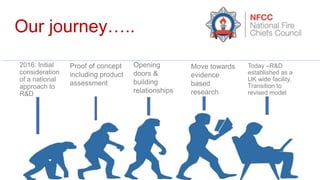
Proof of concept
including product
assessment
Our journey…..
2016: Initial
consideration
of a national
approach to
R&D
Opening
doors &
building
relationships
Move towards
evidence
based
research
Today –R&D
established as a
UK wide facility.
Transition to
revised model
It’s UK wide ….. covering
• Fundamental research
• Industrial research
• Capability development
The NFCC approach to R&D
• Defence Science Technology Laboratory (Dstl)
• Defence and Security Accelerator (DASA)
• College of Policing / NPCC
• The Home Office
• The Home Office IRS team
• The Fire Industry Association (FIA)
• EU and International partners
• Various UK universities including Nottingham
Trent, Brighton, Coventry, Oxford, UCLAN
• The wider NFCC infrastructure
Who do we work
with?
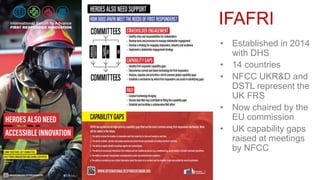
IFAFRI
• Established in 2014
with DHS
• 14 countries
• NFCC UKR&D and
DSTL represent the
UK FRS
• Now chaired by the
EU commission
• UK capability gaps
raised at meetings
by NFCC
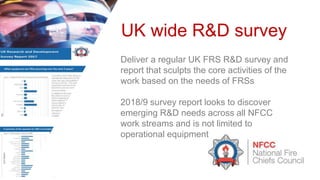
UK wide R&D survey
Deliver a regular UK FRS R&D survey and
report that sculpts the core activities of the
work based on the needs of FRSs
2018/9 survey report looks to discover
emerging R&D needs across all NFCC
work streams and is not limited to
operational equipment
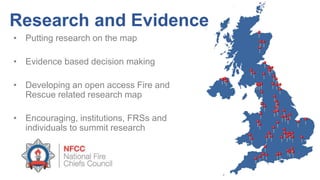
• Putting research on the map
• Evidence based decision making
• Developing an open access Fire and
Rescue related research map
• Encouraging, institutions, FRSs and
individuals to summit research
Research and Evidence
• Horizon Scanning
• Capability Analysis
• Home Office Statement of User Needs
to access S&T assets
• More DASA lead challenges to benefit
FRS here and abroad
• A new delivery model
What next?

DASA Security Showcase - UK Fire Service Presentation

  • 1.
    Research and Development in theUK Fire Service National Lead for R&D National Fire Chiefs Council Geoff Howsego
  • 2.
    Structure • A nationalapproach that supports the NFCC strategy • A network of 11 regional R&D leads and support from the 50 UK FRSs • Work closely with Home Office, industry, academia, national and international partners
  • 3.
    Proof of concept includingproduct assessment Our journey….. 2016: Initial consideration of a national approach to R&D Opening doors & building relationships Move towards evidence based research Today –R&D established as a UK wide facility. Transition to revised model
  • 5.
    It’s UK wide….. covering • Fundamental research • Industrial research • Capability development The NFCC approach to R&D
  • 6.
    • Defence ScienceTechnology Laboratory (Dstl) • Defence and Security Accelerator (DASA) • College of Policing / NPCC • The Home Office • The Home Office IRS team • The Fire Industry Association (FIA) • EU and International partners • Various UK universities including Nottingham Trent, Brighton, Coventry, Oxford, UCLAN • The wider NFCC infrastructure Who do we work with?
  • 7.
    IFAFRI • Established in2014 with DHS • 14 countries • NFCC UKR&D and DSTL represent the UK FRS • Now chaired by the EU commission • UK capability gaps raised at meetings by NFCC
  • 8.
    UK wide R&Dsurvey Deliver a regular UK FRS R&D survey and report that sculpts the core activities of the work based on the needs of FRSs 2018/9 survey report looks to discover emerging R&D needs across all NFCC work streams and is not limited to operational equipment
  • 9.
    • Putting researchon the map • Evidence based decision making • Developing an open access Fire and Rescue related research map • Encouraging, institutions, FRSs and individuals to summit research Research and Evidence
  • 10.
    • Horizon Scanning •Capability Analysis • Home Office Statement of User Needs to access S&T assets • More DASA lead challenges to benefit FRS here and abroad • A new delivery model What next?

Editor's Notes

  • #6  Fundamental Research’.  These are new concepts generally undertaken by research organisations and academia often concluding with a proof of concept.  'Industrial Research’.  This generally concludes with a prototype of a new product or system.   'Capability development'.  This provides new skills, knowledge and equipment that is not currently available.