How will the competition work?
Intellectual property
Online bid submission
Assessors
Technical partners
www.gov.uk/dstl/cde
Beyond battery power
Small, lightweight, modular power generation for unmanned
systems
Technology challenge
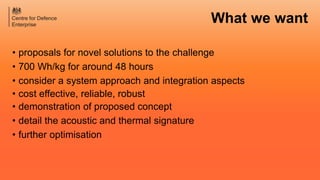
• proposals for novel solutions to the challenge
• 700 Wh/kg for around 48 hours
• consider a system approach and integration aspects
• cost effective, reliable, robust
• demonstration of proposed concept
• detail the acoustic and thermal signature
• further optimisation
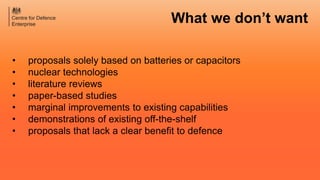
What we want
• proposals solely based on batteries or capacitors
• nuclear technologies
• literature reviews
• paper-based studies
• marginal improvements to existing capabilities
• demonstrations of existing off-the-shelf
• proposals that lack a clear benefit to defence
What we don’t want
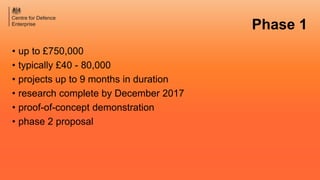
Phase 1
• up to £750,000
• typically £40 - 80,000
• projects up to 9 months in duration
• research complete by December 2017
• proof-of-concept demonstration
• phase 2 proposal
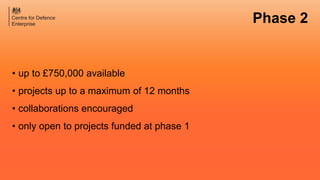
Phase 2
• up to £750,000 available
• projects up to a maximum of 12 months
• collaborations encouraged
• only open to projects funded at phase 1
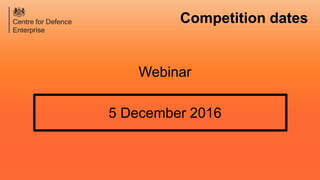
Competition dates
Webinar
5 December 2016
Technical queries
diet@dstl.gov.uk
General queries
cde@dstl.gov.uk
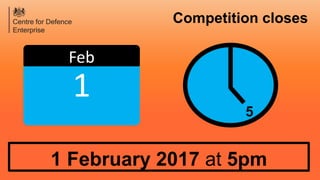
Competition closes
Feb
1
1 February 2017 at 5pm
5

Beyond battery power - how the competition will work

Editor's Notes

  • #2 Good morning My name is Emma Howe and I am one of the themed competition managers at CDE. I’m going to explain how the competition process is going to work for you
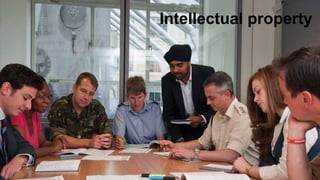
  • #3 This competition will use CDE’s standard contract terms and conditions for phase 1. For intellectual property this is called DEFCON 705. It means that you, the bidders, retain all of the background and foreground IP associated with your innovation. You are free exploit the IP generated from the work done via the CDE contract not only the defence market but also in wider markets outside of defence and security. We do retain a ‘right of use’ over the foreground IP and you need to understand what that means and become familiar with Defcon705. Check our website for full details.
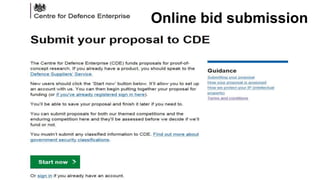
  • #4 There is only one route to submit your research proposal to us – and that is our new improved on line submission service, those of you who have worked with CDE before will know some of the challenges we faced with the old portal. The reason we use one route for all competitions is that it keeps overheads low – for us and for you. It allows very tight control over who gets to see your submission distribution around our network of expert assessors is controlled. This is an important because we take our reputation as a ‘trusted guardian’ of supplier IP very seriously indeed. I recommend you sign up for an account as soon as you can so that you can familiarise yourself with the new service. There’s lots of helpful advice and guidance included at every stage of your submission. Something that never changes is the need to submit a high quality proposal. One which is clear, concise and evidence based. You can get some advice on ‘submitting a successful proposal’ while you are here today, there’s a presentation this afternoon by my colleague Bruce Hardy. You can speak to one of the CDE team sign up for one of our online briefings: ‘how to submit a successful proposal’. The next one is scheduled for XX , you can sign up from the events page on our website.
  • #5 So you have successfully submitted your proposal and the competition has closed. Now it will be assessed by experts from Dstl, DfT and HO. All are government employees and are trained to the same standard, so you can trust them with your IP.
  • #6 If your proposal is funded, you will be provide wit a technical partner from Dstl, DfT or HO who can help you better understand government requirements and provide the link to the defence, security and wider government community.
  • #7 This is where you will need to go for the competition document which describes the scope of the competition. You’ve heard some really interesting background today but you must remember that we’re only looking for what’s described in the competition document. We can’t fund anything that falls outside that scope. Use today to talk to the competition team to make sure your idea is in line with the competition. There maybe some space left for a face-to-face meeting – check with one of my colleagues at the registration desk, they’ll be happy to help.
  • #8 Does this say what you’re looking for??
  • #9 We’re looking for phase 1 proposals that: can achieve a target specific energy density of at least 700 Wh/kg for around 48 hours consider a system approach and include a proof-of-concept demonstration consider the system integration aspects and how components can be integrated into system solutions are cost effective, reliable, robust and provide good value for money – these could include new technologies and advances in manufacturing techniques include detail describing how the acoustic and thermal signature characteristics of your solution will be evaluated provide an indication of how the technology could be further optimised to provide specific energies in excess of 1000 Wh/kg, ideally achieving 1500 Wh/kg You don’t have to provide the complete solution. Your proposed technology could offer part of, or an important step towards, the solution to the challenge. We want a prototype system demonstrating the feasibility of your proposed concept. However, it is recognised that any prototype would require further development and refinement as part of the phase 2 programme of work. If a prototype system can’t be provided at the end of phase 1, you must demonstrate how the most critical components function for around 48 hours duration. We’re looking for innovative proposals, but you should clearly state the technology developments needed to realise the innovation and the expected timescale for technology maturation. We’ll encourage successful phase 1 projects to collaborate in any follow-on phase 2 projects.
  • #10 proposals solely based on batteries or capacitors as these are already part of extant programmes nuclear technologies as these are considered environmentally unacceptable literature reviews paper-based studies marginal improvements to existing capabilities - we’re looking for innovation not evolution proposals that lack a clear defence benefit demonstrations of existing off-the-shelf technologies, unless you propose a novel modification
  • #11 Title slide Add your name and organisation
  • #12 Title slide Add your name and organisation
  • #13 Title slide Add your name and organisation
  • #14 Title slide Add your name and organisation
  • #15 Title slide Add your name and organisation
  • #16 Title slide Add your name and organisation