Graduate Certificate in Career Development
CDAA (WA) - Good Theory, Good Practice – 01/09/12
Barry Horne
barry.horne@ecu.edu.au
Career Development Research Perspectives
Course Entry
Graduate Certificate in Career Development
Undergraduate degree
or
5 years’ relevant experience
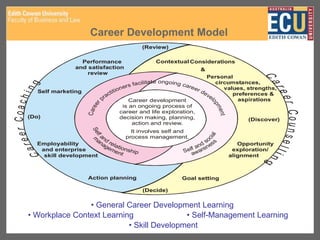
Career Development Model
Career development
is an ongoing process of
career and life exploration,
decision making, planning,
action and review.
It involves self and
process management.
and enterprise
Employability
Goal setting
Judy Denham, July 2004
exploration/
alignment
Opportunity
Action planning
Self marketing
(Do)
(Discover)
(Decide)
(Review)
Performance
and satisfaction
review
skill development
Selfa
nd relationship
m
a
nagement
Careerp
ractitioners facilitate ongoing career deve
lopment
Self and s
ocial
awarenes
s
Contextual
&
• Workplace Context Learning • Self-Management Learning
• General Career Development Learning
• Skill Development
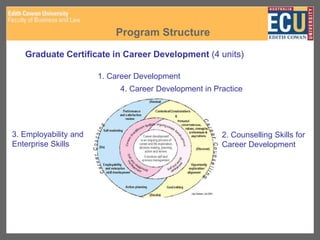
Program Structure
Graduate Certificate in Career Development (4 units)
1. Career Development
3. Employability and
Enterprise Skills
4. Career Development in Practice
2. Counselling Skills for
Career Development
Graduate Certificate Research Projects
Secondary Education
General Programs
 Year / Sub-School Career Education, INSTEP Clusters, Structured
Workplace Learning, Vocational Education and Training (e.g.
Hospitality), TAFE Certification, Work Experience
Targeted Programs
 Distance Education
 Indigenous (Metropolitan Boarding Girls, Regionally Located) and
Cultural Groups (Muslim Girls, Sudanese Refugees, Asian)
 Youth at Risk / Early School Leaver
 Education Support Students / Students with Intellectual Disability
 High Functioning Autistic / Asperger Syndrome Students (Narrative
Approaches)
Graduate Certificate Research Projects
Secondary Education
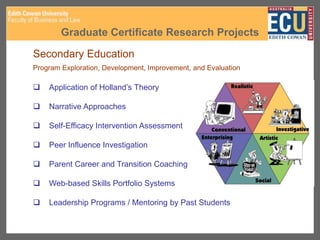
Program Exploration, Development, Improvement, and Evaluation
 Application of Holland’s Theory
 Narrative Approaches
 Self-Efficacy Intervention Assessment
 Peer Influence Investigation
 Parent Career and Transition Coaching
 Web-based Skills Portfolio Systems
 Leadership Programs / Mentoring by Past Students
Graduate Certificate Research Projects
Tertiary Education
 Multi-Campus Service Provision
 Social Return on Investment Evaluation
 Low Socio Economic Status Participation
 Transitions of Students with Disability
 Asian International Students
 Prospective Mature Age Students
 Elite Athlete Programs
 Post-Modern [Innovative] Career Workshops
Graduate Certificate Research Projects
Labour Market
 Talent Retention (Malaysian “Brain Drain”)
 Attraction, Retention, Advancement of Women
 Workforce Flexibility (Recognition of Trade Skills and Prior Learning)
 Rehabilitation of Injured Workers
Workforce
 Return on Investment (Retention, Productivity)
 Career Pathways for Performing Arts Venue Managers
 Semi Skilled, Blue Collar Workers
 Mentoring Program for Graduate Teachers
Graduate Certificate Research Projects
Adult Client Target Groups
 Women (Returning to Work, Mid-Career Change, Located in Isolated
Mining Communities)
 Mature Age Workers (Regional Workforce Participation)
 Single Parents
 Indigenous (Regional, Mining Industry Participation)
 Migrants (Settlement and Integration)
 Speakers of Languages Other Than English (Workplace Readiness)
 People Recovering from Eating Disorders (“Protein to Protean”)
 Transgender People (Service Gaps)
Graduate Certificate Research Projects
Professional Practice
 Multi-Stakeholder Marketing (e.g. Students, Parents, High Schools)
 Role of Personality Assessment
 Social Media Impact on Practice and Client Career Tasks
 Career Transition Tools and Techniques
 Multicultural Counselling Approaches
 Learner Perceptual Modality Preferences
 Telephone Career Guidance
 Metaphoric Representation of Systems Theory Framework for Career
Development
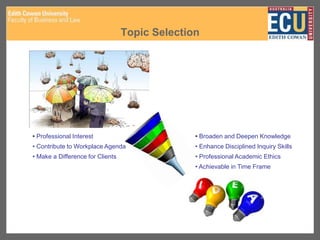
Topic Selection
• Professional Interest
• Contribute to Workplace Agenda
• Make a Difference for Clients
• Broaden and Deepen Knowledge
• Enhance Disciplined Inquiry Skills
• Professional Academic Ethics
• Achievable in Time Frame
CDAA (WA) - Good Theory, Good Practice – 01/09/12
Jackie Breasley
jbreasley@yahoo.com.au
Career Development Support for Adults in
Career Transition: A Private Practice Perspective
Context and Motivation
Context
 Review of Best Practice Models of Service Provision
Motivation
 Author’s Experience of Career Transition
Definitions
 Career is an individual’s work and life roles over their lifespan
 Career development is an ongoing process of career/life exploration,
decision making, planning, action and review. It involves self and process
management.
Initial Research Questions
 How does the world of work impact on adults in career transition? What
are the implications for supporting adults in career transition?
 What are the needs of clients in career transition as outlined in the
literature?
 What are the issues in providing career development support/services to
adults in career transition?
 What career development theories, principles, policies and perspectives
are relevant and useful?
 How does a private practice context influence the provision of career
development support/services to adults in career transition?
Sources of High Quality Literature
Key Articles
 Brott, P. E. (2005). A constructivist look at life roles, Career
Development Quarterly, 562(4), 138-149.
 Dussault, M., Bourassa, B., Fournier, G., Spain, A., Lachance, L.,
Negura, L. (2009). New realities in the work world: The impact on
workers and the professional practice of career counsellors. Canadian
Journal of Career Development, 8(1), 11-21.
 Hartung, P. J. (2010) Practice and research in career counselling and
development. Career Development Quarterly, 59(2), 98-142.
Sources of High Quality Literature
Key Articles
 Savickas, M. L., Nota, L., Rossier, J., Dauwalder, J., Duarte, M. E.,
Guichard, J., Soresi, S., Van Esbroeck, R., van Vianen, A. (2009) Life
designing: A paradigm for career construction in the 21st century.
Journal of Vocational Behaviour, 75(3), 239-250.
 Savickas, M. L. (2000) Renovating the psychology of careers for the
twenty first century. In Collin, A & Young R. A. (Eds.), The future of
career (pp. 53-68). Cambridge: Cambridge University Press.
Key Findings
Professional Practice
 A holistic, action-oriented approach is required
 Career practitioner as partner
 Use different models, theories, approaches and resources, as required
 Ongoing training and professional development
 Referral policy and procedure
Key Findings
Further Research
 Protean and boundaryless careers as they relate to adults in career transition
 Training of career practitioners
 Career decision making of adults in career transition
Professional and Personal Learning
Professional Learning
 Ongoing training and professional development
 Importance of referral policy and procedure
 Practical application of career development theory with adult clients
Personal Learning
 Confidence to translate learning into action
 I enjoy self-directed learning!
CDAA (WA) - Good Theory, Good Practice – 01/09/12
Mark Anderson
mando76@optusnet.com.au
Middle School Career Development Programs
A Preliminary Investigation
Context and Motivation
Middle School
Wholesome curriculum which is differentiated and integrated around themes
that are relevant and delivered by a team.
Rumble & Aspland, Australian Curriculum Studies Association (2009)
 John Wollaston Anglican Community School
 Climate of Curriculum Change
 New Phase of Strategic Plan
 Part of a Whole School Approach to
Career Development
Initial Research Questions
 What do contemporary career development models/frameworks indicate
about desirable goals for a program?
 What are the International, National, and Western Australian education
and career-related policies that need to be taken into account when
designing a program?
 What research evidence exists for the efficacy of current programs?
 What are the key elements of effective programs, and what resources,
techniques and tools are applied to assure high quality delivery?
 What are the staffing and professional implications of developing a high
quality program?
Sources of High Quality Literature
Guidelines
 Australian Blueprint for Career Development and the Toolkit (2010)
 The Western Australian Guidelines for Career Development Services
and Transition Support (2007)
 ReCaP: Resource for Career Practitioners (2010)
Key Text
 Hughes, K., & Karp, M. (2004). School-based career development: a
synthesis of the literature. Institute on Education and the Economy, New
York
Program Specific Sources
 Australian Journal of Career Development
 Education Research Information Centre (http://www.eric.ed.gov)
Key Findings
Effective Middle School Practices
 Individualised Activities
 Lifelong Learning Attributes
 Shared Responsibility
Effective Career Development Programs
 Wide Variety / Assortment of Student AND Information Centred Activities
 Integration of Courses into Career Classes
 ReCaP: A Resource for Career Practitioners
 Role of the Career Development Coordinator
Potential/Actual Application
Wholesome curriculum which is differentiated and integrated around themes
that are relevant and delivered by a team.
Potential Application
 Themed Curriculum
 Effective Career Development Program Relevant to Curriculum
Actual Application
 Whole School Approach to Career Development
 Integrated into Vision of New Strategic Plan
Professional and Personal Learning
Professional Learning
 Reflective Practice
 Participation in School Planning
 Opportunity for Leadership
Personal Learning
 Confidence to Continue with Master of Career Development Studies
 What Else am I Capable of?
 What Else can I Contribute to?

CDAA ECU Career Development Research Topics

  • 1.
    Graduate Certificate inCareer Development CDAA (WA) - Good Theory, Good Practice – 01/09/12 Barry Horne barry.horne@ecu.edu.au Career Development Research Perspectives
  • 2.
    Course Entry Graduate Certificatein Career Development Undergraduate degree or 5 years’ relevant experience
  • 3.
    Career Development Model Careerdevelopment is an ongoing process of career and life exploration, decision making, planning, action and review. It involves self and process management. and enterprise Employability Goal setting Judy Denham, July 2004 exploration/ alignment Opportunity Action planning Self marketing (Do) (Discover) (Decide) (Review) Performance and satisfaction review skill development Selfa nd relationship m a nagement Careerp ractitioners facilitate ongoing career deve lopment Self and s ocial awarenes s Contextual & • Workplace Context Learning • Self-Management Learning • General Career Development Learning • Skill Development
  • 4.
    Program Structure Graduate Certificatein Career Development (4 units) 1. Career Development 3. Employability and Enterprise Skills 4. Career Development in Practice 2. Counselling Skills for Career Development
  • 5.
    Graduate Certificate ResearchProjects Secondary Education General Programs  Year / Sub-School Career Education, INSTEP Clusters, Structured Workplace Learning, Vocational Education and Training (e.g. Hospitality), TAFE Certification, Work Experience Targeted Programs  Distance Education  Indigenous (Metropolitan Boarding Girls, Regionally Located) and Cultural Groups (Muslim Girls, Sudanese Refugees, Asian)  Youth at Risk / Early School Leaver  Education Support Students / Students with Intellectual Disability  High Functioning Autistic / Asperger Syndrome Students (Narrative Approaches)
  • 6.
    Graduate Certificate ResearchProjects Secondary Education Program Exploration, Development, Improvement, and Evaluation  Application of Holland’s Theory  Narrative Approaches  Self-Efficacy Intervention Assessment  Peer Influence Investigation  Parent Career and Transition Coaching  Web-based Skills Portfolio Systems  Leadership Programs / Mentoring by Past Students
  • 7.
    Graduate Certificate ResearchProjects Tertiary Education  Multi-Campus Service Provision  Social Return on Investment Evaluation  Low Socio Economic Status Participation  Transitions of Students with Disability  Asian International Students  Prospective Mature Age Students  Elite Athlete Programs  Post-Modern [Innovative] Career Workshops
  • 8.
    Graduate Certificate ResearchProjects Labour Market  Talent Retention (Malaysian “Brain Drain”)  Attraction, Retention, Advancement of Women  Workforce Flexibility (Recognition of Trade Skills and Prior Learning)  Rehabilitation of Injured Workers Workforce  Return on Investment (Retention, Productivity)  Career Pathways for Performing Arts Venue Managers  Semi Skilled, Blue Collar Workers  Mentoring Program for Graduate Teachers
  • 9.
    Graduate Certificate ResearchProjects Adult Client Target Groups  Women (Returning to Work, Mid-Career Change, Located in Isolated Mining Communities)  Mature Age Workers (Regional Workforce Participation)  Single Parents  Indigenous (Regional, Mining Industry Participation)  Migrants (Settlement and Integration)  Speakers of Languages Other Than English (Workplace Readiness)  People Recovering from Eating Disorders (“Protein to Protean”)  Transgender People (Service Gaps)
  • 10.
    Graduate Certificate ResearchProjects Professional Practice  Multi-Stakeholder Marketing (e.g. Students, Parents, High Schools)  Role of Personality Assessment  Social Media Impact on Practice and Client Career Tasks  Career Transition Tools and Techniques  Multicultural Counselling Approaches  Learner Perceptual Modality Preferences  Telephone Career Guidance  Metaphoric Representation of Systems Theory Framework for Career Development
  • 11.
    Topic Selection • ProfessionalInterest • Contribute to Workplace Agenda • Make a Difference for Clients • Broaden and Deepen Knowledge • Enhance Disciplined Inquiry Skills • Professional Academic Ethics • Achievable in Time Frame
  • 12.
    CDAA (WA) -Good Theory, Good Practice – 01/09/12 Jackie Breasley jbreasley@yahoo.com.au Career Development Support for Adults in Career Transition: A Private Practice Perspective
  • 13.
    Context and Motivation Context Review of Best Practice Models of Service Provision Motivation  Author’s Experience of Career Transition Definitions  Career is an individual’s work and life roles over their lifespan  Career development is an ongoing process of career/life exploration, decision making, planning, action and review. It involves self and process management.
  • 14.
    Initial Research Questions How does the world of work impact on adults in career transition? What are the implications for supporting adults in career transition?  What are the needs of clients in career transition as outlined in the literature?  What are the issues in providing career development support/services to adults in career transition?  What career development theories, principles, policies and perspectives are relevant and useful?  How does a private practice context influence the provision of career development support/services to adults in career transition?
  • 15.
    Sources of HighQuality Literature Key Articles  Brott, P. E. (2005). A constructivist look at life roles, Career Development Quarterly, 562(4), 138-149.  Dussault, M., Bourassa, B., Fournier, G., Spain, A., Lachance, L., Negura, L. (2009). New realities in the work world: The impact on workers and the professional practice of career counsellors. Canadian Journal of Career Development, 8(1), 11-21.  Hartung, P. J. (2010) Practice and research in career counselling and development. Career Development Quarterly, 59(2), 98-142.
  • 16.
    Sources of HighQuality Literature Key Articles  Savickas, M. L., Nota, L., Rossier, J., Dauwalder, J., Duarte, M. E., Guichard, J., Soresi, S., Van Esbroeck, R., van Vianen, A. (2009) Life designing: A paradigm for career construction in the 21st century. Journal of Vocational Behaviour, 75(3), 239-250.  Savickas, M. L. (2000) Renovating the psychology of careers for the twenty first century. In Collin, A & Young R. A. (Eds.), The future of career (pp. 53-68). Cambridge: Cambridge University Press.
  • 17.
    Key Findings Professional Practice A holistic, action-oriented approach is required  Career practitioner as partner  Use different models, theories, approaches and resources, as required  Ongoing training and professional development  Referral policy and procedure
  • 18.
    Key Findings Further Research Protean and boundaryless careers as they relate to adults in career transition  Training of career practitioners  Career decision making of adults in career transition
  • 19.
    Professional and PersonalLearning Professional Learning  Ongoing training and professional development  Importance of referral policy and procedure  Practical application of career development theory with adult clients Personal Learning  Confidence to translate learning into action  I enjoy self-directed learning!
  • 20.
    CDAA (WA) -Good Theory, Good Practice – 01/09/12 Mark Anderson mando76@optusnet.com.au Middle School Career Development Programs A Preliminary Investigation
  • 21.
    Context and Motivation MiddleSchool Wholesome curriculum which is differentiated and integrated around themes that are relevant and delivered by a team. Rumble & Aspland, Australian Curriculum Studies Association (2009)  John Wollaston Anglican Community School  Climate of Curriculum Change  New Phase of Strategic Plan  Part of a Whole School Approach to Career Development
  • 22.
    Initial Research Questions What do contemporary career development models/frameworks indicate about desirable goals for a program?  What are the International, National, and Western Australian education and career-related policies that need to be taken into account when designing a program?  What research evidence exists for the efficacy of current programs?  What are the key elements of effective programs, and what resources, techniques and tools are applied to assure high quality delivery?  What are the staffing and professional implications of developing a high quality program?
  • 23.
    Sources of HighQuality Literature Guidelines  Australian Blueprint for Career Development and the Toolkit (2010)  The Western Australian Guidelines for Career Development Services and Transition Support (2007)  ReCaP: Resource for Career Practitioners (2010) Key Text  Hughes, K., & Karp, M. (2004). School-based career development: a synthesis of the literature. Institute on Education and the Economy, New York Program Specific Sources  Australian Journal of Career Development  Education Research Information Centre (http://www.eric.ed.gov)
  • 24.
    Key Findings Effective MiddleSchool Practices  Individualised Activities  Lifelong Learning Attributes  Shared Responsibility Effective Career Development Programs  Wide Variety / Assortment of Student AND Information Centred Activities  Integration of Courses into Career Classes  ReCaP: A Resource for Career Practitioners  Role of the Career Development Coordinator
  • 25.
    Potential/Actual Application Wholesome curriculumwhich is differentiated and integrated around themes that are relevant and delivered by a team. Potential Application  Themed Curriculum  Effective Career Development Program Relevant to Curriculum Actual Application  Whole School Approach to Career Development  Integrated into Vision of New Strategic Plan
  • 26.
    Professional and PersonalLearning Professional Learning  Reflective Practice  Participation in School Planning  Opportunity for Leadership Personal Learning  Confidence to Continue with Master of Career Development Studies  What Else am I Capable of?  What Else can I Contribute to?

Editor's Notes

  • #14 Summarise and synthesise current information Establish context and variables to be considered by practitioners when supporting adults in career transition (adults bring unique personal and professional experiences) Author does not wish to work in a school or university environment Motivation Do not want to work in a school or university setting
  • #20 Referral policy and procedure – its vital to be clear about your service offering and where it starts and ends and to also effectively communicate that to your clients. Key sources of literature (eg. Savickas) provided examples of activities or counselling situations and tools to use in those situations – practical application of constructivist theory.
  • #23 Structure of the questions led to a ‘top-down’ overview of implementing a career development/ education program
  • #26 Revisit definition of Middle School and link with findings Middle School findings can apply to whole school program efficacy