Badges? Badges? We don’t need
no stinking badges! Except
Today’s Workforce Does
Brenda Perea and Katie Woodmansee
The problem …
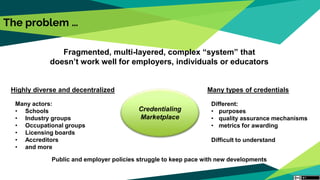
Fragmented, multi-layered, complex “system” that
doesn’t work well for employers, individuals or educators
Highly diverse and decentralized
Many actors:
• Schools
• Industry groups
• Occupational groups
• Licensing boards
• Accreditors
• and more
Many types of credentials
Different:
• purposes
• quality assurance mechanisms
• metrics for awarding
Difficult to understand
Credentialing
Marketplace
Public and employer policies struggle to keep pace with new developments
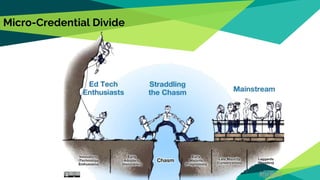
Micro-Credential Divide
What is a Credential?
A documented award by a responsible and authorized body that has
determined that an individual has achieved specific learning outcomes or
attained a defined level of knowledge or skill relative to a given standard.
Umbrella term that includes:
• Degrees
• Certificates
• Industry/Professional Certifications
• Licenses
• Badges
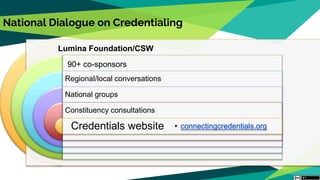
National Dialogue on Credentialing
Lumina Foundation/CSW
90+ co-sponsors
Regional/local conversations
National groups
Constituency consultations
Credentials website • connectingcredentials.org
Potential attributes of a “new” system
• All learning matters wherever it’s obtained
• All credentials are based on learning outcomes (competencies)
• Credentials are portable, transferrable, transparent, useful and
easily understood by learners, workers, employers
• Increases access and equity for all learners
• Helps learners, workers and employers make informed choices about their
investment in and value of the credential they’re purchasing
• Helps employers better qualify employees and reduce recruiting time,
employee turn-over, and cost of retraining
• Builds a competitive, highly skilled workforce
• Dynamic system – agility to be relevant in rapidly changing labor markets
Learning-
Based
&
Learner-
Centered
Creating Relationships Between Other Credentials (Badges)
• Opportunity for real modularizing and stacking
• Badges can represent specific competencies
• Can stand alone or link with other credentials
• Can capture learning missed by other credentials
• Vehicle for agility in credentialing
Learning-
Based
&
Learner-
Centered
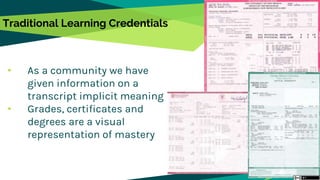
Traditional Learning Credentials
• As a community we have
given information on a
transcript implicit meaning
• Grades, certificates and
degrees are a visual
representation of mastery
Colorado’s Vision…..
Create a series of digital
badges which are:
• Competency and skill
based
• Industry driven
• Community centered
• Learner focused
Provides enhancement of:
current certificates and degrees while
highlighting workforce demanded
competencies not evident in courses,
certificates, degrees
Evidence of value is based on
recognition of the demonstrated
mastery
Evidence includes:
• Assessments
• Testing
• Portfolio of work
• Certifications
• Field work in real time documented
with images, video
Allows a person to
differentiate themselves
within a competitive
workforce
Where did we start?
Colorado Career Cluster
Model:
• Agriculture & Energy
• Advanced
Manufacturing
• IT
• Health Science & Public
Safety
• Hospitality & Education
• Business & Public
Administration
• Business and Industry
round tables to discuss
current educational delivery
and what was really needed
• Viewed badges with a jobs
driven approach
• Identified how the
learner/earner
would value
badges
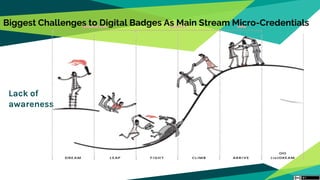
Biggest Challenges to Digital Badges As Main Stream Micro-Credentials
Lack of
awareness
Digital Badge Potential…
• Capturing latent talent using unified language
• Motivate learners
• Creating transparent pathways
• Display achievements
• Building a digital portfolio or academic transcript
At CCCS, every badge issued or accepted is tied to a
specific standard or competency with evidence of
micro-learning valued in the workforce.
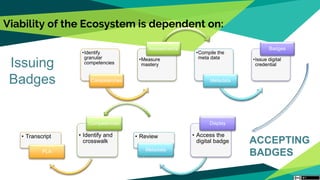
Viability of the Ecosystem is dependent on:
Issuing
Badges
•Identify
granular
competencies
Competencies
•Measure
mastery
Assessments
•Compile the
meta data
Metadata
•Issue digital
credential
Badges
• Transcript
PLA
• Identify and
crosswalk
Competencies
• Review
Metadata
• Access the
digital badge
Display
ACCEPTING
BADGES
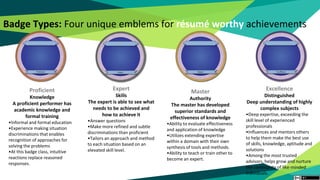
Badge Types: Four unique emblems for résumé worthy achievements
Proficient
Knowledge
A proficient performer has
academic knowledge and
formal training
•Informal and formal education
•Experience making situation
discriminations that enables
recognition of approaches for
solving the problems
•At this badge class, intuitive
reactions replace reasoned
responses.
Expert
Skills
The expert is able to see what
needs to be achieved and
how to achieve it
•Answer questions
•Make more refined and subtle
discriminations than proficient
•Tailors an approach and method
to each situation based on an
elevated skill level.
Master
Authority
The master has developed
superior standards and
effectiveness of knowledge
•Ability to evaluate effectiveness
and application of knowledge
•Utilizes extending expertise
within a domain with their own
synthesis of tools and methods.
•Ability to teach or train other to
become an expert.
Excellence
Distinguished
Deep understanding of highly
complex subjects
•Deep expertise, exceeding the
skill level of experienced
professionals
•Influences and mentors others
to help them make the best use
of skills, knowledge, aptitude and
solutions
•Among the most trusted
advisors, helps grow and nurture
the community of like-minded
individuals.
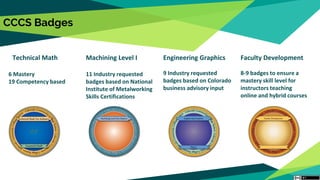
CCCS Badges
Technical Math
6 Mastery
19 Competency based
Machining Level I
11 Industry requested
badges based on National
Institute of Metalworking
Skills Certifications
Engineering Graphics
9 Industry requested
badges based on Colorado
business advisory input
Faculty Development
8-9 badges to ensure a
mastery skill level for
instructors teaching
online and hybrid courses
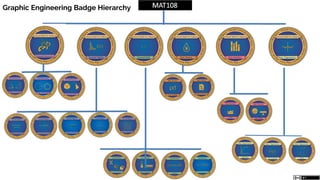
Graphic Engineering Badge Hierarchy
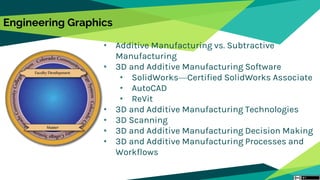
Engineering Graphics
• Additive Manufacturing vs. Subtractive
Manufacturing
• 3D and Additive Manufacturing Software
• SolidWorks—Certified SolidWorks Associate
• AutoCAD
• ReVit
• 3D and Additive Manufacturing Technologies
• 3D Scanning
• 3D and Additive Manufacturing Decision Making
• 3D and Additive Manufacturing Processes and
Workflows
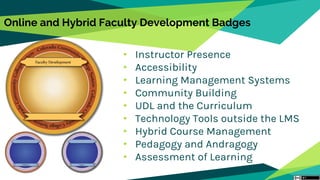
Online and Hybrid Faculty Development Badges
• Instructor Presence
• Accessibility
• Learning Management Systems
• Community Building
• UDL and the Curriculum
• Technology Tools outside the LMS
• Hybrid Course Management
• Pedagogy and Andragogy
• Assessment of Learning
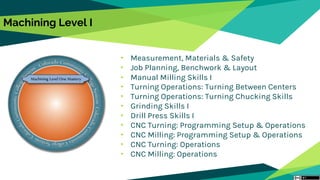
Machining Level I
• Measurement, Materials & Safety
• Job Planning, Benchwork & Layout
• Manual Milling Skills I
• Turning Operations: Turning Between Centers
• Turning Operations: Turning Chucking Skills
• Grinding Skills I
• Drill Press Skills I
• CNC Turning: Programming Setup & Operations
• CNC Milling: Programming Setup & Operations
• CNC Turning: Operations
• CNC Milling: Operations
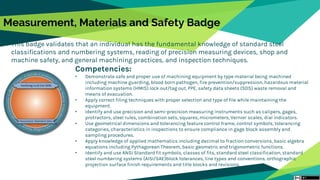
Measurement, Materials and Safety Badge
This badge validates that an individual has the fundamental knowledge of standard steel
classifications and numbering systems, reading of precision measuring devices, shop and
machine safety, and general machining practices, and inspection techniques.
Competencies:
• Demonstrate safe and proper use of machining equipment by type material being machined
including machine guarding, blood born pathogen, fire prevention/suppression, hazardous material
information systems (HMIS) lock out/tag out, PPE, safety data sheets (SDS) waste removal and
means of evacuation.
• Apply correct filing techniques with proper selection and type of file while maintaining the
equipment.
• Identify and use precision and semi-precision measuring instruments such as calipers, gages,
protractors, steel rules, combination sets, squares, micrometers, Vernier scales, dial indicators.
• Use geometrical dimensions and tolerancing feature control frame, control symbols, tolerancing
categories, characteristics in inspections to ensure compliance in gage block assembly and
sampling procedures.
• Apply knowledge of applied mathematics including decimal to fraction conversions, basic algebra
equations including Pythagorean Theorem, basic geometric and trigonometric functions.
• Identify and use ANSI Standard fit symbols, classes of fits, standard steel classification, standard
steel numbering systems (AISI/SAE)block tolerances, line types and conventions, orthographic
projection surface finish requirements and title blocks and revisions.
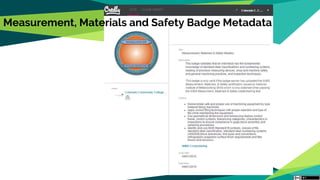
Measurement, Materials and Safety Badge Metadata
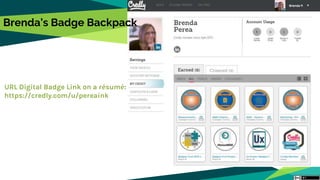
URL Digital Badge Link on a résumé:
https://credly.com/u/pereaink
Brenda’s Badge Backpack
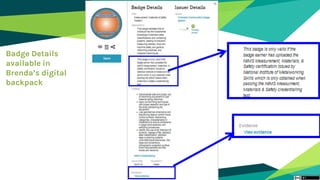
Badge Details
available in
Brenda’s digital
backpack
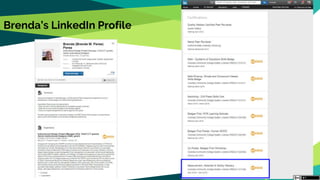
Brenda’s LinkedIn Profile
Can Badges = Jobs?
Here are few current
job listings in
Colorado which can
be tied directly back
to our Machining
Level I badges.
Jobs and Key Competencies:
• Department of Treasury, Machinist: Set up and operate machines for
machining pieces at unusual or compound angles. Determine proper gear train
and gear ratios to produce specific pitch, lead, and pitch diameter for various
standard and nonstandard screw threads, making the necessary computations
for differential, compound and angular indexing. $25-$30 an hour
• CMG, Machine Op/Production: Operate machinery and equipment used in the
manufacture of products .
• Barber-Nichols Inc, CNC Lathe Machinist/Programmer: Programming and use of
CNC equipment.
• Barber-Nichols Inc, Junior Machinist: Setup and operate manual and CNC
machine tools as directed and/or according to documentation/work instruction
• Phillips Service Industries, Inc., Machinist: Calculate dimensions and
tolerances using knowledge of mathematics and instruments such as
micrometers and Vernier calipers
• Niagara Bottling , Machine Operator: Responsible for overall maintaining of a
production line, including starting and stopping of some equipment (palletizers,
carton makers, carton sealers, drop packers). No mechanical work is performed
without prior approval.
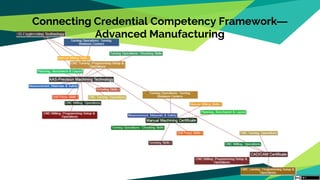
Connecting Credential Competency Framework—
Advanced Manufacturing
Digital Badges
Learner Centered, Community Centered and
Industry Driven
Provides transparency of learning
• Competencies at a granular level
• Link what knowledge to what a badge earner “can do”
Allows Portability
• Follows the learner through a life long learning pathway
• Data can be verified and certified by badge consumer
Thanks!
Katie Woodmansee
katherine.woodmansee@cccs.edu
Brenda Perea
brenda.perea@cccs.edu
Any questions?
You can find us at:
Creative Commons Attribution
Workforce Development presentation by Brenda M. Perea and Larry Good is licensed under a
Creative Commons Attribution 4.0 International License. Permissions beyond the scope of this
license may be available at CCCS.edu/CHAMP.
This workforce solution was funded by a grant awarded by the U.S. Department of Labor’s Employment and
Training Administration. The solution was created by the grantee and does not necessarily reflect the official
position of the U.S. Department of Labor. The Department of Labor makes no guarantees, warranties, or
assurances of any kind, express or implied, with respect to such information, including any information on
linked sites, and including, but not limited to accuracy of the information or its completeness, timeliness,
usefulness, adequacy, continued availability or ownership.

Badges badges we don't need no stinking badges! Except today's workforce does!

  • 1.
    Badges? Badges? Wedon’t need no stinking badges! Except Today’s Workforce Does Brenda Perea and Katie Woodmansee
  • 2.
    The problem … Fragmented,multi-layered, complex “system” that doesn’t work well for employers, individuals or educators Highly diverse and decentralized Many actors: • Schools • Industry groups • Occupational groups • Licensing boards • Accreditors • and more Many types of credentials Different: • purposes • quality assurance mechanisms • metrics for awarding Difficult to understand Credentialing Marketplace Public and employer policies struggle to keep pace with new developments
  • 3.
  • 4.
    What is aCredential? A documented award by a responsible and authorized body that has determined that an individual has achieved specific learning outcomes or attained a defined level of knowledge or skill relative to a given standard. Umbrella term that includes: • Degrees • Certificates • Industry/Professional Certifications • Licenses • Badges
  • 5.
    National Dialogue onCredentialing Lumina Foundation/CSW 90+ co-sponsors Regional/local conversations National groups Constituency consultations Credentials website • connectingcredentials.org
  • 6.
    Potential attributes ofa “new” system • All learning matters wherever it’s obtained • All credentials are based on learning outcomes (competencies) • Credentials are portable, transferrable, transparent, useful and easily understood by learners, workers, employers • Increases access and equity for all learners • Helps learners, workers and employers make informed choices about their investment in and value of the credential they’re purchasing • Helps employers better qualify employees and reduce recruiting time, employee turn-over, and cost of retraining • Builds a competitive, highly skilled workforce • Dynamic system – agility to be relevant in rapidly changing labor markets Learning- Based & Learner- Centered
  • 7.
    Creating Relationships BetweenOther Credentials (Badges) • Opportunity for real modularizing and stacking • Badges can represent specific competencies • Can stand alone or link with other credentials • Can capture learning missed by other credentials • Vehicle for agility in credentialing Learning- Based & Learner- Centered
  • 8.
    Traditional Learning Credentials •As a community we have given information on a transcript implicit meaning • Grades, certificates and degrees are a visual representation of mastery
  • 9.
    Colorado’s Vision….. Create aseries of digital badges which are: • Competency and skill based • Industry driven • Community centered • Learner focused Provides enhancement of: current certificates and degrees while highlighting workforce demanded competencies not evident in courses, certificates, degrees Evidence of value is based on recognition of the demonstrated mastery Evidence includes: • Assessments • Testing • Portfolio of work • Certifications • Field work in real time documented with images, video Allows a person to differentiate themselves within a competitive workforce
  • 10.
    Where did westart? Colorado Career Cluster Model: • Agriculture & Energy • Advanced Manufacturing • IT • Health Science & Public Safety • Hospitality & Education • Business & Public Administration • Business and Industry round tables to discuss current educational delivery and what was really needed • Viewed badges with a jobs driven approach • Identified how the learner/earner would value badges
  • 11.
    Biggest Challenges toDigital Badges As Main Stream Micro-Credentials Lack of awareness
  • 12.
    Digital Badge Potential… •Capturing latent talent using unified language • Motivate learners • Creating transparent pathways • Display achievements • Building a digital portfolio or academic transcript At CCCS, every badge issued or accepted is tied to a specific standard or competency with evidence of micro-learning valued in the workforce.
  • 13.
    Viability of theEcosystem is dependent on: Issuing Badges •Identify granular competencies Competencies •Measure mastery Assessments •Compile the meta data Metadata •Issue digital credential Badges • Transcript PLA • Identify and crosswalk Competencies • Review Metadata • Access the digital badge Display ACCEPTING BADGES
  • 14.
    Badge Types: Fourunique emblems for résumé worthy achievements Proficient Knowledge A proficient performer has academic knowledge and formal training •Informal and formal education •Experience making situation discriminations that enables recognition of approaches for solving the problems •At this badge class, intuitive reactions replace reasoned responses. Expert Skills The expert is able to see what needs to be achieved and how to achieve it •Answer questions •Make more refined and subtle discriminations than proficient •Tailors an approach and method to each situation based on an elevated skill level. Master Authority The master has developed superior standards and effectiveness of knowledge •Ability to evaluate effectiveness and application of knowledge •Utilizes extending expertise within a domain with their own synthesis of tools and methods. •Ability to teach or train other to become an expert. Excellence Distinguished Deep understanding of highly complex subjects •Deep expertise, exceeding the skill level of experienced professionals •Influences and mentors others to help them make the best use of skills, knowledge, aptitude and solutions •Among the most trusted advisors, helps grow and nurture the community of like-minded individuals.
  • 15.
    CCCS Badges Technical Math 6Mastery 19 Competency based Machining Level I 11 Industry requested badges based on National Institute of Metalworking Skills Certifications Engineering Graphics 9 Industry requested badges based on Colorado business advisory input Faculty Development 8-9 badges to ensure a mastery skill level for instructors teaching online and hybrid courses
  • 16.
  • 17.
    Engineering Graphics • AdditiveManufacturing vs. Subtractive Manufacturing • 3D and Additive Manufacturing Software • SolidWorks—Certified SolidWorks Associate • AutoCAD • ReVit • 3D and Additive Manufacturing Technologies • 3D Scanning • 3D and Additive Manufacturing Decision Making • 3D and Additive Manufacturing Processes and Workflows
  • 18.
    Online and HybridFaculty Development Badges • Instructor Presence • Accessibility • Learning Management Systems • Community Building • UDL and the Curriculum • Technology Tools outside the LMS • Hybrid Course Management • Pedagogy and Andragogy • Assessment of Learning
  • 19.
    Machining Level I •Measurement, Materials & Safety • Job Planning, Benchwork & Layout • Manual Milling Skills I • Turning Operations: Turning Between Centers • Turning Operations: Turning Chucking Skills • Grinding Skills I • Drill Press Skills I • CNC Turning: Programming Setup & Operations • CNC Milling: Programming Setup & Operations • CNC Turning: Operations • CNC Milling: Operations
  • 20.
    Measurement, Materials andSafety Badge This badge validates that an individual has the fundamental knowledge of standard steel classifications and numbering systems, reading of precision measuring devices, shop and machine safety, and general machining practices, and inspection techniques. Competencies: • Demonstrate safe and proper use of machining equipment by type material being machined including machine guarding, blood born pathogen, fire prevention/suppression, hazardous material information systems (HMIS) lock out/tag out, PPE, safety data sheets (SDS) waste removal and means of evacuation. • Apply correct filing techniques with proper selection and type of file while maintaining the equipment. • Identify and use precision and semi-precision measuring instruments such as calipers, gages, protractors, steel rules, combination sets, squares, micrometers, Vernier scales, dial indicators. • Use geometrical dimensions and tolerancing feature control frame, control symbols, tolerancing categories, characteristics in inspections to ensure compliance in gage block assembly and sampling procedures. • Apply knowledge of applied mathematics including decimal to fraction conversions, basic algebra equations including Pythagorean Theorem, basic geometric and trigonometric functions. • Identify and use ANSI Standard fit symbols, classes of fits, standard steel classification, standard steel numbering systems (AISI/SAE)block tolerances, line types and conventions, orthographic projection surface finish requirements and title blocks and revisions.
  • 21.
    Measurement, Materials andSafety Badge Metadata
  • 22.
    URL Digital BadgeLink on a résumé: https://credly.com/u/pereaink Brenda’s Badge Backpack
  • 23.
  • 24.
  • 25.
    Can Badges =Jobs? Here are few current job listings in Colorado which can be tied directly back to our Machining Level I badges. Jobs and Key Competencies: • Department of Treasury, Machinist: Set up and operate machines for machining pieces at unusual or compound angles. Determine proper gear train and gear ratios to produce specific pitch, lead, and pitch diameter for various standard and nonstandard screw threads, making the necessary computations for differential, compound and angular indexing. $25-$30 an hour • CMG, Machine Op/Production: Operate machinery and equipment used in the manufacture of products . • Barber-Nichols Inc, CNC Lathe Machinist/Programmer: Programming and use of CNC equipment. • Barber-Nichols Inc, Junior Machinist: Setup and operate manual and CNC machine tools as directed and/or according to documentation/work instruction • Phillips Service Industries, Inc., Machinist: Calculate dimensions and tolerances using knowledge of mathematics and instruments such as micrometers and Vernier calipers • Niagara Bottling , Machine Operator: Responsible for overall maintaining of a production line, including starting and stopping of some equipment (palletizers, carton makers, carton sealers, drop packers). No mechanical work is performed without prior approval.
  • 26.
    Connecting Credential CompetencyFramework— Advanced Manufacturing
  • 27.
    Digital Badges Learner Centered,Community Centered and Industry Driven Provides transparency of learning • Competencies at a granular level • Link what knowledge to what a badge earner “can do” Allows Portability • Follows the learner through a life long learning pathway • Data can be verified and certified by badge consumer
  • 28.
  • 29.
    Creative Commons Attribution WorkforceDevelopment presentation by Brenda M. Perea and Larry Good is licensed under a Creative Commons Attribution 4.0 International License. Permissions beyond the scope of this license may be available at CCCS.edu/CHAMP. This workforce solution was funded by a grant awarded by the U.S. Department of Labor’s Employment and Training Administration. The solution was created by the grantee and does not necessarily reflect the official position of the U.S. Department of Labor. The Department of Labor makes no guarantees, warranties, or assurances of any kind, express or implied, with respect to such information, including any information on linked sites, and including, but not limited to accuracy of the information or its completeness, timeliness, usefulness, adequacy, continued availability or ownership.

Editor's Notes

  • #2 Badges? Badges? We don’t need no stinking badges! Except We Do in Today’s Workplace
  • #3 We know that the range of students served by our educational system and the range of their needs for credentials is greater than ever. Many of today’s postsecondary students no longer conform to a traditional profile of the newly minted high school graduate in pursuit o a 2/4 year degree. They enter into a system that is a Fragmented, multi-layered, complex “system” that doesn’t work well for employers, individuals or educators Highly diverse and decentralized Many actors: schools, industry groups, occupational groups, licensing boards, accreditors, and more Many types of credentials Different purposes Different quality assurance mechanisms Different metrics for awarding Difficult to understand Public and employer policies struggle to keep pace with new developments In short, the credentialing world is confusing, at times even chaotic. To enhance the utility of credentials and reduce costs borne by individuals and employers, we need a common language – a unified analytic framework that helps stakeholders compare the value and suitability of different types of credentials.
  • #4 Micro-Credential Divide - Ed Tech Enthusiasts are the innovators, then those that are straddling the chasm are the early adopters and the early majority. Those in the mainstream are the late majority and the laggards.
  • #5 4
  • #6 5
  • #7 6
  • #8 7
  • #9 Traditional learning credentials As a community we have given information on a transcript implicit meaning Grades, certificates and degrees are a visual representation of mastery
  • #10 Colorado’s Vision Create a series of digital badges which are: Competency and skill based Industry driven Community centered Learner focused Enhancement of: current certificates and degrees while highlighting workforce demanded competencies not evident in courses, certificates, degrees Evidence of value is based on recognition of the demonstrated mastery Evidence includes: Assessments Testing Portfolio of work Certifications Field work in real time documented with images, video Allows a person to differentiate themselves within a competitive workforce
  • #11 Where did we start? Colorado Career Cluster Model: Agriculture & Energy Advanced Manufacturing IT Health Science & Public Safety Hospitality & Education Business & Public Administration Business and Industry round tables to discuss current educational delivery and what was really needed Viewed badges with a jobs driven approach Identified how the learner/earner would value badges
  • #12 Biggest Challenges to Digital Badges as Mainstream Micro-Credentials…. We are still slaying the dragon of “Lack of Awareness”, fear of some new phase of credential, time and effort involved, will this really help me staff my vacancies
  • #13 Digital Badge Potential Capturing latent talent using unified language Motivate learners Creating transparent pathways Display achievements Building a digital portfolio or academic transcript At CCCS Every badge issued or accepted is tied to a specific standard or competency with evidence of micro-learning valued in the workforce.
  • #15 CCCS Badge Classes: Four emblems for “resume worthy” achievements Proficient Knowledge A proficient performer has academic knowledge and formal training Informal and formal education Experience making situation discriminations that enables recognition of approaches for solving the problems At this badge class, intuitive reactions replace reasoned responses. Expert Skills The expert is able to see what needs to be achieved and how to achieve it Answer questions Make more refined and subtle discriminations than proficient Tailors an approach and method to each situation based on an elevated skill level Master Authority The master has developed superior standards and effectiveness of knowledge Ability to evaluate effectiveness and application of knowledge Utilizes extending expertise within a domain with their own synthesis of tools and methods. Ability to teach or train other to become an expert Excellence Distinguished Deep understanding of highly complex subjects Deep expertise, exceeding the skill level of experienced professionals Influences and mentors others to help them make the best use of skills, knowledge, aptitude and solutions Among the most trusted advisors, helps grow and nurture the community of like-minded individuals.
  • #16 Technical Math 6 Mastery 19 Competency based badges Machining Level I 11 Industry requested badges based on National Institute of Metalworking Skills Certifications Engineering Graphics 9 Industry requested badges based on Colorado business advisory input Faculty Development 8-9 badges to ensure a mastery skill level for instructors teaching online and hybrid courses
  • #17 Slide of Technical Math badges and hierarchy
  • #18 Engineering Graphics Additive Manufacturing vs. Subtractive Manufacturing 3D and Additive Manufacturing Software SolidWorks—Certified SolidWorks Associate AutoCAD ReVit 3D and Additive Manufacturing Technologies 3D Scanning 3D and Additive Manufacturing Decision Making 3D and Additive Manufacturing Processes and Workflows
  • #19 Online and Hybrid Faculty Development Badges Instructor Presence Accessibility Learning Management Systems Community Building UDL and the Curriculum Technology Tools outside the LMS Hybrid Course Management Pedagogy and Andragogy Assessment of Learning
  • #20 Machining Level I Measurement, Materials & Safety Job Planning, Benchwork & Layout Manual Milling Skills I Turning Operations: Turning Between Centers Turning Operations: Turning Chucking Skills Grinding Skills I Drill Press Skills I CNC Turning: Programming Setup & Operations CNC Milling: Programming Setup & Operations CNC Turning: Operations CNC Milling: Operations
  • #21 Measurement, Materials and Safety Badge This badge validates that an individual has the fundamental knowledge of standard steel classifications and numbering systems, reading of precision measuring devices, shop and machine safety, and general machining practices, and inspection techniques. Competencies: Demonstrate safe and proper use of machining equipment by type material being machined including machine guarding, blood born pathogen, fire prevention/suppression, hazardous material information systems (HMIS) lock out/tag out, PPE, safety data sheets (SDS) waste removal and means of evacuation. Apply correct filing techniques with proper selection and type of file while maintaining the equipment. Identify and use precision and semi-precision measuring instruments such as calipers, gages, protractors, steel rules, combination sets, squares, micrometers, Vernier scales, dial indicators. Use geometrical dimensions and tolerancing feature control frame, control symbols, tolerancing categories, characteristics in inspections to ensure compliance in gage block assembly and sampling procedures. Apply knowledge of applied mathematics including decimal to fraction conversions, basic algebra equations including Pythagorean Theorem, basic geometric and trigonometric functions. Identify and use ANSI Standard fit symbols, classes of fits, standard steel classification, standard steel numbering systems (AISI/SAE)block tolerances, line types and conventions, orthographic projection surface finish requirements and title blocks and revisions.
  • #22 example of badge on credly.com
  • #23 URL Digital Badge Link on a résumé: https://credly.com/u/pereaink
  • #29 Any questions: You can find us at: Brenda Perea brenda.perea@cccs.edu Katie Woodmansee katherine.woodmansee@cccs.edu
  • #30  Creative Commons Attribution Workforce Development presentation by Brenda M. Perea  and Larry Good is licensed under a Creative Commons Attribution 4.0 International License. Permissions beyond the scope of this license may be available at https://www.cccs.edu/partnering-for-success/trade-adjustment-assistance/taa-champ/. This workforce solution was funded by a grant awarded by the U.S. Department of Labor’s Employment and Training Administration. The solution was created by the grantee and does not necessarily reflect the official position of the U.S. Department of Labor. The Department of Labor makes no guarantees, warranties, or assurances of any kind, express or implied, with respect to such information, including any information on linked sites, and including, but not limited to accuracy of the information or its completeness, timeliness, usefulness, adequacy, continued availability or ownership.