
CBR Based Workflow
       Composition Assistant
Eran Chinthaka, Jaliya Ekanayake, David Leake, Beth Plale
              School of Informatics, Indiana University
                      Bloomington, Indiana, USA.
          {echintha, jekanaya, leake, plale}@cs.indiana.edu
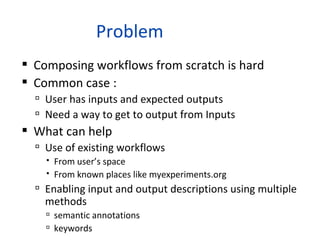
Problem
 Composing workflows from scratch is hard
 Common case :
   User has inputs and expected outputs
   Need a way to get to output from Inputs
 What can help
   Use of existing workflows
     From user’s space
     From known places like myexperiments.org
   Enabling input and output descriptions using multiple
    methods
     semantic annotations
     keywords
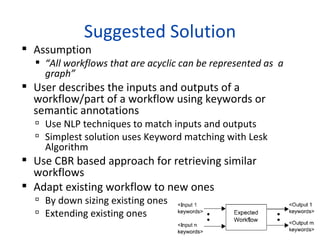
Suggested Solution
 Assumption
   “All workflows that are acyclic can be represented as a
    graph”
 User describes the inputs and outputs of a
  workflow/part of a workflow using keywords or
  semantic annotations
   Use NLP techniques to match inputs and outputs
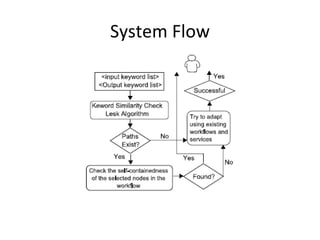
   Simplest solution uses Keyword matching with Lesk
    Algorithm
 Use CBR based approach for retrieving similar
  workflows
 Adapt existing workflow to new ones
   By down sizing existing ones
   Extending existing ones
System Flow
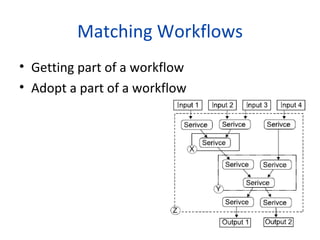
Matching Workflows
• Getting part of a workflow
• Adopt a part of a workflow
Key Features
• Better performance compared to heavy
  knowledge based approach or manual
  composition
• Independent of the workflow description
  languages (WSDL, SCUFL, etc.,)
• Ability to extend similarity measures to use
  semantic annotations or other NLP techniques
• Ability to provide threshold for similarity
  check and to control number of cases
  retrieved
• NLP based keyword checking
Future Work
 Reducing common workflow languages in to
  graph representation
 Integration of standard semantic language like
  OWL, RDF or WSDL-S
 Integration with a workflow composition tool
  (eg: Xbaya, WF)
 Performance Evaluation with an existing
  knowledge heavy system
 Evaluation of accuracy and/or usability of
  suggested cases
Related Work
•   D. Leake and J. Kendall-Morwick, “Towards case-based support for e-science
    workflow generation by mining provenance information,” in Proceedings of the
    Nineth European Conference on Case-Based Reasoning. Springer, 2008, in press.
•   J. Kim, Y. Gil, and M. Spraragen, “A knowledge-based approach to interactive
    workflow composition,” 2004.
•   J. L. Ambite and D. Kapoor, “Automatically composing data workflows with
    relational descriptions and shim services,” International Semantic Web
    Conference, 2007.
•   M. Carman, L. Serafini, and P. Traverso, “Web service composition as planning,” in
    ICAPS03 International Conference on Automated Planning and Scheduling, 2003.
•   E. Sirin, J. Hendler, and B. Parsia, “Semi-automatic composition of web services
    using semantic descriptions,” in ICEIS-2003 Workshop on Web Services.
Thank You !!

CBR Based Workflow Composition Assistant

  • 1.
    CBR Based Workflow Composition Assistant Eran Chinthaka, Jaliya Ekanayake, David Leake, Beth Plale School of Informatics, Indiana University Bloomington, Indiana, USA. {echintha, jekanaya, leake, plale}@cs.indiana.edu
  • 2.
    Problem  Composing workflowsfrom scratch is hard  Common case :  User has inputs and expected outputs  Need a way to get to output from Inputs  What can help  Use of existing workflows  From user’s space  From known places like myexperiments.org  Enabling input and output descriptions using multiple methods  semantic annotations  keywords
  • 3.
    Suggested Solution  Assumption  “All workflows that are acyclic can be represented as a graph”  User describes the inputs and outputs of a workflow/part of a workflow using keywords or semantic annotations  Use NLP techniques to match inputs and outputs  Simplest solution uses Keyword matching with Lesk Algorithm  Use CBR based approach for retrieving similar workflows  Adapt existing workflow to new ones  By down sizing existing ones  Extending existing ones
  • 4.
  • 5.
    Matching Workflows • Gettingpart of a workflow • Adopt a part of a workflow
  • 6.
    Key Features • Betterperformance compared to heavy knowledge based approach or manual composition • Independent of the workflow description languages (WSDL, SCUFL, etc.,) • Ability to extend similarity measures to use semantic annotations or other NLP techniques • Ability to provide threshold for similarity check and to control number of cases retrieved • NLP based keyword checking
  • 7.
    Future Work  Reducingcommon workflow languages in to graph representation  Integration of standard semantic language like OWL, RDF or WSDL-S  Integration with a workflow composition tool (eg: Xbaya, WF)  Performance Evaluation with an existing knowledge heavy system  Evaluation of accuracy and/or usability of suggested cases
  • 8.
    Related Work • D. Leake and J. Kendall-Morwick, “Towards case-based support for e-science workflow generation by mining provenance information,” in Proceedings of the Nineth European Conference on Case-Based Reasoning. Springer, 2008, in press. • J. Kim, Y. Gil, and M. Spraragen, “A knowledge-based approach to interactive workflow composition,” 2004. • J. L. Ambite and D. Kapoor, “Automatically composing data workflows with relational descriptions and shim services,” International Semantic Web Conference, 2007. • M. Carman, L. Serafini, and P. Traverso, “Web service composition as planning,” in ICAPS03 International Conference on Automated Planning and Scheduling, 2003. • E. Sirin, J. Hendler, and B. Parsia, “Semi-automatic composition of web services using semantic descriptions,” in ICEIS-2003 Workshop on Web Services.
  • 9.