A Case-Based Recommendation Approach
for Market Basket Data
Presented by
Niranjan murthy M
mniranjanmurthy@gmail.com
Content
 Introduction
 Literature survey
 Methodology
 Advantages and Limitations
 Conclusion
 Future works
INTRUDUCTION
 Recommendation System is a software tool
 Provide meaningful and effective item recommendation to
the active user.
 It support both User and providers
 User- handling information overload and finding
adequate items to cover their needs
 Provider-To identifying user needs and increasing the
amount diversity of the items they sell.
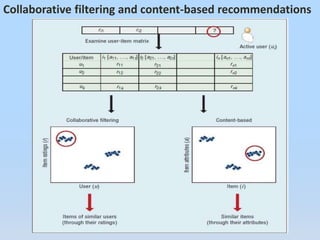
Collaborative filtering and content-based recommendations
Literature Survey
1. Collaborative Filtering Recommender Systems
 Items among those liked by similar users (“neighbors”) are
recommended to the active user.
 A user profile is built of the items that the user has rated highly,
thus similarities in user tastes are deduced from previous ratings.
2. Content-based Recommender Systems: State of the Art
and Trends
• Recommend items similar to those a given user has liked in past.
• Matching up the attributes of a user profile in which preferences
and interests are stored, with the attributes of a content object
(item), in order to recommend to the user new interesting items.
3. Mining Association Rules between Sets of Items in
Large Databases
 Discover interesting hidden patterns and frequent
associations among existing items.
 Applying new approach over voluminous sets of rules
in the post processing step, to reduce the number of
rules to several dozens or less.
4. Exploring Customer Preferences with Probabilistic
Topics Models
 Capability to discover latent baskets and latent users
lays the foundation for understanding user tastes and
their relations to items
 latent topic models can be effective in recommending
items to users even when applied to large data sets
and large item sets.
Methodology
Related Works
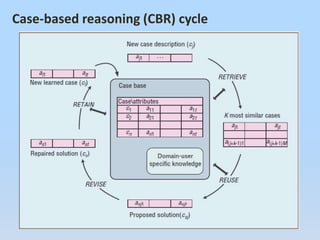
Case-based reasoning (CBR):
 Problem solving System.
 Uses old experience to solve new
problem.
 “Similar problem have similar solution”.
 Learn past/previous cases and give
solution to the new problem.
Case-based reasoning (CBR) cycle
Presented work
 Recommend the similar items of already
user has been selected some items.
 Analyzing previous transaction items and
recommend similar item into the user.
 Using case based recommendation reason
to identify and recommend the item.
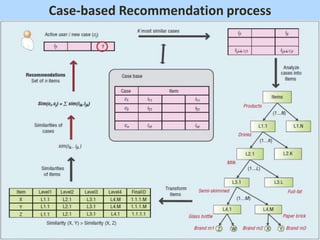
• Every Transaction as a case and its items as
attributes.
Case-based Recommendation process
Advantages
• Recommend the popular items to the user to
compare with the previous transaction of all
users.
• Recommend the meaningful and effective
item to the known user as well as new user.
• Saves the time of the user to search the
similar items.
Limitations
 Not able to recommend the new items
because it recommend the item only on the
basis of previous transaction.
 Need a lot of data to effectively make
recommendations.
Conclusions
 Its ability to recommend complementary items to the
already selected ones.
 Additionally, it can recommend popular items and
generate recommendations to new users.
 Reducing the cold start and the overspecialization
problems of CF and CB techniques.
Future Work
 Quality characteristics of the items and constraints related
to them could be incorporated (for example, to
recommend only new items).
 It could be applied to other domains where the outcome
of a user’s experience depends on the total set of items
used together.
 Finally we plan to examine the temporal characteristics of
the selected items.
Any Queries??
Thank you

case based recommendation approach for market basket data

  • 1.
    A Case-Based RecommendationApproach for Market Basket Data Presented by Niranjan murthy M mniranjanmurthy@gmail.com
  • 2.
    Content  Introduction  Literaturesurvey  Methodology  Advantages and Limitations  Conclusion  Future works
  • 3.
    INTRUDUCTION  Recommendation Systemis a software tool  Provide meaningful and effective item recommendation to the active user.  It support both User and providers  User- handling information overload and finding adequate items to cover their needs  Provider-To identifying user needs and increasing the amount diversity of the items they sell.
  • 4.
    Collaborative filtering andcontent-based recommendations
  • 5.
    Literature Survey 1. CollaborativeFiltering Recommender Systems  Items among those liked by similar users (“neighbors”) are recommended to the active user.  A user profile is built of the items that the user has rated highly, thus similarities in user tastes are deduced from previous ratings. 2. Content-based Recommender Systems: State of the Art and Trends • Recommend items similar to those a given user has liked in past. • Matching up the attributes of a user profile in which preferences and interests are stored, with the attributes of a content object (item), in order to recommend to the user new interesting items.
  • 6.
    3. Mining AssociationRules between Sets of Items in Large Databases  Discover interesting hidden patterns and frequent associations among existing items.  Applying new approach over voluminous sets of rules in the post processing step, to reduce the number of rules to several dozens or less. 4. Exploring Customer Preferences with Probabilistic Topics Models  Capability to discover latent baskets and latent users lays the foundation for understanding user tastes and their relations to items  latent topic models can be effective in recommending items to users even when applied to large data sets and large item sets.
  • 7.
    Methodology Related Works Case-based reasoning(CBR):  Problem solving System.  Uses old experience to solve new problem.  “Similar problem have similar solution”.  Learn past/previous cases and give solution to the new problem.
  • 8.
  • 9.
    Presented work  Recommendthe similar items of already user has been selected some items.  Analyzing previous transaction items and recommend similar item into the user.  Using case based recommendation reason to identify and recommend the item. • Every Transaction as a case and its items as attributes.
  • 10.
  • 11.
    Advantages • Recommend thepopular items to the user to compare with the previous transaction of all users. • Recommend the meaningful and effective item to the known user as well as new user. • Saves the time of the user to search the similar items.
  • 12.
    Limitations  Not ableto recommend the new items because it recommend the item only on the basis of previous transaction.  Need a lot of data to effectively make recommendations.
  • 13.
    Conclusions  Its abilityto recommend complementary items to the already selected ones.  Additionally, it can recommend popular items and generate recommendations to new users.  Reducing the cold start and the overspecialization problems of CF and CB techniques.
  • 14.
    Future Work  Qualitycharacteristics of the items and constraints related to them could be incorporated (for example, to recommend only new items).  It could be applied to other domains where the outcome of a user’s experience depends on the total set of items used together.  Finally we plan to examine the temporal characteristics of the selected items.
  • 15.
  • 16.