Congressional Budget Office
Le Printemps de l’Évaluation
French National Assembly
June 28, 2018
Dorian Carloni
Analyst
Tax Analysis Division
10 Things to Know
About CBO
1
CBO
1
Lawmakers created CBO
to give the Congress a
stronger role in budget
matters.
2
CBO
 CBO was established by the Congressional Budget and Impoundment
Control Act of 1974.
 It provides objective, timely, and nonpartisan analysis to help the
Congress make effective budget and economic decisions.
 It supports the activities of committees rather than individual Members
of Congress.
 And it provides an alternative to relying on the Office of Management
and Budget in the executive branch.
CBO’s History and Mission
3
CBO
2
The Congress sets CBO’s
priorities.
4
CBO
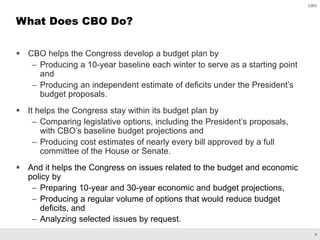
 CBO helps the Congress develop a budget plan by
– Producing a 10-year baseline each winter to serve as a starting point
and
– Producing an independent estimate of deficits under the President’s
budget proposals.
 It helps the Congress stay within its budget plan by
– Comparing legislative options, including the President’s proposals,
with CBO’s baseline budget projections and
– Producing cost estimates of nearly every bill approved by a full
committee of the House or Senate.
 And it helps the Congress on issues related to the budget and economic
policy by
– Preparing 10-year and 30-year economic and budget projections,
– Producing a regular volume of options that would reduce budget
deficits, and
– Analyzing selected issues by request.
What Does CBO Do?
5
CBO
3
CBO produces a lot of
work each year.
6
CBO
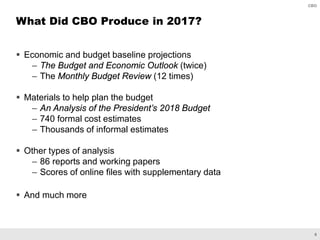
 Economic and budget baseline projections
– The Budget and Economic Outlook (twice)
– The Monthly Budget Review (12 times)
 Materials to help plan the budget
– An Analysis of the President’s 2018 Budget
– 740 formal cost estimates
– Thousands of informal estimates
 Other types of analysis
– 86 reports and working papers
– Scores of online files with supplementary data
 And much more
What Did CBO Produce in 2017?
7
CBO
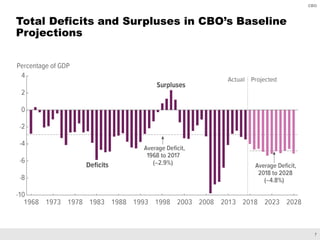
Total Deficits and Surpluses in CBO’s Baseline
Projections
8
CBO
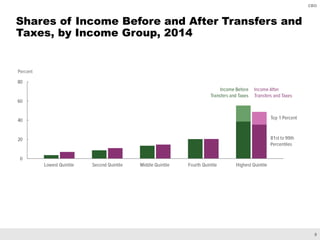
Shares of Income Before and After Transfers and
Taxes, by Income Group, 2014
9
CBO
4
In order to provide the
Congress with the high-
quality analysis that it
needs, CBO’s staff has
expertise in many areas.
10
CBO
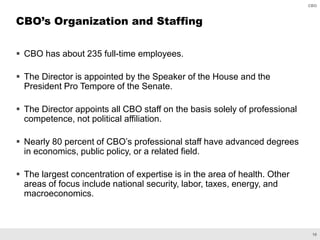
 CBO has about 235 full-time employees.
 The Director is appointed by the Speaker of the House and the
President Pro Tempore of the Senate.
 The Director appoints all CBO staff on the basis solely of professional
competence, not political affiliation.
 Nearly 80 percent of CBO’s professional staff have advanced degrees
in economics, public policy, or a related field.
 The largest concentration of expertise is in the area of health. Other
areas of focus include national security, labor, taxes, energy, and
macroeconomics.
CBO’s Organization and Staffing
11
CBO
5
CBO’s analysis is
objective, impartial, and
nonpartisan.
12
CBO
 It does not make policy recommendations.
 It hires on the basis of expertise without regard to political affiliation.
 It has strict rules about conflicts of interest (or the perception of such
conflicts).
 It holds regular meetings with panels of outside experts who review its
work.
 It routinely consults other outside experts.
How Does CBO Stay Objective?
13
CBO
6
Models do not produce
CBO’s estimates; CBO
does.
14
CBO
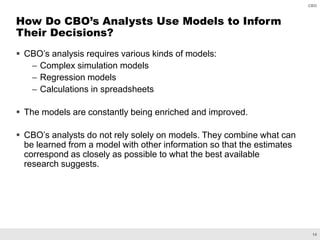
 CBO’s analysis requires various kinds of models:
– Complex simulation models
– Regression models
– Calculations in spreadsheets
 The models are constantly being enriched and improved.
 CBO’s analysts do not rely solely on models. They combine what can
be learned from a model with other information so that the estimates
correspond as closely as possible to what the best available
research suggests.
How Do CBO’s Analysts Use Models to Inform
Their Decisions?
15
CBO
7
CBO has a rigorous system
of checks and balances.
16
CBO
 All of CBO’s cost estimates and reports are reviewed internally for
objectivity, analytical soundness, and clarity. That process involves
many people at various levels in the agency.
 Analysts’ consultations with outside experts help them hear all
perspectives on an issue.
 CBO continually revisits past work and learns from the differences
between projections and actual outcomes.
 CBO compares its analysis to others’ work and incorporates outside
feedback into its projects.
CBO’s Review Process
17
CBO
8
CBO prioritizes
transparency.
18
CBO
 It attempts to explain all cost estimates and projections clearly and in
nontechnical language.
 It reports on the accuracy of its projections.
 It publishes analyses of how sensitive estimates are to key parameters.
 It publishes reports and working papers to describe models and
methods of analysis.
 It presents work at professional conferences.
 And it explains work directly to Members of Congress and their staff.
How Does CBO Provide Transparency?
19
CBO
 The pace of Congressional action sometimes limits the time available
for providing explanations of estimates.
 Overall demand for CBO’s analysis is high, and resources are
constrained.
 Thus, the agency needs to balance requests to explain more about
finished analysis with requests for new analysis and other
responsibilities.
Balancing Demand for Analysis and Demand for
Transparency
20
CBO
9
CBO evolves as the needs
of the Congress evolve.
21
CBO
 CBO works with the Congress in ways probably not envisioned when
the agency was first created.
– It spends more time providing preliminary analysis and technical
support as legislation is being drafted.
– It is asked more often to prepare cost estimates for bills heading
straight for votes by the full House and Senate—bypassing
consideration by committees.
 CBO shifts staffing and develops new analytical tools to address areas
of pressing concern. For example, it has
– Strengthened its ability to analyze health care issues and
– Improved its capability to study how legislative proposals would
affect the economy.
How Has CBO Evolved?
22
CBO
10
CBO is always looking for
ways to do things better.
23
CBO
 CBO is reviewing and updating its models for budget projections
related to federal health care spending.
 It is improving its ability to perform “dynamic analysis” and to analyze
how changes in federal regulations affect the economy and the budget.
 It is expanding its analysis of the distribution of household income,
studying it in relation to spending programs as well as to taxes.
 It is bolstering its responsiveness and transparency.
How Is CBO Looking to Do Things Better?
24
CBO
For more information, visit
www.cbo.gov
Questions?

10 Things to Know About CBO

  • 1.
    Congressional Budget Office LePrintemps de l’Évaluation French National Assembly June 28, 2018 Dorian Carloni Analyst Tax Analysis Division 10 Things to Know About CBO
  • 2.
    1 CBO 1 Lawmakers created CBO togive the Congress a stronger role in budget matters.
  • 3.
    2 CBO  CBO wasestablished by the Congressional Budget and Impoundment Control Act of 1974.  It provides objective, timely, and nonpartisan analysis to help the Congress make effective budget and economic decisions.  It supports the activities of committees rather than individual Members of Congress.  And it provides an alternative to relying on the Office of Management and Budget in the executive branch. CBO’s History and Mission
  • 4.
    3 CBO 2 The Congress setsCBO’s priorities.
  • 5.
    4 CBO  CBO helpsthe Congress develop a budget plan by – Producing a 10-year baseline each winter to serve as a starting point and – Producing an independent estimate of deficits under the President’s budget proposals.  It helps the Congress stay within its budget plan by – Comparing legislative options, including the President’s proposals, with CBO’s baseline budget projections and – Producing cost estimates of nearly every bill approved by a full committee of the House or Senate.  And it helps the Congress on issues related to the budget and economic policy by – Preparing 10-year and 30-year economic and budget projections, – Producing a regular volume of options that would reduce budget deficits, and – Analyzing selected issues by request. What Does CBO Do?
  • 6.
    5 CBO 3 CBO produces alot of work each year.
  • 7.
    6 CBO  Economic andbudget baseline projections – The Budget and Economic Outlook (twice) – The Monthly Budget Review (12 times)  Materials to help plan the budget – An Analysis of the President’s 2018 Budget – 740 formal cost estimates – Thousands of informal estimates  Other types of analysis – 86 reports and working papers – Scores of online files with supplementary data  And much more What Did CBO Produce in 2017?
  • 8.
    7 CBO Total Deficits andSurpluses in CBO’s Baseline Projections
  • 9.
    8 CBO Shares of IncomeBefore and After Transfers and Taxes, by Income Group, 2014
  • 10.
    9 CBO 4 In order toprovide the Congress with the high- quality analysis that it needs, CBO’s staff has expertise in many areas.
  • 11.
    10 CBO  CBO hasabout 235 full-time employees.  The Director is appointed by the Speaker of the House and the President Pro Tempore of the Senate.  The Director appoints all CBO staff on the basis solely of professional competence, not political affiliation.  Nearly 80 percent of CBO’s professional staff have advanced degrees in economics, public policy, or a related field.  The largest concentration of expertise is in the area of health. Other areas of focus include national security, labor, taxes, energy, and macroeconomics. CBO’s Organization and Staffing
  • 12.
    11 CBO 5 CBO’s analysis is objective,impartial, and nonpartisan.
  • 13.
    12 CBO  It doesnot make policy recommendations.  It hires on the basis of expertise without regard to political affiliation.  It has strict rules about conflicts of interest (or the perception of such conflicts).  It holds regular meetings with panels of outside experts who review its work.  It routinely consults other outside experts. How Does CBO Stay Objective?
  • 14.
    13 CBO 6 Models do notproduce CBO’s estimates; CBO does.
  • 15.
    14 CBO  CBO’s analysisrequires various kinds of models: – Complex simulation models – Regression models – Calculations in spreadsheets  The models are constantly being enriched and improved.  CBO’s analysts do not rely solely on models. They combine what can be learned from a model with other information so that the estimates correspond as closely as possible to what the best available research suggests. How Do CBO’s Analysts Use Models to Inform Their Decisions?
  • 16.
    15 CBO 7 CBO has arigorous system of checks and balances.
  • 17.
    16 CBO  All ofCBO’s cost estimates and reports are reviewed internally for objectivity, analytical soundness, and clarity. That process involves many people at various levels in the agency.  Analysts’ consultations with outside experts help them hear all perspectives on an issue.  CBO continually revisits past work and learns from the differences between projections and actual outcomes.  CBO compares its analysis to others’ work and incorporates outside feedback into its projects. CBO’s Review Process
  • 18.
  • 19.
    18 CBO  It attemptsto explain all cost estimates and projections clearly and in nontechnical language.  It reports on the accuracy of its projections.  It publishes analyses of how sensitive estimates are to key parameters.  It publishes reports and working papers to describe models and methods of analysis.  It presents work at professional conferences.  And it explains work directly to Members of Congress and their staff. How Does CBO Provide Transparency?
  • 20.
    19 CBO  The paceof Congressional action sometimes limits the time available for providing explanations of estimates.  Overall demand for CBO’s analysis is high, and resources are constrained.  Thus, the agency needs to balance requests to explain more about finished analysis with requests for new analysis and other responsibilities. Balancing Demand for Analysis and Demand for Transparency
  • 21.
    20 CBO 9 CBO evolves asthe needs of the Congress evolve.
  • 22.
    21 CBO  CBO workswith the Congress in ways probably not envisioned when the agency was first created. – It spends more time providing preliminary analysis and technical support as legislation is being drafted. – It is asked more often to prepare cost estimates for bills heading straight for votes by the full House and Senate—bypassing consideration by committees.  CBO shifts staffing and develops new analytical tools to address areas of pressing concern. For example, it has – Strengthened its ability to analyze health care issues and – Improved its capability to study how legislative proposals would affect the economy. How Has CBO Evolved?
  • 23.
    22 CBO 10 CBO is alwayslooking for ways to do things better.
  • 24.
    23 CBO  CBO isreviewing and updating its models for budget projections related to federal health care spending.  It is improving its ability to perform “dynamic analysis” and to analyze how changes in federal regulations affect the economy and the budget.  It is expanding its analysis of the distribution of household income, studying it in relation to spending programs as well as to taxes.  It is bolstering its responsiveness and transparency. How Is CBO Looking to Do Things Better?
  • 25.
    24 CBO For more information,visit www.cbo.gov Questions?