Human organsHuman organs
Muttayomsuksa 1Muttayomsuksa 1
HealthHealth
Let see the Video
brain (n.)
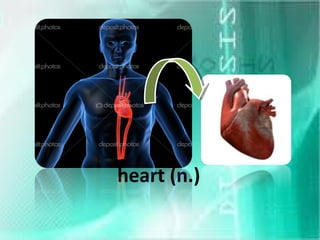
heart (n.)
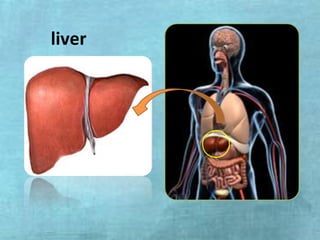
liver(n.)
lungs(n.)
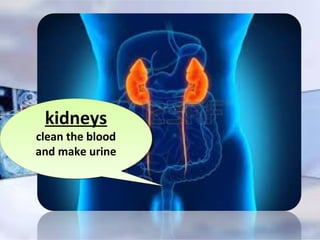
kidneys
stomach(n.)
small intestine (n.)
large intestine (n.)
structure
How to use active voice and passive voice?
• How to use active voice?
• How to use passive voice?
How to use active voice?
The active voice is the 
"normal" voice.  In the 
passive voice, 
the subject receives         
      the action  of the 
verb:
 
Active Form:
Thing doing
action
Thing doing
action verb
thing receiving
action
thing receiving
action
Examples:
How to use passive voice?How to use passive voice?
The passive voice is less usual.
In the passive voice,
the subject receives the action
of the verb:
Passive voice is used
when the focus is on the
action. It is not important
or not known, however,
who or what is
performing the action.
 
Passive Form:
Thing
receiving
action
Thing
receiving
action [be][be] byby
thing
doing
action
thing
doing
action
]
Sometimes a statement in
passive is more polite than
active voice, as the
following example shows:
Controls the
body
Hear soundsHear sounds
Pumps blood
Makes and
destroys
substances
Makes and
destroys
substances
Clean the blood
and make urine
Digests and
absorbs food
For
breathing
One of the two
organs in your
face which you
use to see
One of the two
organs in your
face which you
use to see
Stores and
breaks up
Stores and
breaks up
Removed
water from 
unwanted
brain
heart
kidneys
liver
lungs
stomach
small Intestine
large Intestine
Activity
Listening skillDirections:
•Make a group of 4.
•Watch the video and
discuss about the video in
group. (Each group watch
the different video)
•Draw the picture from
what you have heard.
•Present the picture in
front of class.
Directions:
•Make a group of 4.
•Watch the video and
discuss about the video in
group. (Each group watch
the different video)
•Draw the picture from
what you have heard.
•Present the picture in
front of class.
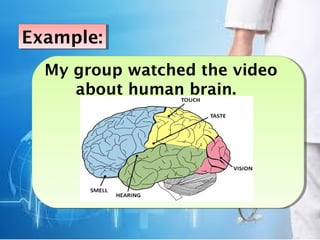
My group watched the video
about human brain.
Example:Example:
Directions:
Read the text and summarize by using
concept mapping then present in front
of class Reading Skill
Reading Skill
Human
Organs
Human
Organs
lungs
Small
intestine
heart
Large
intestine
kidneys
liver
Example:Example:
……………………
……………………
…………………….
……………………
……………………
……………………
……………………
……………………..
……………………
……………………
……………………..
……………………
……………………
……………………..
……………………
……………………
……………………..
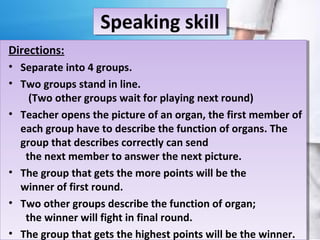
Speaking skill
Directions:
• Separate into 4 groups.
• Two groups stand in line.
(Two other groups wait for playing next round)
• Teacher opens the picture of an organ, the first member of
each group have to describe the function of organs. The
group that describes correctly can send
the next member to answer the next picture.
• The group that gets the more points will be the
winner of first round.
• Two other groups describe the function of organ;
the winner will fight in final round.
• The group that gets the highest points will be the winner.
Example:Example:
Brain
controls the
body
Brain
controls the
body
Heart pumps
blood
Heart pumps
blood
small
intestines
digests and
absorbs
small
intestines
digests and
absorbs
stomach
stores and
breaks up
stomach
stores and
breaks up
lungs
for breathing
lungs
for breathing
heart
pumps blood
heart
pumps blood
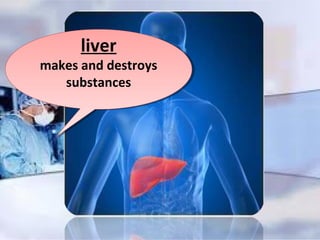
liver
makes and destroys
substances
liver
makes and destroys
substances
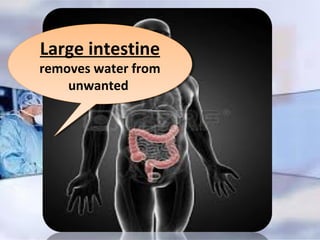
Large intestine
removes water from
unwanted
Large intestine
removes water from
unwanted
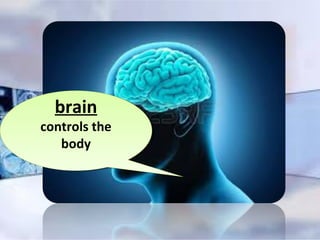
brain
controls the
body
brain
controls the
body
kidneys
clean the blood
and make urine
kidneys
clean the blood
and make urine
writing skill
Directions
•Receive a piece of picture of human organs
from teacher.
•Find the people who get the part of organ
picture that relate with your picture.
•Stick it on the paper.
Describe function of human organs by using
Active voice and Passive voice.
•Present in front of class
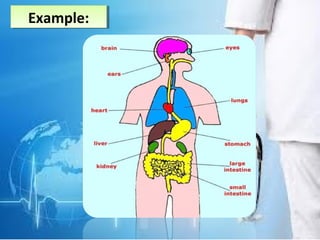
Example:Example:

CBI